woman calculator budgeting finances mobile

How to Track Monthly Expenses

Key Points

•   Start by looking at past financial statements to understand your average monthly income and fixed monthly costs.

•   Categorize expenses into needs, wants, and savings for better financial management.

•   Use apps or spreadsheets to track and categorize expenses efficiently.

•   Automate payments and savings to build consistent financial habits.

•   Review spending monthly to ensure you’re sticking to your budget and working towards long-term goals.

Many people aren’t quite sure where their cash goes. They know they have money flowing in and out but couldn’t tell you the details. If you’re among that group, it can be a good thing to start tracking your monthly expenses.

Why bother? Once you know where your money is going, you can decide if this is actually where you want your money to go. You may find places where you’re wasting money and decide to rejigger your spending so you can put more money towards your goals, whether that’s paying down debt, going on vacation, or being able to retire one day.

If you’re ready to learn how to keep track of expenses, these tips can help.

Check out our Money Management Guide.

This article is from SoFi’s guide on how to manage your money, where you can learn basic money management tips and strategies.


money management guide for beginners

6 Ways to Track Your Monthly Expenses

Getting a handle on your spending is easier than you think. Here’s how.

1. Understanding Your Income and Fixed Costs

To determine how much money is flowing into your checking account each month and exactly where that money is going, you’ll need to gather the last six months’ worth of financial statements.

Use these statements to determine your average monthly income (after taxes are taken out), as well as make a list of your regular, or fixed, expenses (such as rent or mortgage, utilities, and car payments). Next, list out your variable expenses — those change from month to month, such as groceries, gas, and entertainment. This is an area where you might find opportunities to cut back.

2. Categorize Spending and Expenses

Once you have an idea of where your money is currently going, you’ll want to put your expenses into categories. This could be a long detailed list. Or, you might simply divide your expenses into three main buckets: Essential spending (“needs”), nonessential spending (“wants”), and saving and paying down debt (“goals”). This approach is known as the 50/30/20 budget.

Needs

Needs include anything that you have to spend money on to maintain a basic standard of living. Using the 50/30/20 budget, 50% of your budget would go to needs.

Examples of needs include:

•  Housing

•  Utilities

•  Food

•  Healthcare

•  Insurance

This category can include a mix of fixed and variable expenses. For example, your rent or mortgage payment is likely fixed since you pay the same amount all the time. But your utility bills can be variable if you pay more in winter and summer, but less in spring and fall.

One rule of thumb for housing is to spend no more than 30% of your gross (pre-tax) income on rent. This may not be feasible if you live in a metro area with high housing costs. But if you find housing is taking too big a bite out of your budget, you might consider taking on a roommate or moving to a cheaper area of town.

Wants

Wants are things you spend money on but don’t necessarily need to survive. This section accounts for 30% of spending under the 50/30/20 rule.

Examples of wants in a line-item budget can include:

•   New clothes that aren’t really needed

•   Travel

•   Dining out

•   Hobbies and recreation

•   Entertainment

•   Spa or salon visits.

The wants section of your budget is often where you can make the biggest cuts, since these are things you don’t need to spend money on.

Savings and Debt

The remaining 20% in the 50/30/20 budget is dedicated to saving and paying down debt. You could split it equally, and devote 10% to saving and 10% to debt. Or you might divide it differently if you’re prioritizing one financial goal over another.

Some of the things you might save money for in your budget include:

•  Emergency funds

•  Short-term goals, such as a vacation or new furniture

•  Longer-term goals, like the down payment on a house

•  A child’s future college education

•  Retirement.

Financial experts often recommend saving 10% to 15% of your income for retirement alone, so you might need to re-evaluate how much you’re setting aside for that goal. Increasing 401(k) contributions can help you get closer to that target if you’re not there yet. If you don’t have access to a 401(k), you might want to open an Individual Retirement Account (IRA).

On the debt side of the equation you might have student loans, credit cards, car loans, or other debts. How you choose to pay them down can depend on how much money you have to work with and what’s most important to you. The debt snowball method, for example, can help you pay off debts from smallest balance to highest. Meanwhile, the debt avalanche has you pay off debts based on interest rate, going from highest to lowest.

Recommended: Check out the 50/30/20 Budget Calculator to see the breakdown of your money.

Increase your savings
with a limited-time APY boost.*


*Earn up to 4.00% Annual Percentage Yield (APY) on SoFi Savings with a 0.70% APY Boost (added to the 3.30% APY as of 12/23/25) for up to 6 months. Open a new SoFi Checking and Savings account and pay the $10 SoFi Plus subscription every 30 days OR receive eligible direct deposits OR qualifying deposits of $5,000 every 31 days by 3/30/26. Rates variable, subject to change. Terms apply here. SoFi Bank, N.A. Member FDIC.

Emergency Funds

If you don’t have at least three to six months’ worth of living expenses set aside in an emergency fund, consider making that a priority over other goals. The reason: Without a back-up fund, any financial bumps in the road — say, an expensive car repair, medical emergency, or loss of income — could force you to run up credit card debt that could take months, even years, to get out from under.

You can use an emergency fund calculator to help you determine how much you should save.

3. Prioritize and Automate

Prioritizing monthly expenses means deciding where your money will go first. This might include monthly bills and basic living expenses, along with saving and extra payments on debt. What’s left over after that can go towards your wants.

The more you can automate your finances, generally the more successful you’ll be at budgeting and tracking your money.

Some of the payments you might choose to automate include:

Some of the bill payments you might choose to automate include:

•  Mortgage or rent payments

•  Utilities

•  Cell phone and internet bills

•  Car insurance

•  Student loan payments

•  Credit card bill payments

•  Transfers to your emergency fund/other savings

•  Retirement contributions.

Benefits of Automation for Financial Success

Here’s a look at some of the benefits of putting a portion of your spending and savings on autopilot:

•  Reduces the risk of missing payments and getting hit with late fees and interest charges.

•  Helps you build a consistent savings habit without having to remember to transfer money into savings or investment accounts.

•  Minimizes the effort required to manage your finances manually.

•  Removes funds from immediate reach, helping you avoid the temptation to spend savings on impulse purchases.

4. Set Up a Spreadsheet

To track your monthly expenses, you might set up a simple spreadsheet where you list your income and monthly expenses and set saving targets. You can use the SUM function in a spreadsheet to automatically add values together. At the end of each month, you fill in the data and see how everything lines up.

Key Spreadsheet Templates for Budgeting

If you’d rather not go to the trouble of setting up rows, columns, and formulas, you could simply use a pre-made spreadsheet template.
For example, Google Sheets offers free pre-made budget templates, such as an annual budget and a monthly budget. Or if you have Microsoft 365 software, you can download a free pre-made Excel template for budgeting, such as a monthly budget, personal budget, or household budget.

5. Use an App

If you’d rather not have to turn on your computer and manually enter values, you might prefer using a budgeting app for tracking monthly expenses.

These tools can typically link to your bank and credit card accounts and will periodically pull transaction data from your accounts. This allows you to see how much you’ve spent right on your screen in one simple place; no toggling back and forth.

Some apps even allow you to tag or categorize expenses and create graphs or charts so that you have a visual representation of where your money is going each month.

6. Track Your Money With Your Bank’s Help

Many banks provide built-in expense tracking features within their online banking platforms or apps. These tools can often link to outside accounts, track and categorize your transactions, and offer financial insights that can help stay on top of your budget.

For instance, SoFi can help you to:

•  Connect financial accounts in a personal dashboard

•  View and track expenses

•  Monitor your credit scores

•  Create a budget plan

•  Track retirement savings and other money goals

•  Review your debt situation.

Why Is Tracking Your Spending Important for Financial Management?

Tracking your expenses is essential for managing your money because it provides transparency into your spending habits. After a few months of tracking your spending, you’ll likely have a clear sense of where your money is going. This information can empower you to make better financial decisions moving forward.

How Tracking Supports Long-Term Financial Goals

When you spend haphazardly — and simply hope it will all work in the end— you can end up overspending on things that don’t mean that much to you, while giving short shrift to the things that do, like saving for a home, a child’s college education, or retirement.

It’s generally much easier to start saving for these milestones early, then to try to catch up later. This is due to the magic of compound returns — when the returns on your money get reinvested and earn returns of their own. The earlier you start saving for long-term goals, the more you benefit from compound growth.

How Often Should You Review Your Spending?

It’s a good idea to review your spending at least once a month. This allows you to see how your actual spending and saving amounts line up with your plan, and if you need to rejigger your budget for the next month.

Setting a Routine for Monthly Expense Reviews

To get into a routine for monthly expense reviews, you might choose a specific day each month (ideally at the end) to review your expenses.

If you’re budgeting manually, this is when you would gather your bank/credit card statements and receipts and log in your income and expenses. If you’re using an app, most of this work may already be done for you.

Either way, you’ll want to compare your actual spending to your planned spending, identify areas of overspending, and make any needed adjustments to your budget for the following month to ensure you’re on track with your financial goals.

Avoid Common Spending Tracking Mistakes

When trying to figure out how to keep track of expenses, you may make a mistake or two along the way. Here are two common ones to keep in mind:

Overcomplicating the Process

Using overly detailed tracking methods can be overwhelming and discouraging. It’s typically better to stick to simple and effective systems that fit your lifestyle. For example, if you’re not a spreadsheet person, don’t feel like you have to force yourself to embrace them. You might consider using a budgeting app, or simply pen and paper to stay on top of your budget. The best way to track monthly expenses is the one you’ll stick with.

Ignoring Small Expenses

Small, frequent purchases can add up significantly over time. To make sure day-to-day cash expenses don’t slip through the cracks, you might jot them down in a small notebook (or the notes app on your phone). Alternatively, you could collect your receipts in an envelope. Either way, it’s important to add these expenses to the appropriate spending categories at the end of the month.

Recommended: Budgeting for Beginners: A Guide

The Takeaway

Tracking your monthly expenses is an essential part of financial success. Whatever method you choose (pen and paper, a spreadsheet, or an app), it can give you key insights into your spending habits. Once you know where your money is going, you can make informed decisions about how you want to spend and save moving forward.

Interested in opening an online bank account? When you sign up for a SoFi Checking and Savings account with eligible direct deposit, you’ll get a competitive annual percentage yield (APY), pay zero account fees, and enjoy an array of rewards, such as access to the Allpoint Network of 55,000+ fee-free ATMs globally. Qualifying accounts can even access their paycheck up to two days early.


Better banking is here with SoFi, NerdWallet’s 2024 winner for Best Checking Account Overall.* Enjoy 3.30% APY on SoFi Checking and Savings with eligible direct deposit.

FAQ

Why is tracking spending important for financial management?

Tracking spending allows you to see where your money is going, and where you might be overspending (or wasting money), each month. When you track monthly spending regularly, it becomes easier to make a realistic budget so that you can spend and save wisely, as well as work toward other financial goals.

How often should I review my spending?

Ideally, you want to review your spending at least once a month, so you can assess your financial progress and make adjustments as needed. Some people prefer weekly reviews for more real-time tracking, while others do daily check-ins to stay on top of their budget. The key is consistency — frequent reviews help you catch issues early, maintain control over your finances, and ensure you’re sticking to your financial plan.

How can I categorize my expenses to get a better understanding of my spending habits?

One simple way to categorize your expenses is to divide them into three main buckets: needs (rent, utilities, groceries), wants (entertainment, dining out, subscriptions), and goals (savings and debt repayment).

With the 50/30/20 approach to budgeting, you would put 50% of your monthly take-home pay towards needs, 30% towards wants, and 30% towards saving (including retirement) and making debt payments beyond the minimum. Depending on your expenses and goals, however, you might need to decide to tweak these percentages.

What are some common mistakes people make when tracking their spending?

One common mistake people make when they track spending is overcomplicating the process, which can make it harder to stay consistent. Other common errors include: ignoring small expenses, which can add up and lead to inaccurate budgeting; and being inconsistent with tracking, which can result in overlooked wasteful spending or missed opportunities to save more effectively.

How do I track spending if I have irregular income?

It can be tricky to budget and track spending if you have irregular income, but it’s not impossible. One solution is to look back at what you’ve made over the last six months, then divide that number by six to determine your average monthly income. You can then use this number to offset your monthly expenses. Another option is use the lowest amount you earned over the last six months as your monthly income to ensure you don’t overspend.


About the author

Rebecca Lake

Rebecca Lake

Rebecca Lake has been a finance writer for nearly a decade, specializing in personal finance, investing, and small business. She is a contributor at Forbes Advisor, SmartAsset, Investopedia, The Balance, MyBankTracker, MoneyRates and CreditCards.com. Read full bio.


SoFi Checking and Savings is offered through SoFi Bank, N.A. Member FDIC. The SoFi® Bank Debit Mastercard® is issued by SoFi Bank, N.A., pursuant to license by Mastercard International Incorporated and can be used everywhere Mastercard is accepted. Mastercard is a registered trademark, and the circles design is a trademark of Mastercard International Incorporated.

Annual percentage yield (APY) is variable and subject to change at any time. Rates are current as of 12/23/25. There is no minimum balance requirement. Fees may reduce earnings. Additional rates and information can be found at https://www.sofi.com/legal/banking-rate-sheet

Eligible Direct Deposit means a recurring deposit of regular income to an account holder’s SoFi Checking or Savings account, including payroll, pension, or government benefit payments (e.g., Social Security), made by the account holder’s employer, payroll or benefits provider or government agency (“Eligible Direct Deposit”) via the Automated Clearing House (“ACH”) Network every 31 calendar days.

Although we do our best to recognize all Eligible Direct Deposits, a small number of employers, payroll providers, benefits providers, or government agencies do not designate payments as direct deposit. To ensure you're earning the APY for account holders with Eligible Direct Deposit, we encourage you to check your APY Details page the day after your Eligible Direct Deposit posts to your SoFi account. If your APY is not showing as the APY for account holders with Eligible Direct Deposit, contact us at 855-456-7634 with the details of your Eligible Direct Deposit. As long as SoFi Bank can validate those details, you will start earning the APY for account holders with Eligible Direct Deposit from the date you contact SoFi for the next 31 calendar days. You will also be eligible for the APY for account holders with Eligible Direct Deposit on future Eligible Direct Deposits, as long as SoFi Bank can validate them.

Deposits that are not from an employer, payroll, or benefits provider or government agency, including but not limited to check deposits, peer-to-peer transfers (e.g., transfers from PayPal, Venmo, Wise, etc.), merchant transactions (e.g., transactions from PayPal, Stripe, Square, etc.), and bank ACH funds transfers and wire transfers from external accounts, or are non-recurring in nature (e.g., IRS tax refunds), do not constitute Eligible Direct Deposit activity. There is no minimum Eligible Direct Deposit amount required to qualify for the stated interest rate. SoFi Bank shall, in its sole discretion, assess each account holder's Eligible Direct Deposit activity to determine the applicability of rates and may request additional documentation for verification of eligibility.

See additional details at https://www.sofi.com/legal/banking-rate-sheet.

*Awards or rankings from NerdWallet are not indicative of future success or results. This award and its ratings are independently determined and awarded by their respective publications.

Financial Tips & Strategies: The tips provided on this website are of a general nature and do not take into account your specific objectives, financial situation, and needs. You should always consider their appropriateness given your own circumstances.

We do not charge any account, service or maintenance fees for SoFi Checking and Savings. We do charge a transaction fee to process each outgoing wire transfer. SoFi does not charge a fee for incoming wire transfers, however the sending bank may charge a fee. Our fee policy is subject to change at any time. See the SoFi Bank Fee Sheet for details at sofi.com/legal/banking-fees/.
Third Party Trademarks: Certified Financial Planner Board of Standards Center for Financial Planning, Inc. owns and licenses the certification marks CFP®, CERTIFIED FINANCIAL PLANNER®

Third-Party Brand Mentions: No brands, products, or companies mentioned are affiliated with SoFi, nor do they endorse or sponsor this article. Third-party trademarks referenced herein are property of their respective owners.

SOBNK-Q125-085

Read more
couple laptop budgeting

How to Make a Budget in Excel

Budgeting is an essential part of money management. Without any kind of plan, you can end up living paycheck to paycheck, accumulate debt, and miss opportunities to save. Excel can be a powerful budgeting tool that allows you to track your income and expenses and plan for future financial goals.

Below, we’ll walk through the process of creating a budget in Excel, either from scratch or using a template, plus offer tips on how to track your spending, set financial goals, and avoid common budgeting mistakes.

Key Points

•   To create a budget in Excel, you can start with a blank workbook or download a premade budget template.

•   When starting from scratch, you’ll need to list income sources, expense categories, and months.

•   Once you add data, you can calculate totals using the SUM function.

•   Customization options include adding financial goals, charts, and graphs.

•   Using a premade budget template offers a ready-made structure, saving time and allowing you to focus on entering financial information right away.

How to Use Excel to Make a Budget From Scratch

The steps below will help you use Excel to create a basic budget that tracks monthly income and expenses over one year on a single spreadsheet. Once you nail the basics using Excel for budgeting, you can customize your spreadsheet to create all different kinds of budgets from scratch. Here’s how to get started.

Step 1: Opening a Workbook

Opening a workbook

To begin creating a budget in Excel, you’ll need to open Microsoft Excel and create a new workbook. This blank spreadsheet will serve as your budgeting tool. Note that the columns are letters (A, B, C, D, etc) and the rows are numbers (1, 2, 3, 4, etc). We’ll refer to each box in the spreadsheet, such as A1, B2, C3, as a “cell.”

Step 2: Adding Income

Adding Income

To start your budget, add your sources of income. Skip a row from cell 1A and label box 2A “Income.” After Income, you’ll want to list down all sources of income (in cells 3A, 4A, etc.). You might only have one or two sources of income (such as “Salary” and “Tutoring”). Or, you might have several if you earn a paycheck plus extra money through another side gig and/or you have passive income streams like real estate income or investment dividends.

Label the final box in your income list “Total.”

Step 3: Adding Expenses

Adding Expenses

Skip a space under the Total cell in column A and write “Expenses.” Next, you’ll want to list your regular expenses down column A in the same way you did Income, with the final box labeled “Total.”

Step 4: Adding the Months of the Year

Adding the Months of the Year

In row 1, column B (which is cell B1), you’ll want to enter “Jan.” To have Excel add the rest of the months for you, simply select cell B1, click the lower right corner of the cell, and drag it across 12 cells to column M (or cell M1). Excel will fill in all the other months.

Step 5: Entering Data to Start Budgeting

Entering Data to Start Budgeting

Now it’s time to start entering income and expense data for each month that you have available. In the cells labeled Total, you’ll need to enter the SUM function. To do this, select the cell and type “=SUM” followed by the cell range you want added together in parentheses, then press Enter.

For example, if you only have two sources of income listed in column B (cells B3 and B4), you’d type “=SUM(B3:B4).” To add the SUM function for each month, simply click the lower right corner of the cell and drag it across all the rows through to the “Dec.” column.

Note: You can also add a “Year” column after Dec. to get your totals for the year. To do this, you’ll need to add the SUM function to the first cell under “Year,” then drag it down so you can get year-end totals for each source of income and each expense category.

Step 6: How to Track Spending and Stick to a Budget

Entering Data to Start Budgeting

An Excel budget allows you to quickly see how your income and spending line up. To do this, you can add a “Balance” heading in column A, under your Expenses section, to subtract your expenses from your income. (You might skip a row for a cleaner look.) Next, use the SUM function and input the cells you want subtracted from each other, such as “=SUM(B5-B12).”

Ideally, you’ll end up with a positive (rather than a negative) number in your Balance cell.

Step 7: Adding Some Goals

To take your budget to the next level, you’ll want to think about your goals and how much you need to save each month to achieve them. Short-term goals might include building an emergency fund, paying off credit card debt, or saving for a vacation. Long-term goals might include funding your retirement and saving for a child’s future college education.

If your Excel budget shows that your monthly expenses are close to or higher than your monthly income, you’ll want to comb through your regular expenses and find areas where you can cut back. Any money you free up can then be redirected towards saving for your goals.

To help ensure you make progress towards your goals, you might add them as line items in your budget. This allows you to allocate money towards saving each month, just as you earmark money for expenses. Once you know how much you want to save each month, consider setting up an automated monthly transfer from your checking account to a high-yield savings account for that amount.

Increase your savings
with a limited-time APY boost.*


*Earn up to 4.00% Annual Percentage Yield (APY) on SoFi Savings with a 0.70% APY Boost (added to the 3.30% APY as of 12/23/25) for up to 6 months. Open a new SoFi Checking and Savings account and pay the $10 SoFi Plus subscription every 30 days OR receive eligible direct deposits OR qualifying deposits of $5,000 every 31 days by 3/30/26. Rates variable, subject to change. Terms apply here. SoFi Bank, N.A. Member FDIC.

Customizing a Pre-Made Excel Budget Template

A quicker way to create a budget in Excel is use one of their many premade budget templates. Simply go to File>New, then search for the term “budget.” You’ll see a library of budget template options, including a personal monthly budget, household budget, college budget, and vacation budget.

Using one of these templates may allow you to create a more detailed budget. For instance, a template might include “Projected” and “Actual” income and expenses and tabulate the differences.

You can also customize an Excel budget template to make it suit your needs. For example, you can add rows or columns by selecting where you want to add a column or row, right-click, then scroll down to “Insert.” You’ll then have the option to add to “Table Columns to the Left” or to “Table Rows Above.”

In addition, you can get rid of sections that aren’t relevant to you. For example, if you don’t have any loans, you can delete the “Loans” row under the Monthly Expenses tab by right clicking the tab, select “Delete” and “Table Rows.”

How to Track Spending and Stick to a Budget

Once you prepare an Excel budget, you’ll have a sense of your average monthly earnings and spending and how they line up. You may also have a clearer idea of your goals, and how you want to tweak your spending to help you achieve them.

To better manage your money and stick to your spending targets, it’s a good idea to track your spending — at least for a month or two. You can do this by carrying around a small notebook and pen and making it a habit to record every transaction you make (or, you could use the Notes app on your phone). A higher-tech option is to use a budgeting app that links to your credit and debit cards directly. These tools automatically record and categorize your transactions for you (though you may still have to track cash payments).

💡 Quick Tip: Don’t think too hard about your money. Automate your budgeting, saving, and spending with SoFi’s seamless and secure mobile banking app.

Tips for Maintaining Your Excel Budget

To make sure your budget is effective over time, consider these tips:

•   Review your budget monthly: This can help you assess spending patterns and determine if you need to make adjustments in your budget or spending moving forward.

•   Refine categories: As you track spending, you may find that you need to adjust spending categories listed on your budget. You may also decide to change your savings goals based on changes in your habits or financial priorities.

•   Use charts and graphs: Excel allows you to create graphic representations of your data. These charts and graphs can help you visualize where money is going, analyze spending trends, and identify any problem areas.

Recommended: Savings Goal Calculator

Common Mistakes to Avoid When Budgeting in Excel

Excel can be a highly effective budgeting tool when consistently and correctly. Here are some common pitfalls to avoid.

•   Ignoring small expenses: Minor purchases — like a latte here, a bagel sandwich there — can add up to a sizable sum and impact your budget.

•   Overcomplicating the spreadsheet: Keeping your Excel budget layout simple can make it easier to manage. If it becomes too time consuming to fill in your data, you might simply give up on budgeting after a few months.

•   Not accounting for irregular expenses: When listing expenses, it’s important to factor in irregular costs like quarterly bills and annual fees. You can do this by estimating the annual cost, then dividing that sum by 12 to come up with a monthly cost.

Excel Budget Template Examples

Here are some examples of different Excel budget templates you can use:

•   Personal Budget: This offers a simple layout for tracking income and expenses. Monthly and yearly totals are calculated and the spreadsheet is fully customizable.

•   Personal Monthly Budget: This template allows you to hone in on one month at a time. You can also set expected income and expenses, then input your actual income and expenses and see how they line up.

•   Holiday Shopping Budget: This Excel budget template makes it easy to organize your holiday shopping. You can track what you want to purchase, what you have purchased, how much it all cost, and even if it’s been wrapped or not.

•   Wedding Budget: You can use this template to track spending on flowers, reception, photography, and more. It also records estimated versus actual costs and calculates the difference.

The Takeaway

An Excel budget can be a simple and effective way to manage your money. Whether you build one from scratch or use a premade template, Excel allows you to organize your income and expenses, use built-in calculators for accuracy, and create visuals that highlight trends and offer insights into your financial health.

Once you have a clear picture of what’s coming into your bank account each month and where that money is going, you can take better control over your finances, start siphoning more into savings, and get closer to your goals.

Interested in opening an online bank account? When you sign up for a SoFi Checking and Savings account with eligible direct deposit, you’ll get a competitive annual percentage yield (APY), pay zero account fees, and enjoy an array of rewards, such as access to the Allpoint Network of 55,000+ fee-free ATMs globally. Qualifying accounts can even access their paycheck up to two days early.


Better banking is here with SoFi, NerdWallet’s 2024 winner for Best Checking Account Overall.* Enjoy 3.30% APY on SoFi Checking and Savings with eligible direct deposit.

FAQ

How often should I update my Excel budget?

It’s a good idea to update your Excel budget monthly, as this can help you identify overspending, adjust for unexpected expenses, and keep your financial goals on track. It’s also a good idea to check in on your budget whenever there are significant changes to your income or expenses. This can help ensure your budget stays aligned with your financial situation.

Can I use Excel for both personal and business budgeting?

Yes, Excel can be a good tool for both personal and business budgeting. Personal budgets focus on tracking income, expenses, and savings, while business budgets typically include additional elements like cash flow, profit and loss statements, and financial forecasting. Excel allows for multiple sheets within a single workbook, making it easy to manage different aspects of your financial life separately.

How do I handle irregular income in my Excel budget?

To handle irregular income when budgeting, you’ll want to come up with a monthly average based on historical data. For example, if you’re expecting to earn at least $12,000 for the year from freelance work, you would allocate $2,000 a month to income, and use that money to offset monthly expenses.

What are some advanced Excel features that can enhance my budget?

Excel offers a number of advanced features that make budgeting more effective. For example, you might tap advanced charting options to turn your data into pie charts and line charts or use Conditional Formatting to highlight all negative numbers in red and positive numbers in green. Another helpful feature is PivotTables, which allows you to extract data from a larger spreadsheet and put it into a smaller table and even reorganize the data.

How can I visualize my budget data in Excel?

Visualizing budget data in Excel can be a great way to track spending and identify trends. For example, you might create a pie chart to show the proportion of your income you allocate to each spending category. This quickly highlights where the majority of your money is going and can uncover areas where you may be overspending. Or you might create a bar graph that illustrates your spending in different categories for each month of the year. This can help you to see patterns and seasonal fluctuations.


About the author

Julia Califano

Julia Califano

Julia Califano is an award-winning journalist who covers banking, small business, personal loans, student loans, and other money issues for SoFi. She has over 20 years of experience writing about personal finance and lifestyle topics. Read full bio.


SoFi Checking and Savings is offered through SoFi Bank, N.A. Member FDIC. The SoFi® Bank Debit Mastercard® is issued by SoFi Bank, N.A., pursuant to license by Mastercard International Incorporated and can be used everywhere Mastercard is accepted. Mastercard is a registered trademark, and the circles design is a trademark of Mastercard International Incorporated.

Annual percentage yield (APY) is variable and subject to change at any time. Rates are current as of 12/23/25. There is no minimum balance requirement. Fees may reduce earnings. Additional rates and information can be found at https://www.sofi.com/legal/banking-rate-sheet

Eligible Direct Deposit means a recurring deposit of regular income to an account holder’s SoFi Checking or Savings account, including payroll, pension, or government benefit payments (e.g., Social Security), made by the account holder’s employer, payroll or benefits provider or government agency (“Eligible Direct Deposit”) via the Automated Clearing House (“ACH”) Network every 31 calendar days.

Although we do our best to recognize all Eligible Direct Deposits, a small number of employers, payroll providers, benefits providers, or government agencies do not designate payments as direct deposit. To ensure you're earning the APY for account holders with Eligible Direct Deposit, we encourage you to check your APY Details page the day after your Eligible Direct Deposit posts to your SoFi account. If your APY is not showing as the APY for account holders with Eligible Direct Deposit, contact us at 855-456-7634 with the details of your Eligible Direct Deposit. As long as SoFi Bank can validate those details, you will start earning the APY for account holders with Eligible Direct Deposit from the date you contact SoFi for the next 31 calendar days. You will also be eligible for the APY for account holders with Eligible Direct Deposit on future Eligible Direct Deposits, as long as SoFi Bank can validate them.

Deposits that are not from an employer, payroll, or benefits provider or government agency, including but not limited to check deposits, peer-to-peer transfers (e.g., transfers from PayPal, Venmo, Wise, etc.), merchant transactions (e.g., transactions from PayPal, Stripe, Square, etc.), and bank ACH funds transfers and wire transfers from external accounts, or are non-recurring in nature (e.g., IRS tax refunds), do not constitute Eligible Direct Deposit activity. There is no minimum Eligible Direct Deposit amount required to qualify for the stated interest rate. SoFi Bank shall, in its sole discretion, assess each account holder's Eligible Direct Deposit activity to determine the applicability of rates and may request additional documentation for verification of eligibility.

See additional details at https://www.sofi.com/legal/banking-rate-sheet.

*Awards or rankings from NerdWallet are not indicative of future success or results. This award and its ratings are independently determined and awarded by their respective publications.

Financial Tips & Strategies: The tips provided on this website are of a general nature and do not take into account your specific objectives, financial situation, and needs. You should always consider their appropriateness given your own circumstances.

We do not charge any account, service or maintenance fees for SoFi Checking and Savings. We do charge a transaction fee to process each outgoing wire transfer. SoFi does not charge a fee for incoming wire transfers, however the sending bank may charge a fee. Our fee policy is subject to change at any time. See the SoFi Bank Fee Sheet for details at sofi.com/legal/banking-fees/.
Third-Party Brand Mentions: No brands, products, or companies mentioned are affiliated with SoFi, nor do they endorse or sponsor this article. Third-party trademarks referenced herein are property of their respective owners.

Third Party Trademarks: Certified Financial Planner Board of Standards Center for Financial Planning, Inc. owns and licenses the certification marks CFP®, CERTIFIED FINANCIAL PLANNER®

External Websites: The information and analysis provided through hyperlinks to third-party websites, while believed to be accurate, cannot be guaranteed by SoFi. Links are provided for informational purposes and should not be viewed as an endorsement.

SOBNK-Q125-062

Read more
31 Things to Do With a Windfall

Financial Windfall: Definition and Ideas on Use

You just came into a cash windfall. You’re happy about this, but you aren’t exactly sure about what to do with it. Should you spend it? Save it? Invest it?

The answer will depend on the size of the windfall and your current financial situation and goals. Here are some ideas for things you can do with a financial windfall to ensure that you are handling it in the smartest way possible.

Key Points

•   A good way to use a windfall is to pay down high-interest debts, such as credit card balances.

•   It’s also wise to build an emergency fund with at least three to six months of living expenses.

•   Consider putting the funds in a high-yield savings account or investing in stocks or bonds for future growth.

•   You might allocate funds to personal goals like professional development, starting a side business, or home improvements.

•   Another good use for a windfall is donating to a charity for a potential tax deduction and to support causes you care about.

What Is a Financial Windfall

While there’s no one specific definition for a financial windfall, it typically means that you’ve received some unexpected money of a significant amount. For some people, a windfall could be a few hundred dollars; for others, it could be millions.

The key component of a windfall is the element of surprise — you may be surprised by receiving any money at all, the amount of the money, or both. Generally, a windfall isn’t money you’ve factored into your regular income and budget. This can make it a major plus, but it can also lead to some financial challenges, along with some major decisions to make.

Examples of Financial Windfalls

Financial windfalls can come from a variety of sources. Here are some common examples of windfalls:

•   Lottery or prize winnings

•   Employee bonus

•   Tax refund

•   Inheritance or life insurance payout

•   Major successes in investing

•   Profit from selling a property or business

•   Injury or lawsuit settlement

3 Tips to Help You Make the Most of Your Money Windfall

If you are fortunate enough to have a windfall land in your lap, you’ll need to decide if you’re going to spend, save, invest, donate the money, or some combination of the above. The following steps can help you come up with a plan that makes the most of your newfound cash.

•  Get professional advice: Depending on the size and source of your windfall, you might owe taxes on it and it might push you into a different tax bracket. Consulting with an accountant or financial planner can help you identify the implications.

•  Take it slow: While it’s exciting to have cash coming your way, it’s wise to take some time and reflect on how the money would be best spent versus deciding “Dinner’s on me!” for you and your 10 best pals to celebrate. For instance, could your windfall lower or wipe out some debt? Could it be invested? Don’t let the adrenaline rush drive you to make too quick a decision. Take some time to clarify your goals.

•  Think long-term: If you’ve received a sizable sum, it may be tempting to quit your day job to travel or take on a passion project. Again, it could be wise to seek financial counseling before you make that type of leap. What sounds like a major sum may not actually be enough to fully finance your dreams. It’s important to look at the financial implications of a major life change carefully.

Remember That Taxes May Be Due on Your Windfall

Depending on the source of your windfall, it may be subject to income taxes. Tax law regarding windfalls is complicated, however, so it’s a good idea to consult an accountant or other tax professional to make sure you understand how much your windfall is actually yours to keep.

Understanding Tax Implications Based on the Source of the Windfall

Whether or not you owe taxes on a windfall will depend on where your windfall is coming from. Here’s a look at some examples:

•   Inheritance: In general, any inheritance you receive does not need to be reported to the IRS. However, you may owe state taxes if the amount exceeds a certain threshold.

•   Life insurance payout: Proceeds you receive as a beneficiary of a life insurance policy typically aren’t taxable, but if the proceeds have accumulated interest, taxes may be due on that interest.

•   Lottery/prize winnings or large bonus: If your windfall is from a lottery, other prize, or large bonus, you are typically taxed at your ordinary income tax rate. This means you will pay taxes on your windfall based upon your tax bracket.

•   Sale of property or a business: Profits from selling real estate or a business are generally taxed at the long-term capital gains rate, depending how long you owned the asset.

•   A large cash gift: You typically do not have to pay taxes on a windfall that was given to you as a gift; the giver is responsible for paying any gift taxes.

What to Do With a $500 Windfall

Let’s say the amount of money you received was $500. While it isn’t a ton of money, it’s still significant enough that you should figure out what to do with it. Here are a few ideas for what to do with a small windfall.

1. Investing in Real Estate

Did you know that you can become a real estate investor with just $500? Real estate investment trusts (REITs) allow you to invest in real estate on a small scale. Similar to mutual funds, REITs are companies that own a mix of properties and typically pay dividends to investors. Although there is risk involved in investing in REITs, it might be a good way to get your feet wet if you’re interested in real estate investing.

2. Meeting With a Financial Advisor

Hiring a financial advisor to help you learn how to plan for your financial future might be a good use of this money. Financial advisor fees vary: Some charge a flat fee, some charge hourly, some are commission-based. If this professional will be managing a portfolio for you, they may charge 1% to 2% of the portfolio’s value.

3. Buying a New Wardrobe

You could refresh your wardrobe with your new supply of cash. Upgrading your clothes could give you the confidence to go after your professional goals. Or you might splurge on some clothes you’ve been eyeing that give you a self-esteem boost.

4. Traveling Somewhere Cheap

You might plan a weekend getaway or road trip for only $500. Throw in your credit card points or rewards you’ve accumulated to bump up your budget.

5. Investing in a Certificate of Deposit

Another thing you can do with a $500 financial windfall is put it into a certificate of deposit (CD). This is a type of savings account that holds a fixed amount of money for a set period of time and generally pays more than a regular savings account.

6. Getting Your Car Fixed

Have you been putting off car repairs because they’re too expensive? Now that you have $500, it might be time to invest in your vehicle so it’s less likely to break down when you’re on the road.

7. Buying Renter’s Insurance

If you’re a renter, your personal property is not covered under your landlord’s homeowners insurance policy. If you don’t have renter’s insurance, you might use your windfall to buy yourself some peace of mind. The average renter’s insurance cost in the U.S. is $148 per year, which means your windfall could insure your possessions for at least the next three years.

8. Purchasing a Life Insurance Policy

If your family depends on your income, life insurance helps protect them in the event that you pass away. The average cost of a life insurance policy is $26 per month. That means you could pay for the whole year up front with your $500 windfall. Typically, life insurance rates increase as you age and your risk of dying increases. So it’s likely to be less expensive to purchase life insurance while you’re young, rather than waiting until you feel like you can afford it.

Increase your savings
with a limited-time APY boost.*


*Earn up to 4.00% Annual Percentage Yield (APY) on SoFi Savings with a 0.70% APY Boost (added to the 3.30% APY as of 12/23/25) for up to 6 months. Open a new SoFi Checking and Savings account and pay the $10 SoFi Plus subscription every 30 days OR receive eligible direct deposits OR qualifying deposits of $5,000 every 31 days by 3/30/26. Rates variable, subject to change. Terms apply here. SoFi Bank, N.A. Member FDIC.

9. Taking a Professional Development Class

While private colleges and universities might be too pricey, you may be able to find a class online or at your local community college for less than $500. Finding something that is relevant to your career may even help you move up the ladder at your job.

What to Do With a $1,000 Windfall

Did you receive a $1,000 financial windfall? Here are some ideas for how you might use this sudden influx of cash.

10. Getting Started on Your Emergency Fund

An emergency fund is a separate savings account that you can tap to cover or offset the expense of an unexpected expense or loss of income. If you haven’t started building your emergency fund, or it’s not as robust as it should be, your $1,000 windful could boost your safety net.

11. Hiring an Estate Planning Lawyer

Another important thing you could do with a $1,000 cash windfall is meet with an estate planning lawyer to write your will, establish a trust, and determine your power of attorney. You may feel some peace knowing your family will be protected and your assets will be distributed according to your wishes.

12. Opening a 529 Plan

A 529 plan offers a way to save for your child’s college education. With $1,000, you can get a nice head start on college savings. Your money will grow tax-free and if you withdraw the money for qualified educational expenses, you won’t pay any taxes on those withdrawals.

13. Doing Home Improvements

With $1,000, you could do a small home improvement project like replacing your curtains, painting a room or two, putting down a new kitchen floor, or sprucing up your backyard. If you do the work yourself, you may be able to stretch your financial windfall money even further.

14. Donating It

If there’s a nonprofit you’ve always wanted to support, you might consider using your $1,000 windfall to make a donation. Your money could make a big difference. Plus, you may also be able to deduct the contribution on your taxes (if you itemize).

15. Opening a High-Yield Savings Account

Savings accounts rates are averaging 0.42% APY as of December 16, 2024, according to the FDIC. A high-yield savings account, however, may pay 3.00% APY or higher. Plus, savings accounts are typically insured by the FDIC up to $250,000 per depositor, per insured bank, for each account ownership category, in the event of bank failure.

💡 Quick Tip: Most savings accounts only earn a fraction of a percentage in interest. Not at SoFi. Our high-yield savings account can help you make meaningful progress towards your financial goals.

16. Saving for Retirement

If you have a 401(k) but haven’t contributed much so far, your windfall could help you increase your savings rate. Or, if you’re eligible to contribute to a traditional or Roth individual retirement account (IRA), you might open one with your $1,000 windfall to boost your retirement savings.

17. Investing in Your Side Hustle

To make money on your $1,000 financial windfall, you might use it to start a low-cost side hustle. Maybe you’re a freelance graphic designer but you need to buy some software to be able to do more detailed work. Or, perhaps you need to purchase a domain name and hire a developer to create a business website. With this initial investment, you may be able to bring in much more money and improve your finances.

What to Do With a $5,000 Windfall

You just got a cash windfall of $5,000. Now what? Here are some ideas.

18. Saving Up for a Down Payment

In some cases, you only need to put 3% to 5% down on a home. That means you could conceivably buy a $150,000 home using your $5,000 financial windfall money as your down payment. More realistically, you could use your windfall to add to money you’ve already saved for your down payment.

19. Paying Off Credit Card Debt

The average consumer credit card debt balance is $6,730. A $5,000 windfall could pay most of that bill off in one fell swoop and could save you a significant amount of money in interest.

20. Investing Via Robo-Advisors

Do you want to invest your $5,000 cash windfall, but you don’t know where to start? Robo advisors create a diversified investment portfolio based on your investment goals and the level of risk you’re willing to take.

21. Investing in Blue-Chip Stocks

You might also consider using your windfall to invest in blue-chip stocks. These stocks are from well-established and financially stable companies that typically pay dividends to investors.

22. Investing in Bonds

Though they carry some risks, bonds are considered relatively safe and stable investments. When you purchase a bond, you’re lending money to an entity like a government or corporation. In return, you receive the interest payments at regular intervals. At the end of the repayment period, you get your original investment amount back.

23. Taking a Vacation

With $5,000, you and your family could potentially take a great vacation within the U.S. For example, your windfall might be enough to fund an RV excursion, urban getaway, visit to a theme park, or a beach retreat. Check out sites like Expedia, Costco Travel, and Booking.com for deals.

What to Do With a $10,000+ Windfall

If you received a cash windfall of $10,000 or more (lucky you!), here are some things you could do with it.

24. Opening a Money Market Account

You could use your $10,000 to open a money market account, which typically earns a higher interest rate than a regular savings account.

25. Paying Off Student Loan Debt

The average federal student loan debt in the U.S. is $37,853 per borrower. If you have a $10,000 financial windfall, you could put a nice dent in your student loan balance.

26. Trying Peer-to-Peer Lending

Using a peer-to-peer lending platform, you could lend your financial windfall money to someone who is looking for a loan and potentially earn a good return. Just keep in mind that this type of lending involves risks.

27. Making Mortgage Payments

You could make a large principal-only payment toward your mortgage loan with a $10,000 cash windfall. This can help you pay off your loan off sooner and save a significant amount of interest. First, verify that there are no prepayment penalties tied to your loan.

28. Going to College

While $10,000 won’t cover a bachelor’s degree unless you also get grants or scholarships, you may be able to earn your associate’s degree at your local community college with your financial windfall money. Or it might cover several classes at a public university that could lead to career advancement.

29. Starting Your Business

Let’s say you want to do more than start a side hustle, and you’re ready to open a small business. A $10,000 windfall could help you get the ball rolling on your business without needing to borrow money. You might consult with a successful business owner in your industry for guidance on how best to allocate your money.

30. Increase Contributions to Your Retirement Account

This can help you build your nest egg, while also reducing your taxable income, which could help offset taxes owed on your windfall (if applicable).

31. Make a Move

If you’re looking to be closer to work or simply want to live in a quieter — or busier — location, a $10,000 financial windfall could be enough to cover the cost of hiring movers.

The Takeaway

Receiving a financial windfall opens up all kinds of possibilities. You might pay down debt, take a vacation, invest the funds, pursue higher education…or even do a little of each. Though it’s tempting to spend your windfall right away, it’s a good idea to step back and think through the wisest way to use your newfound cash. In the meantime, you might park the money in a high-yield savings account. This allows you to earn an above-average interest on your windfall but still keeps the money accessible.

Interested in opening an online bank account? When you sign up for a SoFi Checking and Savings account with eligible direct deposit, you’ll get a competitive annual percentage yield (APY), pay zero account fees, and enjoy an array of rewards, such as access to the Allpoint Network of 55,000+ fee-free ATMs globally. Qualifying accounts can even access their paycheck up to two days early.


Better banking is here with SoFi, NerdWallet’s 2024 winner for Best Checking Account Overall.* Enjoy 3.30% APY on SoFi Checking and Savings with eligible direct deposit.

FAQ

What amount of money is considered a windfall?

The amount that’s considered a windfall can vary from person to person. For some, it could be a few hundred dollars. For others, a windfall might be thousands or even millions of dollars.

What to do with a $50,000 windfall?

There are many ways to use a $50,000 windfall. You could pay down debt, put a down payment on a home, pump up your retirement account, start or add to a college savings account, do a home renovation, or use it as seed money to start a business.

What can you do with a $100K windfall?

With a $100,000 windfall, you might pay off your mortgage, put a down payment on a home, build your retirement or college savings fund, invest the money for long-term growth, or a combination of the above.

Should you save or invest a windfall?

It depends on your financial situation and goals. If you have high-interest debt, a good use of a windfall is to pay it off. Next, you might start or top off your emergency fund. Whether to save or invest the rest will depend on your goals. For short-term goals, like saving for a vacation, wedding, or new car, consider putting the funds in a high-yield savings account. For goals that are at least five years off (like retirement, buying a house, or a child’s college education) investing may be a better choice.

How can you avoid common mistakes with a windfall?

To avoid common mistakes with a windfall, it’s important to pause and make a plan for how to use the money, rather than spend impulsively. Smart ways to use a windfall include paying off high-interest debt, building an emergency fund, and investing for long-term goals like retirement or a child’s college education.


About the author

Kylie Ora Lobell

Kylie Ora Lobell

Kylie Ora Lobell is a personal finance writer who covers topics such as credit cards, loans, investing, and budgeting. She has worked for major brands such as Mastercard and Visa, and her work has been featured by MoneyGeek, Slickdeals, TaxAct, and LegalZoom. Read full bio.


Photo credit: iStock/TARIK KIZILKAYA

SoFi Checking and Savings is offered through SoFi Bank, N.A. Member FDIC. The SoFi® Bank Debit Mastercard® is issued by SoFi Bank, N.A., pursuant to license by Mastercard International Incorporated and can be used everywhere Mastercard is accepted. Mastercard is a registered trademark, and the circles design is a trademark of Mastercard International Incorporated.

Annual percentage yield (APY) is variable and subject to change at any time. Rates are current as of 12/23/25. There is no minimum balance requirement. Fees may reduce earnings. Additional rates and information can be found at https://www.sofi.com/legal/banking-rate-sheet

Eligible Direct Deposit means a recurring deposit of regular income to an account holder’s SoFi Checking or Savings account, including payroll, pension, or government benefit payments (e.g., Social Security), made by the account holder’s employer, payroll or benefits provider or government agency (“Eligible Direct Deposit”) via the Automated Clearing House (“ACH”) Network every 31 calendar days.

Although we do our best to recognize all Eligible Direct Deposits, a small number of employers, payroll providers, benefits providers, or government agencies do not designate payments as direct deposit. To ensure you're earning the APY for account holders with Eligible Direct Deposit, we encourage you to check your APY Details page the day after your Eligible Direct Deposit posts to your SoFi account. If your APY is not showing as the APY for account holders with Eligible Direct Deposit, contact us at 855-456-7634 with the details of your Eligible Direct Deposit. As long as SoFi Bank can validate those details, you will start earning the APY for account holders with Eligible Direct Deposit from the date you contact SoFi for the next 31 calendar days. You will also be eligible for the APY for account holders with Eligible Direct Deposit on future Eligible Direct Deposits, as long as SoFi Bank can validate them.

Deposits that are not from an employer, payroll, or benefits provider or government agency, including but not limited to check deposits, peer-to-peer transfers (e.g., transfers from PayPal, Venmo, Wise, etc.), merchant transactions (e.g., transactions from PayPal, Stripe, Square, etc.), and bank ACH funds transfers and wire transfers from external accounts, or are non-recurring in nature (e.g., IRS tax refunds), do not constitute Eligible Direct Deposit activity. There is no minimum Eligible Direct Deposit amount required to qualify for the stated interest rate. SoFi Bank shall, in its sole discretion, assess each account holder's Eligible Direct Deposit activity to determine the applicability of rates and may request additional documentation for verification of eligibility.

See additional details at https://www.sofi.com/legal/banking-rate-sheet.

*Awards or rankings from NerdWallet are not indicative of future success or results. This award and its ratings are independently determined and awarded by their respective publications.

Financial Tips & Strategies: The tips provided on this website are of a general nature and do not take into account your specific objectives, financial situation, and needs. You should always consider their appropriateness given your own circumstances.

We do not charge any account, service or maintenance fees for SoFi Checking and Savings. We do charge a transaction fee to process each outgoing wire transfer. SoFi does not charge a fee for incoming wire transfers, however the sending bank may charge a fee. Our fee policy is subject to change at any time. See the SoFi Bank Fee Sheet for details at sofi.com/legal/banking-fees/.
Tax Information: This article provides general background information only and is not intended to serve as legal or tax advice or as a substitute for legal counsel. You should consult your own attorney and/or tax advisor if you have a question requiring legal or tax advice.

Third-Party Brand Mentions: No brands, products, or companies mentioned are affiliated with SoFi, nor do they endorse or sponsor this article. Third-party trademarks referenced herein are property of their respective owners.

Third Party Trademarks: Certified Financial Planner Board of Standards Center for Financial Planning, Inc. owns and licenses the certification marks CFP®, CERTIFIED FINANCIAL PLANNER®

SOBNK-Q125-090

Read more
Routing Number vs Account Number: When to Use and How to Find

Routing vs Account Number: What’s the Difference?

If you’re looking for your bank routing and account numbers, they are likely easier to find than you may think: You can locate them on your checks or by logging into your financial institution’s app, for instance.

That said, you probably don’t want to broadcast these digits to too many people. Your routing and account numbers are the keys to your banking kingdom.

Your account’s routing number designates which financial institution holds your money, while your account number identifies your own unique checking or savings account. As you go about your financial business, you will require these numbers for many transactions, from enrolling in direct deposit at your workplace to signing up for online bill pay.

Key Points

•   A routing number is a nine-digit code that identifies a bank or credit union.

•   An account number is a unique identifier for your specific bank account.

•   Routing numbers are used for various financial transactions like direct deposit, bill pay, and wire transfers.

•   Account numbers are private and should be kept secure to prevent fraud.

•   You can find your routing and account numbers on checks, through online banking, in-app, or by contacting your bank.

🛈 If you’re looking for the SoFi routing number, you can find it here: SoFi routing number.

What Is a Routing Number?

A routing number is a sequence of nine digits that identifies a bank or credit union, and each banking institution has a unique number. Here are some facts about routing numbers and how they work:

•   A routing number is also sometimes referred to as an ABA number, in reference to the American Bankers Association, which assigns them. Routing numbers are only issued to federal or state-chartered financial institutions that are eligible to maintain an account at a Federal Reserve Bank.

•   Your bank’s routing number and ACH routing number may or may not be the same digits. Check with your bank to be sure.

•   The routing number required for making a wire transfer often differs from the routing number that is printed on your checks. That number can be found online or by contacting your bank.

•   A small bank may only have one routing number, while a larger financial institution may have several (they typically vary by state). An online bank, which operates without physical branches, will typically have one routing number.

Purpose of a Routing Number in Banking

The purpose of a routing number is to identify the financial institution that is responsible for the payment and ensure that funds are sent to the right place in a financial transaction.

Routing numbers are generally required when reordering checks, paying bills, setting up direct deposit, or making tax payments. Making sure you have the right digits will help ensure smooth transactions.

What Is an Account Number?

While the routing number identifies the financial institution where your account is held, the bank account number represents your specific account. While anyone can find your bank’s routing number, your account number is private; that’s a key difference in routing vs. account numbers. Here are some other points about account numbers to know:

•   Typically between nine and 12 digits, your account number acts as a road map of sorts for your bank, letting them know where to deposit or withdraw money, whether that’s a checking account or a savings account.

•   If you have two different accounts at the same financial institution, you will have two different account numbers. The routing number for these accounts, however, will be the same.

•   Because your account number can unlock access to the funds in your checking or savings account, it’s critical that you keep it safe.

Role of an Account Number in Transactions

Whether you are receiving a paycheck, making online purchases, or setting up autopay, your account number plays a key role. While routing numbers identify your bank, account numbers ensure that money is correctly credited to or debited from the right account.

Increase your savings
with a limited-time APY boost.*


*Earn up to 4.00% Annual Percentage Yield (APY) on SoFi Savings with a 0.70% APY Boost (added to the 3.30% APY as of 12/23/25) for up to 6 months. Open a new SoFi Checking and Savings account and pay the $10 SoFi Plus subscription every 30 days OR receive eligible direct deposits OR qualifying deposits of $5,000 every 31 days by 3/30/26. Rates variable, subject to change. Terms apply here. SoFi Bank, N.A. Member FDIC.

When You’ll Need a Routing Number or Account Number

You’ll need to know your account number and routing number for a variety of everyday financial transactions. These may include:

•   Setting up direct deposit of your paycheck

•   Setting up autopay

•   Setting up direct deposit of Social Security or other government benefits

•   Paying a bill online

•   Setting up autopay

•   Check processing

•   Sending or receiving a wire transfer

•   Sending up a peer-to-peer payment app or service

•   Transferring funds between accounts at different banks

•   Making payments from your bank account by phone

•   Ordering new checks

•   Linking a budgeting app to your bank account

Finding Your Bank Routing and Account Numbers

If you need to find your routing and account numbers, you have several options:

Looking at a Check

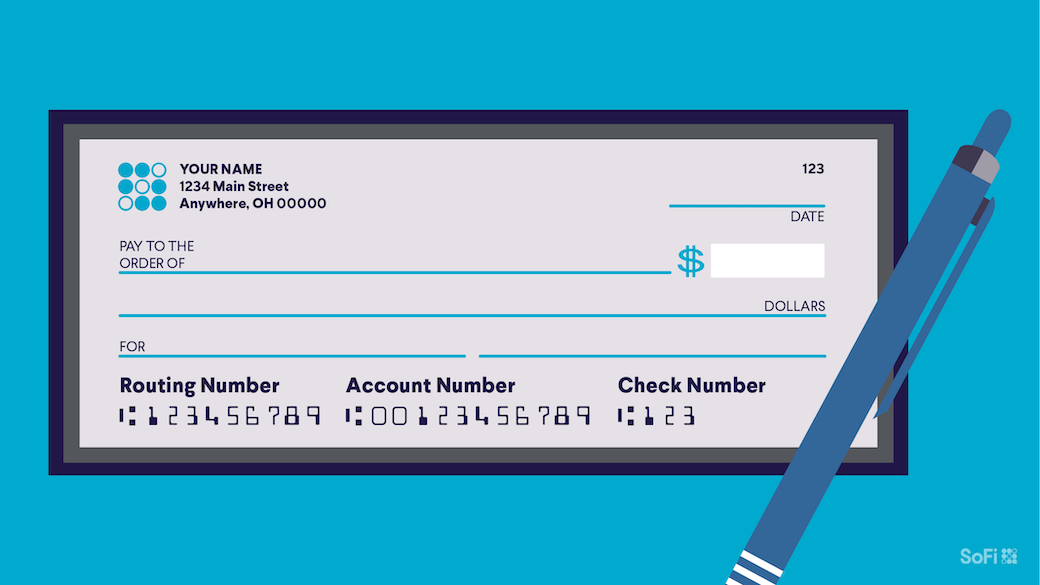
You can find your routing number and account number printed on the bottom of your checks.

You’ll see three groups of numbers (often separated by spaces and/or symbols). Typically, reading left to right, the first number (nine digits) is the routing number; the next group of numbers (usually nine to 12 digits) is the account number; the third is the actual check number.

check image with numbers

Contacting Your Bank

If you need your bank routing and account numbers and don’t have access to a check, you can call your bank (or stop into a branch) and ask a customer service representative to provide you with the numbers. Since your account number is private information, you will likely have to provide identifying details to prove you are who you say you are to gain access to this number.

Note: If all you need is the routing number, you can easily find it on your bank’s website.

Accessing Your Online Account

If you log into your bank account online or in-app, you should be able to get your banking details. Your account number may be encrypted (meaning you can only see the last four digits). If that’s the case, you can typically get the full number by downloading a recent bank statement. Or, there may be a prompt you can click in order to see the full number.

Protecting Your Routing and Account Numbers

Although anyone can locate your bank’s routing number, your account number is not public information. Just like you are mindful about who sees your Social Security number, the same goes for your bank account number. You want to make sure that someone doesn’t use your bank account and routing number without authorization.

Tips for Keeping Your Banking Information Secure

Here are some ways to keep sensitive banking information safe:

•   Avoid sharing your banking details unless necessary. To protect yourself from potential bank fraud, you generally don’t want to share your account number with any person or business unless you absolutely need to. Also wise: not sharing pictures of checks you’ve written on social media, even if it is for the first payment on your dream car.

•   Store physical checks in a secure place. Since checks contain both your routing and account number, it’s a good idea to keep your checkbook tucked away in a safe place, not sitting out in the open. Also be sure to shred old checks and paper statements before throwing them away.

•   Enable multi-factor authentication for online banking. Two- or three-factor authentication requires additional information beyond a password, such as a code sent to your mobile phone or a fingerprint scan, for account access. You’ll typically find this option inside the account settings.

•   Regularly monitor your accounts. It’s a good idea to review your bank statements monthly and check your online banking once a week. This allows you to pick up on any suspicious transactions and nip any potential issues in the bud.

Recommended: How to Write a Check

What to Do if Your Information Is Compromised

If you suspect fraud or unauthorized access to your bank account:

•   Contact your bank immediately. Call customer service and inform the representative of any unauthorized banking transactions as soon as you notice them.

•   Change your login credentials: It’s a good idea to choose a new (unique) password for your bank account. Also consider setting up multi–factor authentication if you haven’t already.

•   Review your recent transactions: Comb through recent activity on your bank account and make a list of any transactions you don’t recognize, noting the date and details. You’ll need this information to file a dispute with your bank.

•   Consider placing a fraud alert on your credit report: You can contact any one of the three credit bureaus — Equifax, Experian, and TransUnion — to place a fraud alert on all three of your credit reports. A fraud alert is free and notifies creditors to take extra steps to verify your identity before extending credit.

The Takeaway

Your account and routing numbers work together to identify your account and ensure that your money gets transferred from the right place or that you receive funds intended for you. If you’re confused about routing vs. account numbers, the routing number indicates the bank where your account is held, while the account number identifies your specific account at that bank.

Knowing the difference between these numbers, where to locate them, and how to protect them is vital to managing your finances securely.

Interested in opening an online bank account? When you sign up for a SoFi Checking and Savings account with eligible direct deposit, you’ll get a competitive annual percentage yield (APY), pay zero account fees, and enjoy an array of rewards, such as access to the Allpoint Network of 55,000+ fee-free ATMs globally. Qualifying accounts can even access their paycheck up to two days early.


Better banking is here with SoFi, NerdWallet’s 2024 winner for Best Checking Account Overall.* Enjoy 3.30% APY on SoFi Checking and Savings with eligible direct deposit.

FAQ

Do you need both a routing and account number?

Typically, yes. Common transactions — like setting up direct deposits, making electronic payments, or transferring money between banks — require both a routing and account number. The routing number identifies your bank, while the account number specifies your individual account. Together, they ensure that funds are correctly transferred to or from the right institution and account.
That said, for some transactions (like in-branch deposits), just your account number may suffice, as the bank already knows its routing number.

What comes first on a check, a routing or account number?

Typically, when you look at the lower portion of a check (reading left to right), the routing number comes first, followed by the account number, and then the actual check number.

The routing number is a nine-digit code that identifies the bank, while the account number specifies your specific account within that bank. Checks are typically numbered to help with record-keeping.

Do I give my account number or routing number for a direct deposit?

For a direct deposit, you need to provide both your routing and account numbers. The routing number ensures the deposit is sent to the correct bank, while the account number directs the funds to your specific account. You may also be asked to provide a voided check.

What happens if I use the wrong routing or account number?

Using the wrong routing or account number can result in a failed transaction or funds being sent to the wrong account.
If your bank catches the mistake, it may reject the transaction. If your bank misses it and the account number belongs to someone else, the money could get deposited into the wrong account. If that occurs, you’ll want to contact your bank immediately to try to remedy the problem.

Are routing numbers the same across all branches of a bank?

Not necessarily. Smaller banks often have a single routing number for all branches. But if a bank has branches located in different states, routing numbers won’t be the same across all branches. Your routing number will be based on the branch where you first opened your account.


Photo credit: iStock/SeventyFour

SoFi Checking and Savings is offered through SoFi Bank, N.A. Member FDIC. The SoFi® Bank Debit Mastercard® is issued by SoFi Bank, N.A., pursuant to license by Mastercard International Incorporated and can be used everywhere Mastercard is accepted. Mastercard is a registered trademark, and the circles design is a trademark of Mastercard International Incorporated.

Annual percentage yield (APY) is variable and subject to change at any time. Rates are current as of 12/23/25. There is no minimum balance requirement. Fees may reduce earnings. Additional rates and information can be found at https://www.sofi.com/legal/banking-rate-sheet

Eligible Direct Deposit means a recurring deposit of regular income to an account holder’s SoFi Checking or Savings account, including payroll, pension, or government benefit payments (e.g., Social Security), made by the account holder’s employer, payroll or benefits provider or government agency (“Eligible Direct Deposit”) via the Automated Clearing House (“ACH”) Network every 31 calendar days.

Although we do our best to recognize all Eligible Direct Deposits, a small number of employers, payroll providers, benefits providers, or government agencies do not designate payments as direct deposit. To ensure you're earning the APY for account holders with Eligible Direct Deposit, we encourage you to check your APY Details page the day after your Eligible Direct Deposit posts to your SoFi account. If your APY is not showing as the APY for account holders with Eligible Direct Deposit, contact us at 855-456-7634 with the details of your Eligible Direct Deposit. As long as SoFi Bank can validate those details, you will start earning the APY for account holders with Eligible Direct Deposit from the date you contact SoFi for the next 31 calendar days. You will also be eligible for the APY for account holders with Eligible Direct Deposit on future Eligible Direct Deposits, as long as SoFi Bank can validate them.

Deposits that are not from an employer, payroll, or benefits provider or government agency, including but not limited to check deposits, peer-to-peer transfers (e.g., transfers from PayPal, Venmo, Wise, etc.), merchant transactions (e.g., transactions from PayPal, Stripe, Square, etc.), and bank ACH funds transfers and wire transfers from external accounts, or are non-recurring in nature (e.g., IRS tax refunds), do not constitute Eligible Direct Deposit activity. There is no minimum Eligible Direct Deposit amount required to qualify for the stated interest rate. SoFi Bank shall, in its sole discretion, assess each account holder's Eligible Direct Deposit activity to determine the applicability of rates and may request additional documentation for verification of eligibility.

See additional details at https://www.sofi.com/legal/banking-rate-sheet.

*Awards or rankings from NerdWallet are not indicative of future success or results. This award and its ratings are independently determined and awarded by their respective publications.

Financial Tips & Strategies: The tips provided on this website are of a general nature and do not take into account your specific objectives, financial situation, and needs. You should always consider their appropriateness given your own circumstances.

We do not charge any account, service or maintenance fees for SoFi Checking and Savings. We do charge a transaction fee to process each outgoing wire transfer. SoFi does not charge a fee for incoming wire transfers, however the sending bank may charge a fee. Our fee policy is subject to change at any time. See the SoFi Bank Fee Sheet for details at sofi.com/legal/banking-fees/.
Third-Party Brand Mentions: No brands, products, or companies mentioned are affiliated with SoFi, nor do they endorse or sponsor this article. Third-party trademarks referenced herein are property of their respective owners.

SOBNK-Q125-084

Read more
woman office phone

How to Save Money From Your Salary

When times are tight, it can feel as though putting even a few dollars away every month is next to impossible. How can you save money when you have a low salary and so many expenses?

There are ways to get that needle moving in the right direction — even for those who are new to working full time and living on their own. Here’s a look at some simple strategies that can help you save the maximum from your paycheck.

Key Points

•   A good way to save more from your salary is to leverage an employer match in a 401(k) plan.

•   Based on the 50/30/20 rule, aim to save around 20% of your monthly take-home pay to fund your goals.

•   Consider putting a budgeting app on your phone to help you track spending and stay on budget.

•   To consistently save from your salary, automate savings with a recurring transfer or split direct deposit.

•   Allocate savings to both short- and long-term financial goals, using appropriate accounts and investments for each.

Taking Advantage of the Employer Match

Concerning but true: One in five adults ages 50-plus have no retirement savings, and more than half (61%) are worried they will not have enough money to support them in retirement, according to a 2024 survey by the AARP. Thankfully, it’s never too late — or too early — to start putting money aside for retirement. Enrolling in your company’s 401(k) plan can be a great place to start, and they may even offer matching contributions.

Maximize Retirement Contributions

Even if retirement feels a long way off, a great way to save more from your salary is to contribute as much as you can to your 401(k). That way, you let compound returns — when the money you earn on your contributions gets reinvested and also generates earnings — have an opportunity to work in your favor. The earlier you start saving for retirement, the less you’ll need to save each year to reach your goal.

If your employer offers a match, it’s a good idea to contribute at least enough to maximize this benefit, which is essentially free money. For example, let’s say your employer offers a 50% match up to 5% of your salary and you make $60,000. You would contribute $3,000 over the course of the year, and your employer would kick in another $1,500. Failing to contribute at least 5% means you’re leaving money on the table. This match significantly increases your retirement savings without additional effort on your part.

You might also consider increasing your contributions over time. Many employers allow you to automate annual increases, which helps you save more as your salary grows.

💡 Quick Tip: Your money deserves a higher rate. You earned it! Consider opening a high-yield checking account online and earn 0.50% APY.

Preparing a Budget and Following It

Creating a realistic budget ensures that you allocate your income wisely and consistently save a portion of your salary. Without a budget, it’s easy to overspend and neglect your financial goals.

If the idea of a budget seems daunting — or past attempts have been less than successful — it might be because your approach to budgeting is too complicated. It’s not necessary to create a complex set of spreadsheets. In fact, when you’re new to budgeting, a simple approach often works better.

One easy budgeting framework you might consider is the 50/30/20 rule. This approach streamlines expenses into three categories so you don’t have to monitor every single expenditure to make it work. Instead, you divide your take-home pay (what you make after taxes are taken out) into three main categories: needs, wants, and goals. Here’s how it works.

•   Put 50% of your money toward needs: This includes housing, utilities, groceries, transportation, insurance, prescription medications, minimum payments on credit cards and other debt, and any other expense you have to cover.

•   Put 30% toward wants: Here’s where everything from vacations to fancy coffees can come in. If it isn’t essential, it goes into this chunk of your budget. You might look at what you are currently spending on wants and see if you can find places to cut. Are you paying for streaming services you rarely watch? Are you a member of a gym you never go to? Could you cook one or two more nights per week and spend less on takeout? It’s all your call — but these costs all must fit into the allotted amount of money.

•   Put 20% towards goals: This category allows you to siphon off some of each paycheck to build your emergency fund, save for other short-term goals (like buying a car or going on vacation), and fund your retirement account. If you’re carrying high-interest debt, you’ll want to use some of this money to pay it down by making payments beyond the minimum.

•   Feel free to tweak: The 50/30/20 guideline is just that — a guideline. You may want to adjust the breakdown if the cost of living is particularly high in your area, and you need to spend more than 50% of your take-home pay on needs. On the other hand, if you’re in a hurry to pay down debt, you might want to cut back on your wants spending to make it work. The key to budget success, however, is to stick with it. So you don’t want to come up with a spending plan that is so austere you can’t maintain it.

💡 Quick Tip: If you’re saving for a short-term goal — whether it’s a vacation, a wedding, or the down payment on a house — consider opening a high-yield savings account. The higher APY that you’ll earn will help your money grow faster, but the funds stay liquid, so they are easy to access when you reach your goal.

Allocating Savings To Short- and Long-Term Goals

The goals category of your budget should include both short- and long-term goals. Here’s a look at how they differ:

•   Short-term goals: These are things you want to accomplish within the next several months or years, such as building an emergency fund, going on vacation, or making a major purchase. CDs, money market accounts, and high-yield savings accounts can be good choices for short-term goals.

•   Long-term goals: These goals are generally five or more years off and might include saving for retirement, a home purchase, or a child’s future college education. Consider investing the funds you set aside for these goals, since there’s time to withstand market fluctuations.

Using Budgeting Tools to Track Your Spending

Once you have a sense of how you want to divide up your salary and increase your savings, you might lean on some tools or apps to help you stay on track. Your bank may offer a free spending tracker as part of their mobile app. If not, consider downloading a separate budgeting app. Some popular options include:

•   YNAB (You Need A Budget): This app allows you to set specific savings goals, then keeps track of your spending and saving and charts your progress.

•   PocketGuard: This tool connects to all of your financial accounts and syncs transactions in real-time, helping you stick to your budget.

•   Goodbudget: Based on the envelope system of budgeting, Goodbudget divides up your salary into categories, then monitors your spending and helps you stick to the plan.

Automating Your Savings and Payments

Once you come up with a framework for how much you will spend and save each month, it’s a good idea to put as much of the plan on autopilot as possible.

Setting up autopay for your regular monthly bills, for example, eliminates the risk of missing payments and racking up late fees. In addition, you may want to consider automating your savings — this way, you won’t have to remember (and, quite possibly, forget) to transfer some money from your salary to savings each month, or be tempted to spend that money.

There are two different ways to automate savings. One is to split your direct deposit into two accounts. For example, you might have the majority of your paycheck go into your checking account and a smaller percentage into a high-yield savings account. If a payroll split isn’t an option, you can set up an automatic transfer from your checking to your savings on the day your paycheck clears. This way, the money gets whisked away before you have a chance to spend it.

The Takeaway

A savings plan doesn’t have to be complicated — or painful. In fact, you can start saving more from your salary by making just a few simple changes. These include: making sure you are putting some of your paycheck into your retirement plan at work (at least up to any employer match), coming up with a basic spending plan (such as the 50/30/20 breakdown), and putting your savings on autopilot. Before long, budgeting and saving will likely become a habit you don’t even have to think about.

Interested in opening an online bank account? When you sign up for a SoFi Checking and Savings account with eligible direct deposit, you’ll get a competitive annual percentage yield (APY), pay zero account fees, and enjoy an array of rewards, such as access to the Allpoint Network of 55,000+ fee-free ATMs globally. Qualifying accounts can even access their paycheck up to two days early.


Better banking is here with SoFi, NerdWallet’s 2024 winner for Best Checking Account Overall.* Enjoy 3.30% APY on SoFi Checking and Savings with eligible direct deposit.

FAQ

How much of my salary should I save every month?

A common recommendation is to save at least 20% of your take-home salary. This 20% includes emergency savings, retirement contributions, and other investments. However, this is just a guideline. If you have a high income and relatively low expenses, you may be able to save much more than 20%. If money is tight, on the other hand, you might need to start with a smaller percentage and gradually increase it over time.

How big of an emergency fund do I need?

A general rule of thumb is to have three to six months’ worth of living expenses set aside in an emergency fund. To come up with an exact amount, tally up all of your fixed expenses (e.g., rent/mortgage, utilities, groceries, transportation, debt, etc) and multiply that number by three or, ideally, six. Having that big of an emergency fund can help you cover your monthly bills in the event of a financial set-back without running up debt.

Should I pay debt instead of saving?

It depends. If you don’t have a solid emergency fund, you’ll want to prioritize saving over paying off debt. After that, you generally want to prioritize paying off high-interest debt (such as credit cards) over saving, since the interest rate you’re paying on your balances likely exceeds what you could earn by saving or investing. If your debt has a relatively low-interest rate, however, it’s a good idea to balance paying it off with putting money into savings.

What does an employer match mean?

An employer match is when your employer contributes to your retirement savings plan, such as a 401(k), based on how much you are contributing, up to a certain limit. For example, if your employer offers a 50% match up to 5%, it means they will contribute 50 cents for every dollar you contribute up to 5% of your salary. Any contributions you make above 5% of your salary will not be matched.

What is the max amount my employer is allowed to match?

Employer match maximums vary by company. The average 401k employer match is 50% partial match contributions up to 4% to 6% of an employee’s salary.

While companies can set their own matching policies, keep in mind that the internal revenue service (IRS) sets overall contribution limits for retirement plans, both for employees and for combined employee/employer contributions. These limits are updated every year.


SoFi Checking and Savings is offered through SoFi Bank, N.A. Member FDIC. The SoFi® Bank Debit Mastercard® is issued by SoFi Bank, N.A., pursuant to license by Mastercard International Incorporated and can be used everywhere Mastercard is accepted. Mastercard is a registered trademark, and the circles design is a trademark of Mastercard International Incorporated.

Annual percentage yield (APY) is variable and subject to change at any time. Rates are current as of 12/23/25. There is no minimum balance requirement. Fees may reduce earnings. Additional rates and information can be found at https://www.sofi.com/legal/banking-rate-sheet

Eligible Direct Deposit means a recurring deposit of regular income to an account holder’s SoFi Checking or Savings account, including payroll, pension, or government benefit payments (e.g., Social Security), made by the account holder’s employer, payroll or benefits provider or government agency (“Eligible Direct Deposit”) via the Automated Clearing House (“ACH”) Network every 31 calendar days.

Although we do our best to recognize all Eligible Direct Deposits, a small number of employers, payroll providers, benefits providers, or government agencies do not designate payments as direct deposit. To ensure you're earning the APY for account holders with Eligible Direct Deposit, we encourage you to check your APY Details page the day after your Eligible Direct Deposit posts to your SoFi account. If your APY is not showing as the APY for account holders with Eligible Direct Deposit, contact us at 855-456-7634 with the details of your Eligible Direct Deposit. As long as SoFi Bank can validate those details, you will start earning the APY for account holders with Eligible Direct Deposit from the date you contact SoFi for the next 31 calendar days. You will also be eligible for the APY for account holders with Eligible Direct Deposit on future Eligible Direct Deposits, as long as SoFi Bank can validate them.

Deposits that are not from an employer, payroll, or benefits provider or government agency, including but not limited to check deposits, peer-to-peer transfers (e.g., transfers from PayPal, Venmo, Wise, etc.), merchant transactions (e.g., transactions from PayPal, Stripe, Square, etc.), and bank ACH funds transfers and wire transfers from external accounts, or are non-recurring in nature (e.g., IRS tax refunds), do not constitute Eligible Direct Deposit activity. There is no minimum Eligible Direct Deposit amount required to qualify for the stated interest rate. SoFi Bank shall, in its sole discretion, assess each account holder's Eligible Direct Deposit activity to determine the applicability of rates and may request additional documentation for verification of eligibility.

See additional details at https://www.sofi.com/legal/banking-rate-sheet.

*Awards or rankings from NerdWallet are not indicative of future success or results. This award and its ratings are independently determined and awarded by their respective publications.

Financial Tips & Strategies: The tips provided on this website are of a general nature and do not take into account your specific objectives, financial situation, and needs. You should always consider their appropriateness given your own circumstances.

We do not charge any account, service or maintenance fees for SoFi Checking and Savings. We do charge a transaction fee to process each outgoing wire transfer. SoFi does not charge a fee for incoming wire transfers, however the sending bank may charge a fee. Our fee policy is subject to change at any time. See the SoFi Bank Fee Sheet for details at sofi.com/legal/banking-fees/.
Third Party Trademarks: Certified Financial Planner Board of Standards Center for Financial Planning, Inc. owns and licenses the certification marks CFP®, CERTIFIED FINANCIAL PLANNER®

SOBNK-Q125-086

Read more
TLS 1.2 Encrypted
Equal Housing Lender