couple home on laptop

Four Ways to Upgrade Your Home

Updating your home can be done without a full (and expensive) renovation. There are a number of light lift projects that can give your home a whole new look and feel, and even increase its resale value. Exterior upgrades, like fresh paint, a new front door, and better landscaping or outdoor lighting, can add to your home’s curb appeal. Indoor improvements, such as updated lighting fixtures, paint, or wallpaper, can give the interior of your home a more up-to-date, high-end look. Here are four ways you can upgrade your home without breaking the bank.

Key Points

•   Home upgrades, starting at $3,000, can enhance the look and value of a property.

•   Exterior upgrades, like a freshly painted front door, new porch lights, and modern landscaping with pollinator and edible gardens, can add curb appeal.

•   Indoor lighting trends favor bold and textured fixtures.

•   Popular paint colors are dusty pink, cinnamon brown, cool grays, and bright purples, while one wallpapered wall can create a mural effect.

•   Window treatments with natural hues, geometric prints, and layered rods add style and privacy.

Exterior Improvements

A home’s front door is the focal point of the exterior. To upgrade its appearance, you might replace the door, or paint it and add new hardware. Decorating the door with a seasonal wreath or another personalized touch can also add to its charm.

Besides a front door refresh or upgrade, other exterior improvements you might consider include a new mailbox, a new porch light fixture, and perhaps some window boxes with plants and fresh flowers that add a bright contrast to your home’s exterior color.

Front door styles that are currently trending include bold colors (from fire engine red to deep greens and bright blues), natural wood stains, and more glass (such as custom inserts and floor-to-ceiling sidelights).

How you landscape your front yard will depend upon where you live and the climate there. In general, though, modern trends include:

•   Natural landscaping using native plants, creating landscaping that’s eco-friendly and easy to maintain.

•   Pollinator gardens that attract butterflies, bees, and other insects that help pollinate.

•   Edible gardens, including lettuce, peppers, tomatoes, and more. Creativity is key!

Recommended: 15 Ways to Boost Your Curb Appeal for a Winter Open House

Lovely Lighting

Outdoor lighting doesn’t need to be white — filters can add a range of colors. These lights can spotlight key areas of landscaping, highlight where you like to entertain, or look attractive for even more curb appeal while providing illumination.

Size-wise, both tiny and boldly large lights are in vogue and, although lanterns aren’t a new trend, they’re still considered stylish. Updating recessed lighting is another popular home improvement project.

After a period of all-white being a hot trend for interior lighting, table lamps and hanging lighting fixtures are appearing more often as dark neutrals in brown, black, or gray. They can be used to update the white, cream, or gray choices in a home.

Paying attention to texture in lighting fixtures can add interest and variety. Materials can range from wood to wicker and rattan, and can be crafted in contemporary shapes to avoid an overly rustic look. Also still trending are geometrically designed lighting fixtures, from simple to more complex shapes.

Painting and Wallpapering

Painting rooms in a home can transform their appearance. What colors are trending? Currently, homeowners are favoring dusty pink, cinnamon brown, cool grays, and bright purples. However, unless you’re planning to sell some time soon, personal taste is what matters most when picking paint colors.

Wallpaper trends also run the gamut, including those with a texture and colors often inspired by landscapes. In this style of wallpaper, expect to see some blues, greens and neutral shades. Some people like to have one pictorial wallpaper wall, which looks like a mural in a room.

Wow Factor on Windows

In-style curtains often have hues found in nature, from green to ochre, and can also feature flowers, landscapes, and more. Geometric prints or two-tone materials may also appeal to some people. Velvet can be used to create a more intimate space.

Consider using double or triple curtain rods to add layers of window coverings. Then you can add a layer that filters light and enhances privacy, while also selecting curtains with the appearance you enjoy. Many designers recommend placing your curtain rod close to ceiling height vs. at the top of the window for a more dramatic and chic effect.

Recommended: How Much Does It Cost to Replace Windows?

Costs of a House Upgrade

The type of house upgrades listed here might be considered low-cost or low-end renovations, and can cost as little as $3,000 for a 1,250 to 1,600 square foot home. If, once momentum gets going, the low-end house upgrade turns into a middle-end one, the average cost could be closer to $5,200, according to the home improvement site Angi.

Another cost-related factor is where the home is located. Pricing in urban areas might be twice as high as in rural areas, depending on the area’s cost of living.

Plus, upgrades in older homes may take more time and attention to complete. If the home is officially considered to be historic, there may be guidelines about what changes can be made.

Recommended: Renovation vs. Remodel: What’s the Difference?

Financing a House Upgrade

Here are some options for financing a home upgrade.

•   Sometimes, homeowners are able to pay for these upgrades out of pocket. This can be true when the costs are relatively small or when money has been saved for the costs of the renovation. This can be the smart choice when possible: no debt, no interest to pay.

A downside to paying for home upgrades with cash may be that the homeowner empties a savings account or cuts corners on the renovations to avoid needing to borrow funds. Or, if, say, a big medical bill pops up and the emergency fund was used to renovate, then high-interest credit cards might need to be used to pay that debt.

•   You might consider a home equity line of credit (HELOC) to finance a house upgrade. This type of loan allows you to borrow against the equity in the home to pay for renovations. How much is available to borrow will depend upon how much equity is available and the loan-to-value ratio (LTV) that a lender permits. For example, if a lender has an 80% LTV ratio, that means the institution would:

◦   Appraise the home (e.g., $250,000).

◦   Calculate 80% of that ($200,000).

◦   Subtract current mortgage balances (e.g., $125,000).

◦   Consider what’s left over ($200,000-$125,000 = $75,000) to be equity in the home.

The lender would also consider the financial profile of the borrower when reviewing the loan application. HELOCs often have a low initial interest rate and, usually, the homeowner can choose to pay interest only during the draw period. However, there may be upfront fees and the rate is often variable with high lifetime caps.

•   Another option might be a home improvement loan, which is an unsecured personal loan and not attached to the home’s equity. Funding can usually be granted more quickly with fewer, or sometimes no, fees. This may be a good option for people who don’t have enough equity in their homes for their project or who don’t want to use their home as collateral.

Recommended: How to Apply for a Personal Loan

The Takeaway

There are a number of ways you can upgrade your home that don’t involve tearing down walls or putting on an $150,000 addition. Lower-cost upgrades, ranging from $3,000 to $50,000 or more, may still require spending more cash than you have just sitting in the bank, however. Plus, you may not want to deplete your savings in order to upgrade your home. A personal loan could be a good option.

Think twice before turning to high-interest credit cards. Consider a SoFi personal loan instead. SoFi offers competitive fixed rates and same-day funding. See your rate in minutes.


SoFi’s Personal Loan was named a NerdWallet 2026 winner for Best Personal Loan for Large Loan Amounts.

FAQ

How do you update your home?

A good plan for updating your home can be to start with changes that can shift the mood of a room. This includes paint and/or wallpaper, carpets and rugs, window treatments, and lighting, among other features.

How to update a home without renovation?

To update a home without a major renovation, make changes to surfaces, such as repainting in a different color, swapping in new curtains or blinds, and adding fresh rugs or refinishing the floors.

How much do home updates cost?

The price of home updates can range considerably depending on the cost of living in your area, how much you DIY vs. calling in professionals, and your taste level and the changes you actually make. A small update can start at $3,000, but prices in the five figures can be common.


SoFi Loan Products
SoFi loans are originated by SoFi Bank, N.A., NMLS #696891 (Member FDIC). For additional product-specific legal and licensing information, see SoFi.com/legal. Equal Housing Lender.


*Awards or rankings from NerdWallet are not indicative of future success or results. This award and its ratings are independently determined and awarded by their respective publications.

Disclaimer: Many factors affect your credit scores and the interest rates you may receive. SoFi is not a Credit Repair Organization as defined under federal or state law, including the Credit Repair Organizations Act. SoFi does not provide “credit repair” services or advice or assistance regarding “rebuilding” or “improving” your credit record, credit history, or credit rating. For details, see the FTC’s website .

Financial Tips & Strategies: The tips provided on this website are of a general nature and do not take into account your specific objectives, financial situation, and needs. You should always consider their appropriateness given your own circumstances.

Third-Party Brand Mentions: No brands, products, or companies mentioned are affiliated with SoFi, nor do they endorse or sponsor this article. Third-party trademarks referenced herein are property of their respective owners.

²SoFi Bank, N.A. NMLS #696891 (Member FDIC), offers loans directly or we may assist you in obtaining a loan from SpringEQ, a state licensed lender, NMLS #1464945.
All loan terms, fees, and rates may vary based upon your individual financial and personal circumstances and state.
You should consider and discuss with your loan officer whether a Cash Out Refinance, Home Equity Loan or a Home Equity Line of Credit is appropriate. Please note that the SoFi member discount does not apply to Home Equity Loans or Lines of Credit not originated by SoFi Bank. Terms and conditions will apply. Before you apply, please note that not all products are offered in all states, and all loans are subject to eligibility restrictions and limitations, including requirements related to loan applicant’s credit, income, property, and a minimum loan amount. Lowest rates are reserved for the most creditworthy borrowers. Products, rates, benefits, terms, and conditions are subject to change without notice. Learn more at SoFi.com/eligibility-criteria. Information current as of 06/27/24.
In the event SoFi serves as broker to Spring EQ for your loan, SoFi will be paid a fee.


Third Party Trademarks: Certified Financial Planner Board of Standards Center for Financial Planning, Inc. owns and licenses the certification marks CFP®, CERTIFIED FINANCIAL PLANNER®

SOPL-Q225-045

Read more

Checking Account Pros and Cons

A checking account can be a convenient place to store your cash and manage daily transactions. Among its benefits: You can usually make as many transfers in and out of the account as you like. Also, your funds are likely to be insured.
There are, however, some cons, too. You probably won’t earn much or any interest for parking your money in a checking account, and you may be hit with an array of fees that nibble away at your funds.

Here, take a closer look at checking account pros and cons so you can pick the right financial product to suit your needs.

Key Points

•   A checking account provides security and easy access to funds.

•   Checking accounts can support direct deposits and convenient bill payments.

•   A benefit of a checking account can be a small amount of interest, plus rewards and sign-up bonuses.

•   Potential drawbacks include low interest and fees.

•   Alternatives to checking accounts include prepaid cards and digital payment services.

What Is a Checking Account?

Simply put, a checking account is a safe place to stash funds and enable the flow of money in (what you earn and receive) and out (what you spend).

Whether held at a brick-and-mortar bank, an online bank, or a credit union, a checking account is often the hub of a person’s financial life. Your pay can be seamlessly direct-deposited, if you like.

For your everyday spending, you might schedule automatic payments for your mortgage and utilities, write a check when paying for a doctor’s appointment, and tap your debit card when treating yourself to a wine tasting with friends on the weekend.

Increase your savings
with a limited-time APY boost.*


*Earn up to 4.00% Annual Percentage Yield (APY) on SoFi Savings with a 0.70% APY Boost (added to the 3.30% APY as of 12/23/25) for up to 6 months. Open a new SoFi Checking and Savings account and pay the $10 SoFi Plus subscription every 30 days OR receive eligible direct deposits OR qualifying deposits of $5,000 every 31 days by 3/30/26. Rates variable, subject to change. Terms apply here. SoFi Bank, N.A. Member FDIC.

Benefits of Checking Accounts

Here’s a closer look at the pros and cons of a checking account, starting with the upsides.

Security

Yes, you could stuff your money under the proverbial mattress, but with a checking account, you have a secure spot for it, where it can’t get lost, stolen, or damaged.

If your bank is insured by the FDIC (Federal Deposit Insurance Corporation) or, in the case of a credit union, the NCUA (National Credit Union Administration), your account will typically be covered up to $250,000 per depositor, per insured institution, for each account ownership category.

Easy Access to Cash

Checking accounts allow you to access your money quickly and easily, whether you need to pay for a meal or something unexpected, like a school donation. Setting up direct deposit allows your paychecks to be transferred directly into your checking or savings account, with some banks offering access to cash up to two days early.

You can then tap your funds by using your checking account’s debit card, writing checks, snagging some cash from the ATM, or making a transfer.

Pay Bills Conveniently

Here’s another benefit of a checking account: Having a checking account means you can get your bills taken care of without much effort. You might set up recurring payments to a car loan, for instance, or use a digital payment app to send money to your roommate, a friend, or your yoga teacher. You can also typically move funds quickly via wire transfer, which can be especially useful for international transactions, and other methods as well.

Debit Card for Purchases

When you open a checking account, you’re usually provided with a debit card that’s linked to the account. Similar to a credit card, you can typically use your debit card to pay in person or online for anything from this week’s groceries to a cool new pair of shades to a matcha latte.

Unlike a credit card, however, debit cards pull funds directly from your checking account. They usually only let you dip into funds you actually have on deposit, which can help you keep spending in check and stay on budget, not to mention avoid credit card debt.

Rewards

Some checking accounts come with rewards that can be a nice perk. For example, when you open an account, you might get a sign-up bonus. Who doesn’t like free money? Or your debit card may carry rewards, similar to those of a credit card, such as cash back.

Direct Deposit Benefits

Direct deposit can be a seamless way to get paid; in fact, more than 95% of Americans get paid this way, according to National Payroll Week. Direct deposit sends cash, ready to spend, straight into your bank account, so you don’t have to deal with depositing a check or cash.

FDIC Insurance Protection

As noted above, most financial institutions (but not all) are insured by either the FDIC or NCUA. In the very rare event of a bank failure, you would be protected from loss up to those limits of $250,000 per depositor, per account ownership category, per insured institution. Note: Some institutions offer programs that provide even more than $250,000 in insurance.

Cons of Checking Accounts

As you might guess, there are advantages and disadvantages to checking accounts, as is the case with most financial products. Checking accounts are designed to serve customers’ everyday, short-term money needs and can have a few potential downsides to consider.

Low or No Interest Earned

While your money is sitting in your checking account, it is probably earning very low, if any, interest. For instance, as of June 2025, the average interest checking account rate was a meager 0.07% of one percent, according to the FDIC. Translated into dollars and cents, that means that if you kept $5,000 in your checking account for a year, you would only earn $3.50 in simple interest.

That said, there are high-yield and premium checking accounts available that pay heftier interest rates. These may come with minimum deposit and balance requirements. Online-only banks frequently offer these accounts without those barriers, however, and with interest rates that are several times higher than the national average.

Potential Overdraft and Other Fees

Sooner or later, many people will try to transfer more money out of their checking account than they actually have on deposit. It could be a simple math error, or they might have forgotten about that on-the-fly payment they made to contribute to, say, a friend’s baby shower gift.

Not having enough money in your checking account can lead to overdraft fees. The average charge currently stands at a steep $25 to $35, with an average (as of 2024) of $27.08. Also, even if you have overdraft protection — meaning you have linked accounts so that money can be pulled from savings into checking to cover payments, if needed — you may still be charged a fee. However, it’s likely to be lower than an overdraft charge.

Also, check the fine print when signing up for a new checking account: There can be other fees, such as account maintenance and out-of-network ATM fees (more on those below).

Security Risks

While banks are extremely safe overall, there is always a small possibility of a security risk (such as a hack). Losing or having your debit card stolen and used without your authorization is another concern— and it can be a common one. A card thief could potentially gain access to the funds in your checking account.

It’s vital to report the issue within two days of noticing the card is missing so that you’ll be liable for no more than $50 in unauthorized usage. Otherwise, you could be liable up to $500 or more depending on the circumstances.

Minimum Balance Requirements

Some checking accounts require the account holder to maintain a certain balance to avoid monthly account fees. Or they might want account holders to keep a certain sum on deposit in order to earn a premium interest rate. Depending on the institution, this minimum deposit could be several hundred or more than a thousand dollars. If your balance dips below this amount, you could be hit with fees and/or lose your interest rate.

Recommended: Ways to Manage Your Money

When a Checking Account Makes Sense

Quite simply, checking accounts make sense for the vast majority of Americans. It typically serves as the hub of one’s daily financial life.

Some people, though, are unbanked, meaning they have not (or are not able) to access the usual banking services. If you are seeking a checking account and haven’t been able to secure one, you can try a few other options:

•   It might be easier to get an account at a credit union, if you qualify for one based on where you live, your profession, or other factors.

•   Your banking history may reveal some issues, such as multiple overdrafts, as tracked by ChexSystems (a kind of reporting agency for the banking industry). In this situation, you might qualify for a second-chance account. This kind of account may have higher fees and/or minimum balance requirements, but it can be a good way to show that you can handle an account responsibly. In some cases, a second-chance account can be a stepping stone to a standard checking account.

When Other Accounts May Be Better

There are some situations in which another kind of account could be better than a checking account. A few scenarios to consider:

•   If you are hoping to park your money for a while and earn interest vs. spend it, a savings account can be a good bet. Some savings accounts have limits on how many transactions can occur per month (check the fine print). Whether or not that applies, you will likely earn a higher interest rate than you would with a checking account. For instance, the current average interest rate for a savings account is 0.38% vs. 0.07% for checking.

•   For those who want their money to earn still more money, a high-yield savings account can offer still more earning potential. At the time of publication, some online-only banks were offering rates in the range of 4.5%.

•   A CD (or certificate of deposit) can be another way to earn a higher return on money you keep in a bank. However, these don’t offer the accessibility of a checking account. You agree to keep your funds on deposit in return for the bank guaranteeing a certain interest rate and are usually penalized if you withdraw funds before the end of your time.

•   For those who want spending power without a checking account, prepaid debit cards can deliver. You load funds onto them and can then spend or pay bills with them. They are typically backed by a major network, like Visa or Mastercard.

•   One other option is to use digital payment services, such as Venmo and PayPal. These can allow you to move funds to shop and otherwise spend without a bank account.

Checking Account Features To Consider

If you are looking for a checking account, you may want to focus on these three considerations:

ATM Access and Fees

Since accessibility is a key selling point of checking accounts, you likely want your money to be within easy and affordable reach. Check out a financial institution’s network of ATMs and make sure they are near your usual haunts.

Also see what the charges are for using an out-of-network bank: Certain banks (especially online-only ones) may waive those usual out-of-network fees that can ding you; these currently average $4.77 a pop.

Online/Mobile Banking

Today, it’s par for the course for financial institutions to provide online banking features and mobile banking apps, but some provide more robust, user-friendly digital services and offer them for free.

As you consider your options, you might look for a bank that helps you save automatically. A round-up function that nudges purchases up to the next whole dollar amount and adds the extra money to your savings can be valuable.

Also helpful are dashboards that allow you to see your money (earnings, spending, and savings) and credit score at a glance, for no extra charge. This feature can help you budget better.

Overdraft Protection

As mentioned above, many people have those “oops” moments and overdraw their accounts. Some banks will give you free overdraft protection up to a certain sum. For instance, they might cover up to $50 of your overdraft without charging you the standard fees. This can be a valuable feature when you are deciding which financial partner is right for you.

Meet the new SoFi Plus!

Get access to higher APY, credit card cash back rewards, discounts, and more.

money management guide for beginners

Account Maintenance Fees

As noted above, some banks will charge monthly account maintenance fees for holding a checking account at their institution. It can be one of the ways that banks make money. These fees can range from, say, $5 to $12 a month or more, which can take a bite out of your budget.

You may find that some banks, especially online ones, offer no-fee checking accounts. Or a financial institution may waive fees if you keep a certain amount on deposit across your accounts or if you meet other requirements.

Customer Service and Support

Another factor to consider is the kind and quality of customer service and support a financial institution offers. Some people may gravitate toward online banks which typically have 24/7 online support by phone or text chat. Others may prefer banking with a traditional bank where they can meet in-person with team members. Consider what’s important to you to make the best decision for your news.

The Takeaway

For many people, a checking account can be a reliable hub for their personal finance needs. You can store your earnings securely and still easily access your money to pay bills and fund daily purchases.

Interested in opening an online bank account? When you sign up for a SoFi Checking and Savings account with eligible direct deposit, you’ll get a competitive annual percentage yield (APY), pay zero account fees, and enjoy an array of rewards, such as access to the Allpoint Network of 55,000+ fee-free ATMs globally. Qualifying accounts can even access their paycheck up to two days early.


Better banking is here with SoFi, NerdWallet’s 2024 winner for Best Checking Account Overall.* Enjoy 3.30% APY on SoFi Checking and Savings with eligible direct deposit.

FAQ

Are checking accounts free?

Some are. You can often find free checking accounts from traditional and online-only banks as well as credit unions. While these accounts may be billed as “free,” keep in mind that some fees may apply, say, if you overdraft your account.

What happens if my checking is overdrawn?

If your checking account is overdrawn, that means you have tried to withdraw more money than you have in your account. This can lead to payments not being processed (a check bouncing, for example) and charges piling up. By linking a checking and savings account, you may be able to have funds automatically transferred from savings into checking to cover the shortfall. Your bank may charge you a fee, whether they cover the shortfall through overdraft protection or not.

Can I have multiple checking accounts?

There is usually no limit on how many checking accounts you can have. It can be convenient to have one for, say, your salary and your living expenses and another for a side hustle and related expenses.

Are checking accounts FDIC insured?

Most but not all checking accounts are FDIC-insured. You can look for this feature before opening an account. With FDIC insurance, you are covered for up to $250,000 per depositor, per account ownership category, per insured institution in the very rare event of a bank failure. Some banks have programs that offer even higher amounts of insurance.

Do checking accounts offer fraud protection?

Most banks will refund you if your account is hacked or your debit card is used without permission, provided you report it in a timely fashion. Check with your financial institution about their policies, but note that if you willingly sent money to an individual or business that turned out to be a scam, refunds are less likely.


Photo credit: iStock/SDI Productions

SoFi Checking and Savings is offered through SoFi Bank, N.A. Member FDIC. The SoFi® Bank Debit Mastercard® is issued by SoFi Bank, N.A., pursuant to license by Mastercard International Incorporated and can be used everywhere Mastercard is accepted. Mastercard is a registered trademark, and the circles design is a trademark of Mastercard International Incorporated.

Annual percentage yield (APY) is variable and subject to change at any time. Rates are current as of 12/23/25. There is no minimum balance requirement. Fees may reduce earnings. Additional rates and information can be found at https://www.sofi.com/legal/banking-rate-sheet

Eligible Direct Deposit means a recurring deposit of regular income to an account holder’s SoFi Checking or Savings account, including payroll, pension, or government benefit payments (e.g., Social Security), made by the account holder’s employer, payroll or benefits provider or government agency (“Eligible Direct Deposit”) via the Automated Clearing House (“ACH”) Network every 31 calendar days.

Although we do our best to recognize all Eligible Direct Deposits, a small number of employers, payroll providers, benefits providers, or government agencies do not designate payments as direct deposit. To ensure you're earning the APY for account holders with Eligible Direct Deposit, we encourage you to check your APY Details page the day after your Eligible Direct Deposit posts to your SoFi account. If your APY is not showing as the APY for account holders with Eligible Direct Deposit, contact us at 855-456-7634 with the details of your Eligible Direct Deposit. As long as SoFi Bank can validate those details, you will start earning the APY for account holders with Eligible Direct Deposit from the date you contact SoFi for the next 31 calendar days. You will also be eligible for the APY for account holders with Eligible Direct Deposit on future Eligible Direct Deposits, as long as SoFi Bank can validate them.

Deposits that are not from an employer, payroll, or benefits provider or government agency, including but not limited to check deposits, peer-to-peer transfers (e.g., transfers from PayPal, Venmo, Wise, etc.), merchant transactions (e.g., transactions from PayPal, Stripe, Square, etc.), and bank ACH funds transfers and wire transfers from external accounts, or are non-recurring in nature (e.g., IRS tax refunds), do not constitute Eligible Direct Deposit activity. There is no minimum Eligible Direct Deposit amount required to qualify for the stated interest rate. SoFi Bank shall, in its sole discretion, assess each account holder's Eligible Direct Deposit activity to determine the applicability of rates and may request additional documentation for verification of eligibility.

See additional details at https://www.sofi.com/legal/banking-rate-sheet.

*Awards or rankings from NerdWallet are not indicative of future success or results. This award and its ratings are independently determined and awarded by their respective publications.

We do not charge any account, service or maintenance fees for SoFi Checking and Savings. We do charge a transaction fee to process each outgoing wire transfer. SoFi does not charge a fee for incoming wire transfers, however the sending bank may charge a fee. Our fee policy is subject to change at any time. See the SoFi Bank Fee Sheet for details at sofi.com/legal/banking-fees/.
^Early access to direct deposit funds is based on the timing in which we receive notice of impending payment from the Federal Reserve, which is typically up to two days before the scheduled payment date, but may vary.


1SoFi Bank is a member FDIC and does not provide more than $250,000 of FDIC insurance per depositor per legal category of account ownership, as described in the FDIC’s regulations. Any additional FDIC insurance is provided by the SoFi Insured Deposit Program. Deposits may be insured up to $3M through participation in the program. See full terms at SoFi.com/banking/fdic/sidpterms. See list of participating banks at SoFi.com/banking/fdic/participatingbanks.

Financial Tips & Strategies: The tips provided on this website are of a general nature and do not take into account your specific objectives, financial situation, and needs. You should always consider their appropriateness given your own circumstances.

Third-Party Brand Mentions: No brands, products, or companies mentioned are affiliated with SoFi, nor do they endorse or sponsor this article. Third-party trademarks referenced herein are property of their respective owners.

SOBNK-Q225-103

Read more
Budgeting as a New Doctor

Budgeting as a New Doctor

The member’s experience below is not a typical member representation. While their story is extraordinary and inspirational, not all members should expect the same results.

Dr. Christine M. has always been goal-oriented about her finances. That approach worked well when she decided to become a doctor. She stretched an annual salary of $55,000 during her five years as a resident and fellow. Once she became a new doctor in private practice on the East Coast, she made paying down her medical school loans her top priority. By being frugal, she was able to pay them off in three years.

The road to becoming a doctor is long — 11 years at a minimum — and the average cost of medical school is expensive. The median medical school debt for borrowers in the Class of 2024 is $205,000, according to the Association of American Medical Colleges. And that’s not counting undergraduate student loans, credit card balances, or other debt.

But the hard work can pay off. The median annual salary for physicians and surgeons is $239,200. That’s a significant increase from the $65,100 median annual salary a first-year resident earns.

If you’re a doctor, the beginning of your career marks a new phase of your earning power. It’s also a prime opportunity to get yourself on sound financial footing, including paying off your medical school loans. That’s why budgeting is so important for doctors. These strategies can help you reach your financial goals.

Key Points

•   New doctors should aim to save 30% of their income, with 25% for retirement and 5% for an emergency fund.

•   Automating finances can help build good saving habits and ensure timely bill payments.

•   New doctors can explore various investment vehicles for retirement savings, including HSAs and IRAs.

•   Physicians may consider disability insurance to protect income in case of injury or illness.

•   Develop a repayment strategy for medical student loans, such as income-driven repayment, using the avalanche or snowball method, or exploring medical loan refinancing.

Resist the Urge to Start Spending Right Away

After years of hard work and sacrifice, you may be tempted to treat yourself. But don’t go wild. “I think lifestyle creep is the biggest danger we see [among new doctors],” says Brian Walsh, CFP® and Head of Advice & Planning at SoFi. Leveling up early in your career can wreak havoc on your savings and financial health while setting unsustainable spending habits that are hard to break.

Automate your finances whenever possible. For instance, preschedule your bill payments and set up automatic contributions to your retirement account.

To encourage good spending habits, use cash or a debit card for purchases, Walsh suggests. You may also need to practice extra self-control. Because Christine was thrifty, she was able to triple her loan payments to $4,500 a month. She also made additional payments whenever she could. “You just have to keep reminding yourself what your priorities are because it’s easy to want more,” she says.

Get Serious About Savings

As a new doctor, you may not start your career until you’re in your thirties, which puts you behind the curve on saving for long-term goals. The good news: earning a higher income can help you make up for lost time.

Walsh advises early-career physicians to set aside 30% of their income for savings. Of that, 25% should be for retirement and 5% for other savings, like starting an emergency fund that can tide you over for three to six months. The remaining 70% of your income should go toward expenses, including monthly medical school loan payments.

The sooner you start saving and investing, the sooner you can enjoy compound growth, which is when your money grows faster over time. That’s because the interest you earn on what you save or invest increases your principal, which earns you even more interest.

Consider Different Investments

For investing your retirement savings, you may need to think beyond maxing out your 401(k) or 403(b), though you should do that as well. Walsh suggests new doctors tap into a combination of different investment vehicles. This strategy, known as diversification, may help protect you from risk. Here are some vehicles to consider:

•  A health savings account (HSA), which provides a triple tax benefit. Contributions reduce taxable income, earnings are tax-free, and money used for medical expenses is also tax-free.

•  An individual retirement account (IRA), like a traditional IRA or Roth IRA, can offer tax advantages. Contributions made to a traditional IRA are tax-deductible, and no taxes are due until you withdraw the money. Contributions to a Roth IRA are made with after-tax dollars; your money grows tax-free and you don’t pay taxes when you withdraw the funds. However, there are limits on how much you can contribute each year and on your income.

•   After-tax brokerage accounts, which offer no tax benefits but give you the flexibility to withdraw money at any time without being taxed or penalized.

Two options to consider bypassing are variable annuities and whole life insurance. Walsh says they aren’t suitable ways to build wealth.

Regardless of the strategy you choose, keep in mind that there may be fees associated with investing in certain funds, which Walsh points out can add up over time.

Protect Your Income

There are a variety of insurance policies available to physicians, and disability insurance is one worth considering. It covers a percentage of your income should you become unable to work due to an injury or illness. If you didn’t purchase a policy during your residency or fellowship, you can buy one as part of a group plan or as an individual. Check to see if it’s a perk offered by your employer. Christine’s practice, for example, includes a disability plan as part of its benefits package. Monthly premium amounts vary, but in general, the younger and healthier you are, the cheaper the policy.

Recommended: Short Term vs. Long Term Disability Insurance

Develop a Plan to Repay Student Loans

No matter how much you owe, having the right repayment strategy can help keep your monthly payments manageable and your financial health protected.

To start, consider the types of student loans you have. Federal loans have safety nets you can explore, like loan forgiveness and income-driven repayment (IDR) plans, which can lower monthly payments for eligible borrowers based on their income and household size.

Once you’ve assessed the programs and plans you’re eligible for, determine your goals for your loans. Do you need to keep monthly payments low, even if that means paying more in interest over time? Or are you able to make higher monthly payments now so that you pay less in the long run?

Two approaches to paying down debt are called the avalanche and the snowball. With the avalanche approach, you prioritize debt repayment based on interest rate, from highest to lowest. With the snowball method approach, you pay off the smallest balance first and then work your way up to the highest balance.

While both have their benefits, Walsh often sees greater success with the snowball approach. “Most people should start with paying off the smallest balance first because then they’ll see progress, and progress leads to persistence,” he says. But, as he points out, the right approach is the one you’ll stick with.

Explore Your Refinancing Options

Besides freeing up funds each month, paying down debt has long-term benefits, like boosting your credit score and lowering your debt-to-income ratio. And you may want to include refinancing in your student loan repayment strategy.

When you refinance, a private lender pays off your existing loans and issues you a new loan. This could give you a chance to lock in a lower interest rate than you’re currently paying and combine all of your loans into a single monthly bill. Some lenders like SoFi also provide medical professional refinancing.

Though the refinancing process is fairly straightforward, some common misconceptions persist, Walsh says. “People overestimate the amount of work it takes to refinance and underestimate the benefits,” he says. A quarter of a percentage point difference in an interest rate may seem inconsequential, for instance, but if you have a big loan balance, it could save you thousands of dollars.

That said, refinancing your student loans is not right for everyone. If you refinance federal student loans, for instance, you may lose access to benefits and protections, such as federal repayment and forgiveness plans. Weigh all the options and decide what makes sense for you and your financial goals.

The Takeaway

As a new doctor, you stand to earn a six-figure salary once you complete medical school and residency. But you’re likely also saddled with a six-figure student loan debt. Learning new strategies for saving and investing your money, and coming up with a smart plan to pay back your student loans, can help you dig out of debt and save for your future.

If you decide that student loan refinancing might be right for you, SoFi can help. Our medical professional refinancing offers competitive rates for doctors.

SoFi reserves our lowest interest rates for medical professionals like you.


Photo credit: iStock/Ivan Pantic

FAQ

How do I budget as a new doctor?

To budget as a new doctor, start saving right away and resist the urge to overspend. Set aside 30% of your income for savings — of that, 25% should go to retirement savings and 5% to other savings, like an emergency fund. Use the remaining 70% of your income to pay for expenses and bills.
In addition, automate your finances. Set up auto-pay for bills and automatic contributions to your retirement accounts, including 401(ks) and IRAs. Finally, develop a plan to repay your student loans. Explore different repayment plans to see which one is best for you.

How much debt does a new doctor have?

The median medical school debt for borrowers in the Class of 2024 is $205,000, according to the Association of American Medical Colleges. That’s not counting undergraduate student loans.

How much does a doctor make?

The median annual salary for physicians and surgeons is $239,200. That’s much more than the $65,100 median annual salary a first-year medical resident earns.

SoFi Student Loan Refinance
Terms and conditions apply. SoFi Refinance Student Loans are private loans. When you refinance federal loans with a SoFi loan, YOU FORFEIT YOUR ELIGIBILITY FOR ALL FEDERAL LOAN BENEFITS, including all flexible federal repayment and forgiveness options that are or may become available to federal student loan borrowers including, but not limited to: Public Service Loan Forgiveness (PSLF), Income-Based Repayment, Income-Contingent Repayment, extended repayment plans, PAYE or SAVE. Lowest rates reserved for the most creditworthy borrowers.
Learn more at SoFi.com/eligibility. SoFi Refinance Student Loans are originated by SoFi Bank, N.A. Member FDIC. NMLS #696891 (www.nmlsconsumeraccess.org).

SoFi Loan Products
SoFi loans are originated by SoFi Bank, N.A., NMLS #696891 (Member FDIC). For additional product-specific legal and licensing information, see SoFi.com/legal. Equal Housing Lender.


Third-Party Brand Mentions: No brands, products, or companies mentioned are affiliated with SoFi, nor do they endorse or sponsor this article. Third-party trademarks referenced herein are property of their respective owners.

Non affiliation: SoFi isn’t affiliated with any of the companies highlighted in this article.

Financial Tips & Strategies: The tips provided on this website are of a general nature and do not take into account your specific objectives, financial situation, and needs. You should always consider their appropriateness given your own circumstances.

Third Party Trademarks: Certified Financial Planner Board of Standards Center for Financial Planning, Inc. owns and licenses the certification marks CFP®, CERTIFIED FINANCIAL PLANNER®

External Websites: The information and analysis provided through hyperlinks to third-party websites, while believed to be accurate, cannot be guaranteed by SoFi. Links are provided for informational purposes and should not be viewed as an endorsement.

SOSLR-Q225-047

Read more
What’s a Good Monthly Retirement Income for a Couple in 2022?

What’s a Good Monthly Retirement Income for a Couple in 2025

Determining a good monthly retirement income isn’t one-size-fits-all. However, many financial experts suggest couples should aim for around 80% of their pre-retirement income to maintain a comfortable lifestyle. If you earn $100,000 in your final working years, for example, you’ll need around $80,000 annually or $6,667 monthly in retirement.

You might also consider the average retirement income for a couple. According to the U.S. Census Bureau, the median household income for retired couples aged 65 and over in 2023 was $84,670 per year, or about $7,056 per month.

The exact monthly income you and your spouse or partner need, however, will depend on several factors, including your expenses, age, health, and desired lifestyle. Below, we explore these key considerations to help you estimate your ideal monthly retirement income and explore where that money might come from.

Key Points

•   Lifestyle preferences and current expenses determine retirement income needs.

•   Social Security benefits and retirement savings are crucial income sources.

•   Inflation reduces purchasing power, necessitating careful financial planning.

•   Retirement spending doesn’t stay static but generally follows a U-shaped curve.

•   A surviving spouse may face financial adjustments and income loss.

How Being a Couple Affects Your Income Needs

Being part of a couple can significantly impact retirement income needs, making it different from retirement planning as an individual.

While some expenses may double — such as food, travel, and health insurance — others can be shared, leading to cost savings. For example, housing, utilities, and transportation often remain similar whether supporting one person or two. That means a couple may not need twice the income of a single retiree to maintain a comfortable lifestyle.

That said, couples typically need to plan for a longer period of retirement, since one partner generally outlives the other. This requires careful long-term planning to ensure both partners are financially secure throughout retirement.


💡 Quick Tip: Want to lower your taxable income? Start saving for retirement with a traditional IRA. The money you save each year is tax deductible (and you don’t owe any taxes until you withdraw the funds, usually in retirement).

What to Consider When Calculating Your Monthly Income

There are many misconceptions about retirement spending. Some couples assume that their expenses will drop significantly after retiring, but that’s not always the case. Here are some key factors to consider when calculating your monthly income needs.

Spending May Not Be as Low as You Think

Many couples anticipate that their living costs will go down after retirement, since they’ll spend less on commuting, professional clothing, and lunches out. Expenses like payroll taxes for Social Security and retirement account contributions also go away after retirement. However, these savings can potentially be offset by increased spending in other areas, like health care, travel, leisure activities, gifts for grandkids, or home renovations. Retirees may also find themselves spending more on hobbies and dining out as they have more free time.

It’s important to calculate your current monthly expenses and then consider which ones may go down or up when you stop working to get an accurate sense of your monthly income needs.

Spending Doesn’t Stay Steady the Whole Time

It’s a common retirement mistake to assume spending will be fixed once you enter the retirement phase of your life. In reality, spending patterns typically take on a U-shaped curve over the course of retirement. Expenses tend to be highest in the first several years, due to increased spending on travel, hobbies, and activities couples may have put off while working. Spending then generally declines as retirees get older and less active, only to rise again due to higher health care costs and (possibly) long-term care expenses. You’ll want to be sure your retirement income plan accounts for all of these different phases of retirement.

Expenses May Change When One of You Dies

When one spouse passes away, the surviving partner often experiences a significant shift in their financial needs. Some expenses like housing may stay the same, while others — such as food, travel, or entertainment — may decrease. In addition, the surviving spouse might lose one source of Social Security or pension income, potentially straining finances. As a result, it’s critical to plan for income flexibility.

Essential vs Discretionary Expenses

When calculating your monthly retirement income needs, it’s important to differentiate between essential and discretionary expenses.

•   Essential expenses are the non-negotiable costs necessary to maintain your basic lifestyle and standard of living in retirement. Examples include housing, utilities, groceries, healthcare, and transportation.

•   Discretionary expenses are optional expenses that enhance your quality of life but are not strictly necessary. These can be adjusted or reduced if your income fluctuates or unexpected costs arise. Examples include: travel/vacations, entertainment, dining out, hobbies and recreation, charitable donations and gifts, and subscriptions and memberships.

By separating needs from wants, you can develop a realistic budget, adjust discretionary spending if your income fluctuates or unexpected costs arise, and increase your chances of a financially secure and enjoyable retirement.

Planning for Inflation and Health Care Costs

Inflation significantly impacts financial needs in retirement by eroding the purchasing power of your income and savings over time. As prices rise, the same amount of money buys fewer goods and services, potentially forcing you to withdraw more from your savings each year to cover expenses. It’s crucial to factor in a realistic inflation rate when calculating retirement needs.

Health care costs also tend to increase over time, both due to inflation and the fact that medical needs generally increase as you get older. Without proper planning, you may find that premiums, out-of-pocket expenses, and services not covered by Medicare can deplete your retirement savings.

Check your score with SoFi

Track your credit score for free. Sign up and get $10.*


Common Sources of Income in Retirement

Building multiple reliable income streams can help ensure a stable and sustainable retirement. Here are the most common income sources for retirees:

Social Security

For many American couples, Social Security is a key retirement income stream. In May 2025, the average Social Security monthly check for retired workers was $2,002.39, according to the Social Security Administration’s (SSA) Monthly Statistical Snapshot. For a couple, this could amount to approximately $4,005 per month. However, benefits vary based on your earnings history and the age at which you start claiming.

Retirement Savings

Retirement savings accounts, such as 401(k)s and IRAs, provide additional income for couples after they leave the workforce. Financial planners often recommend using the 4% rule as a guideline for drawing down your retirement savings. This guideline is based on a 30-year retirement and designed to help ensure you don’t outlive your savings.

To follow the 4% rule, you add up all of your combined retirement savings, then aim to withdraw 4% of that total during your first year of retirement. For example, if you have $1 million in savings, you would withdraw $40,000 per year or around $3,333 monthly. The following year, you would adjust that 4% to account for inflation. So if inflation was 2%, you would give yourself a 2% raise.

While the 4% rule can be a helpful guideline, you may need to adjust your spending rate based on your situation, age, and the performance of your investments.

In addition, as you save for retirement, a retirement calculator can give you a sense of how much you should be regularly putting toward retirement savings to meet your goals for those later years.

Annuities

An annuity is a financial product sold by insurance companies that can offer an income stream in retirement and/or increase retirement savings. With an income annuity, you make a lump sum investment then receive a payout for life or a set period of time. With a tax-deferred annuity, you accumulate tax-deferred savings, while also having the option to receive income in the future. This makes annuities attractive for couples looking for stability after retirement.

Other Savings

The other savings category includes money you have in savings accounts, certificates of deposit (CDs), and nonretirement brokerage accounts. These funds can serve as backup or supplemental income. While they don’t offer the tax advantages that come with retirement accounts, they provide liquidity and flexibility, which can be helpful for managing unexpected expenses.

Pensions

A pension is an employer-based plan that pays out a specified amount of income on a regular basis (typically monthly) to an employee after they retire. It’s generally funded by the employer during the employee’s working years, and those funds are usually invested so they can grow over time. If a worker stays with that employer for a certain period of time, they are eligible to receive payouts from their pension plan when they retire.

Pensions are not as commonly offered as they used to be, however, having largely been replaced by 401(k)s and other defined contributions plans. If neither you nor your spouse have ever worked for a company that offered a pension, you won’t be able to rely on this as a source of income after retirement.

Reverse Mortgages

A reverse mortgage enables eligible homeowners to tap their home equity to earn income in retirement. The most common type of reverse mortgage is called a Home Equity Conversion Mortgage (HECM). HECMs allow homeowners aged 62 and older to borrow against the equity in their home without making monthly payments. The loan is typically repaid when the borrower sells the home, moves out permanently, or dies.

While reverse mortgages can boost monthly retirement income, they have some significant downsides, including fees and interest, which are added to the loan balance each month. And either you or your heirs will eventually have to pay the loan back, usually by selling the home. It’s important to consider the pros and cons carefully before taking out a reverse mortgage.

How to Plan for Retirement as a Couple

Planning for retirement as a couple is an ongoing process that ideally begins decades before you actually retire. Some of the most important steps in the planning process are:

•   Figuring out your target retirement savings number

•   Investing in tax-advantaged retirement accounts

•   Paying down debt

•   Deciding when you’ll retire

•   Deciding when to take Social Security benefits

•   Developing an estate plan

•   Planning for long-term care

Working with a financial advisor can help you to create a plan that’s tailored to your needs and goals.

Recommended: Can a Married Couple Have Two Roth IRAs?

Strategies for Generating Passive Income in Retirement

Passive income helps reduce reliance on withdrawals from retirement accounts, allowing your savings to last longer. Here are two effective strategies for couples:

Rental Properties and Real Estate Investment

Investing in real estate, such as single family rentals or duplexes, can generate steady income in retirement. While property management may require effort, many retirees hire managers or invest in Real Estate Investment Trusts (REITs) to avoid day-to-day responsibilities, making this a type of passive investment.

In addition to cash flow, investing in real estate can add diversification to your portfolio and may come with tax benefits. As with any other investment, however, there are potential risks with passive real estate investing. For example, there’s a chance that property values can decline or an investment doesn’t earn the expected profits.

Dividend Stocks and Interest-Bearing Accounts

Dividends and interest can provide a modest — but steady and reliable — cash flow in retirement.

•   Dividend stocks are shares in companies that distribute a portion of their profits to shareholders, typically on a quarterly, semiannual, or annual basis. Many retirees invest in established “blue chip” companies known for consistent payments. These investments can offer both income and potential portfolio growth. However, they also carry market risk, as stock values fluctuate with economic conditions.

•   Interest-bearing accounts, such as high-yield savings accounts, CDs, and money market accounts, provide a low-risk way to generate income. These accounts pay interest on deposited funds and are typically backed by FDIC insurance, offering a high level of safety. However, returns are often lower than what you could earn by investing in the stock market over the long term.

Maximizing Social Security Benefits

Technically, anyone who is employed for at least 10 years is eligible to begin taking Social Security benefits at age 62. But doing so reduces the benefits you’ll receive. To get the highest possible payment, you and your spouse would need to delay benefits until age 70. At that point, you’d each be eligible to receive an amount that’s equal to 132% of your regular benefit. Whether this is feasible or not can depend on how much retirement income you’re able to draw from other sources.

If one of you has earned significantly less than the other, you may be able to maximize Social Security benefits by taking advantage of spousal benefits. This benefit allows the lower-earning spouse to receive up to 50% of the higher-earning spouse’s Social Security benefits once they reach full retirement age (67 for those born in 1960 or later). However, the higher earning spouse must already be receiving benefits.

The Takeaway

A good monthly retirement income for a couple in 2025 will depend on a variety of factors, but you might aim to earn around 80% of your current monthly income. This amount can likely cover essential and discretionary spending while accounting for inflation, taxes, and unexpected health care costs.

To make sure you’ll have sufficient income in retirement, it’s important for couples to take a holistic view of their finances — combining Social Security, retirement savings, pensions, other savings, and passive income sources — to build a sustainable plan.

With smart planning, clear communication, and diversified income strategies, you and your life partner can enjoy a secure and fulfilling retirement together.

Prepare for your retirement with an individual retirement account (IRA). It’s easy to get started when you open a traditional or Roth IRA with SoFi. Whether you prefer a hands-on self-directed IRA through SoFi Securities or an automated robo IRA with SoFi Wealth, you can build a portfolio to help support your long-term goals while gaining access to tax-advantaged savings strategies.

Help build your nest egg with a SoFi IRA.

FAQ

What is the average retired couple income?

The median household income for retired couples aged 65 and over is $84,670 per year, or about $7,056 per month, according to 2023 data from the U.S. Census Bureau. This includes income sources like Social Security, pensions, savings, and investments. However, actual income can vary widely depending on lifestyle, geographic location, and retirement planning.

What is a good retirement income for a married couple?

A good retirement income for a married couple is typically around 80% of their pre-retirement income to maintain a comfortable lifestyle. For example, if a couple earned $100,000 annually before retiring, a target retirement income would be about $80,000 per year.

This rule of thumb assumes that some expenses (such as payroll taxes for Social Security, retirement account contributions, and work-related expenses) go away after retirement. However, some couples may find that their expenses don’t significantly decline if they travel extensively or take up expensive hobbies or leisure activities.

How much does the average retired person live on per month?

According to the U.S. Bureau of Labor Statistics 2023 Consumer Expenditure Survey, the typical household age 65 and older has monthly expenditures of $60,087. That breaks down to monthly spending of about $5,007 per month. However, many factors can impact a particular household’s spending and the amount of money they need to feel secure.

How can couples manage retirement income tax efficiently?

Couples can manage retirement income tax efficiently by diversifying their sources of income in retirement and planning withdrawals strategically.

When you’re saving for retirement, you might use a mix of tax-deferred retirement accounts, like traditional Individual Retirement Accounts (IRAs) and 401(k)s, and accounts that allow tax-free withdrawals in retirement, like Roth IRAs. This allows for greater control over taxable income.

Once you retire, consider withdrawing funds strategically. For example, if your taxable income is low in a given year, you might withdraw from tax-deferred accounts. If your income is high, you may be better off pulling from tax-free sources like a Roth IRA.

What are some common mistakes couples make when planning for retirement?

Common mistakes couples make include underestimating healthcare costs, failing to plan for longevity, and relying too much on one income source (like Social Security). Many couples also overlook inflation’s impact on fixed incomes and/or retire too early without sufficient savings.

Proper planning, ongoing financial reviews, and professional guidance can help avoid these pitfalls and ensure a secure retirement.


About the author

Rebecca Lake

Rebecca Lake

Rebecca Lake has been a finance writer for nearly a decade, specializing in personal finance, investing, and small business. She is a contributor at Forbes Advisor, SmartAsset, Investopedia, The Balance, MyBankTracker, MoneyRates and CreditCards.com. Read full bio.


Photo credit: iStock/yongyuan

INVESTMENTS ARE NOT FDIC INSURED • ARE NOT BANK GUARANTEED • MAY LOSE VALUE

SoFi Invest is a trade name used by SoFi Wealth LLC and SoFi Securities LLC offering investment products and services. Robo investing and advisory services are provided by SoFi Wealth LLC, an SEC-registered investment adviser. Brokerage and self-directed investing products offered through SoFi Securities LLC, Member FINRA/SIPC.

For disclosures on SoFi Invest platforms visit SoFi.com/legal. For a full listing of the fees associated with Sofi Invest please view our fee schedule.

Financial Tips & Strategies: The tips provided on this website are of a general nature and do not take into account your specific objectives, financial situation, and needs. You should always consider their appropriateness given your own circumstances.

Disclaimer: The projections or other information regarding the likelihood of various investment outcomes are hypothetical in nature, do not reflect actual investment results, and are not guarantees of future results.

Tax Information: This article provides general background information only and is not intended to serve as legal or tax advice or as a substitute for legal counsel. You should consult your own attorney and/or tax advisor if you have a question requiring legal or tax advice.

Investment Risk: Diversification can help reduce some investment risk. It cannot guarantee profit, or fully protect in a down market.

Third Party Trademarks: Certified Financial Planner Board of Standards Center for Financial Planning, Inc. owns and licenses the certification marks CFP®, CERTIFIED FINANCIAL PLANNER®

CalculatorThis retirement calculator is provided for educational purposes only and is based on mathematical principles that do not reflect actual performance of any particular investment, portfolio, or index. It does not guarantee results and should not be considered investment, tax, or legal advice. Investing involves risks, including the loss of principal, and results vary based on a number of factors including market conditions and individual circumstances. Past performance is not indicative of future results.

SOIN-Q225-093

Read more
Are Student Loans Tax Deductible? What You Should Know About the Student Loan Interest Deduction

How the Student Loan Interest Deduction Works & Who Qualifies

If you paid interest on your qualified student loans in the previous tax year, you might be eligible for the student loan tax deduction, which allows borrowers to deduct up to $2,500 in interest paid.

Here are some important things to know about the student loan interest deduction and whether you qualify.

Key Points

•   Borrowers can deduct up to $2,500 in student loan interest annually.

•   Eligibility requires being legally obligated to pay interest on a qualified student loan and not filing as married separately.

•   Income limits for full deduction are based on a borrower’s modified adjusted gross income (MAGI), and MAGI limits are typically changed annually.

•   Form 1098-E reports student loan interest a borrower paid over the year and is required for claiming the student loan interest deduction.

•   Other education-related tax benefits include 529 Plans, the American Opportunity Tax Credit, and the Lifetime Learning Credit.

How the Student Loan Tax Deduction Works

With the student loan tax deduction, a borrower can deduct a certain amount of interest they paid on their student loans during the prior tax year.

The interest applies to qualified student loans that were used for tuition and fees; room and board; coursework-related fees like books, supplies, and equipment, and other necessary expenses such as transportation.

So how much student loan interest can you deduct? If you qualify for the full deduction, you can deduct student loan interest up to $2,500 or the total amount of interest you paid on your student loans, whichever is lower. (You don’t need to itemize in order to get the deduction.)

Who Qualifies for the Student Loan Interest Deduction?

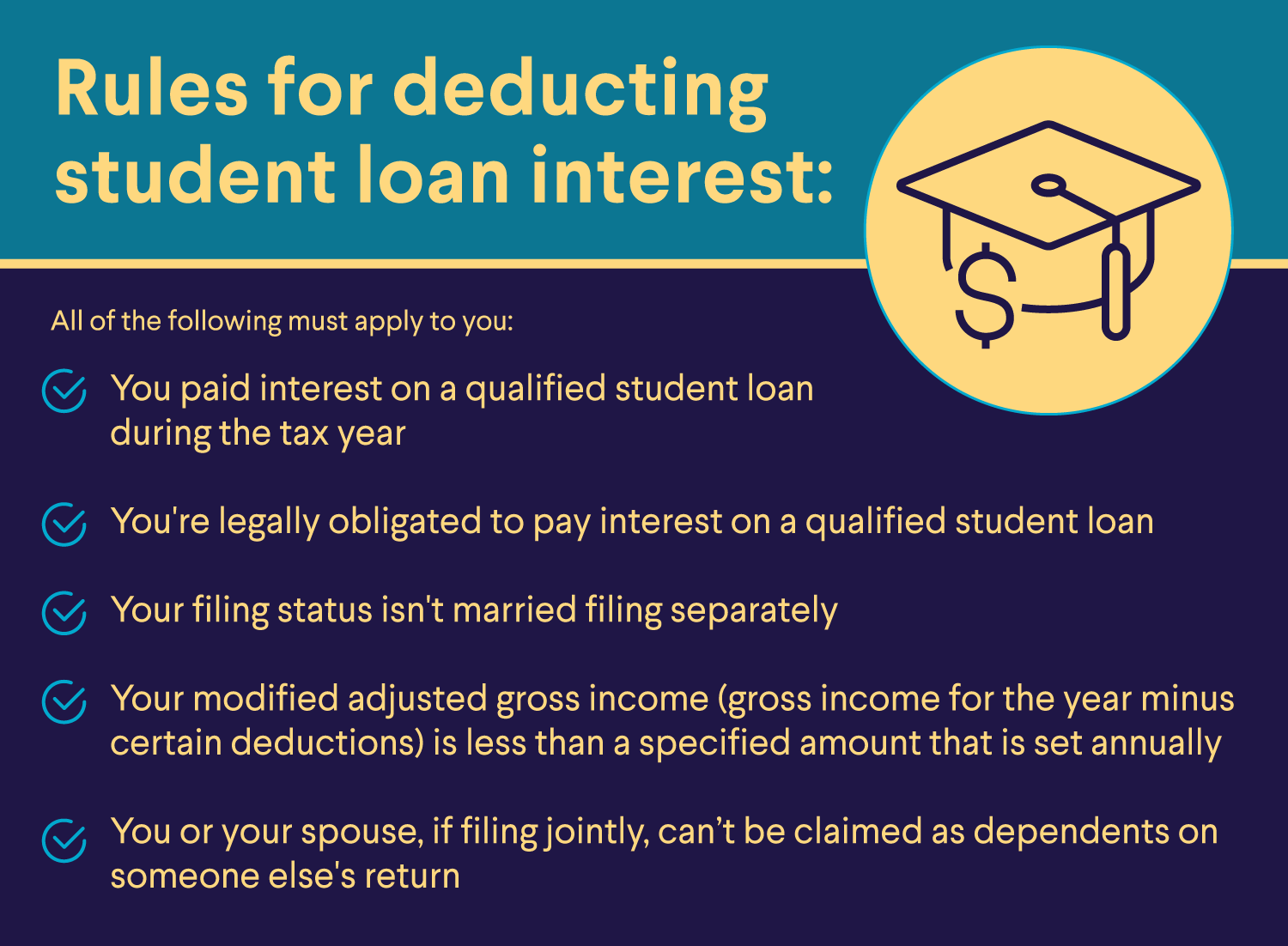
To be eligible to deduct student loan interest, individuals must meet the following requirements:

•   You paid interest on a qualified student loan (a loan for you, your spouse, or a dependent) during the tax year.

•   Your modified adjusted gross income (MAGI) is less than a specified amount that is set annually.

•   Your filing status is anything except married filing separately.

•   Neither you nor your spouse can be claimed as a dependent on someone else’s return.

•   You are legally required to pay the interest on a student loan.

The student loans in question can be federal or private student loans, as well as refinanced student loans.

What Are the Income Requirements for the Student Loan Tax Deduction?

The income requirements for the student loan tax deduction depend on your MAGI and your tax-filing status. The eligible MAGI ranges are typically recalculated annually.

For tax year 2024 (filing in 2025), the student loan interest deduction is worth up to $2,500 for a single filer, head of household, or qualifying widow/widower with a MAGI of $80,000 or less.

For those who exceed a MAGI of $80,000, the deduction begins to phase out. Once their MAGI reaches $95,000 or more, they are no longer able to claim the deduction.

For married couples filing jointly, the phaseout begins with a MAGI of more than $165,000, and eligibility ends at $195,000.

If you have questions about your eligibility, consider consulting a tax professional to make sure you can take advantage of the deduction.

When we say no required fees we mean it.
No late fees, & insufficient fund
fees when you take out a student loan with SoFi.


Other Tax Deductions for Students

In addition to the student loan interest rate deduction, there are other tax breaks that may be available to you if you’re a student, saving for college or paying for certain education expenses for yourself, a spouse, or a dependent. Here are three other tax benefits to consider:

529 Plans

A 529 college savings plan is a tax-advantaged plan that allows you to save for qualified education expenses — like tuition, lab fees, and textbooks — for yourself or your children. In 2025, you can contribute up to $19,000 per year without triggering gift taxes, and other family members can contribute to the fund, as well.

Savings can be invested and grow tax free inside the account. And while the federal government doesn’t offer any tax deductions, some states provide tax benefits like deductions from state income tax. Withdrawals must be used to cover qualified expenses; otherwise you will face income taxes and a 10% penalty.

American Opportunity Tax Credit

The American Opportunity Tax Credit (AOTC) helps offset $2,500 in qualified education expenses per student per year for the first four years of higher education. Unlike a tax deduction, tax credits reduce your tax bill on a dollar-for-dollar basis. And if the credit brings your taxes to zero, 40% of whatever remains of the credit amount can be refunded to you, up to $1,000.

To be eligible for the AOTC, you must be getting a degree or another form of recognized education credential. And at the beginning of the tax year, you must be enrolled in school at least half time for one academic period, and you cannot have finished your first four years of higher education at the beginning of the tax year.

Lifetime Learning Credit

The Lifetime Learning Credit (LLC) helps pick up where the AOTC leaves off. While the AOTC only lasts for four years, the LLC helps offset the expense of graduate school and other continuing educational opportunities. The credit can help pay for undergraduate and graduate programs, as well as professional degree courses that help you improve your job skills. The credit is worth $2,000 per tax return, and there is no limit to the number of years you can claim it. Unlike the AOTC, it is not a refundable tax credit.

To be eligible, you, a dependent, or someone else must pay qualified education expenses for higher education or pay for the expenses of an eligible student and an eligible educational institution. The eligible student must be yourself, your spouse or a dependent that you have listed on your tax return.

Look for Form 1098-E

If you’re wondering how to get the student loan interest deduction, keep an eye out for Form 1098-E, which you will need to file with your tax return. It will be sent out by your loan servicer or lender if you paid at least $600 in interest on your student loans for the tax year in question.

On Form 1098-E, your loan provider reports information on the interest you paid on your student loans throughout the year. The form goes out to student loan borrowers when the tax year ends, typically by mid-February. You can also check for the form on your loan servicer’s website and download a copy.

Note that you won’t receive this student loan tax form if you paid less than $600 in interest on your loan during the tax year.

Calculating Your Student Loan Interest Deduction

To figure out how much of a student loan interest deduction you can claim, start with your MAGI. If your MAGI is in the range to qualify for the full deduction, you’ll be eligible for $2,500 or the amount you paid in interest on your student loans during the tax year, whichever amount is less. (As you are calculating your MAGI, if you’re wondering, do student loans count as income, no, they do not.)

However, if your MAGI falls into the range where student interest deduction is reduced (which is more than $80,000 for single filers and $165,000 for joint filers in 2024), you can generally follow the instructions on the student loan interest deduction worksheet in Schedule 1 of Form 1040 to figure out the amount of your deduction when filing your federal income taxes. Then you can enter the calculated interest amount on Schedule 1 of the 1040 under “Adjustments to Income.”

One thing to note: For loans made before September 1, 2004, loan origination fees and/or capitalized interest may not be included in the amount of interest Form 1098-E says you paid. In this case, Box 2 on the form will be checked. If that applies to you, to calculate the full value of the interest deduction, start with the amount of interest the form says you paid, and then add any interest you paid on qualified origination fees and capitalized interest. Just make sure these amounts don’t add up to more than the total you paid on your student loan principal.

You can consult IRS Publication 970 for more information about how to do this, or consult a tax professional.

Common Mistakes to Avoid

Taking the student loan interest deduction can be somewhat complicated because there are a number of requirements involved. These are some common mistakes to watch out for.

•   Misreporting your income. Be sure to calculate your modified adjusted gross income (MAGI) correctly. It’s critical to use the right MAGI when determining if you are eligible for the student loan interest deduction and how much you can claim.

•   Deducting too much. The deduction is capped at $2,500 a year, no matter how much you paid in interest.

•   Deducting interest paid by someone else. If another person made some of your student loan payments for you — your parents, say — you cannot deduct the interest they paid. You can only deduct the interest you paid.

•   Failing to take the deduction. If you are eligible for the student loan interest deduction, be sure to take it. It can sometimes be easy to overlook this deduction in the hustle to get your tax information together.

Strategies to Reduce Student Loan Payments and Interest

Tax credits and deductions are one way to help cover some of the cost of school. Finding ways to lower your student loan payments is another cost-saving measure. Here are a few potential ways to do that.

•   Put money toward student loans by making additional payments to pay down your principal. Doing this may help reduce the amount of interest you owe over the life of the loan. Just make sure your loan does not have any prepayment penalties.

•   Make interest-only payments while you’re still in school on loans for which interest accrues, such as unsubsidized federal loans.

•   Find out if your loan provider offers discounts if you set up automatic payment. Federal Direct Loan holders may be eligible for a 0.25% discount when they sign up for automatic payments, for example.

•   Consider refinancing student loans. When you refinance, you replace your current student loan with a new loan that ideally has a lower interest rate or more favorable terms.

While there are advantages of refinancing student loans, such as possibly lowering your monthly payments, there are disadvantages as well. One major caveat: If you refinance federal loans, they are no longer eligible for federal benefits or protections. Also, you may pay more interest over the life of the loan if you refinance with an extended term. Weigh the options to decide if refinancing is right for you.

The Takeaway

Qualified student loan borrowers can take a student loan interest deduction of up to $2,500 annually. This applies to federal and private student loans as well as refinanced student loans.

You should get a form 1098-E from your loan servicer if you paid at least $600 in interest on your qualified student loans. Before you file for the deduction, make sure you qualify for it, and then figure out whether you are eligible for a full or partial deduction, based on your MAGI.

Whether you qualify for the student loan interest deduction or not, there are a number of ways to lower your monthly student loan payments, including putting additional payments toward your loan principal, signing up for automatic payments, and refinancing your student loans.

Looking to lower your monthly student loan payment? Refinancing may be one way to do it — by extending your loan term, getting a lower interest rate than what you currently have, or both. (Please note that refinancing federal loans makes them ineligible for federal forgiveness and protections. Also, lengthening your loan term may mean paying more in interest over the life of the loan.) SoFi student loan refinancing offers flexible terms that fit your budget.

With SoFi, refinancing is fast, easy, and all online. We offer competitive fixed and variable rates.

FAQ

How much student loan interest can I deduct?

The amount of student loan interest you can deduct is the lesser of up to $2,500 annually or the amount of interest you paid on your student loans. However, to qualify for the full deduction in 2024, you must have a MAGI of $80,000 or less if you are a single filer, or $165,000 or less if you are filing jointly. You will be eligible for a partial deduction if your MAGI is less than $95,000 for single filers and less than $195,000 for joint filers. Keep in mind that the MAGI limits typically change yearly.

Do I need to itemize my deductions to claim the student loan interest deduction?

No, you do not need to itemize your deduction to claim the student loan interest deduction. The deduction is considered an adjustment to your income, according to the IRS, so there is no need to itemize. You can simply report the amount on Form 1040 when you file your taxes, and include a copy of your Form 1098-E, which shows the student loan interest you paid for the tax year.

Can parents deduct student loan interest if they pay for their child’s loans?

Parents who pay for their child’s student loans can deduct student loan interest only if they are legally obligated to repay the loan — meaning that the loan is in their name or they are a cosigner of the loan. However, if the loan is in the child’s name only, parents cannot take the deduction, even if they paid for their child’s loans. The rules can be confusing, so parents may want to consult a tax professional.

What happens if I refinance my student loans?

Refinanced student loans are eligible for the student loan tax deduction as long as the refinanced loan was used for qualified education expenses and your MAGI falls within the set limits.

Are private student loans eligible for the student loan interest deduction?

Yes, private student loans are eligible for the student loan tax deduction, as are federal loans and refinanced loans. As long as you paid interest on a qualified student loan, your MAGI is less than the specified limit for the year, your filing status is anything except married and filing separately, and you (or your spouse if applicable) can’t be claimed as a dependent on someone else’s return, you are eligible for the deduction as a private student loan borrower.


SoFi Student Loan Refinance
Terms and conditions apply. SoFi Refinance Student Loans are private loans. When you refinance federal loans with a SoFi loan, YOU FORFEIT YOUR ELIGIBILITY FOR ALL FEDERAL LOAN BENEFITS, including all flexible federal repayment and forgiveness options that are or may become available to federal student loan borrowers including, but not limited to: Public Service Loan Forgiveness (PSLF), Income-Based Repayment, Income-Contingent Repayment, extended repayment plans, PAYE or SAVE. Lowest rates reserved for the most creditworthy borrowers.
Learn more at SoFi.com/eligibility. SoFi Refinance Student Loans are originated by SoFi Bank, N.A. Member FDIC. NMLS #696891 (www.nmlsconsumeraccess.org).

SoFi Loan Products
SoFi loans are originated by SoFi Bank, N.A., NMLS #696891 (Member FDIC). For additional product-specific legal and licensing information, see SoFi.com/legal. Equal Housing Lender.


Third-Party Brand Mentions: No brands, products, or companies mentioned are affiliated with SoFi, nor do they endorse or sponsor this article. Third-party trademarks referenced herein are property of their respective owners.

Non affiliation: SoFi isn’t affiliated with any of the companies highlighted in this article.

Tax Information: This article provides general background information only and is not intended to serve as legal or tax advice or as a substitute for legal counsel. You should consult your own attorney and/or tax advisor if you have a question requiring legal or tax advice.

Financial Tips & Strategies: The tips provided on this website are of a general nature and do not take into account your specific objectives, financial situation, and needs. You should always consider their appropriateness given your own circumstances.

Third Party Trademarks: Certified Financial Planner Board of Standards Center for Financial Planning, Inc. owns and licenses the certification marks CFP®, CERTIFIED FINANCIAL PLANNER®

External Websites: The information and analysis provided through hyperlinks to third-party websites, while believed to be accurate, cannot be guaranteed by SoFi. Links are provided for informational purposes and should not be viewed as an endorsement.

SOSLR-Q225-053

Read more
TLS 1.2 Encrypted
Equal Housing Lender