
Wire cutters cutting through exposed electrical cable, symbolizing home electrical repair or rewiring work.

What Is the Cost to Rewire a House?

Updating the wiring in a house could cost between $6 and $10 per square foot, but keeping old wiring could have disastrous consequences. Electrical issues are the third most common cause of house fires in the United States. Modern technology also may demand rewiring a house. Powering multiple electronic devices, having adequate interior and exterior lighting, and heating and cooling a home to today’s standards are difficult if a home’s electrical system is not up to the task. Given all this, rewiring is a common way to upgrade your home. Let’s explore what’s involved and how much is it to rewire a house.

Key Points

•   Rewiring costs for a house typically range from $6 to $10 per square foot.

•   A 1,300-square-foot house may cost between $7,800 and $13,000 to rewire.

•   Rewiring a 2,500-square-foot home could range from $15,000 to $25,000.

•   Factors influencing rewiring costs include house size, age, work extent, materials used, and wiring access.

•   Older and larger homes often require more extensive rewiring, increasing the overall cost.

Factors That Affect the Cost to Rewire a House

Rewiring a home involves removing the outdated wiring inside a home’s walls and installing new, modern wiring that can safely meet today’s electrical needs.

Rewiring is typically done by a licensed electrician who strips out the old wiring and runs new wiring throughout the entire house, installs a new circuit breaker panel to handle the load of the new wiring system, and ensures that building codes are met.

It can be a big job — and an expensive one, too. Let’s look at some common factors that can impact the total cost.

Size of the House

The bigger the home, the more materials and labor the job will likely require. And that can drive up the price. Rewiring a 1,300-square-foot house, for instance, runs around $7,800 to $13,000. For a 2,500-square-foot home, you can expect to pay between $15,000 to $25,000.

House’s Age

Older homes weren’t constructed with 21st century living in mind, so a rewiring project will likely cost more. Common necessities like opening a wall to reach out-of-the-way wiring ($4-$8 per square foot), upgrading outdated wiring ($200-$2,300), and replacing an electrical outlet ($125-$200) can all add to the price tag.

Extent of Work Needed

Small-scale projects are typically cheaper than larger, more complex ones. If you’re planning to set up a new alarm system, run wiring to a backyard shed, or upgrade the electric panel, you’ll likely need to adjust your budget accordingly.

Type of Wiring and Materials Used

The average cost to rewire a house is just that: average. And your own house rewire costs will vary based on the materials used in the job. Below we’ll get into the details of how different materials can affect your job costs.

Local Labor Rates and Permit Requirements

If you’re in a high cost of living area, you can expect hourly rates for electricians, drywall repair, and painting to be above national averages. This, too, will affect the cost of your job.

Recommended: How to Find a Contractor for Home Remodeling

Signs You Need to Rewire a Home

Flickering lights, outlets making a popping sound, or tripped breakers indicate that a home might need to be rewired. When buying an older home, a home inspection typically reveals if rewiring is recommended or necessary.

Even before a professional inspection, prospective homebuyers may be able to get a good idea of how the home is wired by peeking into the attic, basement, or crawl space.

Vintage charm does not extend to knob and tube wiring, which was common through the mid-1900s. The lack of a ground wire is seen as a significant fire hazard, and most carriers will deny homeowners insurance for a home that has knob and tube electrical wiring.

Another way to check for outdated wiring is to find the electrical panel and see if it has modern breaker switches or round fuses. The fuses indicate that the system is outdated, and rewiring the house might be recommended.

In almost every state, home sellers must disclose defects, but cautious buyers may still want to include the inspection contingency in the purchase contract.

If you’re living in a home with older wiring and notice that your circuit breakers trip often, lights flicker, the light switches feel warm to the touch, or there is a burning smell coming from an outlet, it’s time to schedule an appointment with an electrician and explore house rewire costs. Get ready to encounter one of the more common home repair costs
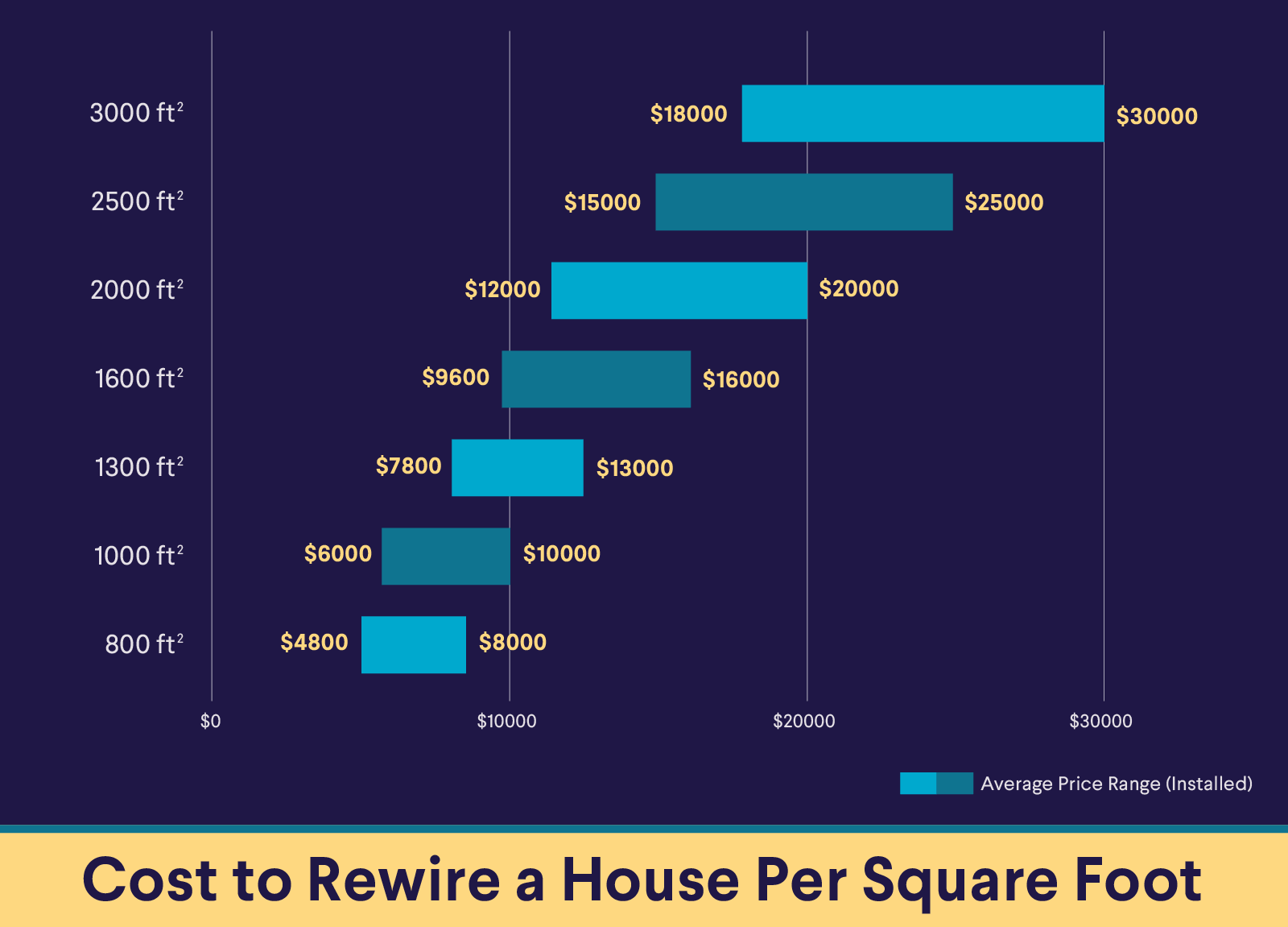
Cost to Rewire a House Per Square Foot

What’s Involved in the Rewiring Process?

Rewiring a house can be a costly endeavor in part because it is a complex process. After all, most of those wires are inside your walls. Depending on the extent of the job, rewiring could involve any or all of the following: Replacing or adding circuits; running new wire through walls, ceiling, and floors; replacing (and potentially adding) outlets and switches; installing ground fault circuit interrupters, which are often required by building codes in areas with potential exposure to moisture such as kitchens and bathrooms. After the work is done, the electrical contractor will test the system.

Filing for building permits before the work and managing an inspection once it is done will also likely be necessary. And in some jobs, an electrical service upgrade will be needed to bring more power to the home. This adds to cost and complexity.

Now let’s look more closely at how much does it cost to rewire a home based on the type of materials being used.

Cost to Rewire a House Per Material

The cost of rewiring a house depends on square footage and how easy or difficult it is to access the space. But the wiring and cable materials can also have an impact. Let’s take a look:

•   Used in most homes, nonmetallic (NM) cables are easy to install, flexible, and cost-effective. If you’re rewiring these cables, expect to pay between $0.40 and $0.80 per linear foot, according to Angi.

•   Underground feeder (UF) cables are similar to NM cables, except that they’re designed to go underground or in damp areas. Rewiring UF cables costs around $0.50 to $0.75 per linear foot.

•   Durable and able to handle high temperatures, THHN and THWN wires are often used in an unfinished space, like a basement, or for hot water heaters and garbage disposals. They cost $0.80 to $1.60 per linear foot to rewire.

•   Coaxial cables have high bandwidth support and are easy to install, which once made them a go-to choice for televisions and video equipment. Today, they’re more commonly used to connect cable or satellite TV signals or for internet connectivity. These cables cost around $0.25 to $0.35 per linear foot to rewire.

Updating a doorbell or thermostat? You’ll likely be working with low-voltage wires, which are used for circuits less than 50 volts. Rewiring typically costs between $0.25 and $0.35.

Copper vs. Aluminum Wiring

As you explore rewiring the house, you may find references to both aluminum and copper wire. If your home dates to the 1970s, it may have aluminum wiring, which was used often in that era because it was light and cheap. Unfortunately, it was also more prone than copper to oxidizing and expanding, which created hazards. Copper is the preferred material and what you will likely be upgrading to. Copper’s conductivity makes it highly efficient and a lower fire risk than aluminum.

Cost of Upgrading the Electrical Panel

If the wiring in your home is outdated, it is possible that your electrical panel will also need an update to provide the level of service necessary for the needs of a modern home. A basic panel upgrade can cost $2,000 to $4,000, with additional costs for a service upgrade requiring underground wiring, for example.

Additional Costs for Smart Home or Energy-Efficient Upgrades

These days, there are abundant add-ons for any wiring project. The universe of smart-home devices seems to be expanding exponentially. A basic smart-home upgrade for your home, often done alongside a rewiring job, might run you between $2,000 and $7,000. This would include installing a hub with a smart speaker and automated door locks, thermostat, and smart lighting in several rooms. If you go all in on a smart refrigerator and other gadgets, the price could climb as high as $16,000.

Recommended: How Much Is My House Worth?

Awarded Best Online Personal Loan by NerdWallet.
Apply Online, Same Day Funding


How to Cover Your House Rewiring Costs

Rewiring a home is not a small expense. Fortunately, there are several ways to pay for it. Here’s a look at some options.

Home Equity Loans

If you’ve built up equity in your home and are facing a major rewiring project, one possible solution is a home equity loan. There are three main types of home equity borrowing to consider: a fixed-rate home equity loan, a home equity line of credit (HELOC), and cash-out refinancing. All of these use your home as collateral, meaning that if you miss payments you could face foreclosure.

Each has its pros and cons. For instance, with a fixed-rate home equity loan, you receive a lump sum payment, which you’ll pay back over a period of time with a set interest rate.

A HELOC, on the other hand, is revolving debt. As the balance borrowed is paid down, it can be borrowed again during the draw period, which typically lasts 10 years. HELOCs tend to have a variable interest rate, so payments are less predictable.

With a cash-out refinance, you can refinance your mortgage for more than what you currently owe, and then take the difference in cash that you can use to cover your renovation.

Home Improvement Loans

A home improvement loan is a type of personal loan used to fund renovations and upgrades, including rewiring a house. Once your loan application is approved, you’ll receive a lump sum of cash, which you can use to pay for home improvements. You’ll repay the loan, with interest, in regular installments over the life of the loan — typically five to seven years.

These loans are unsecured, which means your home isn’t used as collateral. As a result, they often come with a higher interest rate than a home equity loan or HELOC.

💡 Quick Tip: Check out SoFi’s home improvement loan rates to explore competitive terms and find the right financing for your renovation needs.

Credit Cards

A credit card is a fast, easy way to fund a rewiring project, and it can be a good option if you’re able to pay off the balance on the card that month. Or look for a card with an introductory 0% annual percentage rate (APR), as this allows you anywhere from six to 18 months to pay back the balance with zero interest. But keep in mind that any balance left after the promotional period ends will start accruing the card’s regular APR.

Also watch for surcharges on credit card transactions. Many tradespeople charge fees for clients using credit cards, and these can quickly add a considerable sum to a larger project.

Government Assistance or Energy Efficiency Incentives

The U.S. Department of Energy provides tax credits and rebates for certain home energy projects, so it’s a good idea to check the DOE site to see what might be available when planning your project. Local governments and utility companies may also offer incentives if your project is considered energy efficient. The U.S. Department of Agriculture also provides grants and loans to qualified low-income households looking to make home improvements. And if you are purchasing a home that needs rewiring, you may be able to finance the purchase and renovation with an FHA 203(k) loan.

Cash

Depending on the scope of the project and your budget, you may decide to dip into your savings account or withdraw money from your emergency fund, if you have one, to cover the cost of rewiring a home.

As you create a budget and weigh your financing options, look for opportunities to save money. Research how much rewiring a house costs in your area, and include a cushion in your budget for unexpected expenses. If you’re not planning to tackle the job yourself, gather quotes from reputable licensed electricians in your area and see which one can offer you the best deal.

Finally, factor in the long-term costs and benefits. Although rewiring might seem cost-prohibitive when buying a single-family home, owners may find that the cost of rewiring a house — and the peace of mind the upgrade provides — can be money well spent.

Regardless of how you choose to pay for your rewiring job, it’s a good idea to track your home improvement costs, as these records may come in handy for tax purposes if you tackle home improvement projects to increase your home’s value before selling the property.

The Takeaway

At $6 to $10 per square foot, the cost of rewiring a house may seem high. But adequate electrical panels and modern wiring can amp up your home value and prevent fires. Wondering how you’re going to pay for it all? Home equity loans, savings, credit cards, and home improvement loans are all ways to pay for the average cost to rewire a house.

Think twice before turning to high-interest credit cards. Consider a SoFi personal loan instead. SoFi offers competitive fixed rates and same-day funding. See your rate in minutes.

SoFi’s Personal Loan was named a NerdWallet 2026 winner for Best Personal Loan for Large Loan Amounts.

FAQ

Is it worth rewiring an old house?

It’s not only worth rewiring an old house, it’s an important safety measure and a way of protecting your investment. Replacing outdated wiring can help prevent a house fire and add value to the property. Plus, updated, energy-efficient fixtures are sometimes included in a remodeling job of this scope, which can potentially lower utility costs.

How much does it cost to replace all the electrical wiring in a house?

According to the home services website Angi, home owners can expect to pay anywhere from $601 to $2,590 to rewire a house. However, if you have an older, larger home, you’ll likely pay closer to $6,000.

Can a house be rewired without removing drywall?

In many cases, at least some drywall or plaster will need to be removed during a rewiring project. But talk to your electrician to see if the work can be done without disrupting your walls.

What permits or inspections are needed to rewire a house?

All but the most minor electrical work typically requires a permit, although regulations are set locally so you’ll want to explore exactly what is required in your area. Rewiring a house is quite a big job and so any costs associated with permitting should be part of the electrician’s bid.

How long does it typically take to rewire a house?

Rewiring a house can take anywhere from a few days to a few weeks, depending on the size of the job. Angi reports an average time of three to 10 days, with longer times for older and larger houses. If rewiring is happening in the context of other renovations, such as an HVAC installation or plumbing work, you can expect it to take longer. Add additional time for replacing sheetrock or plaster that has been removed and repainting the affected area.


Photo credit: iStock/Dmitriev

SoFi Loan Products
SoFi loans are originated by SoFi Bank, N.A., NMLS #696891 (Member FDIC). For additional product-specific legal and licensing information, see SoFi.com/legal. Equal Housing Lender.


¹FHA loans are subject to unique terms and conditions established by FHA and SoFi. Ask your SoFi loan officer for details about eligibility, documentation, and other requirements. FHA loans require an Upfront Mortgage Insurance Premium (UFMIP), which may be financed or paid at closing, in addition to monthly Mortgage Insurance Premiums (MIP). Maximum loan amounts vary by county. The minimum FHA mortgage down payment is 3.5% for those who qualify financially for a primary purchase. SoFi is not affiliated with any government agency.
²SoFi Bank, N.A. NMLS #696891 (Member FDIC), offers loans directly or we may assist you in obtaining a loan from SpringEQ, a state licensed lender, NMLS #1464945.
All loan terms, fees, and rates may vary based upon your individual financial and personal circumstances and state.
You should consider and discuss with your loan officer whether a Cash Out Refinance, Home Equity Loan or a Home Equity Line of Credit is appropriate. Please note that the SoFi member discount does not apply to Home Equity Loans or Lines of Credit not originated by SoFi Bank. Terms and conditions will apply. Before you apply, please note that not all products are offered in all states, and all loans are subject to eligibility restrictions and limitations, including requirements related to loan applicant’s credit, income, property, and a minimum loan amount. Lowest rates are reserved for the most creditworthy borrowers. Products, rates, benefits, terms, and conditions are subject to change without notice. Learn more at SoFi.com/eligibility-criteria. Information current as of 06/27/24.
In the event SoFi serves as broker to Spring EQ for your loan, SoFi will be paid a fee.


Tax Information: This article provides general background information only and is not intended to serve as legal or tax advice or as a substitute for legal counsel. You should consult your own attorney and/or tax advisor if you have a question requiring legal or tax advice.

Disclaimer: Many factors affect your credit scores and the interest rates you may receive. SoFi is not a Credit Repair Organization as defined under federal or state law, including the Credit Repair Organizations Act. SoFi does not provide “credit repair” services or advice or assistance regarding “rebuilding” or “improving” your credit record, credit history, or credit rating. For details, see the FTC’s website .

Third Party Trademarks: Certified Financial Planner Board of Standards Center for Financial Planning, Inc. owns and licenses the certification marks CFP®, CERTIFIED FINANCIAL PLANNER®

This article is not intended to be legal advice. Please consult an attorney for advice.

External Websites: The information and analysis provided through hyperlinks to third-party websites, while believed to be accurate, cannot be guaranteed by SoFi. Links are provided for informational purposes and should not be viewed as an endorsement.
Third-Party Brand Mentions: No brands, products, or companies mentioned are affiliated with SoFi, nor do they endorse or sponsor this article. Third-party trademarks referenced herein are property of their respective owners.

SOPL-Q126-001

Read more

Conventional Loan Requirements

Conventional loans — mortgages that are not insured by the federal government — are the most popular type of mortgage and offer affordability to homebuyers.

Private mortgage lenders originate and fund conventional loans, which are then often bought by Fannie Mae and Freddie Mac, publicly traded companies that are run under a congressional charter.

By buying and selling these mortgages, Fannie and Freddie help to ensure a reliable flow of mortgage funding.

Key Points

•   Conventional loans in 2026 typically require a minimum FICO® score of 620, with better interest rates offered to those with higher scores.

•   A down payment of 20% is ideal to avoid PMI, but first-time homebuyers can qualify with as little as 3% down.

•   A borrower’s loan-to-value ratio and debt-to-income ratio are also important considerations for lenders.

•   Conventional loans above a certain amount set by the Federal Housing Finance Administration are considered nonconforming loans.

•   Conforming loan limits vary by location, with higher limits in high-cost areas.

Requirements for Conventional Loans

It can be confusing to know how to qualify for a mortgage.

Just realize, for one thing, that a higher credit score is usually required for a conventional home loan than for an FHA loan backed by the Federal Housing Administration, a type popular among first-time homebuyers.

Here are factors a lender will consider when sizing you up for a conventional loan.

Credit Score

You’ll usually need a FICO credit score of at least 620 for a fixed-rate or adjustable-rate mortgage.

The FICO score range of 300 to 850 is carved into these categories:

•   Exceptional: 800 to 850

•   Very Good: 740 to 799

•   Good: 670 to 739

•   Fair: 580 to 669

•   Poor: 300 to 579

In general, the higher your credit score, the better the interest rate you’ll be offered.

Down Payment

Putting 20% down is desirable because it means you can avoid paying for PMI, or private mortgage insurance, which covers the lender in case of loan default.

But many buyers don’t put 20% down. The median down payment on a home for first-time buyers is 10%, according to a recent study by the National Association of Realtors®.

Conventional loans require as little as 3% down for first-time homebuyers, and the down payment can be funded by a gift from a close relative; a spouse, fiancé or domestic partner; a buyer’s employer or church; or a nonprofit or public agency. The gift may require a gift letter for the mortgage.

Just keep in mind that the smaller the down payment, the higher your monthly payments are likely to be, and PMI may come along for the ride until you reach 20% equity.

First-time homebuyers can
prequalify for a SoFi mortgage loan,
with as little as 3% down.

Questions? Call (888)-541-0398.

Debt-to-Income Ratio

Your debt-to-income (DTI) ratio helps a lender understand your ongoing monthly debt obligations relative to your gross monthly income.

To calculate back-end DTI:

1.    Add up your monthly bills (but do not include groceries, utilities, cellphone bill, car insurance, and health insurance).

2.    Divide the total by your pretax monthly income.

3.    Multiply by 100 to convert the number to a percentage.

In general, lenders like to see a DTI ratio of 36% but will accept 43%.

The Fannie Mae HomeReady® loan, for lower-income borrowers, may allow a DTI ratio of up to 50%.

In any case, the lower your DTI ratio, the more likely you are to qualify for a mortgage and possibly better terms.

Loan-to-Value Ratio

The loan-to-value ratio (LTV) is the amount of the mortgage you are applying for compared with the home value. The higher the down payment, the lower the LTV ratio.

Fannie Mae typically sets LTV limits at 97% for a fixed-rate mortgage for a principal residence (think: 3% down) and 85% for a fixed-rate or adjustable-rate loan for a one-unit investment property.

When LTV exceeds 80% on a conforming loan, PMI will likely apply, although some borrowers employ a piggyback loan to avoid mortgage insurance.

Conventional Conforming Loan Limits

Many loans are both conventional and conforming — meaning they meet the guidelines of secondary mortgage market powerhouses Fannie Mae and Freddie Mac, which buy such mortgages and often package them into securities for investors.

Conventional conforming loans fall below limits set by the Federal Housing Finance Agency (FHFA) every year. Staying under a conforming loan limit often equates to a lower-cost mortgage because the loan can be acquired by Fannie and Freddie.

The conforming loan limits for 2026 in many counties in the contiguous states, Washington, D.C., and Puerto Rico rose with market prices:

•   One unit: $832,750

•   Two units: $1,066,250

•   Three units: $1,288,800

•   Four units: $1,601,750

In high-cost areas like Alaska, Hawaii, Guam, and the U.S. Virgin Islands, the 2026 conforming loan limits are:

•   One unit: $1,249,125

•   Two units: $1,599,375

•   Three units: $1,933,200

•   Four units: $2,402,625

If you’re curious about your county’s specific conforming loan limits, you can check out this FHFA guide.

Nonconforming Loans

Word games, anyone? Nonconforming loans are simply mortgages that do not meet Fannie and Freddie standards for purchase. They usually take the form of jumbo loans and government-backed loans.

A homebuyer or refinancer who needs a mortgage beyond the FHFA limits can seek a jumbo mortgage loan. A jumbo loan is still a conventional loan if it’s not backed by a government agency; it’s just considered a “nonconforming” loan.

FHA, VA, and USDA mortgages — those backed by the Federal Housing Administration, Department of Veterans Affairs, and the U.S. Department of Agriculture — are also nonconforming loans.

Nonconforming mortgage rates for jumbo loans may be higher because the loans carry greater risk for lenders, but when the nonconforming loan is backed by the government, its rate might skew lower than conventional conforming rates.

The Takeaway

Conventional loan requirements are good to know when you’re looking at the most popular type of mortgage around. Would-be homebuyers will want to make sure their credit score, debt-to-income ratio, and down payment numbers are lined up as favorably as possible before pursuing their dream property.

Looking for an affordable option for a home mortgage loan? SoFi can help: We offer low down payments (as little as 3% - 5%*) with our competitive and flexible home mortgage loans. Plus, applying is extra convenient: It's online, with access to one-on-one help.

SoFi Mortgages: simple, smart, and so affordable.

FAQ

Are there any drawbacks to a conventional loan?

The main drawback to a conventional loan is that you will need to make some type of down payment on the property. It doesn’t need to be the 20% down payment that was common in decades past. But even a low down payment of, say, 3.5% could add up to tens of thousands of dollars given today’s home prices.

What’s the main reason I might not qualify for a conventional loan?

The most common reason someone might not qualify for a conventional home loan is usually related to credit — perhaps the applicant has a credit score below 620, or maybe there is some other significant warning sign on the credit report, such as a history of delinquencies or bankruptcy.

SoFi Loan Products
SoFi loans are originated by SoFi Bank, N.A., NMLS #696891 (Member FDIC). For additional product-specific legal and licensing information, see SoFi.com/legal. Equal Housing Lender.

SoFi Mortgages
Terms, conditions, and state restrictions apply. Not all products are available in all states. See SoFi.com/eligibility-criteria for more information.


*SoFi requires Private Mortgage Insurance (PMI) for conforming home loans with a loan-to-value (LTV) ratio greater than 80%. As little as 3% down payments are for qualifying first-time homebuyers only. 5% minimum applies to other borrowers. Other loan types may require different fees or insurance (e.g., VA funding fee, FHA Mortgage Insurance Premiums, etc.). Loan requirements may vary depending on your down payment amount, and minimum down payment varies by loan type.
Third-Party Brand Mentions: No brands, products, or companies mentioned are affiliated with SoFi, nor do they endorse or sponsor this article. Third-party trademarks referenced herein are property of their respective owners.
External Websites: The information and analysis provided through hyperlinks to third-party websites, while believed to be accurate, cannot be guaranteed by SoFi. Links are provided for informational purposes and should not be viewed as an endorsement. ¹FHA loans are subject to unique terms and conditions established by FHA and SoFi. Ask your SoFi loan officer for details about eligibility, documentation, and other requirements. FHA loans require an Upfront Mortgage Insurance Premium (UFMIP), which may be financed or paid at closing, in addition to monthly Mortgage Insurance Premiums (MIP). Maximum loan amounts vary by county. The minimum FHA mortgage down payment is 3.5% for those who qualify financially for a primary purchase. SoFi is not affiliated with any government agency. Veterans, Service members, and members of the National Guard or Reserve may be eligible for a loan guaranteed by the U.S. Department of Veterans Affairs. VA loans are subject to unique terms and conditions established by VA and SoFi. Ask your SoFi loan officer for details about eligibility, documentation, and other requirements. VA loans typically require a one-time funding fee except as may be exempted by VA guidelines. The fee may be financed or paid at closing. The amount of the fee depends on the type of loan, the total amount of the loan, and, depending on loan type, prior use of VA eligibility and down payment amount. The VA funding fee is typically non-refundable. SoFi is not affiliated with any government agency. Third Party Trademarks: Certified Financial Planner Board of Standards Center for Financial Planning, Inc. owns and licenses the certification marks CFP®, CERTIFIED FINANCIAL PLANNER®
Checking Your Rates: To check the rates and terms you may qualify for, SoFi conducts a soft credit pull that will not affect your credit score. However, if you choose a product and continue your application, we will request your full credit report from one or more consumer reporting agencies, which is considered a hard credit pull and may affect your credit.

SOHL-Q126-022

Read more
Wooden framing and drywall clutter an attic room with a peaked ceiling that is being remodeled into usable space.”

Can You Use a Construction Loan to Complete Renovations?

Renovations can improve your home and increase its value. But as any seasoned homeowner will tell you, those projects can be expensive. If you can’t afford to cover the costs out of pocket, you may wonder if a construction loan is right for you. While it is an option, there are complications that people should be aware of, as well as other home loans for renovations that might be a better fit.

Let’s take a look at construction loans, their requirements, and some alternatives to consider.

Key Points

•  Construction loans finance new home builds or major renovations, covering various costs.

•  Funds are released in stages, with interest-only payments on received amounts.

•  Lenders require a low debt-to-income ratio, high credit score, and may require a 20% down payment.

•  Benefits include covering all construction expenses, flexible terms, and potential savings.

•  Alternatives like personal loans and cash-out refinances offer lower interest rates and flexible repayment.

What a Construction Loan Is and How it Works

Construction loans finance the building of a new home or substantial renovations to a current home. They are typically short-term loans with higher interest rates, designed to cover the costs of land, plans, permits and fees, labor, materials, and closing costs. They can also provide a contingency reserve if construction goes over budget.

With a construction loan for home renovation or a new build, applicants must submit project plans and schedules along with their financial information as part of the qualification process. We’ll get into that in more detail below.

How Funds Are Disbursed During the Project

Once approved for a construction loan for a remodel or new build, a homeowner receives funding for the first phase of the project only, rather than a lump sum. As construction progresses, assessments are provided to the lender so that the next round of funds can be released. Meanwhile, borrowers make interest-only payments on the funds they’ve received.

When construction is finished — and the borrower now has a home to serve as collateral — the construction loan may be converted to or paid off by a regular mortgage. The borrower then begins repaying both the principal and interest.

Eligibility Requirements and Typical Terms

The formal application process for a construction loan involves submitting plans and specifications for the proposed building. Your builder will need to provide blueprints, estimated costs, and a schedule for the project. With a typical home mortgage loan the back-and-forth is between you and the lender; in a construction loan the builder or contractor will also play a key role, supplying important supporting documents.

As with a typical mortgage, the lender will scrutinize the borrower’s credit score (680 or above is ideal) and debt-to-income ratio, and you can expect to be asked to provide proof of income. A down payment of 20% is often required for a construction loan — after all, the lender is loaning money against collateral that doesn’t entirely exist yet.

Recommended: Home Maintenance Checklist

Renovation Loans vs. Construction Loans: What’s the Difference?

Though renovation loans and construction loans can be used for similar purposes, there are important differences to know. Let’s take a closer look at both types of loans.

Renovation Loans

Unlike other types of home improvement loans, a renovation loan takes into account the property’s after-repair value, which is an estimation of the home’s value once the improvements are made. This can be good news for borrowers, especially those buying a fixer-upper. That’s because they may be able to secure a larger loan amount than they would with a traditional mortgage based on the home’s current value.

What’s more, renovation loans often come with lower interest rates than credit cards and unsecured personal loans.

Some common types of lending for renovations include:

•  Government-sponsored loans, such as the FHA 203(k) home loan, Freddie Mac’s CHOICERenovation loan, and Fannie Mae’s HomeStyle renovation loan. Each type has its own rules and requirements.

•  VA renovation loans, which are available to eligible veterans and active-duty military personnel.

It’s also possible to use a home equity loan or home equity line of credit for renovations. More on that below.

Construction Loans

As we mentioned, a construction loan is commonly used to pay for building a brand-new home. In some cases, the loan can be converted to a mortgage after your home is finished. However, getting one can be more challenging than securing a conventional mortgage.

Lenders generally want to see a debt-to-income ratio of 45% or lower and a high credit score, and you may be required to make a down payment of at least 20%. Depending on the type of construction loan you apply for, you may also be required to provide a detailed plan, budget, and schedule for the construction. Some lenders will also need to approve your builder.

There are different types of construction loans to consider:

•  Construction-to-permanent loans, or single-close loans, which converts to a mortgage once the project is finished. The borrower saves money on closing costs by eliminating a second loan closing.

•  Construction-only loans, or standalone construction loans, which must be paid off when the building is complete. You will need to apply for a mortgage if you don’t have the cash to do so.

•  Renovation construction loans, which are designed to cover the cost of substantial renovations on an existing home. The loan gets folded into the mortgage once the project is complete.

Awarded Best Online Personal Loan by NerdWallet.
Apply Online, Same Day Funding


Pros and Cons of Using a Renovation Loan

As you explore different home improvement loans, consider the following pros and cons of renovation loans.

Pros

•  Borrowers may have access to substantial funds that can pay for major upgrades or repairs.

•  Money can be used for a wide variety of renovation projects.

•  The loan amount is based on the home’s projected value after the repairs and renovations are complete.

•  Interest rates tend to be lower than what you’d be offered with an unsecured loan or credit card.

Cons

•  You may be required to use your home as collateral.

•  As with any loan, you’ll need to meet certain eligibility requirements, such as a good credit score, low debt-to-income ratio, and proof of income and employment.

•  A renovation loan increases your debt load, which could put a strain on your finances.

Recommended: Home Inspection Checklist

Pros and Cons of Using a Construction Loan

There are advantages and disadvantages to consider before taking out remodeling construction loans to fund renovations.

Pros

•  Funds can be used to cover all construction expenses.

•  Borrowers can use equity from other investments as collateral.

•  Loan requirements are generally focused on the construction process instead of a borrower’s credit profile.

•  Borrowers may only need to make interest payments during construction.

•  Loan terms may be more flexible than a traditional loan.

Cons

•  Funds are released as work progresses instead of in one lump sum.

•  It can be difficult to find lenders that offer competitive rates and to qualify for them — particularly if you don’t have a flawless credit history.

•  Loans tend to be short-term and must be paid in full at the end of the term.

•  May need to provide extensive documentation on the construction process in order to get approved.

•  If construction is delayed, you may need to ask the lender for an extension on the loan. This can cause interest rates and fees to accumulate.

When to Use a Renovation Loan vs. a Construction Loan

The key to knowing when to use a renovation loan vs. a construction loan is written right in the names of these financial tools. If you’re building a home, a construction loan will be necessary. But if you are substantially renovating a home, a renovation loan might be just the ticket. It’s not your only option, however, and there are less complicated ways to finance small- or medium-size renovations.

Alternative Ways to Finance Home Renovations

If you are planning a small construction project or renovation, there are a few financing alternatives that might be easier to access and give you more flexibility. Here’s a look at home equity loan vs. HELOCs vs. home improvement loans.

Personal Loans for Renovations

An unsecured personal loan can fund a renovation project or supplement other construction financing.

Personal loan interest rates are typically lower than construction loan rates, depending on your financial profile. And you can frequently choose a personal loan with a fixed interest rate.

Personal loans also offer potentially better terms. Instead of being required to pay off the loan as soon as the home is finished, you can opt for a longer repayment period. And applying for a personal loan and getting approved can be much faster and easier than for a construction loan.

The drawbacks? You won’t be able to roll your personal loan into a mortgage once your renovation or building project is finished.

And because the loan is disbursed all at once, you will have to parse out the money yourself, instead of depending on the lender to finance the build in stages.

Cash-Out Refinance for Construction Costs

A cash-out refinance is also a good financing tool, particularly if you have a lot of equity in your current home. With a cash-out refinance, you refinance your home for more than you owe and are given the difference in cash.

You can estimate your building or renovation expenses with this Home Improvement Cost Calculator. Add your estimate to what you owe on your home to get the amount of your refinance.

Home Equity Loans and HELOCs

Both a home equity loan and a home equity line of credit (HELOC) allow you to borrow funds based on your home equity to use for any purpose you wish. Your home serves as collateral. This means that if you fail to repay what you borrow, with interest, the lender could foreclose. The good news, though, is that because the lending is secured by your home, interest rates are often pretty attractive.

Home equity loans are lump-sum loans, typically with a fixed interest rate. So your monthly payment remains the same for the full repayment term, which could be up to 30 years.

A HELOC is a credit line. You can draw against it as needed, up to the maximum you are allowed. For the first five or ten years, you often don’t have to repay the principal — you can just pay interest. Interest on HELOCs is more likely to be a variable rate, so payments can be somewhat unpredictable. After the initial “draw” period you have to stop borrowing and you begin to repay what you have borrowed, with interest.

Grants or Government Programs for Certain Renovations

FHA loans and VA loans aren’t the only government programs that can help fund renovations. There may be grants or loans available from government or nonprofit sources, depending on your specific renovation project and your personal circumstances. Check your local government web site for more information about programs in your local area. There are often programs specifically for older adults, Native Americans, and those in rural areas. If your renovations might make your home more energy efficient, also check in with your local power company.

Using Savings or Cash for Smaller Projects

Remember that if your renovations aren’t a big production, you may be able to earmark savings for them, if the repairs aren’t urgent and you are willing to be patient and save up the money. Flexing your savings muscle is a good idea even if you are financing some or all of the work. “When budgeting for a remodel, it can be helpful to have a dedicated fund for renovation expenses. This can help you allocate the appropriate amount of money,” says Brian Walsh, CFP® and Head of Advice & Planning at SoFi.

The Takeaway

Planning a new home or substantial renovation? There are several ways to pay for the projects. One option is a renovation loan, which lets you pay for major (and minor) renovations without having to dip into your personal savings. Another option is a construction loan, which typically covers the entirety of new construction expenses. For smaller projects, a personal loan can be a good option — and a lot less complicated.

Think twice before turning to high-interest credit cards. Consider a SoFi personal loan instead. SoFi offers competitive fixed rates and same-day funding. See your rate in minutes.


SoFi’s Personal Loan was named a NerdWallet 2026 winner for Best Personal Loan for Large Loan Amounts.

FAQ

Can you use a construction loan for renovations on an existing home?

It is possible to use a construction loan to fund renovations on an existing home, but it may not be the easiest way to borrow for your renovation. That said, if you need a very large sum and are planning to work with a builder or contractor who can help provide plans and other supporting documents, it is doable.

Can you convert a construction loan to a regular mortgage after renovations are complete?

It is possible to either convert a construction loan to a typical mortgage or take out a mortgage to pay off a construction loan. Explore what your options will be before you sign on to a construction loan with a lender.

Do you need equity in your home to qualify for a renovation or construction loan?

Lenders who fund renovation or construction loans often like to see that a homeowner has a significant amount of equity — sometimes 20% or more — before financing the work. The exception would be for an FHA 203(k) loan. If you have a credit score of 580 or better, you may be able to fund a renovation with an FHA loan even if you have just 3.5% equity. A score from 500 to 579 will require 10% equity.

How do inspections and draw schedules work with construction loans?

In the application stage of your construction loan, you will (with your builder or contractor’s help) submit a schedule with certain milestones that correspond to stages of funding of your loan. As your project reaches each milestone, the project manager, builder, or you will report in to the lender. It’s not just a casual phone call: Your draw request (the process of drawing down your loan) will require documentation, and an inspector may come out to review the work. Once all this is completed and the lender is satisfied, the lender will send the funds.

What are some alternatives if I don’t qualify for a construction or renovation loan?

If you don’t qualify for a construction loan for renovation or a government-backed renovation loan such as an FHA 203(k) loan, you might look into a personal loan, which is unsecured. Or if you have some equity built up in your home, you might fund your renovations by using a home equity loan, home equity line of credit (HELOC), or a cash-out refinance.


SoFi Loan Products
SoFi loans are originated by SoFi Bank, N.A., NMLS #696891 (Member FDIC). For additional product-specific legal and licensing information, see SoFi.com/legal. Equal Housing Lender.


SoFi Mortgages
Terms, conditions, and state restrictions apply. Not all products are available in all states. See SoFi.com/eligibility-criteria for more information.


²SoFi Bank, N.A. NMLS #696891 (Member FDIC), offers loans directly or we may assist you in obtaining a loan from SpringEQ, a state licensed lender, NMLS #1464945.
All loan terms, fees, and rates may vary based upon your individual financial and personal circumstances and state.
You should consider and discuss with your loan officer whether a Cash Out Refinance, Home Equity Loan or a Home Equity Line of Credit is appropriate. Please note that the SoFi member discount does not apply to Home Equity Loans or Lines of Credit not originated by SoFi Bank. Terms and conditions will apply. Before you apply, please note that not all products are offered in all states, and all loans are subject to eligibility restrictions and limitations, including requirements related to loan applicant’s credit, income, property, and a minimum loan amount. Lowest rates are reserved for the most creditworthy borrowers. Products, rates, benefits, terms, and conditions are subject to change without notice. Learn more at SoFi.com/eligibility-criteria. Information current as of 06/27/24.
In the event SoFi serves as broker to Spring EQ for your loan, SoFi will be paid a fee.


¹FHA loans are subject to unique terms and conditions established by FHA and SoFi. Ask your SoFi loan officer for details about eligibility, documentation, and other requirements. FHA loans require an Upfront Mortgage Insurance Premium (UFMIP), which may be financed or paid at closing, in addition to monthly Mortgage Insurance Premiums (MIP). Maximum loan amounts vary by county. The minimum FHA mortgage down payment is 3.5% for those who qualify financially for a primary purchase. SoFi is not affiliated with any government agency.
Veterans, Service members, and members of the National Guard or Reserve may be eligible for a loan guaranteed by the U.S. Department of Veterans Affairs. VA loans are subject to unique terms and conditions established by VA and SoFi. Ask your SoFi loan officer for details about eligibility, documentation, and other requirements. VA loans typically require a one-time funding fee except as may be exempted by VA guidelines. The fee may be financed or paid at closing. The amount of the fee depends on the type of loan, the total amount of the loan, and, depending on loan type, prior use of VA eligibility and down payment amount. The VA funding fee is typically non-refundable. SoFi is not affiliated with any government agency.
Disclaimer: Many factors affect your credit scores and the interest rates you may receive. SoFi is not a Credit Repair Organization as defined under federal or state law, including the Credit Repair Organizations Act. SoFi does not provide “credit repair” services or advice or assistance regarding “rebuilding” or “improving” your credit record, credit history, or credit rating. For details, see the FTC’s website .

Third Party Trademarks: Certified Financial Planner Board of Standards Center for Financial Planning, Inc. owns and licenses the certification marks CFP®, CERTIFIED FINANCIAL PLANNER®

SOPL-Q126-004

Read more
A white claw-foot bathtub with black feet stands center-stage in front of a garden-facing window in a chic bathroom painted and tiled in white with black accents.

How Much Does it Cost to Remodel a Bathroom?

A bathroom remodel is a major project. Whether you’re looking to do a cosmetic refresh or a total gut job with all new high-end fixtures, the process takes planning, time, effort, and money. But the end product can be well worth it: A beautifully updated bathroom can significantly improve your home, bump up its resale value, and make your everyday life more enjoyable.

How much will it cost? Depending on the scope of work, a bathroom remodel could cost anywhere from $3,000 to $80,000, but many homeowners in the U.S. will pay around $26,000 for a midrange bathroom remodel. If you live in a major metro area (where the cost of living is generally higher) and you choose a luxury renovation, you may pay as much as $80,000 for a bathroom remodel.

Your bathroom budget will greatly depend on the purpose of your remodel. Whatever you have in mind, this guide will help you plan appropriately, anticipate problems, and ensure you end up with a room you love.

Key Points

•   The national average cost for a midrange bathroom remodel is about $26,000, but costs can range from $3,000 to $80,000 depending on the scope.

•   The size of the room and the extent of the renovations are the most important factors influencing total cost.

•   A successful remodel requires determining the primary goal, researching costs, budgeting for a 20% cushion for unforeseen expenses, and meticulously planning every detail before demolition begins.

•   For complex projects involving structural or system changes, you should hire professionals such as a designer, architect, or a general contractor.

•   After completion, create a punch list of any issues that need fixing, and hold off on making the final payment until all corrections and finish work are satisfactorily completed.

Why Homeowners Remodel Bathrooms

Here’s a look at the most common reasons why homeowners decide to remodel a bathroom. For many, it can be a combination of reasons.

Updating the Look

Happy with the layout of your current bathroom but feel it just needs a refresh? Focus your attention on material selection, and perhaps add new cabinetry or plumbing fixtures. You can find plenty of inspiration online, including ideas for how to make a small bathroom look bigger.

Even if you’re not making a major structural change, you’ll still want to pay attention to the age of your home and the remodels done by previous homeowners. After all, laying new tile over a foundation rife with mold or making do with an outdated electrical system may mean inviting big problems down the road.

Resale Value

If you’re updating your bathroom in preparation for selling your home, think about what potential buyers might look for. While it’s impossible to anticipate what any one individual might want in a new home, you can research your local real estate market to learn what appeals to the majority of homeowners.

You also can find out the resale value of bathroom remodels by using an online home project value estimator.

Better Functionality and More Storage

Perhaps you’ve always hated how the door hits the vanity as it swings open, or you’re tired of stacking toilet paper on the tank and seeing makeup on the counter. Or maybe you never use the bathtub and long for a large shower stall, or would prefer two sinks instead of one to expedite the family’s morning rush. Is your bathroom a dark, moist cave? It may be crying out for more natural light and better ventilation.

This level of bathroom remodel may require gutting the entire space, possibly rearranging the fixtures and rerouting plumbing. Not only will your bathroom be brand new in that case, it could be higher end, too.

Recommended: Guide to Bedroom Remodels

Factors That Influence Bathroom Remodel Costs

There are two important factors to consider as you’re budgeting for a bathroom overhaul: the size of the room and the extent of the renovations. Let’s say that you’re planning more than a cosmetic refresh. A minor renovation on a small bathroom (say 3×5 feet) might cost as little as $2,300. A major remodel on a large bathroom of, say, 200 square feet, could cost as much as $60,000. As noted above, in areas with an especially high cost of living, the cost to renovate a house is typically high too, and these numbers could be even higher. Prices of materials and labor have increased in recent years. Even the costs to remodel a basement are nothing to sneeze at these days.

Average Cost of a Bathroom Remodel

Now it’s time to get down to the nitty gritty. Exactly how much does it cost to remodel a bathroom? Assuming that you’re planning more than a cosmetic refresh, let’s look at the average costs according to home services and project management site Angi:

•   A minor renovation: $3,000 to $10,000

•   A moderate renovation: $10,000 to $20,000

•   A complete renovation: $25,000 to $80,000

To keep your project on the lower end of the range, avoid moving walls, plumbing lines, or electricity. Removing a bathtub and replacing it with a shower enclosure can be one of the more costly aspects of a project. Many homeowners are surprised to find that demolition (both the labor and the disposal of rubble) can be a costly part of the project.

How much to renovate a bathroom will depend on your budget as well as factors such as how badly deteriorated the conditions are and when you might be planning to sell the property. Rest assured, there are inexpensive ways to refresh your home if you know where to look, and doing the research and brainstorming can actually be fun.

Budgeting for Your Bathroom Remodel

As you prepare your finances for a bathroom remodel it’s helpful to start with a general idea of how much you think you might want to spend. This will inform your discussion with a designer, architect, or contractor (depending on the extent of your project), which will in turn govern your bathroom remodel price. Once you’ve closed in on a general budget, you’ll get bids from a general contractor or from individual tradespeople, depending on how you are managing the project.

The next step in budgeting is to determine where the funds will come from. Perhaps you’ve been saving up for this project and have the cash on hand. If so, congratulations. If you need to borrow money to get the project off the ground, consider a home improvement loan, which is a lump-sum loan specifically designed for household renovations. This type of loan could be anywhere from $5,000 to $100,000 depending on your needs and your credit profile.

You might also use an existing line of credit such as a home equity line of credit if you have one in place. Your contractor or other project manager will provide details on when you’ll need to make payments for the project, so whatever method of financing you choose, remember that it’s unlikely you will need all the funds from Day One. You might be able to make a deposit using savings and then fill in the rest of what is owed with a home improvement loan.

How to Plan a Bathroom Remodel

Embarking on a bathroom remodel can be daunting, and there are many parts of the process where things can go disastrously wrong. What follows are 10 steps that can help streamline the process and ensure your remodel is a success.

1. Determine What Your Bathroom Remodel Should Achieve

When starting any home improvement project that requires a good chunk of time and cash, you want to determine what the overall goal is. Is it to expand the existing space? To add a shower or a tub? To improve your home’s value? To update a vintage bathroom to one that is more modern in design and functionality? Your answers will factor into your design and budget.

Other considerations to make when planning a bathroom remodel include:

•   How many people will use the room?

•   How much time do you spend in the bathroom in the morning, afternoon, and evening?

•   What’s your routine? How does your current space hinder it? How could a new space improve it?

•   Do you just want something that’s easy to clean? Or do you want to improve the look for resale?

2. Research and Budget

Before you get too far with planning, it’s good to know how much bathroom you can afford. Depending on the type of bathroom reno you’re looking to do, most projects will come in between $70 and $250 per square foot.

Before proceeding with your dream plans, think about whether you’re after a basic update, a mid- to upper-range remodel, or a deluxe spa getaway. It’s also a good idea to factor in a cushion of 20% for unforeseen costs. An online home improvement cost calculator can help you get a ballpark estimate of what your plan will cost.

A significant way to cut expenses is to avoid moving the existing plumbing and wiring. Some homeowners focus on just a shower remodel, which can run anywhere from $500 to $20,000.

“One strategy to approaching home improvements is to create your dream list but have alternates in mind in case your budget or material availability creates a need to alter the project down the road. For example, you may love the look of marble flooring, but its price point might be higher than you initially estimated. Having a cost-efficient back-up plan can keep your budget in check,” says Brian Walsh, CFP® and Head of Advice & Planning at SoFi.

3. Hire the Right Professionals

Given the complexity of rerouting plumbing, laying tile and flooring, and installing vanities and toilets, you may need to hire a few different professionals to get the job done:

•   Interior designer, to reimagine the space and source materials

•   Architect, to handle structural changes

•   Plumber

•   Electrician

•   Tile installer

•   General contractor, to manage them all

What exactly will all these folks be doing, besides spending your money? We’ll walk you through it.

First, a professional interior designer will think of things a homeowner will not. For instance: which way the cabinet doors open, if there’s room for a washer/dryer, how a skylight could brighten the space, or ways to rearrange the room in a creative way that maximizes both functionality and efficiency.

On the other hand, if you know what you want and where to find the products you need — and have an eye for good design — then you might take on the design process yourself.

A general contractor will hire and supervise the various subcontractors, and keep the project on schedule and on budget. If you have DIY experience and are comfortable tackling (or supervising) the demolition, construction, and installation, you may not need a general contractor. Just remember that once you start exposing layers of old work, a straightforward update can devolve into something more complex.

For major structural changes, you’ll want to hire an architect, and consider bringing in an experienced plumber and electrician, too. In some places, it’s required by law.

While you’re keeping an eye on the budget, don’t forget about your valuable time. Even with DIY experience, a bathroom remodel can take homeowners several times as long as a professional to complete — and your results may not be up to your high standards. To keep your budget on track, you might take on simpler tasks like demo and painting and hire out the rest.

Recommended: How to Pay for Emergency Home Repairs

4. Refine Your Bathroom Remodel Plan

If your dream bathroom couldn’t ever fit in the space you have, think about what’s on the other side of the bathroom walls. Can you steal square footage from an adjacent closet, adjoining bedroom, or underused hallway? Is it possible to punch out an exterior wall to add square footage?

Other options to consider: whether you want the toilet out in the open or housed in its own private water closet, and what kind of special storage you may need — for hair tools, makeup, and other everyday essentials.

Choosing the style of bathroom you want can also be tricky. You may love the look of the industrial-style bathroom in your favorite restaurant, but will it look right in your Craftsman bungalow? Designers recommend that you look to the rest of your house for inspiration. You may also want to consult resources like Pinterest for ideas.

5. Approve Your Bathroom Remodel Design

Next you’ll consult with your interior designer and/or architect to review preliminary floor plans and sketches. These will show how the room’s components — shower, vanity, any cabinetry — fit in the space.

At this point, you’ll focus on the big picture: where the major elements go and the functionality of the space. Don’t worry about the finishing touches like colors and materials. These drawings and scope of work will be used to interview contractors and solicit estimates.

6. Get Estimates From Contractors

It’s a common process to get three separate estimates from licensed contractors for each home remodel project in which you bring in professional help. If you’re already working with a designer, they may know skilled contractors or can help you interview professionals to make sure they’re right for the job.

You’ll want to carefully evaluate each contractor’s bid. Don’t let the highest bid scare you, or immediately jump on the lowest bid.

Once you have a few bids you can make a first decision about how you might pay for the renovation and whether you have the funds available or need to consider borrowing.

Recommended: How Do Home Improvement Loans Work?

7. Choose Your Bathroom Materials, Finishes, and Colors

Now it’s time to research materials, so you’ll have a basic knowledge of what you need and final costs. Marble may look great, but it’s not stain-resistant and is a pain to maintain.

Maybe you want to look at easy-to-clean options. Or perhaps you didn’t know that wood can indeed work for countertops in bathrooms if properly sealed, or you weren’t aware of the vast stone possibilities that could work with your design.

8. Work on Design Development and Construction Documents

At this stage, you should be actively reviewing the floor plan, elevations, tile layout, and any other relevant drawings associated with your project. More planning on the front end of the project can mean fewer mistakes will arise later in the process.

You’ll also want to be kept up to speed on everything that goes into your project: what materials will be used, and how they will be laid out. If something in construction drawings isn’t specified — such as general tile layout or how you want trim pieces in your shower niche to look — chances are your tile installer will make a decision on the spot, especially if you’re not around on the install day.

This stage will also involve pulling permits. If you’re working with a knowledgeable contractor, they will likely take this on. Many are skilled at navigating the process with contacts they’ve made at the local planning office. If you’re doing much of the work yourself, you’ll need to brush up on what permits you’ll need, and where and how to submit drawings for approval.

9. Plan for Installation and Prepare for Bathroom Demo

In an ideal world, you will have every last detail planned and every material picked out and ordered before construction starts. The last thing you want is to get halfway through your remodel and have to tell your construction crew to take a two-week break while you wait for that back-ordered lavatory fixture to arrive from Italy.

You’ll also want to nail down the nuts and bolts of how construction will flow and where supplies will be stored. You’ll need a dry space inside for most materials, so you’ll need to decide where you’re going to keep displaced furniture and household items while construction is underway. Can you make space in your garage or on the side of your house?

Other questions to consider:

•   Are you prepared for the disruption?

•   What time will the workers be there, and will someone be on-site to answer questions and oversee the construction?

•   Will it affect your work schedule or any trips planned?

•   Where will you shower during construction?

•   Do you have an alternate place to stay should the inconvenience of not having a bathroom become too much?

•   Who in your family will be available should a construction question come up?

Any last-minute decisions need to take top priority to ensure a smooth-running bathroom remodel that stays on budget and on time.

10. Make a Post-Completion Punch List

Despite meticulous planning, it’s likely that something with your bathroom remodel will go wrong. Maybe you overlooked something, materials arrived broken or scratched or not at all, there’s a dent in the wall, or the caulk was too messy.

Now is the time to make a list of these things, either in an informal email or more formal document with your contractor. Get it into the hands of the person responsible for correcting the mistakes and include a date by which the fixes and finish work should be completed.

It’s normal for a contractor to return several times to address any post-project concerns, so try not to worry. Everyone makes little mistakes in a big, complicated project like a bathroom remodel. Just hold off making your final payment until the problems are fixed.

Whether or not you will need a permit for your bathroom remodel will depend on local building codes. Generally speaking, a permit is required if you are moving walls, windows, doors, floors, or making changes to plumbing or electricity. Installing a new drain line or new lighting fixtures might make a permit necessary, for example.

Your contractor can tell you if a permit is needed and can also file the necessary paperwork. Ask about this at the bid stage, as there are charges for filing and expediting permits that should be factored into your costs. You’ll also want to build in time for an inspection after the work is done if obtaining a permit is involved.

Tips for Living at Home During a Bathroom Remodel

If your home has more than one bathroom, and your renovations are confined to the bathroom, you will likely be able to live at home during the renovation. When interviewing contractors and checking their references, you’ll want to ask about cleanliness. Especially if you are going to remain in your home during renovations, you’ll want a contractor known for containing their dust and tidying up their tools well at the end of the day. (Don’t just take the contractor’s word for it; ask references specifically about cleanliness.)

Ask workers to seal off the work area with plastic sheets to minimize exposure to the dust that will inevitably arise. If water will be shut off for long periods, having a second bathroom won’t really help you. Check in with a neighbor to see if you might borrow their bathroom. Or consider getting a membership to a gym with shower facilities.

The Takeaway

A bathroom remodel can be a complex and costly project. Before you jump in, consider the purpose of your remodel, the scope of work it will involve, and your budget. Costs vary widely, anywhere from $3,000 on the low end up to $80,000 on the higher end, with the average falling at about $26,000. To keep costs down, take the time to plan meticulously and get multiple bids from contractors.

Think twice before turning to high-interest credit cards. Consider a SoFi personal loan instead. SoFi offers competitive fixed rates and same-day funding. See your rate in minutes.


SoFi’s Personal Loan was named a NerdWallet 2026 winner for Best Personal Loan for Large Loan Amounts.

FAQ

What is the average cost of a bathroom remodel?

The average cost of a bathroom remodel is $26,000, but costs can range widely based on the size of your bathroom, the extent of the renovation, whether moving plumbing or electrical lines is necessary, and the cost of the fixtures and materials (such as tile) you choose.

How long does a typical bathroom remodel take?

A minor bathroom remodel might take just two or three weeks, while more extensive renovations could require six to eight weeks. This doesn’t include the time you’ll spend designing the bathroom or getting bids from prospective contractors. This cost estimate also assumes that you have all your materials ready at the point that you begin demolishing your existing bathroom. Waiting for deliveries of fixtures, tile, or other materials can delay your progress. If your bathroom requires a building permit, allow additional time at the end for a building inspection if one is necessary.

Do I need a permit to remodel my bathroom?

Permit requirements differ based on location so it’s always a good idea to check your local rules. Generally speaking, you will likely need a permit if you plan to demolish or move walls or windows, move plumbing or electrical lines, or make other major changes. Your contractor can also help you understand whether a permit is needed in your area.

What should I prioritize when remodeling a small bathroom?

Functionality is a top concern when remodeling any bathroom, and this is especially true when you are dealing with a small space. Take time before meeting with a designer or contractor to think about how you use the space and what is currently inconvenient about it. Does it lack storage, for example? An experienced designer can help you maximize storage with efficient cabinetry or shelving, as well as encourage a feeling of spaciousness by using lighting, paint colors, and well-placed mirrors.

Can I remodel a bathroom myself, or should I hire a contractor?

Whether or not you can do your own bathroom renovation will depend on the extent of the changes you’re making and the degree of your skills. In a bathroom, even something that seems relatively simple, like a new coat of paint, can be made more complicated by the need of the surface to withstand repeated exposure to damp conditions. Unless you have experience, it’s unwise to try making changes to plumbing, electrical fixtures, or tile work on your own.


SoFi Loan Products
SoFi loans are originated by SoFi Bank, N.A., NMLS #696891 (Member FDIC). For additional product-specific legal and licensing information, see SoFi.com/legal. Equal Housing Lender.


SoFi Mortgages
Terms, conditions, and state restrictions apply. Not all products are available in all states. See SoFi.com/eligibility-criteria for more information.


²SoFi Bank, N.A. NMLS #696891 (Member FDIC), offers loans directly or we may assist you in obtaining a loan from SpringEQ, a state licensed lender, NMLS #1464945.
All loan terms, fees, and rates may vary based upon your individual financial and personal circumstances and state.
You should consider and discuss with your loan officer whether a Cash Out Refinance, Home Equity Loan or a Home Equity Line of Credit is appropriate. Please note that the SoFi member discount does not apply to Home Equity Loans or Lines of Credit not originated by SoFi Bank. Terms and conditions will apply. Before you apply, please note that not all products are offered in all states, and all loans are subject to eligibility restrictions and limitations, including requirements related to loan applicant’s credit, income, property, and a minimum loan amount. Lowest rates are reserved for the most creditworthy borrowers. Products, rates, benefits, terms, and conditions are subject to change without notice. Learn more at SoFi.com/eligibility-criteria. Information current as of 06/27/24.
In the event SoFi serves as broker to Spring EQ for your loan, SoFi will be paid a fee.


Third Party Trademarks: Certified Financial Planner Board of Standards Center for Financial Planning, Inc. owns and licenses the certification marks CFP®, CERTIFIED FINANCIAL PLANNER®

Non affiliation: SoFi isn’t affiliated with any of the companies highlighted in this article.

Third-Party Brand Mentions: No brands, products, or companies mentioned are affiliated with SoFi, nor do they endorse or sponsor this article. Third-party trademarks referenced herein are property of their respective owners.

SOPL-Q126-009

Read more
A graphic image of a series of tiny toy houses, some of them white and some turquoise

Student Loan Debt and Mortgage: How Much Can You Qualify For?

If you’re like many Americans, you may have student loans, and you may also hope to own your home at some point. You might worry that carrying student debt and getting a mortgage are mutually exclusive, but that’s not necessarily the case.

Understanding your debt-to-income ratio and other aspects of your financial profile can be vital. It can give you a sense of how much room there is in your budget for a home loan and highlight how to improve your odds of being approved for a mortgage.

In this guide, you’ll learn about mortgage and student loan debt, including how mortgage lenders evaluate your finances, the way student loans impact your profile, and strategies that may boost your chances of getting a home loan application approved when you have student debt.

Key Points

•   Student loans affect mortgage eligibility by increasing your debt-to-income (DTI) ratio, a key factor lenders evaluate.

•   A DTI under 36% is ideal, and student loan payments count toward your monthly debt load.

•   A strong credit score, paying down debt, and increasing your income can improve your chances of getting approved.

•   Refinancing student loans can potentially lower monthly payments and reduce your DTI, helping you qualify for a mortgage.

•   Student loans don’t prevent homeownership, but managing debt wisely is key to affording a home.

Getting a Mortgage When You Have Student Loans

Currently, Americans hold more than $1.8 trillion in student loan debt. The average federal student loan debt per borrower is more than $39,075, while the average total balance, including private student loan debt, may be as high as $42,673, according to the Education Data Initiative.

Here’s what you should know about student loan debt and mortgage qualification: When a lender is considering you for a home loan, they want to feel confident that you will pay them back on time. A key factor is whether they think you can afford the mortgage payment with everything else on your plate. To assess this, a lender will examine your debt-to-income ratio (also known as DTI), or how high your total monthly debt payments are relative to your gross monthly income.

For the debt component, the institution will look at all your liabilities. These can include:

•   Car loans

•   Credit card payments

•   Student loans

Many industry professionals say that your debt-to-income ratio should ideally be below 36%, with 43% the maximum. If you have a high student loan payment or a relatively low income, that can affect your DTI and your chances of qualifying for a mortgage.

Can You Get a Mortgage With Student Loan Debt?

Student loan debt and getting a mortgage is possible. However, while carrying student loans doesn’t disqualify you from getting a mortgage, it can make it more difficult. That’s because student loan debt will increase your DTI ratio, which can make it harder to qualify for funds from lenders.

For example, say you hypothetically earn an annual salary of $60,000, making your gross monthly income $5,000. And you owe $650 per month on a car loan and have a credit card balance with a $500 monthly minimum payment.

And let’s say you have student loans with a minimum payment of $650 a month. All your debt payments add up to $1,800 a month. So your debt-to-income ratio is $1,800/$5,000 = 0.36, or 36%. That’s right at the limit that some conventional lenders allow. So you can see how having a student loan payment can affect your ability to qualify for a mortgage.

Another way that student loans can affect your chances of buying a home is if you have a history of missed payments. If you don’t make your minimum student loan payments each month, that gets recorded in your credit history.

When you consistently stop paying your student loans, your loans can become delinquent or go into default. Skipping payments is a red flag to your potential mortgage lender: Since you haven’t met your obligations on other loans in the past, they may fear you’re at risk of failing to pay a new one as well.

That said, if you have an acceptable DTI ratio and a history of on-time payments on your student loans, you likely have a good shot at being approved for a mortgage. It’s not a matter of having to make a choice between paying off student loans or buying a house — you can do both as long as you meet the parameters.

Estimate How Much House You Can Afford

Taking into account the debt-to-income ratio you just learned about, you can use a home affordability calculator to get a general idea of how much you can afford. This tool is one you can use to help estimate the cost of purchasing a home and the monthly payment.


How Student Loan Debt Affects Your DTI Ratio

As noted, student loan debt can increase your DTI ratio. How much it will increase your DTI number will depend on how big your loan debt is.

In addition, other debts you owe are also factored into the DTI equation. Consider these two scenarios:

•  Person A earns $120,000 and has $80,000 in student loan debt, plus a car payment, plus $15,00 in credit card debt.

•  Person B earns $80,000, and has $10,000 in student loan debt, no car payment, and $3,000 in credit card debt.

It’s likely that Person B will have an easier time qualifying for a home loan than Person A since Person A will have a higher DTI ratio.

Understanding Front-End vs Back-End DTI

When you’re purchasing a home, lenders generally calculate two types of DTI — front-end DTI and back-end DTI.

Front-end DTI looks specifically at how much of your income will go toward your future estimated housing-related costs if you are approved for a mortgage, including mortgage payments, homeowner’s insurance, and property taxes.

Back-end DTI factors in all your debt, including student loan debt, credit card debt, and car loan debt, in addition to housing debt.

How Lenders Use DTI to Assess Risk

Lenders use your DTI to evaluate your ability to take on and manage new debt. They do this by comparing your total monthly debt payments to your gross monthly income. The lower your DTI ratio, the better, as it indicates that you’re in a stronger financial position to take on more debt. As mentioned, many lenders prefer a DTI of 36% or below. A higher DTI signals that you have a high proportion of debt relative to your income, which could make you a riskier borrowing proposition.

Strategies to Improve Your DTI Ratio

There are a number of ways to improve your DTI ratio that will also help strengthen your financial situation overall.

•  Reduce your debt. Whether it’s student loans, credit card balances, or a car loan, tackling some of your debt could help lower your DTI. Debt-reduction methods include: prioritizing paying off high-interest loans, which tend to weigh more heavily in your DTI calculation, and making extra loan payments to help reduce what you owe and repay debt faster.

•  Increase your income. Earning more money will improve your DTI ratio and it can help you pay off debt, too. Consider asking for a raise, looking for a new higher-paying job, or taking on a side hustle.

•  Consider debt consolidation. A debt consolidation loan for high-interest debt such as credit card debt could give you a fixed lower interest rate, which could make it easier and potentially faster to repay what you owe.

Improving Your Chances of Qualifying for a Mortgage

Your student loan debt is just one part of the picture when you go shopping for a home loan. Lenders look at many other aspects of your financial situation to assess your trustworthiness as a borrower. By focusing on improving these factors, you may be able to increase your chances of getting a mortgage.

Paying Down Credit Card and Consumer Debt

Paying down high-interest credit card debt, as well as other consumer debt such as student loans and car loans, can help lower your DTI and improve your chances of getting a mortgage.

To do this, you could pay more than the minimum due on your credit cards and/or loans, direct extra payments on your credit card or loan debt, or put more money toward the principal balance on your student loans or auto loan. By paying down the balance on your debts, you can potentially pay off debt faster and reduce the amount of interest you’ll pay overall.

Building Your Credit Score Through Timely Payments

Your credit score is an important measure lenders use to evaluate how risky it would be to lend to you. Your credit score is determined by many factors, including whether you’ve missed payments on bills in the past, which accounts for the biggest percentage (35%) of your score.

If your credit score is below 650 or 700, you may want to work on building it. Starting by consistently making your payments on time may help. If keeping up with payments has been challenging for you in the past, you can set up automatic payments to your credit card so you don’t miss or forget a due date.

First-time homebuyers can
prequalify for a SoFi mortgage loan,
with as little as 3% down.

Questions? Call (888)-541-0398.


How Student Loan Refinancing May Help

If you have student loans and you’re trying to buy a home, another way to potentially improve your debt-to-income ratio is to consider student loan refinancing to help pay off your student debt.

With student loan refinancing, you replace your existing student loans — whether federal, private, or a mix of the two — with a new loan from a private lender that comes with fresh terms.

Refinancing can help borrowers obtain a lower interest rate than they previously had, which may translate to meaningful savings over the life of the loan. You may also be able to lower your monthly payments through refinancing, which can reduce your debt-to-income ratio. A student loan refinancing calculator can help you determine how much refinancing might save you.

Refinancing isn’t for everyone, since you can lose benefits associated with federal student loans, such as access to deferment, forbearance, loan forgiveness, and income-based repayment plans. But for many borrowers, especially those with a solid credit and employment history, it may be an effective way to reduce debt more quickly and improve their chances of getting a mortgage.

Recommended: Preapproval vs Prequalification

Tools to Estimate Home Affordability With Student Loans

Before you apply for a mortgage with student loan debt, you can take some steps to see how much of a mortgage you can afford — including the mortgage principal and interest — without being overburdened. These tools and resources can help.

Using a Mortgage Calculator with Debt Inputs

Online tools such as a mortgage calculator can be a good place to start. Look for a calculator with debt inputs that factor in your existing monthly debt, such as your student loans, car loan, and credit card payments. Once you input your debts along with your income, the calculator can give you an estimate of a home price you can afford.

Working with a Mortgage Advisor

A mortgage advisor could help you assess your overall financial situation, including your debts, income, and credit. The advisor will also likely talk to you about your goals for buying a house. They can then typically help you determine the best type of home loan for your needs, such as fixed rate or variable rate, and give you options from their network of lenders.

The advisor also usually helps would-be buyers prepare and submit their loan application when the time comes.

The Takeaway

Student loans and a mortgage aren’t mutually exclusive. Paying for your education doesn’t have to cost you your dream of owning a home.

If you’ve been making student loan payments on time and your overall debt is manageable relative to your income, your loans might not be an issue at all. If your student loans do become a factor, you can take steps to get them under control, potentially improving your chances of qualifying for a mortgage. Options might include making extra payments on your loans or refinancing them.

Looking to lower your monthly student loan payment? Refinancing may be one way to do it — by extending your loan term, getting a lower interest rate than what you currently have, or both. (Please note that refinancing federal loans makes them ineligible for federal forgiveness and protections. Also, lengthening your loan term may mean paying more in interest over the life of the loan.) SoFi student loan refinancing offers flexible terms that fit your budget.

With SoFi, refinancing is fast, easy, and all online. We offer competitive fixed and variable rates.

FAQ

Can I refinance student loans to improve my mortgage eligibility?

Refinancing student loans might improve your mortgage eligibility. If you obtain a lower interest rate, you could potentially pay down your student loans more quickly, which could lower your debt-to-income (DTI) ratio. However, refinancing federal loans means you are no longer eligible for loan forgiveness and other federal programs.

Can a cosigner help if I have student loans and want to buy a house?

A cosigner with a strong financial profile and credit history could help improve your chances of being approved for a mortgage by lowering your debt-to-income ratio and making you less risky as a borrower from the lender’s perspective.

Will a history of on-time student loan payments positively impact my mortgage application?

A history of on-time loan payments is an asset. It can help build your credit score, which is one of the factors lenders use to assess whether to approve your mortgage application.

How much of a mortgage can I qualify for if I have student loan debt?

How much of a mortgage you can qualify for if you have student loan debt depends on your debt-to-income (DTI) ratio, which is the amount of debt you have compared to your gross monthly income. Most lenders prefer a DTI under 36%, with a maximum of 43%. You can use a mortgage calculator that factors in your existing debts, such as student loans, along with your income to get an estimate on how much of a mortgage you may be able to afford.

Should I delay home buying until after my student loans are paid off?

While it depends on your specific situation, you don’t have to delay buying a home until after you pay off your student loans. If you have an acceptable debt-to-income ratio, a steady job, and a history of on-time payments on your student loans, you may be able to qualify for a mortgage.


SoFi Student Loan Refinance
Terms and conditions apply. SoFi Refinance Student Loans are private loans. When you refinance federal loans with a SoFi loan, YOU FORFEIT YOUR ELIGIBILITY FOR ALL FEDERAL LOAN BENEFITS, including all flexible federal repayment and forgiveness options that are or may become available to federal student loan borrowers including, but not limited to: Public Service Loan Forgiveness (PSLF), Income-Based Repayment, Income-Contingent Repayment, extended repayment plans, PAYE or SAVE. Lowest rates reserved for the most creditworthy borrowers.
Learn more at SoFi.com/eligibility. SoFi Refinance Student Loans are originated by SoFi Bank, N.A. Member FDIC. NMLS #696891 (www.nmlsconsumeraccess.org).

SoFi Private Student Loans
Please borrow responsibly. SoFi Private Student loans are not a substitute for federal loans, grants, and work-study programs. We encourage you to evaluate all your federal student aid options before you consider any private loans, including ours. Read our FAQs.

Terms and conditions apply. SOFI RESERVES THE RIGHT TO MODIFY OR DISCONTINUE PRODUCTS AND BENEFITS AT ANY TIME WITHOUT NOTICE. SoFi Private Student loans are subject to program terms and restrictions, such as completion of a loan application and self-certification form, verification of application information, the student's at least half-time enrollment in a degree program at a SoFi-participating school, and, if applicable, a co-signer. In addition, borrowers must be U.S. citizens or other eligible status, be residing in the U.S., Puerto Rico, U.S. Virgin Islands, or American Samoa, and must meet SoFi’s underwriting requirements, including verification of sufficient income to support your ability to repay. Minimum loan amount is $1,000. See SoFi.com/eligibility for more information. Lowest rates reserved for the most creditworthy borrowers. SoFi reserves the right to modify eligibility criteria at any time. This information is subject to change. This information is current as of 4/22/2025 and is subject to change. SoFi Private Student loans are originated by SoFi Bank, N.A. Member FDIC. NMLS #696891 (www.nmlsconsumeraccess.org).

SoFi Loan Products
SoFi loans are originated by SoFi Bank, N.A., NMLS #696891 (Member FDIC). For additional product-specific legal and licensing information, see SoFi.com/legal. Equal Housing Lender.


Non affiliation: SoFi isn’t affiliated with any of the companies highlighted in this article.

Disclaimer: Many factors affect your credit scores and the interest rates you may receive. SoFi is not a Credit Repair Organization as defined under federal or state law, including the Credit Repair Organizations Act. SoFi does not provide “credit repair” services or advice or assistance regarding “rebuilding” or “improving” your credit record, credit history, or credit rating. For details, see the FTC’s website .

Financial Tips & Strategies: The tips provided on this website are of a general nature and do not take into account your specific objectives, financial situation, and needs. You should always consider their appropriateness given your own circumstances.

SOSLR-Q126-008

Read more
TLS 1.2 Encrypted
Equal Housing Lender