If you’re a qualifying veteran, active military service member, or surviving spouse, a VA loan can be an incredible boon on your homeownership journey: It unlocks the opportunity to buy a house with zero down payment required, limited closing costs, competitively low interest rates, and no private mortgage insurance (PMI). What’s more, those who are eligible can take advantage of this benefit as many times as they like. There’s no limit to how many times you can use a VA home loan.
Here’s a closer look at this special and valuable option available to U.S. veterans and their families.
What Is a VA Loan?
Before we dive into how many times can you use a VA loan, let’s start with defining what a VA loan is in the first place.
VA loans are a type of mortgage that are offered by private banks, but backed by the U.S. Department of Veterans Affairs (VA). Because this type of loan is less risky for lenders, banks are able to offer much more favorable terms, including the ability to buy a home without making a down payment.
That means VA loans lower the barrier to entry for all buyers, but especially for first-time homebuyers, who usually find that saving up enough money for a down payment is one of the biggest challenges when it comes to breaking into property ownership. Even better, the cost of your mortgage won’t be inflated by PMI, which most lenders and mortgage programs require whenever a buyer puts less than 20% down. (You will most likely pay a one-time funding fee; more on that later.) There are other special advantages of a VA loan, so if you are considering one, take the time to learn all the ins and outs of how a VA loan works.
First-time homebuyers can
prequalify for a SoFi mortgage loan,
with as little as 3% down.
It almost sounds too good to be true, but it’s not: You can take out a VA loan as many times as you like — as long as you’re eligible for one and you still have remaining entitlement, which we’ll get to in a moment.
In order to apply for a VA loan, you’ll need to first acquire a Certificate of Eligibility, or COE, from the VA. Specific requirements vary depending on which branch of the military you served in, when you served, and a few other factors. (Full details are available directly from the VA.)
How Many VA Loans Can You Have?
There’s no specific limit on how many VA loans you can take out. Some veterans have taken out two, three, or even eight or more! These are typically sequential loans. You wouldn’t be able to use a VA loan to purchase a second home or vacation home, as VA loans are for primary residences (the one exception to this rule is active-duty members who have received a permanent change of service, or PCS, which we will discuss below).
There is one important factor that can, in some instances, limit an eligible veteran or service member’s ability to take out a new VA loan: entitlement.
💡 Quick Tip: To see a house in person, particularly in a tight or expensive market, you may need to show the real estate agent proof that you’re preapproved for a mortgage. SoFi’s online application makes the process simple.
What Is a VA Loan Entitlement?
As noted above, VA home mortgage loans are backed by the VA. Essentially, the VA promises to pay the bank a certain dollar amount if the borrower — that’s you, the veteran — defaults on the mortgage. That dollar amount is known as your entitlement.
The entitlement is the amount the VA guarantees your lender they’ll receive if you stop paying your loan. Basic entitlement is $36,000, but these days, that’s a very small fraction of most home loans — which is why the VA also offers bonus entitlement, which guarantees the lender the VA will repay 25% of a loan amount over $144,000 if you default.
Full Entitlement
If this is your first time using a VA loan, or if you paid off a previous VA loan in full and then sold the house, you have full entitlement — though the total amount of money you can borrow will still be limited by factors that typically determine whether you will qualify for a mortgage, such as your credit history, income, and assets.
Reduced Entitlement
If you already have an active VA loan, paid off a VA loan for a home you still own, refinanced the VA loan you took out on a home you still own, or had a foreclosure and didn’t pay back the VA in full, you may have reduced entitlement.
Reduced entitlement limits the amount the VA will guarantee to your lender in the event that you default. The limit is the conforming loan limit in your area, minus whatever amount of entitlement you’ve already used. If you have reduced entitlement, you may be required to make a down payment.
Calculators are available online to help you determine how much entitlement you have left, but essentially, the equation is this: your maximum entitlement (one quarter of your county’s conforming loan limit) minus the entitlement you’ve used (one quarter of the VA loan you’ve already taken out) equals your remaining entitlement. Here’s the formula:
Conforming loan limit ÷ 4 = maximum entitlement
Existing loan amount ÷ 4 = entitlement you’ve used
Maximum entitlement – entitlement you’ve used = remaining entitlement
When You Might Have More Than One VA Loan at a Time
All of this begs the question: Why would you have more than one loan at a time, anyway? One home, one loan, right?
Well, if you’re an active-duty military member, you might receive permanent change of service (PCS) orders, which would require you to move to a new duty station — and therefore find new housing. Under those circumstances, you might have two active VA loans at one time.
Pros and Cons of Taking Out a Second VA Loan
If you’re taking out a second VA loan to fund a home purchase, there are both drawbacks and benefits to consider.
Pros:
• If your remaining entitlement is high enough, you may still be able to avoid making a down payment
• You will still benefit from other VA benefits, including competitive low interest rates and easier qualification standards
Cons:
• If you don’t have enough remaining entitlement, you may still be required to put a down payment on the home — though possibly less of one than you would have otherwise
How to Take Out a Second VA Loan
To take out a second VA loan, you must get approved for the loan by a qualified VA lender. The first step is to determine how much remaining entitlement you have, as this will illuminate how much house you can afford to purchase — and how large of a down payment you’ll be required to make, if any. (Remember, your new home loan must be for a primary residence, so you can’t take out a second VA loan to fund a vacation home or investment property.)
💡 Quick Tip: Backed by the Federal Housing Administration (FHA), FHA loans provide those with a fair credit score the opportunity to buy a home. They’re a great option for first-time homebuyers.
Tips on Taking Out a Second VA Loan
Your lender will give you step-by-step instructions on how to apply for a second VA loan, including which documents and identification you’ll need to supply to prove your income, credit history, and more. Keep in mind that your remaining entitlement will determine how much money you’ll need to put down at closing. If you explore the second VA loan and aren’t sure it is right for your situation, consult a home loan help center to learn about more options.
The Takeaway
How many times can you use a VA home loan? While there’s no limit to how many VA loans you can take out in one lifetime, entitlement does limit how much the VA backs those loans for lenders involved — and could limit your ability to qualify for a no-down-payment VA loan.
SoFi offers VA loans with competitive interest rates, no private mortgage insurance, and down payments as low as 0%. Eligible service members, veterans, and survivors may use the benefit multiple times.
Our Mortgage Loan Officers are ready to guide you through the process step by step.
FAQ
Is there a limit on how many times you can use a VA loan?
No — you can use your VA loan benefit as many times as you would like in your lifetime. However, your entitlement, or the amount of money that the VA pledges to back the loan for the lender, can be reduced if you’ve already taken out a VA loan.
Can a VA loan be used multiple times?
Yes — you can use your VA loan benefit multiple times. Your amount of entitlement can change the qualification process, however. If you have reduced entitlement, you may be required to make a down payment on the new loan.
How soon after using a VA loan can you use it again?
While there’s no specific time limit, VA loans can only be used for primary residences, and your entitlement will likely be reduced if you’re still living in the home you purchased with your original VA loan.
Photo credit: iStock/LumiNola
SoFi Mortgages
Terms, conditions, and state restrictions apply. Not all products are available in all states. See SoFi.com/eligibility-criteria for more information.
SoFi Loan Products
SoFi loans are originated by SoFi Bank, N.A., NMLS #696891 (Member FDIC). For additional product-specific legal and licensing information, see SoFi.com/legal. Equal Housing Lender.
†Veterans, Service members, and members of the National Guard or Reserve may be eligible for a loan guaranteed by the U.S. Department of Veterans Affairs. VA loans are subject to unique terms and conditions established by VA and SoFi. Ask your SoFi loan officer for details about eligibility, documentation, and other requirements. VA loans typically require a one-time funding fee except as may be exempted by VA guidelines. The fee may be financed or paid at closing. The amount of the fee depends on the type of loan, the total amount of the loan, and, depending on loan type, prior use of VA eligibility and down payment amount. The VA funding fee is typically non-refundable. SoFi is not affiliated with any government agency.
Financial Tips & Strategies: The tips provided on this website are of a general nature and do not take into account your specific objectives, financial situation, and needs. You should always consider their appropriateness given your own circumstances.
By Kenny Zhu |
Home Ownership, mortgage |
Comments Off on How Much Does It Cost to Build a House? A Guide to Home Building Costs
If you’re in the market for a home, the thought of building your own house may have crossed your mind. Not only does building your own home take you out of the rat race of bidding for a home in a seller’s market, but you get the luxury of building your dream house to spec.
Building a home comes with a multitude of costs, including labor, materials, and land. The costs of all of these elements have risen in recent years along with everything else. The good news is that inflation slowed in 2023 and is expected to continue easing in 2024.
Let’s dive into how much you can expect to spend on building a home today.
Average Cost of Building a House
The cost to build a house (not including land) can range anywhere from $42,000 to $900,000-plus depending on the type and size of the house, where you build it, and how you choose to customize the home. On average, it costs around $329,000 to build a house in the U.S.
When calculating how much it will cost to build a house, you’ll want to consider how many bedrooms you’ll need, since this will impact the square footage and ultimate cost.
On average, building a new house costs $150 per square foot. Here’s a look at the average cost of building a house based on size.
Home Size
Average Cost to Build
800 – 1,500 square feet (2 bedrooms)
$122,000
1,000 – 2,500 square feet (3 bedrooms)
$147,000
1,900 – 2,600 square feet (4 bedrooms)
$285,000
2,500 – 3,500 square feet (5 bedrooms)
$375,000
💡 Quick Tip: SoFi’s Lock and Look + feature allows you to lock in a low mortgage financing rate for 90 days while you search for the perfect place to call home.
First-time homebuyers can
prequalify for a SoFi mortgage loan,
with as little as 3% down.
Questions? Call (888)-541-0398.
Typical Costs Associated With Building a Home
The lion’s share of your home building expenses will consist of land, labor, and materials. And, depending on market conditions when you decide to build a home, these costs can vary widely. Building a home can take many months and cost hundreds of thousands of dollars. In most cases, these expenses aren’t paid out in one lump sum, and you’ll find yourself having to budget over several months.
If you’re thinking of building a house and want to figure out how to properly allocate your funding over the life of the construction project, it’s a good idea to split the home construction project into individual segments. For ease of understanding, we’ve split construction costs into three phases:
• Preparation costs
• Construction costs
• Post-construction costs
Preparation Costs
Preconstruction costs include the land, the initial costs to assemble a team for the construction project, and fees for permits and reviews that must be completed before you’re approved to proceed.
This phase can take several weeks to months. The timing will usually depend on the time to obtain all zoning and permit approvals as well as the availability of contractors.
Purchasing the Land
Before you can build a home you’ll typically need to buy a plot of land, which can range anywhere from $3,000 to $150,000 depending on the size of the lot and the location.
If you already own the land where you want to build the house, you’ll save a significant amount of the total cost of your new home build.
Water & Sewer Inspection
Local ordinances will require professional inspections of water and sewer lines before you break ground. Not only is this mandatory, but it’s also a good idea to ensure that everything is in good working order to avoid costly future problems with your water and sewer lines.
Getting utility connections professionally inspected can run around $8,400.
Architect and Home Planning Fees
Hiring an architect to create a plan for your home can run around 10% of the total cost to build the home. The cost can range anywhere from $2,000 and $20,000 depending on the complexity of your intended home and the local market. Homebuyers interested in smaller or simpler home plans can cut costs by buying pre-designed stock blueprints for as little as $500 or considering a prefabricated home.
Getting Permits & Approvals
Building a new home requires a building permit and other approvals. The cost of obtaining a building permit varies widely but averages from $1,200 to $2,000, depending on your municipality.
Getting the proper permits and zoning approvals is usually one of the most time-consuming parts of the home-building process. Working with your construction team to obtain these permits as early as possible will help to avoid delays.
Construction costs encompass all the expenses of breaking ground, constructing the framework, and erecting the structure, as well as paying for all the materials and labor.
Erecting the structure and ensuring that all of the utilities are hooked up can take months, depending on how complex your home plan is. To mitigate the possibility of delays, most home construction projects begin in the spring and (ideally) plan to wrap up before the end of fall.
Excavating and Laying the Foundation
If the land hasn’t already been prepared for building, you’ll need to have it cleared, or excavated. This can cost around $2,300. After that, the crew can lay the foundation, which can be as simple as a concrete slab or involve building out a basement, which increases the cost. On average, a foundation costs around $4 per square foot. The average foundation for a new home runs around $8,900.
Putting Up the Frame
The frame of your home makes up its skeletal structure and is vital to its structural integrity. Framing costs will vary widely based on the size of the property, choice of materials, and the market costs for obtaining the materials.
On average, you can expect to pay between $7 and $16 per square foot for framing. The average cost to frame a new house ranges from $20,000 to $50,000.
Installing Electrical
The average cost of installing an electrical system in a new home ranges between $7,000 and $13,000.
This includes the cost of hiring licensed electricians, having them install wiring, outlets, switches, and electrical panels throughout your new home to code. The cost depends on your area, the power needs of your home, and whether you choose to install any bells and whistles like backup generators or solar panels.
Installing Plumbing
The average cost of installing a plumbing system in a new home ranges from $1,500 to $17,500.
Licensed plumbers will install piping throughout your home and connect it to the public water and sewer system. Like the rest of your construction expenses, your plumbing expenses will vary depending on the size of your property. It will also depend on how many water hookups you’ll need, the plumbing materials used (PVC pipes cost much less than copper), and the water capacity of the system you choose to install.
Installing a new heating, ventilation, and cooling (HVAC) system in your home can run anywhere from $5,000 to $34,000. The cost of a system that can adequately heat your house during the winter and cool it during the summer can vary widely. Generally the larger your home, the more expensive your system is likely to be.
Installing the Insulation, Drywall, and Flooring
Insulation, drywall, and flooring can significantly add to the cost of building a home. These costs break down as follows:
• Insulation: $3,000 to $10,000
• Drywall: $2.25 per square foot or $15,550 on average
• Flooring: $1 per square foot for synthetic materials (like laminate); $10-plus per square foot or for natural solid hardwood plank
Proper insulation of your home will go a long way toward ensuring that it retains heat in the winter and stays cool in the summer. Installing drywall and flooring gives shape to your home and a canvas with which you can begin to paint.
Expect costs for all three services to fluctuate with the size and location of your home. While drywall costs remain fairly consistent, insulation and flooring costs can vary by geography. If you choose to go with tiles and hardwood flooring in sections of your home, expect to pay a premium for it, especially when compared with linoleum or vinyl.
Roofing
The installation of a brand-new roof costs an average of $8,500, but will depend on the type of roofing material you choose. The standard roofing material is asphalt shingles, which costs around $1.50 to $5.50 per square foot (including installation).
Doors, Windows, and Finishing the Exterior
Finishing the exterior of your new home involves installing siding, trim, windows, and doors. We’ve broken down these average costs as follows.
• Doors: $250 (interior doors); $400 to $3,500 (exterior doors)
• Windows: $150 to $1,500 (depending on the style and window type)
• Exterior siding: $2 to $9 per square foot
• Trim: $1,500
Single-pane windows and doors with cheap weather stripping are more likely to leak cold air in the winter, contributing to higher heating bills. Expect to pay extra for solid timber doors, double-paned windows, and high-tech garage door systems.
Post-Construction
Now that you’ve got your structure in place, it’s time to install the cosmetic finishes that will make your home shine. This includes paint, appliances, lighting, and home fixtures.
This stage is your chance to brand your home with a personality of its own.
Kitchen, Bathroom, & Light Fixtures
Plumbing fixtures include sinks, toilets, tubs, showers, and faucets, and all together can run you around $5,000. Lighting fixtures for a new home can range anywhere from $2,000 to $12,000.
These expenses can vary based on the size of your home, how many bathrooms you have, and the quality and materials of your chosen fixtures.
Painting
The cost of labor and paint required to finish the interior of a new home will depend on the size of the home and whether you choose to paint the interior of your home yourself or hire painters. If you opt to DIY, you could spend as little as $300. If you hire a professional, the cost to paint a house could run as high as $28,000 for a large home with a lot of molding and trim.
Keep in mind that higher-quality paint is usually thicker and lasts longer than cheaper brands.
Countertops and Cabinets
Costs of countertops and cabinets can range from $100 to $1,230 per linear foot depending on materials, quality, and finish.
Expect to pay up for premium options like granite countertops and kitchen islands when compared with basic materials like wood, concrete, and composite. You’ll also typically pay more for custom products than you will for stock items.
Appliances
Appliances like cooking ranges, refrigerators, and washing machines/dryers can cost $3,000 to $15,000-plus total depending on the features you want for each machine.
Just a refrigerator can cost as little as $500 for a basic unit to upwards to $12,000 for a commercial-grade model designed for residential homes. The installation of these machines is fairly straightforward, so expect most of the costs to be for the appliances themselves.
Landscaping work for a brand-new home costs an average of $8,200.
These costs will need to be paid if you don’t want your property to sit on top of a dirt patch. Ground will need to be moved and your lawn will need to be properly seeded to ensure that it comes in green and even in the spring. These costs can be higher still if you want to add flower beds, new trees, or hedgerows.
If you want the help of a landscape architect to create an outdoor space with curb appeal, expect to pay $70 to $150 per hour.
Driveway
Putting in a new driveway can cost about $4,400. This expense can vary, however, depending on the size of your driveway and whether you opt for gravel or paved. A gravel driveway may cost one-third of what a fully paved driveway costs.
Other Factors That Can Affect the Cost of Building a House
There are a number of additional factors you’ll want to keep in mind when building a home, as they may influence your input costs and long-term home value. They include your chosen area, the size of the house, and market temperature and trends.
Real Estate Trends
These are market-driven trends that you have little to no control over as a homebuyer. They include mortgage rates, the balance between home supply and demand in your area, and the general direction of home prices near you.
Overall, rising mortgage rates tend to hurt demand, as higher rates increase borrowing costs for prospective homebuyers. Your borrowing costs could rise as well if your home building project gets delayed.
Demand and home prices in your area will affect land values as well as the potential growth in your home’s value after you complete construction. Rising home values may drive up the expense of your home building project, and indirectly drive up land costs in your area.
💡 Quick Tip: To see a house in person, particularly in a tight or expensive market, you may need to show the real estate agent proof that you’re preapproved for a mortgage. SoFi’s online application makes the process simple.
Living Expenses and Emergency Costs
According to the U.S. Census Bureau, an owner-built home can take nearly 12 months to complete. While you’ll likely have budgeted your home building costs over that period, make sure to factor in your living expenses as well.
You’ll need to ensure you’ve budgeted enough to feed and house your family for months, with money to spare, should the build be delayed. Construction projects can be delayed for any number of reasons; uncooperative weather is a common one.
In some instances, things like spikes in fuel costs and construction materials can cause unexpected budget increases, particularly if you’re planning on building in a particularly remote area. Getting work crews and building materials out there can cost time and money; expect to be billed for that time.
Building a home is the ultimate way to get what you want in a dream home. SoFi does not issue construction loans but does offer construction to permanent financing when the property is complete.
Looking for an affordable option for a home mortgage loan? SoFi can help: We offer low down payments (as little as 3% - 5%*) with our competitive and flexible home mortgage loans. Plus, applying is extra convenient: It's online, with access to one-on-one help.
SoFi Mortgages: simple, smart, and so affordable.
FAQ
Is it cheaper to build or buy a house?
It depends on where you live. Building from scratch can be cheaper in areas where home prices have remained stubbornly high. In some regions, however, buying is more affordable than building.
The states where you can save by building tend to be the West and South Atlantic. In the Midwest, on the other hand, you may be better off buying an existing home than building from scratch.
What’s the lowest possible amount I can use to build a house?
This depends on the location you choose and the cost of labor and materials in your area. You might be able to build a simple tiny house or repurposed shipping container for under $50,000. Keep in mind, though, that you’ll need land to build on, which can cost more than that, as well as all building permits (which can cost up to $3,000).
Is it possible to get a loan to build a house?
Yes, some mortgage lenders offer construction loans to build a house from scratch. With this type of loan, money is usually advanced incrementally during construction, as the home-building project progresses. Typically, you only pay interest during the construction period. Once the construction is over, the loan amount becomes due, and it is converted into a regular mortgage.
Photo credit: iStock/Bouillante
SoFi Loan Products
SoFi loans are originated by SoFi Bank, N.A., NMLS #696891 (Member FDIC). For additional product-specific legal and licensing information, see SoFi.com/legal. Equal Housing Lender.
SoFi Mortgages
Terms, conditions, and state restrictions apply. Not all products are available in all states. See SoFi.com/eligibility-criteria for more information.
*SoFi requires Private Mortgage Insurance (PMI) for conforming home loans with a loan-to-value (LTV) ratio greater than 80%. As little as 3% down payments are for qualifying first-time homebuyers only. 5% minimum applies to other borrowers. Other loan types may require different fees or insurance (e.g., VA funding fee, FHA Mortgage Insurance Premiums, etc.). Loan requirements may vary depending on your down payment amount, and minimum down payment varies by loan type.
Financial Tips & Strategies: The tips provided on this website are of a general nature and do not take into account your specific objectives, financial situation, and needs. You should always consider their appropriateness given your own circumstances.
Mortgages come with different loan terms, and a short 10-year mortgage could be beneficial for some borrowers vs. the common 30-year variety. It’s important to consider your personal finances and goals, since the mortgage length affects the interest rate and monthly payment.
This guide will compare the pros and cons of different mortgage lengths and explore how to get a 10-year mortgage term. Read on to learn if paying off a home loan in a decade is the right fit for you.
How Does a 10-Year Mortgage Work?
A homebuyer or refinancer chooses a mortgage term based largely on the monthly payment they can handle and how long they plan to keep the property. In general, the shorter the term, the higher the monthly payment.
With a 10-year fixed-rate mortgage, the interest rate is set for the life of the loan. Through mortgage amortization, the monthly payment on a fixed-rate mortgage stays the same (excluding changes in property taxes or insurance charges if included in escrow payments). This makes it easy to budget years worth of housing costs.
The amortization schedule determines how the monthly payment is allocated between the principal and interest. Initially, payments primarily go toward interest. Near the end of the loan term, most of the payment will be on the loan principal, with minimal interest remaining.
Adjustable-rate mortgages (ARMs) work differently. A 10-year ARM has a fixed interest rate for 10 years, followed by a fluctuating interest rate until the loan is paid off. You might see a 10/1 ARM or 10/6 ARM. With a 10/1 ARM, the interest rate is fixed for 10 years and then readjusted every year for the remaining term (usually 20 more years). A 10/6 ARM operates similarly but readjusts every six months rather than annually.
First-time homebuyers can
prequalify for a SoFi mortgage loan,
with as little as 3% down.
Questions? Call (888)-541-0398.
Reasons to Choose a 10-Year Mortgage
No two homebuyers or refinancers have the same financial goals and situation, but there are some common reasons for choosing a 10-year mortgage.
Borrowers may prefer a 10-year mortgage to save on total interest paid. This could be a good option for buyers with higher incomes who can afford larger monthly payments with money still left over for savings and other expenses.
When interest rates are low, homeowners with an existing 20- or 30-year mortgage might choose to refinance to a 10-year mortgage to get out of debt sooner and pay less interest. This scenario could be more beneficial if you plan to remain in your home longer, allowing time to recoup the closing costs of refinancing.
A shorter mortgage term can be helpful for people who are approaching retirement, too. Paying off a mortgage while you’re still earning a salary (and in less time) allows soon-to-be retirees to save money on interest payments. After 10 years, retirees can enjoy their paid-off house or sell the property to further pad their savings and downsize.
Pros of a 10-Year Mortgage Term
Considering a 10-year mortgage term? Here are some of the potential upsides of going with a decadelong mortgage term.
• Faster Payoff: You’ll own your home outright in just 10 years.
• Competitive Rates: 10-year mortgage rates are often lower than rates for mortgages with longer terms.
• Less Interest Paid: A shorter mortgage term means less interest is accrued, and thus paid, over the life of the loan.
• Building of Equity: Putting more money toward your mortgage right away can grow home equity faster, which can be borrowed against later for home improvements or other expenses.
Cons of a 10-Year Mortgage Term
Taking out a 10-year mortgage isn’t without its drawbacks. Here are some downsides to be aware of when considering this type of home loan.
• Higher Monthly Payments: A condensed mortgage term comes with higher monthly payments, putting borrowers at risk if they lose a job or incur emergency expenses.
• Risk of Becoming “House Poor”: Putting more money toward your mortgage could prevent you from achieving other financial goals, such as saving for retirement or college tuition.
• Less of a Tax Deduction: Borrowers who use the mortgage interest deduction on taxes will only be able to do so for 10 years.
• Less Property Choice: Buyers may qualify for a smaller loan amount with a 10-year mortgage than a longer-term loan, reducing the number of homes they can afford.
10-Year Mortgage vs 30-Year Mortgage: How They Compare
It’s helpful to compare mortgage options during the homebuying process. This means looking at different lenders and mortgage term lengths.
The 30-year fixed-rate mortgage is the most popular way to finance a home purchase, with 90% of mortgages lasting 30 years. It’s also the route most borrowers using first-time homebuyer programs take.
Let’s take a closer look at how 10-year mortgages and 30-year mortgages compare.
Interest Rates
Fixed-rate mortgages keep the same interest rate over the life of the loan, helping to make payments predictable.
Lenders use a variety of factors to calculate interest rates, such as credit score, down payment, and economic conditions. Generally speaking, paying the loan back in less time is viewed as less risky for the lender. Thus, 10-year mortgages typically come with lower interest rates than 30-year mortgages.
Monthly Payment
With fixed-rate mortgages, equal installment payments are collected each month by a mortgage servicer.
While 10-year mortgages often have lower interest rates, the monthly payment is significantly higher thanks to the condensed payment schedule. Put another way, the monthly payment for a 10-year mortgage is usually double that of a 30-year mortgage.
For example, a $300,000 mortgage at a fixed rate of 5% with a 10-year term would have a monthly payment of $3,182. Meanwhile, borrowing $300,000 at a fixed rate of 5% with a 30-year term would amount to a $1,610 payment each month. This calculation excludes property taxes, homeowners insurance, and any private mortgage insurance.
Your debt-to-income (DTI) ratio, which is calculated by dividing your monthly debts by your gross monthly income, is an important indicator of your ability to repay the loan.
A DTI of 36% or less is recommended for homebuyers, though borrowers with a DTI of 43% may still qualify for a mortgage.
When applying for a 10-year mortgage, the larger monthly payment will increase your DTI, which could affect your ability to qualify, or at least how much you qualify for. Borrowers may qualify for a larger loan amount with a 30-year mortgage because the monthly payment is lower.
Should Inflation Affect Whether You Choose a 10-Year or Longer Mortgage?
Inflation has an impact on the cost of everything. Homebuyers and refinancers need to know that inflation affects mortgage rates.
Choosing a longer mortgage term with lower monthly payments can help safeguard a budget from the effects of inflation.
Most borrowers have the option of making extra principal payments, as their finances allow, to repay the loan faster and save on interest. The same ideas behind how to pay off a 30-year mortgage in 15 years apply to paying it off in 10.
Borrowers can also refinance to a 10-year mortgage later if rates are lower and they have the income to manage the higher monthly payment.
Opting for a 10-year mortgage can help you pay off your home quicker and save money on interest. On the flipside, you’ll have to dedicate more of your budget to payments, potentially at the cost of retirement savings and investments.
Looking for an affordable option for a home mortgage loan? SoFi can help: We offer low down payments (as little as 3% - 5%*) with our competitive and flexible home mortgage loans. Plus, applying is extra convenient: It's online, with access to one-on-one help.
SoFi Mortgages: simple, smart, and so affordable.
FAQ
Is 10 years the shortest mortgage you can get?
Borrowers may access mortgages with terms of less than 10 years by working with their a bank or credit union with which they have a strong relationship to customize a loan.
Are there 50-year mortgages?
Though uncommon, 50-year fixed-rate mortgages exist. With such an extended term, borrowers will pay significantly more in interest over the life of the loan than shorter-term home loans.
Photo credit: iStock/fizkes
SoFi Loan Products
SoFi loans are originated by SoFi Bank, N.A., NMLS #696891 (Member FDIC). For additional product-specific legal and licensing information, see SoFi.com/legal. Equal Housing Lender.
SoFi Mortgages
Terms, conditions, and state restrictions apply. Not all products are available in all states. See SoFi.com/eligibility-criteria for more information.
*SoFi requires Private Mortgage Insurance (PMI) for conforming home loans with a loan-to-value (LTV) ratio greater than 80%. As little as 3% down payments are for qualifying first-time homebuyers only. 5% minimum applies to other borrowers. Other loan types may require different fees or insurance (e.g., VA funding fee, FHA Mortgage Insurance Premiums, etc.). Loan requirements may vary depending on your down payment amount, and minimum down payment varies by loan type.
Financial Tips & Strategies: The tips provided on this website are of a general nature and do not take into account your specific objectives, financial situation, and needs. You should always consider their appropriateness given your own circumstances.
This content is provided for informational and educational purposes only and should not be construed as financial advice.
Third-Party Brand Mentions: No brands, products, or companies mentioned are affiliated with SoFi, nor do they endorse or sponsor this article. Third-party trademarks referenced herein are property of their respective owners.
Tax Information: This article provides general background information only and is not intended to serve as legal or tax advice or as a substitute for legal counsel. You should consult your own attorney and/or tax advisor if you have a question requiring legal or tax advice.
As demand for home improvement work has kept up at a steady pace, so has the rate of home improvement fraud. Bringing a stranger into your home can be a leap of faith, especially if you haven’t done all your homework. Knowing the signs of home improvement fraud may keep you from becoming the next victim of a home repair scam.
What Is a Home Improvement Scam?
A home improvement scam occurs when a company or contractor — or a con artist posing as one — tries to swindle a homeowner out of money in exchange for a renovation or remodel that goes unfinished or is botched.
Many times home improvement scammers go door to door in search of their next victims. With the average cost of a home remodel in the upper tens of thousands of dollars, there is a lot of money at stake. A rule of thumb: If an offer sounds too good to be true, it probably is.
💡 Quick Tip: You never know when you might need funds for an unexpected repair or other big bill. So apply for a HELOC (a home equity line of credit) brokered by SoFi today: You’ll help ensure the money will be there when you need it, and at lower interest rates than with most credit cards.
First-time homebuyers can
prequalify for a SoFi mortgage loan,
with as little as 3% down.
Questions? Call (888)-541-0398.
Examples of Home Improvement Scams
There are many kinds of home improvement scams out there. Seniors have been the most targeted group, but people of all ages need to stay alert to these common frauds.
The ‘Free’ Inspection
“There’s no such thing as a free lunch” holds true when it comes to someone showing up on your doorstep and offering a free inspection. What’s their end game?
The Better Business Bureau reports that scammers and con artists will talk their way into a home to, say, inspect a roof, then cause damage like tearing off shingles to create a situation that actually then does require repairs.
Advertising by Flyer
Handymen often blanket communities with flyers in the hopes that a small percentage of people will call. It’s a good idea to treat such random distributions in your neighborhood as a sign to double-check credentials and legitimacy.
You may also find this a common occurrence after a storm if you live in a location prone to hurricanes or tornadoes. It would be smart to do your research before signing over your insurance check to someone who drops off a flyer.
Door-to-Door Contractors
If a contractor knocks on your door claiming to have leftover supplies from another project and offers you services for a steal, that’s a red flag. While the door-to-door salesman might be a real contractor, anyone going door to door to solicit business is likely not a professional who is in demand.
The Handshake Deal
No contract? No job. Homeowners should always have an ironclad contract in place before any money is exchanged. And if a contractor asks for cash, that’s a potential sign of a scammer (or at least someone looking to avoid the IRS).
Likewise, the contractor should not ask for more money than was decided on in the initial contract and scope of work. Claiming unexpected problems is a sign of a potential scam or an inexperienced contractor.
If there are potential variables in the project, you might want to spell out in the contract that extra work will require a change order, that is, both parties will agree to the additional work and an added fee.
If you’ve arranged for a home improvement loan or other financing, predictability comes in handy.
No-Credential Contractors
Many states don’t require a credential from a contractor if the amount of their annual work is below a certain dollar figure. While it’s unusual for a home improvement company or individual to not have credentials, it’s not unprecedented.
In general, it’s wise to treat non-credentialed contractors with a healthy awareness that they potentially aren’t serious businesspeople.
💡 Quick Tip: Lowering your monthly payments with a mortgage refinance from SoFi can help you find money to pay down other debt, build your rainy-day fund, or put more into your 401(k).
How to Avoid a Home Improvement Scam
While home repair scams are good to know about — especially if you’ve bought a fixer-upper — it’s also important to realize that not every contractor falls into that category, of course. If you take these tips into account, you’ll help yourself avoid a home improvement scam down the road.
Consider Only Contractors Who Are Licensed and Insured
It’s always smart to work with only licensed professionals who are insured, but in this case especially, a contractor who has their own license and insurance is likely not to be a scammer.
One way to get a background check on a contractor candidate is by calling the Better Business Bureau and requesting their rating, as well as asking if there are any complaints against them.
Get Recommendations From People You Trust
One way to avoid getting scammed is by working with contractors who come highly recommended by your friends, family, colleagues, or acquaintances. It’s always a gamble hiring a worker you find via online sources, so the more personal ties you have to contractors — like connections to those who have actually hired them in the past — the less likely it is that you’ll fall victim to a scam.
Get Multiple Estimates
For any construction or remodel project, you’ll want to solicit bids. Usually a minimum of three bids will give you an idea of the price range for your home improvement ideas.
By getting estimates from various professional contractors, you’re less likely to get scammed by someone trying to take advantage of you because, say, you live in a high-dollar neighborhood or drive a nice car. You can also use a home improvement cost calculator to help you estimate what the cost of your project should be.
Read the Contract Carefully
One of the easiest ways to be taken advantage of in any project is by not reading the contract in detail. If the contract is only one page long and doesn’t spell out the basics like budget, deposit, timing, or how to handle change orders, you’re setting yourself up for potential issues as money starts changing hands and construction begins.
And if there are areas of concern in the contract the contractor gives you, you might consider hiring a lawyer to review it and make any necessary revisions for you.
The Takeaway
Stay alert to home repair scams by getting referrals, asking contractors for references, reading all contracts meticulously, and only hiring professionals who provide you with proof that they are licensed and insured.
SoFi now partners with Spring EQ to offer flexible HELOCs. Our HELOC options allow you to access up to 90% of your home’s value, or $500,000, at competitively lower rates. And the application process is quick and convenient.
Unlock your home’s value with a home equity line of credit brokered by SoFi.
FAQ
What to do if you get scammed by a contractor?
If you do find yourself the victim of a home repair scam, there are many organizations you could call for help. You might want to start with your local branch of the FBI, then submit a scam tip to the National Consumers League fraud website. Additionally, you can lodge a complaint with the Better Business Bureau and consult Call for Action, a nonprofit that advocates for consumers by investigating fraudulent contractors.
What should you not say to a contractor?
Agreeing to a large deposit without a commitment to start work is a common mistake. It’s also important to let the contractor know that you’ll be expecting certain benchmarks to be met as the project continues.
Can I withhold payment from a contractor?
If a contractor does not uphold their side of the contract, you can often legally withhold payment until the full scope of work is completed as outlined in the signed agreement.
How much of a deposit should you give a contractor?
A deposit of 10% to 25% is common for a construction project. Certain states may have home improvement laws that, for example, prohibit a contractor from taking more than one-third of the job payment as a deposit upfront.
Photo credit: iStock/SeventyFour
SoFi Loan Products
SoFi loans are originated by SoFi Bank, N.A., NMLS #696891 (Member FDIC). For additional product-specific legal and licensing information, see SoFi.com/legal. Equal Housing Lender.
SoFi Mortgages
Terms, conditions, and state restrictions apply. Not all products are available in all states. See SoFi.com/eligibility-criteria for more information.
*SoFi requires Private Mortgage Insurance (PMI) for conforming home loans with a loan-to-value (LTV) ratio greater than 80%. As little as 3% down payments are for qualifying first-time homebuyers only. 5% minimum applies to other borrowers. Other loan types may require different fees or insurance (e.g., VA funding fee, FHA Mortgage Insurance Premiums, etc.). Loan requirements may vary depending on your down payment amount, and minimum down payment varies by loan type.
²SoFi Bank, N.A. NMLS #696891 (Member FDIC), offers loans directly or we may assist you in obtaining a loan from SpringEQ, a state licensed lender, NMLS #1464945. All loan terms, fees, and rates may vary based upon your individual financial and personal circumstances and state.You should consider and discuss with your loan officer whether a Cash Out Refinance, Home Equity Loan or a Home Equity Line of Credit is appropriate. Please note that the SoFi member discount does not apply to Home Equity Loans or Lines of Credit not originated by SoFi Bank. Terms and conditions will apply. Before you apply, please note that not all products are offered in all states, and all loans are subject to eligibility restrictions and limitations, including requirements related to loan applicant’s credit, income, property, and a minimum loan amount. Lowest rates are reserved for the most creditworthy borrowers. Products, rates, benefits, terms, and conditions are subject to change without notice. Learn more at SoFi.com/eligibility-criteria. Information current as of 06/27/24.In the event SoFi serves as broker to Spring EQ for your loan, SoFi will be paid a fee. Financial Tips & Strategies: The tips provided on this website are of a general nature and do not take into account your specific objectives, financial situation, and needs. You should always consider their appropriateness given your own circumstances.
Third-Party Brand Mentions: No brands, products, or companies mentioned are affiliated with SoFi, nor do they endorse or sponsor this article. Third-party trademarks referenced herein are property of their respective owners.
Buying a house for the first time is a major life moment, both emotionally and financially. For many people, it’s the biggest investment they will ever make. With the median price of a house hitting $436,800 in 2023 (ka-ching), it’s not a purchase to be made lightly.
If you’re buying your first home, you may expect it to be the same as those quick, fun-and-done experiences portrayed on reality TV shows. In truth, however, it’s a process with a steep learning curve and many moving parts, from figuring out your home-shopping budget to satisfying your final mortgage contingencies. There can be minor hiccups and major missteps along the way.
There are so many things to know as a first-time homebuyer, it’s better to educate yourself in advance rather than learn as you go. To that end, this guide will cover the 10 most common first-time homebuyer mistakes to avoid, including:
• Not knowing how much house you can afford
• Failing to include other factors, like insurance and repairs, in your budget
• Waiving an inspection because you’ve found your dream house
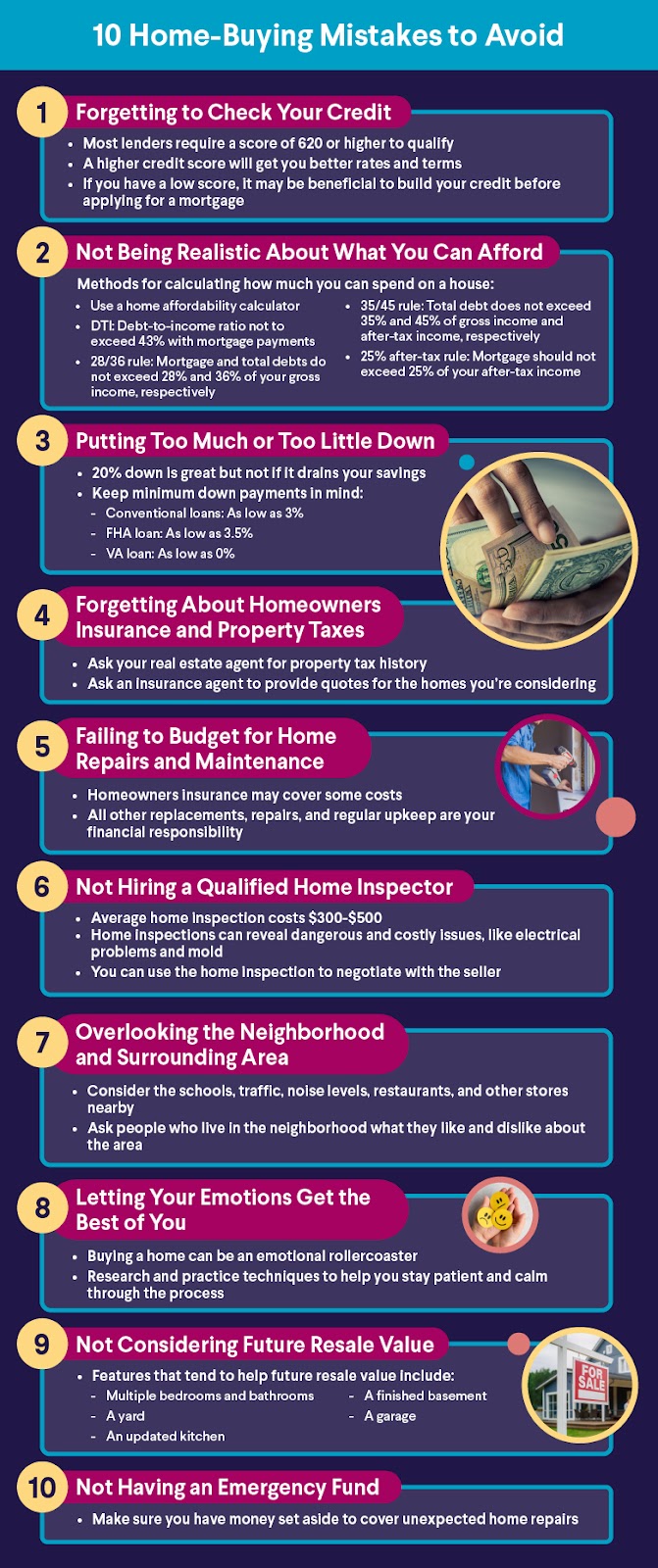
10 Home-Buying Mistakes to Avoid
Home-buying mistakes are easy to make, especially when buying a house for the first time. Review these 10 common first-time homebuyer mistakes before searching for your dream home — so you can ensure you’ll avoid them.
Why? You may not qualify for a mortgage if your credit score is too low. For most types of mortgage loans, you’ll need a 620, though lenders also consider other factors, like your down payment and your debt-to-income (DTI) ratio. You’ll get better rates if you wait to apply for a mortgage until your score is 740 or above.
The lesson? Don’t let a low credit score rule out buying your first home, but if it’s on the lower side, maybe consider taking some time to build your credit score before shopping for a house.
Before you start looking at listings online or working with a real estate agent — and certainly before you try to get preapproved for a mortgage — calculate how much house you can afford.
Once you know the number, avoid looking at houses above your limit. In an April 2024 SoFi survey of 500 potential homebuyers, 54% of those whose home budget was $500,000 or more had a household income of less than $100,000 — hinting that at least some buyers have unrealistic expectations of what they can afford.
So how do you calculate how much house you can afford? There are a few easy methods:
• DTI: Think about your debt-to-income ratio (your debts divided by your gross income). When adding a monthly mortgage payment into your current DTI calculation, the percentage shouldn’t pass 43%. That’s typically the highest ratio mortgage lenders will accept.
• 28/36 rule: With this method, your max mortgage payment should be 28% of your gross income, and your total debts — mortgage and otherwise — should be no more than 36% of your gross income.
• 35/45 rule: Spend no more than 35% of your gross income on debt and no more than 45% of your after-tax income on debt.
• 25% after-tax rule: After adjusting for taxes, your mortgage should not account for more than 25% of your income.
💡 Quick Tip: You deserve a more zen mortgage. SoFi Mortgage Loan Officers are dedicated to closing your loan on time — backed by a $5,000 guarantee offer.‡
3. Putting Too Much or Too Little Down
In their eagerness to become homeowners, many first-time buyers make the mistake of going overboard and directing every bit of money they have to the purchase. (A notable 14% of potential homebuyers in SoFi’s survey said not having saved enough for a down payment was the biggest challenge they are facing.)
If you have to drain your emergency savings to manage the down payment on a home, you might want to dial down the amount or wait and save up a bit more. Consider what could happen if the home needs a costly repair or, worse, if you or someone in your family suddenly has an expensive medical bill. That’s a good example of when to use an emergency fund.
Conventional wisdom says to put 20% down (and it does help you to avoid paying private mortgage insurance (PMI). But with housing costs so high, that’s all but impossible for most homebuyers. Instead, focus on the minimum down payments required for the type of loan you’re considering:
• Conventional loan: As low as 3%
• FHA loan: As low as 3.5%
• VA loan: As low as 0%
Remember, though, that if you put down very little, you’ll need to borrow more. Your monthly payments will be higher, and you could pay more interest over the life of the loan.
4. Forgetting About Homeowners Insurance and Property Taxes
Your monthly mortgage loan payment is more than just the cost of your home. You’ll also need to cover the cost of homeowners insurance and property taxes, which are often paid into an escrow account. Depending on the type of mortgage and how much you’ve paid, you may also have to pay for PMI. Together, these all increase your monthly payment — sometimes substantially. (Indeed, in SoFi’s survey of potential homeowners, 46% of respondents were concerned about property tax costs.)
When you look at a home, the real estate agent should be able to show you property tax history so you can get an idea of what you’d pay each year. You can also work with an insurance agent to simulate insurance quotes for various homes you’re considering.
Property taxes will change from year to year, and you can always change your homeowners insurance to lower the cost, even if you pay for it through the escrow account. It may be a good idea to bundle home and auto policies together to take advantage of a discount.
First-time homebuyers can
prequalify for a SoFi mortgage loan,
with as little as 3% down.
Questions? Call (888)-541-0398.
5. Failing to Budget for Home Repairs and Maintenance
Forgetting to budget for homeowners insurance and property taxes is one of the most common first-time homebuyer mistakes — but those expenses aren’t the only ones people forget to budget for when buying a house for the first time.
If you’ve been accustomed to calling a landlord whenever something breaks in a rental, reset your expectations. Now, you’ll have to take care of basic home maintenance — like replacing air filters, cleaning the gutter, resealing wood decks, and cleaning the chimney — and repairs. When the air conditioner is blowing hot air, the oven stops working, or your roof starts leaking, you’re on the hook for the repairs.
Some issues may be covered by homeowners insurance (but there’s still a deductible!), but other issues caused by general wear and tear are solely your responsibility. And then there are other possible costs, like higher utility bills and homeowners association fees, that can eat into your budget.
6. Not Hiring a Qualified Home Inspector
It may be tempting to waive the home inspection when you’re trying to buy the home of your dreams — especially if you have some stiff competition to be the winning bidder for an in-demand property.
Sorry to say, this is a risky strategy. A home inspection might reveal critical information about the condition of a home and its systems, from electrical problems to hidden mold; from a failing septic system to a leaky roof. What you learn in an inspection could reveal that your dream home is actually a money pit.
What’s more, your inspection report might serve as a useful negotiating tool: You could use it to ask for repairs or to work out a better price from the seller. And if you really aren’t happy with the inspection results, you may be able to use it to cancel the offer to buy.
And in the grand scheme of things, an inspection isn’t too expensive. The average home inspection costs $300 to $500.
7. Overlooking the Neighborhood and Surrounding Area
You may have fallen in love with a specific home, but when you buy a house, you’re also buying the neighborhood that comes with it, so to speak.
How are the surrounding properties maintained? Do the people seem friendly? If you have kids or are planning on having them, do you see other families with young children? How are the schools in the area? What’s the traffic like? How’s the noise level? What restaurants and stores are nearby?
Think about your ideal community — and then try to find a dream home in that type of community.
8. Letting Your Emotions Get the Best of You
Buying your first home or any home thereafter can be a roller coaster, so it’s important to prepare yourself psychologically as well as financially. If you’ve ever talked to someone buying a house, you know there are potential pitfalls all through the purchasing process.
You might fall in love with the perfect house and find it’s way over your budget. You might get annoyed with the sellers or their real estate agent, especially during the negotiation process. You might disagree with your partner about priorities.
All of these scenarios can cause a person to behave emotionally. It might make you want to walk away from a great deal. It might lead you to barrel ahead with a purchase, even when warning lights are flashing.
Our advice to a first-time homebuyer? Recognizing that this will be a challenging and, at times, stressful process (especially because you are new to it), take a deep breath, and proceed calmly. Find tools that help you move ahead with patience and a sense of calm, best as you can. With your eye on the prize — namely, your first home — you’ll get there.
Houses are more than a place to live — they’re an investment. While you certainly want to prioritize buying a home you’ll be happy in, it’s also a good idea to think about how much the property might be worth in five, 10, 15 years and beyond.
It’s impossible to predict the market, but you can feel more confident about strong future resale value by choosing a house with multiple bedrooms and bathrooms, a well-appointed kitchen, and a yard. Other features, like a finished basement or a garage, may also make it easier to sell the home in the future.
10. Not Having an Emergency Fund
One of the basic tenets of personal finance is building an emergency fund. And here’s some blunt advice for first-time homebuyers: You’re going to need an emergency fund.
House emergencies can happen at any time: A tree falls on your roof, a toilet starts to leak, your dog destroys the carpet, you name it. Having money socked away to cover these expenses is crucial when buying a home.
Dream Home Quiz
6 Smart Moves for First-Time Homebuyers
We’ve covered some of the most common first-time homebuyer mistakes, so let’s shift gear to smart moves you can make when buying your first home.
1. Get Paperwork Moving ASAP
What do first-time homebuyers need when getting a mortgage? Here are some of the most common docs to start putting together:
• Proof of income: Lenders will often want to see two months’ worth of pay stubs or bank statements that confirm your income. They’ll also want your tax returns from the previous two years.
• Proof of funds: To take you seriously, lenders want to know you have enough money to cover a down payment andclosing costs.
• Proof of identification: This could include a government ID, a passport, or your driver’s license.
Early in the process, you can furnish this basic information to get prequalified at various lenders. They’ll also run a credit check during the prequalification process.
Being prequalified simply allows lenders to give you an idea of what types of mortgages (fixed rate vs. variable rate, 15-year vs. 30-year, etc.) you might get approved for. It’s not a promise of approval, but it does help set expectations as you start to browse listings.
💡 Quick Tip: Your parents or grandparents probably got mortgages for 30 years. But these days, you can get them for 20, 15, or 10 years — and pay less interest over the life of the loan.
2. Check Out First-Time Homebuyer Programs
It’s wise to shop around for a few different mortgage quotes, but it would be a rookie mistake to overlook some great, government-sponsored programs that make buying a house more affordable. These include:
• FHA loans: These mortgages are designed for those with low to moderate incomes. They typically offer low down-payment requirements, low interest rates, and the ability to get approval even if you have a fair credit score.
• USDA loans: These provide affordable mortgages to those with a lower income who are planning on buying a home in a qualifying rural area.
• VA loans: These mortgages help those on active military duty, veterans, and eligible surviving spouses become homeowners. If you can check one of those boxes, you may be eligible for a home loan with no down payment requirement and no PMI.
3. Consider Additional Costs Beyond the Mortgage
As we’ve discussed above, the actual monthly house payment is not your only cost. Your full mortgage payment includes property taxes, homeowners insurance, and, potentially, PMI.
But before you even get to the point of making monthly payments, consider these upfront costs of buying a house:
• Closing costs, which are traditionally paid for by the buyer.
• Home inspections, which we highly recommend.
• Moving costs, whether just renting a truck or hiring movers.
4. Get Preapproved
Mortgage prequalification isn’t a commitment for the lender or buyer — it’s just a first step. If you appear to meet a lender’s standards, you could move on to the preapproval stage.
Getting preapproved for a home loan involves submitting additional income and asset documentation for a more in-depth review of your finances.
Once the lender approves these aspects of your loan application, you’ll receive a conditional commitment for a designated loan amount — called a preapproval letter — and have a better idea of what your loan terms will be.
Mortgage preapproval can help demonstrate to sellers that you’ve completed the first step in getting a mortgage because your credit, income, and assets have already been reviewed by an underwriter. This can smooth the bidding process and could give you an edge over others in a competitive situation with multiple offers.
You may qualify for various types of mortgage loans. Spend some time researching the different types so you have a better understanding of how they’ll impact your payments for the next several decades.
For instance, you’ll want to know the difference between a fixed-rate mortgage and an adjustable-rate mortgage (ARM). You’ll also want to understand how a 15-year term affects your monthly payments when compared to a 30-year term — but also how a longer term increases the amount you’ll pay in interest.
Finally, remember that you don’t have to go with the first mortgage offer you get. It’s worth your while to get multiple offers so you can compare interest rates, down payment requirements, terms, and more.
The Takeaway
Buying a house for the first time can be a stressful experience, but remember: At the end of it all, you’ll have a place you can call yours. You’ll build equity over time, and the house may increase in value. Just make sure you research the most common first-time homebuyer mistakes so you know how to avoid them.
Looking for an affordable option for a home mortgage loan? SoFi can help: We offer low down payments (as little as 3% - 5%*) with our competitive and flexible home mortgage loans. Plus, applying is extra convenient: It's online, with access to one-on-one help.
SoFi Mortgages: simple, smart, and so affordable.
FAQ
What are some common mistakes first-time homebuyers make?
Some common home-buying mistakes for first-time homebuyers include forgetting to check (and improve) their credit, not calculating how much home they can actually afford, and forgetting to consider additional expenses, like inspections, homeowners insurance, property taxes, closing costs, and increased utilities. First-timers may also forget to consider the neighborhood as a whole or the future resale of the home.
What are the two largest obstacles for first-time homebuyers?
Two large obstacles for first-time homebuyers include rising housing prices and credit score requirements. Those who don’t already have equity in a current home may have more trouble coming up with a down payment on a new home. First-time homebuyers may also lack the credit score needed to get the best possible rate on a new mortgage.
What are three common mortgage mistakes?
Three common mortgage mistakes are 1) buying up to the limit you’re approved for rather than calculating how much you’re comfortable paying; 2) skipping the home inspection to expedite the process or make your offer more appealing to buyers; and 3) not considering related expenses you’ll have to budget for, including homeowners insurance, property taxes, and repairs and maintenance.
What are the most common mistakes that homebuyers make?
Homebuyers make a number of common mistakes, such as making an unnecessarily large down payment, forgetting to budget for related costs, buying more house than they can afford, and not shopping around for the best mortgage loans.
*SoFi requires Private Mortgage Insurance (PMI) for conforming home loans with a loan-to-value (LTV) ratio greater than 80%. As little as 3% down payments are for qualifying first-time homebuyers only. 5% minimum applies to other borrowers. Other loan types may require different fees or insurance (e.g., VA funding fee, FHA Mortgage Insurance Premiums, etc.). Loan requirements may vary depending on your down payment amount, and minimum down payment varies by loan type.
‡SoFi On-Time Close Guarantee: If all conditions of the Guarantee are met, and your loan does not close on or before the closing date on your purchase contract accepted by SoFi, and the delay is due to SoFi, SoFi will give you a credit toward closing costs or additional expenses caused by the delay in closing of up to $10,000.^ The following terms and conditions apply. This Guarantee is available only for loan applications submitted after 04/01/2024. Please discuss terms of this Guarantee with your loan officer. The mortgage must be a purchase transaction that is approved and funded by SoFi. This Guarantee does not apply to loans to purchase bank-owned properties or short-sale transactions. To qualify for the Guarantee, you must: (1) Sign up for access to SoFi’s online portal and upload all requested documents, (2) Submit documents requested by SoFi within 5 business days of the initial request and all additional doc requests within 2 business days (3) Submit an executed purchase contract on an eligible property with the closing date at least 25 calendar days from the receipt of executed Intent to Proceed and receipt of credit card deposit for an appraisal (30 days for VA loans; 40 days for Jumbo loans), (4) Lock your loan rate and satisfy all loan requirements and conditions at least 5 business days prior to your closing date as confirmed with your loan officer, and (5) Pay for and schedule an appraisal within 48 hours of the appraiser first contacting you by phone or email. This Guarantee will not be paid if any delays to closing are attributable to: a) the borrower(s), a third party, the seller or any other factors outside of SoFi control; b) if the information provided by the borrower(s) on the loan application could not be verified or was inaccurate or insufficient; c) attempting to fulfill federal/state regulatory requirements and/or agency guidelines; d) or the closing date is missed due to acts of God outside the control of SoFi. SoFi may change or terminate this offer at any time without notice to you. *To redeem the Guarantee if conditions met, see documentation provided by loan officer. Disclaimer: Many factors affect your credit scores and the interest rates you may receive. SoFi is not a Credit Repair Organization as defined under federal or state law, including the Credit Repair Organizations Act. SoFi does not provide “credit repair” services or advice or assistance regarding “rebuilding” or “improving” your credit record, credit history, or credit rating. For details, see the FTC’s website .
SoFi Loan Products
SoFi loans are originated by SoFi Bank, N.A., NMLS #696891 (Member FDIC). For additional product-specific legal and licensing information, see SoFi.com/legal. Equal Housing Lender.
SoFi Mortgages
Terms, conditions, and state restrictions apply. Not all products are available in all states. See SoFi.com/eligibility-criteria for more information.
Financial Tips & Strategies: The tips provided on this website are of a general nature and do not take into account your specific objectives, financial situation, and needs. You should always consider their appropriateness given your own circumstances.