laptop financial graphics

Understanding Inverse ETFs

An inverse ETF, or short ETF, is a portfolio of securities that allows investors to make a bet that either the broader markets or a particular asset class or market sector will go down in the short term.

There are a wide range of inverse ETFs to choose from. There are dozens that are traded on U.S. markets. They allow investors to make short-term investments in the likelihood that the price of a given asset will go down. Investors can use inverse ETFs to seek returns when there are price dips in equities, fixed-income securities, and certain commodities. They do reset daily, however, and generally, investors may not want to hold onto them longer than a day.

Key Points

•   An inverse ETF is a portfolio of securities designed to profit from market declines.

•   Inverse ETFs trade on exchanges, similar to stocks.

•   These ETFs use futures contracts to attempt to achieve the opposite result of an underlying index or benchmark.

•   Leveraged inverse ETFs offer the potential for amplified returns, but also come with substantial risk.

•   Investors use inverse ETFs to hedge against market drops or bet on short-term declines, but they do reset daily, adding another dimension of risk to a portfolio.

How Does an Inverse ETF Work?

To understand inverse ETFs, an investor first needs to know about Exchange Traded Funds (ETFs). An ETF is a portfolio of stocks, bonds, or other securities that trades on an exchange, like a stock. Its share price fluctuates throughout the day, as investors buy and sell shares of the fund.

As with regular ETFs, investors can buy and sell inverse ETFs throughout the day. Unlike the way ETFs work, however, inverse ETFs are designed not to invest in a given index, but to deliver the opposite result. If the index goes down, the inverse ETF should go up, and vice versa.

Leveraged & inverse ETPs (like ETNs) may be good for short-term trading. If you’re holding them long-term, watch for unexpected market changes and tracking errors. As noted, they reset daily, so there are risks involved with holding them longer than that.

What Do Inverse ETFs Invest In?

Inverse ETFs, or short ETFs, use complex trading strategies, involving a heavy use of futures contracts, to deliver the opposite result of the markets. Futures contracts are essentially agreements to buy or sell a given asset at a given date and price, regardless of the market price at the time. Using futures contracts, an investor can bet that a given asset, like a stock, will go up or down, without actually owning that asset.

Put simply, investors who think the price of a given stock will go down may buy a futures contract that allows them to sell a stock at a higher price than they think it will trade at by the expiration of the contract. If the price of that stock does go down, they can buy it on the open market cheaply and sell it to the other person or institution at the agreed-upon higher price, and pocket the difference.

An inverse ETF does that with a group of stocks, every trading day. The largest inverse ETFs aim to deliver the opposite returns of major stock indexes, like the Nasdaq or the S&P 500. For example, if the S&P 500 goes down 1% on a given day, then a corresponding inverse ETF could be designed to go up 1% that day.

Leveraged Inverse ETFs

There are other inverse ETFs that take the formula one step further, using leverage. That means they buy the futures contracts in their portfolios partially with borrowed money. That gives them the ability to offer outsized returns — two and three times the opposite of the day’s return — but it also exposes them to sizable single-day losses, and larger losses over time.

For example, on that same hypothetical day when the S&P 500 goes down 1%, the corresponding inverse ETF could be designed to go up by 2%.

Who Invests in Inverse ETFs?

An inverse ETF might seem like a good choice for an investor who is generally pessimistic about the prospects for the broader markets over the next few months or years. But that’s not necessarily the case.

Inverse ETFs only invest in one-day futures contracts. The futures contracts they invest in expire at the end of the trading day, locking in the ETFs’ gains and losses.

With an inverse ETF, it’s not enough to be right about the general direction of a given market, asset class, or sector. The performance of inverse ETFs isn’t the exact opposite of the index it tracks over longer periods of time. So, the investor has to be correct on the right days, as well.

Inverse ETFs get a lot of attention in the media during market swoons, when they post eye-popping returns. But most financial professionals probably don’t recommend them as long-term investments. They’re generally best for sophisticated investors with a high tolerance for risk.

What Are the Risks of Inverse ETFs?

Investors who purchase inverse ETFs take on risks that are common to all investors, and also some that are unique to this specific investment vehicle.

•   Loss: If an investor buys an inverse ETF and the index that it tracks goes up, then the investor will lose money. If the given index goes up by 1% that day, then the fund offering the inverse of that index will go down by 1%; with a leveraged ETF, it could even go down by 2% or 3%.

•   Fees: While most ETFs have very low management fees, inverse ETFs may have higher fees, which may take a bite out of returns over time. (It’s worth noting that the management fee can be typically lower than the time and expense of shorting the stocks directly.)

•   Taxes: Inverse ETFs may be less tax efficient than other types of ETFs due to the fact that they reset daily. There could also be other tax-related issues to be aware of, so it may be a good idea to speak with a tax professional to learn more.

The risks are significant enough that, in 2019, the Securities and Exchange Commission proposed new regulations about inverse ETFs, requiring companies that manage leveraged and inverse ETFs to specifically make sure customers understood those risks. The regulation was not approved, which means the onus is still very much on investors to understand the risk.

Additionally, in 2022, regulators released a notice to investors about the risks of holding on to inverse and leveraged ETFs for longer than a day, saying that doing so could result in substantial and sudden losses.

The Takeaway

Inverse ETFs are designed as a tool to allow investors to bet against the market, or specific asset classes. While they come with unique risks, inverse ETFs may help investors seek returns on a given day during market dips, giving them the chance to short the market with one trade. These ETFs go up as the index goes down, offering an opportunity to generate returns when the market is trending down.

The trick: choosing the right inverse ETF on the right day, in order to gain rather than lose. The funds are risky, but can be popular among investors who want to hedge their exposure to a given asset class or market sector, and investors who believe that a given market is due for a big drop.

Invest in what matters most to you with SoFi Active Invest. In a self-directed account provided by SoFi Securities, you can trade stocks, exchange-traded funds (ETFs), mutual funds, alternative funds, options, and more — all while paying $0 commission on every trade. Other fees may apply. Whether you want to trade after-hours or manage your portfolio using real-time stock insights and analyst ratings, you can invest your way in SoFi's easy-to-use mobile app.

Opening and funding an Active Invest account gives you the opportunity to get up to $1,000 in the stock of your choice.¹

FAQ

How does an inverse ETF work?

Inverse ETFs utilize complex trading strategies to deliver the opposite results of the markets. So, if an ETF attempts to mirror the results of the market, an inverse ETF attempts to do the opposite, and can be used as a shorting mechanism.

How often do inverse ETFs reset?

Inverse ETFs reset daily, and as such, are meant to be a short-term trading tool. Holding on to inverse ETFs for longer than a day can introduce significant risk to a portfolio.

What are the risks of inverse ETFs?

The primary risks associated with inverse ETFs are the risks of losses, and more complex tax implications. There may also be management fees that investors should be aware of.


INVESTMENTS ARE NOT FDIC INSURED • ARE NOT BANK GUARANTEED • MAY LOSE VALUE

SoFi Invest is a trade name used by SoFi Wealth LLC and SoFi Securities LLC offering investment products and services. Robo investing and advisory services are provided by SoFi Wealth LLC, an SEC-registered investment adviser. Brokerage and self-directed investing products offered through SoFi Securities LLC, Member FINRA/SIPC.

For disclosures on SoFi Invest platforms visit SoFi.com/legal. For a full listing of the fees associated with Sofi Invest please view our fee schedule.

Financial Tips & Strategies: The tips provided on this website are of a general nature and do not take into account your specific objectives, financial situation, and needs. You should always consider their appropriateness given your own circumstances.

Exchange Traded Funds (ETFs): Investors should carefully consider the information contained in the prospectus, which contains the Fund’s investment objectives, risks, charges, expenses, and other relevant information. You may obtain a prospectus from the Fund company’s website or by emailing customer service at [email protected]. Please read the prospectus carefully prior to investing.


¹Probability of Member receiving $1,000 is a probability of 0.026%; If you don’t make a selection in 45 days, you’ll no longer qualify for the promo. Customer must fund their account with a minimum of $50.00 to qualify. Probability percentage is subject to decrease. See full terms and conditions.

SOIN-Q225-012

Read more
What Is the Difference Between Ebit and Ebitda?

What Is the Difference Between EBIT and EBITDA?

EBIT and EBITDA are two common ways to calculate a company’s profits, and investors may come across both terms when reviewing a company’s financial statements. Though they appear similar, they can present two very different views of a company’s income and expenses.

If you’re an investor or you own a business, it’s important to understand the difference between EBIT and EBITDA and know why the distinction matters.

Key Points

•   EBIT measures operating income, excluding interest and taxes, focusing on core business profitability.

•   EBITDA includes depreciation and amortization, providing a clearer view of cash flow and operational profitability.

•   EBITDA aids in company valuation and comparison by excluding non-cash expenses, including depreciation and amortization.

•   EBIT and EBITDA are not considered part of the Generally Accepted Accounting Principles (GAAP), with critics suggesting some companies may overstate financial stability.

•   Thorough research is crucial before investing to avoid inaccurate assessments of companies’ health. Though there are provisions that exist to protect against misuse.

What Is EBIT?

EBIT stands for “earnings before interest and taxes,” and is a way to measure a company’s operating income. Here’s a look at what each of those components means:

•   Earnings: This is the net income of a company over a specified period of time, such as a quarter or fiscal year.

•   Interest: This refers to interest payments made to any liabilities owed by the company, including loans or lines of credit.

•   Taxes: This refers to any taxes a company must pay under federal and state laws.

Here is the formula for calculating EBIT:

EBIT = Net income + Interest + Taxes

The EBIT calculation assumes you know a company’s net income. To determine net income, you would use this formula:

Net income = Revenue – Cost of Goods Sold – Expenses

In this formula, revenue means the total amount of income generated by goods or services the company sells. Cost of goods sold refers to the cost of making or acquiring any goods the company sells, including labor or raw materials. Expenses include operating costs such as rent, utilities or payroll.

EBIT should not be confused with EBT, or earnings before tax. Earnings before tax is used to measure profits with taxes factored in, but not any interest payments the company owes. You may use this metric to evaluate companies that are subject to different taxation rules at the state level.

You can find EBIT listed on a company’s income or profit and loss statement alongside other important financial ratios, such as earnings per share (EPS).

Is Depreciation Included in EBIT?

The short answer is no, depreciation is not included in the context of the EBIT formula. But you will see depreciation factored in when calculating EBITDA.

What EBIT Tells Investors

Knowing the EBIT for a company can tell you how financially healthy that company is based on its business operations. Specifically, EBIT can tell you things like:

•   How much operating income a company needs to stay in business

•   What level of earnings a company generates

•   How efficiently the company uses earnings when debt obligations aren’t factored in

EBIT can be useful in determining how well a company manages business operations before external factors like debt and taxes come into play. It can also help to create a framework for evaluating whether certain actions, such as a stock buyback, are a true sign that a company is struggling financially.

You can also use EBIT to determine interest coverage ratio. This ratio can tell you how easily a company is able to pay interest on outstanding debt obligations. To find the interest coverage ratio, you’d divide a company’s earnings before interest and taxes by any interest paid toward debt for the specific time period you’re measuring. As an investor, this ratio can give you insight into how well a company is able to keep up with its current debts and any debts it may take on down the line.

What Is EBITDA?

EBITDA is another acronym you may see on financial statements that stands for “earnings before interest, taxes, depreciation, and amortization.” In terms of the first three terms, the breakdown is exactly the same as for EBIT. Plus there are two new additions:

•   Depreciation: This term is used to refer to the decline in an asset’s value over time due to things like regular use, wear and tear or becoming obsolete.

•   Amortization: This term also applies to a decline in value but instead of a tangible asset, it can be used for intangible assets. Amortization can also be referred to in the context of borrowing. For example, a business loan amortization schedule would show how the balance declines over time as payments are made.

The only difference between EBITDA and EBIT, then, is that EBITDA adds depreciation and amortization back in.

The EBITDA formula looks like this:

EBITDA = Net Income + Interest + Taxes + Depreciation + Amortization

Alternately, you can substitute this formula instead:

EBITDA = Operating Profit + Depreciation + Amortization

In this formula, operating profit is the same thing as EBIT. To calculate EBITDA, you’d first need to calculate earnings before interest and taxes.

You should be able to find all the information you need to calculate EBITDA on a company’s income statement, though you may also need a cash flow statement for an accurate calculation.

💡 Recommended: NOPAT vs EBITDA

EBIT vs EBITDA: Which Is Better?

While EBIT allows you to gauge a company’s health based on its operations, EBITDA offers a clearer snapshot of a company’s net cash flow and how money is moving in or out of the business.

Calculating the earnings before interest, taxes, depreciation, and amortization can offer a fuller picture of a company’s financial health in terms of how operational decision-making affects profitability. It can also be useful when calculating valuations for different companies and/or comparing a business to its competitors.

While EBIT and EBITDA can be a starting point for choosing where to put your money, it’s also helpful to consider other fundamental ratios such as earnings per share or price-to-earnings ratio. Active traders who are interested in benefiting from market momentum, may consider technical analysis indicators instead.

Drawbacks of EBIT vs EBITDA

While EBIT and EBITDA can be useful, there are some potential issues to be aware of. Chiefly, neither formula is considered part of Generally Accepted Accounting Principles (GAAP). This is a uniform set of standards that’s designed to encourage transparency and accuracy in accounting for corporations, governments and other entities.

In other words, EBIT and EBITDA don’t have any official seal of approval from an accounting authority. That means companies could potentially manipulate the numbers in their favor, if they choose to.

The better a company looks on paper, the easier it may be to attract investors or qualify for financing. Companies that are struggling behind the scenes may use inflated numbers or leave out critical information when calculating EBIT or EBITDA to appear more financially stable than they are.

Note, too, that the SEC requires listed companies that report EBITDA data to show their work – that is, show how the numbers were calculated from net income, etc. That can help protect investors from potentially misleading data.

Investors who choose to put money into a company because they accepted EBIT or EBITDA calculations at face value. It’s important to dig deeper when deciding where to invest, such as by reviewing a company’s financial statements, as these calculations may not provide a full picture of a company’s financial situation.

The Takeaway

EBIT, or earnings before interest and tax, and EBITDA, or earnings before interest, tax, depreciation and amortization, are two ways to assess the financial health of a company. To recap, EBIT measures operating income, and EBITDA stands for “earnings before interest, taxes, depreciation, and amortization.”

Also be aware that these calculations are not considered to be a part of the Generally Accepted Accounting Principles, so critics note that some companies may inflate numbers to present a rosy outlook to investors. As always, it’s a good idea to research a company from a variety of different angles before investing in it.

Invest in what matters most to you with SoFi Active Invest. In a self-directed account provided by SoFi Securities, you can trade stocks, exchange-traded funds (ETFs), mutual funds, alternative funds, options, and more — all while paying $0 commission on every trade. Other fees may apply. Whether you want to trade after-hours or manage your portfolio using real-time stock insights and analyst ratings, you can invest your way in SoFi's easy-to-use mobile app.

Opening and funding an Active Invest account gives you the opportunity to get up to $1,000 in the stock of your choice.¹

FAQ

What is EBIT?

EBIT stands for “earnings before interest and taxes,” and is a way to measure a company’s operating income. It focuses on a company’s core profitability.

What is EBITDA?

EBITDA stands for “earnings before interest, taxes, depreciation, and amortization.” With more information in the mix, it can tell investors a bit more about a company’s profitability.

What is the difference between EBITDA and EBIT?

The only difference between EBITDA and EBIT, then, is that EBITDA adds depreciation and amortization back into the calculation, and as such, EBITDA may tell investors in a bit more detail about a company’s full financial picture.


About the author

Rebecca Lake

Rebecca Lake

Rebecca Lake has been a finance writer for nearly a decade, specializing in personal finance, investing, and small business. She is a contributor at Forbes Advisor, SmartAsset, Investopedia, The Balance, MyBankTracker, MoneyRates and CreditCards.com. Read full bio.


Photo credit: iStock/Vertigo3d

INVESTMENTS ARE NOT FDIC INSURED • ARE NOT BANK GUARANTEED • MAY LOSE VALUE

SoFi Invest is a trade name used by SoFi Wealth LLC and SoFi Securities LLC offering investment products and services. Robo investing and advisory services are provided by SoFi Wealth LLC, an SEC-registered investment adviser. Brokerage and self-directed investing products offered through SoFi Securities LLC, Member FINRA/SIPC.

For disclosures on SoFi Invest platforms visit SoFi.com/legal. For a full listing of the fees associated with Sofi Invest please view our fee schedule.

Financial Tips & Strategies: The tips provided on this website are of a general nature and do not take into account your specific objectives, financial situation, and needs. You should always consider their appropriateness given your own circumstances.


¹Probability of Member receiving $1,000 is a probability of 0.026%; If you don’t make a selection in 45 days, you’ll no longer qualify for the promo. Customer must fund their account with a minimum of $50.00 to qualify. Probability percentage is subject to decrease. See full terms and conditions.

SOIN-Q225-052

Read more
What every new investor should know about risk

Investment Risk: What Every New Investor Should Know

Risk is a critical component of each and every investment, and there are several things about risk, and an individual’s ability to handle it, that investors need to know. Those include the types of risk involved in investing, the relationship between risk and potential returns, and how to effectively manage it.

Investors should consider their appetite and tolerance for risk, and try to determine which assets are suitable for them. Investing involves understanding the risk profiles of the different assets, among other things, too.

Key Points

•   Higher risk investments typically offer greater potential returns but also increase the potential for loss.

•   Understanding risk tolerance helps align investments with financial goals and comfort levels.

•   A longer time horizon allows for more risk, as there is more time to recover from market downturns.

•   Various risks include market, business-specific, price volatility, and interest-rate risks.

•   Diversification and asset allocation are key strategies for managing investment risk.

Higher Risk, Higher Potential Return

The most important thing to understand about risk is something you’ve probably heard before: Generally, the higher the risk of your investment, the greater return you should expect on your money. It is, however, the nature of risk that the return you expect might not be the return you actually get.

The concept of “Modern Portfolio Theory” emphasizes that risk and reward are linked. If you hope for a higher return, you should also expect higher volatility — the variability of actual returns. The returns on an exchange-traded fund (ETF) may be up one year and down the next.

Returns on a mutual fund of emerging market stocks will likely have much wider changes in returns from year-to-year, or even month-to-month. You might make a lot more money, but you also could lose much more.


💡 Quick Tip: When people talk about investment risk, they mean the risk of losing money. Some investments are higher risk, some are lower. Be sure to bear this in mind when investing online.

How Much Risk Should You Take?

When determining a level of risk that you’re comfortable with, you want to first look at the goals you have (buying a house, saving for college, and retiring, to name a few), as well as how many years will it be before you need the money for each goal. That’s called a “time horizon.”

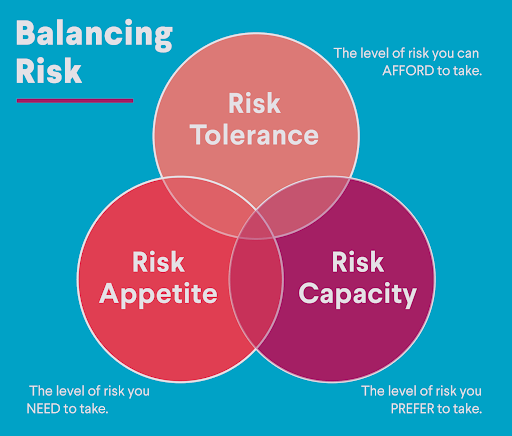
balancing risk

As seen in the visual, an investor’s risk tolerance and risk capacity are important elements to take into consideration. Generally speaking, the longer the time horizon, the more risk you can afford to take, because you have more time to recover from market downturns. Both your tolerance and capacity can change over time, as your goals change as well.

This is why young people are advised to put their retirement savings in a more aggressive portfolio. As you get closer to retirement, you’ll generally want to be more conservative. You can also consult a retirement calculator to see where you stand on your retirement goals.

Recommended: Risk Tolerance Quiz: How Much Investment Risk Are You Comfortable With?

What Types of Risk Are There?

There are several types of risk that every investor should be aware of. Here are a few:

•   market

•   business-specific

•   price volatility

•   interest rate

•   concentration

Some risks you can’t avoid, like market risk or beta. The market goes up and down, and this often affects all stocks. Investors can measure the risk in their stock holdings by finding their portfolio’s beta. This will show how sensitive one’s portfolio is to volatility in the market.

You can, however, reduce other risks. For example, if you buy individual stocks, you open yourself up to business-specific risk. But, if you buy an index fund, you are buying assets in multiple companies. If one of these companies falters, it will impact the index, but it won’t have the same harsh impact on your investment. This is why seasoned investors tend to emphasize portfolio diversification so much.

How Should You Manage Risk?

On a broad level, how do you use these concepts to manage your investing risk? One method is to utilize asset allocation strategies that map to your goals and risk profile.

For example, if you wanted to take a particularly low-risk, or conservative position, you could allocate your portfolio to contain more bonds than stocks. Bonds tend to be safer investments than stocks (though it’s important to remember that there’s no such thing as a “safe” investment), and as such, may be less volatile if the market experiences a downturn or correction.

If you still wanted to play it safe but allow for some risk (and potentially bigger returns), you could split your portfolio’s allocation — that could include 50% stocks, 50% bonds, or something along those lines. Further, if you feel like you have a high risk tolerance, you could take an aggressive position, and invest most of, or your entire portfolio in stocks.


💡 Quick Tip: How to manage potential risk factors in a self-directed investment account? Doing your research and employing strategies like dollar-cost averaging and diversification may help mitigate financial risk when trading stocks.

Managing Specific Types of Risk

If you want to get more granular, you can try to manage specific types of risk in your portfolio, such as interest rate risk, business-specific risk, etc.

Interest rate risk, for one, has to do with investment values fluctuating due to changing interest rates. This generally involves bond investments, and one way to try and manage it is through diversification, or even by participating in hedge funds — though that can be its own can of worms, so do your research before jumping into hedge funds.

Business-specific risk refers to specific or particular companies or industries. For example, the aerospace industry faces a different set of challenges and risks than the food production industry. So, changes to the Federal Aviation Administration could, as a hypothetical, cause price fluctuation to aerospace stocks, but not other types of stocks. Again, this can largely be addressed through diversification.

There are numerous other types of risks, too, and managing them all is difficult, if not impossible, for the typical investor. You can consider consulting a financial professional for further advice, however.

The Takeaway

Risk is unavoidable when investing, and as such, it’s important to understand the nature of the risk, avoid taking risks you can’t afford, and monitor and adjust your investments over time to align with your risk tolerance. Think about it like driving a car: It’s risky, but you understand that risk and mitigate it by maintaining your car, obeying traffic laws, and buying insurance. The return is the peace of mind of having your future destination in sight.

There are no guarantees in investing, but you can make an informed choice of the amount of risk you are willing to take and invest intelligently to reach your goals.

Invest in what matters most to you with SoFi Active Invest. In a self-directed account provided by SoFi Securities, you can trade stocks, exchange-traded funds (ETFs), mutual funds, alternative funds, options, and more — all while paying $0 commission on every trade. Other fees may apply. Whether you want to trade after-hours or manage your portfolio using real-time stock insights and analyst ratings, you can invest your way in SoFi's easy-to-use mobile app.

Opening and funding an Active Invest account gives you the opportunity to get up to $1,000 in the stock of your choice.¹

FAQ

What is risk tolerance?

Risk tolerance in investing refers to an investor’s appetite for risk, or how much risk they’re willing to assume in order to try and achieve higher returns. Some investors have higher risk tolerance than others.

What are common types of investing risk?

There are numerous types of investment risks, but some of the most common include market risk, business-specific risks, price volatility, interest rate risk, and concentration risk.

What strategies can be used to manage risk?

Some common strategies used to mitigate or manage portfolio risk include diversification and strategic asset allocation, and dollar-cost averaging.


INVESTMENTS ARE NOT FDIC INSURED • ARE NOT BANK GUARANTEED • MAY LOSE VALUE

SoFi Invest is a trade name used by SoFi Wealth LLC and SoFi Securities LLC offering investment products and services. Robo investing and advisory services are provided by SoFi Wealth LLC, an SEC-registered investment adviser. Brokerage and self-directed investing products offered through SoFi Securities LLC, Member FINRA/SIPC.

For disclosures on SoFi Invest platforms visit SoFi.com/legal. For a full listing of the fees associated with Sofi Invest please view our fee schedule.

Financial Tips & Strategies: The tips provided on this website are of a general nature and do not take into account your specific objectives, financial situation, and needs. You should always consider their appropriateness given your own circumstances.


¹Probability of Member receiving $1,000 is a probability of 0.026%; If you don’t make a selection in 45 days, you’ll no longer qualify for the promo. Customer must fund their account with a minimum of $50.00 to qualify. Probability percentage is subject to decrease. See full terms and conditions.

Dollar Cost Averaging (DCA): Dollar cost averaging is an investment strategy that involves regularly investing a fixed amount of money, regardless of market conditions. This approach can help reduce the impact of market volatility and lower the average cost per share over time. However, it does not guarantee a profit or protect against losses in declining markets. Investors should consider their financial goals, risk tolerance, and market conditions when deciding whether to use dollar cost averaging. Past performance is not indicative of future results. You should consult with a financial advisor to determine if this strategy is appropriate for your individual circumstances.

Third Party Trademarks: Certified Financial Planner Board of Standards Center for Financial Planning, Inc. owns and licenses the certification marks CFP®, CERTIFIED FINANCIAL PLANNER®

SOIN-Q225-081

Read more
woman in kitchen with coffee and laptop mobile

Pros & Cons of Global Investments

Individual investors have access to a wide variety of investments in and outside of the U.S., which include international and domestic assets. Global investing involves investing in securities that originate all around the world. Global allocation may provide diversification benefits, which is a pillar of wealth management. It can also help investors position their portfolio for long-term growth.

Increased geographic diversification may also offer some downside risk mitigation, as the relative performance of U.S. vs. international stocks has historically alternated. In other words, the U.S. markets may have a different rhythm than international markets. Therefore, investing in both has the potential to give investors the best of both worlds if one rises while the other falls, helping minimize return losses.

Key Points

•   Global investing provides diversification, potentially higher growth, and access to a broader range of opportunities.

•   Risks include currency fluctuations, liquidity issues, political and economic instability, and higher costs.

•   Diversification through global investing helps reduce vulnerability to single-market downturns by spreading assets.

•   Information access in global markets is challenging due to varying regulations and financial disclosure standards.

•   Managing currency risk can be achieved through strategies like dollar-cost averaging and diversification.

Investing in Global Investments

There are several ways, or assets that investors can use to get started in the global market. But before an investment decision is made, it’s important to learn as much as possible about each investment option and understand the risks involved.

Mutual Funds

A mutual fund is a type of security that pools money collected from investors and invests in different assets such as stocks and bonds. The portfolio of a mutual fund is made up of the combination of holdings selected. U.S.-registered mutual funds may invest in international securities. These types of mutual funds include:

•  Global funds that invest primarily in non-U.S. companies, but can invest in domestic companies as well.

•  International funds that invest in non-U.S. companies.

•  Regional or country funds that primarily invest in a specific country or region.

•  International index funds designed to track the returns of an international index or another foreign market.

U.S.-registered mutual funds are composed of a variety of different international investments. As with any mutual fund, when an investor purchases a U.S.-registered mutual fund, they’re buying a fraction of all of the securities, which increases diversification.

For investors to create this level of diversification on their own with individual stocks and bonds would be difficult, expensive, and time-consuming. Therefore, buying shares of U.S.-registered mutual funds may give investors access to more diversification.

Exchange-Traded Funds (ETFs)

An ETF is an investment fund that pools different types of assets, such as stocks and bonds, and divides ownership into shares. Most ETFs track a particular index that measures some segment of the market.

This is important to understand — the ETF is simply the suitcase that packs investments together. When investing in an ETF, investors are exposed to the underlying investment.

ETFs that are U.S.-registered may include foreign markets in their tracking but trade on U.S. stock exchanges. These types of investments may offer similar benefits as U.S.-registered mutual funds.

Stocks

While many non-U.S. companies use Amercian Depositary Receipts (ADRs) to trade their stock, other non-U.S. companies may list stock directly on a U.S. market, known as U.S. Trade foreign stocks. For example, Canadian stocks are listed on Canadian markets and are also listed on U.S. markets instead of using ADRs.

Why Invest in Global Markets?

While some of these investments may seem confusing, there are a few reasons why investors might choose global investments.

Diversification

Again, choosing global investments can diversify an investor’s portfolio. It may be tempting for an investor to concentrate money in a few familiar sectors or in companies for which there is a personal affinity. But putting all their eggs in one basket could potentially lead to vulnerability.

There is no guarantee against the possibility of loss completely — after all, all investments have risk. But spreading assets to international and domestic equities may reduce an investor’s vulnerability because their money is distributed across areas that aren’t likely to react in the same way to the same occurrence.

Global Growth

Another reason investors might choose to invest globally is because of the growth potential. The U.S. is considered a mature market and may not have as much growth potential as other economies. Choosing global investments allows investors to potentially capitalize on profits from growing economies, particularly in emerging markets.

Greater Selection

If you choose not to invest outside of the U.S., you are narrowing your investment opportunity set. Even though investment information may be more challenging to obtain and analyze, there is the potential for a great deal of growth (or decline!).

The Risks of Global Investments

As with any financial decision, careful consideration is required when selecting an investment. But, there are a few unique global investment risks and issues that need to be accounted for before investing in any global investment.

Currency and Liquidity Risk

Currency risk is also known as exchange-rate risk. It stems from the price differences when comparing one currency to another. When the exchange rate between the U.S. dollar and a foreign currency fluctuates, the return on that foreign investment may fluctuate as well. It’s possible that a non-U.S. investment might increase its value in its home market but may decrease in value in the U.S. because of exchange rates.

In addition to the risk of exchange rates, some countries may restrict or limit the movement of money out of certain foreign investments. Conversely, some countries may limit the amount or type of international investment an investor can purchase. This could prevent investors from buying and selling these assets as desired.

Instability

Countries in the midst of transition, war, or economic uncertainty may also be experiencing adverse economic effects, and companies within those countries may be impacted. These days, news can change by the minute, and it might be difficult to keep on top of what’s happening when so much news is happening all at once.

Cost

Sometimes it can be more expensive to invest in non-U.S. investments than investing domestically. This is due to possible foreign taxes on dividends earned outside the U.S., as well as transaction costs, brokers’ commissions, and currency conversions.

Limited Access to Information

Different countries may have various jurisdictions that require foreign businesses to provide different information than the information required of U.S. companies. Also, the frequency of disclosures required, standards, and the nature of the information may vary from what you would see in the U.S.

For example, the Securities and Exchange Commission or SEC is responsible for protecting investors, maintaining fair, orderly, and efficient markets, and facilitating capital formation in the U.S. The SEC does this by requiring public companies to disclose “meaningful financial and other information to the public.” This allows investors to make informed investment decisions about particular securities.

Other countries may have different organizations and guidelines for monitoring and regulating capital markets.

Additionally, analyzing individual investments is challenging enough with all the information available. But when investing internationally, the analysis adds another layer of complexity, since investors need to figure out different issues such as account, language, customs, and currency.


💡 Quick Tip: How to manage potential risk factors in a self-directed investment account? Doing your research and employing strategies like dollar-cost averaging and diversification may help mitigate financial risk when trading stocks.

Consider Investment Risk When Building Your Portfolio

Risks are a part of life. It’s difficult to grow, change, or improve without taking chances. What’s safe isn’t always what’s best, so getting the best of something typically involves some risk.

When creating an investment portfolio, determining risk tolerance, which ranges from conservative investments (low risk) to aggressive investments (high risk), is a typical first place to begin.

Higher-risk investments may have the potential for higher returns, but they also have greater potential for losses. Therefore, by assessing your risk tolerance, you won’t take risks that you can’t afford to take.

Just like in life, there are no guarantees when taking an investment risk, but considering informed risks, based on research and experience, may put financial goals within reach.

Becoming a Global Investor

Even though the world’s political, economic, and sociological landscape is ever changing, considering investments in global markets may help minimize risk exposure.

To become an international investor, a good place to start might be by adding certain mutual funds and ETFs to an investment portfolio. Newer investors might be more comfortable starting with U.S. stocks.

Invest in what matters most to you with SoFi Active Invest. In a self-directed account provided by SoFi Securities, you can trade stocks, exchange-traded funds (ETFs), mutual funds, alternative funds, options, and more — all while paying $0 commission on every trade. Other fees may apply. Whether you want to trade after-hours or manage your portfolio using real-time stock insights and analyst ratings, you can invest your way in SoFi's easy-to-use mobile app.

Opening and funding an Active Invest account gives you the opportunity to get up to $1,000 in the stock of your choice.¹

FAQ

What does global investing entail?

Global investing may involve purchasing assets from around the world, such as mutual funds, ETFs, or stocks, that give investors exposure to markets and economies outside of the United States.

What are the advantages of global investing?

Global investing can allow investors to diversify their portfolios, gain exposure to growing economies outside of the United States, and even open up a broad swath of investments that may not have been on their radar before.

What are some common risks of global investing?

Some risks of investing globally include currency and liquidation risk, instability (economic, political, etc.), the prospect of additional costs, and even limited access to information about international companies or assets.


About the author

Ashley Kilroy

Ashley Kilroy

Ashley Kilroy is a seasoned personal finance writer with 15 years of experience simplifying complex concepts for individuals seeking financial security. Her expertise has shined through in well-known publications like Rolling Stone, Forbes, SmartAsset, and Money Talks News. Read full bio.


INVESTMENTS ARE NOT FDIC INSURED • ARE NOT BANK GUARANTEED • MAY LOSE VALUE

SoFi Invest is a trade name used by SoFi Wealth LLC and SoFi Securities LLC offering investment products and services. Robo investing and advisory services are provided by SoFi Wealth LLC, an SEC-registered investment adviser. Brokerage and self-directed investing products offered through SoFi Securities LLC, Member FINRA/SIPC.

For disclosures on SoFi Invest platforms visit SoFi.com/legal. For a full listing of the fees associated with Sofi Invest please view our fee schedule.

Financial Tips & Strategies: The tips provided on this website are of a general nature and do not take into account your specific objectives, financial situation, and needs. You should always consider their appropriateness given your own circumstances.


¹Probability of Member receiving $1,000 is a probability of 0.026%; If you don’t make a selection in 45 days, you’ll no longer qualify for the promo. Customer must fund their account with a minimum of $50.00 to qualify. Probability percentage is subject to decrease. See full terms and conditions.

Dollar Cost Averaging (DCA): Dollar cost averaging is an investment strategy that involves regularly investing a fixed amount of money, regardless of market conditions. This approach can help reduce the impact of market volatility and lower the average cost per share over time. However, it does not guarantee a profit or protect against losses in declining markets. Investors should consider their financial goals, risk tolerance, and market conditions when deciding whether to use dollar cost averaging. Past performance is not indicative of future results. You should consult with a financial advisor to determine if this strategy is appropriate for your individual circumstances.

Third Party Trademarks: Certified Financial Planner Board of Standards Center for Financial Planning, Inc. owns and licenses the certification marks CFP®, CERTIFIED FINANCIAL PLANNER®

SOIN-Q225-083

Read more
man with laptop and tablet at table mobile

Is 24/7 Stock Trading Available?

Stock exchanges typically have set hours during which they operate, but trading activity isn’t restricted to traditional operating hours. After-hours trading sessions allow investors to continue making trades once the markets have closed for the day.

While after-hours trading isn’t exactly the same as regular day trading, there are some advantages to 24/7 trading. For investors who are interested in trading outside normal stock exchange hours, there are some important things to keep in mind.

Key Points

•   24/7 stock trading allows trading at any time through an electronic communication network (ECN), matching buy and sell orders outside regular hours.

•   Benefits include trading convenience and the ability to react to news outside market hours.

•   Risks involve increased volatility and difficulty in executing limit orders.

•   Pre-market trading occurs from 4:00 am to 9:30 am (ET), while post-market runs from 4:00 pm to 8:00 pm.

•   Some online platforms offer 24/7 trading, but availability and securities vary.

Reviewing After-Hours Trading

In the U.S., the NYSE and the Nasdaq are the two primary stock exchanges investors can use to trade stocks and other securities. Like the NYSE, the Nasdaq also follows a 9:30 am ET to 4:00 pm ET operating schedule, with certain holidays observed.

Both the NYSE and the Nasdaq allow after-hours trading. After-hours trading is divided into two distinct windows: pre-market trading and post-market trading.

What Is Pre-Market Trading?

Pre-market trading allows investors to make portfolio moves in the hours before the market officially opens for the day. For both the NYSE and the Nasdaq, the pre-market trading period extends from 4:00 am ET to 9:30 am ET.

The NYSE also allows for a 30-minute pre-opening season beginning at 3:30 am ET in which limit orders can be entered and queued ahead of the pre-market session.

What Is Post-Market Trading?

Post-market trading, also referred to as extended trading, runs from 4:00 pm ET to 8:00 pm ET on both exchanges. If an investor is completing after-hours trading with an online brokerage, the brokerage may set its own hours for when trading can occur, within the time frames the NYSE and the Nasdaq follow.

Of course, this timing pertains to the U.S. markets only. Globally, foreign markets have their own operating hours. Due to time zone differences, stock markets in the U.S. and markets in other countries don’t always operate during the same time periods.

💡 Quick Tip: Look for an online brokerage with low trading commissions as well as no account minimum. Higher fees can cut into investment returns over time.

How After-Hours Trading Works

After-hours trading takes place outside the regular markets, so it doesn’t work exactly like regular day trading. During the day, trades occur through exchanges — but during pre-market or post-market trading, they’re completed through a different type of exchange — technically, an alternative trading system known as an electronic communication network (ECNs).

An ECN matches up buy orders with sell orders from different investors to execute trades. Orders can only be matched if the buy and sell prices are the same.

All trades placed after-hours have to be limit orders — with buyers and sellers agreeing to the price — rather than market-on-open orders, since the markets are closed.

Just like regular day trades, investors may pay commissions to execute an after-hours trade. But the fees charged may be higher than the fees for normal day trades.

Is 24/7 Trading an Option?

While after-hours trading allows investors more time to execute trades, there is a gap in between the post-market and pre-market hours. Technically, an investor wouldn’t be able to trade between the end of the post-market period at 8:00 pm ET and the beginning of the pre-market period at 4:00 am ET.

However, some online trading platforms have begun rolling out 24/7 trading as a brokerage account option. With this feature, investors would be able to make trades at all times of day — during regular market trading hours, pre-market trading hours, post-market trading hours, and beyond.

For example, if an investor wanted to place a limit order to purchase 100 shares of stock at midnight, they could do so if their online brokerage offered 24/7 trading.

Depending on which trading platform investors are on, they may be limited as to the type of securities they can trade after-hours. For example, some brokerages may only allow 24/7 trades of select individual stocks and exchange-traded funds (ETFs).

Pros of 24/7 Stock Trading

Being able to make trades on one’s own schedule, rather than following the market’s standard trading hours, can yield some benefits.

Trading stocks and other securities after the market closes and before it opens could pay off if an investor is able to capitalize on overnight news or market developments that could affect stock prices, including:

•   Earnings reports. It’s common for companies to release earnings reports after the market has officially closed for the day. If the earnings report looks to boost a stock’s price or cause it to decline, an investor might choose to place an after-hours trade to buy or sell, according to their investment strategy.

•   The announcement of a merger or acquisition.

•   A major political event. For example, the results of a presidential election can influence market outlooks and trading activity.

Trading overnight could allow an investor to get the jump on other investors who normally trade during the day.

There’s also the convenience factor: 24/7 trading is helpful for investors who don’t have time to watch the markets and schedule trades throughout the day.

Trading after-hours means they don’t have to miss out on any opportunities to build and grow their investment portfolio if their day job keeps them busy.


💡 Quick Tip: When you’re actively investing in stocks, it’s important to ask what types of fees you might have to pay. For example, brokers may charge a flat fee for trading stocks, or require some commission for every trade. Taking the time to manage investment costs can be beneficial over the long term.

Risks of After-Hours Trading

While having access to 24/7 trading can have its advantages, there are a few potential downsides to keep in mind.

•   Limit orders aren’t guaranteed. There’s no guarantee that limit orders placed after-hours will be executed. For a trade to be completed, an ECN has to be able to match up your order with another investor’s. Since trading volumes are typically lower during the pre-market and post-market periods, finding a match could prove difficult. Or you could get stuck in a trade at a less than desirable price.

•   The potential for increased volatility. Lower trading volume can also lead to increased volatility and sharper, more sudden price movements. For example, an investor may see a much wider gap between the bid price and ask price during after-hours trading.

Those things make 24/7 trading of stocks or other securities riskier overall. For investors considering this strategy, it might require them to pay closer attention to market movements to minimize the potential for losses.

The Takeaway

While 24/7 stock trading was a long-time dream for some investors, now it’s becoming a reality. As online trading platforms start to offer 24/7 trading to their investors, trading at any hour of the day or night is increasingly possible.

While there are risks to 24/7 trading — notably the chance of increased volatility as well as that a limit order won’t get executed — there are also benefits, such as the convenience of not being limited to the 9:30 am to 4:00 pm ET confines of the NYSE and Nasdaq.

Invest in what matters most to you with SoFi Active Invest. In a self-directed account provided by SoFi Securities, you can trade stocks, exchange-traded funds (ETFs), mutual funds, alternative funds, options, and more — all while paying $0 commission on every trade. Other fees may apply. Whether you want to trade after-hours or manage your portfolio using real-time stock insights and analyst ratings, you can invest your way in SoFi's easy-to-use mobile app.

Opening and funding an Active Invest account gives you the opportunity to get up to $1,000 in the stock of your choice.¹

FAQ

When are the stock markets open?

Typical trading hours are between 9:30 am ET and 4:00 pm ET, Monday through Friday, with pre-market and post-market trading buttressing those hours.

Is it possible to trade 24/7?

Some trading platforms and brokerages allow investors to trade 24/7, but there may be certain limits or restrictions on what specific securities or types of trades that can be made.

Are there additional risks to trading after hours?

It’s possible that limit orders won’t be executed if they’re initiated after-hours, and investors should also know that markets may experience increased volatility outside of traditional trading hours.


About the author

Rebecca Lake

Rebecca Lake

Rebecca Lake has been a finance writer for nearly a decade, specializing in personal finance, investing, and small business. She is a contributor at Forbes Advisor, SmartAsset, Investopedia, The Balance, MyBankTracker, MoneyRates and CreditCards.com. Read full bio.


INVESTMENTS ARE NOT FDIC INSURED • ARE NOT BANK GUARANTEED • MAY LOSE VALUE

SoFi Invest is a trade name used by SoFi Wealth LLC and SoFi Securities LLC offering investment products and services. Robo investing and advisory services are provided by SoFi Wealth LLC, an SEC-registered investment adviser. Brokerage and self-directed investing products offered through SoFi Securities LLC, Member FINRA/SIPC.

For disclosures on SoFi Invest platforms visit SoFi.com/legal. For a full listing of the fees associated with Sofi Invest please view our fee schedule.

Financial Tips & Strategies: The tips provided on this website are of a general nature and do not take into account your specific objectives, financial situation, and needs. You should always consider their appropriateness given your own circumstances.


¹Probability of Member receiving $1,000 is a probability of 0.026%; If you don’t make a selection in 45 days, you’ll no longer qualify for the promo. Customer must fund their account with a minimum of $50.00 to qualify. Probability percentage is subject to decrease. See full terms and conditions.

SOIN-Q225-082

Read more
TLS 1.2 Encrypted
Equal Housing Lender