Can I Rent a Car With a Debit Card?

Can You Rent a Car With a Debit Card?

Renting a car with a debit card is possible at certain car rental agencies, but you may have to jump through a few additional hoops, such as paying a large deposit or undergoing a credit check. Agencies may also impose certain restrictions, such as being over age 25 and having a debit card with a Visa or Mastercard logo.

Here are key things to know about renting a car with a debit card, including which companies accept debit cards, the pros and cons of using debit vs. credit, and alternatives ways to pay for a rental car.

Key Points

•   Many car rental agencies accept debit cards but with certain restrictions.

•   Renting with a debit card often involves a large security deposit and a credit check.

•   Using a debit card avoids credit card interest and does not impact credit utilization.

•   Credit cards usually offer travel insurance and rewards, while debit cards may not.

•   Extra identification and proof of return travel are frequently required when using a debit card.

Is It Possible to Rent a Car With a Debit Card?

So, can you use a debit card to rent a car? Yes! You’ve just got to find rental car agencies that accept debit cards. Though company policies can change, and also vary by location, these are among the agencies that typically allow drivers to rent a car without a credit card:

•   Alamo

•   Avis

•   Budget

•   Dollar

•   Enterprise

•   Hertz

•   Thrifty

Keep in mind that rental car companies that accept debit cards often have additional requirements and restrictions for customers who choose to pay this way.

For example, the company might require a large security deposit and run a credit check on you. You may also have to provide multiple forms of identification, be at least 25 years old, and/or have a debit card with a common logo, like Mastercard, Visa, American Express, or Discover. Airport rental agencies may have additional requirements for renting a car with a debit card, such as proof of return travel.

In addition, the rental company will likely place a debit card hold (equivalent to the total estimated cost of the rental, plus some extra funds for security), which will limit the funds available in your checking account. The hold on the account will be removed after the car is returned and all fees are paid.

It’s a good idea to call the specific location where you hope to rent a car using a debit card. You can then make sure you understand what requirements must be met in order to reserve and pay for the car. In some cases, a rental agency will allow you to use your debit card to pay your final rental bill after you return the car, but require a credit card to make the car reservation.

Recommended: Cheapest Ways to Rent a Car

Why Do Many Car Rental Companies Require a Credit Card?

While many rental car companies will let you rent a car with a debit card, they generally prefer that you use a credit card. The reason is that credit cards offer multiple types of assurances to a rental car agency. For starters, a credit card signals to them that you are trustworthy and responsible — two traits that a company might value before lending you a $25,000+ piece of heavy machinery.

Credit cards also enable rental car companies to collect money for any repairs, tickets, tolls, and other fees. Because of the open line of credit on the card, the rental agency knows it can charge you for incidentals as necessary — without requiring a large security deposit from you up front.

Recommended: Can You Use a Debit Card Online?

Increase your savings
with a limited-time APY boost.*


*Earn up to 4.00% Annual Percentage Yield (APY) on SoFi Savings with a 0.70% APY Boost (added to the 3.30% APY as of 12/23/25) for up to 6 months. Open a new SoFi Checking and Savings account and pay the $10 SoFi Plus subscription every 30 days OR receive eligible direct deposits OR qualifying deposits of $5,000 every 31 days by 3/30/26. Rates variable, subject to change. Terms apply here. SoFi Bank, N.A. Member FDIC.

Pros of Renting a Car With a Debit Card

Renting a car with a credit card certainly seems easier, but are there advantages to using a debit card? Definitely. Here are some of the pros of using a debit card to rent a car:

•   No credit card necessary: The biggest advantage is also the most obvious. If you can’t qualify for a credit card or simply don’t want one, using a debit card allows you to rent a car without needing a line of credit.

•   No credit card interest: If you pay your credit card off in full each month, you probably aren’t worried about credit card interest. But if you suddenly have a major charge for a car rental, you might be tempted to just make your minimum payment on your credit card — and rack up interest. By paying with a debit card, you don’t risk accruing credit card interest.

•   No impact on credit utilization: High credit utilization can drive down your credit score. By using a debit card, you won’t tap into any of your available credit. However, if the agency runs a credit check for debit card users, the hard inquiry could impact your credit score temporarily.

Cons of Renting a Car With a Debit Card

Though it’s possible to rent a car with a debit card, this payment method can have drawbacks. Here are some of the biggest downsides of renting a car with a debit card:

•   Fewer perks: By swiping your debit card, you may be missing out on credit card travel insurance offered to cardmembers. If you have a rewards credit card that earns cash back or points for every purchase, you may also be leaving money on the table by using a debit card.

•   Security deposit: When using a debit card, you’ll often have to pay the full cost of the rental up front. On top of that, an agency may hold additional funds as a security deposit. This could reduce the cash you have available to spend while on your travels.

•   Credit check: Without a credit card, the rental car agency may perform a credit check before handing over the keys. This can result in a hard inquiry on your credit report.

•   More hoops to jump through: In addition, rental agencies may require multiple forms of ID, might have age requirements, and may even need to see proof of scheduled return travel to allow you to pay with a debit card.

Is It Better to Rent a Car With a Debit or Credit Card?

Do you need a credit card to rent a car? Not necessarily. If you cannot qualify for a credit card or do not want one, renting with a debit card may be the right choice for you.

That said, using a credit card can offer some perks. Doing so is likely the better approach for many drivers since it won’t require putting a large hold on the funds in your bank account, may have built-in car insurance, and won’t necessitate a credit check by the agency.

Is It Safer to Rent a Car With a Debit or Credit Card?

Renting a car with a credit card is generally safer than renting a car with a debit card. One reason is that it can be more challenging to dispute charges with a debit card compared to a credit card. In addition, your credit card may also offer rental car insurance as part of its perks, meaning extra protection on the road.

Alternatives to Car Rentals With Debit Cards

While you can use a debit card to rent a car, here are some alternative payment options you may want to consider:

•   Using a credit card: The main alternative is paying for a car rental with a credit card. In fact, this is usually the better option for the driver and the rental agency.

•   Riding with another driver: If someone else in your party has a credit or debit card and is willing to pay for the rental, let them get behind the wheel. Many companies allow customers to add additional drivers to the rental contract, though it may involve a fee.

•   Paying with a prepaid card or cash: While rental car agencies will likely require a credit or debit card to secure the rental, some agencies may allow you to pay with a prepaid card, money order, or even cash at the end of the rental agreement — once the car has successfully been returned.

Recommended: Common Misconceptions About Money

Ways to Protect Yourself While Renting a Car

Renting a car can be stressful, but it also enables you freedom to travel, allows you to put miles on a car that isn’t yours during road trips, and may come in handy when your vehicle is being worked on. Here’s how you can protect yourself when renting a car:

•   Research the car before driving it: Once you know the year, make, model, and trim of your rental, you can research it online to understand any nuances to how it works, especially if you aren’t accustomed to newer safety technologies. The owner’s manual should be in the glove compartment and is worth reviewing if you’re uncomfortable driving an unfamiliar vehicle.

•   Carry insurance: Before renting a car, it’s a good idea to check with your car insurance agent and your credit card company to see what coverage you have. If you don’t have coverage for the rental through any other means, make sure you opt in for the insurance offered by the rental agency.

•   Follow the rules of the road: You should always abide by traffic laws, but they’re especially important when you’re learning a new vehicle. If you’re traveling in a foreign country, it’s a good idea to study their laws and traffic signs at home before your trip.

The Takeaway

Renting a car with a debit card is possible, but you’ll miss out on some of the perks of paying with a credit card — like potential cashback rewards and car insurance. Plus, rental agencies may require you to fulfill more requirements to get behind the wheel, like paying a security deposit or agreeing to a credit check.

Interested in opening an online bank account? When you sign up for a SoFi Checking and Savings account with eligible direct deposit, you’ll get a competitive annual percentage yield (APY), pay zero account fees, and enjoy an array of rewards, such as access to the Allpoint Network of 55,000+ fee-free ATMs globally. Qualifying accounts can even access their paycheck up to two days early.


Better banking is here with SoFi, NerdWallet’s 2024 winner for Best Checking Account Overall.* Enjoy 3.30% APY on SoFi Checking and Savings with eligible direct deposit.

FAQ

Which rental car companies allow you to use a debit card?

Alamo, Avis, Budget, Dollar, Enterprise, Hertz, and Thrifty are just some of the rental car companies that allow you to pay with a debit card. However, these and other rental car companies may have stricter rules and requirements for renting a car with a debit card vs. a credit card, such as requiring a credit check or a larger security deposit.

Are there any restrictions when renting a car with a debit card?

Each rental car company may have its own restrictions when you rent a car with your debit card. For example, they may require you to be 25 or older, pay a large security deposit, and/or agree to a credit check. It’s a good idea to call the specific agency before arriving to understand what you’ll need in order to rent a car with a debit card.

What is the process of renting a car with a debit card?

Rental agencies have varying processes for renting a car with a debit card. It’s a good idea to check online and even to call the specific agency to understand the process ahead of time. In general, companies may require full payment plus a security deposit up front, they may run a credit check, and they might want to see multiple forms of identification. If you’re renting at an airport, they may also require you to provide proof of a return plane ticket.


Photo credit: iStock/Khaosai Wongnatthakan

SoFi Checking and Savings is offered through SoFi Bank, N.A. Member FDIC. The SoFi® Bank Debit Mastercard® is issued by SoFi Bank, N.A., pursuant to license by Mastercard International Incorporated and can be used everywhere Mastercard is accepted. Mastercard is a registered trademark, and the circles design is a trademark of Mastercard International Incorporated.

Annual percentage yield (APY) is variable and subject to change at any time. Rates are current as of 12/23/25. There is no minimum balance requirement. Fees may reduce earnings. Additional rates and information can be found at https://www.sofi.com/legal/banking-rate-sheet

Eligible Direct Deposit means a recurring deposit of regular income to an account holder’s SoFi Checking or Savings account, including payroll, pension, or government benefit payments (e.g., Social Security), made by the account holder’s employer, payroll or benefits provider or government agency (“Eligible Direct Deposit”) via the Automated Clearing House (“ACH”) Network every 31 calendar days.

Although we do our best to recognize all Eligible Direct Deposits, a small number of employers, payroll providers, benefits providers, or government agencies do not designate payments as direct deposit. To ensure you're earning the APY for account holders with Eligible Direct Deposit, we encourage you to check your APY Details page the day after your Eligible Direct Deposit posts to your SoFi account. If your APY is not showing as the APY for account holders with Eligible Direct Deposit, contact us at 855-456-7634 with the details of your Eligible Direct Deposit. As long as SoFi Bank can validate those details, you will start earning the APY for account holders with Eligible Direct Deposit from the date you contact SoFi for the next 31 calendar days. You will also be eligible for the APY for account holders with Eligible Direct Deposit on future Eligible Direct Deposits, as long as SoFi Bank can validate them.

Deposits that are not from an employer, payroll, or benefits provider or government agency, including but not limited to check deposits, peer-to-peer transfers (e.g., transfers from PayPal, Venmo, Wise, etc.), merchant transactions (e.g., transactions from PayPal, Stripe, Square, etc.), and bank ACH funds transfers and wire transfers from external accounts, or are non-recurring in nature (e.g., IRS tax refunds), do not constitute Eligible Direct Deposit activity. There is no minimum Eligible Direct Deposit amount required to qualify for the stated interest rate. SoFi Bank shall, in its sole discretion, assess each account holder's Eligible Direct Deposit activity to determine the applicability of rates and may request additional documentation for verification of eligibility.

See additional details at https://www.sofi.com/legal/banking-rate-sheet.

*Awards or rankings from NerdWallet are not indicative of future success or results. This award and its ratings are independently determined and awarded by their respective publications.

Financial Tips & Strategies: The tips provided on this website are of a general nature and do not take into account your specific objectives, financial situation, and needs. You should always consider their appropriateness given your own circumstances.

We do not charge any account, service or maintenance fees for SoFi Checking and Savings. We do charge a transaction fee to process each outgoing wire transfer. SoFi does not charge a fee for incoming wire transfers, however the sending bank may charge a fee. Our fee policy is subject to change at any time. See the SoFi Bank Fee Sheet for details at sofi.com/legal/banking-fees/.
Third-Party Brand Mentions: No brands, products, or companies mentioned are affiliated with SoFi, nor do they endorse or sponsor this article. Third-party trademarks referenced herein are property of their respective owners.

SOBNK-Q325-020

Read more

How Long Does a Debit Card Refund Take?

While it only takes a moment to swipe or tap a debit card when making a purchase, debit card refunds are not as fast: They typically take between one and 10 business days or even longer.

Debit card refunds can be a common occurrence: Perhaps you used your card to buy laundry detergent but you bought the wrong variety. Or maybe you purchased an item online that arrived damaged.

There are a number of different factors that impact how debit card refunds work. Understanding the debit card refund process can help you know what to expect, and most importantly, when to expect the money to go back into your bank account.

Key Points

•  A refund on a debit card typically takes one to 10 business days, influenced by merchant and bank processing times.

•  Accurate information expedites refunds; incorrect details can cause delays or processing issues.

•  Delays can occur due to merchant processing, incorrect information, and technical difficulties.

•  Contact the merchant first if a refund is delayed, then check with your bank.

•  International debit card refunds can take longer due to multiple processing networks and potential fraud checks.

Understanding the Debit Card Refund Process

One important debit card fact is that refunds don’t usually go through instantly, despite how quick purchase transactions can be with these cards. If you expect the money to be credited to your account immediately (as it could be with a cash refund), you may be disappointed. And depending on how you are managing your cash flow, you could risk overdraft fees if you expect the funds to quickly land back in your bank account.

The most important thing to understand is that your financial institution (whether you do online banking or the traditional kind) cannot issue an immediate refund to your account. Instead, they must wait for the merchant to initiate the refund. Generally, once you request a refund, the merchant will approve it, and then they will alert their bank to issue a refund to your bank.

Each one of these steps can take a few business days, which is why the overall debit card refund process can take up to 10 business days or longer.

Increase your savings
with a limited-time APY boost.*


*Earn up to 4.00% Annual Percentage Yield (APY) on SoFi Savings with a 0.70% APY Boost (added to the 3.30% APY as of 12/23/25) for up to 6 months. Open a new SoFi Checking and Savings account and pay the $10 SoFi Plus subscription every 30 days OR receive eligible direct deposits OR qualifying deposits of $5,000 every 31 days by 3/30/26. Rates variable, subject to change. Terms apply here. SoFi Bank, N.A. Member FDIC.

Factors Affecting Refund Processing Time

There are several factors that can affect how long it takes for a refund on a debit card to arrive at your checking account.

•  Merchant delays: Depending on how you request your refund and which merchant is processing the refund, it may take a couple of business days for your refund to even be initiated. There may also be delays in the processing between the merchant’s bank and your bank.

•  Debit card processing: Your debit card processing network (such as Visa or Mastercard) will have its own schedule and system for refunds. This could potentially slow down your refund. There also could be a slowdown with the merchant’s network.

•  Incorrect information: One of the biggest factors that can delay your debit card refund is if you provide incorrect information to the merchant. Make sure that your refund request has your proper name and bank account details to facilitate a prompt refund.

•  Technical difficulties: There could be technical delays or difficulties. For instance, there might be an abnormally large number of refund requests at a given time. This can increase debit card refund processing time.

•  Payment authorization: It’s important to understand that when you make a purchase, it may take a few business days for the merchant to actually receive your money. If you make a refund request before the merchant has obtained your money, your refund will likely have to wait until after that initial charge has been posted.

•  Fraud checks: A refund request for an unusually large charge may be delayed while the bank checks to make sure that both the charge and the refund request are valid and not a kind of bank fraud. This process can also affect international debit card refund requests, which may take a bit longer than domestic refunds.

Understanding these forces can help explain how long a debit card refund takes to be completed.

Recommended: APY (Annual Percentage Yield) Calculator

Tips to Expedite Your Debit Card Refund

Here are a few ways you may be able to speed up a debit card refund:

•  Be accurate. One of the most important things that you can do to expedite your debit card refund is to provide accurate information to the merchant when you request the refund. This may include your name, address, contact information as well as your bank account routing and account information. If you provide incorrect information, that can delay your refund or even cause the merchant to not be able to process your refund.

•  Follow up. If several business days have passed and you have not received an expected refund, a good next step can be to check in with the merchant again and request information on where the transaction stands. You may be able to track the status of your refund request online, or you may have to call the merchant directly.

•  Check with your bank. If the merchant says that your refund has been processed but you still haven’t seen it post to your account, contact your financial institution to see if they can track the status of your refund. They may help move the transaction forward; they might contact the payment processor for details on the debit card refund’s status.

By following this sequence of steps, you may be able to speed up a debit card refund.

What to Do If Your Refund Is Delayed

As noted above, if your refund is delayed, the first step is to reach out to the merchant. They may be able to verify your refund information and update your refund status. You can also reach out to your bank to see if they can track your debit card refund.

It’s also good to understand that international debit card refunds can take longer still than domestic, due to cross-border processing times.

Though delays in debit card refunds can undoubtedly be frustrating, know that sometimes security measures are the root of the slowdown. The silver lining is that your personal finances are being protected as your refund makes its way back to you.

Recommended: 7 Tips to Managing Your Money Better

The Takeaway

The time frame for how long a debit card refund takes is usually anywhere from one to 10 business days, depending on a number of factors. These include the amount of time it takes for the merchant to process the refund and for both your bank and the merchant’s bank to move the money. There can also be delays due to technical issues and a high volume of transactions. If it’s been several business days and you haven’t seen an expected refund, first check with the merchant. If you don’t get a satisfactory response, check with your bank to see if they can track and expedite your debit card refund.

If you’re looking for a bank account with a debit card and loads of other great features, see what SoFi can offer.

Interested in opening an online bank account? When you sign up for a SoFi Checking and Savings account with eligible direct deposit, you’ll get a competitive annual percentage yield (APY), pay zero account fees, and enjoy an array of rewards, such as access to the Allpoint Network of 55,000+ fee-free ATMs globally. Qualifying accounts can even access their paycheck up to two days early.


Better banking is here with SoFi, NerdWallet’s 2024 winner for Best Checking Account Overall.* Enjoy 3.30% APY on SoFi Checking and Savings with eligible direct deposit.

FAQ

Do credit card refunds process faster than debit card refunds?

No, actually credit card refunds usually take longer to process than returns with cash or debit cards. They typically take between five and 14 business days, versus one to 10 for a debit card refund. However, purchases that you make with a credit card may afford you more protections (such as protection against unauthorized charges) than those made with debit cards.

Can I track my debit card refund status?

It can sometimes be difficult to accurately track the status of your debit card refund. You may be able to track your refund on the merchant’s website (if they provide that service). However, that may only show when the merchant authorized the return. Another option would be to look at your online banking account or talk to your bank’s customer service department. If your debit card refund is delayed, you might reach out to the merchant and then your bank for updates.

How do international refunds differ from domestic ones?

International debit card refunds work in a similar fashion to domestic debit card refunds and may take the same amount of time: up to 10 business days. However, they may take considerably longer; international banking transactions may have to route through multiple processing networks. Additionally, some banks may flag international debit card refunds as potentially fraudulent, leading to further delays as they ascertain if they are valid.


Photo credit: iStock/Hispanolistic

SoFi Checking and Savings is offered through SoFi Bank, N.A. Member FDIC. The SoFi® Bank Debit Mastercard® is issued by SoFi Bank, N.A., pursuant to license by Mastercard International Incorporated and can be used everywhere Mastercard is accepted. Mastercard is a registered trademark, and the circles design is a trademark of Mastercard International Incorporated.

Annual percentage yield (APY) is variable and subject to change at any time. Rates are current as of 12/23/25. There is no minimum balance requirement. Fees may reduce earnings. Additional rates and information can be found at https://www.sofi.com/legal/banking-rate-sheet

Eligible Direct Deposit means a recurring deposit of regular income to an account holder’s SoFi Checking or Savings account, including payroll, pension, or government benefit payments (e.g., Social Security), made by the account holder’s employer, payroll or benefits provider or government agency (“Eligible Direct Deposit”) via the Automated Clearing House (“ACH”) Network every 31 calendar days.

Although we do our best to recognize all Eligible Direct Deposits, a small number of employers, payroll providers, benefits providers, or government agencies do not designate payments as direct deposit. To ensure you're earning the APY for account holders with Eligible Direct Deposit, we encourage you to check your APY Details page the day after your Eligible Direct Deposit posts to your SoFi account. If your APY is not showing as the APY for account holders with Eligible Direct Deposit, contact us at 855-456-7634 with the details of your Eligible Direct Deposit. As long as SoFi Bank can validate those details, you will start earning the APY for account holders with Eligible Direct Deposit from the date you contact SoFi for the next 31 calendar days. You will also be eligible for the APY for account holders with Eligible Direct Deposit on future Eligible Direct Deposits, as long as SoFi Bank can validate them.

Deposits that are not from an employer, payroll, or benefits provider or government agency, including but not limited to check deposits, peer-to-peer transfers (e.g., transfers from PayPal, Venmo, Wise, etc.), merchant transactions (e.g., transactions from PayPal, Stripe, Square, etc.), and bank ACH funds transfers and wire transfers from external accounts, or are non-recurring in nature (e.g., IRS tax refunds), do not constitute Eligible Direct Deposit activity. There is no minimum Eligible Direct Deposit amount required to qualify for the stated interest rate. SoFi Bank shall, in its sole discretion, assess each account holder's Eligible Direct Deposit activity to determine the applicability of rates and may request additional documentation for verification of eligibility.

See additional details at https://www.sofi.com/legal/banking-rate-sheet.

*Awards or rankings from NerdWallet are not indicative of future success or results. This award and its ratings are independently determined and awarded by their respective publications.

Financial Tips & Strategies: The tips provided on this website are of a general nature and do not take into account your specific objectives, financial situation, and needs. You should always consider their appropriateness given your own circumstances.

Third-Party Brand Mentions: No brands, products, or companies mentioned are affiliated with SoFi, nor do they endorse or sponsor this article. Third-party trademarks referenced herein are property of their respective owners.

SOBNK-Q324-082

Read more

What Is a Student Checking Account?

A student checking account is a bank account that is specially designed for students in their teens and early 20s. This type of account typically offers the same tools as a regular checking account, like a debit card and checks, but may have lower fees and minimal balance requirements to make banking more accessible for young adults. Some student bank accounts may also offer extra perks like sign-on bonuses and financial education tools tailored to students.

But student bank accounts also come with some limitations, such as low or no interest and certain eligibility requirements, so it’s important to weigh the pros and cons before choosing this type of account. Here are key things to know about student checking accounts, including their requirements and costs, and how they compare to traditional checking accounts.

Key Points

•   Student checking accounts can offer students a secure, user-friendly, and low-cost way to handle their finances while they’re in school.

•   Student bank account features can include no account, ATM, or overdraft fees, along with perks like financial education programs and cash back.

•   To open a student checking account, you typically need to provide personal details and proof of school enrollment.

•   Students under age 18 may need a parent or guardian to co-own and cosign their student bank account.

•   After graduation, a financial institution may automatically convert a student checking account to a standard checking account.

What Are Student Checking Accounts?

A student checking account is a type of bank account tailored specifically for students, typically those in college. These accounts function similarly to traditional checking accounts but come with benefits tailored to young adults who may be new to banking.

Like a standard checking account, a student checking account allows you to easily deposit, withdraw, and transfer funds. These accounts typically offer a debit card, checks, mobile banking, and ATM access to facilitate shopping and bill paying. Some checking accounts may also pay a small amount of interest (especially if your account is with an online bank).

Unlike traditional checking accounts, however, student bank accounts are generally limited to students and usually require proof of enrollment in school. They also tend to charge lower and fewer fees compared to traditional accounts, along with lower balance requirements. In addition, some student accounts offer additional benefits, such as rewards programs and overdraft forgiveness.

Student Checking Account Features

Here’s a closer look at the features that a typical student checking account may offer:

•  Low (or no) minimum balance requirements: Typically, students are not required to maintain a high balance in order to avoid monthly fees or keep the account open.

•  Free ATM access: Many banks provide fee-free access to a large network of ATMs, making it easy to access funds whether you’re on campus or home for the summer.

•  Overdraft protection: You may have the option to link your checking account to a savings account or receive alerts to prevent overdrafts. Some student accounts also forgive overdrafts, which means you won’t be hit with a fee if you accidentally overdraft your account.

•  Mobile and online banking: Once you set up your account, you can typically check your balance, make payments, and transfer funds on the go via an app or online platform.

•  Debit card access: Debit cards are linked to your checking account and allow you to make purchases (both online and in-store), as well as withdraw cash at ATMs.

•  Direct deposit: A student checking account will typically allow you to have your paychecks or financial aid directly deposited into the account, which can give you faster access to your funds.

•  Rewards programs: Many student checking accounts offer cash back on purchases made with your debit card, which can help you save money on everday expenses.

•  Financial education resources: A student account often comes with tools to help students budget, save, and track expenses.

Recommended: Savings Account Calculator

Who’s Eligible to Open a Student Checking Account?

Student checking account eligibility requirements can vary among financial institutions. In general, these accounts are limited to certain age groups, which can be anywhere from age 13 to 25. If you’re below the age at which you can open a bank account, which is age 18 in most states, you will likely need to open a joint student account with a parent, guardian, or another adult.

To open a student bank account, you must typically also be a current student. This generally means full-time enrollment but some banks may allow part-time students to open a student bank account. Either way, you will likely need to provide proof of enrollment to be approved for a student account.

When you graduate school and/or age out of a student checking account, the financial institution may automatically convert your student account into a standard checking account.

Recommended: How to Deposit a Check

Pros and Cons of Student Checking Accounts

Student checking accounts come with numerous benefits, but also a few downsides. Here’s a look at how the pros and cons stack up.

thumb_up

Pros:

•   No or low monthly fees

•   No or low minimum deposit required

•   No or low minimum balance requirements

•   No or low fees for overdrafting

•   May offer exclusive student perks

thumb_down

Cons:

•   Must meet eligibility criteria

•   May need to open the account in person

•   Joint account holder may be required

•   Pays little or no interest

•   Account conversion after graduation

Advantages of Student Checking Accounts

•  Waived or discounted monthly fees: Banks will often waive or reduce monthly maintenance fees for student checking accounts.

•  Low or no initial deposit: You may be able to open a student checking account with a small, or no, initial deposit.

•  Reduced minimum balance requirements. You may avoid being charged a fee or having your account closed due to not having a certain amount of money in your account.

•  Lower (or no) penalties for overdrafts: A student account will often charge reduced penalties for overdrafts compared to traditional accounts. Some student accounts may not charge any overdraft fees.

•  Special perks: Some accounts come with exclusive benefits like cash back rewards, student sign-up bonuses, and educational resources tailored for students.

Disadvantages of a Student Bank Account

•  Limited availability: Only students can apply, and eligibility ends after graduation or when you turn a certain age.

•  May need to visit a branch: While some banks allow you to apply for a student account online, many require you to come into a branch and apply in person.

•  Low or no interest on deposits. As with a traditional checking account, student checking accounts generally pay little to no interest on any money sitting in the account.

•  You may need a cosigner: Some banks only allow students (especially those under age 18) to open a joint account with a parent or a guardian. This means you may need an adult to cosign your student account when you open it.

•  Potential conversion fees: Once you’re no longer a student, or turn a certain age (such as 25), the account may be converted into a regular checking account and start charging monthly fees.

How to Choose Between Different Student Checking Accounts

Choosing the right student checking account involves understanding your needs and finding the right match. Here are some considerations:

•  Can you open the account on your own, or will you need a joint account holder due to your age?

•  What are the requirements in terms of your school enrollment status?

•  What are the monthly fees, if any?

•  Will your money on deposit earn any interest? If so, how much?

•  How much is the minimum initial deposit when opening the account?

•  Must you maintain a certain balance in the checking account to avoid fees?

•  What happens if you overdraft your account?

•  Is there a sign-up bonus or are any rewards (such as cash back for using your debit card)?

•  What kinds of financial education programs are available in conjunction with the student checking account?

•  Does the bank have branches and/or ATMs in convenient locations?

•  Will your account automatically become a standard checking account when you finish your education or age out of the student checking account?

How to Open a Student Bank Account

Once you’ve figured out which bank is your choice for a student account, you’ll typically follow these steps to open a checking account:

•  Find out if you can sign up online or if you need to apply in person at a branch, and whether or not you’ll need an adult cosigner.

•  Provide your personal information (such as your home address, phone number, and Social Security number) and school information (e.g., school name, address, and phone number).

•  Provide a driver’s license, a student ID, or another official photo ID.

•  Supply proof of enrollment in a school (if required). This might be a school report card, transcript, or acceptance letter, or your student ID.

•  Have your cosigner provide their information (if required).

•  Make an initial deposit (if required). Some banks require an initial deposit of $10 or $25; others may allow you to open your account without any cash at first.

Once your application is reviewed and approved, you may be able to start using your account right away. However, it can take up to 10 days or longer for your debit card and paper checks to arrive in the mail. Once that happens, you’re all set to start fully using your student banking account — congrats!

The Takeaway

A student checking account can be a great tool for a young person learning how to manage their finances. With features like low fees, mobile banking, and overdraft forgiveness, these accounts can provide the flexibility and convenience students need. However, it’s important to shop around and compare different options, understand the terms, and prepare for the transition to a regular checking account after graduation.

Interested in opening an online bank account? When you sign up for a SoFi Checking and Savings account with eligible direct deposit, you’ll get a competitive annual percentage yield (APY), pay zero account fees, and enjoy an array of rewards, such as access to the Allpoint Network of 55,000+ fee-free ATMs globally. Qualifying accounts can even access their paycheck up to two days early.


Better banking is here with SoFi, NerdWallet’s 2024 winner for Best Checking Account Overall.* Enjoy 3.30% APY on SoFi Checking and Savings with eligible direct deposit.

FAQ

Do student checking accounts charge monthly fees?

Many student checking accounts do not charge monthly fees. Banks will often waive or reduce maintenance fees as a benefit to students, helping them manage their finances without extra costs. Some banks will also waive or discount other fees, such as overdraft and ATMs fees, for students. However, it’s important to read the account terms carefully to understand any potential charges before you open a student checking account.

Can I open a student checking account if I’m an international student?

International students are often eligible to open a student checking account in the U.S. Requirements vary by bank but you may need to provide both a foreign and U.S. address, two forms of ID (such as a passport, U.S. student ID, and/or foreign driver’s license), and a foreign tax identification number (FTIN). It’s a good idea to check with specific banks to determine their policies for international students.

What happens to a student checking account after you graduate?

After your scheduled graduation date, your student checking account will likely convert into standard checking accounts, which may include monthly maintenance fees and different account terms. Some banks offer a grace period of a few months post-graduation before making the transition. To avoid unexpected fees, it’s important to check with your bank about post-graduation policies and consider switching to an account that offers benefits that are better suited to your financial situation.


photo credit: iStock/Iryna Melnyk
SoFi Checking and Savings is offered through SoFi Bank, N.A. Member FDIC. The SoFi® Bank Debit Mastercard® is issued by SoFi Bank, N.A., pursuant to license by Mastercard International Incorporated and can be used everywhere Mastercard is accepted. Mastercard is a registered trademark, and the circles design is a trademark of Mastercard International Incorporated.

Annual percentage yield (APY) is variable and subject to change at any time. Rates are current as of 12/23/25. There is no minimum balance requirement. Fees may reduce earnings. Additional rates and information can be found at https://www.sofi.com/legal/banking-rate-sheet

Eligible Direct Deposit means a recurring deposit of regular income to an account holder’s SoFi Checking or Savings account, including payroll, pension, or government benefit payments (e.g., Social Security), made by the account holder’s employer, payroll or benefits provider or government agency (“Eligible Direct Deposit”) via the Automated Clearing House (“ACH”) Network every 31 calendar days.

Although we do our best to recognize all Eligible Direct Deposits, a small number of employers, payroll providers, benefits providers, or government agencies do not designate payments as direct deposit. To ensure you're earning the APY for account holders with Eligible Direct Deposit, we encourage you to check your APY Details page the day after your Eligible Direct Deposit posts to your SoFi account. If your APY is not showing as the APY for account holders with Eligible Direct Deposit, contact us at 855-456-7634 with the details of your Eligible Direct Deposit. As long as SoFi Bank can validate those details, you will start earning the APY for account holders with Eligible Direct Deposit from the date you contact SoFi for the next 31 calendar days. You will also be eligible for the APY for account holders with Eligible Direct Deposit on future Eligible Direct Deposits, as long as SoFi Bank can validate them.

Deposits that are not from an employer, payroll, or benefits provider or government agency, including but not limited to check deposits, peer-to-peer transfers (e.g., transfers from PayPal, Venmo, Wise, etc.), merchant transactions (e.g., transactions from PayPal, Stripe, Square, etc.), and bank ACH funds transfers and wire transfers from external accounts, or are non-recurring in nature (e.g., IRS tax refunds), do not constitute Eligible Direct Deposit activity. There is no minimum Eligible Direct Deposit amount required to qualify for the stated interest rate. SoFi Bank shall, in its sole discretion, assess each account holder's Eligible Direct Deposit activity to determine the applicability of rates and may request additional documentation for verification of eligibility.

See additional details at https://www.sofi.com/legal/banking-rate-sheet.

*Awards or rankings from NerdWallet are not indicative of future success or results. This award and its ratings are independently determined and awarded by their respective publications.

Financial Tips & Strategies: The tips provided on this website are of a general nature and do not take into account your specific objectives, financial situation, and needs. You should always consider their appropriateness given your own circumstances.

Third Party Trademarks: Certified Financial Planner Board of Standards Center for Financial Planning, Inc. owns and licenses the certification marks CFP®, CERTIFIED FINANCIAL PLANNER®

SOBNK-Q125-007

Read more
A smiling woman with long brown hair and a red jacket looks to her right, hands clasped, in a bright room.

Breaking Barriers: New SoFi Data Reveals the Truth About Today’s Female Entrepreneurs

A new SoFi survey reveals groundbreaking news that turns many assumptions about female entrepreneurs on their heads. Women business owners are no longer content to just “stay in their lane.” Instead, they are branching out into fields previously dominated by men, such as construction, transportation and warehouse, and tech/software and AI, according to our research.

In the Summer 2025 SoFi survey of over 1,000 women business owners across the U.S., the majority of respondents reported that they had no financial help or support network when they launched their businesses. Instead, they used their own savings to get their venture off the ground and relied on their experience and know-how.

And forget investors — many female founders are getting the job done with their own money, hard work, ingenuity, and determination.

Key Points

•   68% funded their businesses with their own personal savings. Only 18% had a business or Small Business Administration (SBA) loan; just 3% had venture capital.

•   62% of women business owners taught themselves how to manage their business finances; 42% are very confident in their financial management skills.

•   44% say their industry’s gender makeup has motivated them to prove themselves and stand out.

•   63% of respondents say personal fulfillment comes from flexibility and control, with 42% say satisfaction derives from expanding client bases and 36% from revenue growth.

Why Business Growth Equals Personal Growth

There are over 14 million female-owned businesses in the U.S., and they generate $3.3 trillion of revenue.

Most women business owners say they are very confident in their financial management skills — and those abilities are clearly paying off. However, they do worry about the broader financial situation in the U.S. The majority of SoFi survey respondents cite “current economic uncertainty” as the biggest challenge they face right now in terms of managing their business finances.

The bottom line is that despite the unpredictability of today’s economy, women have discovered that owning a business can be deeply rewarding—and that there can be unexpected opportunities in fields that may have once seemed off-limits. In fact, 30% say that entering a new industry has been the biggest professional reward they’ve gained.

Source: Based on a SoFi survey conducted on June 12-18 of 1,000 women business owners in the U.S. ages 18 and up.

Percentages have been rounded to the nearest whole number, and some questions allowed for multiple answers, so some data may not add up to 100%.

Bridging the Gender Gap

As noted above, women are discovering opportunities in business spaces that were once men-only. Sixteen percent of SoFi respondents say their business is in an industry that’s male dominated, and 39% percent report that the industry they’re in is evenly divided between men and women. By comparison 38% say they’re in an industry that’s female dominated, and 7% don’t know the make-up of their industry.

For many women entrepreneurs, venturing into new territory has had a positive effect:

•   44% say the gender makeup of their industry has motivated them to prove themselves and stand out.

•   29% report that it allows them to distinguish themselves from the competition.

•   20% say they’ve been able to build stronger networks because of it.

•   26% of respondents say gender hasn’t had any impact at all.

Easier Than Expected

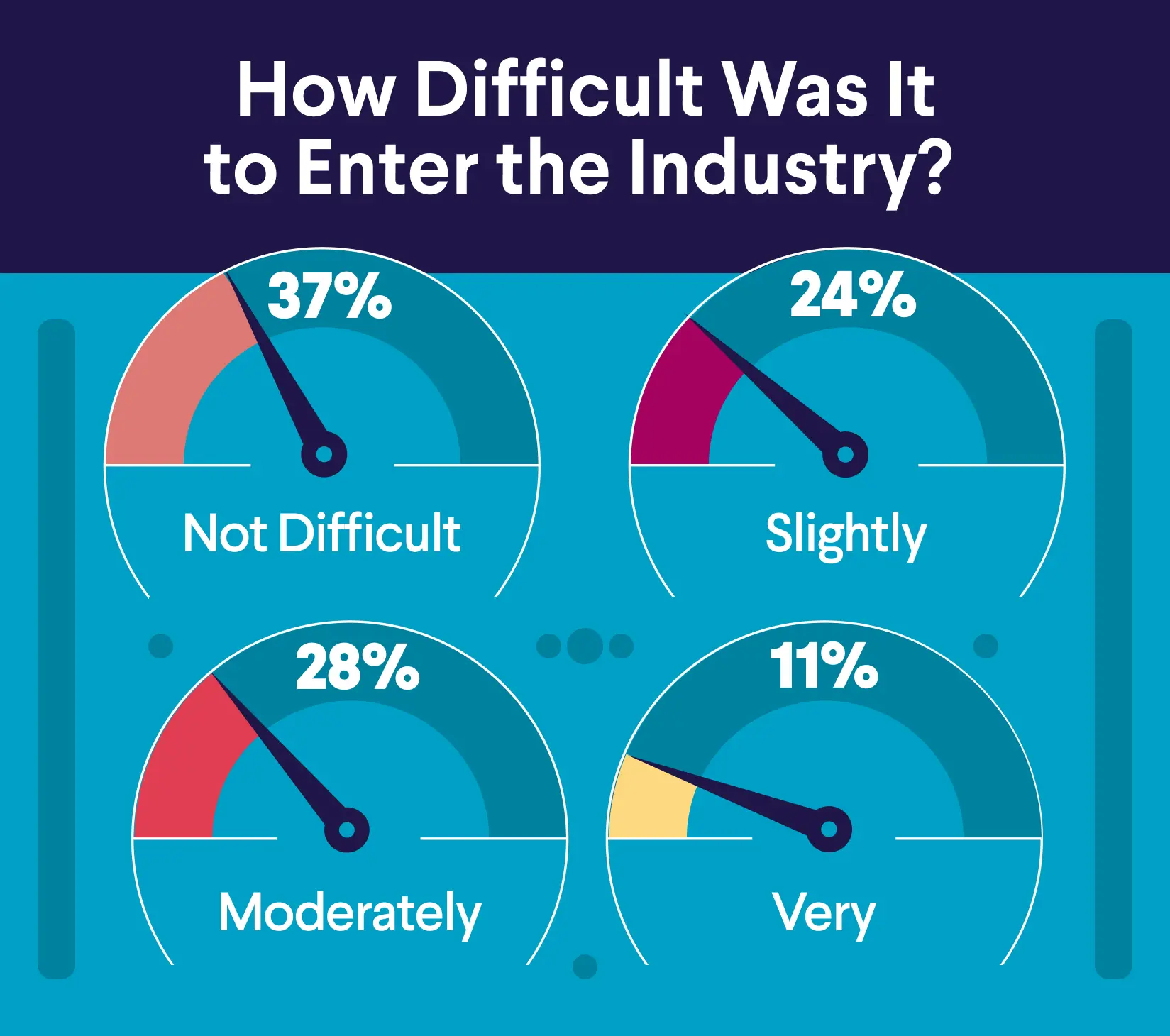
While breaking into a male-dominated field might sound intimidating, it was actually fairly simple, SoFi’s survey found: 61% of women business owners say it was not at all difficult — or just slightly difficult — to enter their industry.

Four gauge charts showing

•   Not at all difficult: 37%

•   Slightly difficult: 24%

•   Moderately difficult: 28%

•   Very difficult: 8%

•   Extremely difficult: 3%

The Challenges Women Entrepreneurs Faced When Entering Their Industry

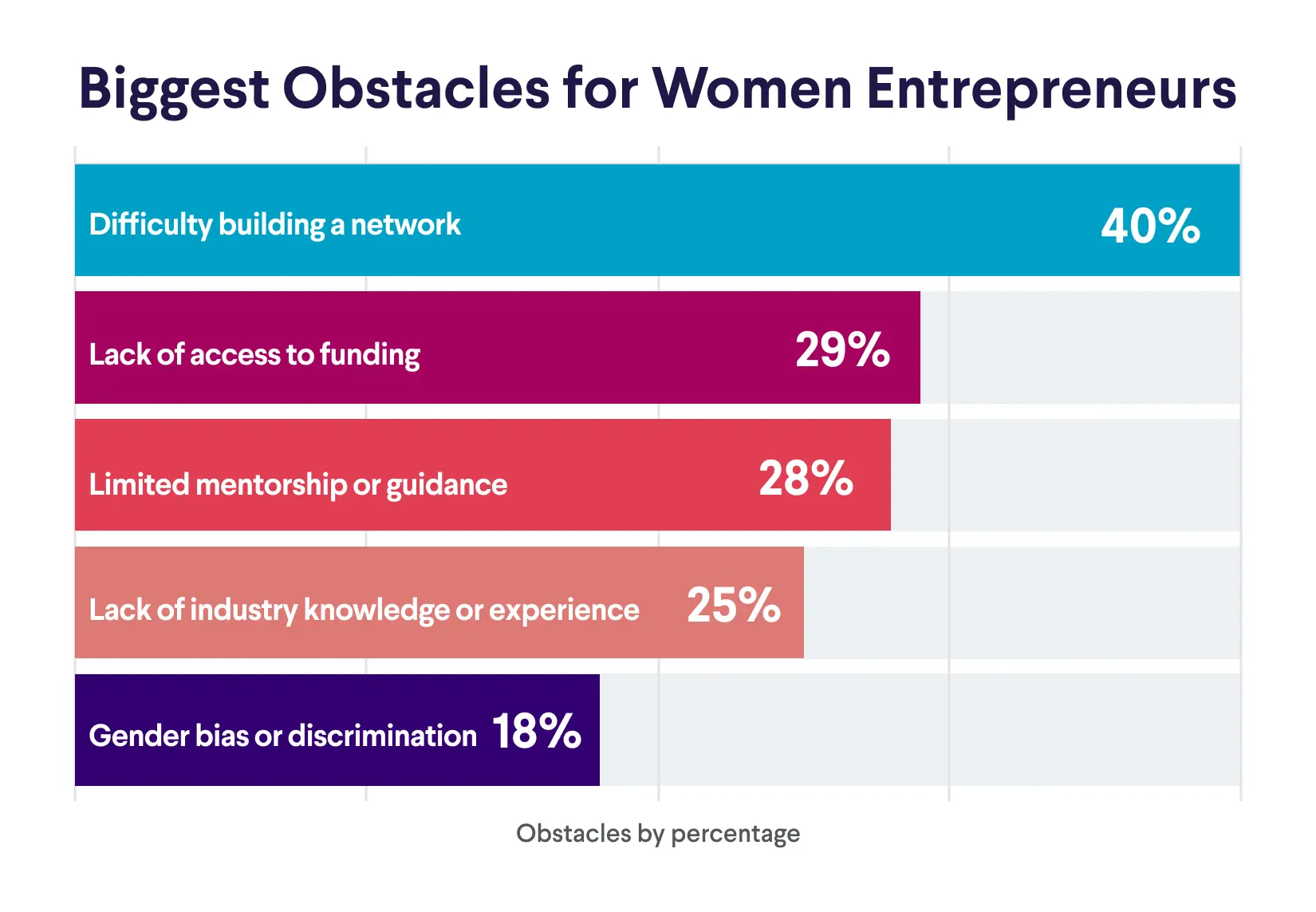
The main obstacles women business owners face had less to do with discrimination and more about building a support system, according to SoFi’s survey. Networking and finding a mentor were top challenges for 68% of respondents. Surprisingly, this was more than twice as challenging as securing funding.

Horizontal bar chart showing

•   Difficulty building a network: 40%

•   Lack of access to funding: 29%

•   Limited mentorship or guidance: 28%

•   Lack of industry knowledge or experience: 25%

•   Gender bias or discrimination: 18%

How Women Overcame the Biggest Challenges to Launching Their Business

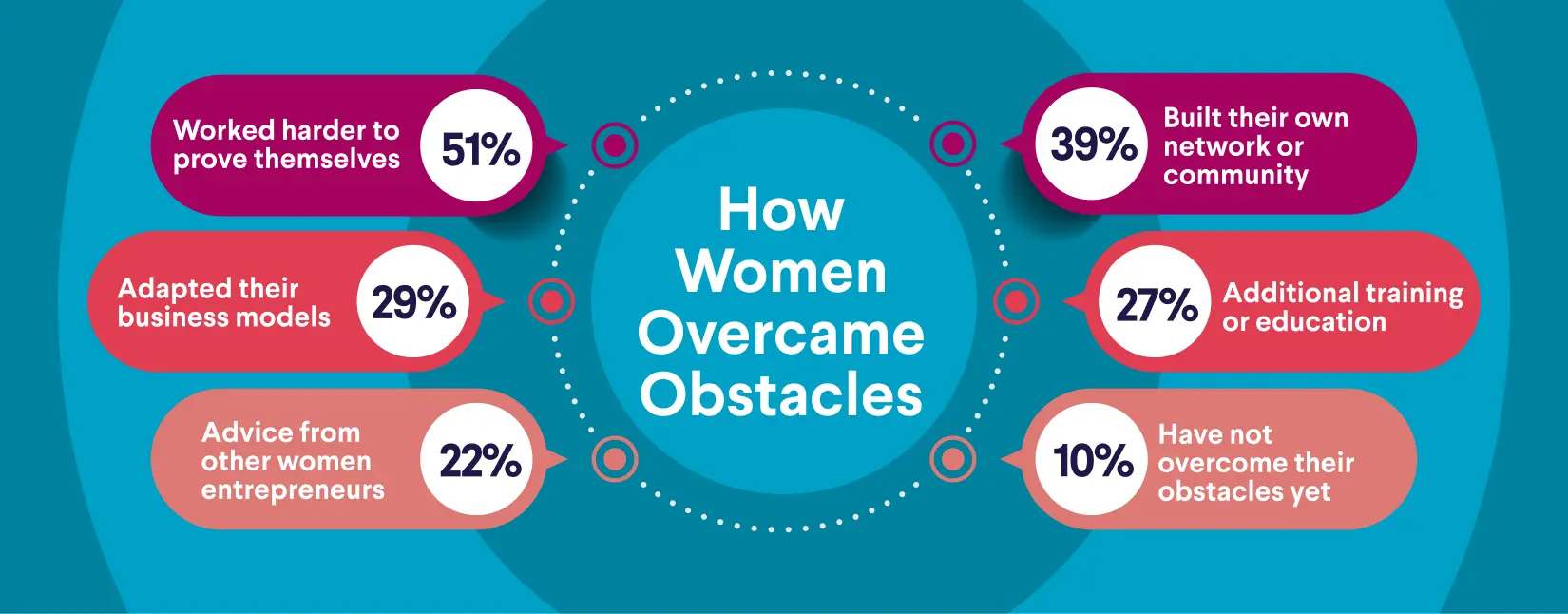
A few roadblocks didn’t slow down these female entrepreneurs, however. In fact, many women business owners found the hurdles motivating.

Infographic:

•   I worked harder to prove myself: 51%

•   I built my own network or support community: 39%

•   I adapted my business model to overcome obstacles: 29%

•   I pursued additional training or education: 27%

•   I sought advice or mentorship from other women entrepreneurs: 22%

•   I haven’t overcome them yet: 10%

Where the Money Comes From

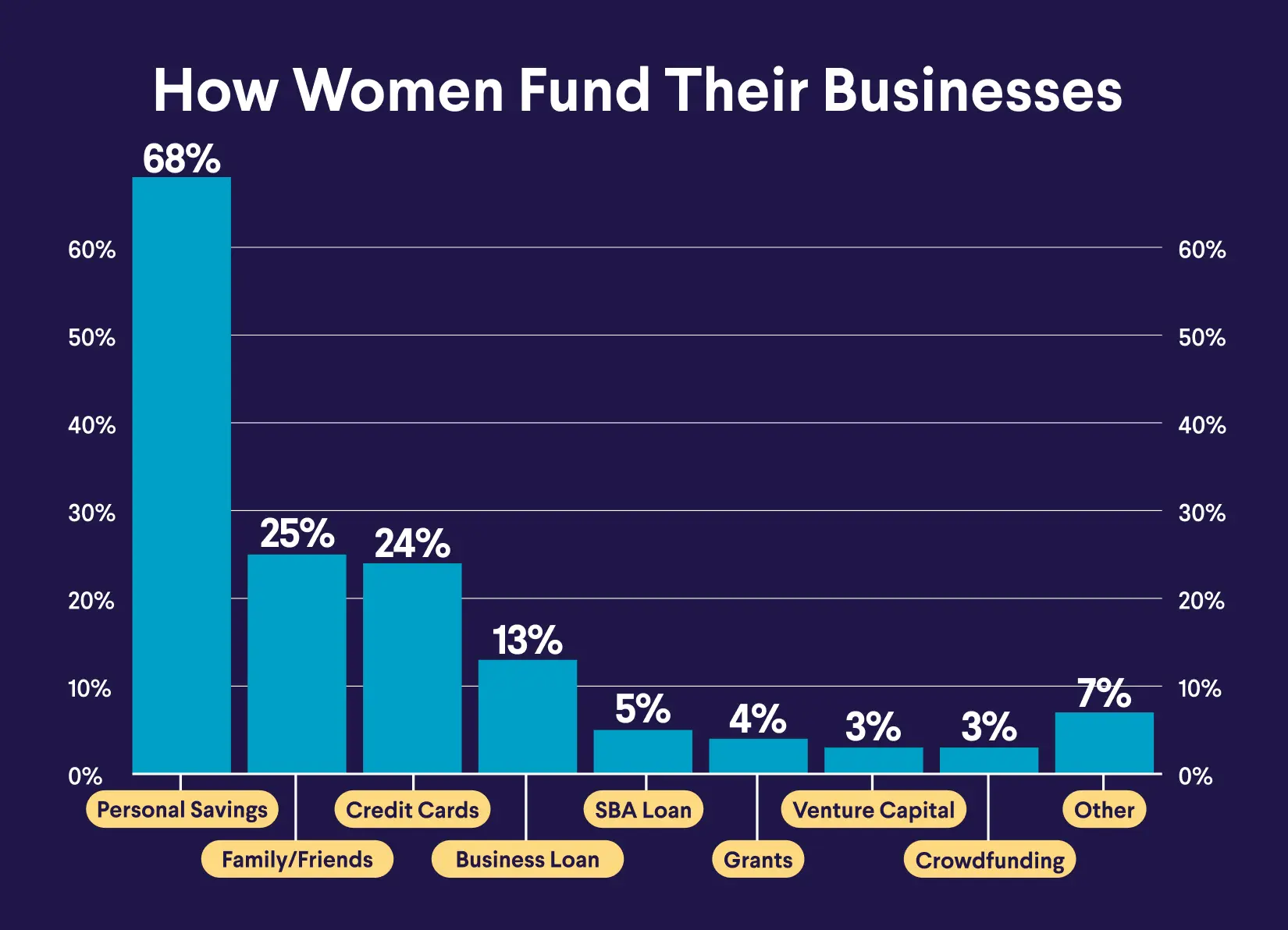
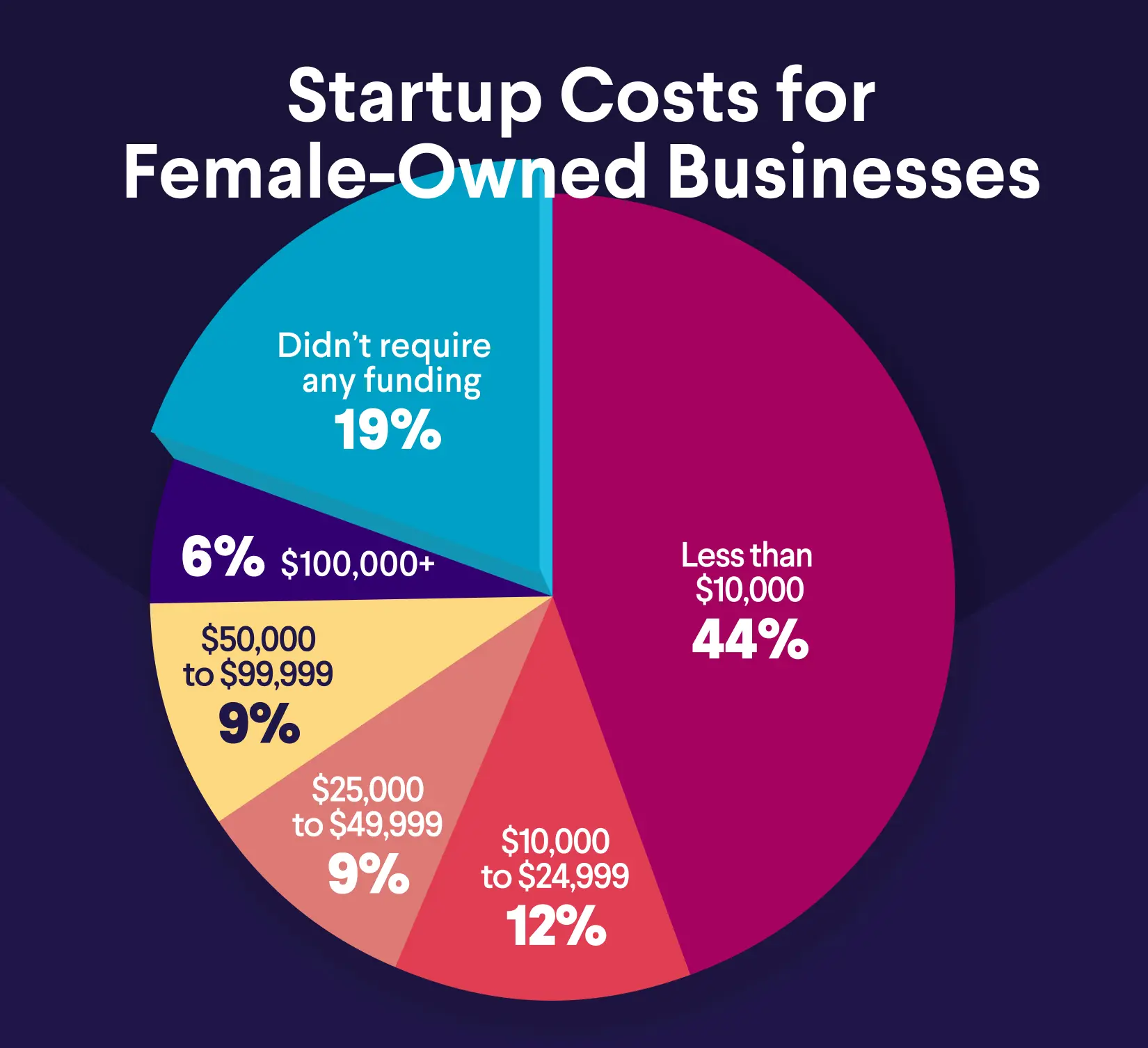
Most women business owners in the SoFi survey dug into their own savings to launch. Only 18% secured a business loan or Small Business Administration (SBA) loan. Perhaps it’s a good thing then that many of them required less than $10,000 to set up shop.

How Women Funded the Launch of Their Business

Bar chart:

•   Personal savings: 68%

•   Friends or family: 25%

•   Credit cards: 24%

•   Business loan (bank or private): 13%

•   SBA loan or assistance: 5%

•   Government grants: 4%

•   Venture capital or angel investors: 3%

•   Crowdfunding platforms: 3%

•   Other: 7%

The Initial Funding Their Business Required

Pie chart:

•   Less than $10,000: 44%

•   $10,000–$24,999: 12%

•   $25,000–$49,999: 9%

•   $50,000–$99,999: 9%

•   $100,000 or more: 6%

•   My business didn’t require any initial funding: 19%

Even though they primarily had to use their own savings or credit cards to launch, 47% of women business owners say they haven’t had any funding obstacles.

Recommended: Small Business Grants: Where to Find Funding

Financially Fluent

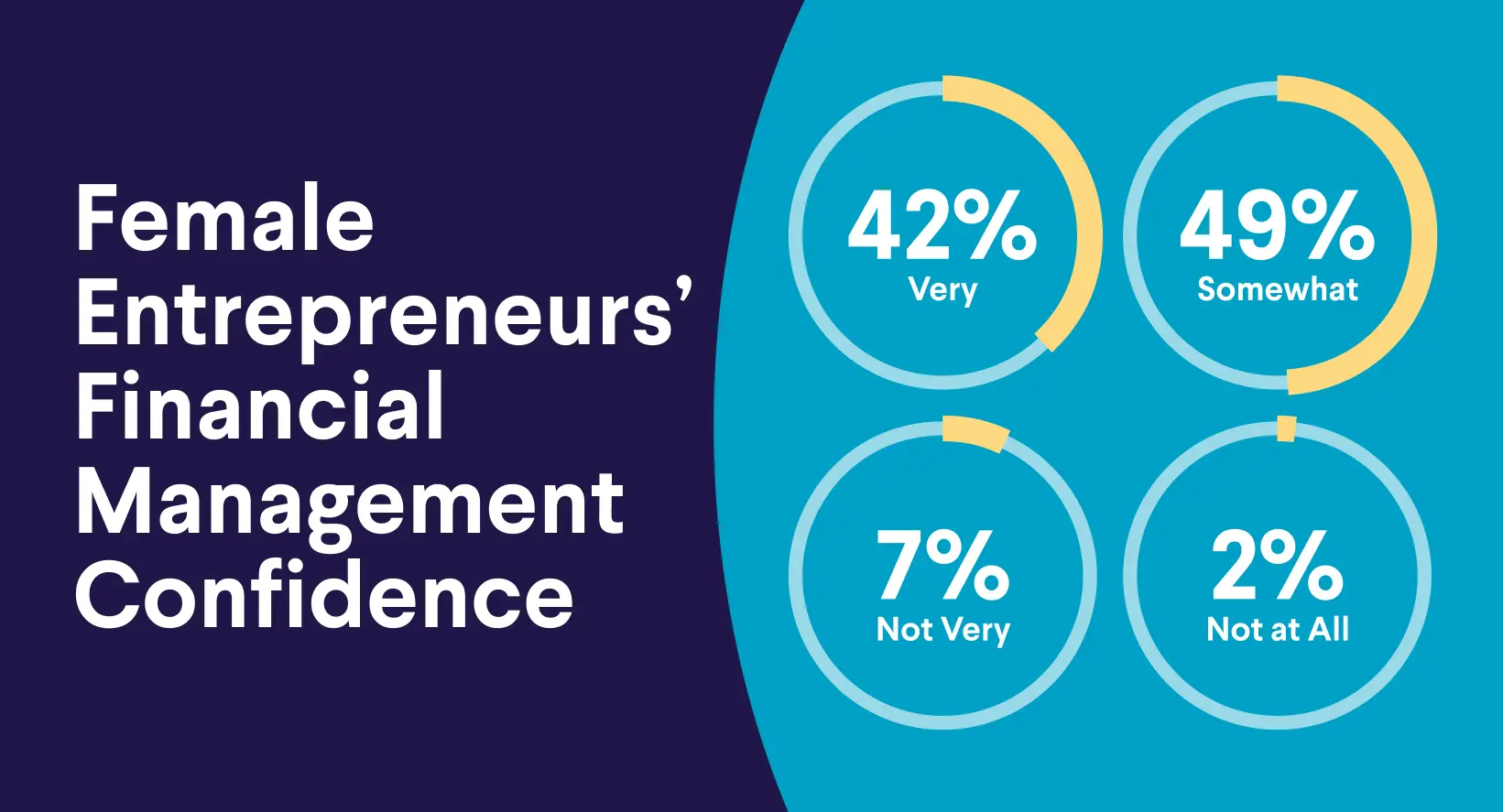
The overwhelming majority of women business owners report that they have good money management skills — and they’re proud to use them. Only 3% outsource this task to a professional.

Four circular charts showing Female Entrepreneurs' Financial Management Confidence: Very 42%, Somewhat 49%, Not Very 7%, Not at All 2%.

When asked how confident they are in managing business finances, respondents answered:

•   Very confident: 42%

•   Somewhat confident: 49%

•   Not very confident: 7%

•   Not confident at all: 2%

Most women business owners learned financial management skills on their own: 62% say they are self-taught through experience. Others had a little help, including 15% who learned from an advisor or mentor, and 12% who took classes or workshops. Eight percent of women entrepreneurs say they are still learning.

What Keeps Them Up At Night

Just like any business owner, female founders have concerns about specific financial issues. A substantial number of them are worried about the state of the U.S. economy.

Here’s what they said when asked: What are the biggest challenges related to managing your business finances?

•   Current economic uncertainty: 38%

•   Setting prices or fees: 32%

•   Understanding taxes or compliance: 27%

•   Budgeting and expense tracking: 21%

•   Forecasting revenue: 20%

•   Managing cash flow: 20%

•   I haven’t had major financial challenges: 19%

•   Access to capital or credit: 15%

Recommended: Mompreneurs: Generational Wealth and Real-Time Struggles

Reaping the Rewards

In the SoFi survey, women business owners revealed that money was less of a motivation to start their company than personal fulfillment. Thirty percent say they were inspired by the desire for flexibility and autonomy, and 27% launched to pursue a strong vision or passion. Just 23% say they started a business to generate income after a job loss or life change.

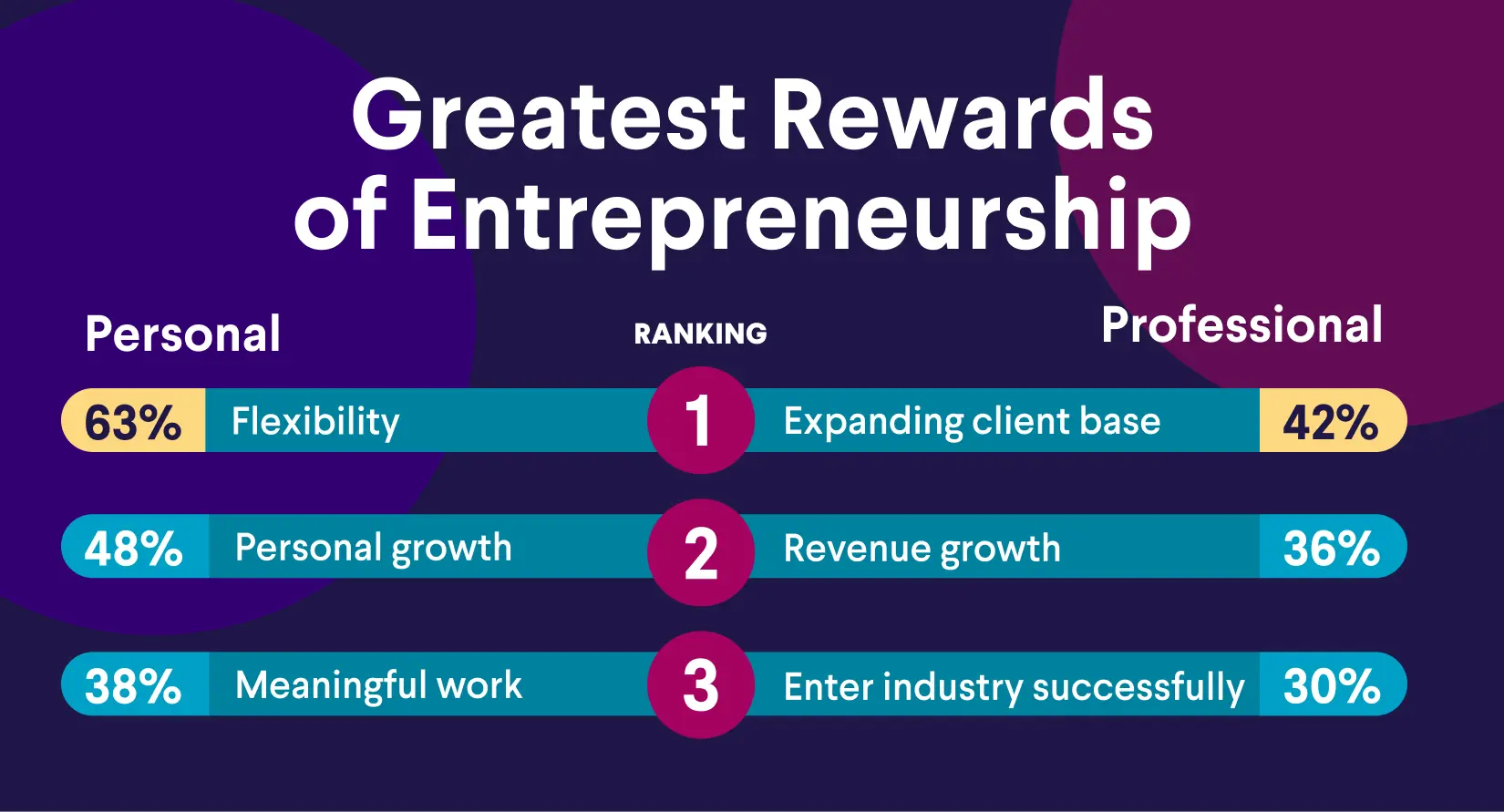
But for most respondents, the rewards have been well worth it.

Greatest Personal Rewards of Owning a Business

Infographic:

•   Flexibility and control over my time: 63%

•   Personal growth or self-confidence: 48%

•   Doing meaningful or impactful work: 38%

•   Financial independence or growth: 36%

•   Being able to provide for my family: 34%

•   Gaining respect or recognition: 28%

•   Growing savings for my family: 27%

•   Creating opportunities for others: 21%

Greatest Professional Rewards of Owning a Business

•   Expanding my client base or market: 42%

•   Achieving revenue growth: 36%

•   Successfully entering a new industry: 30%

•   Launching new services or products: 21%

•   Hiring a strong team: 18%

•   Receiving industry recognition or awards: 16%

Best Advice for Other Aspiring Women Business Owners

Text reads:
Text reads:
Text reads:
Text reads:

When asked what they would tell other women who are starting a business, the female entrepreneurs SoFi surveyed had a lot to say. Here are some of their best tips and words of wisdom:

“Try going out on a limb to achieve your dreams. You never know what you are capable of.”

“Don’t treat your business like a hobby. Keep trying and put all your efforts into it.”

“Be strong, classy, and in control. There’s nothing you can’t do if you put your mind to it.”

“Find support from other women.”

“Know the field well. I had twenty years of experience before I started my own business.”

“Learn as much as you can from someone who is in the same field or a similar one. Shadow them if you can.”

“It’s not always a direct path. Be open to changes.”

“Don’t be afraid to ask for help.”

“Save up your own money, start small and grow, and don’t give up if you have a good concept.”

“Do your homework, make sure you have good business and financial skills, evaluate risk, and don’t depend on one major customer.”

“Be tenacious, do your research, and have a two-year plan, a five-year plan, and a 10-year plan.”

“Keep learning and asking questions as you go.”

“Do your research, stay the course, and make connections everywhere you go. You never know where you will find an opportunity.”

The Takeaway

Women business owners are entering traditionally male-dominated industries in growing numbers. On the whole, they are finding the challenge motivating, according to SoFi’s 2025 survey of female entrepreneurs. Female founders have learned how to stand out from the competition, built stronger networks, and pivoted to adapt their business model to better compete.

These women business owners are confident in their financial management skills, the survey found. That may be because they’ve been doing it since the start — for many of them, funding their business was a DIY operation. They mainly relied on personal savings and credit cards to get the money they needed to launch.

Funding methods other aspiring women business owners may want to pursue include grants and loans. It can be helpful to explore all financial options when putting a business plan into action. If you’re seeking financing for your business, SoFi is here to support you. On SoFi’s marketplace, you can shop and compare financing options for your business in minutes.

If you’re seeking financing for your business, SoFi is here to support you. On SoFi’s marketplace, you can shop and compare financing options for your business in minutes.


Large or small, grow your business with financing that’s a fit for you. Search business financing quotes today.


SoFi's marketplace is owned and operated by SoFi Lending Corp.
Advertising Disclosures: The preliminary options presented on this site are from lenders and providers that pay SoFi compensation for marketing their products and services. This affects whether a product or service is presented on this site. SoFi does not include all products and services in the market. All rates, terms, and conditions vary by provider. See SoFi Lending Corp. licensing information below.

This content is provided for informational and educational purposes only and should not be construed as financial advice.

Financial Tips & Strategies: The tips provided on this website are of a general nature and do not take into account your specific objectives, financial situation, and needs. You should always consider their appropriateness given your own circumstances.

Third-Party Brand Mentions: No brands, products, or companies mentioned are affiliated with SoFi, nor do they endorse or sponsor this article. Third-party trademarks referenced herein are property of their respective owners.

SOSMB-Q325-012

Read more

The Minimum Wage Debate in 2025: Pros, Cons and What It Means for You

The minimum wage is the lowest hourly wage under the law that an employer can pay employees. The current minimum wage in the U.S. is $7.25 an hour, and it’s been the same rate since 2009. The question of whether to raise the minimum wage is a matter of great debate.

There are a number of pros and cons of raising the minimum wage. For example, advocates say that increasing the minimum wage could help low-wage hourly workers make ends meet and keep up with inflation. Some proponents also believe that raising the minimum wage could increase consumer spending and strengthen employee retention and morale.

But opponents point to cons of raising the minimum wage, including potentially increasing the cost of living overall, reducing opportunities for inexperienced workers, and triggering more unemployment.

Read on to learn more about the pros and cons of increasing the minimum wage and potential effect it could have on the economy — and your finances.

Key Points

•   The federal minimum wage has not changed since 2009, despite inflation.

•   There are arguments for and against raising the minimum wage. Proponents say raising it could help low-wage workers escape poverty and keep up with inflation.

•   Increased wages might also lead to higher consumer spending and reduced reliance on government assistance.

•   Higher labor costs from wage increases could lead to unemployment, higher prices for goods and services, and accelerate a shift toward workplace automation, opponents say.

•   Some states have their own minimum wage laws. The state with the highest minimum wage is the state of Washington, where the minimum wage is $16.66 an hour.

What Is the Federal Minimum Wage in 2025?

The federal minimum wage in 2025 is $7.25 per hour. The last time the minimum wage increased was on July 24, 2009, when it grew from $6.55 an hour to $7.25. That was part of a three-phase increase enacted by Congress in 2007.

Tipped employees (like waiters) have a different minimum wage called the tipped minimum wage. The current federal tipped minimum wage is $2.13 an hour, as long as the worker’s tips make up the difference between that and the standard minimum wage.

Similar to the differences in the average salary by state, some states have their own minimum wage laws with a higher (or lower) starting wage than the federal minimum. In such states, employers must pay the higher of the two minimum wages.

Here are some minimum wage fast facts:

•   The state with the highest current minimum wage is Washington, where the rate is $16.66 per hour. Washington state’s minimum wage is expected to increase in 2026 (the amount of the increase has not yet been announced). Although it’s not a state, Washington, D.C. currently has the highest minimum wage in the country — $17.95 an hour as of July 1, 2025.

•   There are 67 cities and counties with minimum wages higher than their state’s minimum wages. Of these, the city of Burien, Washington, currently has the highest wage at $21.16 per hour for employees of large employers (those with more than 500 employees).

•   Three states — Georgia, Oklahoma, and Wyoming — have minimum wages that are lower than the federal minimum. But by law, employees in those states must be paid the federal minimum wage.

•   About 21 million US workers make less than $15 per hour, according to the most recent data (from 2023).

•   While the minimum wage has been stagnant since 2009, inflation has not. The spending power of $7.25 in 2009 is equivalent to $10.92 today. This means that $7.25 can buy today about 66% of what it could buy in 2009, which can impact the cost of living.

What Is the Purpose of the Minimum Wage?

The federal minimum wage was created in the late 1930s as part of the recovery effort after the Great Depression. At the time, Congress found that low wages in certain industries were causing one-third of the population of the U.S. to be “ill-nourished, ill-clad, and ill-housed.”

As part of President Franklin D. Roosevelt’s New Deal program, the Fair Labor Standards Act (FSLA) of 1938 officially established the first minimum wage of $0.25 an hour. The FSLA also created the 40-hour work week, banned child labor, and mandated overtime pay.

The minimum wage was gradually increased to $0.40 an hour in 1945. It has been raised 22 times since then, with the last increase taking place in 2009, as noted above.

Recommended: Salary vs. Hourly Pay

Increase your savings
with a limited-time APY boost.*


*Earn up to 4.00% Annual Percentage Yield (APY) on SoFi Savings with a 0.70% APY Boost (added to the 3.30% APY as of 12/23/25) for up to 6 months. Open a new SoFi Checking and Savings account and pay the $10 SoFi Plus subscription every 30 days OR receive eligible direct deposits OR qualifying deposits of $5,000 every 31 days by 3/30/26. Rates variable, subject to change. Terms apply here. SoFi Bank, N.A. Member FDIC.

The Argument for Raising the Minimum Wage

Increasing the minimum wage could be beneficial for low-wage workers and the labor market, proponents say. These are some of the potential benefits of raising the minimum wage.

Pro: Boosting Consumer Purchasing Power Amidst Inflation

Even without minimum wage increases, inflation has been on a rollercoaster ride over the last several years. At the end of 2019, inflation was 2.3%. By December 2023, it was 3.4%. In August 2025, inflation was 2.9%. That means today, the average American family is likely paying more for the average cost of groceries, among other expenses, than they were six years ago.

The Raise the Wage Act of 2025 was introduced in Congress in April of 2025 to raise the minimum wage to $17 an hour by 2028. The goal of the Act is to give American workers a raise and more buying power to make ends meet. As of September 2025, the Act has not been voted on.

While raising the minimum wage will not necessarily beat inflation, earning more money could make it easier for lower-income families to afford basic necessities.

Pro: Reducing Poverty and Income Inequality

Data from the Bureau of Labor Statistics shows that low-wage earners spend a larger portion of their budget than higher-wage earners on immediate daily needs like food, shelter, transportation, and medical care. Raising the minimum wage could give these workers more money to spend on other things, including discretionary items such as eating out, travel, and streaming services.

Increased consumer spending helps stimulate the economy. It’s a positive economic indicator reflecting consumer confidence in the market, and it typically creates more revenue for businesses.

Pro: Improving Employee Retention in a Competitive Labor Market

According to a study by researchers at the Kellogg School of Management at Northwestern University, workers with a higher minimum wage tend to work harder and are more productive. Not only that, earning a higher wage could be an incentive for workers to stay with a company longer, which can help reduce turnover.

That’s generally considered beneficial since employee turnover is expensive. Replacing an employee with a new candidate can cost about 50% of the worker’s salary or possibly more, according to the HR firm G&A Partners. In that case, it could make more financial sense for a business to pay an employee a better salary to keep them on staff, rather than recruiting and training a new worker to replace them.

The Argument Against Raising the Minimum Wage

Increasing the minimum wage could lead to higher prices and unemployment, opponents say. These are some of the possible cons of raising the minimum wage.

Con: Potentially Increasing Prices for Consumers

If business owners have to raise the minimum wage they pay workers, they would likely raise the prices of their products and services to help pay for the higher labor costs. As employers pass the higher costs along to their customers, consumers will end up paying more for the things they buy. That means their dollars won’t go as far as they used to, which could contribute to inflation.

Con: Risking Job Losses, Especially for Small Businesses

The increased labor costs of a higher minimum wage could be substantial. If the minimum wage increased to, say, $15 an hour, businesses would suddenly need to give raises to everyone making less than that.

But not all companies can afford that. Small businesses that have a slim profit margin could struggle in particular. Restaurants, for example, operate at a 3% to 9% profit margin. Increasing labor costs could shrink (or eliminate) their margins, meaning they might have to let go of some staff or even go out of business.

Con: Could Accelerate a Shift Toward Automation

Employees without specialized skills often work some minimum wage jobs to earn what might be considered entry-level salaries. But as employers are forced to pay workers more, companies might invest in automated technology or artificial intelligence (AI) to do these jobs.

According to one recent survey, approximately 30% of hiring managers said they would use automation or AI if the minimum wage was raised. This could make it more challenging for unskilled laborers to find work; other workers could lose their jobs to automation or AI. They might then have to go on unemployment or try to rely on popular side hustles to try to earn a living and pay their bills.

What Is the Predicted Economic Impact of a Federal Minimum Wage Increase?

There are differing views on how raising the federal minimum might impact the economy. An analysis by the Economic Policy Institute (EPI) found that the $17 an hour minimum wage increase proposed by the Raise the Wage Act of 2025, would provide an additional $70 billion dollars each year in wages to the lowest-paid workers in the U.S. The average worker in this category would make an additional $3,200 a year, the EPI estimates.

However, according to the Congressional Budget Office (CBO), which has also examined the potential impact of the Raise the Wage Act, while the wages and family income of many low-paid workers would likely increase with a higher federal minimum wage, for other families, income would fall due to business owners absorbing the cost of higher wages among other reasons. Overall, the CBO says the number of families in poverty would likely decrease.

But higher wages would likely cause some employers to employ fewer workers, the CBO says. That could result in more unemployed and jobless workers.

How a Changing Minimum Wage Could Affect Your Personal Finances

Beyond the potential impact to the economy, a higher minimum wage could have an effect on individuals’ finances as well — including yours.

For example, an increase in spending by low-wage workers can drive up demand for goods and services and help stimulate the economy and boost economic growth. Employees already making more than the minimum wage might even see their own earnings increase if employers feel pressure to compensate them as well.

But prices may go up as businesses try to offset higher labor costs. That means you might pay more for the things you buy. Employers may also hire fewer workers or make reductions in workforce. And they might also outsource or automate more jobs, which could negatively impact many individuals’ employment opportunities and result in more unemployment.

Fortunately, there are some steps you can take to help protect your own bottom line. Here are some strategies to consider.

Reduce expenses where you can. Take a look at the cost of living in your city or town. Is it reasonable? Or are housing prices and grocery prices more expensive in your locale? Those living in the most affordable cities might find that their dollars go farther. Even relocating a few towns over to one with a lower cost of living might help you save money.

Give your savings a boost. Let’s say you have a goal of saving up for a downpayment on a house, or establishing an emergency fund. One step you might want to consider is opening a high-yield savings account. These accounts have higher interest rates than traditional bank accounts, which could help your savings grow.

Make it simple. Automating your finances can make it easier to save. With direct deposit, for example, your paycheck will go right into your bank account — without you even having to think about it. You might even be able to get your money in there faster. For example, by setting up direct deposit to your SoFi checking and savings account, you can get an early paycheck.

The Takeaway

The original intention for creating a federal minimum wage was to enable workers to have a standard of living that would improve and maintain their health and well-being. However, today’s minimum wage of $7.25 an hour has not risen since 2009. Increasing the minimum wage has a number of potential benefits, but there are possible negative economic effects to minimum wage increases as well.

While the debate over this complex issue will likely continue, remember that you have control over your own finances. Establishing financial goals, and setting up a plan to save for them, can help you manage your money.

Interested in opening an online bank account? When you sign up for a SoFi Checking and Savings account with eligible direct deposit, you’ll get a competitive annual percentage yield (APY), pay zero account fees, and enjoy an array of rewards, such as access to the Allpoint Network of 55,000+ fee-free ATMs globally. Qualifying accounts can even access their paycheck up to two days early.


Better banking is here with SoFi, NerdWallet’s 2024 winner for Best Checking Account Overall.* Enjoy 3.30% APY on SoFi Checking and Savings with eligible direct deposit.

FAQ

Why are state minimum wages different?

In general, states are able to enact laws that differ from federal laws according to their state needs. Many states with a higher cost of living, like California and Washington, have increased their minimum wage to roughly double the federal minimum. If a state’s minimum wage differs from the federal minimum wage, employers must pay the higher of the two rates.

Who benefits from a minimum wage increase?

Low-income workers can potentially benefit from a minimum wage cost, according to proponents of raising the minimum wage. That’s because earning a higher wage could give them more money to spend on things beyond basic needs like food, shelter, and medical care. For example, they could spend more on such discretionary items such as eating out, and streaming services. This kind of increased consumer spending might, in turn, stimulate the economy.

Does increasing the minimum wage affect cost of living?

It’s possible that increasing the minimum wage could raise the cost of living. This might happen if employers raise prices on the items or services they sell to help cover the cost of higher wages for employees. Higher prices, in turn, may cause inflation to rise, which means that dollars won’t go as far as they used to.

What state has the highest minimum wage?

The state with the highest minimum wage is Washington state, where the state minimum wage is currently $16.66 per hour, and it’s expected to increase in 2026. Although it’s not a state, Washington, D.C. has the highest minimum wage overall of $17.95 an hour.

What might be an opportunity cost of raising the minimum wage?

One possible opportunity cost of raising the minimum wage is that employers might reduce their labor force and lay off workers to help pay for the increased cost of higher wages. They might also automate certain jobs, which could result in more unemployment.


Photo credit: iStock/MicroStockHub

SoFi Checking and Savings is offered through SoFi Bank, N.A. Member FDIC. The SoFi® Bank Debit Mastercard® is issued by SoFi Bank, N.A., pursuant to license by Mastercard International Incorporated and can be used everywhere Mastercard is accepted. Mastercard is a registered trademark, and the circles design is a trademark of Mastercard International Incorporated.

^Early access to direct deposit funds is based on the timing in which we receive notice of impending payment from the Federal Reserve, which is typically up to two days before the scheduled payment date, but may vary.

Annual percentage yield (APY) is variable and subject to change at any time. Rates are current as of 12/23/25. There is no minimum balance requirement. Fees may reduce earnings. Additional rates and information can be found at https://www.sofi.com/legal/banking-rate-sheet

Eligible Direct Deposit means a recurring deposit of regular income to an account holder’s SoFi Checking or Savings account, including payroll, pension, or government benefit payments (e.g., Social Security), made by the account holder’s employer, payroll or benefits provider or government agency (“Eligible Direct Deposit”) via the Automated Clearing House (“ACH”) Network every 31 calendar days.

Although we do our best to recognize all Eligible Direct Deposits, a small number of employers, payroll providers, benefits providers, or government agencies do not designate payments as direct deposit. To ensure you're earning the APY for account holders with Eligible Direct Deposit, we encourage you to check your APY Details page the day after your Eligible Direct Deposit posts to your SoFi account. If your APY is not showing as the APY for account holders with Eligible Direct Deposit, contact us at 855-456-7634 with the details of your Eligible Direct Deposit. As long as SoFi Bank can validate those details, you will start earning the APY for account holders with Eligible Direct Deposit from the date you contact SoFi for the next 31 calendar days. You will also be eligible for the APY for account holders with Eligible Direct Deposit on future Eligible Direct Deposits, as long as SoFi Bank can validate them.

Deposits that are not from an employer, payroll, or benefits provider or government agency, including but not limited to check deposits, peer-to-peer transfers (e.g., transfers from PayPal, Venmo, Wise, etc.), merchant transactions (e.g., transactions from PayPal, Stripe, Square, etc.), and bank ACH funds transfers and wire transfers from external accounts, or are non-recurring in nature (e.g., IRS tax refunds), do not constitute Eligible Direct Deposit activity. There is no minimum Eligible Direct Deposit amount required to qualify for the stated interest rate. SoFi Bank shall, in its sole discretion, assess each account holder's Eligible Direct Deposit activity to determine the applicability of rates and may request additional documentation for verification of eligibility.

See additional details at https://www.sofi.com/legal/banking-rate-sheet.

We do not charge any account, service or maintenance fees for SoFi Checking and Savings. We do charge a transaction fee to process each outgoing wire transfer. SoFi does not charge a fee for incoming wire transfers, however the sending bank may charge a fee. Our fee policy is subject to change at any time. See the SoFi Bank Fee Sheet for details at sofi.com/legal/banking-fees/.
*Awards or rankings from NerdWallet are not indicative of future success or results. This award and its ratings are independently determined and awarded by their respective publications.

Financial Tips & Strategies: The tips provided on this website are of a general nature and do not take into account your specific objectives, financial situation, and needs. You should always consider their appropriateness given your own circumstances.

Third-Party Brand Mentions: No brands, products, or companies mentioned are affiliated with SoFi, nor do they endorse or sponsor this article. Third-party trademarks referenced herein are property of their respective owners.

SOBNK-Q325-108

Read more
TLS 1.2 Encrypted
Equal Housing Lender