college campus overhead mobile

What to Do the Summer Before College

The summer before college can be a transformative time before you head off for your independent life as a student. You can reflect, work, get organized, and spend quality time with the people you love at the places you love one last time before school is in session.

At the same time, there are a number of tasks you’ll need to complete to make sure your transition to school goes as smoothly as possible. Here’s a simple checklist that can help ensure you make the most of your last summer before college.

Key Points

•   The summer before college can be a good time for reflection and preparation, setting the stage for a successful transition.

•   Work, volunteer, or intern to earn extra money and gain valuable experience.

•   Organize belongings, donate or sell unneeded items, and clean up old academic work.

•   Review and update social media presence to present a professional image to future employers.

•   Connect with family and future roommates, and prepare a list of dorm essentials.

Getting Organized

Now is the time to clear out the old so you can bring in the new. The bedroom is a good place to start.

Clear out your closet: Use the summer to clean out your closet and dresser and get rid of any clothing you may no longer need or want for college. Start by pulling every single item out and making a giant pile on the floor, separating the clothing into piles to keep, toss, and donate. Donating gently used items to a local charity or second-hand shop will help them find a second life. Or you might try to sell your stuff and raise some cash.

Toss old academic work: Go through notebooks, binders, and bookbags, using the same sorting method as with clothing. Cleaning out your computer and deleting any files you no longer need — perhaps moving some to cloud storage — can allow you to enter college with a clean desktop and plenty of space on your hard drive.

Start packing: To make the moving process a little smoother, try organizing your items and packing slowly over the summer instead of cramming it all into one day. Creating boxes labeled as bedding, kitchen, bathroom, academic, and miscellaneous — maybe limiting the size of that particular box, though — then adding items as you’re organizing will make moving easier when the time comes.

Cleaning up Your Social Media

Just like cleaning out your closet, it’s probably time to think about cleaning up your social media presence, too. You may have joined Facebook groups or liked pages that no longer reflect your interests or what you believe in.

On Twitter and Instagram, it may be a good idea to look back at your content to make sure what you’re sharing is appropriate for future employers to see. If not, you might want to consider deleting it.

Finally, think about your social media handles and your email address. If possible, it might be a good idea to use your full name or a combination of first initial and last name — something clean and simple. Potential employers will likely look at this information before hiring for summer internships or future jobs, so presenting yourself as a professional might pay off in the long run.

Recommended: College Freshman Checklist for the Upcoming School Year

Spending Quality Time With Your Family

Even though your parents may have sometimes embarrassed you through your high school years and your siblings may have annoyed you since you became siblings, you’ll probably still miss them when you head off to college. Use this time to make memories with your family so you have something fond to look back on if you’re ever homesick.

Over the summer, try creating family date nights. Play board games, cook together, go to your favorite restaurants, the movies, whatever makes you all happy. As a bonus, you’ll get to visit all your favorite hometown spots along the way, too.

Recommended: 5 Ways to Start Preparing For College

Connecting With Your New Roommate

If you’re living in a dorm in the fall, you likely already know who your roommate will be. You may want to use the few weeks before school begins to prepare for the college experience ahead by connecting with them, via phone, text/email, Facetime, or, if possible, in-person.

Consider making a list of dorm room items that you can share, and try making a list of ground rules before you even move in. This could help alleviate any issues before they ever begin.

Recommended: A Guide to Making Friends in College

Preparing Your Dorm Essentials

After chatting with your roommate and figuring out what you both need, it’s time to make a full list of dorm essentials. This essentials list should include bedding, toiletries that fit into a basket to carry to and from shared bathrooms, a pair of slippers to use in common areas (including shower areas), and office supplies like pens, paper, notebooks, labels, rubber bands, scissors, and sticky notes.

You’ll now be responsible for doing your own laundry, so make sure to add on a laundry basket and detergent. The list can also include decorations such as desk lamps, a bulletin board, and any fun decor that fits your style.

Becoming Familiar With Your College Town

You can get familiar with your new town even before you set foot in it by checking out local publications, including local news sites and your school’s newspaper. You might want to make a list of restaurants you want to try and local attractions you’d like to see.

You might also consider sharing the list with your new roommate so you can explore the town together.

Recommended: How to Get Involved on Campus in College

Registering for Classes

It could be prudent to check out class offerings before registration even opens. Familiarize yourself with the classes offered (such as lower vs. upper division courses) in your degree program, which ones are available to freshmen, and which electives you’d like to take. Make a list and have it handy for registration day.

Pro tip: Sign up for classes as soon as registration is open because popular classes may fill up fast.

Checking Out Your Professors Online

Once you’ve got your classes lined up, it’s time to check out your future professors. Doing a bit of online research on the people who will be teaching you could help identify any potential future mentors.

Getting to know professors can make asking for recommendations for internships and jobs easier. If they don’t know you well, it might be difficult for them to recommend you.

Getting Your Finances in Order

It’s time for the most adult step of all. During the summer before college, it’s probably time to get your finances in order. If you don’t already have a checking account, it’s a good idea to open one, ideally at a bank that you can access easily while at school.

Now is also a good time to explore — and discuss with your family — how you will finance all four years of your college education. You may have filled out the FAFSA and explored your options for funding your expenses.

Private student loans are available through private lenders, including banks, credit unions, and online lenders. Rates and terms vary, depending on the lender. Unlike federal student loans, private student loans will require a credit check. Generally, borrowers (or cosigners) who have strong credit qualify for the lowest rates.

Keep in mind, though, that private loans may not offer the borrower protections — like income-based repayment plans and deferment or forbearance — that automatically come with federal student loans.

The Takeaway

The summer before college starts can be a good time to get organized, spend time with friends and family, connect with your roommate(s), explore your new campus, register for classes, and make sure you’re ready to handle the cost of your education.

If you’ve exhausted all federal student aid options, no-fee private student loans from SoFi can help you pay for school. The online application process is easy, and you can see rates and terms in just minutes. Repayment plans are flexible, so you can find an option that works for your financial plan and budget.


Cover up to 100% of school-certified costs including tuition, books, supplies, room and board, and transportation with a private student loan from SoFi.

FAQ

Should I work the summer before college?

It can be a smart move to work the summer before college, even if you have tuition covered for the upcoming terms. By working, you can save money for incidental expenses or begin an emergency fund.

What is the summer before freshman year good for?

The summer before your freshman year of college is a good time to get acclimated to the school year ahead. It can be wise to consider the supplies you’ll need for your living space and classes; spend time with family and hometown friends, and learn how your new campus operates and what extracurricular activities are available. The summer is also a good time to earn some extra money to put toward your education.

How to be productive the summer before college?

There are a variety of ways to be productive the summer before college. You might get a job, internship, or volunteer position. Or you could organize your belongings as you pack, selling or donating what you don’t need. Another idea is to prepare for your classes, if you know what they are, by securing books and looking at the course syllabus. You could also reach out and begin forging a relationship with your roommate(s).


SoFi Loan Products
SoFi loans are originated by SoFi Bank, N.A., NMLS #696891 (Member FDIC). For additional product-specific legal and licensing information, see SoFi.com/legal. Equal Housing Lender.


SoFi Private Student Loans
Please borrow responsibly. SoFi Private Student loans are not a substitute for federal loans, grants, and work-study programs. We encourage you to evaluate all your federal student aid options before you consider any private loans, including ours. Read our FAQs.

Terms and conditions apply. SOFI RESERVES THE RIGHT TO MODIFY OR DISCONTINUE PRODUCTS AND BENEFITS AT ANY TIME WITHOUT NOTICE. SoFi Private Student loans are subject to program terms and restrictions, such as completion of a loan application and self-certification form, verification of application information, the student's at least half-time enrollment in a degree program at a SoFi-participating school, and, if applicable, a co-signer. In addition, borrowers must be U.S. citizens or other eligible status, be residing in the U.S., Puerto Rico, U.S. Virgin Islands, or American Samoa, and must meet SoFi’s underwriting requirements, including verification of sufficient income to support your ability to repay. Minimum loan amount is $1,000. See SoFi.com/eligibility for more information. Lowest rates reserved for the most creditworthy borrowers. SoFi reserves the right to modify eligibility criteria at any time. This information is subject to change. This information is current as of 4/22/2025 and is subject to change. SoFi Private Student loans are originated by SoFi Bank, N.A. Member FDIC. NMLS #696891 (www.nmlsconsumeraccess.org).

Financial Tips & Strategies: The tips provided on this website are of a general nature and do not take into account your specific objectives, financial situation, and needs. You should always consider their appropriateness given your own circumstances.

Third-Party Brand Mentions: No brands, products, or companies mentioned are affiliated with SoFi, nor do they endorse or sponsor this article. Third-party trademarks referenced herein are property of their respective owners.

SOISL-Q325-111

Read more
doctor and nurse on smartphone

What Is the Average Medical School Debt?

While many med school students eventually may earn six figures or more, they also can expect to graduate with student debt that averages close to a quarter of a million dollars. According to the Education Data Initiative (EDI), the average medical school debt for students is $234,597.

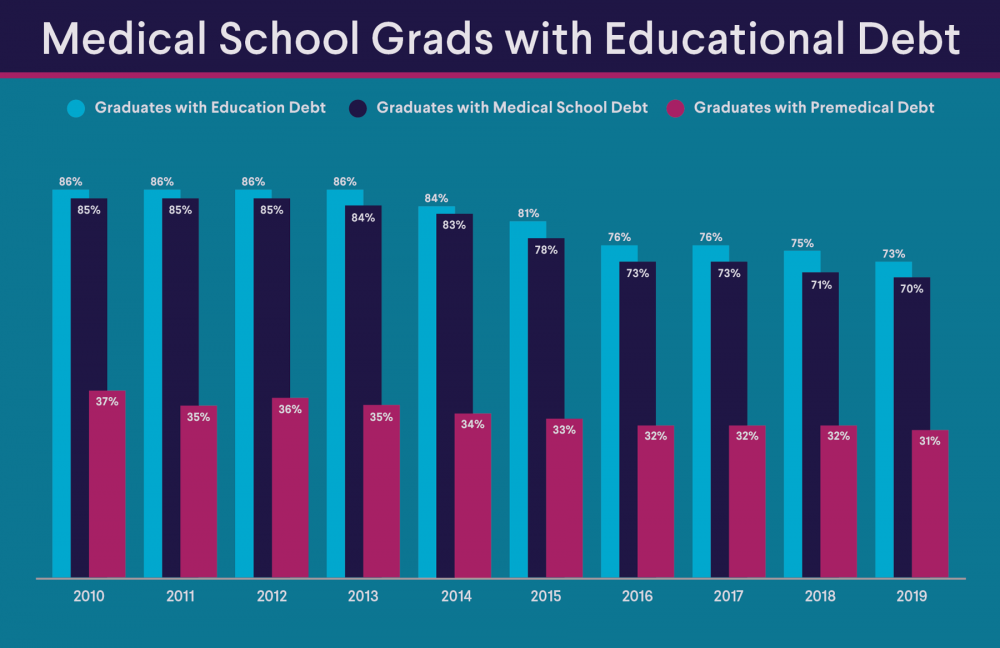
And that’s just what these graduates owe for their medical school education. EDI found that 31% of indebted medical school graduates also have premedical education debt to pay for.

Because of the high cost of medical school debt, it’s crucial for aspiring and current medical school students and graduates to understand their debt repayment options.

Key Points

•  The average medical school debt for graduates in 2024 was reported at $234,597, contributing to a total education debt of approximately $264,519 when including premedical loans.

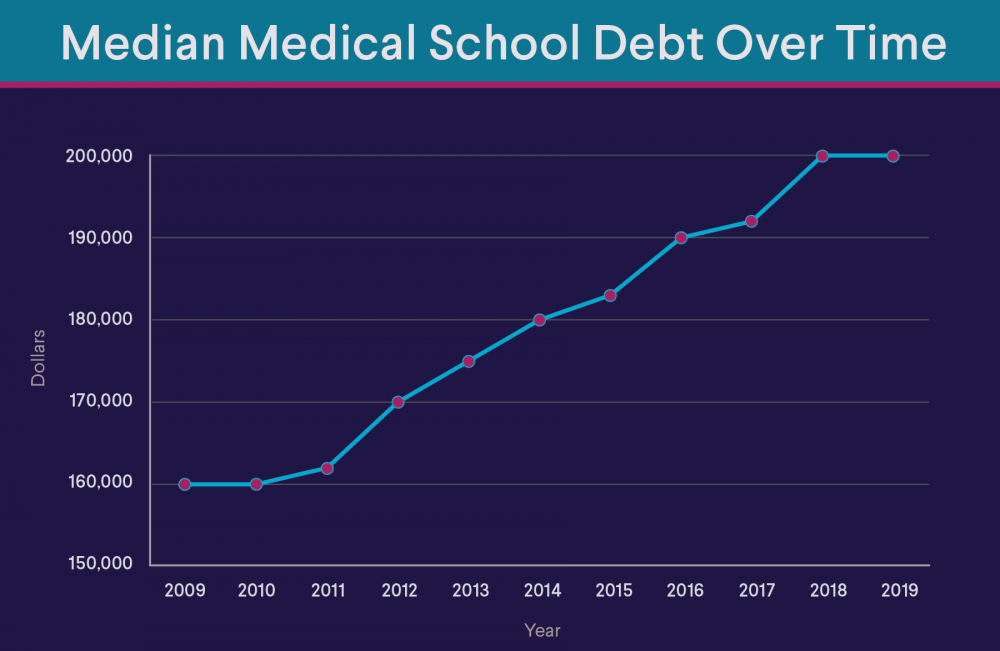
•  Average medical school debt increased by 48.5% between 1998 and 2019.

•  Federal student loans currently available for medical students include Direct Unsubsidized Loans and Grad PLUS loans, but Grad PLUS Loans will be eliminated as of July 1, 2026.

•  Graduates facing high debt can consider options like deferment, income-driven repayment, refinancing, or loan consolidation to help manage their financial burden.

•  A disparity in student debt exists among medical schools, with some institutions leading to significantly higher debt levels compared to others, highlighting the variability in medical education costs.

Medical School Debt Statistics

Here’s a snapshot of what the average medical school debt can look like for graduates, based on a roundup of the most recent statistics available:

•  According to a 2024 report by EducationData.org, medical school graduates had, on average, $264,519 in total education debt (premed and medical school). Compare that with the average educational debt for the class of 1999-2000: $87,020.

•  When the Association of American Medical Colleges (AAMC) looked at members of the class of 2020 who took out educational loans (the most recent data available), it found that:

◦  5.4% borrowed $1 to $49,999 for premed studies and medical school

◦  6.1% borrowed $50,000 to $99,999

◦  8.2% borrowed $100,000 to $149,999

◦  13.7% borrowed $150,000 to $199,999

◦  25.1% borrowed $200,000 to $299,999

◦  11.2% borrowed $300,000 to $399,999

◦  2.9% borrowed $400,000 to $499,999

•  Between 1998 and 2019, average medical school debt increased by 48.5%.


Source: Association of American Medical Colleges

Factors That Influence Medical School Debt

The increase in medical school debt is due to a number of factors, including the cost of education, the type of medical specialty a student chooses, years spent training, and relocating for a residency, among others.

Tuition and Fees

The cost of medical school increased 39% between 2001 and 2024, according to EDI. The average cost of tuition and fees for a first-year medical student in the 2023-2024 school year was $58,327. The average price of medical application fees alone was almost $3,000 in 2023.

The cost of tuition and fees can vary widely depending on whether a medical student attends a public or private university. According to the AAMC, the average cost of tuition and fees at private schools is more than $60,000 yearly. At public schools, the cost is approximately $41,000 for in-state students.

Cost of Living and Relocation

In addition to tuition and fees, medical students also need to cover cost-of-living expenses, such as housing, food, transportation, and books and other supplies needed for classes. Depending where the student goes to school, these expenses can add upward of $10,000 to the total cost of medical schooling.

When a med student is ready to begin their residency, it will typically involve relocating to another city. Along with travel expenses involved with applying for residency, a medical student will also likely need to pay for movers or to ship their belongings, rent for a new place to live (which typically involves a security deposit), and any necessary fees to hook up utilities and so on. If a med student is doing their residency in a big city, the cost for everything from food to rent may be more expensive as well.

Choice of Specialization

The area of medicine a medical student chooses to specialize in can also impact the average cost of medical school. Certain specialties require longer and more specialized training. For example, med students who want to become surgeons typically need to do an extended residency of five to seven years, compared to three to five years of residency for those studying to become primary care physicians. This can result in a higher overall cost for borrowers in specialties and sub-specialties of medicine.

What Does This Mean for Borrowers?

With all these expenses to cover, many aspiring doctors turn to student loans when they’re trying to figure out how to pay for medical school. Data from EDI shows that 70% of medical school students take out loans to help with medical school costs specifically.

It’s important to note that when it comes to borrowing for medical school, loan terms and conditions offered by the federal government might be different from borrowing as an undergrad. This is one of the basics of student loans that it’s helpful to understand when it comes to the average medical school debt.

Some med students may benefit from finding scholarships and loan forgiveness programs that may cut their costs substantially. But many will end up making loan payments for years — or even decades.

So what does the average debt after medical school look like? According to EDI, the average doctor will ultimately pay from $135,000 to $440,000 for their educational loans, with interest factored in.


Source: Association of American Medical Colleges

Medical School Loan Options

Due to upcoming changes to student loans as part of the domestic policy bill that was signed in July 2025, there will be just one type of federal student loan available to medical students as of July 1, 2026 — the Direct Unsubsidized Loan.

Another type of federal student loan that has previously been available to those going to medical school, the Grad PLUS Loan, will be eliminated for new borrowers on July 1, 2026.

Instead graduate students will have new lending limits through the Direct Unsubsidized Loan program. This includes an annual limit of $20,500 for graduate students with a $100,000 lifetime limit. Professional students, such as medical students, may qualify for a Direct Unsubsidized Loan with a yearly limit of $50,000 and a lifetime limit of $200,000.

However, those who already have Grad PLUS Loans before the changes take place, can continue to borrow money under the current limits for three additional academic years.

Medical students also can apply for private student loans to help cover their average medical student debt. Generally, borrowers need a solid credit history for private student loans, among other financial factors that will vary by lender. Private lenders offer different rates, terms, and conditions, so it can be worthwhile to shop around.

Just be aware that federal loans currently come with many student protections and benefits that private loans don’t, such as the Public Service Loan Forgiveness program and income-driven repayment.

Recommended: A Complete Guide to Private Student Loans

How to Deal With Debt

There are several medical school repayment strategies that graduates grappling with the average medical student debt may want to consider.

Deferment

Temporarily delaying payments while in school may seem like a good idea during a stressful time, but delaying can be costly. During student loan deferment, most Direct Unsubsidized Loans and Direct PLUS loans continue to accrue interest. The problem those in medical fields can face is debt accumulation during their residency, which can last anywhere from three to seven years.

Even while making a modest income — in 2024, the average resident earned $70,000, according to Medscape — the debt would grow considerably.

If your loans are in deferment, making interest-only payments and putting that money toward student loans can reduce the amount of interest that could be added to the loan.

Income-Driven Repayment

Medical residents who can’t afford full payments may want to consider an income-driven repayment (IDR) plan. These plans are designed to make student loan payments more manageable by basing monthly payments on the borrower’s discretionary income and family size.

As of August 2025, there are three income-driven repayment plans you can enroll in, but only one of them — the Income-Based Repayment (IBR) Plan — may allow borrowers to have the outstanding balance of their loan forgiven after 20 years.

However, the new U.S. domestic policy bill will eliminate a number of student loan repayment plans. For borrowers taking out their first loans on or after July 1, 2026, there will be only one repayment option that is similar to the current IDR plans: the Repayment Assistance Program (RAP). On RAP, payments range from 1% to 10% of a borrower’s adjusted gross income for up to 30 years. At that point, any remaining debt will be forgiven. If a borrower’s monthly payment doesn’t cover the interest owed, the interest will be cancelled.

Refinancing Loans

Refinancing medical school loans to help cover the average medical student debt is an option during residency, after residency, or both.

Refinancing student loans with a private lender might help save you money if you can get a lower interest rate than the rates of your current student loans.

Student loan refinancing means paying off one or more of your existing student loans with one new loan. An advantage of refinancing student loans is that you’ll only have one monthly payment to make.

If you refinance your student loans and get a better rate, you could choose a term that allows you to pay off the loan more quickly if you’re able to shoulder the payments, which should save you on interest.

However, refinancing federal loans isn’t a good fit for those who wish to take advantage of federal programs and protections. Refinancing federal loans means you no longer have access to these benefits.

Consolidating Loans

The federal government offers Direct Consolidation Loans through which multiple eligible federal student loans may be combined into one. The interest rate on the new loan is the weighted average of the original loans’ interest rates, rounded up to the nearest one-eighth of a percentage point.

If your payment goes down, it’s likely because the term has been extended from the standard 10-year repayment to up to 30 years on the consolidation loan. Although you may pay less each month, you’ll be paying more in interest over the life of your loan.

Schools With the Highest Student Debt

When it comes to student debt, all medical programs are not equal. According to U.S. News and World Report’s “Best Grad School” rankings, the range can be extensive. Out of 122 medical schools listed, the three that left grads with the most debt in 2022 (the most recent year available) were:

•   Nova Southeastern University Patel College of Osteopathic Medicine (Patel) in Fort Lauderdale, Florida: $322,067

•   Western University of Health Sciences in Pomona, California: $281,104

•   West Virginia School of Osteopathic Medicine in Lewisburg, West Virginia: $268,416

On the other end of the spectrum, the school that graduated students with the least amount of debt was the University of Houston Tilman J. Fertitta Family College of Medicine, with about $34,000 of debt, according to a 2025 report by the AAMC.

Public vs. Private Medical School

The cost of attending a private medical school is typically higher than a public school.

According to EDI, these were the average yearly costs of tuition and fees based on the type of school.

•   Public medical school: $53,845

•   Private medical school: $67,950

•   Public school, in-state resident: $52,107

•   Public school, nonresident: $67,348

However, EDI also found that the average cost of an out-of-state education has decreased; whereas costs for in-state public schools have risen by more than 10%.

Strategies for Minimizing Medical School Debt

For medical students looking for ways to reduce the amount of debt they accumulate, there are some programs that can help. Here are two options to explore.

Scholarships and Grants

There are many scholarships and grants available to medical school students to help reduce the average cost of medical school. In fact, some of the top medical school scholarships are worth thousands of dollars to those who qualify.

Scholarships are offered by the federal government, state governments, private organizations, and even medical schools. Cast a wide net to search for a scholarship you may be eligible for.

Service-Based Loan Forgiveness Programs

Medical students may also be eligible to have their student loans forgiven. For example, there are loan repayment programs for those in the medical field who choose to work in an underserved area and/or medical specialty.

The National Health Service Corps Loan Repayment Program offers doctors and other eligible health care providers an opportunity to have their qualifying federal or private student loans repaid while serving in communities with limited access to care.

Medical professionals in a variety of fields, including pediatric research, health disparities research, and clinical research, may be eligible for the National Institutes of Health (NIH) Loan Repayment Programs. Payments may be up to $50,000 annually and can be applied to qualifying federal or private educational debt.

And the Public Service Loan Forgiveness (PSLF) program may be an option for doctors who work in public service careers. If they work full-time for a qualifying government, nonprofit, or public health employer and make 120 qualifying student loan payments, borrowers may be eligible to have their remaining federal Direct loan balance erased.

The Takeaway

Studying medicine can lead to a lucrative career, but the expense involved can be daunting. When the average debt of a medical student tops $230,000 (excluding undergraduate debt), some aspiring and newly minted doctors will want to look for a remedy, stat. Options to help make payments more manageable include income-driven repayment, federal Direct Loan Consolidation, and refinancing.

Looking to lower your monthly student loan payment? Refinancing may be one way to do it — by extending your loan term, getting a lower interest rate than what you currently have, or both. (Please note that refinancing federal loans makes them ineligible for federal forgiveness and protections. Also, lengthening your loan term may mean paying more in interest over the life of the loan.) SoFi student loan refinancing offers flexible terms that fit your budget.


With SoFi, refinancing is fast, easy, and all online. We offer competitive fixed and variable rates.

FAQ

How long does it take to pay off medical school debt?

The time to pay off medical school debt varies widely, typically ranging from approximately eight to 25 years. Factors include the total debt amount, income, repayment plan, and any loan forgiveness programs. Many doctors aim to pay off their debt within 10 years, but it can take longer depending on individual circumstances.

Is medical school worth it financially?

Medical school can be financially worthwhile due to the high earning potential of physicians. However, it often comes with significant debt. The return on investment depends on factors like specialty choice, career path, and personal financial management. Many find it worth it, but it’s a complex decision.

How can you pay off medical school debt faster?

To pay off medical school debt faster, consider strategies like living frugally, maximizing income through high-paying specialties, refinancing loans, and exploring loan forgiveness programs. Creating a strict budget and making extra payments may also accelerate the process.

What is the average debt for medical students who attend private institutions?

The average debt for medical students in the class of 2024 who attended private schools is $227,839, according to the American Association of Medical Colleges. By comparison, the average debt for medical students who attend public colleges is $203,606, the AAMC found.

Are there medical schools with lower tuition costs?

Yes, there are medical schools with lower tuition costs. Public medical schools with the lowest annual tuition costs include the University of Texas Austin Dell Medical School ($19,994 for residents and $35,058 for nonresidents), the University of Central Florida Medical School ($29,680 for in-state and $59,241 for out-of-state), and the University of Texas Rio Grande Valley School of Medicine ($21,532 for residents and $34,632 for nonresidents).

The least expensive private schools of medicine are New York University Grossman School of Medicine, which is offering a full tuition scholarship, and Baylor College of Medicine ($19,682 for residents and $32,782 for nonresidents).


SoFi Student Loan Refinance
Terms and conditions apply. SoFi Refinance Student Loans are private loans. When you refinance federal loans with a SoFi loan, YOU FORFEIT YOUR ELIGIBILITY FOR ALL FEDERAL LOAN BENEFITS, including all flexible federal repayment and forgiveness options that are or may become available to federal student loan borrowers including, but not limited to: Public Service Loan Forgiveness (PSLF), Income-Based Repayment, Income-Contingent Repayment, extended repayment plans, PAYE or SAVE. Lowest rates reserved for the most creditworthy borrowers.
Learn more at SoFi.com/eligibility. SoFi Refinance Student Loans are originated by SoFi Bank, N.A. Member FDIC. NMLS #696891 (www.nmlsconsumeraccess.org).

SoFi Private Student Loans
Please borrow responsibly. SoFi Private Student loans are not a substitute for federal loans, grants, and work-study programs. We encourage you to evaluate all your federal student aid options before you consider any private loans, including ours. Read our FAQs.

Terms and conditions apply. SOFI RESERVES THE RIGHT TO MODIFY OR DISCONTINUE PRODUCTS AND BENEFITS AT ANY TIME WITHOUT NOTICE. SoFi Private Student loans are subject to program terms and restrictions, such as completion of a loan application and self-certification form, verification of application information, the student's at least half-time enrollment in a degree program at a SoFi-participating school, and, if applicable, a co-signer. In addition, borrowers must be U.S. citizens or other eligible status, be residing in the U.S., Puerto Rico, U.S. Virgin Islands, or American Samoa, and must meet SoFi’s underwriting requirements, including verification of sufficient income to support your ability to repay. Minimum loan amount is $1,000. See SoFi.com/eligibility for more information. Lowest rates reserved for the most creditworthy borrowers. SoFi reserves the right to modify eligibility criteria at any time. This information is subject to change. This information is current as of 4/22/2025 and is subject to change. SoFi Private Student loans are originated by SoFi Bank, N.A. Member FDIC. NMLS #696891 (www.nmlsconsumeraccess.org).

SoFi Loan Products
SoFi loans are originated by SoFi Bank, N.A., NMLS #696891 (Member FDIC). For additional product-specific legal and licensing information, see SoFi.com/legal. Equal Housing Lender.


Third-Party Brand Mentions: No brands, products, or companies mentioned are affiliated with SoFi, nor do they endorse or sponsor this article. Third-party trademarks referenced herein are property of their respective owners.

Non affiliation: SoFi isn’t affiliated with any of the companies highlighted in this article.

Financial Tips & Strategies: The tips provided on this website are of a general nature and do not take into account your specific objectives, financial situation, and needs. You should always consider their appropriateness given your own circumstances.

Third Party Trademarks: Certified Financial Planner Board of Standards Center for Financial Planning, Inc. owns and licenses the certification marks CFP®, CERTIFIED FINANCIAL PLANNER®

External Websites: The information and analysis provided through hyperlinks to third-party websites, while believed to be accurate, cannot be guaranteed by SoFi. Links are provided for informational purposes and should not be viewed as an endorsement.

SOSLR-Q325-020

Read more
What Is a Financial Instrument? Types & Asset Classes Explained

What Is a Financial Instrument? Types & Asset Classes Explained

A financial instrument is simply a contract between entities that represents the exchange of money for a certain asset. Financial instruments include most types of investments: cash, stocks, bonds, mutual funds, exchange-traded funds (ETFs), derivatives, and more.

Financial instruments facilitate the movement of capital through the markets and the broader economic system. While this may take different forms, the flow of capital remains a central feature.

Key Points

•   Financial instruments are contracts for exchanging monetary value for assets, crucial for market capital movement.

•   Financial instruments can include equities, debt, and more.

•   Derivatives, such as options and futures, derive value from underlying assets and are often used for hedging risk or speculation.

•   Foreign exchange instruments facilitate currency trading in international markets.

•   Financial instruments can help facilitate the flow of capital, helping businesses raise funds, or investors store value.

What Is a Financial Instrument?

Generally Accepted Accounting Principles (GAAP) defines a financial instrument as cash; evidence of an ownership interest in a company or other entity; or a contract. A financial instrument confers either a right or an obligation to the holder of the instrument, and is an asset that can be created, modified, traded, or settled.

Investors can trade financial instruments on a public exchange. The New York Stock Exchange (NYSE) is an example of a spot market in which investors can trade equity instruments for immediate delivery.

Financial Instrument vs Security

A security is a type of financial instrument with a fluctuating monetary value that carries a certain amount of risk for the individual or entity that holds it. Investors can trade securities through a public exchange or over-the-counter market.

The federal government regulates securities and the securities industry under a series of laws, including the Securities Act of 1933, the Securities Exchange Act of 1934, and the Dodd-Frank Wall Street Reform and Consumer Protection Act of 2010.

All securities are financial instruments but not all financial instruments are securities.

Like financial instruments, securities fall into different groups or categories. The four types of securities include:

•   Equities. Equities represent an ownership interest in a company. Stocks and mutual funds are examples of equity securities.

•   Debt. Debt refers to money lent by investors to corporate or government entities. Corporate and municipal bonds are two examples of debt securities.

•   Derivatives. Derivatives are financial contracts whose value is tied to an underlying asset. Futures, swaps, and stock options are derivative instruments.

•   Hybrid. Hybrid securities combine aspects of debt and equity. Convertible bonds are a type of hybrid instrument.

Recommended: Bonds vs. Stocks: Understanding the Difference

Types of Financial Instruments

Financial instruments are not all alike. There are different types of financial instruments in different asset classes. Certain financial instruments are more complex in nature than others, meaning they may require more knowledge or expertise to handle or trade.

1. Cash Instruments

Cash instruments are financial instruments whose value fluctuates based on changing market conditions. Cash instruments can be securities traded on an exchange, such as stocks, or other types of financial contracts.

For example, a certificate of deposit account (CD) is a type of cash instrument. Loans also fall under the cash instrument heading as they represent an agreement or contract between two parties where money is exchanged.

2. Derivative Instruments

Derivative instruments or derivatives draw their value from an underlying asset, and fluctuate based on the changing value of the underlying security or benchmark.

As mentioned, options are a type of derivative instrument, as are futures contracts, forwards, and swaps.

3. Foreign Exchange Instruments

Foreign exchange instruments are financial instruments associated with international markets. For example, in forex trading investors trade currencies from different currencies through global exchanges.

Asset Classes of Financial Instruments

Financial instruments can also be broken down by asset class.

Debt-Based Financial Instruments

Companies use debt-based financial instruments as a means of raising capital. For example, say a municipal government wants to launch a road improvement project but lacks the funding to do so. They may issue one or more municipal bonds to raise the money they need.

Investors buy these bonds, contributing the capital needed for the road project. The municipal government then pays the investors back their principal at a later date, along with interest.

Equity-Based Financial Instruments

Equity-based financial instruments convey some form of ownership of an entity. If you buy 100 shares of stock in XYZ company, for example, you’re purchasing an equity-based instrument.

Equity-based instruments can help companies raise capital, but the company does not have to pay anything back to investors. Instead, investors may receive dividends from the stock shares they own, or realize profits if they’re able to sell those shares for a capital gain.

Are Commodities Financial Instruments?

Commodities such as oil or gas, precious metals, agricultural products, and other raw materials are not considered financial instruments. A commodity itself, such as pork or copper, doesn’t direct the flow of capital.

That said, there are certain instruments whereby commodities are traded, including stocks, exchange-traded funds, and futures contracts.

A futures contract represents an agreement to buy or sell a certain commodity at a specific price at a future date. So, for example, an orange grower might sell a futures contract agreeing to sell a certain amount of their crop for a set price. An orange juice company could then buy a contract to purchase oranges at X price.

For the everyday investor, futures trading in commodities typically doesn’t mean you plan to take delivery of two tons of coffee beans or 4,000 bushels of corn. Instead, you buy a futures contract with the intention of selling it before it expires.


💡 Quick Tip: Many investors choose to invest in a range of assets so that you’re not overly reliant on any one company or market to do well. For example, investing in different sectors can add diversification to a portfolio, which may help mitigate some risk factors over time.

Uses of Financial Instruments

Investors and businesses may use financial instrument for the following purposes:

1. As a Means of Payment

You probably already use financial instruments in your everyday life. When you write a check to pay a bill or use cash to buy groceries, you’re exchanging a financial instrument for goods and services.

Likewise, business entities may charge purchases to a business credit card. They’re borrowing money from the credit card company and paying it back at a later date, often with interest.

2. Risk Transfer

Some investors often use financial instruments to help transfer risk when trading options and other derivative instruments, such as interest rate swaps. With options, for example, an investor has the option to buy or sell an underlying asset at a specified price on or before a predetermined date. A contract exists between the individual who writes the option and the individual who buys it. This type of financial instrument allows an investor to speculate about which way prices for a particular security may move in the future.

3. To Store Value

Businesses often use financial instruments to store value. For example, say you default on a credit card balance. Your credit card company can write off the amount as a bad debt and sell it to a debt collector. Meanwhile, businesses with outstanding invoices they’re awaiting payment on can use factoring or accounts receivables financing to borrow against their value.

4. To Raise Capital

Companies and entities may issue stocks or bonds in order to get access to capital that they can invest in their business or fund a project. In this case, the financial instruments could be a means of raising capital for one party and a store of value for the other.

Importance of Financial Instruments

Financial instruments are central to not only the stock market, but also the financial and economic system as a whole. They provide structures and legal obligations that facilitate the regulated exchange of capital via investing, lending and borrowing, speculation and growth.

In short, financial instruments keep the financial markets moving, and they also help businesses to keep their doors open and allow consumers to manage their finances, plan for the future, and invest with the hope of future gains.

For example, you may also have a savings account that you use to hold your emergency fund, an Individual Retirement Account (IRA) that you use to save for retirement and a taxable brokerage account for trading stocks. Your checking account is one of the basic tools you might use to pay bills or make purchases.

You might be paying down a mortgage or student loans while occasionally using credit cards to spend. All of these financial instruments allow you to direct the flow of money from one place to another.

The Takeaway

Financial instruments are integral to every aspect of the financial world, and they also play a significant part in business transactions and day-to-day financial management. For example, if you trade stocks, invest in an IRA, or write checks to your landlord, then you’re contributing to the movement of capital with various financial instruments.

Understanding the different types of financial instruments is the first step in becoming a steward of your own money.

Invest in what matters most to you with SoFi Active Invest. In a self-directed account provided by SoFi Securities, you can trade stocks, exchange-traded funds (ETFs), mutual funds, alternative funds, options, and more — all while paying $0 commission on every trade. Other fees may apply. Whether you want to trade after-hours or manage your portfolio using real-time stock insights and analyst ratings, you can invest your way in SoFi's easy-to-use mobile app.


Opening and funding an Active Invest account gives you the opportunity to get up to $1,000 in the stock of your choice.¹

FAQ

What is a financial instrument?

Generally, a financial instrument is cash, evidence of an ownership interest in a company or other entity, or a contract. A financial instrument confers either a right or an obligation to the holder of the instrument, and is an asset that can be created, modified, traded, or settled.

What are financial instruments used for?

Financial instruments can be used to make payments, help transfer risk, store value, or raise capital, among other things.

What are the four types of securities?

The four main types of securities are equities, debt, derivatives, and hybrid securities, with sub-types within each category.


Photo credit: iStock/Love portrait and love the world

INVESTMENTS ARE NOT FDIC INSURED • ARE NOT BANK GUARANTEED • MAY LOSE VALUE

SoFi Invest is a trade name used by SoFi Wealth LLC and SoFi Securities LLC offering investment products and services. Robo investing and advisory services are provided by SoFi Wealth LLC, an SEC-registered investment adviser. Brokerage and self-directed investing products offered through SoFi Securities LLC, Member FINRA/SIPC.

For disclosures on SoFi Invest platforms visit SoFi.com/legal. For a full listing of the fees associated with Sofi Invest please view our fee schedule.

Financial Tips & Strategies: The tips provided on this website are of a general nature and do not take into account your specific objectives, financial situation, and needs. You should always consider their appropriateness given your own circumstances.

An investor should consider the investment objectives, risks, charges, and expenses of the Fund carefully before investing. This and other important information are contained in the Fund’s prospectus. For a current prospectus, please click the Prospectus link on the Fund’s respective page. The prospectus should be read carefully prior to investing.
Alternative investments, including funds that invest in alternative investments, are risky and may not be suitable for all investors. Alternative investments often employ leveraging and other speculative practices that increase an investor's risk of loss to include complete loss of investment, often charge high fees, and can be highly illiquid and volatile. Alternative investments may lack diversification, involve complex tax structures and have delays in reporting important tax information. Registered and unregistered alternative investments are not subject to the same regulatory requirements as mutual funds.
Please note that Interval Funds are illiquid instruments, hence the ability to trade on your timeline may be restricted. Investors should review the fee schedule for Interval Funds via the prospectus.


Tax Information: This article provides general background information only and is not intended to serve as legal or tax advice or as a substitute for legal counsel. You should consult your own attorney and/or tax advisor if you have a question requiring legal or tax advice.

Mutual Funds (MFs): Investors should carefully consider the information contained in the prospectus, which contains the Fund’s investment objectives, risks, charges, expenses, and other relevant information. You may obtain a prospectus from the Fund company’s website or clicking the prospectus link on the fund's respective page at sofi.com. You may also contact customer service at: 1.855.456.7634. Please read the prospectus carefully prior to investing.Mutual Funds must be bought and sold at NAV (Net Asset Value); unless otherwise noted in the prospectus, trades are only done once per day after the markets close. Investment returns are subject to risk, include the risk of loss. Shares may be worth more or less their original value when redeemed. The diversification of a mutual fund will not protect against loss. A mutual fund may not achieve its stated investment objective. Rebalancing and other activities within the fund may be subject to tax consequences.

Exchange Traded Funds (ETFs): Investors should carefully consider the information contained in the prospectus, which contains the Fund’s investment objectives, risks, charges, expenses, and other relevant information. You may obtain a prospectus from the Fund company’s website or by emailing customer service at [email protected]. Please read the prospectus carefully prior to investing.

Investment Risk: Diversification can help reduce some investment risk. It cannot guarantee profit, or fully protect in a down market.

Options involve risks, including substantial risk of loss and the possibility an investor may lose the entire amount invested in a short period of time. Before an investor begins trading options they should familiarize themselves with the Characteristics and Risks of Standardized Options . Tax considerations with options transactions are unique, investors should consult with their tax advisor to understand the impact to their taxes.


¹Probability of Member receiving $1,000 is a probability of 0.026%; If you don’t make a selection in 45 days, you’ll no longer qualify for the promo. Customer must fund their account with a minimum of $50.00 to qualify. Probability percentage is subject to decrease. See full terms and conditions.

An investor should consider the investment objectives, risks, charges, and expenses of the Fund carefully before investing. This and other important information are contained in the Fund’s prospectus. For a current prospectus, please click the Prospectus link on the Fund’s respective page. The prospectus should be read carefully prior to investing.
Alternative investments, including funds that invest in alternative investments, are risky and may not be suitable for all investors. Alternative investments often employ leveraging and other speculative practices that increase an investor's risk of loss to include complete loss of investment, often charge high fees, and can be highly illiquid and volatile. Alternative investments may lack diversification, involve complex tax structures and have delays in reporting important tax information. Registered and unregistered alternative investments are not subject to the same regulatory requirements as mutual funds.
Please note that Interval Funds are illiquid instruments, hence the ability to trade on your timeline may be restricted. Investors should review the fee schedule for Interval Funds via the prospectus.


External Websites: The information and analysis provided through hyperlinks to third-party websites, while believed to be accurate, cannot be guaranteed by SoFi. Links are provided for informational purposes and should not be viewed as an endorsement.

SOIN-Q325-109

Read more
Image focuses on the hands of a woman who is typing on a computer keyboard and holding a pen, with a notebook next to her

Financial Benefits of Going to a Community College

Attending community college can often be a much more affordable choice than going to a four-year public or private university. Students and their parents can save money both on tuition as well as travel and living expenses, especially if the student lives at home. This can translate into taking out smaller student loans and paying them off sooner after graduation.

Going to a community college also comes with other benefits. Here’s a closer look at why a college-bound student might consider choosing a community college.

Key Points

•   Community college tuition is significantly lower than four-year colleges and universities, reducing overall education costs.

•   Smaller, less intimidating classes can help students transition smoothly from high school.

•   Flexible class schedules support students who work part-time or full-time.

•   Some community colleges now offer bachelor’s degrees, minimizing transfer needs.

•   Credits are often transferable to four-year institutions, ensuring educational continuity.

What Is a Community College?

A community college, also known as a junior college or two-year college, provides a two-year course of study that either ends with an Associate of Arts (AA) or Associate of Science (AS) degree. Alternatively, it can provide the equivalent to the freshman and sophomore years of a four-year college, since credits can typically be transferred and used toward a bachelor’s degree.

Community colleges are located throughout the U.S. and come in varying sizes. You can find large community colleges with multiple campuses in urban and suburban areas, as well as small community colleges in rural settings.

Many community colleges also have technical and vocational programs with close links to local high schools, community groups, and employers.

Benefits of Attending a Community College

Here’s a look at some of the advantages of going to a community college vs. a four-year college or university.

A Smoother Transition

The transition from high school to college can be challenging, but attending a community college can be easier for some people.

Community college classes are generally smaller and less intimidating. If you prefer smaller class sizes and not having to walk across a large campus daily with thousands (or tens of thousands) of students, then a community college may feel less overwhelming.

Transferring to a four-year college could also be easier for students who have taken classes from a community college.

If you are thinking about using community college as a stepping stone to a four-year school, you may want to find out if the school has a transfer relationship with any four-year colleges, and what GPA and grades are needed to successfully transfer.

If the school doesn’t have a relationship with a college you’re considering, you’ll want to make sure that the credits earned will count at that college.

Flexibility

One reason that many students opt for community college is the flexibility. You can typically take as many classes as you want, and it can vary from semester to semester.

Community colleges also give students the option to enroll when they want, unlike four-year universities, where you typically need to enroll by early fall.

Rolling admissions give students more flexibility in planning their studies, especially if they are working part time or need to save money to pay for tuition and books. The community college website will include key deadlines and requirements, such as transcripts from high school or another college, and any prerequisite classes.

The schedules at community colleges also tend to be more flexible, often allowing a student to work during the day and take classes in the evening.

A Possible Bachelor’s Degree

A growing number of states are allowing some community colleges to offer bachelor’s degree programs. This means students do not always have to transfer to another college after taking classes the first two years. While many of the degrees are focused on a particular industry or skill, community colleges are adding more degree options.

Obtaining a four-year degree at a community college could save a student the time of researching other universities and colleges, transferring credits, having to move, and potentially accruing more student loan debt.

Community colleges are updating the type of degrees offered to meet the needs of the workforce and often include ones in information management, nonprofit management, and health care.

Recommended: A Guide to Choosing the Right College Major

Price Tag

Community college tuition is typically significantly lower than tuition at public and private universities. Some states even offer free community college.

According to the Education Data Initiative, the average cost of tuition at an in-district community college is $3,598 per year. For out-of-state students, the average community college tuition is $8,622.

For comparison, yearly tuition at a public university averages $11,260 (for in-state students) and $29,150 (for out-of-state students). The average student at a private college or university spends a total of $41,540 on tuition and fees.

Even if you don’t live at home while attending community college, you may be able to find housing that is less costly than living in a dorm or an off-campus apartment in a college town. Plus, taking classes at a nearby community college gives you the flexibility to work part time and earn some income you can use to cover your college expenses.


💡 Quick Tip: Need a private student loan to cover your school bills? Because approval for a private student loan is based on creditworthiness, a cosigner may help a student get loan approval and a lower rate.

Financing a Community College Education

You can cover the cost of community college (and potentially two additional years at a traditional college after that) using a combination of savings, help from family, financial aid, and loans.

A great first step is to fill out the Free Application for Federal Student Aid (FAFSA), which will let you know if you are eligible for financial aid, which includes grants, scholarships, work-study, and federal student loans (which may be subsidized or unsubsidized).

You can also help pay for your community college tuition by working at a part- or full-time job while taking classes in the evenings.

If you still have gaps in funding, you may want to look into getting a private student loan. These are available through private lenders, including banks, credit unions, and online lenders. Rates and terms vary, depending on the lender. Generally, borrowers (or cosigners) who have strong credit qualify for the lowest rates.

Keep in mind, though, that private loans may not offer the borrower protections — like income-based repayment and Public Service Loan forgiveness — that automatically come with federal student loans.

The Takeaway

Community college can be an affordable, flexible, and convenient way to pursue higher education. The average cost is less than $4,000 a year for in-district tuition, which can make it a valuable choice for many students. However, students may still need help making ends meet financially, which is where federal and/or private student loans can help.

If you’ve exhausted all federal student aid options, no-fee private student loans from SoFi can help you pay for school. The online application process is easy, and you can see rates and terms in just minutes. Repayment plans are flexible, so you can find an option that works for your financial plan and budget.

Cover up to 100% of school-certified costs including tuition, books, supplies, room and board, and transportation with a private student loan from SoFi.

FAQ

What are the pros of going to community college?

Community colleges can provide affordable, flexible educational options, often with smaller class sizes. Credits may be transferable should a student choose to pursue a degree at a four-year institution.

Is it better to go to a university or a community college?

Finding the right fit will depend on a student’s needs. In general, a four-year college or university will provide deeper training and greater career readiness than a community college. However, community colleges can be flexible and affordable ways to pursue a degree after high school.

What are the cons of a community college?

Possible cons of going to a community college include more limited paths of study, less preparation for careers, and less sense of community and bonding with classmates and professors as you work toward graduation.


SoFi Loan Products
SoFi loans are originated by SoFi Bank, N.A., NMLS #696891 (Member FDIC). For additional product-specific legal and licensing information, see SoFi.com/legal. Equal Housing Lender.


SoFi Private Student Loans
Please borrow responsibly. SoFi Private Student loans are not a substitute for federal loans, grants, and work-study programs. We encourage you to evaluate all your federal student aid options before you consider any private loans, including ours. Read our FAQs.

Terms and conditions apply. SOFI RESERVES THE RIGHT TO MODIFY OR DISCONTINUE PRODUCTS AND BENEFITS AT ANY TIME WITHOUT NOTICE. SoFi Private Student loans are subject to program terms and restrictions, such as completion of a loan application and self-certification form, verification of application information, the student's at least half-time enrollment in a degree program at a SoFi-participating school, and, if applicable, a co-signer. In addition, borrowers must be U.S. citizens or other eligible status, be residing in the U.S., Puerto Rico, U.S. Virgin Islands, or American Samoa, and must meet SoFi’s underwriting requirements, including verification of sufficient income to support your ability to repay. Minimum loan amount is $1,000. See SoFi.com/eligibility for more information. Lowest rates reserved for the most creditworthy borrowers. SoFi reserves the right to modify eligibility criteria at any time. This information is subject to change. This information is current as of 4/22/2025 and is subject to change. SoFi Private Student loans are originated by SoFi Bank, N.A. Member FDIC. NMLS #696891 (www.nmlsconsumeraccess.org).

Financial Tips & Strategies: The tips provided on this website are of a general nature and do not take into account your specific objectives, financial situation, and needs. You should always consider their appropriateness given your own circumstances.

SOISL-Q325-113

Read more
woman graduate with diploma

Gift Aid vs Self Help Aid For College

Over the past few decades, the cost of earning a college degree has soared. For the 2024-25 academic year, the average cost of attendance was roughly $30,000 at in-state public universities, $49,000 for public universities out of state, and $63,000 at private colleges, according to the College Board.

Those figures can feel overwhelming to many families. Fortunately, financial aid can make higher education far more affordable. Generally speaking, there are two main types: gift aid and self-help aid.

Gift aid is financial assistance that typically does not have to be paid back. This includes grants and scholarships, which may be awarded based on financial need or merit. Self-help aid, on the other hand, includes work-study opportunities and loans. It’s referred to as self-help because the student is responsible for taking action, either by working for wages or repaying borrowed funds.

Understanding the differences between these two types of aid can help you make smarter financial decisions for your education. Here, we’ll walk you through how each type of financial aid works, their pros and cons, and how to qualify.

Key Points

•   Financial aid for college students is divided into gift aid and self-help aid.

•   Gift aid, like scholarships and grants, does not require repayment and helps reduce long-term debt.

•   Gift aid is competitive, may not cover all expenses, and could impact eligibility for other aid.

•   Self-help aid includes work-study programs and loans, providing flexible work and borrowing options.

•   Self-help aid may offer limited earnings, and interest on loans adds to college costs.

What Is Gift Aid?

Gift aid refers to financial assistance awarded to students that generally does not require repayment. Gift aid can come from various sources — federal or state governments, colleges, private organizations, nonprofit foundations, and even employers.

Here’s a look at the two main types of gift aid:

Grants

Government agencies, private organizations, and colleges award grants to both undergraduate and graduate students, typically based on financial need. Award amounts, eligibility requirements, and application processes vary depending on the grant.

The largest federal grant program available to undergraduate students is the Pell Grant. For the 2025–26 award year, the maximum Federal Pell Grant is $7,395. Other federal grants include the TEACH Grant (for students who want to pursue a teaching career) and Federal Supplemental Educational Opportunity Grant (for undergraduate students with exceptional financial need).

There are also state-specific grants and institutional grants. You generally apply for grants by filling out the Free Application for Federal Student Aid (FAFSA®).

💡 Quick Tip: SoFi offers low fixed- or variable-interest rates. So you can get a private student loan that fits your budget.

Scholarships

There are thousands of scholarships available to help students pay for college. They are offered by schools, employers, individuals, private companies, nonprofits, communities, religious groups, and professional and social organizations.

Scholarships are often awarded based on merit, such as academic achievement, athletic ability, artistic talent, leadership qualities, or a specific field of study. Some scholarships are based on financial need. There are also scholarships that are geared toward particular groups, such as scholarships for women or students who come from military families.

You can find out about scholarships through your high school guidance counselor and the financial aid office at the school you plan to attend, as well as by using an online scholarship database. “Start researching scholarships early, because gathering the required documents and information to apply takes time, and early deadlines are common for large awards,” advises Brian Walsh, CFP® and Head of Advice & Planning at SoFi.

Pros and Cons of Gift Aid

There are both benefits and drawbacks to gift aid. Here are some to keep in mind:

Pros of Gift Aid

•  No repayment required: You typically don’t have to pay the money back, making it the most financially beneficial type of aid.

•  Reduces long-term debt: Every dollar of gift aid is one less dollar you might need to borrow.

•  Can cover a variety of costs: Depending on the award, funds may be used for tuition, fees, housing, books, and other education-related expenses.

•  Can be renewable: Many grants and scholarships can be renewed annually if you continue to meet the requirements.

Cons of Gift Aid

•  Competitive and limited: Scholarships often have strict eligibility requirements and can be highly competitive.

•  May not cover all expenses: Gift aid often doesn’t fully cover the total cost of attendance.

•  Performance requirements: Some awards require you to maintain a certain GPA, be enrolled full-time, or meet other ongoing conditions.

•  Possible impact on other aid: Receiving large amounts of gift aid can sometimes reduce eligibility for need-based aid.

What Is Self-Help Aid?

Self-help aid includes resources that require either repayment or active participation by the student. Here’s a look at the two main types of self-help aid.

Work-Study Program

The Federal Work-Study Program provides part-time jobs for undergraduate and graduate students with financial need, helping them to earn money they can put towards education expenses. These jobs are often located on campus, but they can also be with off-campus nonprofit organizations or public agencies. Work hours also tend to be flexible to accommodate class schedules.

When you get a work-study job, you’ll earn at least the current federal minimum wage. These earnings will be paid directly to you (unless you request otherwise) and can be used for any expenses, not just tuition.

Students apply for work-study through the FAFSA, which determines eligibility based on financial need. If you’re eligible, work-study will likely be included in your financial aid package.

While work-study can be a great way to earn money and gain work experience, it’s important to note that your earnings will depend on how many hours you can work, and the total award is capped at a certain amount per year.

Federal and Private Student Loans

Student loans are borrowed funds that must be repaid with interest. There are two main types of student loans: federal and private.

Federal student loans are offered by the U.S. Department of Education. These loans generally have lower interest rates and more flexible repayment options. You do not have to start repaying federal student loans until after you graduate, leave school, or change your enrollment status to less than half time.

The main types of federal student loans include:

•  Direct Subsidized Loans: Offered based on financial need, the government pays the interest on these loans while you’re in school at least half-time. There are annual (and total) limits on how much you can borrow.

•  Direct Unsubsidized Loans: These loans are not offered based on financial need, but interest will begin accruing from the moment the loan is disbursed. As with Direct Subsidized Loans, there are annual (and total) limits on how much you can borrow.

•  Direct PLUS Loans: These loans are available to parents of dependent undergraduates and graduate/professional students. Eligibility is based on a credit check, and you can currently borrow up to the full cost of attendance, minus other aid. (Note: Grad PLUS loans are being eliminated as of July 1, 2026.)

Private student loans are provided by banks, credit unions, and other private lenders. A credit check is required, so students typically need a cosigner unless they already have a strong credit history. Private student loans often have higher interest rates and fewer borrower protections than federal student loans. However, they come with higher borrowing limits, which can make them useful for bridging funding gaps if federal aid is insufficient.

💡 Quick Tip: Parents and sponsors with strong credit and income may find much lower rates on no-fee private parent student loans than federal parent PLUS loans. Federal PLUS loans also come with an origination fee.

Pros and Cons of Self-Help Aid

Here’s a look at the advantages and disadvantages of self-help aid:

Pros of Self-Help Aid

•   Accessible to many students: Student loans and work-study programs are widely available.

•   Builds responsibility: Managing work and loan repayment can help students develop time management and budgeting skills.

•   Flexible repayment for federal loans: Federal loans offer options like income-driven repayment, deferment, and loan forgiveness for qualifying borrowers.

•   Work experience: Work-study jobs can build your résumé and help with networking.

Cons of Self-Help Aid

•   Repayment obligation: Loans must be repaid with interest, which can significantly increase the total amount you owe.

•   Potential for debt burden: Borrowing too much can lead to long-term financial strain after graduation.

•   Limited earnings with work-study: Work-study wages are often modest and unlikely to cover major expenses.

•   Time commitment: Balancing work hours with academic responsibilities can be challenging.

Qualifying for Gift Aid and Self-Help Aid

Both gift aid and self-help aid are typically awarded through the college’s financial aid process, and most programs require you to submit the FAFSA each year.

Eligibility for gift aid is often based on:

•   Financial need: Many grants, such as the Pell Grant, are need-based.

•   Academic achievement: Scholarships may require a certain GPA, standardized test score, or other achievements.

•   Special criteria: Some awards are based on factors like major, athletic ability, community service, or demographic background.

How to qualify for self-help aid depends on the type of aid.

•   Work-Study: This is awarded based on financial need as determined by your FAFSA, but also depends on available funding at your school.

•   Federal loans: Students who complete the FAFSA typically qualify for some type of federal student loan, regardless of credit history or income.

•   Private loans: These loans require a credit check, and students without established credit may need a cosigner.

It’s important to meet all deadlines and supply accurate information to maximize your eligibility for any aid.

The Takeaway

When it comes to paying for college, both gift aid and self-help aid can play important roles. Gift aid — grants and scholarships — reduces the cost of college without adding debt, making it the ideal first choice. However, because gift aid alone often doesn’t cover the full cost of attendance, self-help aid like work-study and student loans can help bridge the gap.

A smart approach is to prioritize free money first, then use self-help aid to fill in any remaining needs. Borrow only what you truly need, and be mindful of repayment terms. By understanding your aid options and planning ahead, you can make college more affordable without sacrificing your financial future.

If you’ve exhausted all federal student aid options, no-fee private student loans from SoFi can help you pay for school. The online application process is easy, and you can see rates and terms in just minutes. Repayment plans are flexible, so you can find an option that works for your financial plan and budget.


Cover up to 100% of school-certified costs including tuition, books, supplies, room and board, and transportation with a private student loan from SoFi.

FAQ

What is the difference between gift aid and self-help aid?

Gift aid is financial assistance for college that doesn’t need to be repaid, such as grants and scholarships. It’s often awarded based on financial need, academic merit, or special criteria. Self-help aid, on the other hand, requires the student to take action, either by repaying borrowed money (student loans) or working for wages (work-study programs). While gift aid directly reduces costs, self-help aid helps students manage expenses through debt or employment, so it typically requires more responsibility after receiving it.

Do parents who make $120,000 still qualify for FAFSA?

Yes, FAFSA isn’t itself an income-based approval system. It’s simply the application for federal student aid. While high-income households may not qualify for need-based federal grants like the Pell Grant, they can still access unsubsidized federal loans, work-study (in some cases), and merit-based scholarships awarded by colleges that use FAFSA information in their aid decisions.

What is self-help aid for college?

Self-help aid is financial assistance that requires the student to take an active role in covering education costs, either through repayment or work. The two main forms are student loans, which must be repaid with interest, and work-study programs, where students earn money by working party-time jobs, often on campus. Unlike gift aid, which is essentially free money, self-help aid doesn’t reduce tuition costs. Instead, it provides a way for students to manage their expenses.

What are two types of gift aid?

The two main types of gift aid are scholarships and grants. Scholarships are often awarded based on merit, such as academic achievement, athletic skill, leadership, or artistic talent, though some also consider financial need. Grants are typically need-based and come from the federal government, state programs, or institutions. Both scholarships and grants typically do not require repayments, making them highly desirable forms of aid.


SoFi Private Student Loans
Please borrow responsibly. SoFi Private Student loans are not a substitute for federal loans, grants, and work-study programs. We encourage you to evaluate all your federal student aid options before you consider any private loans, including ours. Read our FAQs.

Terms and conditions apply. SOFI RESERVES THE RIGHT TO MODIFY OR DISCONTINUE PRODUCTS AND BENEFITS AT ANY TIME WITHOUT NOTICE. SoFi Private Student loans are subject to program terms and restrictions, such as completion of a loan application and self-certification form, verification of application information, the student's at least half-time enrollment in a degree program at a SoFi-participating school, and, if applicable, a co-signer. In addition, borrowers must be U.S. citizens or other eligible status, be residing in the U.S., Puerto Rico, U.S. Virgin Islands, or American Samoa, and must meet SoFi’s underwriting requirements, including verification of sufficient income to support your ability to repay. Minimum loan amount is $1,000. See SoFi.com/eligibility for more information. Lowest rates reserved for the most creditworthy borrowers. SoFi reserves the right to modify eligibility criteria at any time. This information is subject to change. This information is current as of 4/22/2025 and is subject to change. SoFi Private Student loans are originated by SoFi Bank, N.A. Member FDIC. NMLS #696891 (www.nmlsconsumeraccess.org).

SoFi Bank, N.A. and its lending products are not endorsed by or directly affiliated with any college or university unless otherwise disclosed.

SoFi Loan Products
SoFi loans are originated by SoFi Bank, N.A., NMLS #696891 (Member FDIC). For additional product-specific legal and licensing information, see SoFi.com/legal. Equal Housing Lender.


Third Party Trademarks: Certified Financial Planner Board of Standards Center for Financial Planning, Inc. owns and licenses the certification marks CFP®, CERTIFIED FINANCIAL PLANNER®

SOISL-Q325-147

Read more
TLS 1.2 Encrypted
Equal Housing Lender