Low-angle view of a brick and blue-tiled apartment building, a classic multifamily property under a clear blue sky.

How to Buy a Multifamily Property and What to Look For

Buying a multifamily home — like a duplex, triplex, or fourplex — can be a smart way to enter the housing market while generating rental income and building long-term wealth. Unlike single-family homes, these properties offer multiple units under one roof, allowing owners to live in one unit and rent out the others or manage the entire property as an investment.

Understanding the unique financing, management responsibilities, and potential cash-flow benefits is key before taking the leap into multifamily ownership.

  • Key Points
  • •   Multifamily homes allow buyers to own multiple units in one property, offering the potential to live in one unit while renting out the others.
  • •   Rental income from additional units can help offset mortgage payments and improve overall affordability.
  • •   Financing requirements may be more complex than for single-family homes, with different down payment and qualification rules depending on occupancy and loan type.
  • •   Owning a multifamily property comes with added responsibilities, including property management, maintenance, and tenant relationships.
  • •   Multifamily homes can be a long-term investment opportunity, offering potential cash flow, appreciation, and diversification within real estate ownership.

What Is a Multifamily Property?

Multifamily property consists of multiple units in a single building. This includes duplexes, triplexes, fourplexes, condominium buildings, student housing, apartment complexes, age-restricted communities, low-income housing, and townhomes. The units in a full multifamily housing property must have separate entrances, kitchens, bathrooms, and utility meters.

Individual investors may tend to gravitate toward two- to four-unit properties due to ease of management compared to other multifamily properties and residential home loan options. Residential loans of 30 years with a fixed rate are available for properties with one to four dwelling units. FHA, VA, and USDA loans are available for those properties if they are owner-occupied.

For five or more units, a commercial loan is required. Commercial loans usually come with a higher down payment requirement, higher interest rate, and a shorter term, meaning significantly higher mortgage payments.

💡 Quick Tip: With SoFi, it takes just minutes to view your rate for a home loan online.

First-time homebuyers can
prequalify for a SoFi mortgage loan,
with as little as 3% down.

Questions? Call (888)-541-0398.

Why Buy a Multifamily Property?

Buying a multifamily home can jump-start your own real estate portfolio and investment portfolio. Here’s how.

Income From Flipping

Multifamily homes can be improved and then resold for a profit, or ”flipped.” Buying a multifamily property, remodeling, and then reselling can be even more profitable than flipping single-family homes because as you remodel, you can increase rents.

Once you increase rents, the property becomes more valuable, both in terms of monthly income, cash flow, and overall worth.

The ‘BRRRR’ Method

BRRRR stands for buy, rehab, rent, refinance, repeat. An investor buys a property, renovates it, and rents out the newly refurbished units for more money. After that, they can refinance the property to take out extra cash to buy a new property to renovate.

This method works well with larger multifamily properties because the rehabbing of multiple units can be done while other units that are not being renovated can still bring in some income.

Cash Flow

Multifamily homes were designed for cash flow. Space and amenities are optimized to bring in money for the investor. On the other hand, single-family homes are designed for comfort. The added space of a single-family home may not bring as high of a return as a multifamily property.

Quick Portfolio Expansion

Buying multifamily properties allows investors to acquire multiple units with one transaction, so they may have a favorite in the single-family vs. multifamily comparison. Additionally, investing in multifamily properties can allow an investor to quickly generate income, which could be enough to acquire more properties.

Reduced Risk

A multifamily property lessens risk exposure. When you have single-family homes, vacancies may have a bigger effect on your monthly cash flow. With one or more multifamily properties, the risk is spread across a number of properties. In other words, there may be units still rented that can help cover the costs of the units that are vacant.

Recommended: First-Time Homebuyer Guide

Analyzing the Investment Potential of a Multifamily Property

Investors can use a number of methods to determine if it makes sense to buy a multifamily property or not. Here are some of the most common calculations you can use to make that determination for yourself.

Cash Flow

In real estate investing, cash flow is money that’s generated by the property and money spent on the property. Positive cash flow, also known as profit, means income exceeds expenses.

Investors have differing amounts that they consider acceptable. Some real estate investors bank on the appreciation of the property instead of the amount of cash flow.

The 1% Rule

The 1% rule states that the gross rents should be 1% or more of the purchase price. The 1% rule is hard to apply in high-income areas where the purchase price of a property is high relative to the rents it generates.

Gross Rent Multiplier

The gross rent multiplier (GRM) is a ratio: the fair market value of a property divided by its gross annual rents. It doesn’t take expenses into consideration and is meant to be a simple calculation to determine if a property is worth exploring further. If you’re comparing two properties for purchase, the one with the lower GRM may be the better investment.

Cash on Cash Return

The cash on cash return is the annual amount earned compared with the amount of cash invested. It’s expressed as a formula: annual net cash flow divided by cash investment. This is helpful for investors who want to know how much cash is brought in by their cash investment each year.

Capitalization Rate

The capitalization rate, or cap rate, is the amount of net operating income divided by the purchase price. This number indicates how long it will take to get back all your money in an investment.

Recommended: Market Capitalization: Definition, What It Tells You, Formula

Internal Rate of Return

The IRR measures the rate of return over an amount of time. It takes into account both cash flow and expected appreciation.


Get matched with a local
real estate agent and earn up to
$9,500 cash back when you close.

Recommended: Mortgage Payment Calculator

How to Buy a Multifamily Property

You may be able to use 75% of documented rental income to help finance mortgage interest on your loan. And again, multifamily homes with four or fewer units can be financed more traditionally, while five or more units require a commercial mortgage.

Getting preapproved for a mortgage for your multifamily investment property is one of the best things you can do to get started. After a mortgage officer has examined your finances and greenlighted an amount, you can go shopping for your multifamily investment properties.

Find a Multifamily Home

To narrow your search for a new multifamily property here, you’ll want to decide what it is you’re looking for. Keep a few of these factors in mind:

•   Location: Do you have an area that you have expertise in? Are you going to manage the property yourself? These are some questions you’ll want to ask yourself to determine if you can buy a multifamily property near or far.

•   Price range: After you’ve looked at where you want to potentially invest, you’ll get a good sense of what properties will cost by looking at real estate listings. Keep in mind that you can count 75% of documented rents toward the purchase price for many loan types, so the price you’ll be looking at will be much different than if you were looking for a single-family home.

•   Type of property: Are you looking for a fourplex or an apartment complex? Duplex or 55+ community? There are many choices to make between different property types and whether or not they’ll bring you a profit.

•   Profit potential: Are you looking to invest for appreciation or cash flow? Many properties with a lower price tag in the Midwest may be better for cash flow, while properties on the West Coast may appreciate more. Take a look at both and decide on your investment strategy.

•   Condition: Do you have the resources and team in place to take on a multifamily property that needs a lot of work? Or would you rather have something turnkey? You’ll want to be sure you know what resources you can commit to the project before you get in over your head.

Choose a Loan

The type of rental property used may determine what type of loan you’re able to get. If this is your first rental, you may want to consider living in one of the units so you can qualify for owner-occupied financing, which usually comes with lower rates and down payment requirements.

Choose a lender that can answer your questions about mortgages.

Make an Offer and Close

Working with a real estate agent, you’ll submit a competitive offer for the property you’ve chosen. Some buyers use cash to make the most competitive offer, while others need financing.

Renovate and Get Ready for Your Tenants

No matter what class of property you buy, the rental units will almost always require some work. Whether it’s a simple clean or a major renovation, these things are both tax-deductible and will improve the value, not to mention rentability, of your property.

Create a Management Plan

To make sure you’re running a business, and it’s not running you, you need to have a solid plan in place for how the rentals will be managed. How are repairs going to be taken care of? What’s your process when a rental turns over? How are you going to keep up with laws and ordinances?

Having a plan helps. Even so, you’ll learn as you go and will need to adjust this plan.

💡 Quick Tip: One answer to rising house prices is a jumbo loan. Apply for a jumbo loan online with SoFi, and you could finance up to $2.5 million with as little as 10% down. Get preapproved and you’ll be prepared to compete in a hot market.

The Takeaway

To buy a multifamily property, do your research and choose a property that you’ll have the ability to finance and manage. Investing in rental properties and multifamily investing is not easy, but it can generate cash flow and create family wealth.

Looking for an affordable option for a home mortgage loan? SoFi can help: We offer low down payments (as little as 3% - 5%*) with our competitive and flexible home mortgage loans. Plus, applying is extra convenient: It's online, with access to one-on-one help.

SoFi Mortgages: simple, smart, and so affordable.

FAQ

Is buying a multifamily property a good investment?

Finding a multifamily property that is a good investment will depend on the investor’s analysis of the property. This can include the price, condition, gross rent multiplier, capitalization rate, and a number of other factors that will make renting the units successful.

What are the different kinds of multifamily properties?

•   Duplexes, triplexes, fourplexes

•   Townhouses

•   Apartment buildings

•   Condominiums

•   Bungalow courts

•   Mixed-use buildings

•   Student housing

•   Age-restricted housing units

•   Low-income housing units

What is the best way to finance a multifamily home?

Some would argue that an FHA loan with 3.5% down is one of the best ways to finance a home with up to four units. The owner must live in one of the units to qualify for this type of financing.


Photo credit: iStock/Andrey Sayfutdinov

SoFi Mortgages
Terms, conditions, and state restrictions apply. Not all products are available in all states. See SoFi.com/eligibility-criteria for more information.

SoFi Loan Products
SoFi loans are originated by SoFi Bank, N.A., NMLS #696891 (Member FDIC). For additional product-specific legal and licensing information, see SoFi.com/legal. Equal Housing Lender.


*SoFi requires Private Mortgage Insurance (PMI) for conforming home loans with a loan-to-value (LTV) ratio greater than 80%. As little as 3% down payments are for qualifying first-time homebuyers only. 5% minimum applies to other borrowers. Other loan types may require different fees or insurance (e.g., VA funding fee, FHA Mortgage Insurance Premiums, etc.). Loan requirements may vary depending on your down payment amount, and minimum down payment varies by loan type.
‡Up to $9,500 cash back: HomeStory Rewards is offered by HomeStory Real Estate Services, a licensed real estate broker. HomeStory Real Estate Services is not affiliated with SoFi Bank, N.A. (SoFi). SoFi is not responsible for the program provided by HomeStory Real Estate Services. Obtaining a mortgage from SoFi is optional and not required to participate in the program offered by HomeStory Real Estate Services. The borrower may arrange for financing with any lender. Rebate amount based on home sale price, see table for details.

Qualifying for the reward requires using a real estate agent that participates in HomeStory’s broker to broker agreement to complete the real estate buy and/or sell transaction. You retain the right to negotiate buyer and or seller representation agreements. Upon successful close of the transaction, the Real Estate Agent pays a fee to HomeStory Real Estate Services. All Agents have been independently vetted by HomeStory to meet performance expectations required to participate in the program. If you are currently working with a REALTOR®, please disregard this notice. It is not our intention to solicit the offerings of other REALTORS®. A reward is not available where prohibited by state law, including Alaska, Iowa, Louisiana and Missouri. A reduced agent commission may be available for sellers in lieu of the reward in Mississippi, New Jersey, Oklahoma, and Oregon and should be discussed with the agent upon enrollment. No reward will be available for buyers in Mississippi, Oklahoma, and Oregon. A commission credit may be available for buyers in lieu of the reward in New Jersey and must be discussed with the agent upon enrollment and included in a Buyer Agency Agreement with Rebate Provision. Rewards in Kansas and Tennessee are required to be delivered by gift card.

HomeStory will issue the reward using the payment option you select and will be sent to the client enrolled in the program within 45 days of HomeStory Real Estate Services receipt of settlement statements and any other documentation reasonably required to calculate the applicable reward amount. Real estate agent fees and commissions still apply. Short sale transactions do not qualify for the reward. Depending on state regulations highlighted above, reward amount is based on sale price of the home purchased and/or sold and cannot exceed $9,500 per buy or sell transaction. Employer-sponsored relocations may preclude participation in the reward program offering. SoFi is not responsible for the reward.

SoFi Bank, N.A. (NMLS #696891) does not perform any activity that is or could be construed as unlicensed real estate activity, and SoFi is not licensed as a real estate broker. Agents of SoFi are not authorized to perform real estate activity.

If your property is currently listed with a REALTOR®, please disregard this notice. It is not our intention to solicit the offerings of other REALTORS®.

Reward is valid for 18 months from date of enrollment. After 18 months, you must re-enroll to be eligible for a reward.

SoFi loans subject to credit approval. Offer subject to change or cancellation without notice.

The trademarks, logos and names of other companies, products and services are the property of their respective owners.


Financial Tips & Strategies: The tips provided on this website are of a general nature and do not take into account your specific objectives, financial situation, and needs. You should always consider their appropriateness given your own circumstances.
Third-Party Brand Mentions: No brands, products, or companies mentioned are affiliated with SoFi, nor do they endorse or sponsor this article. Third-party trademarks referenced herein are property of their respective owners.
Checking Your Rates: To check the rates and terms you may qualify for, SoFi conducts a soft credit pull that will not affect your credit score. However, if you choose a product and continue your application, we will request your full credit report from one or more consumer reporting agencies, which is considered a hard credit pull and may affect your credit.
Tax Information: This article provides general background information only and is not intended to serve as legal or tax advice or as a substitute for legal counsel. You should consult your own attorney and/or tax advisor if you have a question requiring legal or tax advice.

SOHL-Q126-076

Read more
piggy bank blue background

Understanding the Basics of an Employee Savings Plan

An employee savings plan (ESP) is a valuable financial tool designed to help workers set aside money for future goals, such as retirement or health care expenses. Offered as a workplace benefit, these plans provide structured and often tax-advantaged ways to save regularly through automatic payroll deductions. Some employers may also add to their employees’ savings with matching contributions. A popular ESP offered by U.S. employers is the 401(k) retirement plan.

Below, we take a closer look at how ESPs work, the types available, their benefits and potential drawbacks, and how to make the most of this valuable workplace perk.

Key Points

•   An employee savings plan offers a way to save for future goals like retirement through payroll deductions.

•   Contributions are often matched by employers, increasing savings potential.

•   Retirement sayings plans typically offer a range of investment options, including stocks and bonds, but generally charge fees.

•   Contributions and earnings may grow tax-deferred until withdrawal.

•   Other types of employee savings plans include health savings accounts, pension plans, and profit-sharing plans.

What Is an Employee Savings Plan?

Some employers offer an employee savings plan to help employees invest for retirement and other long-term financial goals. Leveraging an employee savings plan is one of the first steps to building a simple savings plan you can stick to.

Typically, each employee chooses how much they want to contribute to the plan each pay period. That amount is then deducted from the employee’s paycheck. The automated process can help make it easier to save, and employees generally have the option to change their contribution amount based on their needs and goals.

Employee savings plan contributions are often made on a pre-tax basis. That means the funds are transferred to your savings plan before taxes are taken from your paycheck. This allows you to save money for future needs while paying taxes on a smaller portion of your salary.

In some cases, your employer may offer a matching contribution to any funds you contribute to your employee savings plan. Usually, there is a match limit equivalent to a certain percentage of your salary.

For instance, imagine your employer matches 100% of your contributions up to 3% of your salary and you earn $75,000 a year. That amounts to $2,250 of essentially “free money” each year. As long as you contribute at least $2,250 to your plan, your employer will give you the same amount, for a total of $4,500 — plus anything over that amount you decide to contribute.

Types of Employee Savings Plans

Employee savings plans most commonly help workers save for retirement and come in two main forms: defined-contribution plans offered by private employers (known as 401(k) plans), and defined-contribution plans offered by public or non-profit organizations (known as 403(b) or 457(b) plans).

Another type of employee savings plan you may see is a health savings account (HSA). Some companies will offer this kind of account to employees with high-deductible health plans (HDHPs ). An HSA lets you save money tax-free to pay for qualified medical costs that aren’t covered by insurance.

A profit-sharing plan is less common, but also helps you save for retirement. With this type of ESP, employees receive an amount from their employer based on company profits. Smaller companies may offer a stand-alone profit-sharing plan, where only employer contributions are permitted. Larger companies, on the other hand, may make contributions based on profits to an employee’s 401(k) plan; they may or may not offer employer-matching contributions as well.

A pension plan is another type of employer-sponsored retirement savings plan. With this plan, employers contribute to a pool of funds for a worker’s future benefit. In some cases, the employee can also contribute to the plan via paycheck deductions. When the employee retires, they receive their pension either as a lump-sum payment or a set monthly payment for life. These days, very few companies offer this type of benefit, instead opting to offer a 401(k) plan or other similar option.

Recommended: Savings Calculator

What Are the Benefits of an Employee Savings Plan?

There are a number of advantages to using an employee savings plan. The first is that contributions are typically made on a pre-tax basis. This gives you a tax break upfront, reducing the amount of taxes you pay on your overall salary. So even though your take-home pay is smaller because of those automatic contributions, your taxable income is also less. Plus you have a growing investment account to help you prepare for retirement or other goals.

Another advantage of participating in an employee savings plan is that your employer could offer a free contribution match as part of their benefits package to retain team members. According to 2024 research by Vanguard, 96% of 401(k) plans have some kind of an employer contribution.

Employer-sponsored retirement saving plans also come with larger annual contribution limits than individual retirement accounts (IRAs). In 2025, the 401(k) contribution limit is $23,500 for employee salary deferrals ($70,000 for combined employee and employer contributions). Those aged 50 to 59 or 64 or older are eligible for an additional $7,500 in catch-up contributions; those aged 60 to 63 can contribute up to $11,250 in catch-up contributions, if their plan allows. A traditional IRA, on the other hand, only allows you to contribute $7,000 ($8,000 for those age 50 or older) for tax year 2025.

In 2026, the 401(k) contribution limit is $24,500 for employee salary deferrals ($72,000 for combined employee and employer contributions). Those aged 50 to 59 or 64 or older are eligible for an additional $8,000 in catch-up contributions; those aged 60 to 63 can contribute up to $11,250 in catch-up contributions, if their plan allows. By comparison, a traditional IRA only allows you to contribute $7,500 ($8,600 for those age 50 or older) for tax year 2026.

Under a new law regarding catch-up contributions that went into effect on January 1, 2026 (as part of SECURE 2.0), individuals aged 50 and older whose FICA wages exceeded $150,000 in 2025 are required to put their catch-up contributions into a Roth 401(k) account. Because of the way Roth accounts work, these individuals will pay taxes on their 401(k) catch-up contributions upfront, and make eligible withdrawals tax-free in retirement. This means their taxable income will not be lowered; they could even potentially move into higher tax bracket. Those impacted by the new law should check with their employer or plan administrator to find out how to proceed.

What to Look Out For

While there are a number of advantages that come with an employee savings plan, there are also some pitfalls to beware of. Consider these points:

•   Some employers require you to work at the company for a certain number of years (often five) before you are fully vested, meaning you own 100% of your employer’s contributions to your 401(k). If you leave the company (either voluntarily or involuntarily) before that time has elapsed, you may forfeit some or all of the company match. Any contributions you make, however, are 100% owned by you and cannot be forfeited. It’s important to find out these details from the human resources department at your company, especially if you’re thinking about a job change.

•   Another downside to an employer savings plan for retirement is that although your contributions may be tax-free, you typically have to pay federal and state income taxes when you make withdrawals.

•   Another factor to consider is your tax bracket. Some people may expect to be in a higher tax bracket during their prime working years, so the immediate tax deduction may be helpful. Others may end up being in a higher tax bracket after they’ve accumulated wealth over decades and reach retirement age.

•   In addition to paying income taxes on your withdrawals, employee savings plans for retirement also typically come with a 10% early withdrawal penalty if you take out cash before reaching 59 ½ years old. There are some exceptions to this penalty, but be aware of it should you be considering making an early withdrawal.

•   Also remember that your plan contributions are investments that are subject to risk. It’s not like a savings account through a financial institution that offers a yield based on your deposits. You will typically be responsible for crafting your portfolio and managing your investments. The options available to you may vary based on the specific plan offered by your employer.

•   No matter how much you contribute, the value of your plan is impacted by the performance of your investment choices, regardless of how much money you contributed over the years. It is also helpful to review your goals regularly and gauge your risk based on your time horizons.

For instance, investors may opt to invest in riskier investment vehicles when they’re younger because the potential for gains may outweigh the risk. As they get older and approach retirement, they may begin to allocate less money to those higher-risk investments.

•   Finally, be aware of any administrative fees that come with your plan. Fees for 401(k) plans typically range from 0.5% to 2%, but can vary widely depending on the size of the plan, number of participants, and the plan’s provider. You can find the fees in the prospectus you receive when you enroll in the plan

Recommended: Money Management Guide

Borrowing from Your Employee Savings Plan

Many employee savings plans designed to save for retirement allow you to borrow funds from your account if you choose to. Typically, you can borrow up to 50% of your 401(k) account balance for up to five years, up to a maximum of $50,000.

You’ll pay interest just as you would with any other loan, but that money gets paid back into your account. This may be one option to consider if you find yourself in need of cash, but there are several drawbacks to be aware of.

The loan terms only apply while you remain at the job providing the employee savings plan. If you leave your job with a loan balance, you must repay the full amount by the due date of your next federal tax return.

Another consideration is that if you don’t pay the loan back by its due date, it counts as a distribution and you will likely have to pay income taxes and a penalty on the money.

You’ll also miss out on the growth those borrowed funds may have experienced, which could set back your retirement goals. To avoid this scenario, it’s a good idea to build an emergency fund and keep it in an account that pays a competitive rate but allows you to easily access your funds when you need them, such as a high-yield savings account.

The Takeaway

An employee savings plan can be an advantageous way to save towards retirement and other goals. It can be especially beneficial if your employer offers matching contributions, which can help boost your savings.

By starting early and automating the process, you can build an investment account with robust contributions throughout your career.

An employee savings plan can be one part of a well-rounded financial portfolio, but there are other types of savings accounts that can be useful as well. For shorter-term goals, like building an emergency fund or saving for a large purchase or upcoming vacation, it may be worth opening a high-yield savings account.

Interested in opening an online bank account? When you sign up for a SoFi Checking and Savings account with eligible direct deposit, you’ll get a competitive annual percentage yield (APY), pay zero account fees, and enjoy an array of rewards, such as access to the Allpoint Network of 55,000+ fee-free ATMs globally. Qualifying accounts can even access their paycheck up to two days early.


Better banking is here with SoFi, NerdWallet’s 2024 winner for Best Checking Account Overall.* Enjoy 3.30% APY on SoFi Checking and Savings with eligible direct deposit.

🛈 While SoFi does not offer Employee Savings Plans (ESPs), we do offer alternative savings vehicles such as high-yield savings accounts.

SoFi Checking and Savings is offered through SoFi Bank, N.A. Member FDIC. The SoFi® Bank Debit Mastercard® is issued by SoFi Bank, N.A., pursuant to license by Mastercard International Incorporated and can be used everywhere Mastercard is accepted. Mastercard is a registered trademark, and the circles design is a trademark of Mastercard International Incorporated.

Annual percentage yield (APY) is variable and subject to change at any time. Rates are current as of 12/23/25. There is no minimum balance requirement. Fees may reduce earnings. Additional rates and information can be found at https://www.sofi.com/legal/banking-rate-sheet

Eligible Direct Deposit means a recurring deposit of regular income to an account holder’s SoFi Checking or Savings account, including payroll, pension, or government benefit payments (e.g., Social Security), made by the account holder’s employer, payroll or benefits provider or government agency (“Eligible Direct Deposit”) via the Automated Clearing House (“ACH”) Network every 31 calendar days.

Although we do our best to recognize all Eligible Direct Deposits, a small number of employers, payroll providers, benefits providers, or government agencies do not designate payments as direct deposit. To ensure you're earning the APY for account holders with Eligible Direct Deposit, we encourage you to check your APY Details page the day after your Eligible Direct Deposit posts to your SoFi account. If your APY is not showing as the APY for account holders with Eligible Direct Deposit, contact us at 855-456-7634 with the details of your Eligible Direct Deposit. As long as SoFi Bank can validate those details, you will start earning the APY for account holders with Eligible Direct Deposit from the date you contact SoFi for the next 31 calendar days. You will also be eligible for the APY for account holders with Eligible Direct Deposit on future Eligible Direct Deposits, as long as SoFi Bank can validate them.

Deposits that are not from an employer, payroll, or benefits provider or government agency, including but not limited to check deposits, peer-to-peer transfers (e.g., transfers from PayPal, Venmo, Wise, etc.), merchant transactions (e.g., transactions from PayPal, Stripe, Square, etc.), and bank ACH funds transfers and wire transfers from external accounts, or are non-recurring in nature (e.g., IRS tax refunds), do not constitute Eligible Direct Deposit activity. There is no minimum Eligible Direct Deposit amount required to qualify for the stated interest rate. SoFi Bank shall, in its sole discretion, assess each account holder's Eligible Direct Deposit activity to determine the applicability of rates and may request additional documentation for verification of eligibility.

See additional details at https://www.sofi.com/legal/banking-rate-sheet.

*Awards or rankings from NerdWallet are not indicative of future success or results. This award and its ratings are independently determined and awarded by their respective publications.

Financial Tips & Strategies: The tips provided on this website are of a general nature and do not take into account your specific objectives, financial situation, and needs. You should always consider their appropriateness given your own circumstances.

We do not charge any account, service or maintenance fees for SoFi Checking and Savings. We do charge a transaction fee to process each outgoing wire transfer. SoFi does not charge a fee for incoming wire transfers, however the sending bank may charge a fee. Our fee policy is subject to change at any time. See the SoFi Bank Fee Sheet for details at sofi.com/legal/banking-fees/.
Tax Information: This article provides general background information only and is not intended to serve as legal or tax advice or as a substitute for legal counsel. You should consult your own attorney and/or tax advisor if you have a question requiring legal or tax advice.

Third-Party Brand Mentions: No brands, products, or companies mentioned are affiliated with SoFi, nor do they endorse or sponsor this article. Third-party trademarks referenced herein are property of their respective owners.

External Websites: The information and analysis provided through hyperlinks to third-party websites, while believed to be accurate, cannot be guaranteed by SoFi. Links are provided for informational purposes and should not be viewed as an endorsement.
Third Party Trademarks: Certified Financial Planner Board of Standards Center for Financial Planning, Inc. owns and licenses the certification marks CFP®, CERTIFIED FINANCIAL PLANNER®

SOBNK-Q225-012
CN-Q425-3236452-36
Q126-3525874-014

Read more

Guide to the Average Savings in America by Age

How much does the average American have in savings? Age tends to have a lot to do with it. Generally, as people get older, they are likely to have more savings.

But what the average person has in a savings account also depends on their financial goals and personal circumstances.

If you’re looking for a benchmark of just how much you should save by a specific age, or how much you should start contributing right now, read on for average savings by age and some tips that could help.

Key Points

•   The average savings for individuals under 35 is $20,540.

•   Individuals between the ages of 35 and 44 have an average savings of $41,540.

•   Those aged 45 to 54 have an average savings of $71,130.

•   The average savings for individuals between 55 and 64 is $72,520.

•   Individuals aged 65 and older have an average savings of $100,2500.

The Importance of Saving for the Future

Life can happen fast. For example, the average cost of having a new baby is almost $19,000, including approximately $3,000 in out-of-pocket expenses for pregnancy and delivery. And then there’s the cost of caring for a child, which some estimates put at more than $310,605 for raising them through age 17.

And, if that baby wants to get a college degree, you’re looking at a whole new realm of savings. The cost of a four-year public college education can range from about $108,584 to $182,832, according to the Education Data Initiative.

There’s one other big reason to save for the future: People are living longer. According to a 2025 survey by the Employee Benefit Research Institute, only 28% of American workers are “very confident they will be able to retire comfortably.” Thirty-two percent of workers say their lack of confidence is because they have less than $25,000 in savings and investments.

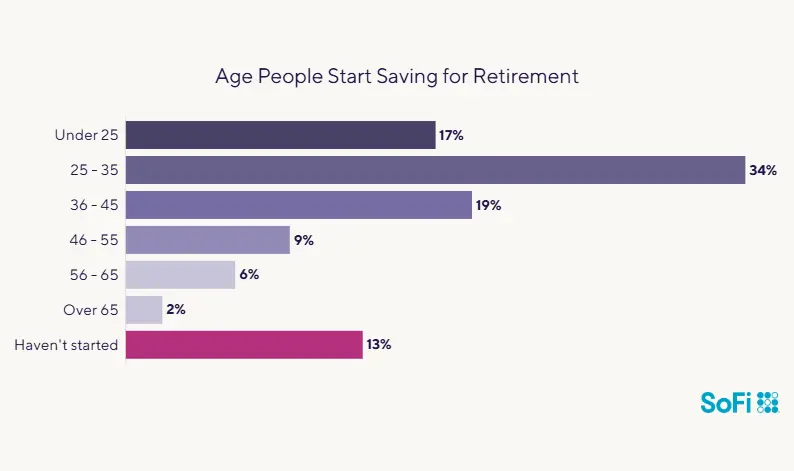
Fortunately, the concept of saving for the future seems to be resonating with people at younger ages. According to the SoFi 2024 Retirement Survey, more than half (51%) of respondents started saving for retirement before age 35, with many of that group starting by age 25.

Age-People-Start-Saving-for-Retirement
Source: SoFi 2024 Retirement Survey

A Savings Shortfall

Still, Americans’ savings strategy has a way to go. More than half of Americans can’t cover an unexpected $1,000 expense, according to Bankrate’s 2025 emergency savings report. Only 41% say they could cover it.

And 37% of all Americans don’t have enough cash in savings to cover even a $400 emergency, the Federal Reserve found in its “Economic Well-Being of U.S. Households in 2024” report.

Average Savings by Age in the USA

The Federal Reserve’s latest (2022) Survey of Consumer Finances shows that the typical American household has an average savings balance of $62,410.

But average savings varies greatly by age and number of people in a household. Here’s what savings by age looks like.

Average Savings for Those 35 and Younger

Americans under the age of 35 had an average savings account balance of $20,540, according to the Fed’s survey.

This is a large age bracket that can range from those just graduating high school to recent college grads to young professionals well into a decade’s worth of work.

It’s wise to have three to six months of expenses in an emergency fund. At the very least, aiming to have $1,000 handy in a savings account for unexpected expenses is recommended.

Use our emergency fund calculator to see how much you should ideally have stashed away.

For those who have started their careers, employer-sponsored retirement funds such as a 401(k) plan can be good options to start saving for long-term retirement goals.

It makes sense to contribute at least enough to get matching funds from an employer, if that’s an option with your company’s plan. For reference, the average 401(k) savings for those ages 25 to 34 is $42,640, according to Vanguard’s “How America Saves 2025” report.

Recommended: Why You Should Start Retirement Planning in Your 20s

Average Savings by Age: 35 to 44

Americans ages 35 to 44 had an average savings account balance of $41,540, according to the Federal Reserve survey. Those in this age bracket are now well into adulthood. At this stage of life, it’s prudent to have that three-to six-months’ worth of savings in an emergency fund, to cover the cost of everything from an accident to a lost job.

This may also be the time to think about diversifying a financial portfolio and possibly investing in the stock or bond market.

And, of course, keep contributing to your 401(k). For reference, the average 401(k) savings for those ages 35 to 44 is $103,552, according to the Vanguard report.

Average Savings by Age: 45 to 54

People ages 45 to 54 had an average savings account balance of $71,130, according to the Fed’s survey.

At this point, general financial advice dictates that a 50-year-old should have at least six times their annual salary if their intention is to retire at 67.

Those in this age group have an average 401(k) savings of $188,643.

Average Savings by Age: 55 to 64

The Fed survey found that Americans ages 55 to 64 had an average savings account balance of $72,520.

Since this is the time when most Americans are staring down retirement in a few years, it’s generally a good idea to boost retirement savings into high gear.

That’s because while younger people in 2025 are capped at contributing $23,500 a year to a 401(k) account, those age 50 and up are allowed to contribute an additional $7,500.This is known as a catch-up contribution. Also for 2026, those under age 50 can contribute up to $24,500, and those 50 and up can contribute an additional $8,000. And those aged 60 to 63 may again contribute an additional $11,250 instead of $8,000.

Under a new law that went into effect on January 1, 2026 (as part of SECURE 2.0), individuals aged 50 and older who earned more than $150,000 in FICA wages in 2025 are required to put their 401(k) catch-up contributions into a Roth 401(k) account. With Roth accounts, individuals pay taxes on contributions upfront, but can make qualified withdrawals tax-free in retirement.

The average retirement savings account for a person aged 55 to 64 is $271,230. It’s important to note that taking a withdrawal from such a plan before the age of 59 ½ could mean paying taxes and penalties.

Average Savings by Age: 65 and Older

This is when savings really peaks for the average American. The latest Federal Reserve Survey of Consumer Finances found that Americans ages 65 to 74 had an average savings account balance of $100,250.

However, that savings number does drop over time. According to the survey, Americans ages 75 and up had an average savings account balance of $82,800.

This underscores the importance of creating a retirement budget and sticking to it in order to have enough savings for as long as needed.

But before retirement, try to hit the average retirement savings amount for those ages 65 and up, which is $299,442.

This chart offers an at-a-glance comparison of the average American savings by age.

Age

Average savings

Under 35 $20,540
35-44 $41,540
45-54 $71,130
55-64 $72,520
65+ $100,250

Median Savings by Age

Median savings is different from average savings. The median is the number in the middle of all the other numbers, meaning half the numbers are higher and half are lower. So with median savings, half the people in an age category will have saved more and half will have saved less.

These are the median savings by age, according to the latest Federal Reserve Survey of Consumer Finances:

•   Under 35: $5,400

•   35-44: $7,500

•   45-54: $8,700

•   55-64: $8,000

•   65-74: $13,400

Savings vs Retirement Savings

What Americans have saved for emergencies, expenses, and other near-future goals is different from what they have in their retirement savings accounts, as you can see from all the information above. It’s critical to have both types of savings at the same time.

And keep this in mind: As you get older, and closer to retirement, it’s important that your retirement savings grow even more. It’s a good idea to contribute the maximum amount allowed to your retirement accounts at this time, if you can. This is one of the ways to save for retirement.

Saving a Little Bit More

Reaching specific savings goals doesn’t have to be complicated. It just means doing a bit of homework, strategizing, and staying diligent about personal finances.

The first step in saving more is to analyze current expenses to see what can be cut back on or cut out altogether to make more room for saving. This means creating a personal budget and tracking current spending.

To track spending, a person could create an excel spreadsheet and list all expenditures by categories like groceries, phone bill, car expenses, housing, medical, entertainment and others over the course of a month, filling it in with every single dollar spent to see where the money is going. Or you can use an online tracker like SoFi’s tracker, which allows users to connect all their accounts to one dashboard and track spending habits in real time.

After the month is up, the next step is to look back on the expenditures list. Was there anything that surprised you? Do you need all those streaming subscriptions? How about that gym membership — did it actually get used? This is the time to get a little ruthless.

After figuring out what’s left, try implementing a general budget outline like the 50/30/20 rule. This means that approximately 50% of your after-tax income goes toward essential expenses like food and rent, while 30% goes toward discretionary expenses like nights out at the movies or concerts. The last 20% belongs to savings and retirement account goals.

Next, it’s time to get creative about saving even more for the future. This can be done by putting more cash into a high-yield savings account via direct deposit right from a paycheck.

Those looking to save a few more bucks every month could also do so by getting rid of unnecessary expenses. But, instead of pocketing that cash, consider using mobile banking to direct that cash right to savings.

Still feeling the pinch and don’t really have room to save more from a budget? Working part-time for, say, a ride-sharing company could allow you to set your own hours and earn extra income based on how much time you can dedicate to it. Other options might include freelance work in photography, writing, or other creative arts.

The Takeaway

Saving for goals in the near term — such as a house or a car — along with putting away money for an emergency savings fund to cover unexpected expenses, is important at every age. And so is investing in your future, including for retirement. The earlier you start saving for all your goals, the better.

Interested in opening an online bank account? When you sign up for a SoFi Checking and Savings account with eligible direct deposit, you’ll get a competitive annual percentage yield (APY), pay zero account fees, and enjoy an array of rewards, such as access to the Allpoint Network of 55,000+ fee-free ATMs globally. Qualifying accounts can even access their paycheck up to two days early.


Better banking is here with SoFi, NerdWallet’s 2024 winner for Best Checking Account Overall.* Enjoy 3.30% APY on SoFi Checking and Savings with eligible direct deposit.

FAQ

How much should a 30 year old have in savings?

By age 30, you should have the equivalent of your annual salary saved. So if you make $60,000 a year, you should have $60,000 in savings.

How much money does an average person have in savings?

The average American has a savings balance of $62,410, according to the 2022 Federal Reserve Survey of Consumer Finances, which is the latest data available.

How many Americans have $100,000 in savings?

According to one 2023 survey, only 14% of Americans have at least $100,000 in savings.


SoFi Checking and Savings is offered through SoFi Bank, N.A. Member FDIC. The SoFi® Bank Debit Mastercard® is issued by SoFi Bank, N.A., pursuant to license by Mastercard International Incorporated and can be used everywhere Mastercard is accepted. Mastercard is a registered trademark, and the circles design is a trademark of Mastercard International Incorporated.

Annual percentage yield (APY) is variable and subject to change at any time. Rates are current as of 12/23/25. There is no minimum balance requirement. Fees may reduce earnings. Additional rates and information can be found at https://www.sofi.com/legal/banking-rate-sheet

Eligible Direct Deposit means a recurring deposit of regular income to an account holder’s SoFi Checking or Savings account, including payroll, pension, or government benefit payments (e.g., Social Security), made by the account holder’s employer, payroll or benefits provider or government agency (“Eligible Direct Deposit”) via the Automated Clearing House (“ACH”) Network every 31 calendar days.

Although we do our best to recognize all Eligible Direct Deposits, a small number of employers, payroll providers, benefits providers, or government agencies do not designate payments as direct deposit. To ensure you're earning the APY for account holders with Eligible Direct Deposit, we encourage you to check your APY Details page the day after your Eligible Direct Deposit posts to your SoFi account. If your APY is not showing as the APY for account holders with Eligible Direct Deposit, contact us at 855-456-7634 with the details of your Eligible Direct Deposit. As long as SoFi Bank can validate those details, you will start earning the APY for account holders with Eligible Direct Deposit from the date you contact SoFi for the next 31 calendar days. You will also be eligible for the APY for account holders with Eligible Direct Deposit on future Eligible Direct Deposits, as long as SoFi Bank can validate them.

Deposits that are not from an employer, payroll, or benefits provider or government agency, including but not limited to check deposits, peer-to-peer transfers (e.g., transfers from PayPal, Venmo, Wise, etc.), merchant transactions (e.g., transactions from PayPal, Stripe, Square, etc.), and bank ACH funds transfers and wire transfers from external accounts, or are non-recurring in nature (e.g., IRS tax refunds), do not constitute Eligible Direct Deposit activity. There is no minimum Eligible Direct Deposit amount required to qualify for the stated interest rate. SoFi Bank shall, in its sole discretion, assess each account holder's Eligible Direct Deposit activity to determine the applicability of rates and may request additional documentation for verification of eligibility.

See additional details at https://www.sofi.com/legal/banking-rate-sheet.

We do not charge any account, service or maintenance fees for SoFi Checking and Savings. We do charge a transaction fee to process each outgoing wire transfer. SoFi does not charge a fee for incoming wire transfers, however the sending bank may charge a fee. Our fee policy is subject to change at any time. See the SoFi Bank Fee Sheet for details at sofi.com/legal/banking-fees/.
*Awards or rankings from NerdWallet are not indicative of future success or results. This award and its ratings are independently determined and awarded by their respective publications.

Financial Tips & Strategies: The tips provided on this website are of a general nature and do not take into account your specific objectives, financial situation, and needs. You should always consider their appropriateness given your own circumstances.

Third-Party Brand Mentions: No brands, products, or companies mentioned are affiliated with SoFi, nor do they endorse or sponsor this article. Third-party trademarks referenced herein are property of their respective owners.

Disclaimer: The projections or other information regarding the likelihood of various investment outcomes are hypothetical in nature, do not reflect actual investment results, and are not guarantees of future results.

Investment Risk: Diversification can help reduce some investment risk. It cannot guarantee profit, or fully protect in a down market.

Third Party Trademarks: Certified Financial Planner Board of Standards Center for Financial Planning, Inc. owns and licenses the certification marks CFP®, CERTIFIED FINANCIAL PLANNER®

External Websites: The information and analysis provided through hyperlinks to third-party websites, while believed to be accurate, cannot be guaranteed by SoFi. Links are provided for informational purposes and should not be viewed as an endorsement.

SOBNK-Q325-095
CN-Q425-3236452-35
Q126-3525874-012

Read more
A woman in a gray blazer sits at a desk typing on a laptop.

Important Retirement Contribution Limits

By saving and investing for retirement, you are working toward financial freedom — a goal worthy of your time and effort.

As you may know, there are benefits to using an account designed specifically for retirement, such as a 401(k) plan or Roth IRA.

For instance, some company retirement programs may offer an employer match. Second, these accounts are designed to hold investments over time so that investors can potentially earn compound returns.

Retirement accounts also have tax advantages. Because these accounts have special tax treatment, there’s a limit to how much money the IRS allows individuals to contribute to each of them in a given year.

These retirement contribution limits vary depending on the type of account you have. For example, 401(k) contribution limits are different from IRA contribution limits.

To build a successful long-term financial plan, you’ll likely want a solid understanding of your retirement plan options. Below is a summary of some different types of retirement accounts and their respective annual retirement contribution limits.

Key Points

•   Retirement accounts have specific annual contribution limits set by the IRS due to their special tax treatment.

•   Employee contributions to 401(k) plans are capped at $23,500 in 2025 and $24,500 in 2026.

•   Individuals aged 50 and over can make additional catch-up contributions to 401(k)s of $7,500 in 2025 and $8,000 in 2026.

•   Traditional and Roth IRA contributions are limited to $7,000 in 2025, with an extra $1,000 catch-up for those 50 and older, and $7,500 in 2026, with an extra $1,100 for those 50 and older.

•   Employer contributions to SEP IRAs are capped at the lesser of 25% of compensation or $70,000 in 2025, and $72,00 in 2026, with no catch-up options.

What Are Retirement Contribution Limits?

Ever heard someone say that they have “maxed out” their retirement account? Maxing out means contributing the total amount allowed by the IRS in a given year.

Generally, the IRS increases retirement contribution limits every few years as the cost of living increases. Many of the 2025 and 2026 contribution limits were increased from the previous year.

There are a lot of different types of retirement accounts, and each comes with its own nuances, which can make it hard to keep them straight.

This list of the account types, along with their contribution limits, will help you keep track.


401(k) Contribution Limits

A 401(k) plan is a tax-deferred retirement account that is typically offered through a person’s employer, usually as part of a benefits package. With a 401(k) plan, the employee can opt to have a certain percentage of their salary withheld from their paycheck on a pretax basis.

Individual 401(k) plans — also known as solo 401(k) plans — are available to people who are self-employed and have an employee identification number (EIN).

2025 Employee contribution limit: $23,500

2026 Employee contribution limit: $24,500

Plans may allow for catch-up contributions for employees ages 50 and over.

2025 Catch-up contribution limit: $7,500

2026 Catch-up contribution limit: $8,000

In 2025 and 2026, those aged 60 to 63 may contribute up to an additional $11,250 instead of $7,500 and $8,000, thanks to SECURE 2.0.

Under a new law that went into effect on January 1, 2026 (as part of SECURE 2.0), individuals aged 50 and older who earned more than $150,000 in FICA wages in 2025 are required to put their 401(k) catch-up contributions into a Roth 401(k) account. With Roth accounts, individuals pay taxes on contributions upfront, but can make eligible withdrawals tax-free in retirement.

Some employers may offer a company match in their 401(k) plans. A typical match would see employers match around 3% of an employee’s salary when that employee contributes 6% to the plan. The company match plan is determined by the employer.

Employer contributions to a 401(k) do not count toward the employee’s contribution limits. But instead of putting a cap on how much the employer alone can contribute, there’s a total contribution limit that includes both the employer and employee contributions.

2025 Total employer plus employee contribution limit: The lesser of 100% of the employee’s compensation or $70,000 — if the employee is eligible for the catch-up contribution, then it would be $77,500. (If the employee is eligible for the Secure 2.0 catch-up contribution, then it would be $81,250.)

2026 Total employer plus employee contribution limit: The lesser of 100% of the employee’s compensation or $72,000 — if the employee is eligible for the catch-up contribution, then it would be $80,000. (If the employee is eligible for the Secure 2.0 catch-up contribution, then it would be $83,250.)

403(b) Contribution Limits

A 403(b) plan is similar to a 401(k) but is offered to employees of public schools, nonprofit hospital workers, tax-exempt organizations, and certain ministers.

2025 Employee contribution limit: $23,500

2026 Employee contribution limit: $24,500

2025 Catch-up contribution limit: $7,500

2026 Catch-up contribution limit: $8,000

Catch-up contributions are for employees aged 50 and older. In 2025 and 2026, those aged 60 to 63 may contribute an additional $11,250 instead of $7,500 and $8,000, thanks to SECURE 2.0.

As mentioned with 401(k) plans, as of January 1, 2026, individuals aged 50 and older with FICA wages above $150,000 in 2025 are required to put their 403(b) catch-up contributions into a Roth account.

Employees of any age who have been in service for 15 or more years with the same eligible 403(b) employer can potentially contribute another $3,000. There is a $15,000 lifetime limit for the latter catch-up provision. It may be possible to qualify for both catch-up provisions; if you think you qualify, check with the plan or your CPA to be sure.

2025 Total employer plus employee contribution limit: The lesser of 100% of the employee’s compensation or $70,000 — if the employee is eligible for the catch-up contribution, then it would be $77,500. (If the employee is eligible for the Secure 2.0 catch-up contribution, then it would be $81,250.)

2026 Total employer plus employee contribution limit: The lesser of 100% of the employee’s compensation or $72,000 — if the employee is eligible for the catch-up contribution, then it would be $80,000. (If the employee is eligible for the Secure 2.0 catch-up contribution, then it would be $83,250.)

It is important to keep in mind that some 403(b) plans have mandatory employee contributions. These mandatory contributions are made by the employee, but since you do not have a choice they do not count towards the employee contribution limit. If you are part of a plan like this you might actually be able to contribute your annual contribution maximum plus the mandatory contributions.

457(b) Contribution Limits

A 457(b) plan is similar to a 401(k) plan but for governmental and certain nonprofit employees. Unlike a 401(k), there is only one contribution limit for both employer and employee.

2025 Total employer plus employee contribution: $23,500

2026 Total employer plus employee contribution: $24,500

Those in government plans who are 50 or older, may be able to make a catch-up contribution of up to $7,500 in 2025 and $8,000 in 2026; those ages 60 to 63 may be able to take the special SECURE 2.0 contribution of up to $11,250 for those years instead. As with 401(k) and 403(b) plans, under the new law that went into effect in 2026, individuals aged 50 and older with FICA wages above $150,000 in 2025 are required to put their 457(b) catch-up contributions into a Roth account. (Those in non-governmental plans do not have the option of catch-up contributions.)

If permitted by the plan, a participant who is within three years of the normal retirement age may contribute the lesser of twice the annual limit or the standard annual limit plus the amount of the limit not used in prior years.

Thrift Savings Plan (TSP) Contribution Limits

A TSP is similar to a 401(k), but for federal employees and members of the military.

2025 Employee contribution limit: $23,500

2026 Employee contribution limit: $24,500

Tax-free combat zone contributions: Military members serving in tax-free combat zones are allowed to make the full $70,000 in employee contributions for 2025, and $72,000 in 2026.

2025 Catch-up contribution limit: $7,500 (or a SECURE 2.0 contribution limit of $11,250 for those ages 60 to 63)

2026 Catch-up contribution limit: $8,000 (or a SECURE 2.0 contribution limit of $11,250 for those ages 60 to 63)

According to the “spillover” method for TSP catch-up contributions, for those eligible to make catch-up contributions, any contributions made that exceed the annual employee contribution limit will automatically count toward the catch-up contribution limit of $7,500 in 2025 and $8,000 in 2026.

Traditional IRA Contribution Limits

The traditional IRA (individual retirement account is a tax-deferred account that is set up by the individual. Unlike workplace retirement plans, IRA accounts tend to have lower contribution limits. These contribution limits are combined totals for all the traditional or Roth IRAs an individual may have .

2025 Contribution limit: $7,000

2026 Contribution limit: $7,500

2025 Catch-up contribution limit: $1,000 (for a total of $8,000 for those age 50 or over)

2026 Catch-up contribution limit: $1,100 (for a total of $8,600 for those age 50 or older)

Additionally, there are income limits for tax deductions on contributions that vary based on whether or not you are covered by a retirement plan at work.

Calculate your IRA contributions.

Use SoFi’s IRA contribution calculator to determine how much you can contribute to an IRA in 2024.


money management guide for beginners

Roth IRA Contribution Limits

Similar to a traditional IRA, a Roth IRA is set up by the individual.

Unlike tax-deferred retirement accounts, Roth IRA contributions are not tax deductible. However, you will not need to pay income taxes on qualified withdrawals. Again, these contribution limits are combined totals for the traditional and Roth IRAs an individual may have.

2025 Contribution limit: $7,000

2026 Contribution limit: $7,500

2025 Catch-up contribution limit: $1,000 (for a total of $8,000 for those age 50 or over)

2026 Catch-up contribution limit: $1,100 (for a total of $8,600 for those age 50 or older)

There are income limitations for who is able to use a Roth IRA. These limits exist on a phase-out schedule and ability to use a plan slowly tapers off until the final income cap.

Single-filer income limit: Under $165,000 for tax year 2025, and under $168,000 for tax year 2026.

Married, filing jointly income limit: under $246,000 for tax year 2025, and under $252,000 for tax year 2026.

💡 Quick Tip: Did you know that you can choose the investments in a self-directed IRA? Once you open a new IRA online and start saving, you get to decide which mutual funds, ETFs, or other investments you want — it’s totally up to you.

SEP IRA Contribution Limits

A simplified employee pension simplified employee pension (SEP) IRA is a tax-deferred retirement account for employers and self-employed individuals.

2025 Contribution limit: An employer’s contributions to an employee’s SEP IRA can’t exceed the lesser of 25% of the employee’s compensation or $70,000.

2026 Contribution limit: An employer’s contributions to an employee’s SEP IRA can’t exceed the lesser of 25% of the employee’s compensation or $72,000.

Catch-up contributions are not permitted in SEP plans.

SIMPLE IRA

A savings incentive match plan for employees [SIMPLE) IRA is a retirement savings plan for small businesses with 100 or fewer employees.

2025 Employee contribution limit: $16,500

2026 Employee contribution limit: $17,000

2025 Catch-up contribution limit: $3,500 for those age 50 and older

2026 Catch-up contribution limit: $4,000 for those age 50 and older

In 2025, those aged 60 to 63 may contribute up to an additional $5,250 instead of $3,500, due to SECURE 2.0. And in 2026, those aged 60 to 63 may contribute up to an additional $5,250 instead of $4,000.

Employer contribution limit: The employer is generally required to make up to 3% of employee contribution, or 2% of employee compensation up to $350,000 in 2025 and up to $360,000 in 2026.

Also, under a SECURE Act 2.0 provision, an employer can make an additional non-elective contribution which is the lesser of 10% of compensation or $5,000 per employee.

Maxing Out Your Retirement Contributions

If you have a 401(k), you would need to contribute $1,958.33 each month to reach the $23,500 limit for 2025 and $2,041.66 each month to reach the $24,500 limit for 2026. With IRAs, that number is $583.33 per month to reach the annual $7,000 contribution limit for 2025 and $625 each month to reach the annual contribution limit of $7,500 in 2026.

When you make pre-tax contributions to a tax-deferred account such as a 401(k), the money is entering into the account before taxes. Therefore, the difference in your post-tax paycheck might not be as drastic as you may think.

There are several tactics you can take when working to increase how much you’re contributing to your retirement plan.

But whether you increase your contribution each month, quarter, or year, you may want to consider automating the saving process. Automation removes human emotion from the equation, which may help you save.

You may also want to try to avoid massive lifestyle creep as your income increases over the years. It’s a balance to take care of both your current situation and your future situation. When you get raises or bonuses, consider allocating those funds to your retirement instead of a material purchase.

The most successful savers will likely have a strategy that focuses on earning more and cutting costs.

Opening Your Own Retirement Account

If you have a retirement account through work, contributions are taken directly from your paycheck and you can take advantage of a company match program if it’s offered.

For those without a workplace retirement plan, getting set up with an account may take slightly more initiative. Luckily, opening an account doesn’t have to be hard. An account like a traditional IRA, Roth IRA, SEP IRA, or Solo 401(k), or a general investment account, can be set up at a brokerage firm of your choosing.

Prepare for your retirement with an individual retirement account (IRA). It’s easy to get started when you open a traditional or Roth IRA with SoFi. Whether you prefer a hands-on self-directed IRA through SoFi Securities or an automated robo IRA with SoFi Wealth, you can build a portfolio to help support your long-term goals while gaining access to tax-advantaged savings strategies.

Easily manage your retirement savings with a SoFi IRA.

🛈 While SoFi does not offer 401(k), 403(b), 457(b), TSP, or SIMPLE IRA plans at this time. However, we do offer Individual Retirement Accounts (IRAs).

INVESTMENTS ARE NOT FDIC INSURED • ARE NOT BANK GUARANTEED • MAY LOSE VALUE

SoFi Invest is a trade name used by SoFi Wealth LLC and SoFi Securities LLC offering investment products and services. Robo investing and advisory services are provided by SoFi Wealth LLC, an SEC-registered investment adviser. Brokerage and self-directed investing products offered through SoFi Securities LLC, Member FINRA/SIPC.

For disclosures on SoFi Invest platforms visit SoFi.com/legal. For a full listing of the fees associated with Sofi Invest please view our fee schedule.

Mutual Funds (MFs): Investors should carefully consider the information contained in the prospectus, which contains the Fund’s investment objectives, risks, charges, expenses, and other relevant information. You may obtain a prospectus from the Fund company’s website or clicking the prospectus link on the fund's respective page at sofi.com. You may also contact customer service at: 1.855.456.7634. Please read the prospectus carefully prior to investing.Mutual Funds must be bought and sold at NAV (Net Asset Value); unless otherwise noted in the prospectus, trades are only done once per day after the markets close. Investment returns are subject to risk, include the risk of loss. Shares may be worth more or less their original value when redeemed. The diversification of a mutual fund will not protect against loss. A mutual fund may not achieve its stated investment objective. Rebalancing and other activities within the fund may be subject to tax consequences.

Exchange Traded Funds (ETFs): Investors should carefully consider the information contained in the prospectus, which contains the Fund’s investment objectives, risks, charges, expenses, and other relevant information. You may obtain a prospectus from the Fund company’s website or by emailing customer service at [email protected]. Please read the prospectus carefully prior to investing.

Financial Tips & Strategies: The tips provided on this website are of a general nature and do not take into account your specific objectives, financial situation, and needs. You should always consider their appropriateness given your own circumstances.

Tax Information: This article provides general background information only and is not intended to serve as legal or tax advice or as a substitute for legal counsel. You should consult your own attorney and/or tax advisor if you have a question requiring legal or tax advice.

SOIN-Q425-081
Q126-3525874-007

Read more
A close-up of the upper body of someone wearing a dark blue suit, white shirt, and blue dotted tie, complete with a red lapel flower pin.

The Cost of Being in Someone’s Wedding

It’s an honor to be asked to be a member of a friend’s or family member’s wedding, but it also comes with a cost. Between buying/renting attire, attending prewedding events, and purchasing gifts, it can run around $1,650 to be a bridesmaid and $1,600 to be a groomsman.

Just one wedding can take a bite out of your budget, not to mention the familiar scenario of attending several weddings in one year. We’ll help you understand the expenses that go into being a part of the big day so you can prepare and budget well in advance.

Key Points

•   Being in a wedding costs around $1,650 for bridesmaids and $1,600 for groomsmen, with expenses varying widely by location and event style.

•   Bridesmaids typically pay for their dress ($128 on average), alterations, accessories, hair, and makeup, and they may also contribute to the bachelorette party.

•   Groomsmen usually cover attire or tux rentals ($100-$250) and bachelor party expenses (averaging $1,300).

•   Travel and accommodations add significantly to costs, especially for destination events.

•   Both bridesmaids and groomsmen are expected to give gifts, with bridesmaids spending around $170 and groomsmen about $160 on average.

How Much Does It Cost to Be a Bridesmaid?

While the average bridesmaid may spend $1,650 to be a part of the bridal party, costs vary significantly depending on the location of the wedding, number of events, and dress code. Before you agree to participate as a bridesmaid (or maid of honor), it’s important to consider what costs you may be responsible for.

Recommended: What Are Personal Loans Used For?

The Dress

Etiquette dictates that bridesmaids cover the cost of their dress, shoes, and any accessories the bride has selected for them to wear. According to The Knot’s 2025 Real Weddings Study (which surveyed nearly 17,000 couples who wed in 2024), the average bridesmaid dress costs $128 per person.

You’ll likely also be responsible for any alterations, which can run from $75 to $150, depending on what adjustments are needed. While there are ways you can save — such as renting a dress — that decision is often not up to the bridesmaid.

Recommended: 2026 Wedding Cost Calculator with Examples

Hair and Makeup

Traditionally, if the bride requests that everyone in the party have their hair and makeup done in a certain style, she will cover the cost. If, on the other hand, bridesmaids are given the option to opt in or do their own thing, the bridesmaids generally cover the cost of getting glammed up for the big day. The average cost of wedding hair for bridesmaids is $100, and you can tack on another $100 for makeup.

Bachelorette Party

Bachelorette parties have become more elaborate in recent years. Typically, every attendant pays for their own expenses, while also splitting the cost to cover most, or all, of the bride’s expenses.

According to The Knot, the average cost of a bachelorette party in 2023 was $1,300 per person. Of course, the cost of attending a bachelorette party varies significantly depending on the type, location, and length of the event. Celebrations that last one to two days cost, on average, $1,135 per attendee, while those that go on for three to four days can total $1,630 each. Also, the farther you need to travel to the event, the more you’ll need to spend. Guests who travel to the bachelorette party locale by plane spend an average of $2,000, while those who travel by personal car spend an average of $900 to attend the event.

Wedding Travel and Accommodations

For the wedding itself, the bridal party is typically expected to cover the costs of travel and accommodations, which can vary significantly depending on the location of the event and length of stay (with members of the bridal party possibly needing to arrive early or stay late).

On average, wedding guests who need to travel outside of their town or city to attend a wedding spend between $840 and $1680 on travel and up to $630 on accommodations. You could end up spending significantly more if you’re covering travel costs for yourself and other family members, or if the wedding involves long-distance travel. When the wedding is local, travel costs are likely to be minimal.

Recommended: Guide to Saving Money on Hotels for Your Next Vacation

Gifts

Bridesmaids traditionally give shower and wedding gifts, which add to the cost of being in someone’s wedding. According to The Knot, the average bridesmaid bridal shower gift costs between $50 and $75, while the average bridesmaid wedding gift costs around $170. A group gift may allow you to spend less while giving something nicer than you could afford on your own.

What Does the Maid of Honor Pay For?

Being the maid of honor generally doesn’t cost more than being a bridesmaid, but it does come with additional duties and a greater commitment of time. Generally, the maid of honor is there to assist with any tasks she can take off the bride’s to-do list. They may be involved in planning prewedding events and communicating with other members of the wedding party.

In some cases, the maid of honor might plan the shower and help cover the costs. However, these days, the cost of a wedding shower is more commonly covered by family.

Recommended: How to Save for Your Dream Wedding

What Do Groomsmen Pay For?

Groomsmen typically pay for their wedding attire, the cost to attend a bachelor party (which may include sharing the cost for the groom’s attendance), the cost to attend the wedding (which might involve travel and accommodations), as well as a wedding gift. Here’s a look at what it all adds up to.

Formalwear or Tuxedo Rental

Just like bridesmaids generally pay for their dresses, groomsmen typically pay for their wedding day clothing. This might be a suit, tuxedo, shirt and slacks, or another type of attire selected by the groom or couple. Typically, the groomsmen’s attire is purchased or rented, but in some cases, a groom will let their wedding party choose from their own wardrobe, which can be a more affordable option.

If you need to rent a tux for the event, costs vary depending on what style, design, brand, and accessories you’ll need to wear. On average, you can expect to pay between $150 and $300 to rent a tux for the standard period.

Bachelor Party

Groomsmen normally take part in planning the bachelor party and may cover their own costs and the groom’s. According to a recent survey by The Knot (which included roughly 500 respondents who attended, or planned to attend, a bachelor party in 2023), the average cost of a bachelor party is $1,400 per person. The survey also found that the average bachelor celebration lasts for two days, and roughly one-fifth of attendees are flying to the party destination. Indeed, 29% of those surveyed are spending $2,000 or more to celebrate in a major metro city.

For guests who drove or were planning to drive to the event’s location, spending was less, averaging $1,000 per attendee.

Wedding Gift

Groomsmen are generally expected to give the couple a wedding gift, though they are not expected to spend more on a gift than other guests do. According to The Knot’s 2024 Real Wedding Guest Study, wedding party members spend an average of $160 on their gifts. If you want to save money, consider chipping in for a group gift with other wedding party members.

The Takeaway

It’s not unusual for a bridesmaid to spend $1,650, including the dress, bachelorette party, and gifts. Groomsmen may spend just a little bit less ($1,600) for a rental tux, bachelor party, and wedding gift. Keep in mind, however, that the cost to be in someone’s wedding can run much higher or lower, depending on the location and style of the wedding.

If you haven’t saved up enough money to be in a friend’s or family member’s wedding in advance, there are better options than throwing it all on a credit card. Personal loans are designed to help cover life’s big events. SoFi Personal Loans offer low fixed rates, no-fee options, and a quick and easy online application process. Checking your rate takes just a minute.

SoFi’s Personal Loan was named a NerdWallet 2026 winner for Best Personal Loan for Large Loan Amounts.


FAQ

What do bridesmaids and groomsmen usually pay for?

Bridesmaids and groomsmen are typically expected to pay for their wedding-day attire and accessories, travel and accommodations, and a wedding gift. They might also cover the costs of bachelorette or bachelor parties, which often make up a large portion of the expense.

How can I participate in a wedding while staying on budget?

You can keep costs down by splitting the cost of a group gift, limiting optional expenses such as professional hair and makeup, and choosing more affordable travel and accommodation options if needed. Planning ahead and discussing your expectations can help you manage your budget.

Does being the maid of honor cost more than being a bridesmaid?

Not necessarily. The maid of honor usually has more responsibilities and dedicates more time to helping with the wedding, but the role doesn’t generally cost more than being a bridesmaid, since most of the major expenses are the same and wedding shower costs are commonly covered by family.


SoFi Loan Products
SoFi loans are originated by SoFi Bank, N.A., NMLS #696891 (Member FDIC). For additional product-specific legal and licensing information, see SoFi.com/legal. Equal Housing Lender.


Non affiliation: SoFi isn’t affiliated with any of the companies highlighted in this article.

Third-Party Brand Mentions: No brands, products, or companies mentioned are affiliated with SoFi, nor do they endorse or sponsor this article. Third-party trademarks referenced herein are property of their respective owners.

Financial Tips & Strategies: The tips provided on this website are of a general nature and do not take into account your specific objectives, financial situation, and needs. You should always consider their appropriateness given your own circumstances.

SOPL-Q126-015

Read more
TLS 1.2 Encrypted
Equal Housing Lender