How Much Does Culinary School Cost?

How Much Does Culinary School Cost?

If you’re passionate about food, a career in the culinary arts may be right for you. Going to culinary school can help you acquire the knowledge, skills, and hands-on experience required to work in the field.

But how much does it cost to go to culinary school compared to trade school or traditional college? It depends on where you go and the type of degree you pursue. Getting a bachelor’s degree at a private school can run as high as $120,000. However, going to an in-state public culinary school and/or pursuing a shorter (associate) degree can cost significantly less.

Getting a bachelor’s degree at a private school can run more than $100,000. However, going to an in-state public culinary school and/or pursuing a shorter (associate) degree can cost significantly less.

This guide will examine culinary school cost factors and payment options to help you decide if it’s the right move for your future.

Key Points

•  Culinary school tuition can range from just a few thousand to over $100,000, depending on the program and institution.

•  Students should budget for additional costs like books, uniforms, and tools, which can add several thousand dollars to the total expense.

•  Many students can reduce costs through scholarships, grants, and federal financial aid.

•  Shorter programs are generally less expensive, but may offer fewer comprehensive skills.

•  In addition to federal aid, students can apply for private student loans to help cover the costs of culinary school.

Tuition Rates for Culinary Schools

The cost of culinary school will depend on what degree you pursue and whether you go to a private or public college.

Getting an associate degree at a public school may cost less than $10,000 if you live in-state, or $30,000 or more if you live out-of-state.

An associate degree at a private culinary school, on the other hand, can run $50,000 to $56,000.

Pursuing a bachelor’s degree in the culinary arts generally comes with a higher price tag. At a public school, it can cost $47,000 to $50,000 (if you live in-state) and $50,000 to $100,000 (if you live out-of-state). The cost of getting a bachelor’s degree at a private school can run around $120,000.

When evaluating a program’s sticker price, keep in mind that tuition pricing may reflect a standalone semester, rather than the entire program cost. Depending on your field of study and type of degree you pursue, you may need anywhere from four to eight semesters to finish a program or degree.

Why Is Culinary School So Expensive?

Culinary schools can have an intensive structure. Condensed schedules can translate to more time spent in both the classroom and kitchen than typical college students.

Whereas a lecture hall can accommodate hundreds of students for a course, culinary students typically receive more one-on-one instructions in smaller class sizes. Also, culinary coursework that involves cooking and baking has the added cost of buying ingredients and materials.

Culinary school costs might also include purchasing cooking equipment, such as knives, cutting boards, and a kitchen uniform. Depending on the program, these may be automatically factored into the tuition price or tacked on as an additional fee.

Recommended: What Is the Average Cost of College Tuition in 2024?

Types of Culinary Degrees Available

You have a variety of options to choose from for a culinary degree. The types of schools offering culinary degrees include technical schools, community colleges, four-year colleges, and independent culinary institutes.

Students can choose from certificate programs, an associate degree, or a bachelor’s degree in culinary arts.

Certificate programs are usually the shortest to complete with one to two semesters of coursework and training. Associate programs generally last two years and may incorporate a mix of hands-on training, internships, and coursework. Bachelor’s degrees require more time ― generally four years ― to complete but can help further develop culinary skills and knowledge in related subjects like business and nutrition.

Culinary degrees can also focus on a specific discipline, such as baking and pastry arts or hospitality and restaurant management.

How Can You Pay for Culinary School?

A combination of funding sources may be required to cover tuition, equipment, and related expenses. Prospective students and parents can consider the following options to pay for culinary school.

Grants and Scholarships

Figuring out how much culinary school is going to set you back starts with filling out the Free Application for Federal Student Aid (FAFSA®) to determine eligibility for federal financial aid. You may qualify for assistance in the form of grants if you have significant financial need.

There are also numerous culinary-specific scholarships that you can apply for. The National Restaurant Association awards merit-based scholarships between $2,500 to $10,000 for students pursuing undergraduate degrees in culinary arts and related fields.

Some additional grant and scholarship opportunities include:

•  The James Beard Foundation: This nonprofit organization awards scholarships, tuition waivers, and work-study grants to students attending accredited culinary schools.

•  The American Institute of Wine and Food (AIWF): Full-time students attending accredited culinary schools can apply for an AIWF scholarship from local chapters in California and Kansas.

•  Rachel Ray, Yum-o!: The famous Food Network chef’s nonprofit funds culinary scholarships in partnership with the National Restaurant Association Education Foundation.

You can also explore grants for college from state government and private organizations for additional funding.

Federal Student Loans

Students may need to use student loans when scholarships and grants aren’t sufficient, and they cannot afford to pay out of pocket.

Through the Federal Direct Loan Program, you can access both subsidized and unsubsidized loans to pay for school. Subsidized loans are awarded based on a student’s financial need. The Department of Education pays the interest on subsidized loans while you are studying at least half-time and during the six-month grace period after leaving school. You may be eligible to defer loan payments further if you attend graduate school, join the military, or experience financial hardship.

Unsubsidized loans don’t require financial need to be eligible. Schools determine how much students can borrow based on the cost of attendance and a student’s total financial aid package. Interest on unsubsidized loans begins accruing as soon as the loan is disbursed.

Recommended: Types of Federal Student Loans

Employment

If financial aid isn’t enough to cover culinary school costs in full, working while studying could help pay the remainder.

Students with financial need may qualify for part-time employment through the Federal-Work Study Program. Work-study jobs are typically geared towards a student’s area of study or community service. Awards can vary according to the student’s need, the timing of application, and how much total funding is available at a given participating school.

Finding part-time work at a restaurant or food-related enterprise is another funding option that also supports professional development.

Private Student Loans

If financial aid and other sources aren’t enough to pay for culinary school in full, you can consider a private student loan.

You can obtain private student loans from banks, credit unions, and online lenders. Some students may need a cosigner to qualify for private student loans due to a lack of credit history and income.

Private student loan interest rates and loan terms vary by lender, which gives borrowers more choice in term length. However, private student loans do not carry the same borrower protections as federal student loans, such as income-driven repayment plans, deferment or forbearance, or the Public Service Loan Forgiveness program. You may want to consider private student loans as an option only after you have exhausted all other sources of aid, including federal student loans.

The Takeaway

While many food service and restaurant jobs don’t require education beyond a high school diploma, completing culinary school could lead to a higher-paying career. According to the Bureau of Labor Statistics, the average salary in 2024 for chefs and head cooks at restaurants was $60,990. With experience, you can earn considerably more. According to Glassdoor, the average annual pay for an executive chef in New York City is $80,000.

There are numerous ways to cover the cost of culinary school, including federal and private student loans, work-study, financial aid, and scholarships.

If you’ve exhausted all federal student aid options, no-fee private student loans from SoFi can help you pay for school. The online application process is easy, and you can see rates and terms in just minutes. Repayment plans are flexible, so you can find an option that works for your financial plan and budget.


Cover up to 100% of school-certified costs including tuition, books, supplies, room and board, and transportation with a private student loan from SoFi.

FAQ

What additional expenses are there beyond culinary school tuition?

Additional costs include chef uniforms, knife sets, textbooks, kitchen tools, and lab/technology fees, which often total between $1,000 and $4,000.

Are financial aid and financing options available for culinary school students?

Yes — students can pursue federal and private loans, scholarships, grants, and payment plans to help offset tuition and related expenses.

How can students save money on culinary school?

Students can save money on culinary school by applying for scholarships, grants, and financial aid, choosing affordable institutions, enrolling in part-time or online programs, and seeking out apprenticeships or internships that offer hands-on experience and potentially reduce tuition costs.


Photo credit: iStock/visualspace

SoFi Private Student Loans
Please borrow responsibly. SoFi Private Student loans are not a substitute for federal loans, grants, and work-study programs. We encourage you to evaluate all your federal student aid options before you consider any private loans, including ours. Read our FAQs.

Terms and conditions apply. SOFI RESERVES THE RIGHT TO MODIFY OR DISCONTINUE PRODUCTS AND BENEFITS AT ANY TIME WITHOUT NOTICE. SoFi Private Student loans are subject to program terms and restrictions, such as completion of a loan application and self-certification form, verification of application information, the student's at least half-time enrollment in a degree program at a SoFi-participating school, and, if applicable, a co-signer. In addition, borrowers must be U.S. citizens or other eligible status, be residing in the U.S., Puerto Rico, U.S. Virgin Islands, or American Samoa, and must meet SoFi’s underwriting requirements, including verification of sufficient income to support your ability to repay. Minimum loan amount is $1,000. See SoFi.com/eligibility for more information. Lowest rates reserved for the most creditworthy borrowers. SoFi reserves the right to modify eligibility criteria at any time. This information is subject to change. This information is current as of 4/22/2025 and is subject to change. SoFi Private Student loans are originated by SoFi Bank, N.A. Member FDIC. NMLS #696891 (www.nmlsconsumeraccess.org).

SoFi Loan Products
SoFi loans are originated by SoFi Bank, N.A., NMLS #696891 (Member FDIC). For additional product-specific legal and licensing information, see SoFi.com/legal. Equal Housing Lender.


Non affiliation: SoFi isn’t affiliated with any of the companies highlighted in this article.

Financial Tips & Strategies: The tips provided on this website are of a general nature and do not take into account your specific objectives, financial situation, and needs. You should always consider their appropriateness given your own circumstances.

Third-Party Brand Mentions: No brands, products, or companies mentioned are affiliated with SoFi, nor do they endorse or sponsor this article. Third-party trademarks referenced herein are property of their respective owners.

Third Party Trademarks: Certified Financial Planner Board of Standards Center for Financial Planning, Inc. owns and licenses the certification marks CFP®, CERTIFIED FINANCIAL PLANNER®

SOISL-Q325-047

Read more
What Happens When You Pay Off Your Mortgage?

What Happens When You Pay Off Your Mortgage?

What happens when you pay off your mortgage? You may have some paperwork and account switching (such as property taxes) to take care of. And you may look forward to greater cash flow.

But is paying off a mortgage always the right move? In some cases, a person who is about to pay off a mortgage may want to consider a couple of options that might make more sense for their particular financial situation.

Learn more about the payoff path and alternatives here.

Key Points

•   Paying off a mortgage early eliminates monthly payments and saves on the total interest you pay for the loan.

•   Any remaining funds in escrow are returned to the homeowner after payoff.

•   Homeowners must take on responsibility for property taxes and homeowners insurance previously handled by the lender.

•   If you’re wondering “should I pay off my mortgage early?” assess your financial situation carefully – it’s not the best option for everyone.

•   Homeowners should plan for ways to use the money freed up by paying off their mortgage, such as paying off other debts or boosting their emergency fund.

Should I Pay Off My Mortgage Early?

Paying off your mortgage is a fantastic milestone to reach, but it’s not without trade-offs. Here are a few considerations to help you make the best decision for your situation.

Pros of Paying Off a Mortgage

Cons of Paying Off a Mortgage

No monthly payment There may be prepayment penalties
No more interest paid to the lender Your cash is all tied up in your home’s equity
More cash in your pocket each month If you pay extra to pay off your home, you may miss out on investment strategies
You’ll need less income in retirement Lost opportunities for other uses for your money
Greatly reduced risk of foreclosure No tax deduction for mortgage interest, if you’re among the few who still take the deduction


Pros of Paying Off Mortgage Early

The upsides of paying off your mortgage early may seem obvious. You won’t need to make that monthly payment any longer, which can free up cash. You’ll save much of the interest you would have paid over the life of your home loan. And you’ll be reducing the amount of money you’ll need during your retirement, which is good planning. Plus, with no mortgage, you’ll be minimizing your risk of foreclosure.

Cons of Paying Off Mortgage Early

There are potential negatives, as well. If you’re making extra payments, you may miss out on investment opportunities and alternative uses for your money, and after you pay off your mortgage, much of your cash will be tied up in your home equity. Additionally, if you’re paying the loan off early, there may be prepayment penalties, depending on the terms of your mortgage. And once you’ve paid off your mortgage, you won’t be able to deduct your mortgage insurance from your taxes, if you’re someone who took advantage of that option.


💡 Quick Tip: Thinking of using a mortgage broker? That person will try to help you save money by finding the best loan offers you are eligible for. But if you deal directly with an online mortgage lender, you won’t have to pay a mortgage broker’s commission, which is usually based on the mortgage amount.

First-time homebuyers can
prequalify for a SoFi mortgage loan,
with as little as 3% down.


What Happens After You Pay Off Your Mortgage?

Here’s how mortgage payoff works:

•   To find out the amount you need to pay off your mortgage, the first thing you need to do is request a mortgage payoff letter. If you pay the amount on your last statement, you won’t have the right amount. A mortgage payoff letter will include the appropriate fees and the amount of interest through the day you’re planning to pay the loan off.

•   Know that the payoff letter is only good for a set amount of time, and make sure to get your payment in on time.

•   Follow the instructions you’re given about where and how to submit the payment.

•   Once you’ve sent the payoff amount, your mortgage lender is responsible for sending you and the county recorder documentation to release the mortgage and lien on your home.

•   You should be sent any funds remaining in escrow.

•   You will want to contact your insurance company about this change if you paid your lender for your homeowners insurance along with your mortgage payment and have the bills switched over to you directly.

•   If your property taxes were paid as part of your mortgage payment, you will want to contact your local tax authority about shifting those bills to you as well.

What Documents Do You Get After Paying Off a Mortgage?

After paying off your mortgage, you should receive (or have access to) documents proving you paid off the mortgage and no longer have a lien attached to your home.

Mortgage Payoff Statement

As noted earlier, when you’re thinking about paying off your mortgage, you can request a payoff letter that will detail the exact amount you need to pay off your mortgage, what it covers, and when it’s due. If you decide to follow through, your lender may send you a payoff statement showing that your loan has been paid in full.

As further evidence that your mortgage has been satisfied, you may receive your canceled promissory note. This is your promise to pay your mortgage, and you signed it when you closed on your home. Now that your mortgage has been satisfied, you may receive this document back with a “canceled” or “paid in full” marked on it, though it’s also possible you may have to call and request the document.

Satisfaction of Mortgage or Release of Lien

This is an official, signed document that your lender will prepare to confirm that you have fulfilled the conditions of the mortgage and the lender no longer has any claim to the property. Typically, this document will be filed with the county recorder (or other applicable recording agency) by the lender. It details the mortgage and states that the mortgage has been satisfied and the lien released. Ideally, you should receive notification from the filing authority once the document has been filed. Having this document on file can help expedite things if you later want to sell your home, for example.

What Should You Do After Paying Off Your Mortgage?

After you pay off your mortgage, you’ll need to take care of a few housekeeping items, as mentioned earlier.

Update Your Records and Insurance

You may be wondering what do you pay after your mortgage is paid off? Now that you have full title to your home, you’ll need to take on a few responsibilities your lender may have handled. Your lender will send you any remaining funds from your escrow account. But you’ll need to take care of the items funded through your escrow account, usually your taxes and homeowners insurance. Contact your tax authority to make sure you’ll get its messages going forward, and reach out to your insurance company to let it know of the change as well.

Plan for Ongoing Property Expenses

Without that escrow account, you’ll need to start budgeting for ongoing property expenses, including your property taxes and homeowners insurance. Fortunately, those costs will probably be far lower than the mortgage premiums you’ve been paying, so just be sure you budget in advance to cover them. As for other ongoing costs, like maintenance and utilities, you’ve likely been paying those while you’ve had your mortgage, but now you may want to budget for larger projects or additions to your home. It’s wise to make plans for that freed-up cash, whether it’s paying off other debts, shoring up your emergency fund, adding to your retirement fund, or building a garage. Cash you don’t make plans for has a way of slipping away.

Recommended: 2025 Home Loan Help Center

Is Prepaying a Good Idea?

Generally, paying off your mortgage early is a great idea. It reduces the principal, which in turn reduces the amount you’ll pay in interest over the life of your loan. Still, there are reasons that some homeowners consider not paying their mortgage off early.

Most lenders do not charge a prepayment penalty, but home loans signed before January 10, 2014, may include one. Some conventional mortgage loans (especially nonconforming loans) signed on or after that date may have a prepayment penalty that applies within the first three years of repayment. (The different types of mortgage loans include conforming and nonconforming conventional mortgages.)

The best way to find out if prepayment is subject to a penalty is to call your mortgage servicer. The terms of your mortgage paperwork should also outline whether or not you have a prepayment penalty.

Should You Refinance Instead?

Another option you might consider is refinancing your mortgage. There are several reasons you may want to refinance instead of paying off your mortgage.

Lower monthly payment. Getting a lower rate or different loan term may lower your monthly payment without requiring as much cash as a payoff. Be sure to check out current rates, and use a mortgage calculator to find out what a possible new payment would be.

Shorter mortgage term. Refinancing a 30-year mortgage to, say, a 15-year mortgage can keep you close to paying off your mortgage while also providing financial flexibility. Note that your monthly payments may increase, though you’ll likely save money in interest over the long term.

Spare cash. Whatever your need is — home renovations, college funding, paying off higher-interest debt — a cash-out refinance might be an option.


💡 Quick Tip: Compared to credit cards and other unsecured loans, you can usually get a lower interest rate with a cash-out refinance loan.

The Takeaway

What happens when you pay off your mortgage? After doing a jig in the living room, you’ll need to take care of a few housekeeping tasks and make plans for the extra money.

An alternative to consider: Would a refinance to a shorter term make more sense, or pulling cash out with a cash-out refi? It can be wise to review all your options as you move toward taking this major financial step.

Looking for an affordable option for a home mortgage loan? SoFi can help: We offer low down payments (as little as 3% - 5%*) with our competitive and flexible home mortgage loans. Plus, applying is extra convenient: It's online, with access to one-on-one help.


SoFi Mortgages: simple, smart, and so affordable.

FAQ

Is paying off your mortgage a good idea?

The answer depends on your individual situation. If you have the money and you’d love to shed that monthly obligation for good, paying off a mortgage can be a good idea. But if you’re worried about funding your retirement or losing opportunities to invest, paying off your mortgage may not be a good idea for you.

What do you do after you pay off your mortgage?

Ensure that you have received your canceled promissory note, and update your property tax and insurance billers on where to bill you. And remember what you do need to pay after your mortgage is paid off: Since you no longer will have a mortgage servicing company, you must pay your insurance and property taxes yourself.

Is it better to pay off a mortgage before you retire?

Paying off a mortgage could give you more money to work with in retirement. But if your retirement accounts need a boost, most financial experts contend that allocating money there is a better idea than paying off your mortgage. Paying off a mortgage when you have low cash reserves can also put you at risk.

Does paying off your mortgage early affect your credit score?

Surprisingly, paying off your mortgage early won’t affect your credit score much. Your credit score has already taken into account the years of full, on-time payments you made each month.

What documents prove your mortgage is paid off?

When you’ve paid off your mortgage, your lender will send you a number of documents indicating that your mortgage is paid off. These may include a mortgage statement showing your obligations were paid in full and/or a canceled promissory note. Additionally, the lender should have filed a satisfaction of mortgage or release of lien with your county recorder’s office. While you should keep all documentation pertaining to your mortgage payoff, if you haven’t, you may be able to request a copy from your county recorder.


Photo credit: iStock/katleho Seisa


*SoFi requires Private Mortgage Insurance (PMI) for conforming home loans with a loan-to-value (LTV) ratio greater than 80%. As little as 3% down payments are for qualifying first-time homebuyers only. 5% minimum applies to other borrowers. Other loan types may require different fees or insurance (e.g., VA funding fee, FHA Mortgage Insurance Premiums, etc.). Loan requirements may vary depending on your down payment amount, and minimum down payment varies by loan type.

SoFi Mortgages
Terms, conditions, and state restrictions apply. Not all products are available in all states. See SoFi.com/eligibility-criteria for more information.


SoFi Loan Products
SoFi loans are originated by SoFi Bank, N.A., NMLS #696891 (Member FDIC). For additional product-specific legal and licensing information, see SoFi.com/legal. Equal Housing Lender.


Financial Tips & Strategies: The tips provided on this website are of a general nature and do not take into account your specific objectives, financial situation, and needs. You should always consider their appropriateness given your own circumstances.

Tax Information: This article provides general background information only and is not intended to serve as legal or tax advice or as a substitute for legal counsel. You should consult your own attorney and/or tax advisor if you have a question requiring legal or tax advice.

Third Party Trademarks: Certified Financial Planner Board of Standards Center for Financial Planning, Inc. owns and licenses the certification marks CFP®, CERTIFIED FINANCIAL PLANNER®

SOHL-Q325-027

Read more
Guide to Credit Union vs Bank Mortgages

Credit Union Mortgage vs. Bank Mortgage: Which Is Better?

When you’re looking for a mortgage loan, credit union vs. bank is a key question. Each option comes with pros and cons.

Here’s an overview to help you make the right choice for your situation.

Key Points

•   Credit unions and banks have similar mortgage approval processes, and both offer various mortgage types.

•   Membership criteria can limit credit union accessibility, whereas banks are generally open to most customers.

•   Credit union mortgage rates vs. bank rates tend to be lower, and credit unions offer benefits like fewer fees and personalized service.

•   Credit unions may offer limited loan options and fewer branch offices compared to larger banks.

•   Borrowers should compare rates and consider their individual needs when they’re looking at credit unions vs. banks for mortgages.

How Credit Union and Bank Mortgages Are Similar

In many ways, banks and credit unions can be quite similar as mortgage providers. At a high level, approval processes are the same at each type of financial institution. Each will have mortgage underwriting guidelines, and after a borrower applies, the loan will be reviewed and approved, suspended, or denied. Plus, both may offer mortgage preapprovals.

Below are more similarities.

Application Process

As you look at credit union mortgages vs. bank mortgages, you’ll see that both typically offer you multiple ways to apply for a loan, including in an in-person appointment at a branch office, over the telephone, or online on the organization’s website.

Types of Mortgages

Generally, you’ll be able to apply for many different mortgage types at a bank or a credit union. Common types of home loans include fixed-rate and adjustable-rate loans as well as conventional and government-insured loans (such as FHA and VA mortgages).

One-Stop Shop for Finances

Both credit unions and banks usually offer a range of financial services, so you can also turn to them for savings and checking accounts, personal or auto loans, and CDs, among other services.


Get matched with a local
real estate agent and earn up to
$9,500 cash back when you close.


💡 Quick Tip: SoFi’s Lock and Look + feature allows you to lock in a low mortgage financing rate for 90 days while you search for the perfect place to call home

Differences Between Credit Union and Bank Mortgages

While there are similarities between bank and credit union mortgages, there are also differences to be aware of.

Membership

Banks are typically open to serving most customers, but credit unions are meant for their members. There can be membership criteria – such as living in a certain area or being a member of a specific profession – that can limit the credit union options open to you.

Loan Options

When it comes to options among mortgage loans, credit unions vs. banks may have a disadvantage. Major national banks may have more loan choices available than credit unions, which tend to be smaller institutions.

Profitability

Banks are generally for-profit businesses, and aim to make money for their stockholders. Credit unions, on the other hand, are generally non-profit organizations.

Underwriting Process

Banks, especially large ones, often follow strict underwriting guidelines. Credit unions, which tend to be smaller and more local, may underwrite loans locally, giving them a fuller picture of their members’ financial situations, and may be able to be more flexible

Benefits of Getting a Credit Union Mortgage

Are credit unions good for mortgages? In many ways they are. While a bank has stockholders, a credit union consists of members (account holders) who more or less serve in this same role. A bank must satisfy its investors by making a profit; credit unions don’t have that obligation, so they can return those dollars to members through more attractive interest rates, lower fees, and more.

To enhance their members’ financial wellness, credit unions typically provide the following benefits.

Looser Approval Criteria

In general, credit unions may approve more loans in the lower- to middle-income range for their members. And if your credit scores are less than ideal, a credit union loan is sometimes the better choice.

Lower Interest Rates

Overall, credit unions offer lower rates on their mortgage loans. To estimate how much money this may save you, use a mortgage calculator.

Fewer Fees

Credit unions can pass on savings to members through lower fees as well as lower rates.

The Personal Touch

Because credit unions are less likely to sell their mortgage loans to a third party, a borrower is more likely to know the loan servicer (the credit union). This can lead to more personalized service.

Local Market Knowledge

Since a credit union is typically more local, with ties in the community, you’re likely to be working with a loan officer who is familiar with your area, what’s typically available, and what the going rates for different kinds of homes are. This knowledge can help you find and make a fair offer on your home more easily.

Recommended: How Does the Mortgage Preapproval Process Work?

Disadvantages of Getting a Credit Union Mortgage

Are credit unions better for mortgages? That depends on your needs and preferences. Credit union mortgages also have downsides.

Membership is a Must

In most cases, a borrower must meet certain requirements to join a credit union. This can include living in a certain community, belonging to a certain profession, or otherwise having the appropriate affiliation.

Fewer Locations

Usually, credit unions have fewer branches, which can limit their geographical range. So when you’re away from home, outside the credit union’s range, it may be harder to conduct all the financial transactions you might like. For example, the ATM network may be smaller and less convenient.

Stale Tech

Because credit unions are often more local institutions, they typically won’t have the up-to-date technology found at larger banks. So if a borrower wants first-class online and mobile banking, credit unions may not be the best choice.

Limited Menu

Credit unions may offer fewer financial products, especially on the savings and investment side. They may only offer checking and savings accounts, for example, plus credit cards. Although that may not affect a borrower’s ability to get a mortgage, it can limit what other products they can benefit from at the credit union.

Possibly Higher Interest Rates

Sometimes credit unions can’t compete with banks, especially when a large bank offers especially good interest rates. So be sure to compare rates if you’re looking for the most attractive ones.


💡 Quick Tip: Generally, the lower your debt-to-income ratio, the better loan terms you’ll be offered. One way to improve your ratio is to increase your income (hello, side hustle!). Another way is to consolidate your debt and lower your monthly debt payments.

Benefits of Getting a Bank Mortgage

Getting a home loan at a bank has its upsides, including the following.

Variety of Services

Banks often offer a significant range of savings, lending, and retirement-related financial products, making it easier for a borrower to have an all-in-one financial institution.

Multiple Branches and ATMs

Banks, especially national ones, will typically allow you to have access to multiple branches in more locations as well as a larger ATM network. This can make for a more convenient experience.

New Tech

Banks are, overall, more likely to have the latest in banking technology, including the ability to bank online and to use more sophisticated mobile apps.

Access to Loan Products

Because they tend to be larger and serve a broader population, banks often have a wider range of loan products available to their customers, like jumbo loans.

Disadvantages of Getting a Bank Mortgage

Drawbacks of getting a bank home loan can include the following.

Higher Interest Rates

Banks need to generate profit for stockholders — and credit unions don’t — so banks may charge a higher rate on home loans. But this isn’t universally true, so it’s always a good idea to compare rates.

Higher Fees

In general, banks charge higher mortgage fees than credit unions do. Although not always true, this is something to investigate.

Less Personalized Customer Service

Because credit union membership tends to be smaller and more local, bank customers may receive less personal service, especially when using a branch outside their more typical one (perhaps while traveling). Plus, banks are more likely to sell mortgage loans to a third-party loan servicer.

With any lender, bank, or credit union, a house hunter should feel at ease asking a range of mortgage questions.

Recommended: Tips on How to Shop Around for a Mortgage Lender

How to Choose the Right Mortgage Lender

Whether you’re better off with a mortgage from a bank or a credit union depends heavily on your situation and preferences.

First, consider what kind of experience you want. If you’re looking for a wide network of services and many different loan options, a bank may work for you. If you’d like a more personalized approach that could involve less rigorous qualifications and allow you to tap into local expertise, a credit union may be the better option.

You’ll also want to consider the cost. Though credit unions may typically offer lower rates, costs, and fees, that’s not always true, so it’s worth looking around and comparing.

Finally, you may want to factor in convenience. Banks typically have more branches and more up-to-date tech options, but credit unions may more easily allow you to develop ongoing relationships with local loan providers who understand your situation.

Taking all these factors into account, you can make an informed decision about what option will best suit you.

The Takeaway

Thinking about a credit union mortgage vs. a bank mortgage? Each has its upsides and potential downsides. If you’re a borrower looking for a home mortgage loan, explore the pros and cons to make the right choice for your specific situation.

Looking for an affordable option for a home mortgage loan? SoFi can help: We offer low down payments (as little as 3% - 5%*) with our competitive and flexible home mortgage loans. Plus, applying is extra convenient: It's online, with access to one-on-one help.


SoFi Mortgages: simple, smart, and so affordable.

FAQ

Is it better to get a mortgage at a credit union?

Not necessarily. It’s a good idea to look into what each route offers before making the right choice for you.

What are the disadvantages of credit unions?

Credit unions tend to be smaller and more localized than many banks, so disadvantages can include fewer locations, a smaller ATM network, and more limited financial products. Borrowers must qualify to become a credit union member; technology probably won’t be as modern as that at a larger bank; and, in some cases, rates can be higher.

Are credit unions safe for mortgages?

The National Credit Union Administration insures deposits of up to $250,000 at all federal and some state credit unions, protects the members who own credit unions, and regulates federal credit unions. Eligible bank accounts of the same amount are insured by the Federal Deposit Insurance Corporation.

Can I take out a HELOC or second mortgage through a credit union?

Not all credit unions offer the same products, but many of them do offer home equity lines of credit and home equity loans.

Do credit unions have better mortgage rates than banks?

Sometimes credit unions have better mortgage rates than banks, but that isn’t always true. In some cases, large banks may be able to offer lower rates, so it’s always worth shopping around and comparing credit union mortgage rates vs. bank rates to find the best terms you can get.


Photo credit: iStock/Lemon_tm

SoFi Loan Products
SoFi loans are originated by SoFi Bank, N.A., NMLS #696891 (Member FDIC). For additional product-specific legal and licensing information, see SoFi.com/legal. Equal Housing Lender.


SoFi Mortgages
Terms, conditions, and state restrictions apply. Not all products are available in all states. See SoFi.com/eligibility-criteria for more information.


*SoFi requires Private Mortgage Insurance (PMI) for conforming home loans with a loan-to-value (LTV) ratio greater than 80%. As little as 3% down payments are for qualifying first-time homebuyers only. 5% minimum applies to other borrowers. Other loan types may require different fees or insurance (e.g., VA funding fee, FHA Mortgage Insurance Premiums, etc.). Loan requirements may vary depending on your down payment amount, and minimum down payment varies by loan type.

Third Party Trademarks: Certified Financial Planner Board of Standards Center for Financial Planning, Inc. owns and licenses the certification marks CFP®, CERTIFIED FINANCIAL PLANNER®

+Lock and Look program: Terms and conditions apply. Applies to conforming, FHA, and VA purchase loans only. Rate will lock for 91 calendar days at the time of pre-approval. An executed purchase contract is required within 60 days of your initial rate lock. If current market pricing improves by 0.25 percentage points or more from the original locked rate, you may request your loan officer to review your loan application to determine if you qualify for a one-time float down. SoFi reserves the right to change or terminate this offer at any time with or without notice to you.

Financial Tips & Strategies: The tips provided on this website are of a general nature and do not take into account your specific objectives, financial situation, and needs. You should always consider their appropriateness given your own circumstances.

‡Up to $9,500 cash back: HomeStory Rewards is offered by HomeStory Real Estate Services, a licensed real estate broker. HomeStory Real Estate Services is not affiliated with SoFi Bank, N.A. (SoFi). SoFi is not responsible for the program provided by HomeStory Real Estate Services. Obtaining a mortgage from SoFi is optional and not required to participate in the program offered by HomeStory Real Estate Services. The borrower may arrange for financing with any lender. Rebate amount based on home sale price, see table for details.

Qualifying for the reward requires using a real estate agent that participates in HomeStory’s broker to broker agreement to complete the real estate buy and/or sell transaction. You retain the right to negotiate buyer and or seller representation agreements. Upon successful close of the transaction, the Real Estate Agent pays a fee to HomeStory Real Estate Services. All Agents have been independently vetted by HomeStory to meet performance expectations required to participate in the program. If you are currently working with a REALTOR®, please disregard this notice. It is not our intention to solicit the offerings of other REALTORS®. A reward is not available where prohibited by state law, including Alaska, Iowa, Louisiana and Missouri. A reduced agent commission may be available for sellers in lieu of the reward in Mississippi, New Jersey, Oklahoma, and Oregon and should be discussed with the agent upon enrollment. No reward will be available for buyers in Mississippi, Oklahoma, and Oregon. A commission credit may be available for buyers in lieu of the reward in New Jersey and must be discussed with the agent upon enrollment and included in a Buyer Agency Agreement with Rebate Provision. Rewards in Kansas and Tennessee are required to be delivered by gift card.

HomeStory will issue the reward using the payment option you select and will be sent to the client enrolled in the program within 45 days of HomeStory Real Estate Services receipt of settlement statements and any other documentation reasonably required to calculate the applicable reward amount. Real estate agent fees and commissions still apply. Short sale transactions do not qualify for the reward. Depending on state regulations highlighted above, reward amount is based on sale price of the home purchased and/or sold and cannot exceed $9,500 per buy or sell transaction. Employer-sponsored relocations may preclude participation in the reward program offering. SoFi is not responsible for the reward.

SoFi Bank, N.A. (NMLS #696891) does not perform any activity that is or could be construed as unlicensed real estate activity, and SoFi is not licensed as a real estate broker. Agents of SoFi are not authorized to perform real estate activity.

If your property is currently listed with a REALTOR®, please disregard this notice. It is not our intention to solicit the offerings of other REALTORS®.

Reward is valid for 18 months from date of enrollment. After 18 months, you must re-enroll to be eligible for a reward.

SoFi loans subject to credit approval. Offer subject to change or cancellation without notice.

The trademarks, logos and names of other companies, products and services are the property of their respective owners.


SOHL-Q325-033

Read more
woman at laundromat

What Happens If You Default on a Personal Loan?

If you are struggling to make payments on a personal loan and the loan goes into default, there can be negative consequences like damage to your credit score, having the loan turned over to a collection agency, and legal repercussions. Learn more about this situation and what your options are.

Key Points

•   Defaulting on a personal loan can result in late fees, credit score damage, and legal actions like wage garnishment or property liens.

•   A personal loan default can severely harm your credit score, affecting future credit opportunities and lasting up to seven years on your credit report.

•   When a personal loan goes into default, the process can involve fees, notification of credit bureaus, and aggressive collection efforts.

•   To avoid default, reassess your budget, negotiate with your lender for better terms, and/or explore refinancing options.

•   When selecting a new lender, evaluate borrowing limits, interest rates, fees, and additional benefits.

What Does It Mean to Default on a Personal Loan?

Just as with a mortgage or student loans, defaulting on a personal loan means you’ve stopped making payments according to the loan’s terms. You might be just one payment behind, or you may have missed a few. The point at which delinquency becomes default with a personal loan — and the consequences — may vary depending on the type of loan you have, the lender, and the loan agreement you signed.

How Does Loan Default Work?

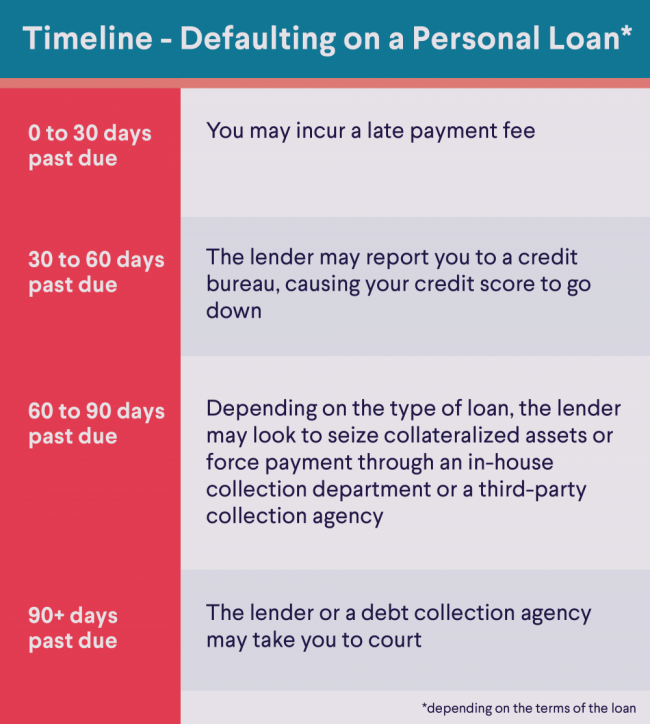
Even if you miss just one payment on a personal loan, you might be charged a late fee. Your loan agreement should have information about when this penalty fee kicks in — it might be one day or a couple of weeks — and whether it will be a flat fee or a percentage of your monthly payment.

The agreement also should tell you when the lender will get more serious about collecting its money. Because the collections process can be costly for lenders, it might be a month or more before yours determines your loan is in default. But at some point, you can expect the lender to take action to recover what they’re owed.

What Are the Consequences of Defaulting on a Personal Loan?

Besides those nasty late fees, which can pile up fast, and the increasing stress of fretting about a debt, here are some other significant consequences to consider:

Damage to Your Credit

Lenders typically report missing payments to the credit bureaus when borrowers are more than 30 days late. This means your delinquency will likely show up on your credit reports and could cause your credit scores to go down. Even if you catch up down the road, those late payments can stay on your credit reports for up to seven years.

If you actually default and the debt is sold to a collection agency, it could then show up as a separate account on your credit reports and do even more damage to your credit scores.

Though you may not feel the effects of a lower credit score immediately, it could become a problem the next time you apply for new credit — whether that’s for a credit card, car loan, or mortgage loan. It could even be an issue when you try to rent an apartment or need to open new accounts with your local utilities.

Sometimes, a lender may still approve a new loan for borrowers with substandard credit scores, but it might be at a higher interest rate. This means you’d pay back more interest over the life of the loan, which could set you back even further as you work toward financial wellness.

Dealing with Debt Collectors

If you have a secured personal loan, the lender may decide to seize the collateral you put up when you got the loan (your car, personal savings, or some other asset). If it’s an unsecured personal loan, the lender could come looking for payment, either by working through its in-house collection department or by turning your debt over to a third-party collection agency.

Even under the best conditions, dealing with a debt collector can be unpleasant, so it’s best to avoid getting to that stage if you can. But if you fall far enough behind to be contacted by a debt collector, you should be prepared for some aggressive behavior on the part of the collection agency. These agents may have monthly goals they must meet, and they could be hoping you’ll pay up just to make them go away.

There are consumer protections in place through the Fair Debt Collection Practices Act that clarify how far third-party debt collectors can go in trying to recover a debt. There are limits, for example, on when and how often a debt collector can call someone. And debt collectors aren’t allowed to use obscene or threatening language. If you feel a debt collector has gone too far, you can file a complaint with the Consumer Financial Protection Bureau (CFPB).

You Could Be Sued

If at some point the lender or collection agency decides you simply aren’t going to repay the money you owe on a personal loan, you eventually could end up in court. And if the judgment goes against you, the consequences could be wage garnishment or, possibly, the court could place a lien on your property.

The thought of going to court may be intimidating, but failing to appear at a hearing can end up in an automatic judgment against you. It’s important to show up and to be prepared to state your case.

A Cosigner Could Be Affected

If you have a co-applicant or cosigner on your personal loan, they, too, could be affected if you default.

When someone cosigns on a loan with you, it means that person is equally responsible for paying back the amount you borrowed. So if a parent or grandparent cosigned on your personal loan to help you qualify, and the loan goes into default, the lender — and debt collectors — may contact both you and your loved one about making payments. And your cosigner’s credit score also could take a hit.

Is There a Way to Avoid Defaulting on a Loan?

If you’re worried about making payments and you think you’re getting close to defaulting — but you aren’t there yet — there may be some things you can do to try to avoid it.

Reassessing Your Budget

Could you maybe squeak by and meet all your monthly obligations if you temporarily eliminated some expenses? Perhaps you could put off buying a new car for a bit longer than planned. Or you might be able to cut down on some discretionary expenses, such as dining out and/or subscription services.

This process may be a bit painful, but you can always revisit your budget when you get on track financially. And you may even find there are things you don’t miss at all.

Talking to Your Lender

If you’re open about your financial issues, your lender may be willing to work out a modified payment plan that could help you avoid default. Some lenders offer short-term deferment plans that allow borrowers to take a temporary break from monthly payments if they agree to a longer loan term.

You won’t be the first person who’s contacted them to say, “I can’t pay my personal loan.” The lender likely has a few options to consider — especially if you haven’t waited too long. The important thing here is to be clear on how the new payment plan might affect the big picture. Some questions to ask the lender might include: “Will this change increase the overall cost of the loan?” and “What will the change do to my credit scores?”

Getting a New Personal Loan

If your credit is still in good shape, you could decide to get proactive by looking into refinancing the personal loan with a new one that has terms that are more manageable with your current financial situation. However, be sure to factor in any fees (such as origination fees on the new loan and/or a prepayment penalty on the old loan) to make sure the refinance will save you money. You’ll also want to keep in mind that extending the term of the term of your loan can increase the cost of the loan over time.

You can use an online personal loan calculator to see how much interest you might be able to save by paying off your existing debt with a loan.

Or you might consider combining the old loan and other debts into one debt consolidation loan with a more manageable payment. This strategy would be part of an overall plan to get on firmer financial footing, of course. Otherwise, you could end up in trouble all over again.

But if your income is higher now and/or your credit scores are stronger than they were when you got the original personal loan, you could potentially improve your interest rate or other loan terms. (Personal loan requirements vary by lender.) Or you might be able to get a fresh start with a longer loan term that could potentially lower your payments.

If you decide a new personal loan is right for your needs, the next step is to choose the right lender for you. Some questions to ask lenders might include:

•   Can I borrow enough for what I need?

•   What is the best interest rate I can get?

•   Can I get a better rate if I sign up for automatic payments?

•   Do you charge any loan fees or penalties?

•   What happens if I can’t pay my personal loan because I lost my job? Do you offer unemployment protection?

Is There a Way Out of Personal Loan Default?

Even if it’s too late to avoid default, there are steps you may be able to take to help yourself get back on track. After carefully evaluating the situation, you may decide you want to propose a repayment plan or lump-sum settlement to the lender or collection agency. If so, the CFPB recommends being realistic about what you can afford, so you can stick to the plan.

If you need help figuring out how to make it work, the CFPB says, consulting with a credit counselor may help. These trained professionals can work with you to come up with a debt management plan. While a counselor usually doesn’t negotiate a reduction in the debts you owe, they might be able to help get your interest rates lowered or have loan terms extended, which could lower your monthly payments.

What’s more, a credit counselor can also help you create a budget, advise you on managing your debts and money, and may even often offer free financial education workshops and resources.

But consumers should be cautious about companies that claim they can renegotiate, settle, or change the terms of your debt. The CFPB warns that some companies promise more than they can deliver. If you’re interested in exploring credit counseling, a good place to start is browsing this list of nonprofit agencies that have been certified by the Justice Department.

Finally, as you make your way back to financial wellness, it can be a good idea to keep an eye on two things:

1. The Statute of Limitations

For most states, the statute of limitations — the period during which you can be sued to recover your debt — is about three to six years. If you haven’t made a payment for close to that amount of time — or longer — you may want to consult a debt attorney to determine your next steps. (Low-income borrowers may even be able to get free legal help.)

2. Your Credit Score

Tracking your credit reports — and seeing first-hand what builds or hurts your credit scores — could provide extra incentive to keep working toward a healthier financial future. You can use a credit monitoring service to stay up to date, or you could take a DIY approach and check your credit reports yourself. Every U.S. consumer is entitled to free credit reports available at AnnualCreditReport.com, which is a federally authorized source.

The Takeaway

If you default on a personal loan, there can be various negative impacts, such as a lower credit score, owing fees, and having your debt turned over to a collection agency. If you’re struggling to make payments, you might proactively talk to your current lender about modified payment terms — or it might be time to consider a new personal loan to consolidate high-interest debt.

Think twice before turning to high-interest credit cards. Consider a SoFi personal loan instead. SoFi offers competitive fixed rates and same-day funding. See your rate in minutes.


SoFi’s Personal Loan was named a NerdWallet 2026 winner for Best Personal Loan for Large Loan Amounts.

FAQ

How bad is it to default on a personal loan?

When a loan goes into default, it can trigger fees, damage your credit score, and stay on your credit report for up to seven years. You could face legal action as well. These negative consequences can mean it’s harder to qualify for new credit or do so at a favorable rate.

What happens if I don’t pay back a personal loan?

While the exact consequences will vary depending on your loan and your lender, typically, when you don’t pay back a personal loan, your credit score will be negatively impacted, you may face collection efforts from an agency or the lender, and you could also face legal action.

Is it a crime to default on a loan?

It isn’t a crime to default on a loan. You cannot be arrested. However, you could face legal action and have to appear in court in connection with the non-payment of the debt.


SoFi Loan Products
SoFi loans are originated by SoFi Bank, N.A., NMLS #696891 (Member FDIC). For additional product-specific legal and licensing information, see SoFi.com/legal. Equal Housing Lender.


*Awards or rankings from NerdWallet are not indicative of future success or results. This award and its ratings are independently determined and awarded by their respective publications.

Disclaimer: Many factors affect your credit scores and the interest rates you may receive. SoFi is not a Credit Repair Organization as defined under federal or state law, including the Credit Repair Organizations Act. SoFi does not provide “credit repair” services or advice or assistance regarding “rebuilding” or “improving” your credit record, credit history, or credit rating. For details, see the FTC’s website .

Financial Tips & Strategies: The tips provided on this website are of a general nature and do not take into account your specific objectives, financial situation, and needs. You should always consider their appropriateness given your own circumstances.

External Websites: The information and analysis provided through hyperlinks to third-party websites, while believed to be accurate, cannot be guaranteed by SoFi. Links are provided for informational purposes and should not be viewed as an endorsement.
Third-Party Brand Mentions: No brands, products, or companies mentioned are affiliated with SoFi, nor do they endorse or sponsor this article. Third-party trademarks referenced herein are property of their respective owners.

This article is not intended to be legal advice. Please consult an attorney for advice.

Third Party Trademarks: Certified Financial Planner Board of Standards Center for Financial Planning, Inc. owns and licenses the certification marks CFP®, CERTIFIED FINANCIAL PLANNER®

SOPL-Q325-046

Read more
Personal Loans, Mortgages, and How They Can Interact

Personal Loans, Mortgages, and How They Can Interact

When you apply for a mortgage, any outstanding debts you have — including personal loans, credit cards, and auto loans — can impact how much of a mortgage you can get, and whether you even qualify in the first place.

If you’re planning to buy a home within the next couple of years, applying for a personal loan could potentially reduce how much you can borrow. A personal loan can also affect your credit — this impact could be positive or negative depending on how you manage the loan.

Whether you’re thinking about getting a personal loan or currently paying one off, here’s what you need to know about how personal loans interact with mortgages.

Key Points

•   A personal loan can have a negative or positive effect on your chances of getting approved for a mortgage.

•   Personal loans affect debt-to-income ratio, which can influence mortgage approval and borrowing limits.

•   If handled responsibly, a personal loan can have a positive impact on your credit profile.

•   New credit inquiries from personal loans can temporarily lower credit scores.

•   A diverse credit mix, including personal loans, can enhance your credit file.

How Do Personal Loans Work?

A personal loan is a lump sum of money borrowed from a bank, credit union, or online lender that you pay back in fixed monthly payments, or installments. Unlike mortgages and auto loans, personal loans are typically unsecured, meaning there’s no collateral (an asset that a borrower pledges as security for a loan) required.

Lenders typically offer loans from $1,000 to $50,000, and this money can be used for virtually any purpose. Common uses for personal loans include:

•   Debt consolidation

•   Home improvement projects

•   Emergencies

•   Medical bills

•   Refinancing an existing loan

•   Weddings

•   Vacations

Personal loans usually have fixed interest rates, so the monthly payment is the same for the term of the loan, which can range from two to seven years. On-time loan payments can help build your credit file, but missed payments can hurt it.

Can Personal Loans Affect Mortgage Applications?

Yes, getting a personal loan could impact a future mortgage application. When you apply for a home mortgage loan, the lender will look at your full financial picture. That picture includes your credit history (how well you’ve managed debt in the past), how much debt you currently have (including personal loans, credit cards, and other debt), your income, and credit score.

Depending on your financial situation, getting a personal before you buy a house could have a positive or negative impact on a mortgage application. Here’s a closer look.

Negative Effects

A personal loan could have a negative impact on your mortgage application if the loan payments are high in relation to your income. A lender may worry that you don’t have enough wiggle room to cover your current expenses and debts, plus a mortgage payment.

Another potential drawback is the impact on your credit score, especially if the loan is recent. When you apply for a personal loan, it triggers a hard inquiry on your credit report, which can temporarily lower your score. In addition, any missed or late payments on your personal loan impact your payment history, which is a significant factor in your credit score.

Recommended: Using a Personal Loan for a Down Payment

Positive Effects

If you have a personal loan that is a reasonable size (relative to your income), your personal loan payment history shows that you regularly pay on time, and you’re consistently paying down any other debts, a mortgage lender could see that as a positive indicator that you’d likely be a low-risk investment.

What’s more, a personal loan adds variety to your credit mix — the types of credit you use. A balanced credit portfolio that includes both revolving credit (like credit cards) and installment credit (like personal loans) may help strengthen your credit profile.

How Personal Loans Can Affect Getting a Mortgage

Here’s a closer look at the ways in which getting a personal loan can affect your ability to get a home mortgage.

Credit Score

Your credit score is one indication to a lender of how likely you are to be to repay a loan — or, in other words, how much risk you represent to the lender. A personal loan can affect your credit score in several different ways. These include:

Payment History

Your bill-paying track record is typically the most significant factor in your credit scores, accounting for approximately 35% of your FICO® Score. On-time payments on a personal loan demonstrate financial responsibility and help build a positive payment history. Over time, this consistency can have a favorable impact on your credit file. On the flip side, missed or late payments can negatively affect your credit profile and damage your chances of mortgage approval.

New Credit

When you apply for a personal loan, the lender will run a hard credit inquiry. This type of credit check can cause a small, temporary drop in your scores. In addition, a new loan reduces the average age of your credit accounts, which may further impact your credit file, especially if your credit history is limited.

Credit Mix

Credit mix accounts for about 10% of your FICO credit score. Lenders like to see that you can manage various types of credit responsibly. If you only have credit cards, adding an installment loan like a personal loan could positively impact your credit file and make you look more attractive to a mortgage lender.

Credit Utilization

If you use a personal loan to consolidate and pay off high-interest credit card debt, it could favorably impact your credit by lowering your credit utilization ratio.

Your credit utilization ratio is the percentage of available credit that you’re currently using on your credit cards and other lines of credit, and is another important factor in your credit scores. Keeping your utilization below 30% is generally recommended for maintaining good credit health.

Recommended: Personal Loan Calculator

Debt-to-Income Ratio

Your debt-to-income (DTI) ratio refers to the total amount of debt you carry each month compared to your total monthly income. Your DTI ratio doesn’t directly impact your credit score, but it’s an additional factor lenders may consider when deciding whether to approve you for a new credit account, such as a mortgage. Having a personal loan will increase your debt load and, in turn, your DTI ratio.

To calculate your DTI ratio, add up all your monthly debt payments and divide them by your gross monthly income (that’s your income before taxes and other deductions are taken out). Next, convert your DTI ratio from a decimal to a percentage by multiplying it by 100.

The DTI ratio you need to secure a mortgage varies by lender. Generally, though, mortgage lenders prefer a DTI ratio of 36% or below.

Should You Pay Off Your Personal Loan Before Applying for a Mortgage?

If you already have a personal loan, are close to the end of your repayment term, and can afford to pay off the remainder before applying, eliminating the debt could improve your chances of getting the mortgage amount you’re looking for.

Another reason why you may want to pay off your personal loan before buying a home is that home ownership generally comes with a lot of additional expenses. Not having a personal loan payment to make each month can free up cash you may need for other things, like mortgage payments, homeowners insurance, and more.

That said, if paying off a personal loan will use up money you had earmarked for a downpayment on a home or leave you cash poor (with no emergency fund), it might be better to keep making your monthly payments, rather than pay off your personal loan early.

Tips to Help Your Mortgage Application

Generally speaking, having a personal loan won’t make or break your odds of getting a mortgage. If you’re concerned about being approved, however, here are some steps that can help.

Avoid Taking on New Debt Before Applying

It’s wise to avoid taking any type of new debt in the months before applying for a mortgage. New debt can increase your DTI and also cause a temporary drop in scores due to the recent hard inquiry. It also signals to lenders that you may be relying on credit to make ends meet, which can raise concerns about your financial stability.

Check Your Credit Report for Errors

Before you submit a mortgage application, it’s a good idea to review your credit reports to make sure there are no errors or inaccuracies. Mistakes like incorrect balances, outdated accounts, or erroneous late payments can hurt your chances of approval.

You’re entitled to a free credit report every week from each of the three major credit bureaus — Equifax®, Experian®, and TransUnion® — at AnnualCreditReport.com. If you find any mistakes, you can dispute them with the appropriate bureau.

Consider Getting Prequalified

Getting prequalified for a mortgage gives you an idea of how much you may be able to borrow based on your income, credit, and debts. It’s not a guarantee of loan approval, but it can help you identify any red flags in your financial profile — such as a high DTI or low credit score — before formally applying.

Prequalification also helps you set realistic expectations when house hunting and shows sellers you’re a serious buyer.

The Takeaway

A personal loan can impact your ability to get a mortgage, but the effects depend on how you manage the loan and your overall financial situation. Personal loans can increase your debt burden and negatively affect your credit file if mismanaged. But they can also help build credit and demonstrate responsible borrowing when used wisely.

If you’re not planning to apply for a mortgage right away, and can comfortably manage the personal loan payments (and possibly even pay off the loan early), getting a personal loan could help you build credit and make it easier to get a mortgage.

Think twice before turning to high-interest credit cards. Consider a SoFi personal loan instead. SoFi offers competitive fixed rates and same-day funding. See your rate in minutes.

SoFi’s Personal Loan was named a NerdWallet 2026 winner for Best Personal Loan for Large Loan Amounts.

FAQ

Can a personal loan hurt your chances of getting a mortgage?

A personal loan could potentially hurt your chances of getting a mortgage. A personal loan increases your monthly debt obligations, which could reduce the amount you’re approved to borrow. Also, If you struggle to make timely payments on the personal loan, it will negatively impact your payment history, which is a key component of your credit score.
That said, having a personal loan and managing it responsibility could be a net positive if it adds to your positive payment history and diversifies your credit mix. This could improve your chances of getting a mortgage.

Should you close a personal loan before applying for a mortgage?

Closing (or paying off) a personal loan before applying for a mortgage can be beneficial, especially if it lowers your debt-to-income (DTI) ratio. A lower DTI can improve your mortgage eligibility and may help you qualify for better interest rates. However, it’s important to weigh this decision carefully. If paying off the personal loan significantly depletes your savings and limits your ability to make a substantial down payment, it might be more strategic to continue making regular payments.

How much does a personal loan impact debt-to-income ratio?

A personal loan directly affects your debt-to-income (DTI) ratio because its monthly payment is included in your total monthly debt obligations. Lenders calculate DTI by dividing total monthly debt by gross monthly income. Even a relatively small personal loan can increase your DTI enough to impact your mortgage eligibility. Keeping your DTI below 36% is generally recommended for mortgage approval.

Is it easier to get a mortgage without other active loans?

Yes, having no other active loans can make it easier to qualify for a mortgage. Without additional debt, your debt-to-income (DTI) ratio will be lower, making you appear less risky to lenders. A low DTI may also allow you to qualify for a larger loan amount or better interest rates. However, having a mix of well-managed credit can also be favorable. The key is maintaining a healthy balance — manageable debt, on-time payments, and a strong credit score.

Do mortgage lenders consider personal loans as part of your liabilities?

Yes, mortgage lenders include personal loans when calculating your total liabilities. These liabilities help determine your debt-to-income (DTI) ratio, a key factor in mortgage approval. Lenders will look at your credit report to verify outstanding balances and monthly payment obligations, including personal loans. Even if the loan has a low balance, the monthly payment counts toward your DTI. Keeping loan payments manageable and your overall DTI low can improve your chances of mortgage approval.


Photo credit: iStock/kate_sept2004

SoFi Loan Products
SoFi loans are originated by SoFi Bank, N.A., NMLS #696891 (Member FDIC). For additional product-specific legal and licensing information, see SoFi.com/legal. Equal Housing Lender.


Financial Tips & Strategies: The tips provided on this website are of a general nature and do not take into account your specific objectives, financial situation, and needs. You should always consider their appropriateness given your own circumstances.

Disclaimer: Many factors affect your credit scores and the interest rates you may receive. SoFi is not a Credit Repair Organization as defined under federal or state law, including the Credit Repair Organizations Act. SoFi does not provide “credit repair” services or advice or assistance regarding “rebuilding” or “improving” your credit record, credit history, or credit rating. For details, see the FTC’s website .

Third-Party Brand Mentions: No brands, products, or companies mentioned are affiliated with SoFi, nor do they endorse or sponsor this article. Third-party trademarks referenced herein are property of their respective owners.

Third Party Trademarks: Certified Financial Planner Board of Standards Center for Financial Planning, Inc. owns and licenses the certification marks CFP®, CERTIFIED FINANCIAL PLANNER®

SOPL-Q325-006

Read more
TLS 1.2 Encrypted
Equal Housing Lender