man on laptop close up

How Debt Collection Agencies Work

If a debt goes unpaid for long enough, it can eventually end up with a collection agency. That’s when the aggressive phone calls and letters usually start. Hearing from a debt collector can feel stressful, overwhelming, and even scary. However, it doesn’t have to be. Understanding how debt collection agencies work — and what your rights are — can help you navigate a difficult situation with more confidence and less panic.

Below, we break down what collection agencies actually do, how they’re different from debt buyers, what steps you should take if you’re contacted, and how this process can affect your credit.

Key Points

•  Debt collection agencies recover unpaid debts for creditors, earning a percentage as fee.

•  Debt buyers purchase and own delinquent debts and use similar recovery methods.

•  If you’re contacted by a debt collector, verify the debt is valid and, if necessary, dispute the debt.

•  Negotiate settlements or payment plans with collectors, considering your financial limits.

•  Collections can negatively impact your credit file but paying them may improve future credit prospects.

How Does Debt Collection Work?

Debt collection is the process of pursuing payment on overdue debts. Having a “debt in collections” means the original creditor (such as a credit card company, an auto lender, or a utility) has sent the debt to a third-party person or agency to collect it.

Typically, a debt doesn’t go to collections if you miss one payment. If nonpayment goes on for a while (typically 90 to 180 days), however, the original creditor may decide to give up trying to collect from you and write the debt off as a loss. This process is known as a charge-off. At that point, they will usually do one of two things: assign the debt to a third-party debt collection agency or sell it to a debt buyer.

Once the debt is transferred or sold, the collection process intensifies. You may start receiving letters, phone calls, or emails from the debt collector. Their goal is to recover as much of the debt as possible, either in full, through a payment plan, or via a negotiated settlement.

💡 Quick Tip: Everyone’s talking about capping credit card interest rates. But it’s easy to swap high-interest debt for a lower-interest personal loan. SoFi credit card consolidation loans are so popular because they’re cheaper, safer, and more transparent.

What Is a Debt Collector?

A debt collector is any individual or company whose primary job is to recover money owed on delinquent accounts. They might be part of a collection agency, a law firm specializing in collections, or an in-house department of the original creditor.

Under the Fair Debt Collection Practices Act, debt settlement companies are required to follow strict guidelines when contacting consumers. They are prohibited from using abusive, deceptive, or unfair practices. For example, they can’t call before 8 a.m. or after 9 p.m., harass you, or misrepresent themselves.

Recommended: What Is the Difference Between Personal Loan vs Credit Card Debt?

What Do Collection Agencies Do?

Collection agencies work on behalf of creditors to recover unpaid debts. Generally the way they make money is by receiving a percentage — usually between 25% and 50% — of the amount they recover. Commissions tend to be on the higher end of that range for older debts, since they are more difficult to collect.

Collection agencies can — and do — use a variety of tactics to recover funds, including:

•  Calling you at home or work

•  Sending letters, text, or emails

•  Contacting you through social media

•  Showing up at your front door

•  Contacting your friends and family to confirm your contact information (they can’t do this more than once, however, or reveal why they need the information)

•  Take you to court to recover a past-due debt

When dealing with collections, it’s important to keep in mind that there is a statute of limitations on debt. Collectors generally have between three to six years to file a lawsuit over old debts (the timeline varies by where you live and type of debt). The clock starts when your debt was first recorded delinquent. After the statute of limitations ends, a collection agency cannot legally sue you for the debt. They can, however, still hound you for the money.

How Is This Different from a Debt Buyer?

A debt buyer doesn’t work for the creditor like a debt collection agency does. They buy debts that have been charged off by creditors, sometimes buying a collection of old debts from a single creditor. How much these collectors pay for debt varies but it can be as little as a few cents on the dollar.

Because debt collectors own the debt, they generally have more freedom to negotiate than collection agencies that are merely collecting on someone else’s behalf. Also because they often pay so little for debt, any recovery can represent a profit.

Like debt collection agencies, debt buyers sometimes use aggressive tactics to collect a debt. However, they are subject to the same state and federal laws designed to protect borrowers from harassment.

Recommended: Credit Card Debt Collection: What Is It and How Does It Work?

How to Deal With a Debt in Collections

Finding out that a debt is in collections can be alarming. However, taking deliberate, informed steps can help protect your finances and your rights.

Verify the Debt

Before paying anything, it’s important to always verify the debt. Debt collectors are required by law to send you a debt validation notice within five days of contacting you. This notice should include:

•  The debt collector’s name and address

•  The name of the creditor

•  The amount owed

•  What to do if you don’t think it’s your debt

•  Your debt collection rights

If you’re unsure about the validity of the debt or the amount, send a written request for verification within 30 days. This forces the agency to provide documentation proving the debt is legitimate. If the debt is not valid, you can dispute it with the collector.

Negotiate a Payment Plan or Settlement

If the debt is legitimate, consider negotiating. Many collectors are willing to accept a lump-sum settlement for less than the full balance, especially if they purchased the debt cheaply. Alternatively, you might be able to arrange a payment plan that fits your budget.

When negotiating, be sure to consider your financial situation and avoid agreeing to any terms you can’t realistically meet. Once you sign off on a payment plan or make a payment on old debt, it restarts the clock on the statute of limitations.

Get Agreements in Writing

Before sending any money to a collection agency, make sure you have a written agreement that outlines the terms. This document should specify the amount to be paid, the payment schedule, and whether the agency will report the account as “paid in full” or “settled” to credit bureaus.

Getting agreements in writing protects you from future disputes and ensures you have proof of compliance.

How Does a Debt in Collections Affect Your Credit?

Missed payments on a debt already negatively impact your credit profile. When a debt goes into collections, the situation typically worsens.

When the original creditor decides to stop trying to collect on your debt and closes your account, the charge-off goes on your credit report. Once the debt goes to collections and the debt collector sends you a notice, the collector will create a new collection account, which also lands on your credit report.

Both the charge-off and the collection account are negative entries, and can cause an immediate drop in your credit scores of 50 to 100 points, possibly more.

While paying the debt collector will not remove the collection account from your credit report, it’s generally a good idea to do so. For one reason, some newer credit scoring models ignore collection accounts with a zero balance. Potential lenders also tend to view paid-off collection accounts more favorably when they check your credit report as part of a credit application. On top of that, you’ll no longer be harassed by the debt collection company.

Alternatives to Debt Collection Agencies

You can avoid having debt land in collections by taking steps to manage and pay down existing debt. Here are some strategies to consider.

Consumer Credit Counseling Services

Nonprofit credit counseling agencies offer free or low-cost services to help you gain better control of your finances. You can often get counseling, budgeting advice, and credit education from a certified counselor free of charge.

For an added fee, a counselor can also set up a debt management plan. This means they will negotiate with creditors on your behalf to lower your interest rates and fees and establish a payment plan that works for you. They then consolidate your payments into one monthly amount. You make a single payment to the counseling agency, which distributes the funds to your creditors.

Debt Settlement

If you’re more than 90 days past due on a debt and suffering financial hardship, you might consider debt settlement, also known as debt relief. This is a strategy where you negotiate with your creditors to lower your debt in return for one lump sum payment. You can try this yourself or hire a debt settlement company, though the latter often charges high fees and may not guarantee success.

Just keep in mind that settling a debt can negatively affect your credit file, since settled accounts stay on your credit report for up to seven years. However, for those overwhelmed by debt, it may be preferable to ongoing collections or bankruptcy.

Debt Consolidation

Debt consolidation involves combining multiple debts — typically high-interest debts like credit card balances — into a single loan or credit account. The main goal with this debt payoff strategy is to simplify repayment and potentially lower the interest rate or monthly payments. Some common ways to consolidate debt include:

•   Debt consolidation loans: These are essentially personal loans that are used to pay off other debts and rates tend to be lower than credit cards.

•   Balance transfer credit cards: These are credit cards that let you move balances from others cards; some offer a 0% introductory rate.

•   Home equity loans or lines of credit: This involves borrowing against your home equity to pay off debts.

Before you consolidate debt, it’s important to look closely at rates and any added fees to make sure the move will be cost effective.

💡 Quick Tip: Before choosing a personal loan, ask about the lender’s fees: origination, prepayment, late fees, etc. One question can save you many dollars.

Bankruptcy as a Last Resort

Personal bankruptcy is a legal process designed to provide relief for people facing severe financial difficulties who are unable to repay their debts. There are two main types for individuals:

•   Chapter 7: This allows you to discharge most types of unsecured debt, such as credit card balances and medical bills, but you must first liquidate non-exempt assets to repay as much of the debt as possible.

•   Chapter 13: This allows you to restructure your debt under a new repayment plan that usually spans three to five years.

Keep in mind that bankruptcy has serious long-term credit consequences. It stays on your credit report for seven to 10 years (seven for Chapter 13 and 10 for Chapter 7), making future borrowing more difficult.

The Takeaway

If you’ve gotten a phone call or letter from a debt collector, it’s important to understand how debt collection agencies work and how to handle debt in collections. Ignoring a collector won’t make the debt go away. Instead, it’s better to gather as much information as possible to make informed decisions.

If you’re struggling with multiple high-interest debts, keep in mind that there are options available to help regain control of your finances.

Credit cards have an average APR of 20%–25%, and your balance can sit for years with almost no principal reduction. Personal loan interest rates average 12%, with a guaranteed payoff date in 2 to 7 years. If you’re carrying a balance of $5,000 or more on a high-interest credit card, consider a SoFi Personal Loan instead. See your rate in minutes.


SoFi’s Personal Loan was named a NerdWallet 2026 winner for Best Personal Loan for Large Loan Amounts.

FAQ

What rights do you have when dealing with a collection agency?

When dealing with a collection agency, you have rights under the Fair Debt Collection Practices Act. Collectors must treat you fairly and cannot harass, threaten, or lie to you. They must identify themselves, provide proof of the debt if requested, and cannot contact you at inconvenient times (such as before 8 a.m. or after 9 p.m.). You also have the right to request all communication in writing and to dispute the debt within 30 days of first contact.

Can a debt collector sue you or garnish wages?

Yes, a debt collector can sue you for unpaid debt. If they win the lawsuit, they may obtain a court judgment allowing wage garnishment. However, collectors must notify you and give you a chance to respond. State and federal laws also limit how much a creditor can garnish from your wages. Always respond to legal notices promptly, and consider speaking with an attorney or credit counselor if you’re being sued over a debt.

How do you remove a collection from your credit report?

To remove a collection from your credit report, start by checking if it’s accurate. If it’s incorrect or too old (over seven years), you can dispute it with the credit bureau. For valid collections you’ve paid, you might request a “goodwill deletion” after you’ve paid it. This involves calling or writing to the collection agency and asking to have the account deleted as a gesture of goodwill. They don’t have to comply, but they might.

Does paying off collections improve your credit score?

It might. Some credit scoring models consider accounts in collections, even if they are paid. However, newer FICO and VantageScore models ignore paid collections, which means paying them off can be beneficial. Regardless, settling or paying off collections looks better to lenders and can help you qualify for credit in the future. It also prevents further action, like lawsuits. Always ask for a written confirmation of payment or settlement.

What’s the difference between a debt collector and a debt buyer?

A debt collector is a company hired by a creditor to collect money on their behalf. They don’t own the debt but earn a fee or commission for collecting payment. A debt buyer, on the other hand, purchases delinquent debts from original creditors, often for pennies on the dollar, and then owns the debt outright. Your rights remain the same under both.


SoFi Loan Products
SoFi loans are originated by SoFi Bank, N.A., NMLS #696891 (Member FDIC). For additional product-specific legal and licensing information, see SoFi.com/legal. Equal Housing Lender.


Financial Tips & Strategies: The tips provided on this website are of a general nature and do not take into account your specific objectives, financial situation, and needs. You should always consider their appropriateness given your own circumstances.

Disclaimer: Many factors affect your credit scores and the interest rates you may receive. SoFi is not a Credit Repair Organization as defined under federal or state law, including the Credit Repair Organizations Act. SoFi does not provide “credit repair” services or advice or assistance regarding “rebuilding” or “improving” your credit record, credit history, or credit rating. For details, see the FTC’s website .

Third-Party Brand Mentions: No brands, products, or companies mentioned are affiliated with SoFi, nor do they endorse or sponsor this article. Third-party trademarks referenced herein are property of their respective owners.

Third Party Trademarks: Certified Financial Planner Board of Standards Center for Financial Planning, Inc. owns and licenses the certification marks CFP®, CERTIFIED FINANCIAL PLANNER®

SOPL-Q325-008

Read more
Woman looking out car with sunglasses

Your Guide to Handling High-Interest Debt

High-interest debt can feel like a heavy weight, keeping you from reaching your financial goals and constantly draining your resources. Even if you consistently make the minimum payments, a significant portion goes towards interest, making it difficult to make any progress on the principal — or original debt.

Fortunately, there are strategies and tools you can use to manage and pay off high-interest debt more efficiently. Below, we walk you through what qualifies as high-interest debt, how it impacts your finances, and practical methods to help you tackle it head-on.

Key Points

•   High-interest debt, such as credit cards, can significantly increase borrowing costs and hinder financial goals.

•   High balances and missed payments can negatively affect credit scores, leading to higher future interest rates.

•   Borrowers can often save on interest by sweeping their credit card debt into a lower rate personal loan.

•   The avalanche payoff method targets high-interest debts first to minimize total interest paid.

•   The snowball payoff method focuses on smallest debts to build momentum and motivation.

What Is Considered High-Interest Debt?

High-interest debt generally refers to any loan or credit product with an interest rate significantly above average. While there’s no universally accepted definition of “high interest,” generally speaking, any annual percentage rate (APR) in the double-dibits is considered high.

The most common sources of high-interest debt include:

•   Credit card debt: As of May 2025, the average credit card interest rate was 22.25%, but you may see rates as high as 25%.

•   Payday loans: These are short-term, high-cost loans, typically for small amounts (often $500 or less), that are due on your next payday. Fees typically run around $15 per $100, which equates to an APR of almost 400%, according to the Consumer Financial Protection Bureau. This makes payday loans one of the most expensive forms of borrowing.

•   Store credit cards: Store-only credit cards charge an average of 30.24% APR, substantially higher than the average interest rate on general-purpose credit cards.

•   Personal loans for bad credit borrowers: Lenders typically charge higher interest rates — often 30% APR or higher — on personal loans for borrowers with poor credit primarily due to increased risk.

Unlike mortgages or student loans, which tend to have lower, fixed interest rates, high-interest debts can grow quickly if not managed, making them harder to pay off over time.

💡 Quick Tip: There is a lot of debate around credit card interest caps. For consumers carrying high-interest credit card balances, however, one of the shortest paths to debt relief is switching to a lower-interest personal loan. With a SoFi credit card consolidation loan, every payment brings you closer to financial freedom.

How High-Interest Debt Can Dent Finances

High-interest debt doesn’t just make it hard to stay on top of bills, but can have a ripple effect on nearly every aspect of your financial life. Here’s a look at the potential fallout:

•   Increased costs over time: The higher the interest rate, the more you pay in interest over the life of the loan or credit balance. For example, carrying a $5,000 credit card balance at a 22% APR and only making minimum payments could result in paying thousands of dollars in interest on top of what you originally borrowed.

•   Slower progress toward goals: When large chunks of your income go toward interest payments, there’s less money left for savings, investing, or major purchases like a car or a home. High-interest debt can delay financial goals such as building an emergency fund, starting a business, or saving for retirement.

•   Credit impacts: High balances relative to your credit limit can negatively affect your credit utilization ratio, a key factor in credit scoring. Missed or late payments can also damage your credit, which can lead to even higher interest rates in the future.

•   Emotional stress: Living under the constant pressure of unmanageable debt can lead to stress and anxiety. Financial insecurity can also negatively impact your relationships and overall well-being.

Personal Loan CalculatorPersonal Loan Calculator

How to Pay Off High-Interest Debt

Tackling high-interest debt takes commitment, planning, and sometimes a little help. Here are some effective tools and strategies to consider.

Refinancing

Refinancing involves replacing one loan with another, ideally one that has a lower interest rate. Two popular options for refinancing high-interest debt are:

•   Personal loans: Interest rates on personal loans are generally much lower than credit cards, especially if you have good credit. If you can qualify for a competitive rate on a personal loan for debt consolidation, and use it to pay off your high-interest debt, it could help you save money and potentially pay off your debt faster.

•   Home equity loans or lines of credit (HELOCs): If you own a home, borrowing against your equity can provide access to low-interest funds to pay off high-interest debt. Just keep in mind that these are secured loans, meaning your home is used as collateral. Should you run into trouble repaying your loan or credit line, you could risk losing your home.

To determine if refinancing is worth it, you’ll want to compare loan terms carefully and check for any fees or penalties, which can add to your costs. An online debt consolidation calculator can help you determine exactly how much you could save by refinancing high-interest debt with a lower-interest loan.

💡 Quick Tip: Before choosing a personal loan, ask about the lender’s fees: origination, prepayment, late fees, etc. One question can save you many dollars.

Balance Transfer

A balance transfer involves taking out a new credit card, ideally one with a 0% introductory APR, and using it to pay off your current credit card balances. This can be an excellent tool for saving on interest, if used wisely. However, there are a few caveats to keep in mind:

•  Balance transfer cards usually charge a 3.0% to 5.0% transfer fee on the transferred amount. So for every $1,000 you transfer, a 4.0% percent balance transfer fee would cost $40.

•  If you don’t pay off the balance within the promotional period (which can be anywhere from 12 to 21 months), the interest rate will jump, potentially undoing your progress.

•  You typically can’t transfer balances between cards from the same bank.

•  You generally need a good credit score to qualify for the best balance transfer offers.

Credit Counseling

Working with a nonprofit credit counseling agency can be a good way to get free or low cost help with managing high-interest debt.

General credit counseling and budgeting advice is often free. For a small fee, a counselor can also set up a debt repayment plan (DMP). If you sign up for a DMP, your counselor will negotiate with your creditors on your behalf to lower interest charges and fees, and come up to a manageable repayment plan. You then make a single monthly payment to the agency and they distribute payments to your creditors.

A DMP typically requires closing your credit accounts and you usually can’t access new credit during the plan.

Recommended: What Is a Credit Card Interest Cap?

Common Debt Repayment Strategies

If you want to tackle your debt on your own, it’s important to take a systematic approach. “Focus on paying off one debt at a time,” advises Brian Walsh, CFP® and Head of Advice & Planning at SoFi. “If you spread your money out over many debt payments, your progress may not be as fast as you want. But by focusing on one goal at a time, you can see success sooner — and that can keep your motivation up.”

Two popular debt payoff strategies — the avalanche and snowball methods — offer different psychological and financial benefits. Here’s how they work:

The Avalanche Method

With the avalanche method, you list your debts in order of interest rate then make extra payments on the debt with the highest rate, while continuing to pay the minimum on the rest. Once that debt is erased, you funnel your extra payments towards the debt with the next-highest interest rate, and so on. This approach helps you save money on interest over time, but it can take longer to see results.

The Snowball Method

With the debt snowball method, you list your debt in order of size, ignoring interest rates. You then focus extra payments on the debt with the smallest balance, while making minimum payments on the rest. Once that debt is paid off, you roll its monthly payment to the debt with the next-smallest debt, and so on, creating a “snowball” effect.

This strategy helps you build momentum and motivation as you eliminate entire debts faster, but may cost more in interest compared to the avalanche method.

The Takeaway

High-interest debt may be daunting, but it’s not unbeatable. With the right combination of tools, you can take control of your finances and move toward a debt-free future. Whether you opt for refinancing, a balance transfer, credit counseling, or a DIY payoff approach, the key is to start now, stay committed to your plan, and remember that each payment moves you one step closer to financial freedom.

Credit cards have an average APR of 20%–25%, and your balance can sit for years with almost no principal reduction. Personal loan interest rates average 12%, with a guaranteed payoff date in 2 to 7 years. If you’re carrying a balance of $5,000 or more on a high-interest credit card, consider a SoFi Personal Loan instead. See your rate in minutes.


SoFi’s Personal Loan is cheaper, safer, and more predictable than credit cards.

FAQ

What is an example of high-interest debt?

A common example of high-interest debt is credit card debt. Many credit cards carry annual percentage rates (APRs) topping 20%, especially for those with lower credit scores. Due to compounding interest, balances can keep growing if you only pay the minimum due each month. Payday loans and personal loans for bad credit borrowers are also considered high-interest debt. These loans often feature extremely steep rates that can trap borrowers in a cycle of ongoing payments.

How can I prioritize high-interest debt over other financial goals?

To prioritize high-interest debt, start by creating a budget that allocates extra funds toward these debts while covering essentials. Consider using the avalanche payoff method, which prioritizes paying off debts with the highest interest rates first. While saving and investing are important, aggressively tackling high-interest debt can free up more money in the long run and improve your financial stability.

Does consolidating high-interest debt hurt your credit score?

Debt consolidation can cause a temporary dip in your credit score due to a hard credit inquiry and the opening of a new credit account. However, if managed responsibly, it can have a net positive impact on your credit file over time. By simplifying payments and potentially lowering your interest rate, consolidation can help you build a positive payment history, a key factor in your credit score. The long-term effect on your score largely depends on how well you manage the new loan.

Are personal loans a good option for high-interest credit card debt?

Yes, personal loans can be a smart option for paying off high-interest credit card debt. They typically offer lower fixed interest rates and a set repayment term, making monthly payments more predictable. This can help you save on interest and potentially pay down debt faster. However, it’s important to compare lenders, watch for fees, and avoid racking up new credit card debt after consolidation. Success depends on disciplined repayment and budgeting habits.

How long does it take to pay off high-interest debt with a structured plan?

The time it takes to pay off debt with a structured plan varies based on your total debt, repayment strategy, and how much extra you can pay monthly. Using a formal debt management plan offered by a credit counseling agency, many people become debt-free in two to five years. Larger debts may take longer, especially if you’re only making minimum payments.


SoFi Loan Products
SoFi loans are originated by SoFi Bank, N.A., NMLS #696891 (Member FDIC). For additional product-specific legal and licensing information, see SoFi.com/legal. Equal Housing Lender.


Financial Tips & Strategies: The tips provided on this website are of a general nature and do not take into account your specific objectives, financial situation, and needs. You should always consider their appropriateness given your own circumstances.

Disclaimer: Many factors affect your credit scores and the interest rates you may receive. SoFi is not a Credit Repair Organization as defined under federal or state law, including the Credit Repair Organizations Act. SoFi does not provide “credit repair” services or advice or assistance regarding “rebuilding” or “improving” your credit record, credit history, or credit rating. For details, see the FTC’s website .

Third Party Trademarks: Certified Financial Planner Board of Standards Center for Financial Planning, Inc. owns and licenses the certification marks CFP®, CERTIFIED FINANCIAL PLANNER®

SOPL-Q325-017

Read more

How to Lower Credit Card Debt Without Ruining Your Credit

While paying off your credit cards can have a positive effect on your credit profile, this isn’t always the case. Depending on the strategy you use to wipe away your debt, you could (inadvertently) do some damage to your scores. This could make it harder to get a mortgage, car loan, or even a rental agreement in the future. Here’s what you need to know to pay down your credit obligations while protecting your credit.

Key Points

•  Ignoring credit card debt leads to growing interest, late fees, and potential legal actions, harming financial health.

•  Payoff strategies like debt avalanche and debt snowball can help reduce balances and build credit.

•  Debt consolidation may temporarily reduce your credit scores, but can favorably impact your credit file over time.

•  Personal loans, balance transfer cards, and home equity loans offer unique benefits and risks for debt consolidation.

•  Negotiating with creditors through workout agreements, settlements, and hardship programs can provide relief but may negatively impact credit.

What Not to Do: Ignoring Credit Card Debt

When it comes to credit card debt, the consequences of avoidance and procrastination are steep, both to your financial well-being and to your credit scores. Here’s a look at the potential fallout.

•  Interest charges will pile up: Generally, the longer you avoid paying down your debt, the more interest will accrue. The average interest rate on credit cards as of July 2025 is 20.13%. This means that even if your debt isn’t growing through new purchases, interest alone can make your balance balloon over time.

•  Late fees and credit damage: Credit card issuers usually charge fees if you don’t make the minimum payment by the due date. After 30 days of no payment, your issuer will likely report the missed payment to the credit bureaus, which can do significant damage to your credit profile.

•  Debt collection and legal consequences: Ignoring credit card debt for too long could lead to the debt being sent to a collection agency, a third party that can be aggressive in pursuing repayment. In extreme cases, your creditors might sue you, potentially leading to wage garnishment or seizure of personal assets.

Best Ways to Pay off Debt Without Hurting Credit

When managed carefully, paying off debt can actually have a positive impact on your credit profile. The key is to use tactics that reduce your balances without negatively impacting your payment history, credit utilization, or credit mix.

Consolidate Credit Card Debt

Credit card consolidation involves combining multiple debts into a single loan, such as a debt consolidation loan, ideally with a lower interest rate. This approach can make repayment more manageable and may reduce the total interest you pay. You’ll still need to make consistent monthly payments, but streamlining your bills into one can reduce your chances of missing a due date.

As long as you make on-time payments, your credit profile may benefit from the reduced credit utilization and positive payment history.

💡 Quick Tip: Everyone’s talking about capping credit card interest rates. But it’s easy to swap high-interest debt for a lower-interest personal loan. SoFi credit card consolidation loans are so popular because they’re cheaper, safer, and more transparent.

Balance Transfer

A balance transfer involves moving high-interest credit card debt to a new card with a lower interest rate — ideally one with a 0% introductory annual percentage rate (APR). This strategy can give you a temporary break from interest charges, allowing you to pay off the principal more quickly.

To avoid credit score harm, don’t close old cards after transferring the balance — doing so can reduce your available credit and increase your utilization ratio. It’s also important to pay off the balance before the promotional period ends, or you may face high interest rates (again). Some balance transfer cards offer a 0% APR for as long as 20 months.

Automate Payments

Late or missed payments are among the biggest threats to your credit scores. Automating payments ensures your minimums are paid on time every month, which protects your payment history, a key factor in your credit score.

You can set up automatic payments through your bank or directly with your credit card issuer. You can always make additional manual payments to reduce the balance faster.

Debt Snowball vs. Debt Avalanche Payoff Strategies

One of the best ways to pay off debt without hurting credit is to use a DIY payoff plan. Here are two popular strategies for whittling down multiple debts:

•  Debt avalanche method: Here, you make extra payments on the credit card with the highest interest rate first, while making minimum payments on the others. Once the highest-rate card is paid off, you funnel those extra funds toward the card with the next-highest rate, and so on. This strategy minimizes the amount of interest you’ll pay over time.

•  Debt snowball method: With this approach, you put extra payments toward the card with the smallest balance first, while making minimum payments on the others. When that card is cleared, you focus on paying off the next-smallest balance, and so on. This gives you quick wins and a psychological boost, which can help you stay motivated.

Negotiating and Settling Credit Card Debt

Sometimes, repayment in full isn’t realistic. In those cases, negotiating with your creditor may provide relief while minimizing damage to your credit.

Workout Agreement

With this arrangement, the credit card company may agree to lower your interest rate or temporarily waive interest altogether. They may also be willing to take additional steps to make it easier for you to repay your debt, such as waiving past late fees or lowering your minimum payment.

Because this agreement is informal and not reported as negative to credit bureaus, it can help you pay off debt without hurting your credit, provided you uphold your end of the deal.

Debt Settlement

In a debt settlement, the credit card company agrees to accept less than the full amount you owe, forgive the rest, and close the account. While this might seem appealing, a debt settlement comes with consequences. A settled debt becomes a negative entry on your credit report, where it can stay for seven years. You’ll want to consider debt settlement as a last-resort option, and also be cautious of third party settlement companies that charge high fees or make unrealistic promises.

Hardship Agreement

Some card issuers offer a hardship or forbearance program for borrowers who are experiencing a temporary financial setback, such as a job loss, illness, or injury. Under these programs, the company may agree to lower your interest rate, even temporarily suspend payments. Keep in mind that the issuer might freeze your account while you’re enrolled, which means you won’t be able to use your card. Also, if the plan extends your repayment term, it could increase the total amount of interest you pay.

While a hardship program typically doesn’t impact your credit, it could if the card issuer decides to close your account or lower your available credit.

What Is the Statute of Limitations on Credit Card Debt?

The statute of limitations on debt governs how long a creditor or collection agency can sue you for nonpayment of a debt. The statute of limitations on credit card debt varies from state to state, but is typically between three and six years. Once the statute of limitations has passed, debt collectors can’t win a court order for repayment.

Even if your credit card debt is past the statute of limitations, however, it doesn’t magically disappear. Negative entries — such as late or missed payments, accounts sent to collections, and accounts not paid as agreed — generally stay on your credit report for seven years. These negative marks can lower your credit scores, making it hard to qualify for new credit cards and loans with attractive rates and terms in the future.

Does Credit Card Debt Consolidation Hurt Your Credit?

Debt consolidation can cause a temporary dip in your credit scores, mostly due to the hard inquiry from the loan application and the new account appearing on your report. However, the long-term effects are often positive if you manage the new loan responsibly.

By reducing your credit utilization ratio and maintaining on-time payments, debt consolidation can have a net positive effect on your credit profile over time. The key is to avoid racking up new balances while paying off the consolidated loan.

Recommended: What Is a Credit Card Interest Cap?

How to Consolidate Credit Card Debt Without Hurting Your Credit

The right strategy can help you consolidate debt while protecting or even building your credit.

Consider Debt Consolidation Options

Start by exploring the types of consolidation available — personal loans, balance transfer credit cards, and home equity loans/lines of credit (HELOCs) can all be used to pay off your credit cards and streamline repayment. It’s important to compare interest rates, terms, and fees to find the best fit for your situation.

An online debt consolidation calculator can show you exactly how much interest you could save by paying off your existing credit card (or cards) with a new loan or line of credit.

Get Prequalified

Before applying, see if you can prequalify for a consolidation loan. Prequalification uses a soft credit inquiry and won’t impact your score. It can give you an idea of the interest rate and terms you might receive and help you make an informed choice before formally applying for the loan.

Stop Using Your Credit Cards

Once you consolidate your balances, it’s a good idea to stop or limit use of your consolidated cards. While it’s wise to keep those accounts open (to maintain your credit history and limit), continuing to run up balances on those cards can lead to even more debt, undermining the purpose of consolidation and damaging your credit utilization ratio.

Pay Bills On Time

Payment history is generally the most important factor in your credit scores — it makes up 35% of your overall FICO® credit score. So paying your consolidated loan or transferred balance on time is critical. Even a single late payment can lead to a negative mark on your credit reports and undo some of your progress.

Set up reminders or automate payments to stay on track and build positive credit habits.

Recommended: FICO Score vs Credit Score

The Takeaway

Credit card debt can be a major financial burden, but it doesn’t have to ruin your credit or your financial future. By facing your debt and adopting a planned approach, you can gradually reduce what you owe. Whether you choose to use a paydown strategy (like avalanche or snowball), negotiate with creditors, or explore a consolidation loan, there are various strategies to help you regain control of your finances while protecting — and ultimately building — your credit.

Whether or not you agree that credit card interest rates should be capped, one thing is undeniable: Credit cards are keeping people in debt because the math is stacked against you. If you’re carrying a balance of $5,000 or more on a high-interest credit card, consider a SoFi Personal Loan instead. SoFi offers lower fixed rates and same-day funding for qualified applicants. See your rate in minutes.


SoFi’s Personal Loan was named a NerdWallet 2026 winner for Best Personal Loan for Large Loan Amounts.

FAQ

Can paying off credit card debt improve my credit score?

Paying off credit card debt can have a positive impact on your credit profile. It lowers your credit utilization ratio (the percentage of available credit you’re currently using), which is a major factor in your credit scores. A lower utilization rate suggests responsible credit management. Making consistent, on-time payments while reducing debt also adds to your positive payment history, which is another key factor in your scores.

Will settling credit card debt hurt my credit?

Settling credit card debt can negatively impact your credit, at least temporarily. When you settle a debt for less than the full amount owed, it may be reported to the credit bureaus as “settled” rather than “paid in full.” This status indicates that you didn’t repay the full debt and the entry can remain on your credit report for up to seven years. However, settling is still better than leaving debts unpaid or going into default.

How long does credit card debt stay on your credit report?

Negative information related to credit card debt — such as late payments, charge-offs, and collection accounts — generally remains on your credit report for seven years. However, positive information — like closed accounts paid as agreed — can stay on your report for up to ten years, helping your credit history. Active accounts in good standing stay on your report as long as the account is open and the lender is reporting it to the credit bureaus.

Is using a personal loan to pay off credit cards a good idea?

Using a personal loan to pay off credit cards can be a smart move if the loan offers a lower interest rate. This strategy, known as debt consolidation, can simplify payments and reduce interest costs. It can also improve your credit utilization ratio (the percentage of available credit you are currently using), which is factored into your credit scores. However, it’s important to have a solid repayment plan and avoid taking on more credit card debt, or the benefits could be short-lived.

What is the best way to pay down high-interest credit card debt?

One of the best ways to pay down high-interest credit card debt is using the avalanche method. This involves making extra payments on the card with the highest interest rate while making minimum payments on others. Once that card is paid off, you funnel the extra payment to the card with the next-highest rate, and so on. This minimizes the total interest paid over time. Another good option is to transfer your balances to a card with 0% introductory APR or a lower-interest personal loan. Whichever method you choose, consistent, above-minimum payments and avoiding new debt are key to getting ahead.


SoFi Loan Products
SoFi loans are originated by SoFi Bank, N.A., NMLS #696891 (Member FDIC). For additional product-specific legal and licensing information, see SoFi.com/legal. Equal Housing Lender.


Financial Tips & Strategies: The tips provided on this website are of a general nature and do not take into account your specific objectives, financial situation, and needs. You should always consider their appropriateness given your own circumstances.

Disclaimer: Many factors affect your credit scores and the interest rates you may receive. SoFi is not a Credit Repair Organization as defined under federal or state law, including the Credit Repair Organizations Act. SoFi does not provide “credit repair” services or advice or assistance regarding “rebuilding” or “improving” your credit record, credit history, or credit rating. For details, see the FTC’s website .

Third-Party Brand Mentions: No brands, products, or companies mentioned are affiliated with SoFi, nor do they endorse or sponsor this article. Third-party trademarks referenced herein are property of their respective owners.

Third Party Trademarks: Certified Financial Planner Board of Standards Center for Financial Planning, Inc. owns and licenses the certification marks CFP®, CERTIFIED FINANCIAL PLANNER®

SOPL-Q325-007

Read more
A jubilant young woman with curly hair and glasses holds a phone, pumping her fist in front of a laptop.

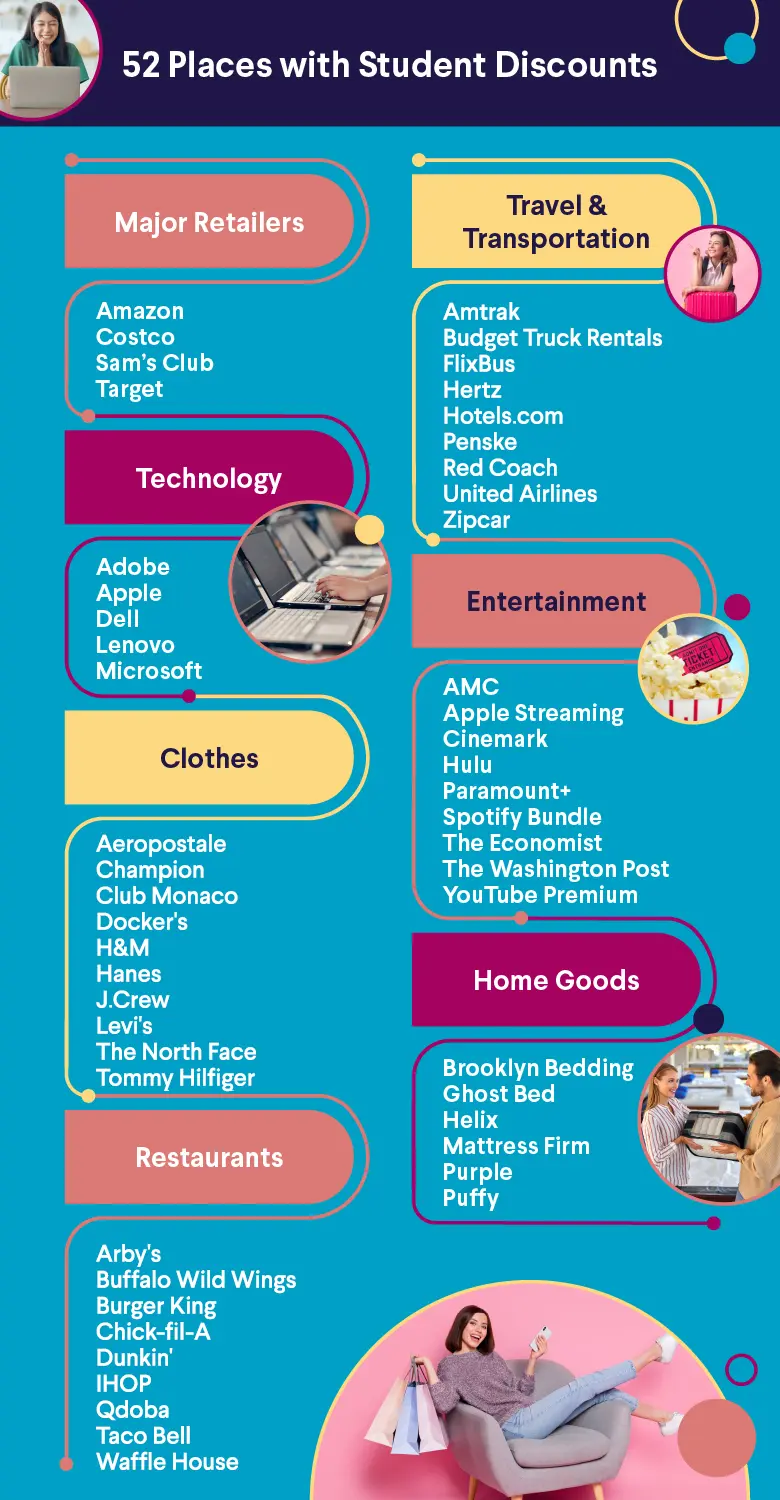
52 Companies that Offer Student Discounts in 2026

College comes with a lot of expenses. On top of tuition, fees, books, and housing, you might also want to occasionally go out and have fun. Maybe you want to go shopping, see a movie, or meet friends for lunch or dinner. That’s not always easy on a student budget. Fortunately, there are widely available deals and discounts designed just for college students. Here’s where you can find them.

Key Points

•  Major retailers like Amazon and Sam’s Club offer special pricing and membership benefits to college students.

•  Technology companies such as Apple, Microsoft, and Dell provide discounts on products and software for students.

•  Clothing stores like J.Crew, Aeropostale, and Levi’s offer a percentage off purchases upon showing a valid student ID.

•  Restaurants including Burger King, Chick-fil-A, and Buffalo Wild Wings provide various discounts and deals for students.

•  Travel and transportation services like Zipcar, Amtrak, and United Airlines offer reduced rates for students traveling domestically.

Major Retailers

1. Amazon

Amazon Prime for Young Adults gives college students a six-month free trial, followed by a discounted Prime subscription ($7.49/month). You also get access to student-exclusive offers, including free Grubhub+ and 5% cash back on a wide variety of purchases.

2. Sam’s Club

Sam’s Club offers qualified college students 60% off a Club membership or $50 off a Plus membership (which comes with free curbside pickup and free delivery on orders of $50-plus). Students need to apply online to qualify.

💡 Quick Tip: You’ll make no payments on some private student loans for six months after graduation.

3. Target

Target Circle’s College Student Appreciation program offers exclusive perks and discounts to students, which could come in handy when you’re shopping for your dorm room. To access deals, including 50% off Circle 360, you need to verify your student status (by uploading a student ID, class schedule, or tuition receipt) and join Target Circle for free.

4. Costco

A Costco membership can also help make college more affordable. College students who join Costco as a new Gold Star Member through UNiDAYS (a site that verifies student status and offers exclusive student deals) can get a $40 Digital Costco Shop Card.

Technology

5. Apple

Keep this in mind when you’re preparing for college: Apple offers special pricing for current and recently accepted college students (along with their parents). For example, you can get a 13” Macbook Air starting at $899 or an iPad air from $549.

6. Microsoft

Students (as well as parents and teachers) can save up to 10% off eligible computers and accessories with Microsoft’s student discount.

7. Dell

Dell offers 10% off when you register for Dell Rewards and verify your student status.

8. Lenovo

College students get an extra 5% off their tech purchases at Lenovo. Incoming students can also access the deal by providing a letter of acceptance. You simply need to verify your student status through ID.me during checkout.

9. Adobe

Adobe allows students to get Creative Cloud Pro for $24.99/month for the first year and $39.99/month after that (it’s normally $66.99/month). To get the deal, you need to provide a school-issued email address during purchase so you can be instantly verified.

52 Places with Student Discounts

Clothes

10. Aeropostale

Students can benefit from an extra 15% off at Aeropostale. To take advantage of the deal, you’ll simply need to register and verify your student status with UNiDAYS.

11. J.Crew

J.Crew gives students with a valid student ID 15% off purchases both in store and online. The discount can be used up to four times a month.

12. Hanes

Need some basics, like tees or undergarments? Hanes offers students 10% off online purchases. To score your discount, you need to verify your student status through ID.me and get a promo code.

13. The North Face

The North Face gives students a 10% discount when shopping in store or online. To get the discount in person, simply show your ID at the register. For online purchases, you’ll need to verify your student status on the site.

14. Tommy Hilfiger

Tommy Hilfiger offers students 15% off online or in-store. First, you have to create or log in to your ID.me account.

15. Levi’s

Levi’s offers students 15% off online purchases after you verify your student status on the site.

16. Club Monaco

Students who are Club Monaco fans can get 15% off both online and in-store through Student Beans, a money-saving website and app for college students.

17. Docker’s

Docker’s offers students a generous 25% off all purchases made online. You simply need to verify your student status through the site.

18. H&M

H&M gives students 10% off online orders through UniDAYS.

19. Champion

Champion offers college students 15% off full-price items and 5% off sale items through UniDAYS when shopping online.

Recommended: Guide to Saving Money in College

Restaurants

20. Burger King

You can typically get Burger King deals through Student Beans, such as free any size fries, when you order online and pick up in store.

21. Chick-fil-A

Student discounts vary by location, but many Chick-fil-As offer students deals, such as a free drink with any purchase.

22. Dunkin’

Dunkin’ offers a 10% off student discount at participating locations. To claim the deal, simply show your student ID to your cashier.

23. Arby’s

You can save 10% on your Arby’s meal when you show your student ID at participating locations.

24. Buffalo Wild Wings

Want to catch the game and eat some wings with friends? Students can score 10% off at many Buffalo Wild Wings locations.

25. Waffle House

Looking for a late-night meal? Students can enjoy a 10% discount at participating Waffle Houses.

26. IHOP

If you don’t have a Waffle House nearby, many IHOP locations also offer 10% off for students.

27. Qdoba

Qdoba offers a 10% student discount when you show a valid student ID at participating locations.

28. Taco Bell

Craving a Crunchwrap Supreme? You can get a 10% student discount at participating Taco Bells.

💡 Quick Tip: Need a private student loan to cover your school bills? Because approval for a private student loan is based on creditworthiness, a cosigner may help a student get loan approval and a more competitive rate.

Travel & Transportation

29. Zipcar

New Zipcar University members get their first year free. The student membership allows you to reserve cars by the hour or day, and includes gas, secondary insurance, and up to 180 miles per day. (Other fees, such as a young driver fee, may apply.) 

30. Amtrak

Students between the ages of 17 and 24 can travel by Amtrak train for 15% off when booking at least one day in advance.

31. United Airlines

United Airlines offers a 5% flight discount to MileagePlus® members who are 18 to 23 years old. To get the deal, you need to book through the United app.

32. Hotels.com

Through Student Beans, you can get a 10% student discount at Hotels.com. You’ll get a discount code that you can use at checkout. Better yet, it can be applied on top of on-site promotions.

33. FlixBus

You can get 10% off Flixbus tickets with Student Beans. Simply use your FlixBus student discount code at checkout.

34. Hertz

Hertz offers up to 25% off, and up to 2.0% cash back, for students through ID.me.

35. Budget Truck Rentals

Budget Truck Rentals offers students 20% off local moves and 15% off one-way moves any day of the week. Use the discount code TRUKU.

36. Penske

Penske offers college students a 10% discount on all truck rentals and unlimited miles on one-way moving truck rentals. Simply use the discount code STUDENT at checkout. You’ll need to provide a college ID or proof of enrollment status at pickup to receive the discount.

37. Red Coach

RedCoach offers high school, college, and graduate students 10% off tickets. To get the discount, check the student option at checkout then show your student ID card to the driver along with your ticket.

Recommended: College Move-In Day Tips for Parents

Entertainment

38. AMC

Students get a lower ticket price at select AMC theaters every day. Just bring your photo student ID (and maybe some extra money for popcorn).

39. Cinemark

Student discounts at Cinemark vary by location and time of day, so check with the local box office to see what kind of deal you can snag.

40. Apple Streaming

Apple’s student music subscription is $5.99 per month for up to 48 months (normally $10.99 per month). You also get Apple TV at no extra cost.

41. Hulu

Hulu offers students its ad-supported plan for just $1.99 a month (an 83% discount). If you’re interested in a bundle, check out the deal below.

42. Spotify Bundle

As a student, you can get Spotify Premium Student with Hulu (with ads) free for one month and $5.99/month after that. You can cancel anytime.

43. The Washington Post

The Washington Post has a digital all-access student subscription plan for just $1 every four weeks for one year, then $7 every four weeks after that.

44. Paramount+

As a student, you can get 50% off any Paramount+ Plan. You just need to verify your student status on their website.

45. YouTube Premium

YouTube Premium (which allows you to enjoy YouTube and YouTube Music ad⁠-⁠free) is available to students at a discounted rate of $7.99 a month, after a free one-month trial. You can cancel at any time.

46. The Economist

The Economist offers students an Espresso subscription (which offers quick daily updates on important issues) for free and an annual digital subscription for $62.25, a steep 75% off.

💡 Quick Tip: Even if you don’t think you qualify for financial aid, you should fill out the FAFSA form. Many schools require it for merit-based scholarships, too.

Home Goods

47. Ghost Bed

As a student or teacher, you can get 27% off your entire order at GhostBed. To take advantage of the deal, just click on the ID.me button and then “Student ID” to sign up and get verified.

48. Mattress Firm

After verifying your student status through ID.me, Mattress Firm will give you a single-use coupon code that can be used in-store or online. You get an extra 20% off select purchases or an extra 10% off Purple with the code.

49. Purple

You can also get a 10% discount directly from Purple. Once you verify your eligibility, you’ll be emailed a coupon for 10% off your order.

50. Helix

After verifying your student status at Helix, you’ll receive a one-time 25% discount code to apply during checkout.

51. Puffy

Puffy offers a generous student and educator discount — $1,425 off any Puffy mattress.

52. Brooklyn Bedding

Brooklyn Bedding offers a 5% discount and free shipping to students. You simply need to verify your eligibility through ID.me.

The Takeaway

Student discounts can help you save on everything from food and clothing to electronics and entertainment. Even with these deals, however, you may still need help covering your college expenses.

If you completed the FAFSA and didn’t get enough financial aid to pay all of your school bills, keep in mind that you may be able to get a private student loan to help fill in any gaps. Unlike federal student loans, which have strict application deadlines, you can apply for private student loans at any time — including mid-semester.

Private student loans also allow you to borrow up to 100% of the school-certified cost of attendance. Just keep in mind that private student loans don’t offer the borrower protections — like income-driven repayment plans and deferment or forbearance — that come with federal student loans.

If you’ve exhausted all federal student aid options, no-fee private student loans from SoFi can help you pay for school. The online application process is easy, and you can see rates and terms in just minutes. Repayment plans are flexible, so you can find an option that works for your financial plan and budget.


Cover up to 100% of school-certified costs including tuition, books, supplies, room and board, and transportation with a private student loan from SoFi.

FAQ

How many times can you use a student discount?

It depends on the company. Some retailers and restaurants allow you to use your student discount once per visit or purchase; others limit you to a certain number of times per month or year.

How much is the average student discount?

Student deals typically give you 10% to 15% off, though you may find some discounts for 50% off or even higher. In some cases, a student discount may come with restrictions, such as only being able to use it on full-price merchandise. So it’s always a good idea to compare your student discount to any other available deals and sales.

Do student discounts only apply to college students?

Typically, student discounts only apply to college and graduate students. In some cases, high school students can get deals if they have an email that ends in .edu. The colleges and programs that retailers recognize can vary, but you can expect most major colleges and universities to be eligible.


SoFi Private Student Loans
Please borrow responsibly. SoFi Private Student loans are not a substitute for federal loans, grants, and work-study programs. We encourage you to evaluate all your federal student aid options before you consider any private loans, including ours. Read our FAQs.

Terms and conditions apply. SOFI RESERVES THE RIGHT TO MODIFY OR DISCONTINUE PRODUCTS AND BENEFITS AT ANY TIME WITHOUT NOTICE. SoFi Private Student loans are subject to program terms and restrictions, such as completion of a loan application and self-certification form, verification of application information, the student's at least half-time enrollment in a degree program at a SoFi-participating school, and, if applicable, a co-signer. In addition, borrowers must be U.S. citizens or other eligible status, be residing in the U.S., Puerto Rico, U.S. Virgin Islands, or American Samoa, and must meet SoFi’s underwriting requirements, including verification of sufficient income to support your ability to repay. Minimum loan amount is $1,000. See SoFi.com/eligibility for more information. Lowest rates reserved for the most creditworthy borrowers. SoFi reserves the right to modify eligibility criteria at any time. This information is subject to change. This information is current as of 4/22/2025 and is subject to change. SoFi Private Student loans are originated by SoFi Bank, N.A. Member FDIC. NMLS #696891 (www.nmlsconsumeraccess.org).

SoFi Bank, N.A. and its lending products are not endorsed by or directly affiliated with any college or university unless otherwise disclosed.

SoFi Loan Products
SoFi loans are originated by SoFi Bank, N.A., NMLS #696891 (Member FDIC). For additional product-specific legal and licensing information, see SoFi.com/legal. Equal Housing Lender.


Non affiliation: SoFi isn’t affiliated with any of the companies highlighted in this article.

Third-Party Brand Mentions: No brands, products, or companies mentioned are affiliated with SoFi, nor do they endorse or sponsor this article. Third-party trademarks referenced herein are property of their respective owners.

External Websites: The information and analysis provided through hyperlinks to third-party websites, while believed to be accurate, cannot be guaranteed by SoFi. Links are provided for informational purposes and should not be viewed as an endorsement.

SOISL-Q425-020

Read more
Paying Off $10,000 in Credit Card Debt

Paying Off $10,000 in Credit Card Debt

An estimated 20% of Americans have $10,000 or more in credit card debt.

Five-figure credit card debt, and the interest that accrues along with it, can feel overwhelming. It’s the kind of debt that keeps people up at night, and prevents them from pursuing their other financial goals.

But, that debt doesn’t have to stick around forever. With a strategy, chipping away at a $10,000 in credit card debt is achievable. Here are some options for how to pay off $10,000 in credit card debt.

Key Points

•   Use the debt avalanche method to focus on paying off the highest-interest debt first, saving money over time.

•   Consider the snowball method to pay off small debts first.

•   Credit card debt forgiveness involves negotiating with debt collectors to repay a portion of the debt, but it can negatively impact your credit score.

•   Explore balance transfers to a card with a lower interest rate to save on interest costs and pay off debt more quickly.

•   Borrowers can often save on interest by sweeping their credit card debt into a lower rate personal loan.

Tips for Paying Off $10,000 in Credit Card Debt

Paying down $10,000 in credit card debt takes discipline and time. These tips and tools could help speed up the journey toward debt freedom.

Consider a Side Hustle

If your budget doesn’t have much wiggle room to make extra payments toward credit card debt, you might consider finding ways to generate more income. Starting a side hustle could be a powerful way to pay down a $10,000 credit card debt faster. Whether it’s grabbing a job in the gig economy or taking a catering job on the weekends, you can put those paychecks toward your credit card debt.

Ask for a Raise

If time is limited for a side hustle, think of how you could make more money in your current role. Is it time to ask for a raise, for instance?

Similarly, switching jobs may land you a higher salary. Just make sure that extra income goes toward debt payoff, and not lifestyle creep.

Switch to Cash

When you’re paying down $10,000 in credit card debt, it’s important to avoid accruing a higher balance. Adding more debt can not only feel discouraging, it can extend your payoff timeline.

As you tackle paying down debt, consider avoiding any further spending on credit cards. That can take the form of paying for things in cash, or using a debit card where you can only spend what you actually have. Making a switch to cash means you’re less likely to add to your burden of debt.

Recommended: What Is the Trump Credit Card Interest Cap?

Debt Management Plans

While tips and tricks may help you pay down $10,000 in credit card debt, you may have to consider a larger overall strategy to move you towards payoff. Having a debt management plan in place can take some of the pressure away and could put you on a track toward paying off debt faster.

Two popular methods to accelerate debt repayment include the snowball and avalanche method.

Snowball Method

The snowball method prioritizes paying off small debts first and working your way up. Here’s how:

1.    Make the minimum monthly payments on all debts.

2.    Take inventory of all your debts and order them from lowest outstanding balance to highest.

3.    Put any extra cash toward the smallest balance debt.

4.    Repeat this until the lowest debt is paid off.

5.    Next, move onto the next lowest debt, adding the surplus cash from step 2 to this card’s monthly payments.

6.    Continue to repeat this process, scaling up to the high-balance debts once you pay off the lower ones.

While this method can seem counterintuitive because of the interest that high balances can generate, starting off with small wins has psychological benefits for some. Having those wins early on may motivate you to move forward.

If you tend to be more disciplined and don’t mind playing the long game, you might prefer the debt avalanche method to pay off $10,000 in debt. Here’s how to deploy the avalanche method:

1.    Make minimum payments on all debts.

2.    Compile all your debt, and order it by interest rate from highest to lowest.

3.    Put any extra cash toward the debt with the highest interest rate.

4.    Repeat until the highest-interest debt it paid off.

5.    Move onto the debt with the next-highest interest rate. Put any extra cash toward this balance until it’s paid off.

6.    Continue this process, prioritizing the highest interest debt first, until all balances are settled.

Typically, the debt avalanche saves more money in interest payments in the long run. However, it can take time to see a win with this method, as opposed to debt snowball.

Recommended: Creating a Credit Card Debt Elimination Plan

Credit Card Debt Forgiveness

Credit card debt forgiveness is not as simple as waving a magic wand at your balances and watching them disappear. Forgiveness does not mean the debt’s completely erased, and it comes with its own drawbacks.

Credit card debt forgiveness only becomes an option when a cardholder stops paying their debt and the credit card company sells the outstanding balance to a debt collector. From there, you can negotiate with the debt collector as to how much debt to repay.

Debt collectors typically buy debts for far less than their face value, and thus are willing to recuperate just a portion of the initial amount owed. For example, if you owe $10,000 in credit card debt and it goes to collections, you may be able to negotiate to settle the debt for just $5,000. That payment may be a lump sum or small payments over time.

While credit card debt forgiveness means paying less than the total owed, it has a fair share of drawbacks. Neglecting credit card debt can wreak havoc on a person’s credit score, and you’ll still need to pay some portion of the debt.

Additional Options for Paying Off Debt

Credit card debt forgiveness isn’t the only route toward paying off $10,000 in credit card debt. Depending on your situation, one of the following solutions may work.

Balance Transfers

Some credit card companies allow cardholders to make credit card balance transfers. That means you transfer the outstanding balance from one credit card to another, often with an introductory low interest rate or no interest.

Balance transfers do come with fees, but depending on how much you owe and how much you could save on interest, it could be worth it in the long run. However, keep in mind the interest rate the balance transfer offers may be for a limited time. You’ll want to pay off the remaining balance before the rate rises, or you could owe more than you did before the transfer.

Personal Loans

There are a number of common uses for personal loans, including paying off credit card debt. Often, a personal loan will have a lower interest rate than credit cards, which could help you pay down your debt faster and save on interest. If you’re struggling to figure out how to pay off $10,000 in credit card debt, consolidating multiple balances into a single loan also may streamline the process.

Your credit score can impact if you get approved for a personal loan, as well as what interest rate you receive. If you have a less than stellar credit score, you may not get approved.

Using a personal loan calculator can help you determine if this strategy will net you savings and, if so, how much.

💡 Quick Tip: Credit card interest rates average 20%-25%, versus 12% for a personal loan. And with loan repayment terms of 2 to 7 years, you’ll pay down your debt faster. With a SoFi personal loan for credit card debt, who needs credit card rate caps?

The Takeaway

Paying down $10,000 in debt might not be easy, but with the right strategies, it is possible. This could mean adopting an aggressive payoff method or looking for additional options to pay down the debt, like personal loans.

Credit cards have an average APR of 20%–25%, and your balance can sit for years with almost no principal reduction. Personal loan interest rates average 12%, with a guaranteed payoff date in 2 to 7 years. If you’re carrying a balance of $5,000 or more on a high-interest credit card, consider a SoFi Personal Loan instead. See your rate in minutes.


SoFi’s Personal Loan was named a NerdWallet 2026 winner for Best Personal Loan for Large Loan Amounts.

FAQ

How do I get out of credit card debt with high interest?

You have options when it comes to paying off credit card debt. One to consider is the avalanche method, which involves paying off the card with the highest interest rate first while making minimum payments on other cards. Then, move on to the debt with the next-highest interest rate, and continue the process until you have no more balances.

Should I seek credit card forgiveness?

Credit card forgiveness isn’t common. That said, you may be able to negotiate with your creditor to reduce the amount you owe, which can help relieve some of your debt burden.

How long will it take to pay off $10k in credit card debt?

The length of time it will take you to pay off $10,000 in credit card debt depends largely on the amount of your monthly payment and your card’s APR. Consider this example: If you have an APR of 21.95%, and make monthly payments of $500, it will take you 26 months to pay off the debt. If you can swing a larger monthly payment of $1,000, it would take you 12 months.


Photo credit: iStock/ArtistGNDphotography

SoFi Loan Products
SoFi loans are originated by SoFi Bank, N.A., NMLS #696891 (Member FDIC). For additional product-specific legal and licensing information, see SoFi.com/legal. Equal Housing Lender.


Non affiliation: SoFi isn’t affiliated with any of the companies highlighted in this article.

Financial Tips & Strategies: The tips provided on this website are of a general nature and do not take into account your specific objectives, financial situation, and needs. You should always consider their appropriateness given your own circumstances.

SOPL-Q225-008

Read more
TLS 1.2 Encrypted
Equal Housing Lender