What Is UCITS?

What Are UCITS Funds?

UCITS, or Undertakings for Collective Investment in Transferable Securities, refers to a set of guidelines that allow pooled securities, similar to mutual funds, to be traded across borders within the European Union.

As such, UCITS is essentially a framework or directive that governs the composition and trading of UCITS funds.

UCITS funds are registered in individual EU countries and must comply with European Commission rules. Investors in the U.S. may also access these funds via authorized brokers. UCITS may be available in other regions, like Asia, as well.

Key Points

•   UCITS refers to a set of guidelines that allows a certain type of mutual fund to be traded freely across country borders within the EU.

•   UCITS funds are a type of mutual fund that complies with European Union regulations and holds securities from throughout the region.

•   The rules for UCITS funds are periodically updated, with each new version noted by a Roman numeral.

•   Although these are considered EU securities, U.S. investors can purchase these funds through an authorized broker.

•   UCITS funds are highly regulated, and investors outside the EU may face tax events when trading these funds.

What Is a UCITS Fund?

UCITS funds are a type of mutual fund that complies with European Union regulations. These securities can be traded across the borders of EU member states.

The EU launched UCITS for two primary reasons:

1.    To structure a type of security under the EU umbrella that allowed for the cross-border sale of mutual funds throughout the EU, and across other markets.

2.    To better regulate investment asset transactions among all EU member countries, giving investors inside and outside of the EU access to more tightly regulated investment funds.

Fundamentally, UCITS rules give EU regulators a powerful tool to centralize key financial services issues like types of investments allowed, asset liquidity, investment disclosures, and investor safeguards. By rolling the new rules and regulations into UCITS, EU regulators sought to make efficient and secure investment funds available to a broad swath of investors.

For investors, UCITS funds offer flexibility and security. Not only are the funds widely viewed as safe and secure owing to the level of regulation, but UCITS funds offer a diversified fund option to investors who might otherwise have to depend on single public companies for the bulk of their investment portfolios.

A Brief History of UCITS

The genesis of UCITS funds dates back to the mid-1980’s, with the rollout of the European Directive legislation, which set a new blueprint for financial markets across the continent. The new law introduced UCITS funds on an incremental basis and has been used as a way to regulate financial markets with regular updates and revisions over the past three decades.

In 2002, the EU issued a pair of new directives related to mutual fund sales — Directives 2001/107/EC and 2001/108/EC, which expanded the market for UCITS across the EU and loosened regulations on the sale of index funds in the region.

The fund initiative accelerated in 2009 and 2010, when the Directive 2009/65/EC of the European Parliament and of the Council of 13 July 2009 clarified the use of UCITS in European investment markets, especially in coordination of all laws, regulations, and administrative oversight. The next year, the European Union reclassified UCITS w as investment funds regulated under Part 1 of the Law of 17 December 2010.

In recent years, “Alt UCITS” or alternative UCITS funds have grown in popularity, along with other types of alternative investments.

How Does a UCIT Fund Work?

Structurally, UCITS are built like mutual funds, with many of the same features, regulatory requirements, and marketing models.

Individual and institutional investors, who form a collective group of unit holders, put their money into a UCIT, which, in turn, owns investment securities (mostly stocks and bonds) and cash. For investors, the primary goal is to invest their money into the fund to capitalize on specific market conditions that favor the stocks or bonds that form the UCITS.

UCITS funds may provide one way for American investors to get more international diversification within their portfolios.

A professional money manager, or group of managers, run the fund, and they are singularly responsible for choosing the securities that make up the fund. The UCITS investor understands this agreement before investing in the fund, thus allowing the fund managers to choose investments on their behalf.

An investor may leave the fund at any point in time, and do so by liquidating their shares of the fund on the open market. American investors should know that the Internal Revenue Service may classify UCITS as passive foreign investment companies, which could trigger more onerous tax treatments, especially when compared to domestic mutual funds.


💡 Quick Tip: How to manage potential risk factors in a self-directed investment account? Doing your research and employing strategies like dollar-cost averaging and diversification may help mitigate financial risk when trading stocks.

UCITS Rules and Regulations

UCITS do have some firm regulatory and operational requirements to abide by in the European Union, as follows:

•   The fund and its management team are usually based on a tax-neutral EU country (Ireland would be a good example).

•   A UCITS fund operates under the laws mandated by the member state of its headquarters. After the fund is licensed in the EU state of origin, it can then be marketed to other EU states, and to investors around the world. The fund must provide proper legal notification to the state or nation where it wants to do business before being allowed to market the fund to investors.

•   A UCITS fund must provide proper notice to investors in the form of a Key Investor Information Document, usually located on the fund’s website. The fund must also be approved.

•   A UCITS fund must also provide a fund prospectus to investors (also normally found on the fund’s web site) and must file both annual and semiannual reports.

•   Any time a UCITS company issues, sells, or redeems fund shares, it must make pricing notification available to investors.

The Takeaway

Undertakings for Collective Investment in Transferable Securities (UCITS) is a category of investment funds primarily available in the EU, but investors in the U.S. may access these funds through authorized brokers.

UCITS may be an interesting type of investment for U.S. investors looking to diversify their portfolios. As with any investment, investors must conduct thorough due diligence on a UCITS security, which should include a review of fund holdings, past performance, management stability, fees, and tax consequences.

FAQ

What is UCITS in simple terms?

UCITS is a set of guidelines governing a type of mutual fund in the EU. It stands for: “undertaking for collective investment in transferable securities.” This means it’s a type of pooled investment, similar to a U.S. mutual fund, that invests in securities like stocks, bonds, short-term government bonds, and cash.

What is a non-UCITS fund?

A non-UCITS fund does not comply with UCITS guidelines. For example, a non-UCITS fund might not be open-ended or it might be illiquid — two primary UCITS requirements.

What are the disadvantages of UCITS?

UCITS funds may have higher costs, owing to the regulatory requirements governing securities in the EU. Also, because the UCITS standards can be restrictive, these funds may not be able to take advantage of certain market conditions. UCITS funds can also have higher tax consequences for U.S. investors.


Photo credit: iStock/kupicoo

INVESTMENTS ARE NOT FDIC INSURED • ARE NOT BANK GUARANTEED • MAY LOSE VALUE

SoFi Invest is a trade name used by SoFi Wealth LLC and SoFi Securities LLC offering investment products and services. Robo investing and advisory services are provided by SoFi Wealth LLC, an SEC-registered investment adviser. Brokerage and self-directed investing products offered through SoFi Securities LLC, Member FINRA/SIPC.

For disclosures on SoFi Invest platforms visit SoFi.com/legal. For a full listing of the fees associated with Sofi Invest please view our fee schedule.

Mutual Funds (MFs): Investors should carefully consider the information contained in the prospectus, which contains the Fund’s investment objectives, risks, charges, expenses, and other relevant information. You may obtain a prospectus from the Fund company’s website or clicking the prospectus link on the fund's respective page at sofi.com. You may also contact customer service at: 1.855.456.7634. Please read the prospectus carefully prior to investing.Mutual Funds must be bought and sold at NAV (Net Asset Value); unless otherwise noted in the prospectus, trades are only done once per day after the markets close. Investment returns are subject to risk, include the risk of loss. Shares may be worth more or less their original value when redeemed. The diversification of a mutual fund will not protect against loss. A mutual fund may not achieve its stated investment objective. Rebalancing and other activities within the fund may be subject to tax consequences.

Fund Fees
If you invest in Exchange Traded Funds (ETFs) through SoFi Invest (either by buying them yourself or via investing in SoFi Invest’s automated investments, formerly SoFi Wealth), these funds will have their own management fees. These fees are not paid directly by you, but rather by the fund itself. these fees do reduce the fund’s returns. Check out each fund’s prospectus for details. SoFi Invest does not receive sales commissions, 12b-1 fees, or other fees from ETFs for investing such funds on behalf of advisory clients, though if SoFi Invest creates its own funds, it could earn management fees there.
SoFi Invest may waive all, or part of any of these fees, permanently or for a period of time, at its sole discretion for any reason. Fees are subject to change at any time. The current fee schedule will always be available in your Account Documents section of SoFi Invest.


Tax Information: This article provides general background information only and is not intended to serve as legal or tax advice or as a substitute for legal counsel. You should consult your own attorney and/or tax advisor if you have a question requiring legal or tax advice.

Investment Risk: Diversification can help reduce some investment risk. It cannot guarantee profit, or fully protect in a down market.

Disclaimer: The projections or other information regarding the likelihood of various investment outcomes are hypothetical in nature, do not reflect actual investment results, and are not guarantees of future results.

Financial Tips & Strategies: The tips provided on this website are of a general nature and do not take into account your specific objectives, financial situation, and needs. You should always consider their appropriateness given your own circumstances.

SOIN-Q225-098

Read more
Class A vs Class B vs Class C Shares, Explained

Class A vs Class B vs Class C Shares, Explained

Class A, Class B, and Class C shares are different categories of company shares that have different voting rights and different levels of access to distributions and dividends. Companies may use these tiers so that certain key shareholders, such as founders or executives, have more voting power than ordinary shareholders. These shareholders also may have priority on the company’s profits and assets, and may have different access to dividends.

Not all companies have alternate stock classes. And what can make share categories even more complicated is that while the classifications are common, each company can define their stock classes, meaning that they can vary from company to company. That makes it even more important for investors to know exactly what they’re getting when they purchase a certain type of stock.

Key Points

•   Class A, Class B, and Class C shares are different categories of company stock with varying voting rights and access to dividends.

•   Companies may use different share classes to give certain shareholders more voting power and priority on profits.

•   Share classes can vary from company to company, making it important for investors to understand the specific terms and differences.

•   Class A shares generally have more voting power and higher priority for dividends, while Class B shares are common shares with no preferential treatment.

•   Class C shares can refer to shares given to employees or alternate share classes available to public investors, with varying restrictions and voting rights.

Why Companies Have Different Types of Stock Shares

When a company goes public, it sells portions of itself, known as stocks or shares, to shareholders.

Shareholders own a portion of the company’s assets and profits and have a say in how the company is governed. To help mitigate risk and retain majority control of the company, a company can restrict the amount of stock they sell and retain majority ownership in the company. Or, it can create different shareholder classes with different rights.

By creating multiple shareholder classes when they go public, a company can ensure that executives maintain control of the company and have more influence over business decisions. For example, while ordinary shareholders, or Class B shareholders, may have one vote per share owned, individuals with executive shares, or Class A shares, may have 100 votes per share owned. Executives also may get first priority of profits, which can be important in the case of an acquisition or closure, where there is only a finite amount of profit.

Different stock classes can also reward early investors. For example, some companies may designate Class A investors as those who invested with the company prior to a certain time period, such as a merger. These investors may have more votes per share and rights to dividends than Class B investors. A company’s charter, perspective, and bylaws should outline the differences between the classes.

Class differentiation has become more critical in creating a portfolio in recent years because investors have access to different classes in a way they may not have had access in the past. For example, mutual funds frequently divide their shares into A, B, and C class shares based on the type of investor they want to attract.

The Different Types of Shares

Just like there are different types of stock, there are different types of shareholders. Because different stock classes have such different terms, depending on the company, investors may use additional terminology to describe the stock they hold. This can include:

Preferred Shares

Investors who buy preferred shares may not have voting rights, but may have access to a regular dividend that may not be available to shareholders of common stock.

Common Shares

Sometimes called “ordinary shares,” common shares are stocks bought and measured on the market. Owners have voting rights. They may have dividends and access to profits, though they may come after other investors, such as executive shareholders and preferred shareholders have been paid.

Nonvoting Shares

These are typically offered by private companies or as part of a compensation package to employees. Companies may use non voting shares so employees and former employees don’t have an outsize influence in company decision-making, or so that power remains consolidated with the executive board and outside shareholders. Some companies create a separate class of stock, Class C stock, that comes without voting rights and that may be less expensive than other classes.

Executive Shares

Typically, these shares are held by founders or company executives. Their stock may have outsize voting rights and may also have restrictions on the ability to sell the shares. Executive shares usually do not trade on the public markets.

Advisory Shares

Often offered to advisors or large investors of a company, these shares may have preferred rights and do not trade on public markets.

Restricted Shares

Restricted shares are called so because they come with strings attached, typically having to do with whether they can be sold or transferred. For instance, an employee of a company may earn restricted shares as a part of their compensation package, and aren’t able to sell them until after a certain period of time.

Treasury Shares

Treasury shares are shares that a company purchases back from the open market from shareholders. When you hear of stock “buybacks,” this is typically what that term is referring to. In effect, a company is reabsorbing its shares, and reducing the total outstanding stock on the market.

Recommended: Shares vs. Stocks: Differences to Know

Get up to $1,000 in stock when you fund a new Active Invest account.*

Access stock trading, options, alternative investments, IRAs, and more. Get started in just a few minutes.


*Customer must fund their Active Invest account with at least $50 within 45 days of opening the account. Probability of customer receiving $1,000 is 0.026%. See full terms and conditions.

What Are Class A Shares?

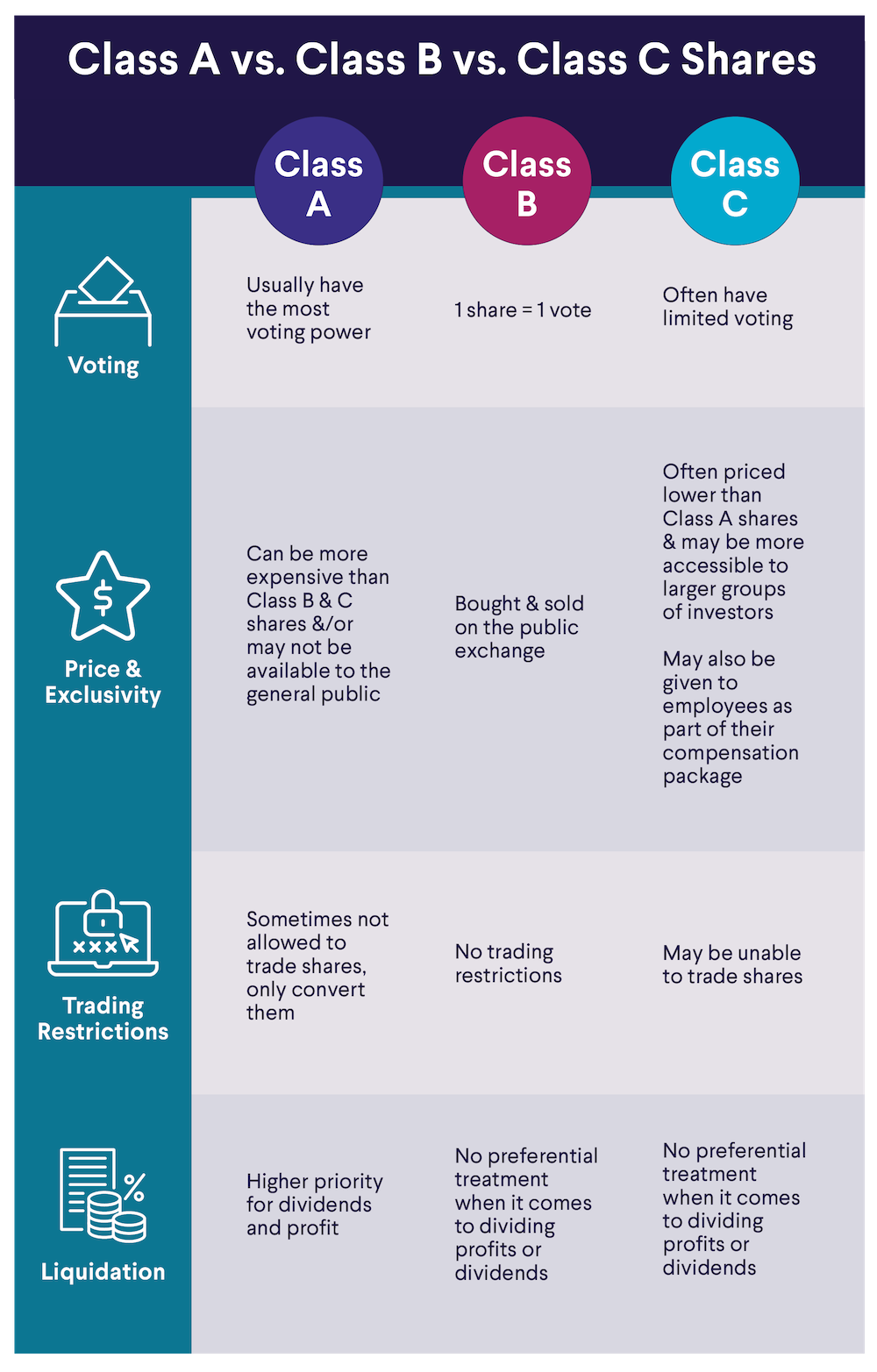
While the specific attributes of Class A shares depend on the company, they generally come with more voting power and a higher priority for dividends and profit in the event of liquidation. Class A shares may be more expensive than Class B shares, or may not be available to the general public.

Advantages and Disadvantages of Class A Shares

Class A shares have some advantages and disadvantages over other types of shares. But again, it all comes down to the specifics.

Many companies can have different stock tiers that trade at different prices. For instance, Company X may have Class A stock that regularly trades at hundreds of thousands of dollars while its Class B stock may trade for hundreds of dollars per share.

Class B stockholders may also only have a small percentage of the vote that a Class A stockholder has. And while Class A stockholders might be able to convert their shares into Class B shares, a Class B shareholder may not be able to convert their shares into Class A shares.

Many of the tech companies that have gone public in recent years have also used a dual-share class system.

In some cases, shareholders are not allowed to trade their Class A shares, so they have a conversion that allows the owner to convert them into Class B, which they can sell or trade. Executives may also be able to sell their shares in a secondary offering, following the IPO.


💡 Quick Tip: Distributing your money across a range of assets — also known as diversification — can be beneficial for long-term investors. When you put your eggs in many baskets, it may be beneficial if a single asset class goes down.

What Are Class B Shares?

Often companies refer to their Class B shares as “common shares” or “ordinary shares,” (But occasionally, companies flip the definition and have Class A shares designated as common shares and Class B shares as founder and executive shares).

Advantages and Disadvantages of Class B Shares

Class B shares are generally liquid, meaning that investors can buy and sell common shares on a public stock exchange, where, typically, one share equals one vote. However, Class B shares carry no preferential treatment when it comes to dividing profits or dividends.

What Are Class C Shares?

Some companies also offer Class C shares, which they may give to employees as part of their compensation package. The difference between Class C and common stock shares can be subtle.

It’s important to note that these stock classes vary depending on the company. So doing research and understanding exactly which type of shares you’re buying is key before you commit to purchasing a certain class of stock.

Advantages and Disadvantages of Class C Shares

Class C shares may have specific restrictions, such as an inability to trade the shares.

Class C shares also may also refer to alternate share classes available to public investors. Often priced lower than Class A shares and with restrictions on voting rights, these shares may be more accessible to larger groups of investors. But this is not always the case. For example, Alphabet has Class A and Class C shares. Both tend to trade at similar prices.

Note that the chart below represents common definitions of Class A, B, and C shares, but that companies may structure their own stock classes differently.

Class A vs Class B vs Class C Shares

What Are Dual Class Shares?

Companies that offer more than one class of shares have “dual class shares.” This is a fairly common practice, and some companies offer dual class shares that automatically convert to a common share with voting privilege at a set period of time.

Why Some Companies Use Dual Class Shares

Some companies may use dual class shares if they hope to IPO, and do not want public investors to have a say in the company’s decision-making. There has been controversy about companies offering two share classes of stock to the public, with detractors concerned that multiple share classes may lead to governance issues, such as reduced accountability. But others argue that multiple share classes can be an asset for a public company, leading to improved performance.

Examples of Companies With Dual Class Shares

There are numerous companies that use dual class share systems. Here are some examples of some of most recognizable:

•   Alphabet (Google)

•   Berkshire Hathaway

•   Meta

•   Ford

•   Nike

The Takeaway

Class A, Class B, and Class C shares have different voting rights and different levels of access to distributions and dividends. It can be difficult to determine which investment class is the best option for you if you’re deciding to invest in a public company that offers multiple share classes. Beyond market price, understanding how the stock will function in your overall portfolio as well as your personal investing philosophy can help guide you choose the best share class for you.

For example, investors who may be looking for shorter-term investments may choose a stock class without voting privileges. Other investors who want to be active in corporate governance may prefer share classes that come with voting rights. And some investors may be looking for stocks that provide guaranteed dividends, which may guide their decision toward one class of shares.

Invest in what matters most to you with SoFi Active Invest. In a self-directed account provided by SoFi Securities, you can trade stocks, exchange-traded funds (ETFs), mutual funds, alternative funds, options, and more — all while paying $0 commission on every trade. Other fees may apply. Whether you want to trade after-hours or manage your portfolio using real-time stock insights and analyst ratings, you can invest your way in SoFi's easy-to-use mobile app.

Opening and funding an Active Invest account gives you the opportunity to get up to $1,000 in the stock of your choice.¹

FAQ

Are there specific types of businesses that prefer Class A, Class B, or Class C shares?

Not necessarily, as how each share class is structured is typically done for different strategic reasons. As such, some companies in certain industries may operate in similar manners, but it doesn’t mean their share structures would necessarily follow suit.

Do Class B shares always have fewer voting rights than Class A shares?

Class B shares often, or commonly have fewer voting rights than Class A shares, but it’s not always the case. Some companies structure their shares such that Class B shares actually have more voting rights than Class A shares.

Can investors convert Class B or C shares into Class A shares?

Some investors are able to convert their Class B or C shares into Class A shares, depending on the specific stock.

Why do some companies prefer dual class share structures?

Some companies might use dual class share structures in order to concentrate voting power among a select group of investors, rather than leave it to the whims of public or retail investors.

How do different share classes impact dividend payments?

Broadly speaking, different share classes often have different dividend payments, and that can depend on numerous factors.


Photo credit: iStock/g-stockstudio

INVESTMENTS ARE NOT FDIC INSURED • ARE NOT BANK GUARANTEED • MAY LOSE VALUE

SoFi Invest is a trade name used by SoFi Wealth LLC and SoFi Securities LLC offering investment products and services. Robo investing and advisory services are provided by SoFi Wealth LLC, an SEC-registered investment adviser. Brokerage and self-directed investing products offered through SoFi Securities LLC, Member FINRA/SIPC.

For disclosures on SoFi Invest platforms visit SoFi.com/legal. For a full listing of the fees associated with Sofi Invest please view our fee schedule.

Financial Tips & Strategies: The tips provided on this website are of a general nature and do not take into account your specific objectives, financial situation, and needs. You should always consider their appropriateness given your own circumstances.


¹Probability of Member receiving $1,000 is a probability of 0.026%; If you don’t make a selection in 45 days, you’ll no longer qualify for the promo. Customer must fund their account with a minimum of $50.00 to qualify. Probability percentage is subject to decrease. See full terms and conditions.

Disclaimer: The projections or other information regarding the likelihood of various investment outcomes are hypothetical in nature, do not reflect actual investment results, and are not guarantees of future results.

Mutual Funds (MFs): Investors should carefully consider the information contained in the prospectus, which contains the Fund’s investment objectives, risks, charges, expenses, and other relevant information. You may obtain a prospectus from the Fund company’s website or clicking the prospectus link on the fund's respective page at sofi.com. You may also contact customer service at: 1.855.456.7634. Please read the prospectus carefully prior to investing.Mutual Funds must be bought and sold at NAV (Net Asset Value); unless otherwise noted in the prospectus, trades are only done once per day after the markets close. Investment returns are subject to risk, include the risk of loss. Shares may be worth more or less their original value when redeemed. The diversification of a mutual fund will not protect against loss. A mutual fund may not achieve its stated investment objective. Rebalancing and other activities within the fund may be subject to tax consequences.

Investment Risk: Diversification can help reduce some investment risk. It cannot guarantee profit, or fully protect in a down market.

Investing in an Initial Public Offering (IPO) involves substantial risk, including the risk of loss. Further, there are a variety of risk factors to consider when investing in an IPO, including but not limited to, unproven management, significant debt, and lack of operating history. For a comprehensive discussion of these risks please refer to SoFi Securities’ IPO Risk Disclosure Statement. This should not be considered a recommendation to participate in IPOs and investors should carefully read the offering prospectus to determine whether an offering is consistent with their investment objectives, risk tolerance, and financial situation. New offerings generally have high demand and there are a limited number of shares available for distribution to participants. Many customers may not be allocated shares and share allocations may be significantly smaller than the shares requested in the customer’s initial offer (Indication of Interest). For more information on the allocation process please visit IPO Allocation Procedures.

SOIN-Q225-154

Read more
20 Renter Friendly House Updates

20 Renter-Friendly House Updates

When you’re a renter, it can feel like all the transformative DIY projects are reserved for homeowners. But just because you rent doesn’t mean you can’t spruce up your space.

That’s right: Rental-friendly upgrades exist. And the best part? Many improvements can have a major impact on your space without blowing your budget.

Key Points

•   There are many affordable, temporary ways to update a rental home.

•   An accent wall can be created using washi tape or removable wallpaper to enhance visual appeal.

•   Light fixtures can be updated with decorative lamps or string lights for a cost-effective upgrade.

•   Bookcases can improve style and provide additional storage space.

•   Contact paper can be applied to cabinets and appliances for a fresh, updated look.

1. Create an Accent Wall

Spicing up your walls doesn’t have to cost a fortune, nor must it require gallons of paint. For just a few bucks a roll, you can buy washi tape and create a custom accent wall that won’t ruin the paint job. Or, if you’re able to spend a few extra dollars, you could also invest in removable wallpaper.

2. Update Light Fixtures

Light fixtures in rentals are notoriously drab and tend to provide uneven lighting. Fortunately, there is no shortage of lighting options to help you brighten up your space. A recessed lighting conversion kit, for instance, is fairly inexpensive, easy to install, and allows you to hang a pendant or other light fixture. Not sure your landlord would approve? You can always buy some decorative lamps or even string lights to help amp up the brightness and style of any room.

3. Install Radiator Shelving

In older units, rusty radiators can be a renter’s nightmare. But luckily, there are some rental upgrades — like installing radiator shelving — that can disguise even the most unattractive units. You can DIY a custom shelving unit to work around your radiator, upgrade some shelving from a local thrift store, or even order one online.

4. Buy Matching Bookshelves

Bookshelves are a simple way to upgrade the decor and add much-needed storage space. Placing tall, matching shelves on either side of a TV, couch, or even a bed could bring some serious style (and space) to a small room, plus allow you to display photos or art without putting holes in the wall.

5. Apply Contact Paper

Do you have older appliances you’d like to freshen up? For just a couple bucks, you can invest in some stainless steel contact paper to make them at least look shiny and new again! Contact paper also comes in a wide variety of colors and styles that you can use to liven up your cabinets and refresh your countertops.

6. Replace Pulls & Knobs

This is another budget-savvy, rental-friendly upgrade that can add some flair to your home. Replace your door handles, kitchen cabinet knobs, and any other pulls with something more your style. Affordable, stylish knobs can be found on sites (like Etsy and Amazon) and in stores like Lowe’s and Home Depot. Be sure to hang on to the original knobs so you can swap them back in before you move out.

7. Install a Bike Mount

If you own a bike but are short on storage, install a bike mount or other bike storage solution. Just make sure your landlord is okay with the installation since it may require some drilling.

8. Try Large Floor Mirrors

Sometimes more is more. Exhibit A: an oversized leaning mirror (don’t worry; it’s mounted securely though it looks casually propped against a wall). It can serve double-duty as a luxe decoration that brightens a room and a functional mirror.

9. Invest in Houseplants

Want to add some life to your rental — literally? Look no further than a houseplant. If you don’t have a green thumb, explore hardy varieties, like air plants, or even artificial plants.

10. Upgrade Your Showerhead

Installing a new showerhead is a quick, effective way to upgrade your bathroom. You could start reaping the rewards the very first time you turn on the faucet. Make sure to hang on to that original showerhead so you can reinstall it when you move out.

Recommended: How Much Does a Shower Remodel Cost?

11. Set Up Room Dividers

Need to carve out space for a home office? Or maybe even make room for a closet? Buying or creating stylish room dividers can provide an instant rental update. And when you need a larger space, simply close the dividers.

12. Use a Pantry Organization System

Help bring order to the busiest spot in your home: the kitchen. Pantry organization systems come in a variety of shapes, sizes, and varieties, so you should be able to find one that suits your home and the budget you’re working with.

13. Update Your Blinds

It can be easy to forget about window coverings. But freshening up your blinds or curtains can add a new visual element to the room, frame a window, or help brighten the space.

14. Install Sticker Flooring

When you’re considering places to upgrade, don’t forget to look down. Changing up the flooring — even temporarily — can make a room feel brand-new. One option to consider if you have a tile floor: removable tile stickers, which come in a variety of styles, sizes, and price points.

15. Create a Kitchen Backsplash

You can also use removable stickers to freshen up a kitchen backsplash, which is a much easier and cheaper option than replacing the tiles. New to this type of project? There are online video tutorials you can watch that will show you how to get the job done.

Recommended: Renovation vs. Remodel: What’s the Difference?

16. Replace Light Switch Covers

Don’t sleep on the small details — sometimes, they can have a major impact. One example of this is swapping out basic light switch covers with ones that match the decor of your rental. Plus, new covers are generally affordable and easy to install.

17. Buy a New Kitchen Faucet

There’s something to be said for upgrading the items in your rental that you use every day, such as the kitchen faucet. Installing a new faucet is a fairly simple DIY project, provided you know how to shut off the water to your sink and use a wrench. If you’re unsure how to do either, though, you can enlist the help of a plumber. Just be sure to put the old faucet in storage so you can swap it back before moving.

18. Find a Stylish Toilet Seat

Let’s be honest: Most rentals come with a basic toilet seat. When yours just won’t do anymore, it may be time to upgrade to something more modern and comfy. You can find a wide variety of options online or in stores.

19. Paint the Molding and Trim

Before selecting color swatches, you may want to double-check with your landlord that painting is allowed. Many landlords welcome you painting your molding and trim, since it’s an easy, affordable way to update a rental.

20. Invest in Good Rugs

Quality rugs can run well into the thousands of dollars. But there are less expensive options that are also durable and stylish. Besides protecting your flooring, a good rug can also visually anchor a room and help absorb sound.

No matter the price of your rug, you may want to consider purchasing renters insurance to protect it and your other valuables against losses.

Financing Your Home Updates

Some of these home updates may be easily paid for out of your checking or savings account. But others can add up. If you need a quick infusion of cash, you might consider taking out a small home improvement loan.

This is basically an unsecured personal loan, which is typically available at a lower interest rate than a credit card. It gives you a lump sum of cash (perhaps just $1,000 or so, depending on your needs) that is then paid back with interest over a term of one to seven years.

Recommended: How to Apply for a Personal Loan

The Takeaway

When you’re a renter, you may not be able to rip out walls or change out kitchen cabinets. But there are still simple, effective ways to transform your space without breaking the terms of your lease. While these sorts of jobs tend to be affordable, you can easily rack up quite the bill if you plan on tackling several home improvement projects at once. In that case, a personal loan could be a wise move.

Think twice before turning to high-interest credit cards. Consider a SoFi personal loan instead. SoFi offers competitive fixed rates and same-day funding. See your rate in minutes.


SoFi’s Personal Loan was named a NerdWallet 2026 winner for Best Personal Loan for Large Loan Amounts.

FAQ

What is a good way to update a rental?

Small, temporary changes can work well. You might choose to create an accent wall with removable wallpaper, or add a floor mirror, which you can take with you when you move.

How can I update a rental home?

Some small moves that will have a big impact include adding new window treatments, lighting, showheads, and toilet seats. Painting or adding peel-and-stick wallpaper are other ways to freshen up a rental home.

What can make rental cabinets look better?

If you want to make cabinets in a rental residence look better, consider putting up vinyl or contact paper to give them a new look. This can be removed when you move out.


Photo credit: iStock/CreativaStudio

SoFi Loan Products
SoFi loans are originated by SoFi Bank, N.A., NMLS #696891 (Member FDIC). For additional product-specific legal and licensing information, see SoFi.com/legal. Equal Housing Lender.


*Awards or rankings from NerdWallet are not indicative of future success or results. This award and its ratings are independently determined and awarded by their respective publications.

Disclaimer: Many factors affect your credit scores and the interest rates you may receive. SoFi is not a Credit Repair Organization as defined under federal or state law, including the Credit Repair Organizations Act. SoFi does not provide “credit repair” services or advice or assistance regarding “rebuilding” or “improving” your credit record, credit history, or credit rating. For details, see the FTC’s website .

Financial Tips & Strategies: The tips provided on this website are of a general nature and do not take into account your specific objectives, financial situation, and needs. You should always consider their appropriateness given your own circumstances.

Third-Party Brand Mentions: No brands, products, or companies mentioned are affiliated with SoFi, nor do they endorse or sponsor this article. Third-party trademarks referenced herein are property of their respective owners.

SOPL-Q225-090

Read more
A Guide to Personal Loans for Single Mothers

Personal Loan Need to Knows for Single Mothers

Whether you’ve been a single mom from the get-go or are in the process of becoming a solo parent, raising a child on your own can be expensive. Housing, other essentials, fun purchases (toys!), and extracurriculars add up. Add in childcare, major expenses like braces, and legal bills during a separation, and you may find yourself with your finances stretched thin.

One option to consider is a personal loan. Read on for a closer look at personal loans for single moms, including their pros and cons, how to qualify, plus other funding options you may want to explore.

Key Points

•   Single mothers can use personal loans for diverse needs, including debt consolidation and major purchases.

•   Personal loans provide flexible, quick funds with fixed repayment terms.

•   Overborrowing and credit score damage are significant risks associated with personal loans.

•   Qualifying for a loan without income is difficult but may be achieved with alternative income sources and/or a cosigner.

•   Home equity, government assistance, and educational grants can be viable alternatives to personal loans.

Why Might a Single Mom Need a Personal Loan?

First, consider what a personal loan is. This type of loan provides a lump sum of money up front you then pay back (plus interest) in monthly installments over time. You can use the funds from a personal loan for virtually any purpose, whether it’s making a large purchase, covering living expenses, or paying down other, higher-interest debt.

There are many reasons why a single mother — or any parent — might consider applying for a personal loan. These include:

1.    Debt consolidation

2.    Covering the cost of a move

3.    Paying tuition or extracurricular expenses for children

4.    Stopgap funds during times of unemployment

5.    Covering housing costs, such as rent or a mortgage

6.    Paying for a home remodeling project

7.    Buying a car

8.    Purchasing major appliances

Recommended: What Is a Personal Loan? How Do Personal Loans Work?

Are Personal Loans for Single Mothers Special?

In a word, no. The process of applying for a personal loan is the same for everyone. However, there may be particular approval hurdles to overcome as a single parent.

One is income. If you’re newly single, you may not have a steady income, which can make it more difficult to get approved for a personal loan. Another is your credit. If you’ve had to rely on credit cards to cover the cost of divorce or the transition to single parenting, your credit may not be what it used to be. The amount of debt you owe on your credit cards is one of the biggest factors affecting your credit score.

However, these obstacles aren’t insurmountable (more on that below).

Benefits and Risks of Personal Loans for a Single Mother

A personal loan can offer a single mom a valuable lifeline to meet immediate needs, such as unexpected expenses, education costs, or debt consolidation. However, taking on any type of debt generally comes with costs, as well as risks. Here’s a look at the pros and cons of getting a loan as a single mom.

Pros

Cons

Flexibility in usage of funds Interest and fees add to your costs
Quick access to funds Risk of overborrowing
Fixed repayment schedule Missed or late payments can negatively impact your credit
Interest rates are typically lower than credit cards Can add to your debt burden

Pros of Personal Loans for Single Mothers

•  Flexibility Personal loans provide flexibility in how you can use the borrowed funds. Whether it’s covering medical bills, home repairs, or summer camp tuition, the uses of personal loans are numerous and varied.

•  Quick access to funds Personal loans often come with a streamlined application process and relatively quick approval. You may be able to access the funds quickly, enabling you to address urgent financial needs promptly.

•  Fixed repayment schedule Personal loans usually come with fixed monthly payments over a specified term. This predictability can make it easier for you to budget and plan your finances effectively.

•  Potential for lower interest rates Depending on the borrower’s creditworthiness, personal loans can offer competitive interest rates compared to other types of borrowing, such as credit cards or payday loans. Single mothers with a good credit history may benefit from more favorable repayment terms.

Cons of Personal Loans for Single Mothers

•  Interest and fees On top of interest, some lenders charge fees for personal loans, which increase the overall cost of borrowing. It’s important to carefully evaluate the terms and conditions to make sure you can comfortably manage the repayments without straining your budget.

•  Risk of overborrowing As a single mom, you likely want to avoid overborrowing or taking on more debt than they can reasonably repay. Overcommitting to loan payments may lead to a cycle of financial stress and difficulty in meeting other essential expenses.

•  Impact on credit score Taking out a personal loan creates a new line of credit, and if not managed properly, it could negatively affect your credit profile. Late or missed payments can damage creditworthiness, potentially impacting future borrowing opportunities.

•  Debt burden A personal loan will add to your existing financial obligations as a single mother. Before opting for a loan, you’ll want to be certain to assess the long-term implications and consider whether the loan repayments align with your income and financial goals.

Is Getting a Personal Loan With No Income Possible?

If you’re a single mother with no job or you’ve been a stay-at-home-mother with little or no income of your own, it may be difficult, though not impossible, to qualify for a personal loan.

Lenders typically want to see proof of a regular income. However, that does not necessarily have to be job-related income. You may be able to count these other sources of income:

•  Unemployment

•  Alimony

•  Child support

•  Investment income

•  Rental income

•  Pension or annuity income

•  Freelance work

•  Gig work

If you don’t have much income to speak of, then you might consider a cosigner or co-applicant for your loan. This a person who agrees to make the loan payments if the main borrower cannot or does not. For some borrowers, family members have the financial flexibility to cosign on a loan, but it can be a good idea to have a conversation about expectations and potential hypotheticals if you were no longer able to pay back the loan.

Another option is to secure a personal loan with collateral. This is an asset of value, such as a vehicle or money in a savings account, you use to back the loan in case you default. Should you become unable to repay the loan, the lender can seize your collateral to recover their losses. This lowers risk for the lender, making steady income (or less-than-stellar credit) less critical.

Also keep in mind that if you have no income but excellent credit, you may still find a lender who is willing to offer you an unsecured personal loan.

You’ll also want to be wary, however, of lenders who advertise “no-income loans,” as these loans may come with sky-high interest rates, short repayment terms, and low loan amounts.

Alternatives to Personal Loans for Single Mothers

There are other alternatives to personal loans, depending on your financial circumstances and your needs. Here are some you might consider.

Home Loans for Single Mothers

If you own your home, using your home as a financial asset may be one way to borrow funds at a reasonable cost. If you have built up equity in your home, you may be able to tap that equity by getting a home equity loan or a home equity line of credit (HELOC). Just keep in mind that the loan is backed by your home. Should you have difficulty repaying the loan or credit line, you could potentially lose your home.

Government Resources for Single Parents

If your income is low, you may be eligible for one or more government assistance programs. Some options you may want to explore include:

•  Special Supplemental Nutrition Program for Women, Infants, and Children (WIC)

•  National School Lunch Program

•  Temporary Assistance for Needy Families (TANF)

•  Low Income Home Energy Assistance Program (LIHEAP)

•  The Emergency Food Assistance Program

You can find more resources at benefits.gov.

Educational Aid for Single Mothers

If you’re considering going back to school, below are some programs that can help make it more affordable (or even free):

•  Pell Grants

•  Teach Grants

•  Women’s Independence Scholarship Program (WISP)

There also may be private scholarships and grants for single parents available from the institutions you’re interested in attending. Speaking with the financial aid office may help you see the breadth of options available to you.

Other Financial Help For Single Mothers

Becoming a single mother, either by choice or circumstance, can feel overwhelming. But there is support out there. It can help to talk to other single parents in your community — you may be surprised by all the resources that are available. Other opportunities may include:

•   Financial aid or tuition assistance If your children are in private school or extracurricular programs, there may be financial aid available to help lower the cost. Even if there’s not a formal program, it can’t hurt to explain your situation and ask what may be available.

•   Employer-based programs Your human resources department may have certain programs, such as childcare coverage, free legal consultations, and access to financial planning and debt counseling, for eligible workers. Talk to your HR representative or look through their materials to assess what’s available.

•   Family and friends People close to you may be willing to provide support, or there may be creative ways to trade services, such as babysitting, to get more financial help. If a friend or family member offers to loan you money, it can be helpful to put an agreement in writing, including any interest you will pay and the terms of repayment, so there is no confusion that could cause a rift in your relationship.

Recommended: A Guide to Unsecured Personal Loans

The Takeaway

As a single mother, there are avenues that can help you manage your finances and achieve your financial goals. One option is taking out a personal loan. This type of financing can provide financial relief and flexibility, but it is important to weigh the pros and cons, compare options from different lenders, and assess your ability to manage repayments responsibly.

Think twice before turning to high-interest credit cards. Consider a SoFi personal loan instead. SoFi offers competitive fixed rates and same-day funding. See your rate in minutes.


SoFi’s Personal Loan was named a NerdWallet 2026 winner for Best Personal Loan for Large Loan Amounts.

FAQ

Can you get a loan for being a single mother?

There can be loans that are a good fit for single mothers, such as certain home loans that suit those with financial challenges or less strong credit scores. There may be other programs that have special products or accommodations for single mothers for other types of loans as well. It can be wise to research options.

Can stay-at-home moms get a personal loan?

Yes, a stay-at-home mom may be able to get a personal loan, but they may have to take additional steps to qualify. For instance, a co-applicant could be required or proof of other sources of income vs. a salary.

What is a hardship grant for single mothers?

Hardship grants offer quick sources of cash for families or individuals facing urgent financial need. A good place to start searching for this kind of financing can be local credit unions.


Photo credit: iStock/RyanJLane

SoFi Loan Products
SoFi loans are originated by SoFi Bank, N.A., NMLS #696891 (Member FDIC). For additional product-specific legal and licensing information, see SoFi.com/legal. Equal Housing Lender.


*Awards or rankings from NerdWallet are not indicative of future success or results. This award and its ratings are independently determined and awarded by their respective publications.

Disclaimer: Many factors affect your credit scores and the interest rates you may receive. SoFi is not a Credit Repair Organization as defined under federal or state law, including the Credit Repair Organizations Act. SoFi does not provide “credit repair” services or advice or assistance regarding “rebuilding” or “improving” your credit record, credit history, or credit rating. For details, see the FTC’s website .

Financial Tips & Strategies: The tips provided on this website are of a general nature and do not take into account your specific objectives, financial situation, and needs. You should always consider their appropriateness given your own circumstances.

Third-Party Brand Mentions: No brands, products, or companies mentioned are affiliated with SoFi, nor do they endorse or sponsor this article. Third-party trademarks referenced herein are property of their respective owners.

External Websites: The information and analysis provided through hyperlinks to third-party websites, while believed to be accurate, cannot be guaranteed by SoFi. Links are provided for informational purposes and should not be viewed as an endorsement.

SOPL-Q225-089

Read more
couple home on laptop

Four Ways to Upgrade Your Home

Updating your home can be done without a full (and expensive) renovation. There are a number of light lift projects that can give your home a whole new look and feel, and even increase its resale value. Exterior upgrades, like fresh paint, a new front door, and better landscaping or outdoor lighting, can add to your home’s curb appeal. Indoor improvements, such as updated lighting fixtures, paint, or wallpaper, can give the interior of your home a more up-to-date, high-end look. Here are four ways you can upgrade your home without breaking the bank.

Key Points

•   Home upgrades, starting at $3,000, can enhance the look and value of a property.

•   Exterior upgrades, like a freshly painted front door, new porch lights, and modern landscaping with pollinator and edible gardens, can add curb appeal.

•   Indoor lighting trends favor bold and textured fixtures.

•   Popular paint colors are dusty pink, cinnamon brown, cool grays, and bright purples, while one wallpapered wall can create a mural effect.

•   Window treatments with natural hues, geometric prints, and layered rods add style and privacy.

Exterior Improvements

A home’s front door is the focal point of the exterior. To upgrade its appearance, you might replace the door, or paint it and add new hardware. Decorating the door with a seasonal wreath or another personalized touch can also add to its charm.

Besides a front door refresh or upgrade, other exterior improvements you might consider include a new mailbox, a new porch light fixture, and perhaps some window boxes with plants and fresh flowers that add a bright contrast to your home’s exterior color.

Front door styles that are currently trending include bold colors (from fire engine red to deep greens and bright blues), natural wood stains, and more glass (such as custom inserts and floor-to-ceiling sidelights).

How you landscape your front yard will depend upon where you live and the climate there. In general, though, modern trends include:

•   Natural landscaping using native plants, creating landscaping that’s eco-friendly and easy to maintain.

•   Pollinator gardens that attract butterflies, bees, and other insects that help pollinate.

•   Edible gardens, including lettuce, peppers, tomatoes, and more. Creativity is key!

Recommended: 15 Ways to Boost Your Curb Appeal for a Winter Open House

Lovely Lighting

Outdoor lighting doesn’t need to be white — filters can add a range of colors. These lights can spotlight key areas of landscaping, highlight where you like to entertain, or look attractive for even more curb appeal while providing illumination.

Size-wise, both tiny and boldly large lights are in vogue and, although lanterns aren’t a new trend, they’re still considered stylish. Updating recessed lighting is another popular home improvement project.

After a period of all-white being a hot trend for interior lighting, table lamps and hanging lighting fixtures are appearing more often as dark neutrals in brown, black, or gray. They can be used to update the white, cream, or gray choices in a home.

Paying attention to texture in lighting fixtures can add interest and variety. Materials can range from wood to wicker and rattan, and can be crafted in contemporary shapes to avoid an overly rustic look. Also still trending are geometrically designed lighting fixtures, from simple to more complex shapes.

Painting and Wallpapering

Painting rooms in a home can transform their appearance. What colors are trending? Currently, homeowners are favoring dusty pink, cinnamon brown, cool grays, and bright purples. However, unless you’re planning to sell some time soon, personal taste is what matters most when picking paint colors.

Wallpaper trends also run the gamut, including those with a texture and colors often inspired by landscapes. In this style of wallpaper, expect to see some blues, greens and neutral shades. Some people like to have one pictorial wallpaper wall, which looks like a mural in a room.

Wow Factor on Windows

In-style curtains often have hues found in nature, from green to ochre, and can also feature flowers, landscapes, and more. Geometric prints or two-tone materials may also appeal to some people. Velvet can be used to create a more intimate space.

Consider using double or triple curtain rods to add layers of window coverings. Then you can add a layer that filters light and enhances privacy, while also selecting curtains with the appearance you enjoy. Many designers recommend placing your curtain rod close to ceiling height vs. at the top of the window for a more dramatic and chic effect.

Recommended: How Much Does It Cost to Replace Windows?

Costs of a House Upgrade

The type of house upgrades listed here might be considered low-cost or low-end renovations, and can cost as little as $3,000 for a 1,250 to 1,600 square foot home. If, once momentum gets going, the low-end house upgrade turns into a middle-end one, the average cost could be closer to $5,200, according to the home improvement site Angi.

Another cost-related factor is where the home is located. Pricing in urban areas might be twice as high as in rural areas, depending on the area’s cost of living.

Plus, upgrades in older homes may take more time and attention to complete. If the home is officially considered to be historic, there may be guidelines about what changes can be made.

Recommended: Renovation vs. Remodel: What’s the Difference?

Financing a House Upgrade

Here are some options for financing a home upgrade.

•   Sometimes, homeowners are able to pay for these upgrades out of pocket. This can be true when the costs are relatively small or when money has been saved for the costs of the renovation. This can be the smart choice when possible: no debt, no interest to pay.

A downside to paying for home upgrades with cash may be that the homeowner empties a savings account or cuts corners on the renovations to avoid needing to borrow funds. Or, if, say, a big medical bill pops up and the emergency fund was used to renovate, then high-interest credit cards might need to be used to pay that debt.

•   You might consider a home equity line of credit (HELOC) to finance a house upgrade. This type of loan allows you to borrow against the equity in the home to pay for renovations. How much is available to borrow will depend upon how much equity is available and the loan-to-value ratio (LTV) that a lender permits. For example, if a lender has an 80% LTV ratio, that means the institution would:

◦   Appraise the home (e.g., $250,000).

◦   Calculate 80% of that ($200,000).

◦   Subtract current mortgage balances (e.g., $125,000).

◦   Consider what’s left over ($200,000-$125,000 = $75,000) to be equity in the home.

The lender would also consider the financial profile of the borrower when reviewing the loan application. HELOCs often have a low initial interest rate and, usually, the homeowner can choose to pay interest only during the draw period. However, there may be upfront fees and the rate is often variable with high lifetime caps.

•   Another option might be a home improvement loan, which is an unsecured personal loan and not attached to the home’s equity. Funding can usually be granted more quickly with fewer, or sometimes no, fees. This may be a good option for people who don’t have enough equity in their homes for their project or who don’t want to use their home as collateral.

Recommended: How to Apply for a Personal Loan

The Takeaway

There are a number of ways you can upgrade your home that don’t involve tearing down walls or putting on an $150,000 addition. Lower-cost upgrades, ranging from $3,000 to $50,000 or more, may still require spending more cash than you have just sitting in the bank, however. Plus, you may not want to deplete your savings in order to upgrade your home. A personal loan could be a good option.

Think twice before turning to high-interest credit cards. Consider a SoFi personal loan instead. SoFi offers competitive fixed rates and same-day funding. See your rate in minutes.


SoFi’s Personal Loan was named a NerdWallet 2026 winner for Best Personal Loan for Large Loan Amounts.

FAQ

How do you update your home?

A good plan for updating your home can be to start with changes that can shift the mood of a room. This includes paint and/or wallpaper, carpets and rugs, window treatments, and lighting, among other features.

How to update a home without renovation?

To update a home without a major renovation, make changes to surfaces, such as repainting in a different color, swapping in new curtains or blinds, and adding fresh rugs or refinishing the floors.

How much do home updates cost?

The price of home updates can range considerably depending on the cost of living in your area, how much you DIY vs. calling in professionals, and your taste level and the changes you actually make. A small update can start at $3,000, but prices in the five figures can be common.


SoFi Loan Products
SoFi loans are originated by SoFi Bank, N.A., NMLS #696891 (Member FDIC). For additional product-specific legal and licensing information, see SoFi.com/legal. Equal Housing Lender.


*Awards or rankings from NerdWallet are not indicative of future success or results. This award and its ratings are independently determined and awarded by their respective publications.

Disclaimer: Many factors affect your credit scores and the interest rates you may receive. SoFi is not a Credit Repair Organization as defined under federal or state law, including the Credit Repair Organizations Act. SoFi does not provide “credit repair” services or advice or assistance regarding “rebuilding” or “improving” your credit record, credit history, or credit rating. For details, see the FTC’s website .

Financial Tips & Strategies: The tips provided on this website are of a general nature and do not take into account your specific objectives, financial situation, and needs. You should always consider their appropriateness given your own circumstances.

Third-Party Brand Mentions: No brands, products, or companies mentioned are affiliated with SoFi, nor do they endorse or sponsor this article. Third-party trademarks referenced herein are property of their respective owners.

²SoFi Bank, N.A. NMLS #696891 (Member FDIC), offers loans directly or we may assist you in obtaining a loan from SpringEQ, a state licensed lender, NMLS #1464945.
All loan terms, fees, and rates may vary based upon your individual financial and personal circumstances and state.
You should consider and discuss with your loan officer whether a Cash Out Refinance, Home Equity Loan or a Home Equity Line of Credit is appropriate. Please note that the SoFi member discount does not apply to Home Equity Loans or Lines of Credit not originated by SoFi Bank. Terms and conditions will apply. Before you apply, please note that not all products are offered in all states, and all loans are subject to eligibility restrictions and limitations, including requirements related to loan applicant’s credit, income, property, and a minimum loan amount. Lowest rates are reserved for the most creditworthy borrowers. Products, rates, benefits, terms, and conditions are subject to change without notice. Learn more at SoFi.com/eligibility-criteria. Information current as of 06/27/24.
In the event SoFi serves as broker to Spring EQ for your loan, SoFi will be paid a fee.


Third Party Trademarks: Certified Financial Planner Board of Standards Center for Financial Planning, Inc. owns and licenses the certification marks CFP®, CERTIFIED FINANCIAL PLANNER®

SOPL-Q225-045

Read more
TLS 1.2 Encrypted
Equal Housing Lender