Building a Houseboat: Step-By-Step Guide

What to Know About Building a Houseboat

You can’t be lily-livered to want to build a houseboat, a self-propelled boat with a cabin. It will take a lot of time and more than a few doubloons.

Houseboat kits are a thing, and an alternative to building your own boat is buying a used houseboat and modifying it.

This piece will help you navigate how to build a houseboat and more.

Key Points

•   Building a houseboat is a significant time and financial investment.

•   Options include building from scratch, using a prefab kit, or renovating a used houseboat.

•   Costs range from a few thousand dollars to well over $35,000.

•   The process involves finding a location, obtaining approvals, and installing systems.

•   Research local regulations and ensure you have the necessary space and resources.

First Off, Can You Build a Houseboat Yourself?

As long as you have the time and money, which can mean securing financing, yes, you can build your own houseboat.

Small houseboats may only have one or two rooms in their cabins, with people using them to fish or enjoy time on a river. Larger ones may be used somewhat like a summer home, with several rooms included. Houseboats of just about any size have a sort of porch on the ends, perhaps covered with awnings.

Although they have this in common with another type of house, the floating home, which is permanently moored, houseboats are designed for quick connection and disconnection with a marina’s electrical, water, and sewer services.

Typical Costs of Building a Houseboat

How much does it cost to build a houseboat? Well, as is the case with the cost to build a house, it depends. Costs will vary based on the size of the boat, the materials used, fixtures included, and so forth.

A small basic houseboat may cost from somewhere around $10,000 to build, while a somewhat larger one can range from $35,000 up to $100,000. (That said, there are luxury houseboats worth millions, so the sky’s the limit if the budget permits!)

How Long Will It Take to Build a Houseboat?

The time investment will depend on the size of the boat, the materials used, your level of building experience, how much help you have — and perhaps even the weather. One estimate suggests that building your own houseboat will take 600 hours.

Pros and Cons of Building a Houseboat from Scratch

thumb_up

Pros:

•   When you build something yourself vs. finding a contractor, you can save on labor costs.

•   You can pick the design you’d like and, when possible, make customized choices.

•   You can benefit from the satisfaction of DIY.

thumb_down

Cons:

•   This can be a big job.

•   If this is the first time you’ll build a houseboat, there can be a learning curve.

•   You’ll need to ensure that you have space to build, ideally near water.

How to Build a Houseboat

Steps include the following:

•   Find a spacious location to build

•   Request approval to build

•   Design your own houseboat

•   Build or buy a hull

•   Purchase materials

•   Start building

•   Install plumbing and electrical

Here’s more information about each step.

Find a Spacious Location to Build

Even a small houseboat can take space in which to build, so make sure you have enough room for the boat and for any workers.

Plus, consider how, once the boat is constructed, you’ll get it to the waterfront. Where do you plan to dock the houseboat? Is there sufficient building space near the dock to solve two problems at once?

Request Approval to Build

The U.S. Coast Guard’s Boating Safety Division provides information about relevant federal laws and regulations, Coast Guard directives, state boating laws, and more. Be sure to follow those while also checking in with your city and county government agencies to dot your local I’s and cross your T’s.

Design Your Houseboat

Determine the design. Check local associations, Google “houseboat plans,” and/or ask the owners of a houseboat what they recommend.

Plans are pretty affordable and can save you plenty of hassle, so pick the one that fits your budget and dovetails with your vision.

Recommended: How Do Home Equity Lines of Credit Work?

Build or Buy a Hull

The hull is the heart of the houseboat’s design and engineering ability, and also the part of the houseboat where you can walk around. The quality and appropriateness of the hull determine how well it floats and how stable and durable the boat will be.

As you seek out building plans for the houseboat, examine what’s involved in building the hull and then make your style decision from there. The hull may be a V-bottom, a flat bottom, multihull, or pontoon style, the most popular for a houseboat.

Pontoon boats can be spacious and more likely to provide a smooth, comfortable ride. They can be easy to maintain and may be a good choice for family use.

On the other hand, pontoon boats aren’t built for speed or easy maneuverability. They typically come with an outboard engine, and it can be hard to find another kind.

Purchase Materials

Just as you wouldn’t want to run out of egg whites when preparing a soufflé, you won’t want to run out of important building materials for your houseboat.

A personal loan could come in handy. You might be able to borrow up to $100,000.

Another possibility, for some homeowners, is a home equity line of credit (HELOC) or home equity loan. The interest rate will be lower than that of unsecured loans.

Make a list, check it twice, and then make sure you buy the right quality and quantity. Buying parts bit by bit can be more expensive, create more stress, and delay the project.

Start Building

This is what you’ve been waiting for, right? Now is the time to take the materials you’ve purchased and, by following the plans you’ve chosen, actually build your houseboat. Perhaps you’ll need to reach out for help, or maybe you’ve got this all by yourself. Either can work!

Install Plumbing and Electrical

With a houseboat, you can navigate the waters rather than being moored in place. Electrical wiring and plumbing will allow you to have access to electricity and use toilets. Waste will go into a holding tank that, when you get to a marina, can be removed by attaching your electrically powered pump to the marina’s system.

Are Houseboats Cheaper Than Houses?

Because houseboats range from a few thousand dollars to over $1 million, the answer is that some, but certainly not all of them, are cheaper than a house.

Expenses will continue to flow after the build. Most houseboat owners will pay mooring fees, liveaboard fees, insurance, and pump-out fees. But they may catch a tax break: A boat can be a main or second home, allowing owners the mortgage interest deduction if they itemize.

Recommended: What Is a Home Equity Loan and How Does It Work?

Can You Get a Houseboat Prefab Kit?

You can! It may make sense to explore those options to see if one fits your needs and budget — and compare that to the cost of building your houseboat from scratch.

Other Ways of Getting a Houseboat Other Than Building From Scratch

Here are two methods:

•   Buy an old houseboat and renovate it

•   Buy a new houseboat

Buy an Old Houseboat and Renovate It

You can save money by buying a used houseboat, especially if you have the know-how to make any necessary repairs and modify it. Or, depending on what needs to be done, you might still come out ahead financially if you buy an old houseboat and have an expert renovate the vessel.

Buy a New Houseboat

Just as when you buy a car, truck, or RV, when you buy new, you can benefit from the warranty and enjoy your new houseboat without worrying about what parts have worn down.

The Takeaway

How to build a houseboat? You could try building one from scratch or using a prefab kit, or you could buy a used houseboat and renovate it. What’s most important is choosing what fits your budget and enhances your lifestyle. How to launch your houseboat plans? One way is a HELOC brokered by SoFi that has a lower interest rate than unsecured loans.

SoFi now partners with Spring EQ to offer flexible HELOCs. Our HELOC options allow you to access up to 90% of your home’s value, or $500,000, at competitively lower rates. And the application process is quick and convenient.

SoFi Mortgages: simple, smart, and so affordable.

FAQ

Can you live permanently on a houseboat?

Yes. Some marinas allow full-time liveaboards. Otherwise, check with your state’s anchoring regulations to see how long you can remain in a certain spot with the houseboat and what you’d be required to do.

Do houseboats retain their value?

Boats in general decrease in value, especially during the first couple of years and then gradually after that. That said, pontoon houseboats can last for decades. So when looking at what you’d invest and then dividing that cost by 30, 40, or even 50 years of potential use, you may consider this a good investment even without lots of resale value.

How long do houseboats last?

Pontoon boats are known to last so long that people use them their entire lives. The average lifespan is 30 to 40 years, with some lasting 50 years or longer.

Can you get a loan to finance a houseboat?

Although it may be challenging to find a loan program specifically for houseboats, you can contact banks, credit unions, and online lenders to see if their boat financing program includes houseboats. Or, if buying one, check with the dealer.

Other options include a HELOC, home equity loan, or personal loan to pay for your houseboat.


Photo credit: iStock/Cucurudza

SoFi Mortgages
Terms, conditions, and state restrictions apply. Not all products are available in all states. See SoFi.com/eligibility-criteria for more information.


SoFi Loan Products
SoFi loans are originated by SoFi Bank, N.A., NMLS #696891 (Member FDIC). For additional product-specific legal and licensing information, see SoFi.com/legal. Equal Housing Lender.


*SoFi requires Private Mortgage Insurance (PMI) for conforming home loans with a loan-to-value (LTV) ratio greater than 80%. As little as 3% down payments are for qualifying first-time homebuyers only. 5% minimum applies to other borrowers. Other loan types may require different fees or insurance (e.g., VA funding fee, FHA Mortgage Insurance Premiums, etc.). Loan requirements may vary depending on your down payment amount, and minimum down payment varies by loan type.

Financial Tips & Strategies: The tips provided on this website are of a general nature and do not take into account your specific objectives, financial situation, and needs. You should always consider their appropriateness given your own circumstances.

²SoFi Bank, N.A. NMLS #696891 (Member FDIC), offers loans directly or we may assist you in obtaining a loan from SpringEQ, a state licensed lender, NMLS #1464945.
All loan terms, fees, and rates may vary based upon your individual financial and personal circumstances and state.
You should consider and discuss with your loan officer whether a Cash Out Refinance, Home Equity Loan or a Home Equity Line of Credit is appropriate. Please note that the SoFi member discount does not apply to Home Equity Loans or Lines of Credit not originated by SoFi Bank. Terms and conditions will apply. Before you apply, please note that not all products are offered in all states, and all loans are subject to eligibility restrictions and limitations, including requirements related to loan applicant’s credit, income, property, and a minimum loan amount. Lowest rates are reserved for the most creditworthy borrowers. Products, rates, benefits, terms, and conditions are subject to change without notice. Learn more at SoFi.com/eligibility-criteria. Information current as of 06/27/24.
In the event SoFi serves as broker to Spring EQ for your loan, SoFi will be paid a fee.

SOHL-Q125-006

Read more

What Are Fixed-Rate Mortgages and How Do They Work?

With the median U.S. home listing price sitting at $400,500 in January 2025, most people will need a mortgage to fund their purchase, and the majority of them will choose a fixed-rate loan, in which the interest rate does not fluctuate over the life of the loan.

But if you’re preparing to take the homeownership plunge, how do you know which kind of loan is right for you and what are the pros and cons of fixed-rate mortgages? Let us be your guide.

Key Points

•   Fixed-rate mortgages offer a consistent interest rate and monthly payment throughout the loan term.

•   These loans are especially popular among first-time homebuyers.

•   Fixed-rate loans are available in terms of 10, 15, 20, and 30 years.

•   Shorter-term mortgages have higher monthly payments but lower total interest.

•   Refinancing a fixed-rate mortgage is possible but involves additional costs.

What Is a Fixed-Rate Mortgage?

The fixed-rate mortgage definition is, as its name suggests, a mortgage loan whose interest rate is fixed across the lifetime of the loan. The rate is stated at the time the documents are signed and does not change at any point throughout the loan term (provided that all payments are made in full and on time).

Fixed-rate mortgages are the most common type of mortgage. According to the National Association of Realtors® 2024 Profile of Home Buyers and Sellers, 64 percent of all buyers use a fixed-rate mortgage, with this type of mortgage being slightly more common among first-time homebuyers than repeat buyers. Fixed-rate mortgage terms can be 10, 15, 20, or 30 years. A mortgage calculator can help you work through the different monthly payments for each and see what best suits your situation.

How Does a Fixed-Rate Mortgage Work?

Once you sign your home loan documents and close on your purchase, you’ll begin making a monthly mortgage payment. With a fixed-rate loan, you can expect to pay the same amount each month. How much of your payment goes toward the principal vs. interest will change over the life of your loan — typically more of your payment goes toward interest at the outset of the loan, with more going toward the principal nearer to the end of the term — but the overall payment amount will remain the same. You can see the breakdown of your payments in your loan’s mortgage amortization table.

How are fixed mortgage rates determined? Monetary policy actions by the Federal Reserve and overall economic factors (such as inflation) influence the rates lenders offer in broad strokes. The specific rate each individual borrower is offered is additionally affected by factors such as the loan amount, loan type, and loan term as well as borrower credit scores and financial profile.

Fixed-Rate Mortgages vs. Adjustable-Rate Mortgages

If you’re deciding between a fixed-rate vs. adjustable-rate mortgage (or ARM), the difference is that with an ARM, the interest rate can move up or down according to the market. The rate is calculated according to the index and margin — the index is a benchmark interest rate based on market conditions at large, and the margin is a number set by the lender when the loan is applied for.

You may see options like a 5/1 ARM, which means the rate is set for the first five years of the loan and then adjusts annually after that.

Long story short: A fixed-rate mortgage offers you a predictable interest rate and monthly payment, whereas an adjustable-rate mortgage can shift over the course of the loan term according to external factors, like inflation affecting the APR or the actions of the Federal Reserve.

It is, however, important to understand that your total monthly housing bill can still change, even with a fixed-rate mortgage, if, for example, your property taxes or homeowners insurance rates change or if you miss several payments.

Recommended: Home Loan Help Center

Types of Fixed-Rate Mortgages

There are a few variables to fixed-rate mortgages.

•   Conventional Loans: Conventional fixed-rate mortgages are offered by banks, credit unions, and other lending institutions. They typically have stringent requirements about credit score and debt-to-income ratio (or DTI) that an applicant must meet.

•   Government-Insured Loans: FHA, USDA, and VA mortgages tend to have less tough requirements and target certain kinds of homebuyers, like those with lower income, in the military (past or present), and living in rural areas. They may offer no or low down payment and other perks, too.

•   Conforming and Non-Conforming Loans: Mortgages can also be considered “conforming” or “nonconforming,” depending on whether or not they meet the guidelines established by the Federal Housing Finance Agency (commonly known as Fannie Mae and Freddie Mac). For 2026, the conforming loan limit for one-unit properties is $832,750, or up to $1,249,125 in areas deemed “high cost.”

Of course, homes costlier than these limits exist, and it is possible to take out a mortgage to buy one. Those loans are considered “nonconforming” and are also sometimes called “jumbo loans.”

Because the loans are so large, eligibility requirements tend to be more stringent, with borrowers usually needing a down payment well above 3%, cash in the bank, and a solid credit score.

Fixed-Rate Mortgage Term Lengths

You can’t answer the question “what is a fixed-rate mortgage?” without looking closely at mortgage term lengths. The term length that a buyer chooses for a fixed-rate mortgage can have a significant effect on the overall costs of the loan, so it’s helpful to understand how term lengths and costs intersect.

30-Year Fixed

The most common term length for a fixed-rate mortgage is 30 years. Repaying the loan (plus interest) over three decades means paying more interest over the life of the loan than you would if you chose a shorter term length, but the longer term also makes for a lower monthly payment than a shorter term. This is one reason it’s such a popular choice. A chart showing 30-year mortgage rate trends can help you see how current rates compare to historical highs and lows.

15-Year Fixed

A shorter term means higher monthly payments but less interest paid over the life of the loan, which is a critical consideration when choosing between a 30-year and a 15-year mortgage. For example, if a homebuyer borrowed $350,000 at 7.00% with a 30-year loan, the monthly payment amount would be $2,328.56 and the total interest paid would be $488,281.14. But borrowing the same amount at the same rate with a 15-year term would mean a monthly payment of $3,145.90 and total interest paid of $216,261.81. A 15-year mortgage term, or other shorter-term fixed-rate loan, may be a good choice for those who can afford to comfortably make the higher monthly payment.

Other Terms

As noted above, a fixed-rate mortgage term can also be 10 or 20 years. To see how changing the term length affects the monthly payment amount and the total interest paid over the life of the loan, try plugging different term lengths into a mortgage calculator.

Example of a Fixed-Rate Mortgage

Here’s an example of how a fixed-rate mortgage might work if you buy a house for $428,700 with 20% down and take out a 30-year fixed-rate home loan. Your mortgage principal will be $342,960, and at a rate of 6.72% with a solid credit score of 740+, your monthly payment (not including any taxes or insurance) will be $2,217.

As we’ve seen, when you make your loan payments, at first most of the money goes towards interest. This is because the interest is “front-loaded,” to use the industry lingo. Perhaps 90% of your payment will be paying interest and 10% will be applied to the principal. As you get to the end of your loan payment, these figures may well be reversed. That is, 10% of the $2,217 goes towards interest and 90% toward the principal.

Pros and Cons of Fixed-Rate Mortgages

Fixed-rate mortgages are more common among homebuyers because of the predictability they offer. Still, there are both drawbacks and benefits to pursuing this kind of home loan.

Benefits of Fixed-Rate Mortgages

Because homebuyers who take out fixed-rate mortgages will know their rates at the time they sign on the dotted line, these loans provide long-term predictability and stability — which can help people who need to fit their housing expenses into a tight budget.

Fixed-interest mortgages, and other types of fixed-rate loans, shield borrowers from potentially high interest rates if the market fluctuates in such a way that the index significantly rises.

Drawbacks of Fixed-Rate Mortgages

Although fixed-rate mortgages are more predictable over time, they tend to have higher interest rates than ARMs — at least at first. Sometimes an ARM might have a lower interest rate but only for a relatively brief introductory period, after which the rate will be adjusted.

If the index rate falls in the future, homebuyers who opt for a fixed-rate loan might end up paying more in interest than they would have with an ARM.

Because lenders risk losing money on fixed-interest mortgages if index interest rates go up, these loans can be harder to qualify for than their adjustable-rate counterparts.

How to Calculate Fixed-Rate Mortgage Payments

Now that you know what a fixed-rate mortgage is and how it functions, you might wonder how much it could cost you. If you are curious about what fixed-rate mortgage payments would look like at different home price points, for varying terms, you use an online mortgage calculator or, for an even more detailed look at what you’ll pay each month, check out a mortgage calculator with taxes and insurance.

When Is a Fixed-Rate Mortgage the Right Choice?

Fixed-rate mortgages offer long-term predictability, which can be a must for those who need budget stability. Furthermore, fixed interest rates can be beneficial for those who plan to stay in their home for a longer period of time — say, at least seven to 10 years.

Here’s why: Homebuyers with 30-year fixed-rate loans may need that long to build home equity (remember: during the initial years of the loan most of your payments go toward interest, not equity).

Finally, if homebuyers suspect that interest rates are about to rise, a fixed-interest loan can be a good way to protect themselves from those increasing rates over time.

That said, there are some instances in which an ARM may be a better choice. If a homebuyer is planning to sell in a short amount of time, for example, the low introductory interest rate on an adjustable-interest loan could save them money (as long as they can sell the property) before the rate can tick upward.

Recommended: First-Time Homebuyer Guide

The Takeaway

Fixed-rate loans, in which the interest rate holds steady for a loan term of 10, 15, 20, or 30 years, are popular in part because their costs are predictable. But when you’re in the market for a home, shopping for the right loan is almost as important as shopping for the house itself, so an adjustable-rate mortgage might be worth a look too, especially if you need a lower monthly payment and don’t plan to stay in the home for very long.

Looking for an affordable option for a home mortgage loan? SoFi can help: We offer low down payments (as little as 3% - 5%*) with our competitive and flexible home mortgage loans. Plus, applying is extra convenient: It's online, with access to one-on-one help.

SoFi Mortgages: simple, smart, and so affordable.

FAQ

Can you refinance a fixed-rate mortgage?

Yes, you can refinance a fixed-rate home loan. Because refinancing means taking out an entirely new loan and involves some upfront costs, it’s important to make sure that these costs don’t outweigh the savings you will enjoy due to, say, a lower interest rate or a shorter loan term (two of the chief reasons people opt to refinance).

What is the average fixed-rate mortgage?

Mortgage rates can change daily, so if you want to know the current average fixed-rate mortgage number, it’s best to check online. For most of the last two and a half years (dating back to mid-2022) the 30-year fixed rate has been between 6.00% and 7.00%.

Are most mortgages fixed rate?

Fixed-rate mortgages have been more popular than adjustable-rate mortgages since the housing market crisis in 2007, largely because they offer borrowers a predictable payment schedule. Over the last 15 years, the share of adjustable-rate mortgages originated has been between 4 percent and 25 percent of all new home loans.


SoFi Loan Products
SoFi loans are originated by SoFi Bank, N.A., NMLS #696891 (Member FDIC). For additional product-specific legal and licensing information, see SoFi.com/legal. Equal Housing Lender.


SoFi Mortgages
Terms, conditions, and state restrictions apply. Not all products are available in all states. See SoFi.com/eligibility-criteria for more information.


*SoFi requires Private Mortgage Insurance (PMI) for conforming home loans with a loan-to-value (LTV) ratio greater than 80%. As little as 3% down payments are for qualifying first-time homebuyers only. 5% minimum applies to other borrowers. Other loan types may require different fees or insurance (e.g., VA funding fee, FHA Mortgage Insurance Premiums, etc.). Loan requirements may vary depending on your down payment amount, and minimum down payment varies by loan type.

Financial Tips & Strategies: The tips provided on this website are of a general nature and do not take into account your specific objectives, financial situation, and needs. You should always consider their appropriateness given your own circumstances.

Third-Party Brand Mentions: No brands, products, or companies mentioned are affiliated with SoFi, nor do they endorse or sponsor this article. Third-party trademarks referenced herein are property of their respective owners.

Tax Information: This article provides general background information only and is not intended to serve as legal or tax advice or as a substitute for legal counsel. You should consult your own attorney and/or tax advisor if you have a question requiring legal or tax advice.

¹FHA loans are subject to unique terms and conditions established by FHA and SoFi. Ask your SoFi loan officer for details about eligibility, documentation, and other requirements. FHA loans require an Upfront Mortgage Insurance Premium (UFMIP), which may be financed or paid at closing, in addition to monthly Mortgage Insurance Premiums (MIP). Maximum loan amounts vary by county. The minimum FHA mortgage down payment is 3.5% for those who qualify financially for a primary purchase. SoFi is not affiliated with any government agency.
Veterans, Service members, and members of the National Guard or Reserve may be eligible for a loan guaranteed by the U.S. Department of Veterans Affairs. VA loans are subject to unique terms and conditions established by VA and SoFi. Ask your SoFi loan officer for details about eligibility, documentation, and other requirements. VA loans typically require a one-time funding fee except as may be exempted by VA guidelines. The fee may be financed or paid at closing. The amount of the fee depends on the type of loan, the total amount of the loan, and, depending on loan type, prior use of VA eligibility and down payment amount. The VA funding fee is typically non-refundable. SoFi is not affiliated with any government agency.
Checking Your Rates: To check the rates and terms you may qualify for, SoFi conducts a soft credit pull that will not affect your credit score. However, if you choose a product and continue your application, we will request your full credit report from one or more consumer reporting agencies, which is considered a hard credit pull and may affect your credit.

SOHL-Q125-066

Read more
US Average Income By Age

US Average Income By Age

Age plays a major role in how much money people make. This is simply because as you get older, you gain career experience and bring more value to companies. Income tends to peak at ages 35-44. But when are a worker’s “peak earning years,” and what happens after they’re past that period?

Keep reading for insight into the average income by age in the United States.

Key Points

•   Average income increases with age, peaking in the 35-44 age group with a typical average salary of about $70,000 per year.

•   Workers aged 55-64 earn less, possibly due to perceived overpayment and hiring of younger employees.

•   Retirement savings are often advisable to start in one’s 20s.

•   Budgeting and debt reduction can maximize a salary.

•   Automating savings and investing can grow wealth.

Average Salary by Age in the US

Your education, industry, work experience, negotiation skills, and plain luck can all influence how much money you make. To get an idea of whether you’re earning a competitive salary, it can be helpful to know how much other people in the same age group are making.

Here’s a closer look at the average income by age in the U.S. at the end of 2024, according to the Bureau of Labor Statistics.

Check your credit score for free. Sign up and get $10.*

and get $10 in rewards points on us.


RL24-1993217-B

Average Salary for Ages 16-19

The early days of your working life usually aren’t the most lucrative: 16 to 19 year-olds who work full-time make $679 a week or $35,308 a year on average.

Average Salary for Ages 20-24

Salaries start to rise as workers gain experience. Those in the 20 to 24 age group make an average of $784 a week or an annual salary of $40,768.

This is when many financially savvy professionals start building their 401(k) balance. That’s because the earlier you invest for retirement, the less money you’ll typically have to invest over time. Or, as the saying goes, your time in the market is more important than marketing timing.

Recommended: Average Savings by Age

Average Salary for Ages 25-34

Salaries begin to jump up once workers reach the 25 to 34 age group, with the average weekly pay being $1,136 or an annual income of $59,072.

Ideally, employees will put much of their raises and bonuses toward savings rather than impulse spending.

Average Salary for Ages 35-44

For 35 to 44 year olds, annual salaries are still growing: The average weekly pay is $1,356 or $70,512 per year on average. This is the beginning of what’s commonly referred to as “peak earning years.”

Average Salary for Ages 45-54

While many employees enjoy higher wages into their 50s, others find their salary stagnating. Overall, workers in the 45 to 54 age group actually see salaries drop a little, with a weekly pay of $1,336 on average. The average annual income in middle age is $69,472.

Recommended: Financial Tips for People in Their 40s

Average Salary for Ages 55-64

Salaries drop further for workers between 55 and 64, whose average weekly salary is $1,268 for an annual salary of $65,936. What happened to paying for experience? Some companies may believe they can pay younger employees less for the same work, and see older workers as overpaid. As a result, 55+ workers are no longer offered the same retention incentives — such as pay raises — regardless of performance.

On the other hand, professionals who are satisfied with their retirement savings may choose to work less or retire early instead of waiting until the average retirement age.

Average Salary for Ages 65 and Older

Once workers reach 65, they are likely shifting to part-time work to stay active during retirement and to earn a little extra retirement income. Some people need more retirement income than others, and Social Security benefits and savings aren’t always enough. Which may be why we see salaries drop to an average of $1,159 for an annual salary of $60,268 per year for those 65 or older.

Tips for Maximizing Your Salary

Now that we’ve shed some light on the average income by age in the U.S., let’s address some ways workers can maximize their salary. That can mean finding ways to hold on to what you’re earning or to make it grow.

Create a Budget

If you’ve ever created a spending budget, you know how shocking it can be to see all the ways we fritter away our hard-earned salary on unnecessary purchases. By cutting back on items you don’t really need — from bottled water to forgotten subscriptions — you’ll free up more cash for things like saving and investing.

Pay Down Debt

What’s even more shocking than the amount you spend on little things like daily snacks and late-night Ubers? The interest charges and fees that come with debt. The faster you pay off high-interest credit cards, the more you can put toward longer-term goals: an emergency fund, travel, or buying a home.

Make Saving Automatic

One easy way to make saving and investing a priority is to automate it: Set up regular, recurring transfers from your paycheck or checking account. That way, big goals like a dream wedding and retirement are prioritized before there’s even a chance to spend that money.

Take Advantage of Tax Deductions and Credits

Taxes may be an unavoidable part of life, but there are ways to pay less to Uncle Sam. Whether you hire a tax accountant or use software to file your return, look for opportunities to snag a larger tax refund.

Make Retirement Contributions

Contributing to a retirement savings account is a convenient way to save and invest in one fell swoop. As an added benefit, some employers match a portion of employee contributions. That means if someone isn’t contributing to their employer sponsored 401(k) plan, they’re leaving free money on the table. that helps expand an employee’s net worth.

Recommended: Investing 101 Guide

Open a High-Yield Savings Account

A low-risk way to earn money on savings is by opening a high-yield savings account. This type of savings account tends to offer a higher interest rate than normal savings accounts.

The Takeaway

The average income by age in the U.S. tends to rise as workers gain more experience. Eventually salaries plateau and then drop off. Your peak earning years coincide with middle age, meaning you make the most you ever will in your 40s and 50s. The average salary in the U.S. tops out at $ $70,512 for ages 35-44.

Take control of your finances with SoFi. With our financial insights and credit score monitoring tools, you can view all of your accounts in one convenient dashboard. From there, you can see your various balances, spending breakdowns, and credit score. Plus you can easily set up budgets and discover valuable financial insights — all at no cost.

With SoFi, you can keep tabs on how your money comes and goes.

FAQ

What does the average 30 year old make?

On a weekly basis the average 30 to 34 year old makes $1,136 per week or an annual income of $59,072. Workers ages 35 to 44 can expect to earn more: The average weekly pay is $1,356 or $70,512 per year on average.

What percentage of Americans earns over $100,000 a year?

Estimates vary about how many Americans earn over $100,000 per year. Some studies say about 18% of the population earns that much; others say almost 40% do.

What salary is middle class?

The salary that places you in the middle class varies depending on where you live and the cost of living there. According to one Pew Research study, the median middle-class household (not individual) makes $106,100. However, if you can afford to pay your bills and have money left over for savings and modest indulgences, you’re likely middle class.


About the author

Jacqueline DeMarco

Jacqueline DeMarco

Jacqueline DeMarco is a freelance writer who specializes in financial topics. Her first job out of college was in the financial industry, and it was there she gained a passion for helping others understand tricky financial topics. Read full bio.


Photo credit: iStock/Prostock-Studio

SoFi Relay offers users the ability to connect both SoFi accounts and external accounts using Plaid, Inc.’s service. When you use the service to connect an account, you authorize SoFi to obtain account information from any external accounts as set forth in SoFi’s Terms of Use. Based on your consent SoFi will also automatically provide some financial data received from the credit bureau for your visibility, without the need of you connecting additional accounts. SoFi assumes no responsibility for the timeliness, accuracy, deletion, non-delivery or failure to store any user data, loss of user data, communications, or personalization settings. You shall confirm the accuracy of Plaid data through sources independent of SoFi. The credit score is a VantageScore® based on TransUnion® (the “Processing Agent”) data.

*Terms and conditions apply. This offer is only available to new SoFi users without existing SoFi accounts. It is non-transferable. One offer per person. To receive the rewards points offer, you must successfully complete setting up Credit Score Monitoring. Rewards points may only be redeemed towards active SoFi accounts, such as your SoFi Checking or Savings account, subject to program terms that may be found here: SoFi Member Rewards Terms and Conditions. SoFi reserves the right to modify or discontinue this offer at any time without notice.

Financial Tips & Strategies: The tips provided on this website are of a general nature and do not take into account your specific objectives, financial situation, and needs. You should always consider their appropriateness given your own circumstances.

This content is provided for informational and educational purposes only and should not be construed as financial advice.

Tax Information: This article provides general background information only and is not intended to serve as legal or tax advice or as a substitute for legal counsel. You should consult your own attorney and/or tax advisor if you have a question requiring legal or tax advice.

Third-Party Brand Mentions: No brands, products, or companies mentioned are affiliated with SoFi, nor do they endorse or sponsor this article. Third-party trademarks referenced herein are property of their respective owners.

Third Party Trademarks: Certified Financial Planner Board of Standards Center for Financial Planning, Inc. owns and licenses the certification marks CFP®, CERTIFIED FINANCIAL PLANNER®

SORL-Q125-029

Read more
house next to a condo

House or Condo: Which is Right For You? Take The Quiz

If you’re thinking about buying a home in the not-too-distant future, you may be wondering what kind of property to purchase. Would a single-family house be better, or perhaps a condo unit?

Some important factors: Do you prefer being in a city, perhaps in an apartment or townhome, or are you all about a house with a picket fence? Do you like handling your own gardening and picking your own front-door paint colors, or would you like to delegate that? Do you like neighbors close by or prefer privacy? Does your household include furbabies?

These are some of the considerations that may impact whether a house or a condo is right for you. Each option has its pros and cons, and of course, finances will play a role too.

Key Points

•   Houses typically cost more but are considered better long-term investments.

•   Condos reduce maintenance and utility costs, but fees apply.

•   Houses offer more privacy and living space.

•   Condos often include shared amenities, and many offer urban perks.

•   Condo values appreciate more slowly than those of houses.

To decide which might suit you best, take this house vs. condo quiz, and then learn more about some key factors.

House or Condo Quiz

Next, you might want to take these pros and cons into consideration as well.

Pros and Cons of Buying a House

A top-of-mind question for many people is, “Isn’t a house more expensive than a condo?” Cost is a factor, especially when buying in a hot market, and there can typically be a significant difference between a house and a condo when you are home shopping.

The median sales price of existing single-family homes was $404,400 in the fourth quarter of 2024, according to St. Louis Fed data, compared with a median existing condo price of $359,000 in December 2024, according to the National Association of Realtors®.

Now that you know that price info, look at these pros and cons when buying a house vs. a condo.

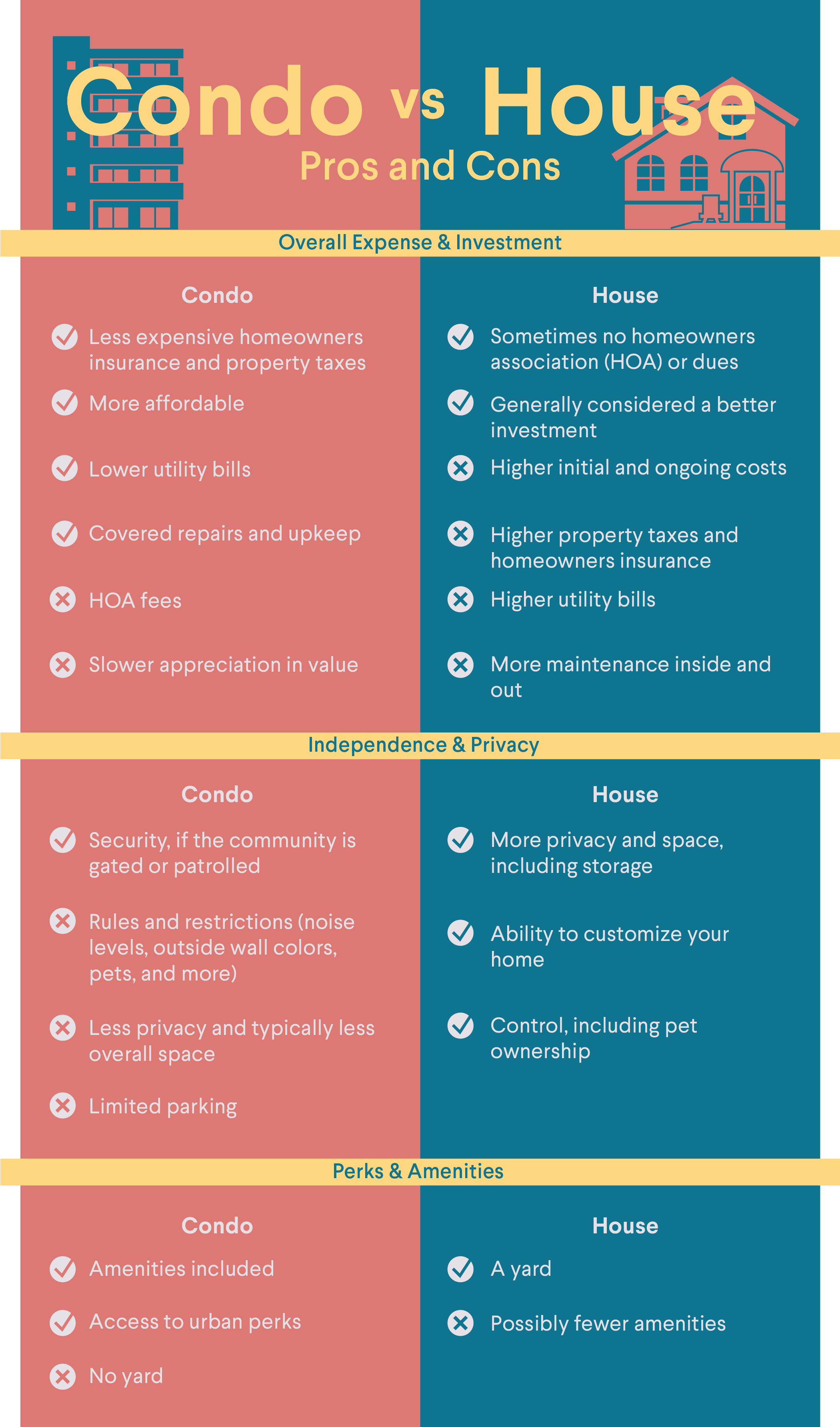
Pros of Buying a House

Among the benefits of buying a house are the following:

•   More privacy and space, including storage

•   A yard

•   Ability to customize your home as you see fit

•   Room to garden and create an outdoor space, just as you want it to be

•   Control of your property

•   Pet ownership unlikely to be an issue

•   Sometimes no homeowners association (HOA) or dues

•   Generally considered a better investment

Cons of Buying a House

However, you may have to contend with these downsides:

•   Potentially higher initial and ongoing costs

•   More maintenance inside and out

•   Typically higher utility bills

•   Potentially higher property taxes and homeowners insurance

•   Possibly fewer amenities (such as common areas, a gym, etc.)

If, after taking the quiz and weighing the pros and cons, buying a house feels like the right choice, you can start brainstorming about size, style, location, and price; attending open houses; and looking online.

Learning how to win a bidding war might also come in handy, depending on the temperature of the market.

First-time homebuyers can
prequalify for a SoFi mortgage loan,
with as little as 3% down.

Questions? Call (888)-541-0398.


Pros and Cons of Buying a Condo

A quick look at how condos work before diving in: Condominium owners share an interest in common areas, like the grounds and parking structures, and hold title to their individual units. They are members of an HOA that enforces community rules. Being a member of a community in this way is a key difference between a condo and a house.

Pros of Buying a Condo

Here are some of the upsides of purchasing a condo:

•   More affordable

•   Amenities included (this might include common rooms, a fitness center, and other features)

•   Potentially less expensive homeowners insurance and property taxes

•   Repairs and upkeep of the property typically taken care of

•   Typically lower utility bills

•   Security, if the community is gated or patrolled

•   Access to urban perks

Cons of Buying a Condo

Next, consider the drawbacks of condo living:

•   Less privacy

•   Typically no private yard

•   Rules and restrictions (about noise levels, outside wall colors, pets, and more)

•   Typically less overall space

•   HOA fees

•   Limited parking

•   Slower appreciation in value

Plus, the mortgage interest rate and down payment are often higher on a condo vs. a house of the same value, though that isn’t always the case, especially for a first-time buyer of an owner-occupied condo.

Conventional home loan mortgage lenders sometimes charge more for loans on condo units; they take into consideration the strength of the condo association financials and vacancy rate when weighing risk.

Mortgages backed by the Federal Housing Administration (FHA) are available for condos, even if they are not part of an FHA-approved condominium project, with a process called the Single Unit Approval Program.

An FHA loan is easier to qualify for and requires as little as 3.5% down, but you’ll pay upfront and ongoing mortgage insurance premiums.

Condo vs House Pros and Cons

What Are the Costs of a House or Condo?

As mentioned above, houses tend to cost more than condos. But here are a few other ways to look at the financials when comparing a condo vs. a house:

•   Condos tend to have lower list prices than houses which may mean a smaller mortgage. However, you also need to factor in monthly maintenance fees and HOAs so you get the full picture.

•   Condos may have assessments from time to time. These are additional charges to fund projects for the unexpected expenses, such as a capital improvement to the entire dwelling.

•   Homeowner fees are growing along with inflation, so when you make your purchase, understand that these charges are not static.

•   Before buying into an HOA community, it’s imperative to vet the board’s finances, including its reserve fund, how often it has raised rates in recent years, whether it has collected any special assessments or plans, and whether it’s facing any lawsuits.

•   If you are buying a house, keep in mind that maintenance and upkeep are your responsibility. This can mean everything from replacing a hot-water heater that’s reaching the end of its lifespan to dealing with roof repairs.

•   Down payments will vary due to several factors. For a condo, a down payment is typically around 10% but can vary considerably from, say, 3% to 20%.

•   With a house, a down payment could be from 3.5% with an FHA loan to the conventional 20% needed to avoid private mortgage insurance, or PMI. Those who qualify for VA loans may be able to buy a house without a down payment.

•   If you are buying a house, make sure to scrutinize property taxes and factor those into your budget. Those are not fixed and can rise over time.

Another smart move: Check out this home affordability calculator to get a better feel for the bottom line.

When Is a Good Time to Buy?

You may know what you’d like to buy (condo vs. a house) and where (in what neighborhood), but do you feel as though now is the right time? If so, fantastic.

You might decide, though, that you want to rent for a while longer under certain circumstances, which can include:

•   Hoping to wait out an overheated market and looking at price-to-rent ratios

•   Wanting to save more money for the down payment and closing costs (the bigger your down payment, the lower your monthlies will likely be)

•   Needing to boost your credit score first

•   Wanting to pay down credit card debt or other debt, which improves your debt-to-income ratio or DTI

•   Needing more time to look at houses and condos before deciding which path to take


Get matched with a local
real estate agent and earn up to
$9,500 cash back when you close.

The Takeaway

The condo vs. house decision depends on a multitude of factors. Reviewing the pros and cons of buying a condo vs. a house can at least give you a direction to start your search. And so can such givens as knowing that you want to be in a certain location (downtown in a condo instead of in a house on a couple of acres), or that you have lots of dogs and therefore want your own yard, and so forth.

Looking for an affordable option for a home mortgage loan? SoFi can help: We offer low down payments (as little as 3% - 5%*) with our competitive and flexible home mortgage loans. Plus, applying is extra convenient: It's online, with access to one-on-one help.

SoFi Mortgages: simple, smart, and so affordable.


Financial Tips & Strategies: The tips provided on this website are of a general nature and do not take into account your specific objectives, financial situation, and needs. You should always consider their appropriateness given your own circumstances.

SoFi Mortgages
Terms, conditions, and state restrictions apply. Not all products are available in all states. See SoFi.com/eligibility-criteria for more information.


SoFi Loan Products
SoFi loans are originated by SoFi Bank, N.A., NMLS #696891 (Member FDIC). For additional product-specific legal and licensing information, see SoFi.com/legal. Equal Housing Lender.


External Websites: The information and analysis provided through hyperlinks to third-party websites, while believed to be accurate, cannot be guaranteed by SoFi. Links are provided for informational purposes and should not be viewed as an endorsement.
‡Up to $9,500 cash back: HomeStory Rewards is offered by HomeStory Real Estate Services, a licensed real estate broker. HomeStory Real Estate Services is not affiliated with SoFi Bank, N.A. (SoFi). SoFi is not responsible for the program provided by HomeStory Real Estate Services. Obtaining a mortgage from SoFi is optional and not required to participate in the program offered by HomeStory Real Estate Services. The borrower may arrange for financing with any lender. Rebate amount based on home sale price, see table for details.

Qualifying for the reward requires using a real estate agent that participates in HomeStory’s broker to broker agreement to complete the real estate buy and/or sell transaction. You retain the right to negotiate buyer and or seller representation agreements. Upon successful close of the transaction, the Real Estate Agent pays a fee to HomeStory Real Estate Services. All Agents have been independently vetted by HomeStory to meet performance expectations required to participate in the program. If you are currently working with a REALTOR®, please disregard this notice. It is not our intention to solicit the offerings of other REALTORS®. A reward is not available where prohibited by state law, including Alaska, Iowa, Louisiana and Missouri. A reduced agent commission may be available for sellers in lieu of the reward in Mississippi, New Jersey, Oklahoma, and Oregon and should be discussed with the agent upon enrollment. No reward will be available for buyers in Mississippi, Oklahoma, and Oregon. A commission credit may be available for buyers in lieu of the reward in New Jersey and must be discussed with the agent upon enrollment and included in a Buyer Agency Agreement with Rebate Provision. Rewards in Kansas and Tennessee are required to be delivered by gift card.

HomeStory will issue the reward using the payment option you select and will be sent to the client enrolled in the program within 45 days of HomeStory Real Estate Services receipt of settlement statements and any other documentation reasonably required to calculate the applicable reward amount. Real estate agent fees and commissions still apply. Short sale transactions do not qualify for the reward. Depending on state regulations highlighted above, reward amount is based on sale price of the home purchased and/or sold and cannot exceed $9,500 per buy or sell transaction. Employer-sponsored relocations may preclude participation in the reward program offering. SoFi is not responsible for the reward.

SoFi Bank, N.A. (NMLS #696891) does not perform any activity that is or could be construed as unlicensed real estate activity, and SoFi is not licensed as a real estate broker. Agents of SoFi are not authorized to perform real estate activity.

If your property is currently listed with a REALTOR®, please disregard this notice. It is not our intention to solicit the offerings of other REALTORS®.

Reward is valid for 18 months from date of enrollment. After 18 months, you must re-enroll to be eligible for a reward.

SoFi loans subject to credit approval. Offer subject to change or cancellation without notice.

The trademarks, logos and names of other companies, products and services are the property of their respective owners.


SOHL-Q125-045

Read more

Nurse Practitioner vs. Physician Assistant: Key Differences

Health-care jobs are projected to grow faster than average for all occupations through 2033, resulting in about 1.9 million openings each year, according to the Bureau of Labor Statistics. If heath care is a field you’re interested in, two positions to consider that are expected to see substantial employment growth are nurse practitioner (NP) and physician assistant (PA).

NPs and PAs are advanced practitioners with similar job responsibilities but also some key differences. If you’re trying to decide between the two, read on to learn what you need to know about the difference between a PA vs NP.

Key Points

•   Both nurse practitioners and physician assistants are advanced health-care professionals with similar responsibilities but different educational and practice approaches.

•   Nurse practitioners emphasize patient-centered care while physician assistants focus on a disease-centered approach.

•   Nurse practitioners can operate independently in many states, whereas physician assistants must collaborate with supervising physicians.

•   Salaries for both professions are comparable, with physician assistants typically earning slightly more.

•   Employment growth is expected to be robust for both professions, with nurse practitioners projected to see faster growth.

Physician Assistant vs Nurse Practitioner: Key Similarities and Differences

PAs and NPs are both important health-care professionals. They work in similar settings, including hospitals, clinics, and physicians’ offices. Here’s how the two specialties are alike and how they differ.

What Is a Physician Assistant?

A physician assistant is a licensed medical professional with an advanced degree who provides direct patient care in primary-care settings, performing many of the same jobs a physician does. This includes doing medical exams, diagnosing conditions, prescribing medication, and treating illnesses. PAs work in collaboration with a supervising physician as determined by state law.

A PA’s education is in general medicine, and their training is disease-centered and similar to that of a physician.

Recommended: Budgeting as a New Doctor

What Is a Nurse Practitioner?

Nurse practitioners are registered nurses (RNs) with advanced education and training for patient care. They typically choose a primary specialty before they enter their graduate program.

NPs provide comprehensive health care and can examine patients, diagnose conditions, prescribe medication, and treat illnesses. In approximately 28 states, NPs can practice without a doctor’s supervision.

Physician Assistant vs. Nurse Practitioner: Key Responsibilities

One of the major differences between an NP and PA is their approach to health care, which is based on different medical models. PAs focus on disease treatment, while NPs focus on patient treatment. So while many of their responsibilities may be similar, the context in which they perform them is not.

The duties of NPs revolve around the patient and include:

•   Recording health histories

•   Conducting physical exams

•   Diagnosing and treating health problems

•   Interpreting lab results and X-rays

•   Prescribing medications and therapies

•   Referring patients to other health professionals if needed

•   Patient education

By comparison, PAs take a biology-based approach to diagnose and treat diseases. They perform such duties as:

•   Doing hospital rounds

•   Performing patient exams

•   Diagnosing illnesses

•   Assisting with surgeries

•   Ordering and interpreting lab tests and X-rays

•   Prescribing medications

•   Developing and managing treatment plans

•   Advising patients on preventative care and treatments

Recommended: Budgeting as a New Nurse

What Is a Nurse Practitioner’s Scope of Practice?

NPs choose a primary specialty, concentrating on a specific patient population. They can specialize in such areas as acute care, family care, neonatal, pediatric, oncology, gerontology, and women’s health.

As mentioned, in 28 states, NPs can treat patients and prescribe medications without a physician’s supervision.

What Is a Physician Assistant’s Scope of Practice?

PAs typically collaborate with supervising physicians as determined by state law. They are trained as generalists, meaning they can practice in almost any medical field. Many PAs have a variety of specialties and sub-specialties, which might include emergency medicine, internal medicine, radiology, pediatrics, surgery, and orthopedics.

Nurse Practitioner vs. Physician Assistant: Education and Certification

PAs and NPs must earn advanced degrees and become licensed and certified. Here’s what’s required for each role.

How to Become a Nurse Practitioner

It typically takes six to eight years to become an NP, including undergraduate and graduate school. The first step is to become an RN by earning a bachelor of science in nursing (BSN) degree. After that, a student can choose to pursue a master of science in nursing (MSN), which usually takes two years to complete, or a doctor of nursing practice (DNP), which typically takes four years to complete.

After earning an MSN or DNP, an NP must receive accreditation from a certification board, such as the American Academy of Nurse Practitioners (AANP-CP), which confirms that their coursework and clinical training meets the licensure board’s requirements. They then get licensed.

How to Become a Physician Assistant

It takes about six to eight years to become a PA. First, an aspiring PA must earn a bachelor’s degree with an emphasis on science. Then they must complete a PA program accredited by the Accreditation Review Commission on Education for the Physician Assistant (ARC-PA), which involves classes and clinical rotations. Students graduate with a master’s in PA studies.

Finally, a PA needs to take the Physician Assistant National Certifying Exam (PANCE), and get licensed in the state(s) where they wish to practice.

Nurse Practitioner and Physician Assistant Specializations

As noted, NPs specialize in certain practice areas, while PAs have a more general medical education.

Types of Nurse Practitioners

There are many different types of NPs with different specializations. Some types of NP you may want to consider include:

•   Family nurse practitioner (FNP): FNPs specialize in family medicine and work with people of all ages. They perform physical exams and health screenings, monitor patients, and develop treatment plans. They also provide continuing education and support.

•   Pediatric nurse practitioner (PNP): PNPs work with children and conduct physical exams, health screenings, and diagnosis and treatment. They may work in private practice, public health centers, pediatric ICUs, emergency departments, and specialty-based clinics.

•   Adult-gerontology nurse practitioner (AGNP): AGNPs work with patients ranging in age from adolescence to the elderly, offering continuing comprehensive care for a broad spectrum of needs. They may work in private practice, hospital settings, nursing homes, or in the homes of patients.

•   Psychiatric nurse practitioner (PMHNP): These mental health professionals treat mental illnesses, disorders, and substance abuse problems. They may work in private psychiatric practices, schools, and community mental health centers.

•   Neonatal nurse practitioner (NNP): NNPs work with premature and sick infants and babies with birth defects and other health conditions. They often work in neonatal ICUs.

•   Women’s health nurse practitioner (WHNP): NPs who work in women’s health advise women on reproductive and sexual health and treat reproductive system disorders. They may work in fertility clinics, hospitals, or private practices.

Types of Physician Assistants

PAs work in primary care or in specialty and subspecialty roles. Those in primary care positions may work in family medicine, internal medicine, or pediatrics, for instance.

If they specialize in internal medicine, the subspecialties they could focus on include:

•   Cardiology

•   Critical care

•   Endocrinology

•   Gastroenterology

•   Hematology and oncology

•   Infectious disease

•   Nephrology

•   Neurology

•   Pulmonology

•   Rheumatology

There are also surgical subspecialties a PA might choose, such as:

•   Cardiovascular or cardiothoracic surgery

•   Bariatric surgery

•   General surgery

•   Neurosurgery

•   Oncology surgery

•   Orthopedic surgery

•   Pediatric surgery

•   Plastic surgery

•   Transplant surgery

•   Trauma surgery

Other specialties a PA might pursue include: allergy and immunology, dermatology, geriatrics, obstetrics and gynecology, pain management, emergency medicine, psychiatry, and radiology.

Nurse Practitioner vs. Physician Assistant: Salary and Career Outlooks

As you’re deciding between nurse practitioner vs physician assistant, it’s important to consider the career and salary opportunities for each.

Average Annual Salary

PAs and NPs earn similar salaries, with PAs making slightly more. However, employment for NPs is projected to be higher than that of PAs.

Nurse Practitioner Salary and Career Outlook

When it comes to salary opportunities as a nurse, the median annual salary for an NP in 2023 was $129,480 per year, or $62.25 per hour. The overall employment for nurse practitioners is projected to grow 40% between 2023 and 2033.

About 31,900 NP openings are projected on average for each year over the next decade.

Physician Assistant Salary and Career Outlook

The median annual salary for a PA was $130,020 in 2023, and the overall employment for these medical professionals is expected to grow 28% from 2023 to 2033.

Approximately 12,900 openings for PAs are projected on average each year over the next 10 years.

Nurse Practitioner vs. Physician Assistant: Which Career Is Right For Me?

PAs and NPs are equally important roles in the health-care system. They make similar salaries and the employment outlook for each is strong.

As you debate which career is the best fit for you, think about your interests and goals. If you are drawn to the patient-centered model of care, an NP might be the right choice for you. If you prefer a disease-centered model, a PA could be the job you’re looking for.

In addition, consider the cost of college for each. An NP may spend as much as $78,820 on their education. In contrast, a PA might spend up to $95,165.

Whether you decide to pursue a NP or PA degree, there are a variety of funding options to help you pay for school, including federal student loans, scholarships and grants, and private student loans.

In addition, there are ways to make paying your student loans more affordable or manageable, including income-driven repayment (IDR) plans for federal student loans, loan repayment assistance programs offered by states and organizations, and student loan refinancing.

By refinancing student loans, you replace your current loans with a new loan from a private lender that ideally will have a lower interest rate and more favorable loan terms.

If you can secure a lower interest rate, refinancing student loans to save money may make sense for you to help pay for schooling to become an NP or PA. Just be aware that refinancing federal student loans makes them ineligible for federal benefits like income-driven repayment.

Using a student loan refinancing calculator can help you see what your monthly payment might be if you choose to refinance.

If you need more information, our student loan refinancing guide can give you additional details about the process and whether it’s right for you.

The Takeaway

Nursing practitioner and physician assistant are both rewarding careers in the medical field. The main difference between the two is their approach to health care. An NP’s approach is patient-centered, while a PA’s is disease-centered. Think carefully about which role offers the best career path — and the most rewarding type of work — for you.

And while schooling to become a PA or an NP can be expensive, remember that there are a multitude of ways to help pay for it including federal and private student loans.

Looking to lower your monthly student loan payment? Refinancing may be one way to do it — by extending your loan term, getting a lower interest rate than what you currently have, or both. (Please note that refinancing federal loans makes them ineligible for federal forgiveness and protections. Also, lengthening your loan term may mean paying more in interest over the life of the loan.) SoFi student loan refinancing offers flexible terms that fit your budget.

With SoFi, refinancing is fast, easy, and all online. We offer competitive fixed and variable rates.

FAQs

Who goes to school longer, a PA or a nurse practitioner?

It takes about the same amount of time to become an NP and a PA — approximately six to eight years, including graduate school. However, to become an NP, some universities require at least one year of experience as an RN before a student can pursue their master of science in nursing.

Is it harder to become a nurse practitioner or a PA?

The schooling and experience necessary to become both a nurse practitioner and a PA is challenging. Which one is more difficult for you depends on your unique skills and strengths. If you’re good at patient care, an NP might be a better fit for you. If you’re drawn to a more traditional medical school approach, you may find that it makes sense for you to become a PA.

Is a nurse practitioner higher than a PA?

As licensed health-care professionals who play important roles in medical care, neither a nurse practitioner nor physician assistant is higher than the other. One thing to keep in mind, however, is that NPs can work independently in many states, while PAs work in collaboration with a physician.


About the author

Melissa Brock

Melissa Brock

Melissa Brock is a higher education and personal finance expert with more than a decade of experience writing online content. She spent 12 years in college admission prior to switching to full-time freelance writing and editing. Read full bio.


Photo credit: iStock/SDI Productions

SoFi Student Loan Refinance
Terms and conditions apply. SoFi Refinance Student Loans are private loans. When you refinance federal loans with a SoFi loan, YOU FORFEIT YOUR ELIGIBILITY FOR ALL FEDERAL LOAN BENEFITS, including all flexible federal repayment and forgiveness options that are or may become available to federal student loan borrowers including, but not limited to: Public Service Loan Forgiveness (PSLF), Income-Based Repayment, Income-Contingent Repayment, extended repayment plans, PAYE or SAVE. Lowest rates reserved for the most creditworthy borrowers.
Learn more at SoFi.com/eligibility. SoFi Refinance Student Loans are originated by SoFi Bank, N.A. Member FDIC. NMLS #696891 (www.nmlsconsumeraccess.org).

SoFi Loan Products
SoFi loans are originated by SoFi Bank, N.A., NMLS #696891 (Member FDIC). For additional product-specific legal and licensing information, see SoFi.com/legal. Equal Housing Lender.


Third-Party Brand Mentions: No brands, products, or companies mentioned are affiliated with SoFi, nor do they endorse or sponsor this article. Third-party trademarks referenced herein are property of their respective owners.

Non affiliation: SoFi isn’t affiliated with any of the companies highlighted in this article.

Financial Tips & Strategies: The tips provided on this website are of a general nature and do not take into account your specific objectives, financial situation, and needs. You should always consider their appropriateness given your own circumstances.

External Websites: The information and analysis provided through hyperlinks to third-party websites, while believed to be accurate, cannot be guaranteed by SoFi. Links are provided for informational purposes and should not be viewed as an endorsement.

SOSLR-Q424-011

Read more
TLS 1.2 Encrypted
Equal Housing Lender