Finding Value Is in Season: Even the Rich Are Discount Shopping Now

How America shops is shifting in a fundamental way.

Shoppers are turning to discount stores such as Dollar Tree, ALDI, and Big Lots more often, driven largely by spiking inflation, which peaked at 9.1% in June 2022. These days, shoppers are increasingly asking themselves, Why pay more? as they place a higher premium on value.

According to SoFi’s Discount Shopping Survey of 1,500 consumers fielded in August 2023, 81% of respondents are currently shopping at discount stores at least monthly, regardless of their income level.

Surely, the impetus may vary:

•   For many, discount stores are a vital tool when sticking to a tight budget.

•   For others, it might be a way to find splurges, both large and small, at the right price.

Still, though circumstances may vary, a whopping 78% of respondents are laser-focused on snagging the lowest possible prices for items on their list.

While shoppers may have been swayed by ambience and amenities at stores in the past, now it’s all about getting top value for every hard-earned dollar. Sticking to — and stretching — one’s budget is the new black. Also worth noting: Among the ranks of discount shoppers are high-earners pulling in six figures.

SoFi’s proprietary research found intriguing and unexpected facts about just who’s hitting the discount stores, what they are hunting for at these retailers, and why the face of shopping may never be the same again.

Where the Buyers Are: 74% of Respondents Dropped Into Dollar Tree
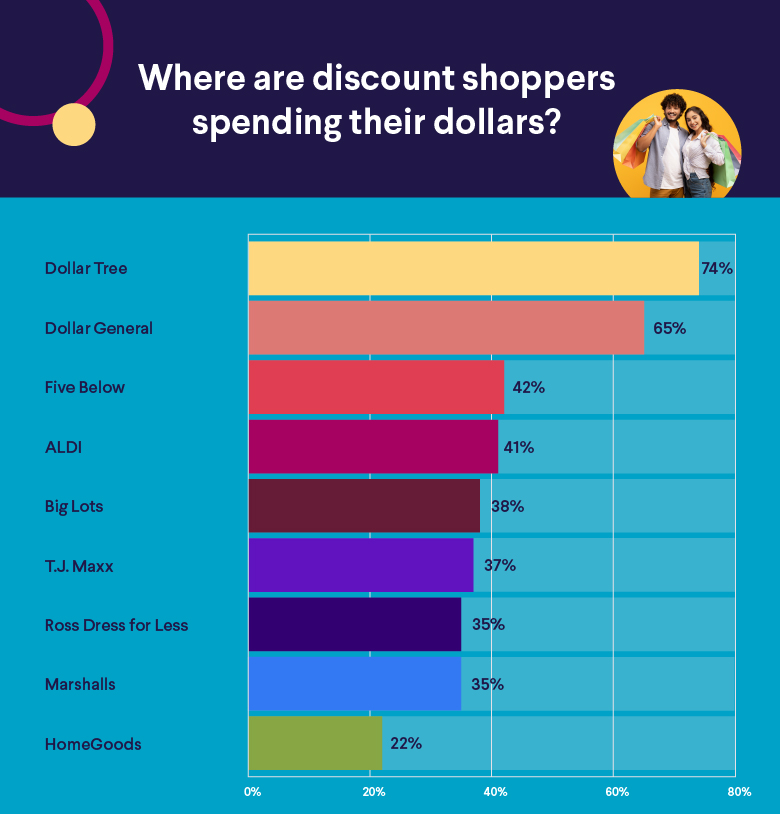
Where are discount shoppers spending their dollars?

Curious about which discount retailers are topping shoppers’ lists? According to SoFi’s Discount Shopping Survey, almost three-quarters (74%) of discount shoppers have dropped into a Dollar Tree, where the motto is “Extreme Value Every Day,” over the past year.

It isn’t just those living paycheck to paycheck who are shopping at Dollar Tree:

•   64% of the survey’s highest earners (households bringing in $150,000+) say they’ve bought items at Dollar Tree in the last 12 months.

Discount shoppers are also looking elsewhere to find where the best buys are. Over the past year:

•   65% have shopped at Dollar General

•   42% at Five Below

•   41% at ALDI

•   38% at Big Lots

•   37% at T.J. Maxx

•   35% at Ross Dress for Less

•   35% at Marshalls

Where else are moneywise shoppers queuing up? It turns out that 22% have shopped at HomeGoods, while one in five (20%) has rung up items at brand-name outlets (Nordstrom Rack, for instance).

Discount Stores: The New Social Media Darlings

Reflecting their new status as many shoppers’ go-to destination, discount stores are accumulating hefty followings. As of September 2023, the stats are:

•   ALDI USA has 955K Instagram followers; 184K on TikTok

•   Dollar Tree has 675K Instagram followers; 76.6K on TikTok

•   Five Below has 706K Instagram followers; 214.3K on TikTok

💡 Quick Tip: Bank fees eat away at your hard-earned money. To protect your cash, open a checking account with no account fees online — and earn up to 0.50% APY, too.

81% Discount-Shop at Least Once a Month

18% of respondents shop at discount stores at least once a month

People aren’t just hitting the discount shops for an occasional find. Rather, SoFi’s discount shopping research uncovered that these retailers are quickly gaining traction as routine destinations for shoppers.

•   81% of respondents shop at discount stores at least once a month.

•   38% — practically four out of ten people — shop at discount stores weekly.

•   14% of respondents say you’ll find them shopping at discount stores several times a week. (These may be people who are saving money daily with their shopping habits.)

Compelling find: Close to half of high-income earners (those making $100,000+ a year) say they shop at discount stores at least weekly.

Inflation Surge Drives Shoppers to Discount Stores

63% of discount shoppers say inflation prompted them to shop at discount stores

If you’re wondering why discount shopping is surging, consider the economic state of our union. After inflation rates fell month after month for a solid year, July 2023 saw an uptick in prices that surely set some people on edge. (Inflation in July 2023 increased 3.2% from July 2022.)

What’s more, the cost of living is soaring. Social Security recipients enjoyed a cost of living adjustment (COLA) to the tune of 8.7% in 2023, one indicator of how steeply the price of, well, everything has been rising.

Indeed, consider this:

•   Nearly two-thirds of discount shoppers (63%) say inflation and rising costs have prompted them to shop at discount stores over the last 12 months.

•   In addition, nearly half of discount shoppers have ramped things up, with 49% saying they are hitting discount stores more frequently than they did before the inflation surge.

When it comes to defending one’s paycheck against price hikes, bargain-hunting is a smart maneuver. ”Inflation is real for just about all of us,” says David Bakke, a consumer finance expert and writer at personal finance blog Dollar Sanity. “My discount shopping has definitely increased. I find myself spending a lot more time at ALDI, Dollar General, and the like.”

Indeed, inflation is making over the way Americans shop. SoFi’s discount shopping data shows this significant stat:

•   40% of respondents say they “always” search for ways to save on their purchases when shopping.

•   Only 2% said they never search for ways to save.

Discount shoppers' cost-cutting tactics

Here are some of the leading tactics discount shoppers have used to cut costs:

•   41% have used couponing websites.

•   40% have subscribed to company emails.

•   31% have followed a company or brand on social media.

•   21% have joined a Facebook group or other online community.

•   18% have followed an influencer on social media who talks about discount shopping.

More Than Half Discount-Shop to Benefit Their Budget

In these challenging economic times, many consumers are embracing budgeting as a way to manage their finances. Almost six out of 10 discount shoppers (58%) say one of the biggest benefits of shopping at discount stores is the ability to stick to a budget.

This holds true for 62% of those with household incomes under $75K, as well as 46% of those pulling in $100K or more.

Other reasons to love these retailers? SoFi’s discount shopper respondents said:

•   Regular availability of discounted products (47%)

•   The convenience and accessibility of discount stores (46%)

•   The ability to find trendy or seasonal items at lower prices (45%)

Another shopping pattern that SoFi’s discount shopping survey uncovered: A significant number of discount shoppers are making most of their purchases from these lower-priced retailers:

•   36% make more than 50% of their purchases at discount stores.

•   Almost one in 10 (9%) of those with household incomes of $150,000 or more do more than 75% of their shopping at discount stores.

First on the Discount Shopping List: Groceries
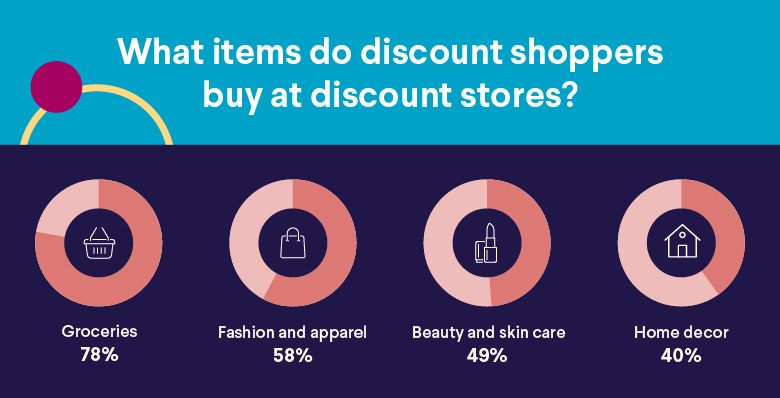
What items do discount shoppers buy at discount stores?

It’s no secret that food prices can trigger sticker-shock, and that’s not just for luxuries like a pumpkin spice latte. Overall, food prices are ratcheting up 5.9% this year, per the USDA’s numbers, which may explain why consumers are hitting the low-cost stores for items they might otherwise buy at a standard supermarket.

According to the SoFi discount shopping research, groceries are the most common purchase made by discount shoppers: 78% buy groceries at discount stores.

And no wonder: These stores often have an array of staples and snacks, from coffee to cookies, and some are putting a health spin on things, as with Dollar General’s “Better for You” selections. Shopping at discount stores can be a solid way to save money on food.

“I shop at discount grocer ALDI,” says Melissa Cid, consumer savings expert with MySavings.com. “Chips, peanuts, cookies, yogurt, and ice cream are 25% to 50% cheaper than at traditional grocery stores.”

After food, the next most popular items:

•   Fashion and apparel: 58%

•   Beauty and skin care: 49%

•   Home decor: 40%

I shop at discount grocer Aldi.

11% Splash Out When Discount Shopping

Think shoppers are only grabbing cereal, socks, and a bottle of shampoo? Not necessarily.

Yes, many people are hunting for lower-priced essentials at the discount stores, but super-low prices are also leading to big-ticket purchases, for some. According to SoFi’s survey:

•   11% of discount shoppers say the most expensive item they’ve purchased at a discount store in the past 12 months cost $250 or more.

Here is what shoppers say are some of the priciest items they purchased at a discount store:

•   18% say it was a fashion/apparel item.

•   16% say it was an electronic item.

•   13% say it was a home decor item.

“Tech gadgets and home essentials top the list of items that I purchase from discount stores,” explains Thomas Paddock, an Amazon FBA Six-Figure Seller and the founder of Learn Retail Arbitrage, an online selling resource. “These categories often carry substantial markups in conventional retail outlets. Discount stores can offer high-quality items at a more
reasonable cost.”

There is, however, a bit of a gender gap when it comes to shopping for certain items at discount stores:

•   36% of men have purchased electronics vs. 27% of women.

•   67% percent of women have made clothing purchases vs. 44% of men.

•   Nearly 3x as many men (22%) have made sports/outdoor purchases vs. women (8%).

Finding Fashion at Discount Shops? Yes, Says Gen Z
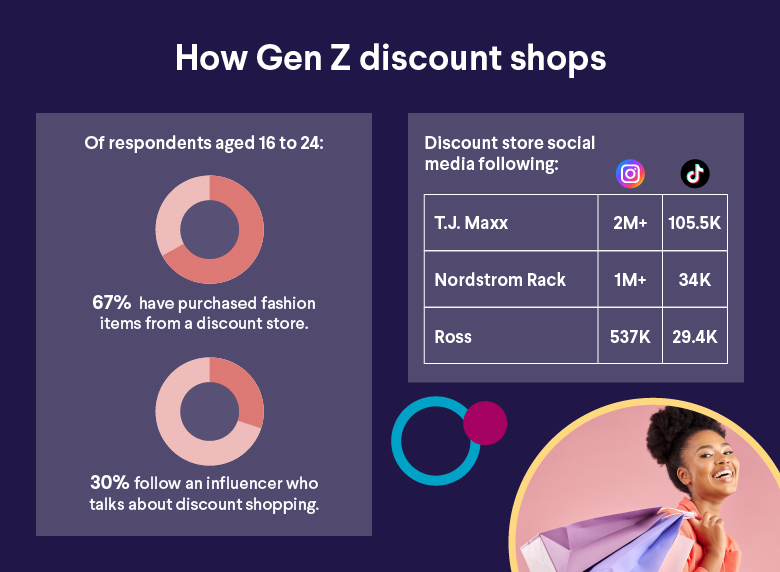
How Gen Z discount shops

The SoFi discount shopping stats reveal that 67% of young people (aged 16-24) have purchased fashion and apparel items at a discount store within the last year.

Given that Gen Z is broadly recognized as the first digitally native generation, it’s probably no surprise that social media may have led many of them to these style purchases:

•   30% of respondents aged 16-24 have followed an influencer on social media who talks about discount shopping, vs. 18% of total respondents.

And the presence these retailers have on social media channels is significant. On Instagram, as of September 2023, T.J. Maxx has 2+ million followers, Nordstrom Rack has 1+ million followers, and Ross Dress for Less has 537K followers. All three have tens of thousands of followers on TikTok.

Almost 50% of Shoppers Seek Seasonal Wares

Seasonal and holiday shopping is (very) big business in the U.S., with Halloween spending, for instance, totalling $10.6 billion in 2022.

“Here today, gone tomorrow” items are part of the allure of discount stores, where goods can be found at a rock-bottom price. Consider these numbers from the SoFi survey:

•   45% of discount shoppers say one of the biggest benefits of discount stores is the availability of lower-priced trendy or seasonal items.

•   65% of discount shoppers are hunting for clearance or end-of-season items.

•   70% of women look for clearance and end-of-season deals at discount stores vs. 56% of men.

More Than Half of Discount Shoppers Spend Serious Time Bargain-Hunting

Discount shoppers spend serious time bargain-hunting

The new wave of smart shoppers are dedicated bargain-hunters. They will invest hours to get a great deal. In fact, more than half (51%) will spend between one and three hours extra to find savings or specific items at discount stores. A dedicated 4% are willing to spend five hours or more. (Of these, 63% have a household income of less than $50,000.)

Discount Shoppers Also Prioritize Availability

60% of discount shoppers with household income of $150,000

Low prices are the leading reason for the popularity of discount shopping, but availability of desired products is another big incentive:

•   52% head to these retailers for the specific items they know they can find there.

Whether it’s a favorite energy bar or shower gel, items that are part of a person’s usual shopping list are a big draw for discount shoppers.

This is especially true of the deep-pocketed respondents to the SoFi survey. Why spend top-dollar on your favorite matcha beverages or other small luxuries when you can buy them for much less?

•   60% of the highest earners (household income of $150,000 or more) say one of the reasons they shop at discount stores is for specific items they know they can find there.

There are a good number of impulse buyers among the aisles though:

•   Almost one in five (19%) discount shoppers say they don’t go to the stores looking for any particular item. Rather, they “go in without a plan and buy things that speak to them.”

As for the rest of the respondents to SoFi’s survey:

•   More than half of discount shoppers (51%) say they know what they need when they go to a discount store, but are open to buying items not on their list.

•   More than a quarter (26%) say they buy what they need and exit ASAP.

•   Only 3% say they just browse and rarely actually purchase anything.

And the Biggest Frustration With Discount Shopping Is…

Obviously, there is much to love about discount shopping, as detailed above. But, yes, there are a couple of pain points. Here, the two biggest downsides:

•   38% of discount shoppers say the items they want aren’t always available. That suggests that consumers would buy even more at these retailers if they could find everything they are hunting for.

•   22% say that the biggest downside is that the items are of a lower quality.

It seems that getting what you want, when you want it, may matter even more than an item’s quality.

That said, Thomas Paddock of Learn Retail Arbitrage contends that you can find good quality if you shop smart. “Contrary to general assumptions, not every item in a discount store is of inferior quality. Many times, these are overstock products or emerging brands,” he says. “Discount stores can be an avenue to discover value.”

The Takeaway

As inflation increases, shoppers of all income levels are finding that discount stores can serve their needs. Of the 1,500 consumers surveyed for SoFi’s Discount Shopping Survey in August 2023, 81% say they are visiting discount stores (think Dollar Tree, ALDI, and Five Below) at least once a month. Popular purchases are food, fashion, personal care, and home decor items.

What frustrates discount shoppers when seeking their budget buys? Lack of availability first and foremost, followed by lower quality of some goods.

For anyone looking to make the most of their money, finding the right banking partner can also make a big difference. One that charges low or no fees and offers a competitive interest rate can help you make the most of your finances.

Interested in opening an online bank account? When you sign up for a SoFi Checking and Savings account with eligible direct deposit, you’ll get a competitive annual percentage yield (APY), pay zero account fees, and enjoy an array of rewards, such as access to the Allpoint Network of 55,000+ fee-free ATMs globally. Qualifying accounts can even access their paycheck up to two days early.


Better banking is here with SoFi, NerdWallet’s 2024 winner for Best Checking Account Overall.* Enjoy 3.30% APY on SoFi Checking and Savings with eligible direct deposit.


SoFi Checking and Savings is offered through SoFi Bank, N.A. Member FDIC. The SoFi® Bank Debit Mastercard® is issued by SoFi Bank, N.A., pursuant to license by Mastercard International Incorporated and can be used everywhere Mastercard is accepted. Mastercard is a registered trademark, and the circles design is a trademark of Mastercard International Incorporated.

Annual percentage yield (APY) is variable and subject to change at any time. Rates are current as of 12/23/25. There is no minimum balance requirement. Fees may reduce earnings. Additional rates and information can be found at https://www.sofi.com/legal/banking-rate-sheet

Eligible Direct Deposit means a recurring deposit of regular income to an account holder’s SoFi Checking or Savings account, including payroll, pension, or government benefit payments (e.g., Social Security), made by the account holder’s employer, payroll or benefits provider or government agency (“Eligible Direct Deposit”) via the Automated Clearing House (“ACH”) Network every 31 calendar days.

Although we do our best to recognize all Eligible Direct Deposits, a small number of employers, payroll providers, benefits providers, or government agencies do not designate payments as direct deposit. To ensure you're earning the APY for account holders with Eligible Direct Deposit, we encourage you to check your APY Details page the day after your Eligible Direct Deposit posts to your SoFi account. If your APY is not showing as the APY for account holders with Eligible Direct Deposit, contact us at 855-456-7634 with the details of your Eligible Direct Deposit. As long as SoFi Bank can validate those details, you will start earning the APY for account holders with Eligible Direct Deposit from the date you contact SoFi for the next 31 calendar days. You will also be eligible for the APY for account holders with Eligible Direct Deposit on future Eligible Direct Deposits, as long as SoFi Bank can validate them.

Deposits that are not from an employer, payroll, or benefits provider or government agency, including but not limited to check deposits, peer-to-peer transfers (e.g., transfers from PayPal, Venmo, Wise, etc.), merchant transactions (e.g., transactions from PayPal, Stripe, Square, etc.), and bank ACH funds transfers and wire transfers from external accounts, or are non-recurring in nature (e.g., IRS tax refunds), do not constitute Eligible Direct Deposit activity. There is no minimum Eligible Direct Deposit amount required to qualify for the stated interest rate. SoFi Bank shall, in its sole discretion, assess each account holder's Eligible Direct Deposit activity to determine the applicability of rates and may request additional documentation for verification of eligibility.

See additional details at https://www.sofi.com/legal/banking-rate-sheet.

Financial Tips & Strategies: The tips provided on this website are of a general nature and do not take into account your specific objectives, financial situation, and needs. You should always consider their appropriateness given your own circumstances.

SOBK1023012

Read more
pink notebook pen and calculator mobile

How Is Income-Driven Repayment Calculated?

After graduation and your six-month federal student loan grace period, it’ll be time to start paying your dues. If you are on the Standard Repayment Plan, you’ll pay at least $50 a month for 10 years. But there are other ways to pay back your student loans: through income-driven repayment plans.

Not all of these plans have the same repayment strategy, and not all federal loans qualify for income-driven repayment. We’ll help you find the one that aligns with your financial situation before you commit.

Key Points

•   Income-driven repayment plans calculate monthly payments as a percentage of discretionary income, which is determined by adjusted gross income above a protected threshold.

•   The SAVE plan offers the lowest payments for undergraduate loans, setting payments at 5% of discretionary income, while the IBR plan sets payments at 10% to 15%.

•   Borrowers may qualify for loan forgiveness after 20 or 25 years on IDR plans, with those owing less than $12,000 eligible for forgiveness after 10 years on the SAVE plan.

•   Alternatives to IDR include federal loan consolidation to simplify payments or refinancing with a private lender to potentially secure a lower interest rate.

•   Refinancing federal student loans removes access to government benefits like Public Service Loan Forgiveness and income-driven repayment plans, so borrowers should carefully weigh their options.

How Does Income-Driven Repayment Work?

The U.S. Department of Education offers two income-driven repayment (IDR) plans for holders of federal student loans. (Two other plans, PAYE and Income-Contingent Repayment, are no longer accepting new enrollments.) The current plans are:

•   Income-Based Repayment (IBR)

•   Saving on a Valuable Education (SAVE) Plan

For IDR plans, your monthly payment is calculated as a portion of your discretionary income. The Department of Education defines discretionary income as your adjusted gross income in excess of a protected amount.

Discretionary income under the SAVE Plan, for example, is any adjusted gross income you have above 225% of the federal poverty guideline appropriate to your family size. You’ll have a $0 monthly payment under the SAVE Plan if your annual income doesn’t exceed the protected amount of $32,805 for a single borrower and $67,500 for a family of four in 2023.

If you don’t qualify for a $0 monthly payment on the SAVE Plan, your monthly payment beginning in July 2024 is set at 5% of discretionary income for undergraduate loans, 10% for graduate loans, and a weighted average if you have both.

On the IBR plan, your monthly payment is typically set at 10% to 15% of your discretionary income above 150% of the federal poverty guideline appropriate to your family size. But unlike the SAVE Plan, a borrower’s monthly payment on the IBR plan will never be more than what you would have paid through the Standard Repayment Plan.

IDR Loan Forgiveness

All federal IDR plans can end with your remaining loan balance being forgiven after 20 or 25 years, but some borrowers may receive forgiveness sooner under the SAVE Plan. Beginning in July 2024, federal student loan borrowers with original principal balances of less than $12,000 can have their remaining loan balance forgiven after 10 years of monthly qualifying payments on the SAVE Plan.

For more details on federal IDR debt relief benefits, check out our Guide to Student Loan Forgiveness.

Your personal circumstances and goals may dictate which student loan repayment plan is right for you. You can estimate how much your monthly payments will be through the federal Loan Simulator calculator.

Take control of your student loans.
Ditch student loan debt for good.


💡 Quick Tip: Ready to refinance your student loan? You could save thousands.

The Difference Between Income-Driven Repayment Plans

Deciding which IDR plan is right for you (and that you may qualify for) depends on your financial situation and your loan type(s). Here’s what they mean:

•   IBR (Income-Based Repayment). This plan is based on your income and family size. The potential IBR payment must be less than what you would pay under the Standard Repayment Plan to qualify. Any remaining balance is forgiven after 20 or 25 years.

•   SAVE (Saving on a Valuable Education). This IDR plan replaced the former REPAYE Plan. Anyone with qualifying student loans can enroll into the SAVE Plan. However, you could end up paying more per month under this plan than the Standard Repayment Plan. You’ll have a $0 monthly payment under the SAVE Plan if your annual income falls below 225% of the federal poverty guideline appropriate to your family size.

Alternatives to Income-Driven Repayment Plans

The 2023 debt ceiling bill officially ended the three-year Covid-19 forbearance, requiring federal student loan interest accrual to resume on Sept. 1, 2023, and payments to resume in October 2023.

Aside from the Standard Repayment Plan, there are a few options to consider instead of IDR:

Consolidation

If you have federal student loans, you can get a Direct Consolidation Loan. This will move all your eligible federal student loans into one monthly payment. Your new interest rate is the weighted average of all your loans, rounded up to the nearest eighth of a percent.

This can be helpful if you have many smaller loans that each have a minimum monthly payment. It typically won’t lower your monthly payment, however, but it can make it manageable and easier to keep track of. Only federal loans are eligible for a Direct Consolidation Loan.

Refinancing

Refinancing is similar to consolidation. You get one loan to replace all of your other loans, but it’s a new loan with a new interest rate from a private lender or bank. Your credit report and other personal financial factors are considered to see if you’re a responsible borrower. If you previously had a co-borrower, such as a parent, you can look into refinancing without a cosigner.

Many lenders allow you to refinance all of your student loans, not just federal student loans. So if you have a mix of private student loans and federal student loans, refinancing will create one new loan with one payment to replace them.

If you qualify for a lower interest rate and a shorter term, it could reduce the amount of money paid in interest over the life of the loan. You may pay more interest over the life of the loan if you refinance with an extended term. You can explore different scenarios with our Student Loan Refinance Calculator.

You may ask, “Should I refinance my federal student loans?” Refinancing federal student loans with a private lender forfeits your access to Public Service Loan Forgiveness (PSLF), Teacher Loan Forgiveness, and federal IDR plans. You can weigh the pros and cons when determining whether student loan refinancing is right for you.


💡 Quick Tip: Refinancing could be a great choice for working graduates who have higher-interest graduate PLUS loans, Direct Unsubsidized Loans, and/or private loans.

How Do You Calculate Income for an Income-Driven Plan?

The Department of Education considers three different components when calculating a borrower’s income. While this may seem needlessly complicated, it actually benefits borrowers:

Annual Income

Any income that’s taxable counts toward the Education Department’s calculation. That means regular wages, plus interest and dividends from savings and investments, unemployment benefits, etc. On the flip side, any income that isn’t taxed doesn’t count: gifts and inheritances, cash rebates from retailers, child support payments, and so on.

Spouse’s Income

If you and your spouse file a joint tax return, then their income must also be factored in. If you file separately, only your income counts.

Family Size

Your family size is the number of people who live with you and receive more than half their support from you. This includes children but also dependent adults, such as an older parent.

The Takeaway

There are now two income-driven repayment plans for federal student loan holders, IBR and SAVE. The PAYE and Income-Contingent Repayment plans stopped accepting new borrowers as of July 1, 2024, although current enrollees can remain on the plan after that date.

Looking to lower your monthly student loan payment? Refinancing may be one way to do it — by extending your loan term, getting a lower interest rate than what you currently have, or both. (Please note that refinancing federal loans makes them ineligible for federal forgiveness and protections. Also, lengthening your loan term may mean paying more in interest over the life of the loan.) SoFi student loan refinancing offers flexible terms that fit your budget.


With SoFi, refinancing is fast, easy, and all online. We offer competitive fixed and variable rates.


SoFi Student Loan Refinance
Terms and conditions apply. SoFi Refinance Student Loans are private loans. When you refinance federal loans with a SoFi loan, YOU FORFEIT YOUR ELIGIBILITY FOR ALL FEDERAL LOAN BENEFITS, including all flexible federal repayment and forgiveness options that are or may become available to federal student loan borrowers including, but not limited to: Public Service Loan Forgiveness (PSLF), Income-Based Repayment, Income-Contingent Repayment, extended repayment plans, PAYE or SAVE. Lowest rates reserved for the most creditworthy borrowers.
Learn more at SoFi.com/eligibility. SoFi Refinance Student Loans are originated by SoFi Bank, N.A. Member FDIC. NMLS #696891 (www.nmlsconsumeraccess.org).

SoFi Loan Products
SoFi loans are originated by SoFi Bank, N.A., NMLS #696891 (Member FDIC). For additional product-specific legal and licensing information, see SoFi.com/legal. Equal Housing Lender.


SoFi Private Student Loans
Please borrow responsibly. SoFi Private Student loans are not a substitute for federal loans, grants, and work-study programs. We encourage you to evaluate all your federal student aid options before you consider any private loans, including ours. Read our FAQs.

Terms and conditions apply. SOFI RESERVES THE RIGHT TO MODIFY OR DISCONTINUE PRODUCTS AND BENEFITS AT ANY TIME WITHOUT NOTICE. SoFi Private Student loans are subject to program terms and restrictions, such as completion of a loan application and self-certification form, verification of application information, the student's at least half-time enrollment in a degree program at a SoFi-participating school, and, if applicable, a co-signer. In addition, borrowers must be U.S. citizens or other eligible status, be residing in the U.S., Puerto Rico, U.S. Virgin Islands, or American Samoa, and must meet SoFi’s underwriting requirements, including verification of sufficient income to support your ability to repay. Minimum loan amount is $1,000. See SoFi.com/eligibility for more information. Lowest rates reserved for the most creditworthy borrowers. SoFi reserves the right to modify eligibility criteria at any time. This information is subject to change. This information is current as of 4/22/2025 and is subject to change. SoFi Private Student loans are originated by SoFi Bank, N.A. Member FDIC. NMLS #696891 (www.nmlsconsumeraccess.org).

External Websites: The information and analysis provided through hyperlinks to third-party websites, while believed to be accurate, cannot be guaranteed by SoFi. Links are provided for informational purposes and should not be viewed as an endorsement.
Tax Information: This article provides general background information only and is not intended to serve as legal or tax advice or as a substitute for legal counsel. You should consult your own attorney and/or tax advisor if you have a question requiring legal or tax advice.

Financial Tips & Strategies: The tips provided on this website are of a general nature and do not take into account your specific objectives, financial situation, and needs. You should always consider their appropriateness given your own circumstances.

SOSL1023007

Read more
top view working on desk with flowers

How to Get the Student Loan Interest Deduction

If you’re tackling school debt and looking for ways to maximize your tax refund, one avenue to consider is the student loan interest deduction. This benefit allows you to take a tax deduction for the interest you paid on student loans that you took out for yourself, your spouse, or your dependents. The deduction can lower how much of your income is taxed, which could result in a lower overall tax bill.

However, there’s a limit to how much you can deduct each tax year, and you must meet certain criteria in order to get the deduction. Let’s look at how the student loan interest deduction works and how to qualify for it.

Are Student Loan Payments Deductible?

Typically, when you repay a student loan, your monthly payment goes toward the original amount you borrowed plus origination fees (the loan principal) and the amount a lender charges you to borrow it (interest). With the student loan interest deduction, you are only allowed to deduct the amount you paid in interest, not the full amount of the loan payment.

Is Student Loan Interest Deductible?

The student loan interest deductible allows you to subtract up to $2,500 or the total amount of interest paid on student loans — whichever is lower — from your taxable income. Private and federal loans may qualify for this benefit. The deduction is considered “above the line,” which means you don’t have to itemize your taxes to take advantage of it.

Note that there are income phaseouts based on your modified adjusted gross income (MAGI). A borrower can claim the full credit if their MAGI is $80,000 or less ($160,000 or less if you’re filing jointly). The deduction is gradually reduced if your MAGI falls between $80,000 and $90,000 ($160,000 and $180,000 if you’re filing jointly). The deduction is eliminated for borrowers with a MAGI of more than $90,000 ($180,000 or more if you’re filing jointly).


💡 Quick Tip: Ready to refinance your student loan? With SoFi’s no-fee loans, you could save thousands.

Who Can Deduct Student Loan Interest?

Not everyone is able to claim the student loan interest deduction. In order to be eligible for it, you must meet certain criteria:

•   You paid interest on a qualified student loan for you, your spouse, or your dependents in the previous tax year. (A qualified student loan is a loan taken out to pay for qualified education expenses like tuition, housing, books, and supplies. The loan must be used within a “reasonable period” after it’s taken out.)

•   You’re legally required to pay interest on a qualified student loan.

•   Your MAGI in the 2023 tax year is less than $90,000 (or less than $180,000 if you’re filing jointly).

•   Your filing status is anything except married filing separately.

•   If you’re filing taxes jointly, neither you nor your spouse can be claimed as a dependent on someone else’s tax return.

Your eligibility may be impacted if your employer made payments on your student loans as part of a work benefit.

What to Know About the Student Loan Interest Deduction Form

If you pay $600 or more in interest on qualified student loans during a tax year, your loan servicer should send you IRS Form 1098-E. This student loan tax form is usually sent out around the end of January.

If you don’t receive a 1098-E form, you should be able to download it from your loan servicer’s website. To find out who your loan servicer is, log on to the Federal Student Aid website, and the information will be listed in your dashboard. You can also call the Federal Student Aid Information Center at 800-433-3243.

Keep in mind that if you didn’t make payments on your federal student loans because of the Covid-related payment pause — or if you didn’t pay $600 in interest during the tax year — you may not get a 1098-E form. However, you can contact your servicer to find out how much interest you paid during the year if you’re planning to report it on your taxes.

Recommended: How Student Loans Could Impact Your Taxes

Additional Education Tax Breaks

The student loan interest deduction isn’t the only benefit worth knowing about. You may also want to see if you qualify for certain education tax credits, which represent a dollar-for-dollar reduction in your overall tax burden. They can directly lower the tax amount you owe. Here are two to consider.

American Opportunity Tax Credit

The American Opportunity Tax Credit (AOTC) is a credit for tuition and other qualified educational expenses paid during the first four years of a student’s college education. The credit is worth up to $2,500 per eligible student. Once your tax bill hits zero, you could earn 40% of whatever remains (up to $1,000) as a tax refund.

You must meet certain requirements in order to qualify for the AOTC. You must:

•   Pursue a degree or other recognized education credential

•   Be enrolled at least half time for at least one academic period beginning in the tax year

•   Have no felony drug convictions at the end of the tax year

•   Haven’t claimed the AOTC for more than four tax years

As with the student loan interest deduction, your income matters. To claim the full credit, your MAGI must be $80,000 or less ($160,000 or less if you’re filing jointly) in the 2023 tax year. The credit amount begins to decrease if your MAGI falls between $80,000 and $90,000 (over $160,000 but less than $180,000 if you’re filing jointly). The credit is eliminated if your MAGI is over $90,000 ($180,000 if you’re filing jointly).

Lifetime Learning Credit

The Lifetime Learning Credit (LLC) works a little differently. The credit is worth 20% of the first $10,000 of qualified educational expenses, or a maximum of $2,000 per year. Unlike the AOTC, which only applies to the first four years of a student’s college education, the LLC includes undergraduate, graduate, and professional schools, and courses needed to acquire job skills. There’s no limit to the number of years you can claim it.

However, the LLC has a lower income limit, which means it could be more difficult to qualify for. For instance, in 2022, the credit amount gradually decreased if your MAGI fell between $80,000 and $90,000 ($160,000 and $180,000 if you filed jointly) in the 2022 tax year. The credit was eliminated if your MAGI is $90,000 or more ($180,000 or more if you filed jointly).

Strategies to Lower Monthly Student Loan Payments

Borrowers looking to save beyond tax time may want to explore ways to lower their monthly student loan payments.

One option to consider is a Direct Consolidation Loan. This loan is offered through the Department of Education and lets you combine different federal student federal loans into a single loan, resulting in one monthly payment. It can also lower your monthly payment amount, allow you to switch from a variable to a fixed interest rate, and help set up loans that are eligible for forgiveness.

Another strategy to think about is refinancing your student loans with a private lender, resulting in one new loan, hopefully with a lower interest rate. Just realize that if you refinance a federal student loan, you will lose access to federal protections and programs, such as the Covid-related payment pause, the Public Service Loan Forgiveness program, and income-driven repayment plans. And if you’re refinancing to get a lower monthly payment, know that you may pay more interest over the life of the loan if you refinance with an extended term.

Recommended: 7 Tips to Lower Your Student Loan Payments

The Takeaway

The student loan interest deduction can lower how much of your income is taxed, which could result in a lower overall tax bill. Depending on your income, you can deduct up to $2,500 of the interest paid on your loans. If you earn more than $90,000 a year (or $180,000 if you’re filing jointly), you are not eligible. Education tax credits, like the American Opportunity Tax Credit and the Lifetime Learning Credit, could also help lower your tax bill. Like the student loan interest deduction, you must meet certain criteria to be eligible.

There are different strategies that may help you lower your monthly payments so you can save outside of tax time. A Direct Consolidation Loan, for example, lets you combine multiple federal loans into a single loan and switch from a variable to a fixed interest rate.

Looking to lower your monthly student loan payment? Refinancing may be one way to do it — by extending your loan term, getting a lower interest rate than what you currently have, or both. (Please note that refinancing federal loans makes them ineligible for federal forgiveness and protections. Also, lengthening your loan term may mean paying more in interest over the life of the loan.) SoFi student loan refinancing offers flexible terms that fit your budget.


With SoFi, refinancing is fast, easy, and all online. We offer competitive fixed and variable rates.


SoFi Student Loan Refinance
Terms and conditions apply. SoFi Refinance Student Loans are private loans. When you refinance federal loans with a SoFi loan, YOU FORFEIT YOUR ELIGIBILITY FOR ALL FEDERAL LOAN BENEFITS, including all flexible federal repayment and forgiveness options that are or may become available to federal student loan borrowers including, but not limited to: Public Service Loan Forgiveness (PSLF), Income-Based Repayment, Income-Contingent Repayment, extended repayment plans, PAYE or SAVE. Lowest rates reserved for the most creditworthy borrowers.
Learn more at SoFi.com/eligibility. SoFi Refinance Student Loans are originated by SoFi Bank, N.A. Member FDIC. NMLS #696891 (www.nmlsconsumeraccess.org).

SoFi Loan Products
SoFi loans are originated by SoFi Bank, N.A., NMLS #696891 (Member FDIC). For additional product-specific legal and licensing information, see SoFi.com/legal. Equal Housing Lender.


Tax Information: This article provides general background information only and is not intended to serve as legal or tax advice or as a substitute for legal counsel. You should consult your own attorney and/or tax advisor if you have a question requiring legal or tax advice.

External Websites: The information and analysis provided through hyperlinks to third-party websites, while believed to be accurate, cannot be guaranteed by SoFi. Links are provided for informational purposes and should not be viewed as an endorsement.
Non affiliation: SoFi isn’t affiliated with any of the companies highlighted in this article.

Financial Tips & Strategies: The tips provided on this website are of a general nature and do not take into account your specific objectives, financial situation, and needs. You should always consider their appropriateness given your own circumstances.

SOSL09230677

Read more
Can You Use A Credit Card To Pay Off Your Student Loans_780x440

Can You Use a Credit Card to Pay Your Student Loans?

Making student loan payments with a credit card can be tempting. After all, if your credit card offers you rewards like points or miles, by putting your student loan payments on your card, you could be cashing in on points and scoring a free flight to Vegas, right?

On the flip side, you might be looking for a way to make your monthly student loan payment during a month when your checking account isn’t quite as full as you’d like.

So is it even possible to pay down your student loans with a credit card? The short answer is that it’s not possible to do so on federal student loans, though there may be ways to do so on some private student loans.

Can I Make a Student Loan Payment With My Credit Card?

Federal student loan servicers, as a rule, do not allow credit card payments directly. In order to pay student loans with a credit card, payments have to go through a third-party platform for a fee – which would usually negate any points you might have earned from using your card to pay off your loans. And if you’re keeping a balance rather than paying off your credit card bill immediately, you’ll have to contend with high credit card interest rates.

You may be able to pay off a private student loan with a credit card. To find out if student loan payment with your credit card is an option, consider calling your student loan servicer to find out. Some allow credit card payments in certain situations, such as if it’s the last day before your payment becomes overdue.


💡 Quick Tip: Enjoy no hidden fees and special member benefits when you refinance student loans with SoFi.

Take control of your student loans.
Ditch student loan debt for good.


Is Using a Credit Card to Pay on a Student Loan a Good Idea?

Even if your student loan servicer accepts credit card payments, the practice could have downsides.

As previously mentioned, there may be additional fees to use a credit card to pay student loans. Paying additional fees could offset the benefit of earning any additional points or miles on your credit card.

Another factor is that credit card interest rates are generally higher than your student loans. If you’re unable to make monthly payments in full on your credit card, you might end up paying significantly more interest by using your credit card instead of a modest interest often associated with student loans. Simply put, making a student loan payment on a credit card, especially a high yield one, can cost you much more.

So while racking up those credit card points can seem enticing, they might not be such a great deal if you’re paying more on your student loans in the long run.

How Paying Student Loans With a Credit Card Can Affect Your Credit

You might want to also consider your credit score. Your credit usage makes up 30% of your FICO® score. Typically, you don’t want to use more than a third of the credit available to you. If you put a large student loan payment on your credit card, you might use a bigger chunk of your available credit, which could potentially bring down your credit score.

If you’re unable to keep up with your student loan or credit card payments, you could end up with both student loan and credit card debt.

Both the mix of credit and length of credit history are two factors that inform your credit score. Paying off your student loans may result in a temporary dip in your credit score because you have closed the loan.

Is There a Better Way to Manage Student Loan Debt?

If you feel like you’re going to fall behind on student loan payments, using a credit card isn’t your only option.

Income-Driven Repayment Plans

If you’re experiencing long-term financial difficulty, federal student loan borrowers may consider switching to an income-driven repayment plan (IDR). These plans are based on your discretionary income, are intended to make payments more affordable, and have terms that allow for loan forgiveness after a set amount of years. Here are the four IDR with their respective payment terms:

•   Pay As You Earn (PAYE) Plan: Borrowers typically pay 10 % of their discretionary income but not more than the 10-year Standard Repayment Plan. Remaining balances are forgiven after 20 years of payment with this plan.

•   Saving on a Valuable Education (SAVE) Plan: Borrowers typically pay 10 % of their discretionary income over the course of 20 years for loans for undergraduate study or 25 years for graduate or professional school loans. However, the repayment period can be as little as 10 years for undergraduate borrowers with balances under $12,000. And the minimum payment will fall to 5% of discretionary income starting in July 2024.

•   Income-Based Repayment (IBR) Plan: Student loan holders typically pay 10 % or 15% of their discretionary income but not more than the 10-year Standard Repayment Plan. After 20 or 25 years, depending on when the loan was first received, any remaining balance will be forgiven.

•   Income-Contingent Repayment (ICR) Plan: As a new borrower, student loan holders typically pay the lesser of these two: 20% of their discretionary income or a fixed payment over the course of 12 years. Any remaining balance will be forgiven after 25 years with this plan.

Consolidating Student Loans

A Direct Consolidation Loan could lower your monthly payment by giving you up to 30 years to repay your federal student loans.

If you’re not able to make your monthly payments, you could ask your loan servicer about forbearance or deferment, both of which pause payments until your financial situation improves. Student loan borrowers with both federal and private loans can consolidate their loans via private student loan refinancing. It’s important to note that consolidating the federal loans will release the borrower from federal loan forgiveness programs.

Refinancing Student Loans

You could also consider refinancing your student loans with a private lender. Refinancing combines existing student loans into a new loan, one ideally with a lower interest rate and a more favorable loan term, which may mean lower, more affordable monthly payments. (Note: You may pay more interest over the life of the loan if you refinance with an extended term.) To determine your interest rate, private lenders will generally conduct a credit check, evaluate your credit score, and income among other factors.

Recommended: 7 Tips to Lower Your Student Loan Payment

The Takeaway

Can you pay student loans with a credit card? In short, it’s possible, but may require the use of a third-party app or paying additional fees to the lender. These fees can outweigh the benefits of earned credit card points or miles. If you’re using a credit card because you’re struggling to make monthly payments on your student loan, you’re probably better off refinancing or using an income-driven repayment plan.

Looking to lower your monthly student loan payment? Refinancing may be one way to do it — by extending your loan term, getting a lower interest rate than what you currently have, or both. (Please note that refinancing federal loans makes them ineligible for federal forgiveness and protections. Also, lengthening your loan term may mean paying more in interest over the life of the loan.) SoFi student loan refinancing offers flexible terms that fit your budget.

With SoFi, refinancing is fast, easy, and all online. We offer competitive fixed and variable rates.

FAQ

Can I pay student loans with a debit card?

Generally, paying student loans with a debit card is not permitted. It may be possible, but there may be fees associated. For the most part, student loan servicers prefer payments made electronically from your bank account. Most lenders will allow borrowers to enroll in automatic payments, where the loan payment is automatically debited from the checking account each month.

Can you pay off student loans all at once?

It is possible to make a lump sum payment to pay off all of your loans at once. Your lender should be able to provide a payoff quote if you are interested in this option.


SoFi Loan Products
SoFi loans are originated by SoFi Bank, N.A., NMLS #696891 (Member FDIC). For additional product-specific legal and licensing information, see SoFi.com/legal. Equal Housing Lender.


SoFi Private Student Loans
Please borrow responsibly. SoFi Private Student loans are not a substitute for federal loans, grants, and work-study programs. We encourage you to evaluate all your federal student aid options before you consider any private loans, including ours. Read our FAQs.

Terms and conditions apply. SOFI RESERVES THE RIGHT TO MODIFY OR DISCONTINUE PRODUCTS AND BENEFITS AT ANY TIME WITHOUT NOTICE. SoFi Private Student loans are subject to program terms and restrictions, such as completion of a loan application and self-certification form, verification of application information, the student's at least half-time enrollment in a degree program at a SoFi-participating school, and, if applicable, a co-signer. In addition, borrowers must be U.S. citizens or other eligible status, be residing in the U.S., Puerto Rico, U.S. Virgin Islands, or American Samoa, and must meet SoFi’s underwriting requirements, including verification of sufficient income to support your ability to repay. Minimum loan amount is $1,000. See SoFi.com/eligibility for more information. Lowest rates reserved for the most creditworthy borrowers. SoFi reserves the right to modify eligibility criteria at any time. This information is subject to change. This information is current as of 4/22/2025 and is subject to change. SoFi Private Student loans are originated by SoFi Bank, N.A. Member FDIC. NMLS #696891 (www.nmlsconsumeraccess.org).

Third-Party Brand Mentions: No brands, products, or companies mentioned are affiliated with SoFi, nor do they endorse or sponsor this article. Third-party trademarks referenced herein are property of their respective owners.

SoFi Student Loan Refinance
Terms and conditions apply. SoFi Refinance Student Loans are private loans. When you refinance federal loans with a SoFi loan, YOU FORFEIT YOUR ELIGIBILITY FOR ALL FEDERAL LOAN BENEFITS, including all flexible federal repayment and forgiveness options that are or may become available to federal student loan borrowers including, but not limited to: Public Service Loan Forgiveness (PSLF), Income-Based Repayment, Income-Contingent Repayment, extended repayment plans, PAYE or SAVE. Lowest rates reserved for the most creditworthy borrowers.
Learn more at SoFi.com/eligibility. SoFi Refinance Student Loans are originated by SoFi Bank, N.A. Member FDIC. NMLS #696891 (www.nmlsconsumeraccess.org).

Financial Tips & Strategies: The tips provided on this website are of a general nature and do not take into account your specific objectives, financial situation, and needs. You should always consider their appropriateness given your own circumstances.

Disclaimer: Many factors affect your credit scores and the interest rates you may receive. SoFi is not a Credit Repair Organization as defined under federal or state law, including the Credit Repair Organizations Act. SoFi does not provide “credit repair” services or advice or assistance regarding “rebuilding” or “improving” your credit record, credit history, or credit rating. For details, see the FTC’s website .

SOSL0923019

Read more

10 Questions to Ask When Choosing a Student Loan Refinance Lender

More than 43 million Americans have student loan debt. Today, the average borrower graduates with a balance of nearly $38,000. For those with private loans, that amount may be closer to $40,500.

If you’re among those borrowers looking for ways to reduce student loan debt as quickly and easily as possible, you may want to consider refinancing.

A common reason for refinancing student loans is to secure a lower interest rate, which can help lower monthly payments and save money on interest. But you may also choose to refinance to change other loan terms or change your lender.

But choosing a refinance lender can be overwhelming. So to help you evaluate student loan refinancing companies, we’ve created a handy cheat sheet. Asking these 10 questions can help you zero-in on your best fit.

Key Points

•   Borrowers should compare interest rates and use prequalification with a soft credit check before applying to avoid multiple hard inquiries.

•   Refinancing federal loans can lower rates or payments but means losing access to federal protections like income-driven repayment and forgiveness programs.

•   Lenders differ on flexibility — look for options to choose between fixed vs. variable rates, shorter vs. longer terms, and support if you lose your job.

•   Some lenders offer extra perks such as no hidden fees, cosigner options, autopay discounts, or even career support services.

•   It’s important to research a lender’s reputation, online accessibility, and long-term offerings to ensure they align with your financial goals.

Student Loan Refinance Lender Questions Cheat Sheet

1. How Great is the Rate?

One of the main reasons to refinance your loans is to get a lower interest rate.

Ask the lender to provide your interest rate before doing a hard credit pull. Most online lenders allow you to prequalify with a “soft” credit pull , which won’t impact your credit score.1 This should allow you to “rate shop” without affecting your credit.

A “hard” credit inquiry, on the other hand, stays on your credit report for up to two years. One or two hard inquiries will probably have a minimal impact on your credit. But several within a short period can harm it, which is why it’s important to get quotes before officially applying for a loan.

You can use a student loan refinancing calculator to estimate your total savings with a new refinanced loan, even before you prequalify.


💡 Quick Tip: Get flexible terms and competitive rates when you refinance your student loan with SoFi.

2. Do the Pros Outweigh the Cons?

All new federal student loans are granted through the William D. Ford Federal Direct Loan (Direct Loan) Program. Private student loans, on the other hand, are provided by individual financial institutions.

Refinancing federal student loans is an option available to borrowers. Sometimes, refinancing can be beneficial. For example, it may be a good idea if you can qualify for a lower interest rate and save a significant amount of money.

Others may find that refinancing a federal loan isn’t the right option for them. Here’s a quick list of some of the pros and cons to consider if you’re thinking of refinancing federal student loans.

Some of the Pros to Consider:

•   Long-Term Savings: Refinancing to a lower interest rate could potentially help you save money in interest over the life of the loan.

•   Lower Monthly Payments: You can also choose to extend the repayment term, which would result in lower monthly payments. This may make sense if you’re struggling to fit your payments into your budget. However, you may pay more interest over the life of the loan if you refinance with an extended term.

•   Faster loan payoff: Imagine having no more student loans to pay back! By shortening your loan term, you could speed up your repayment.

•   Rate Change: Variable rates often start off lower than fixed rates, which can be helpful if you plan to pay off your loan quickly.

Some of the Cons to Consider:

•   Loss of Access to Federal Repayment Plans: When you refinance federal loans with a private lender, they’ll no longer qualify for any federal repayment plans. This includes income-driven repayment plans that reduce payments to a small percentage of your income.

•   No Longer Eligible Federal Forgiveness Programs: If you’re pursuing Public Service Loan Forgiveness (PSLF) or other federal forgiveness programs, refinancing may not be the right option for you, since doing so makes your loans ineligible.

•   Inability to Defer Your Loans: You’d also lose the opportunity to put your federal student loans into deferment or forbearance in the event of financial difficulty.

3. Can You Pick Between Fixed and Variable Rate Loans?

With a fixed rate loan, the interest rate is locked in for the entire life of the loan. This means you’ll have a predictable monthly payment for the entire term.

The interest rate on a variable-rate loan, however, can go up or down over time, depending on market conditions. While the initial rate may be lower, you could end up with a high rate a few years into your loan.

Fixed-rate loans are generally considered to be less risky than variable rate loans. But if you’re able to repay your loan in a relatively short time period, variable-rate loans can be worth considering.

You can use SoFi’s student loan payment calculator to estimate your student loan payments with a fixed rate. Tools like this can help give you an idea of how much more you may need to be paying each month if you want to pay your loan off faster.

4. Can You Choose Your Loan Term?

Typically, this is the case. But beware: Choosing the term that results in the lowest monthly payment isn’t always the best option. Stretching out your repayment term helps reduce the monthly payments, but it also means you’ll pay more in interest over the life of the loan.

If you recently graduated, you may not be making enough money to afford your current payment. In that case, a longer term with lower monthly payments to free up some cash flow in the short-term might make sense.

Be realistic about how much you can afford to pay back each month. If you can afford a higher monthly payment, you’ll likely pay off your loan more quickly, and ultimately pay less money in interest.


💡 Quick Tip: When refinancing a student loan, you may shorten or extend the loan term. Shortening your loan term may result in higher monthly payments but significantly less total interest paid. A longer loan term typically results in lower monthly payments but more total interest paid.

5. What Happens if You Lose Your Job?

Life is unpredictable, and if you unexpectedly lose your job, it may be difficult to keep up with your loan payments. When you miss loan payments, you might incur late fees or other penalties. Additionally, late payments can have a negative impact on your credit score. After a series of missed payments, the loan could go into default.

Borrowers with federal student loans can apply for deferment or forbearance to temporarily reduce or pause their loan payments while they look for work. Or they can look into income-driven repayment plans, provided their federal student loans are current.

6. Will the Lender Help With Your Career?

The higher your earnings, the easier it is to pay off your student loans quickly. A lender who helps you get ahead in your career understands this principle.

Lenders know that if you can’t get a job, or you lose your job, you won’t be able to pay back your loans. Ask your lender if they offer any networking or other career services that could help you advance in your career.

7. What Other Perks Come With Your New Loan?

Not all lenders are created equal. As you are reviewing different lenders and refinancing options, review everything the lender has to offer. In some cases, you might find you qualify for similar refinancing options at a few different lenders, but one might offer additional benefits that pushes it ahead of the other options.

A few of the perks of refinancing with SoFi include:

•   Zero hidden fees: There are no application fees, origination fees, or prepayment penalties.

•   Add a cosigner: Many students have limited income and credit history, so adding a cosigner could help improve their application’s chances of being approved.

•   Automatic payments: Not only can automatic payments help prevent any late or missed payments, but enrolling your SoFi loan in autopay could qualify you for an interest rate reduction.

8. Is the Application Online?

The last thing you want is to be buried in a mountain of actual paperwork. Look for lenders that offer a short, simple, online form.

9. What’s the Lender’s Reputation?

Make sure to do your due diligence on any potential lender. A quick Google search should provide some online reviews and media coverage of the lender, which will help you determine if they’re legitimate.

You can also check out their social media pages. Overall engagement levels and conversations within a lender’s social communities may provide additional, valuable insights and help give you a sense of the company’s commitment to things like customer service.

10. Will the Lender Grow With You?

Sure, lenders can refinance your student loans, but what about helping you with other financial milestones, such as buying a home and saving for retirement? Look for a lender that sees the big picture—and wants to invest in your long-term success.

Start the Refinancing Process Today

Whether you’re ready to start your application or you’re just beginning to consider refinancing, the SoFi team is here to help. Refinancing your student loans with SoFi could help you spend less money in interest, lower your monthly payments, or even pay off your loan faster. (You may pay more interest over the life of the loan if you refinance with an extended term.)

Keep in mind that refinancing federal student loans with a private lender will eliminate them from federal protections and benefits like deferment, loan forgiveness, and income-driven repayment plans.

Looking to lower your monthly student loan payment? Refinancing may be one way to do it — by extending your loan term, getting a lower interest rate than what you currently have, or both. (Please note that refinancing federal loans makes them ineligible for federal forgiveness and protections. Also, lengthening your loan term may mean paying more in interest over the life of the loan.) SoFi student loan refinancing offers flexible terms that fit your budget.

With SoFi, refinancing is fast, easy, and all online. We offer competitive fixed and variable rates.


SoFi Student Loan Refinance
Terms and conditions apply. SoFi Refinance Student Loans are private loans. When you refinance federal loans with a SoFi loan, YOU FORFEIT YOUR ELIGIBILITY FOR ALL FEDERAL LOAN BENEFITS, including all flexible federal repayment and forgiveness options that are or may become available to federal student loan borrowers including, but not limited to: Public Service Loan Forgiveness (PSLF), Income-Based Repayment, Income-Contingent Repayment, extended repayment plans, PAYE or SAVE. Lowest rates reserved for the most creditworthy borrowers.
Learn more at SoFi.com/eligibility. SoFi Refinance Student Loans are originated by SoFi Bank, N.A. Member FDIC. NMLS #696891 (www.nmlsconsumeraccess.org).

SoFi Loan Products
SoFi loans are originated by SoFi Bank, N.A., NMLS #696891 (Member FDIC). For additional product-specific legal and licensing information, see SoFi.com/legal. Equal Housing Lender.


Non affiliation: SoFi isn’t affiliated with any of the companies highlighted in this article.

External Websites: The information and analysis provided through hyperlinks to third-party websites, while believed to be accurate, cannot be guaranteed by SoFi. Links are provided for informational purposes and should not be viewed as an endorsement.
Financial Tips & Strategies: The tips provided on this website are of a general nature and do not take into account your specific objectives, financial situation, and needs. You should always consider their appropriateness given your own circumstances.

SOSL0923055

Read more
TLS 1.2 Encrypted
Equal Housing Lender