Consumers Fear Credit Card Fraud, Still Get Lazy About Security

Think for a moment about all the personal information floating around online: We chronicle our activities on Insta and TikTok, send payments to keep the lights and WiFi on, and order up a storm of gifts, groceries, and impulse buys with a few quick clicks.

Sure, our digital lives are fast and fun, but there’s a downside — you might say a dark side. Many of us have online habits that can leave us wide open to the growing ranks of hackers and scammers. Cybersecurity is becoming an increasingly common concern, and getting hacked — or just the fear of it — can be one more stressor in an already anxious world.

SoFi took on the topic with a survey of 1,000 U.S. adults who self-identified as credit card holders, conducted online in February 2023. It revealed some surprising statistics about who’s been hacked, how worried people are, and what steps they are (and aren’t) taking to avoid becoming a victim.
SoFi's survey result

Over Half of People Believe They’re Doomed to Be Hacked

With the average person spending more than 6.5 hours per day online, there’s a lot of sharing going on of ideas, feelings, funny memes… And highly personal data.

Perhaps you’ve made a flurry of purchases on social media or discussed embarrassing symptoms via text and then thought, Uh-oh, I hope that was secure.

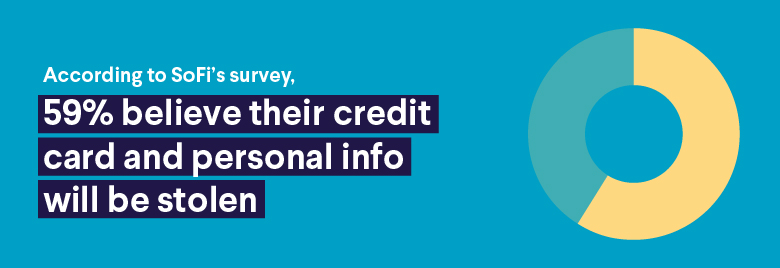
You aren’t alone. According to SoFi’s survey, 59% of people believe their credit card information or personally identifiable information will be stolen at some point, if it hasn’t been already.

That means the majority of people who participated in our survey expect to be hacked or already have been. When you consider how the number of data breaches is rising, it makes sense. Cybercrime is projected to almost triple between 2022 and 2027. No wonder we’re worried!

Less Than Half of Respondents Say They Know How to Outsmart Hackers

Frankly, most of us don’t have a clue as to what is really involved when you fall victim to cyber crime. Less than half of respondents in SoFi’s study believe they understand the risks of credit card fraud and different types of identity theft very well. In fact, only 45% of respondents said they understand very well how to protect themselves from online crime.

Most Respondents Are Working Hard to Defend Their Data and Assets

No one wants their most personal info kicking around on the dark web. Nor does anyone relish checking their credit card bill and seeing that someone charged $600 worth of baby clothes to their account when they are most definitely not a parent.
Most popular online security measures

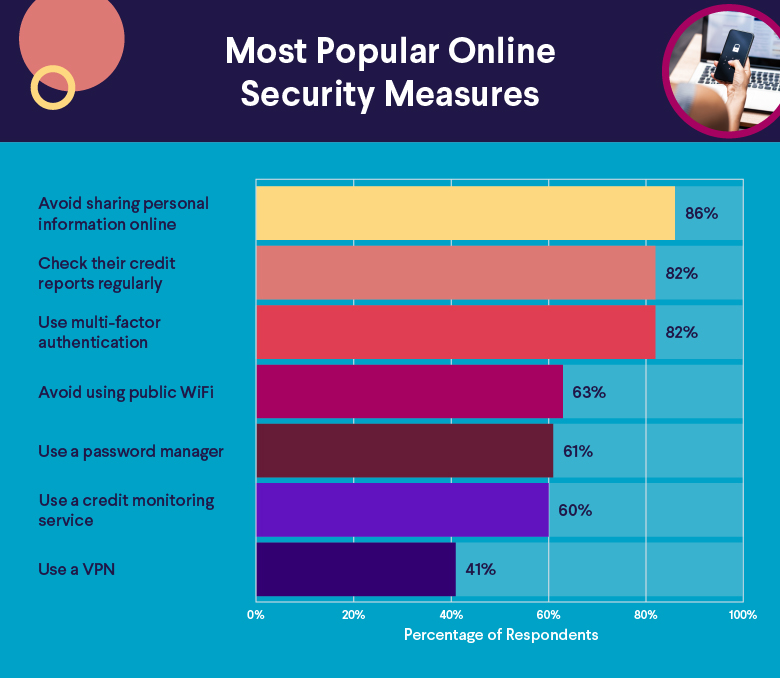
Here’s what SoFi’s research found about how people are playing defense. Check out how many people use these protective tactics to avoid becoming an identity theft or credit card fraud statistic:

•   82% of people check their credit reports regularly.

•   82% use multi-factor authentication, or MFA. (A good sign: Only 3% of people don’t have a clue what MFA is.)

•   63% avoid using public WiFi.

•   41% use a VPN, or virtual private network. That said, 8% don’t know what a VPN is.

•   61% use a password manager.

•   86% avoid sharing personal information online.

•   60% use a credit monitoring service.

More of Us Should Be Monitoring Our Credit

That last move, using a credit monitoring service, is an important one. It can make mobile banking safer and help protect other aspects of a person’s digital life.
Steve Tcherchian quote

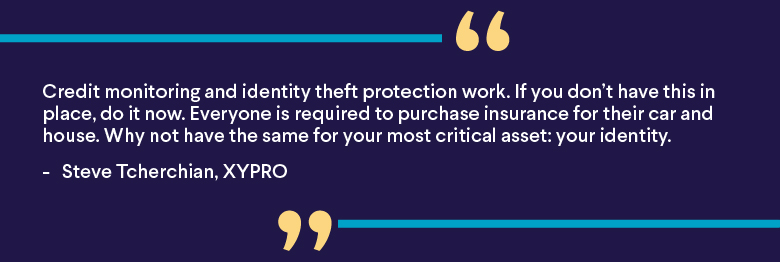
“Credit monitoring and identity theft protection work. If you don’t have this in place, do it now. With the size of the last few mega breaches and the companies they have affected, assume your data is exposed and you’re at risk. Everyone is required to purchase insurance for their car and house. Why not have the same for your most critical asset: your identity?” —Steve Tcherchian, CISO and Chief Product Officer at XYPRO, a cybersecurity solutions company

In addition to using the tactics above, the SoFi survey respondents have also deployed these moves to protect themselves from credit card fraud and other cybercrimes:

•   Using strong passwords

•   Clearing browser cookies and cache frequently

•   Not sharing their location in browsers or apps

•   Checking their account activity frequently

Most people (90%) check their credit card statements at least once per month. 44% of people check their statements at least once a week.

More Than Half of Respondents Admit to Recycling Passwords

Most people have good intentions when it comes to protecting themselves from the bad guys trying to swipe their financial or personal data. But hello, we’re all human. And that can mean sometimes recycling passwords because it’s just too complicated to come up with a new one. Or logging onto WiFi at a cafe or in a hotel because those Taylor Swift tickets are about to go on sale and you cannot, cannot live without them.
Risky online behaviors

More Than 1/3 of Respondents Use Public WiFi Without a VPN

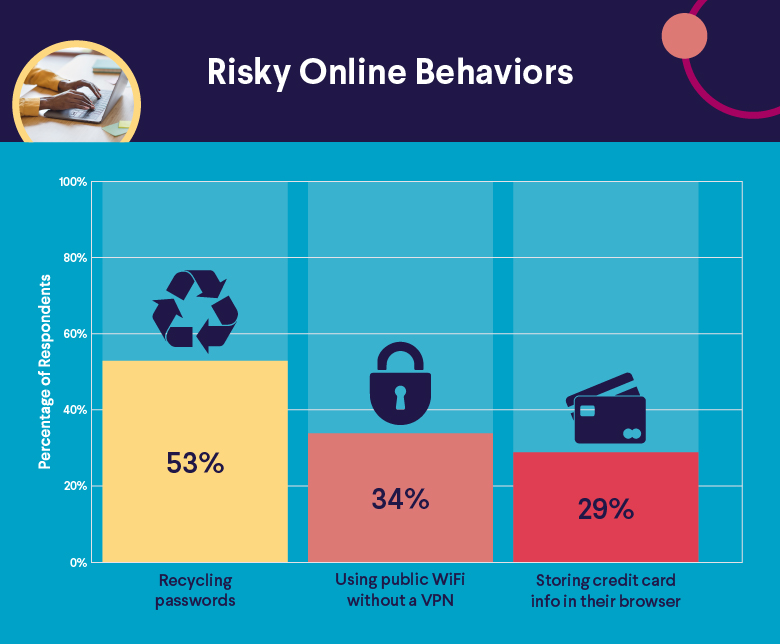
Here, the SoFi survey respondents admit to risky online behavior:

•   53% have used the same passwords for multiple accounts.

•   34% have used public WiFi without a VPN.

•   29% have stored credit card information in their browser.

•   27% have provided credit card info over the phone.

•   26% have stored confidential information on a cloud server, such as Google Drive or Dropbox.

•   20% have shared credit card information with others (either in person or not secured online).

•   18% have downloaded software from unsecure websites.

•   13% have left their phone or computer unattended in a public space.

•   11% have responded to emails from unknown senders that asked for personal information.

“When logging onto public WiFi that doesn’t require a password for access, know that hackers can track your internet activity and intercept passwords and other sensitive data that is exchanged. If you must use an unprotected public WiFi network, avoid entering your social media, email, or bank credentials while connected.” —Brandon King, founder of Home Security Heroes, an identity-security advisory service

Not everyone realizes the very real risks of playing fast and loose with their personal data. More warnings about the consequences of getting hacked or scammed could be a huge help.

“Education and awareness campaigns need to be implemented at all levels, including schools, workplaces, and public forums. Financial institutions can play a significant role in providing customer education on safeguarding personal information. And social media platforms can spread awareness and provide tips on preventing fraud and identity theft.” —Andrew Lokenauth, founder of Fluent in Finance, a financial education platform

With the right information, many people might avoid becoming an identity theft statistic.

14% of Respondents Are Using Their Birthday or Their Pet’s Name as Their Password

You don’t need to confess, but many people are guilty of using shockingly simple passwords. One like your first name plus the digits of your birthday. Or your phone number. Or even the dreaded password1234.

And, making matters even worse, lots of busy people reuse their passwords with abandon. It’s easy to understand why: You might be prompted to create an account when shopping online so you can unlock a discount or free shipping, so you fall back on your old favorite. Or perhaps you need to create a password to access info on your vet’s website, so of course your doggo’s name is an easy to remember password, right?

Dumb password moves

Whatever the reason, there’s no doubt that there are plenty of people who aren’t following password security best practices. Here are some of the missteps the SoFi survey revealed:

•   14% use passwords that include their pets’ names or birthdays

•   13% use passwords that include their childrens’ names or birthdays

•   11% use passwords that include their significant other’s name or birthday

•   10% use use passwords that relate to a band or song they like

•   7% use something easy to remember like “12345” or “password”

•   7% use something easy to type like “QWERTY”

On the flip side, 16% use auto-generated, secure passwords provided by a password manager. High-five to those folks!

No More Lame Passwords: Pro Advice
Brandon King quote

Some advice from experts on this super-important subject:

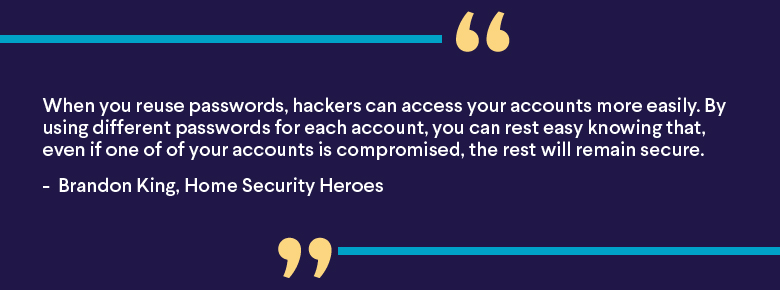
•   Buckle down and “use different passwords for each login or account. If you reuse passwords, hackers can access your accounts more easily” in the event of a security breach. “By using separate passwords for each account, you can rest easy knowing that even if one of your accounts is compromised, the rest will remain secure.” —Brandon King, Home Security Heroes

•   “Keep a close eye on credit card balances, and immediately report any discrepancies to the bank or credit card company” to minimize your liability. —Andrew Lokenauth, Fluent in Finance

•   “Don’t write down passwords!” —Monica Eaton, founder of Chargebacks911, a chargeback management company

And need we mention that writing your PIN on the back of your debit card is a real no-no?
44% experienced fraudulent

44% of Respondents Have Had Bogus Credit Card Charges

Sometimes, you get lucky, and your bank or credit card company pings you asking whether that’s really you trying to pay for a lavish dinner in SoHo, NYC, when you are actually sitting on your couch in Santa Cruz. Fraud protection can be a wonderful thing, but it doesn’t catch every scammer. Learn more about threats to credit card security:

Older Respondents Are More Than 2x As Likely to Endure Credit-Card Fraud

Here’s what SoFi survey participants told us about experiencing examples of credit card fraud in the form of unauthorized charges:

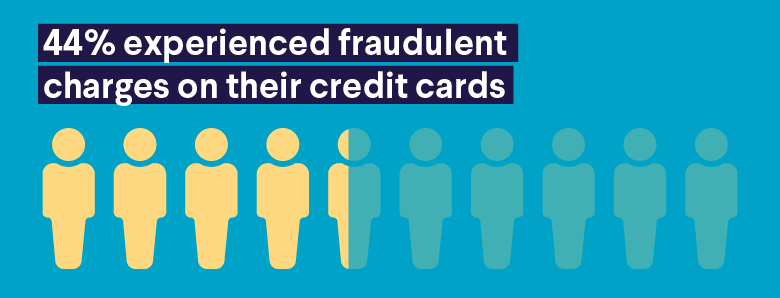
•   44% of people have experienced fraudulent charges on their credit cards.

◦   Nearly two-thirds of this group (63%) have experienced fraudulent charges more than once.

◦   For most people (84%), the unauthorized charges were less than $500.

◦   6% of people said their most recent fraudulent charge was $1,000 or more.

•   4% of respondents have experienced fraudulent charges five or more times.

•   53% of respondents ages 55 and older have experienced fraudulent charges on their credit cards, showing that older age seems to correlate with being scammed more often.

◦   Perhaps that’s why confidence in one’s credit card security seems to wane with age: 26% of those aged 55 or older said they had been or expected to be hacked, versus 10% of those aged 18 to 24.

•   Almost three-quarters (74%) of those who experienced fraudulent charges said their credit card company notified them of suspicious activity.

Who Knew? Where Scammers Shop

Curious about where credit card scammers go shopping? People who experienced fraudulent charges and knew where their stolen credit card numbers were used said the purchases were made in these types of environments:

•   Big box retailers and grocery stores like Walmart, Target, Sam’s Club, Costco, Whole

•   Foods

•   Online retailers like Amazon and eBay

•   Smaller ecommerce sites

•   Gas stations and convenience stores
Monica Eaton quote

How can you better protect yourself?

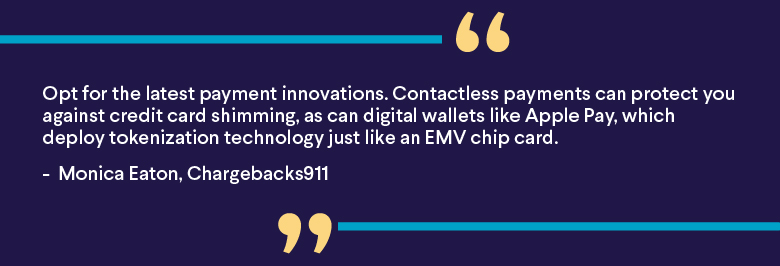
“Opt for the latest payment innovations. Contactless payments, for example, can protect you against credit card ‘shimming’ [in which scammers insert a thin device into the slot of card readers to steal your data], as can digital wallets like Apple Pay, which deploy tokenization technology just like an EMV [which stands for Europay, Mastercard, and Visa] chip card does.” —Monica Eaton, Chargebacks911

Ouch: 15% of Respondents Have Been Victims of Identity Theft

It’s a scary fact that identity theft is on the rise. It can be deeply upsetting to have someone steal your personal information and credentials and use them for nefarious purposes, opening accounts and making purchases that you would never dream of. It can be similarly troubling to have to unravel the damage done and reclaim what is rightfully yours.

34% of Victims Lost Money Due to Identity Theft
Personal impact of identity theft

Unfortunately, the SoFi survey revealed the following identify theft statistics:

•   15% of respondents have been victims of identity theft.

•   Most often, this group found out about identity theft because they noticed fraudulent charges on their bank statements (21%).

•   Other common ways people found out:

◦   12% said they were getting suspicious emails, calls, and text messages.

◦   12% said their tax return was incorrect or filed by someone else.

◦   12% said there were inaccuracies on their credit report.

◦   10% said they were unexpectedly denied credit.

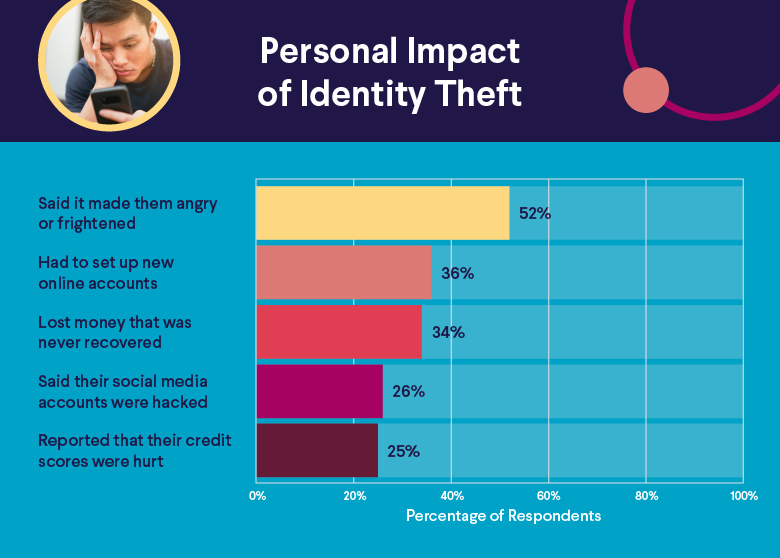
•   The most common impacts that people described as a result of identity theft were:

◦   52% said it made them angry or frightened.

◦   36% had to set up new online accounts.

◦   34% lost money that was never recovered.

◦   26% said their social media accounts were hacked.

◦   25% reported that their credit scores were hurt.

•   More than half of all respondents (51%) said they know someone who has been a victim of identity theft.

Those who are concerned about the possibility of identity theft can subscribe to services designed to help protect one’s information and send alerts about any evidence of this kind of activity. It can help provide peace of mind as this kind of crime increases.

92% of Respondents Are Confident Companies Can Protect Their Data

Learning about all the risks of credit card and identity theft out there can be troubling and make a person feel as if they have a big bullseye on their back, tempting hackers to target them.

But of course, that’s not the case. Steps are being taken to protect consumers from identity and money scams and new techniques are emerging. Most people recognize that it’s not all doom and gloom out there.
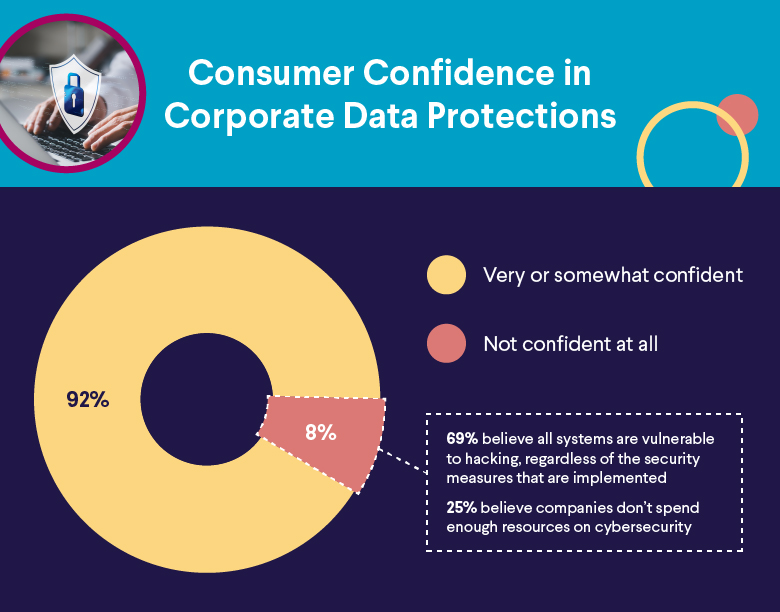
Consumer confidence in corporate data protections

In general, people are cautiously optimistic about how well their information is and can be safeguarded.

•   92% of people are somewhat confident or very confident in companies’ abilities to protect their personal information.

•   8% of respondents said they’re not confident at all in companies’ abilities to protect their information

◦   However, people realize there is only so much that can be done to protect information. 69% of this group believe all systems are vulnerable to hacking, regardless of the security measures that are implemented.

◦   On the flip side, 25% of this group believe companies don’t spend enough resources on cybersecurity.

Yes, we all may be at risk, but by adopting smart strategies and partnering with top-notch, security-focused financial institutions and other businesses, we can minimize the odds of falling prey to cybercriminals.

The Takeaway

As SoFi’s survey reveals, credit card fraud and identity theft are growing concerns for Americans. But there are proven and emerging ways to stay ahead of the scammers. By doubling down on smart tactics and taking steps to safeguard your personal information, you can protect yourself from serious damage.

To learn more about options for protecting your credit cards and tips for managing your accounts, explore our credit card guide.


Third-Party Brand Mentions: No brands, products, or companies mentioned are affiliated with SoFi, nor do they endorse or sponsor this article. Third-party trademarks referenced herein are property of their respective owners.

Financial Tips & Strategies: The tips provided on this website are of a general nature and do not take into account your specific objectives, financial situation, and needs. You should always consider their appropriateness given your own circumstances.

Read more
Cost of Christmas Lights on Utility Bills

How Much Christmas Lights Cost to Run for a Month

Many people love showing their holiday spirit with Christmas lights, whether just a strand of twinkle lights around a window or going all-out like the Griswolds.

While these lights are festive, it’s worth noting that they aren’t free. In fact, the cost of running holiday lights rose 13% last year, costing the average household $15.48 vs. $13.41 the prior year.

In this economy, every dollar can count, so if you want to learn how much it costs to run Christmas lights for a month and how to reduce that expense, read on.

Here, you’ll learn more about:

•   How much do Christmas lights cost to run?

•   How much does it cost to run Christmas lights for a month?

•   How can you save money on your holiday light electric bill?

Factors Affecting the Cost of Running Christmas Lights

Running Christmas lights uses energy, which can translate to higher utility bills. How much of an increase you see in your electric bill can depend on a number of factors, including:

•   How many strands of lights you use

•   The type of bulbs used in each strand

•   The number of hours you run your lights each day

•   How many days you run Christmas lights for

•   Where you live and what you pay per kilowatt hour for electricity.

All of these things can influence how large your Christmas lights electric bill turns out be once January rolls around. Understanding what you could wind up paying can help if affordably celebrating the holidays is your goal.

Keep in mind that other costs can drive up electric bills during the holidays, apart from Christmas lights. If you’re using the oven more often to prepare holiday meals, for example, that can result in a higher electric bill. You may also see a bigger bill if colder weather means the heat is kicking on more often or your kids are home all day using electronics more while school is out. Lowering your energy bill may require a multifaceted approach.

💡 Quick Tip: Tired of paying pointless bank fees? When you open a bank account online you often avoid excess charges.

How Much Electricity Do Christmas Lights Use?

The amount of energy used by Christmas lights can depend on the type of bulb and the number of bulbs per strand. The most popular options for Christmas lights include incandescent mini lights, mini LED lights, and ceramic C7 lights.

So which type of bulb uses the most energy?

The simplest answer is to look at the wattage of Christmas lights, based on bulb size and number of bulbs per strand. For example:

•   With C7 lights, for instance, you’re typically getting 25 lights per strand.

•   With mini LED lights, you’ll normally have 50 bulbs for a 14-foot strand and 100 bulbs per 32-foot strand.

•   With mini icicle lights, you often have 300 bulbs for a 26-foot strand.

Here’s how the average wattage for each one compares, though note that incandescent bulbs stopped being manufactured and sold in August 2023 (some people may still own and use strands of these, however):

•   C7 lights: 5 watts

•   C9 incandescent lights (2-¼” long): 7 watts

•   Mini incandescent lights: 0.4 watts

•   Mini LED lights: 0.07 watts

Between those three options, mini LED lights draw the least amount of energy per strand while C7 lights draw the most.

LEDs possibly lowering energy costs by up to 90% vs. the other options. Switching to LEDs could be a way to save money daily during the holidays.

Also note that you’d need four strands of C7 lights to equal the same number of bulbs in just one strand of incandescent or LED mini lights. This is important to understand because it can affect the number of kilowatt hours used and your overall energy costs.

Recommended: 23 Tips on Saving Money Daily

Cost of Running Christmas Lights

So how much do Christmas lights cost to run for a month? Or longer? Calculating your estimated cost of running Christmas lights matters when trying to lower your electric bill during the winter months. Again, what you’ll pay can depend on a variety of factors, including where you live and how much electricity costs.

The average household pays $0.17 cents per kilowatt hour for electricity, according to the U.S. Department of Energy, but prices may be significantly higher or lower in different parts of the country due to cost of living differences.

If you live in Connecticut, for example, you might pay an average of $0.21 cents per kilowatt hour. People living in Florida, however, might pay an average of $0.11 cents per kilowatt hour. Residents of Hawaii typically pay the most, currently spending $0.32 cents per kilowatt hour.

Here’s how to figure out how much you’ll pay for Christmas lighting:

•   Multiply the wattage of the lights by the hours per day the lights will be on, then divide by 1,000 to find kilowatt hours per day

•   Multiply kilowatt hours per day by your cost of electric usage to get the cost per day

•   Multiply the cost per day by the number of days your lights will be on

Calculating the Cost of Christmas Lights

Now, for how much does it cost to run Christmas lights? Here’s a look at what it would cost to run C7 lights, C9, and mini incandescent lights, and mini LED lights for six hours a day for 30 days, using a price of $0.14 cents per kilowatt hour. Here’s what you’d pay for each one:

Bulb Type

Hourly Cost

Daily Cost

Monthly Cost

C7 (25 bulbs, 5 watts per bulb) $0.0175 $0.105 $3.15
C9 (25 bulbs, 7 watts per bulb) $0.025 $0.15 $4.50
Incandescent Mini Lights (100 bulbs, 0.45 watts per bulb) $0.0063 $0.0378 $1.13
Mini LED Lights (100 bulbs, 0.07 watts per bulb) $0.0042 $0.0252 $0.76

Keep in mind that these costs are for just one strand of lights, as noted. If you string together several strands on your tree, frame your windows with lights, and then drape your shrubs or street-facing windows outdoors with more, your costs will of course go up.

Also, in terms of what the average person spends on Christmas lights, it can vary by a state’s cost of living, as well as by what kind of bulbs are used. Louisiana residents who run LED lights, for example, would likely spend the least, since they are paying just over nine cents per kilowatt hour (currently the lowest rate in the US) and they would be using energy-saving bulbs. Meanwhile, Hawaiians who opt for incandescent bulbs would probably spend the most, since their bulbs use a considerable amount of power and they currently pay the highest national rate for energy of almost 33 cents per kilowatt hour.

💡 Quick Tip: Most savings accounts only earn a fraction of a percentage in interest. Not at SoFi. Our high-yield savings account can help you make meaningful progress towards your financial goals.

Tips to Save on Your Christmas Lighting Bill

If you’re looking for ways to lower your energy bill when you start plugging in your holiday lights, follow this advice.

Embracing Energy-Efficient LEDs

As mentioned, the wattage of Christmas lights plays an important part in determining how much you pay for electric bills over the holidays. Between C7 lights, incandescent lights and LED lights, LED lights are highly energy-efficient. According to the Department of Energy, residential LEDs that are ENERGY STAR rated use up to 75% less energy and last 25 times longer than incandescent lights.

People who use LED Christmas lights tend to pay far less than those using incandescent bulbs or C7 lights. So it follows that an easy way to save money on your electric bill and reduce energy usage would be to use mini LED lights as often as possible. Aside from that, LED bulbs emit less light and are less likely to overload sockets, making them a potentially safer option for Christmas lighting compared to other types of bulbs.

So if you still have some incandescent bulbs in your box of Christmas decorations, you may want to think about swapping them out for LEDs. (You won’t find incandescents made or sold in the US anymore either.)

Benefits of Solar-Powered Outdoor Lights

You might consider using solar-powered outdoor lights on your house over the holidays. These strands depend upon energy collected by small panels that gather and hold energy from the sun during the day.

These strands don’t plug in and draw no electrical power. So they can be especially easy and economical to use over the holidays.

Battery-Operated Lights for Smaller Displays

If you like to create smaller displays, you might consider battery-powered strands of lights. There is a wide range of how long these lights will stay illuminated, but this can be a good unplugged option to try for small-scale displays. While you do have to pay for the batteries, it can be cheaper than plugging in lights for weeks on end.

Recommended: 18 Common Misconceptions About Money

The Takeaway

A higher-than-usual electric bill can put a damper on your holiday celebrations. Estimating your potential costs beforehand can help you manage utility expenses. And you can decide whether it’s worth it to invest a little money in upgrading your current Christmas lights to energy-efficient options.

Having the right banking partner, such as one with budgeting tools, can also help make tackling high utility bills after the holidays easier.

Interested in opening an online bank account? When you sign up for a SoFi Checking and Savings account with eligible direct deposit, you’ll get a competitive annual percentage yield (APY), pay zero account fees, and enjoy an array of rewards, such as access to the Allpoint Network of 55,000+ fee-free ATMs globally. Qualifying accounts can even access their paycheck up to two days early.


Better banking is here with SoFi, NerdWallet’s 2024 winner for Best Checking Account Overall.* Enjoy 3.30% APY on SoFi Checking and Savings with eligible direct deposit.

FAQ

Do LED Christmas lights use a lot of electricity?

Compared to C7 lights or incandescent mini lights, LED Christmas lights use the least amount of energy. Specifically, they can use up to 90% less energy while lasting longer. LED Christmas lights also emit less heat and can be easier to install than other types of holiday lighting.

Do Christmas lights raise your light bill?

Holiday lights can raise your electric bill during the winter months. How much it costs to run Christmas lights can depend on several things, including the type of bulbs used, how many light strands you’re running, how long you turn the lights on for, and the average cost of energy per kilowatt hour in your area. Using timers and switching to energy-efficient bulbs can be helpful for reducing your Christmas lights electric bill.

Do Christmas trees use a lot of electricity?

Christmas trees can use a lot of electricity, depending on the type of lights you use, the number of strands on the tree, and how long you leave your tree plugged in each day. Using mini LED lights can reduce electric costs for Christmas tree lighting, while using C7 bulbs to light your tree could result in a higher energy bill.


Photo credit: iStock/BanksPhotos

SoFi Checking and Savings is offered through SoFi Bank, N.A. Member FDIC. The SoFi® Bank Debit Mastercard® is issued by SoFi Bank, N.A., pursuant to license by Mastercard International Incorporated and can be used everywhere Mastercard is accepted. Mastercard is a registered trademark, and the circles design is a trademark of Mastercard International Incorporated.

Annual percentage yield (APY) is variable and subject to change at any time. Rates are current as of 12/23/25. There is no minimum balance requirement. Fees may reduce earnings. Additional rates and information can be found at https://www.sofi.com/legal/banking-rate-sheet

Eligible Direct Deposit means a recurring deposit of regular income to an account holder’s SoFi Checking or Savings account, including payroll, pension, or government benefit payments (e.g., Social Security), made by the account holder’s employer, payroll or benefits provider or government agency (“Eligible Direct Deposit”) via the Automated Clearing House (“ACH”) Network every 31 calendar days.

Although we do our best to recognize all Eligible Direct Deposits, a small number of employers, payroll providers, benefits providers, or government agencies do not designate payments as direct deposit. To ensure you're earning the APY for account holders with Eligible Direct Deposit, we encourage you to check your APY Details page the day after your Eligible Direct Deposit posts to your SoFi account. If your APY is not showing as the APY for account holders with Eligible Direct Deposit, contact us at 855-456-7634 with the details of your Eligible Direct Deposit. As long as SoFi Bank can validate those details, you will start earning the APY for account holders with Eligible Direct Deposit from the date you contact SoFi for the next 31 calendar days. You will also be eligible for the APY for account holders with Eligible Direct Deposit on future Eligible Direct Deposits, as long as SoFi Bank can validate them.

Deposits that are not from an employer, payroll, or benefits provider or government agency, including but not limited to check deposits, peer-to-peer transfers (e.g., transfers from PayPal, Venmo, Wise, etc.), merchant transactions (e.g., transactions from PayPal, Stripe, Square, etc.), and bank ACH funds transfers and wire transfers from external accounts, or are non-recurring in nature (e.g., IRS tax refunds), do not constitute Eligible Direct Deposit activity. There is no minimum Eligible Direct Deposit amount required to qualify for the stated interest rate. SoFi Bank shall, in its sole discretion, assess each account holder's Eligible Direct Deposit activity to determine the applicability of rates and may request additional documentation for verification of eligibility.

See additional details at https://www.sofi.com/legal/banking-rate-sheet.

Financial Tips & Strategies: The tips provided on this website are of a general nature and do not take into account your specific objectives, financial situation, and needs. You should always consider their appropriateness given your own circumstances.

SOBK1023001

Read more
financial report investment

What Is Yield?

Yield is the income generated by an investment over a period of time. Yield is typically calculated by taking the dividend, coupon or net income earned, dividing the figures by the value of the investment, then calculating the result as a percentage.

Yield is not the same as return or the rate of return. Yield is a way to track how much income was earned over a set period, relative to the initial cost of the investment or the market value of the asset. Return is the total loss or gain on an investment. Returns often include money made from dividends and interest. While all investments have some kind of rate of return, not all investments have a yield, because not all investments produce interest or dividends.

How Do You Calculate Yield?

Yield is typically calculated annually, but it can also be calculated quarterly or monthly.

Yield is calculated as the net realized income divided by the principal invested amount. Another way to think about yield is as the investment’s annual payments divided by the cost of that investment.

Here are formulas depending on the asset:

= Dividends Per Share/Share Price X 100%
= Coupon/Bond Price X 100%
= Net Income From Rent/Real Estate Value X 100%

For example, if a $100 stock pays out a $2 dividend for the year, then the yield for that year is 2 ÷ 100 X 100%, or a 2% yield.

Cost Yield vs. Current Yield

One important thing to think about when doing yield calculations is whether you’re looking at the original price of the stock or the current market price. (That can also be referred to as the current market value or face value.)

For example, in the above example, you have a $100 stock that pays a $2 dividend. If you divide that by the original purchase price, then you have a 2% yield. This is also known as the cost yield, because it’s based on the cost of the original investment.

However, if that $100 stock has gone up in price to $120, but still pays a $2 dividend, then if someone bought the stock right now at $120, it would be a 1.67% yield, because it’s based on the current price of the stock. That’s also known as the current yield.

Rate of Return vs. Yield

Calculating rate of return, by comparison, is done differently. Yield is simply a portion of the total return.

For example, if that same $100 stock has risen in market price to $120, then the return includes the change in stock price and the paid out dividend: [(120-100) + 2] ÷ 100, so 0.22, or a 22% total return.

The reason this matters is because the rate of return can change if the stock price changes, but often the yield on an investment is established in advance and generally doesn’t fluctuate too much.

Definition of Yield for Different Investments

Yield in Stock Investing

When you make money on stocks it often comes in two forms: as a dividend or as an increase in the stock price. If a stock pays out a dividend in cash to stockholders, the annual amount of those payments can be expressed as a percentage of the value of the security. This is the yield.

Many stocks actually pay out dividends quarterly. In order to calculate the annual yield, simply add up all the dividends paid out for the year and then do the calculation. If a stock doesn’t pay a dividend, then it doesn’t have a dividend yield.

Note that real estate investment trusts (REITs) are required to pay out 90% of their taxable income to existing shareholders in order to maintain their status as a pass-through entity. That means the yield on REITs is typically higher than for other stocks, which is one of the pros for REIT investing.

Sometimes investors also calculate a stock’s earnings yield, which is the earnings over a year, dividend by the share price. It’s one method an investor may use to try to value a stock.

Yield in Bond Investing

When it comes to bonds vs. stocks, the yield on a bond is the interest paid—which is typically stated on the bond itself. Bond interest payments are usually determined at the beginning of the bond’s life and remain constant until that bond matures.

However, if you buy a bond on the secondary market, then the yield might be different than the stated interest rate because the price you paid for the bond was different from the original price.

For bonds, yield is calculated by dividing the yearly interest payments by the payment value of the bond. For example, a $1,000 bond that pays $50 interest has a yield of 5%. This is the nominal yield. Yield to maturity calculates the average return for the bond if you hold it until it matures based on your purchase price.

Some bonds have variable interest rates, which means the yield might change over the bond’s life. Often variable interest rates are based on the set U.S. Treasury yield.

Is There a Market Yield?

Treasury yields are the yields on U.S. Treasury bonds and notes. When there is a lot of demand for bonds, prices generally rise, which causes yields to go down.

The Department of the Treasury sets a fixed face value for the bond and determines the interest rate it will pay on that bond. The bonds are then sold at auction. If there’s a lot of demand, then the bonds will sell for above face value also known as a premium.

That lowers the yield on the bond, since the government only pays back the face value plus the stated interest. (If there’s lower demand, then the bonds may sell for below face value, which increases the yield.)

When Treasury yields rise, interest rates on business and personal loans generally rise too. That’s because investors know they can make a set yield on government issued products, so other investment products have to offer a better return in order to be competitive. This affects the market in that it affects the rates on mortgages, loans, and in turn, market growth.

There isn’t a set market yield, since the yield on each stock and bond varies. But there is a yield curve that investors track, which is a good reference. The yield curve plots Treasury yields across maturities—i.e., how long it takes for a bond to mature. Typically, the curve plots upward, since it takes more of a yield to convince an investor to hold a bond for a longer amount of time.

An inverted yield curve can be a sign of an oncoming recession and can cause concern among investors. While you don’t necessarily need to track 10-year Treasury yields or worry about the yield curve, it is good to know what the general yield meaning is for investors so you can stay informed about your investments.


💡 Quick Tip: Before opening any investment account, consider what level of risk you are comfortable with. If you’re not sure, start with more conservative investments, and then adjust your portfolio as you learn more.

The Takeaway

A high yield means more cash flow and a higher income. But a yield that is too high isn’t necessarily a good thing. It could mean the market value of the investment is going down or that dividends being paid out are too high for the company’s earnings.

Of course, yield isn’t the only thing you’re probably looking for in your investments. Even when investing in the stock market, you may want to consider other aspects of the stocks you’re choosing: the history of the company’s growth and dividends paid out, potential for future growth or profit, the ratio of profit to dividend paid out. You may also want a diversified portfolio made up of different kinds of assets to balance return and risk.

Invest in what matters most to you with SoFi Active Invest. In a self-directed account provided by SoFi Securities, you can trade stocks, exchange-traded funds (ETFs), mutual funds, alternative funds, options, and more — all while paying $0 commission on every trade. Other fees may apply. Whether you want to trade after-hours or manage your portfolio using real-time stock insights and analyst ratings, you can invest your way in SoFi's easy-to-use mobile app.

Opening and funding an Active Invest account gives you the opportunity to get up to $1,000 in the stock of your choice.¹


INVESTMENTS ARE NOT FDIC INSURED • ARE NOT BANK GUARANTEED • MAY LOSE VALUE

SoFi Invest is a trade name used by SoFi Wealth LLC and SoFi Securities LLC offering investment products and services. Robo investing and advisory services are provided by SoFi Wealth LLC, an SEC-registered investment adviser. Brokerage and self-directed investing products offered through SoFi Securities LLC, Member FINRA/SIPC.

For disclosures on SoFi Invest platforms visit SoFi.com/legal. For a full listing of the fees associated with Sofi Invest please view our fee schedule.

Financial Tips & Strategies: The tips provided on this website are of a general nature and do not take into account your specific objectives, financial situation, and needs. You should always consider their appropriateness given your own circumstances.



¹Probability of Member receiving $1,000 is a probability of 0.026%; If you don’t make a selection in 45 days, you’ll no longer qualify for the promo. Customer must fund their account with a minimum of $50.00 to qualify. Probability percentage is subject to decrease. See full terms and conditions.

SOIN0723027

Read more
piggy bank with books

Can You Pay Off Student Loans with Your 401(k)?

If you’re one of the 44 million Americans who currently hold a portion of the country’s more than $1.7 trillion student debt—and are perhaps now back to making payments after a three-year pause—chances are you’re looking for solutions to get rid of that debt ASAP. After all, the average student who borrowed money to pay for school graduates with just over $37,000 in federal student loan debt alone.

Paying off that much debt is an impressive feat which takes discipline and commitment. If you’re currently living under the heavy weight of your student loans, you may have considered using your 401(k) for student loans. But should you really cash out your 401(k) for student loans?

It probably goes without saying that figuring out how you’re going to pay off your student loans is overwhelming—and there isn’t one definitive solution. And while it’s certainly tempting to just take the cash from your 401(k) and pay off a high-interest loan, there are some serious drawbacks to consider before running with that plan.

Key Points

•   Using a 401(k) to pay off student loans can eliminate debt quickly but has significant drawbacks, including penalties and lost investment growth.

•   Early withdrawal from a 401(k) before age 59½ incurs a 10% penalty and is subject to income tax.

•   Alternatives like income-driven repayment plans or loan forgiveness programs offer safer ways to manage student loan debt without risking retirement savings.

•   Refinancing student loans might lower interest rates and monthly payments, providing a financial breather without tapping into retirement funds.

•   Borrowing from a 401(k) or taking a hardship withdrawal are options, but they compromise future financial stability and retirement planning.

The Downsides of Using Your 401(k) to Pay Off Your Student Loans

A potential benefit of using your 401(k) to pay off student loans is that you can eliminate your debt in one fell swoop. However, withdrawing money from your 401(k) should be considered a last resort option—or maybe not an option at all. That’s because there are several major downsides to doing so:

•   Early withdrawal penalty: If you’re under the age of 59½, you’ll generally have to pay a 10% early withdrawal penalty on the amount you take out. The amount you withdraw will also be considered taxable income, which means you could owe a hefty tax bill for that year.

•   Opportunity cost: By using your 401(k) money to pay off student loans, you are potentially losing out on an overall higher return from your investments. For example, if your loan has an interest rate of 6% and your 401(k) returns an average of 8% per year, you essentially lose 2% a year by liquidating those funds to pay off your loans.

•   Difficulty catching up: With your stunted 401(k) balance, you’ll need to make much larger contributions going forward to make up for it, which could strain your budget. Plus, there is a cap on the total amount you can contribute to a 401(k) each year. You may never be able to fully make up for the growth you would have experienced if that money stayed invested.

When deciding whether or not to withdraw money from your retirement savings, it’s important to note that while you borrow loans for other expenses in life, there’s no such thing as a “retirement loan.” You’re responsible for ensuring you have enough money to live on in retirement.

While it can feel like student loans are preventing you from living your life or meeting your financial goals today, saving for retirement can be a valuable investment in your future.


💡 Quick Tip: Get flexible terms and competitive rates when you refinance your student loan with SoFi.

Alternatives to Help Control Your Student Loan Debt

If you’re struggling with student loan payments, there are alternatives to taking money out of your 401(k) that can help you get your student loan debt under control while keeping your retirement savings intact. Here are a few examples:

Applying for Income-Driven Repayment

One option is applying for an income-driven repayment (IDR) plan. These plans reduce your payments to a small percentage of your discretionary income. The term length also gets extended out to 20 or 25 years, depending on the specific program. At the end of the repayment term, any remaining debt is forgiven. The exception is the newest plan, Saving on a Valuable Education (SAVE), which awards forgiveness for some borrowers with smaller balances within as few as 10 years.

Keep in mind that extending your repayment term usually means paying more in interest over the life of the loan. Any canceled IDR debt may also be taxed as income. Still, if your payments are far too high to afford on the Standard Repayment Plan, income-driven repayment could provide much-needed relief. In fact, if your income is below a certain threshold, you could qualify for $0 payments.

Pursuing Loan Forgiveness

There are also many programs that forgive student loans after you’ve worked in a qualifying profession and made a certain number of payments. On the national level, Public Service Loan Forgiveness (PSLF) is one example. If you work for a qualifying employer in the public service sector, such as the government or a non-profit, you can have your loans forgiven after 120 payments. Other similar programs include Teacher Loan Forgiveness and National Defense Student Loan Discharge.

In addition to federal forgiveness programs, there are also hundreds of programs offered through states, schools, and other organizations.

Refinancing Your Student Loans

When you refinance your student loans, you take out a brand new loan from a private lender, who will review your credit history and other financial factors to determine how much they will lend to you and at what rate. You then use those funds to pay off your existing loan(s).

With a solid financial picture and credit history, you could qualify for a lower interest rate. This could result in lower monthly payments, as well as reducing the amount of money you spend in interest over the life of the loan (depending on the loan term, of course).

You could also lower your monthly payments by extending the length of the loan term. This results in paying more money in interest over the life of the loan, but could help free up some cash flow more immediately.

It’s important to note that refinancing federal student loans with a private lender means you’ll permanently lose access to federal loan benefits including income-driven repayment plans, forbearance, and deferment.

To help you decide if refinancing is a good idea, take a look at SoFi’s student loan payoff calculator to see when you might pay off your current loans. Then compare that with a potential new loan—you may be surprised at how much of a difference refinancing can make. And with more wiggle room in your budget, you could make headway toward student loan repayment and save for a retirement you’ll be able to enjoy.

Take control of your student loans.
Ditch student loan debt for good.


💡 Quick Tip: When refinancing a student loan, you may shorten or extend the loan term. Shortening your loan term may result in higher monthly payments but significantly less total interest paid. A longer loan term typically results in lower monthly payments but more total interest paid.

Options for Using Your 401(k) to Pay Off Debt

If you decide to pursue using 401(k) funds to pay off student loans despite the many risks and drawbacks, there are a few ways to go about it. First, you’ll need to determine how much you are eligible to withdraw from your 401(k), and what penalties and taxes you would encounter. In most cases, you would be responsible for a 10% penalty and regular income taxes on a withdrawal from your 401(k) prior to age 59 ½.

There are a few exceptions to this rule. For instance, if you were laid off, you may be able to withdraw money penalty-free as long as certain requirements are met.

And depending on the exact terms of your 401(k) plan, you may be able to withdraw the money from your plan without penalty in certain hardship situations—like to cover tuition or medical expenses.

If you already attended college and are trying to use your 401(k) to pay back student loans, that doesn’t qualify for a hardship withdrawal. If you’re not sure what the exact rules of your plan entail, it’s worth contacting your HR representative or the financial firm that handles your company’s 401(k) program.

Again, using money from your 401(k) to pay off debt can be a risky proposition. While on the bright side it would potentially allow you to eliminate your student debt, it also puts your retirement savings at risk. You’ll not only potentially have to pay a penalty and taxes on the withdrawn amount, but you’ll also lose out on years of compounding returns on money you take out.

Still, depending on your circumstances, you might be considering cashing out your entire 401(k). Alternatively, however, you could borrow against your 401(k) by taking out a 401(k) loan. Here’s a bit more info about those two options.

Cashing Out Your 401(k)

Withdrawing money from your 401(k) can seem like a tempting idea when your student loan payments are causing you to stress at the moment and retirement feels like it’s ages away.

But making an early withdrawal comes with penalties. If you withdraw your money prior to the age of 59 ½ you’ll pay a 10% penalty on the amount you withdraw, in addition to regular income tax on the distribution itself. In addition to the taxes and the early withdrawal penalty, money that you withdraw loses valuable time to grow between now and retirement. That is why, as mentioned, simply withdrawing money from a 401(k) very rarely makes sense, when you consider the taxes, penalties, and lost growth.

To reinforce this point, let’s consider a (completely hypothetical) person who earns $68,000 per year and is a single filer, putting them in the 22% income tax bracket. (And remember, this is just an example – there are many other factors that can come into play, but this should give you a high-level glimpse into why withdrawing cash from your 401(k) might not be the best call.)

If this person cashed out $20,000 from their 401(k), they would have to pay a 10% penalty of $2,000 right off the top. Then they’d need to pay federal income taxes at the highest end of their bracket, totaling $4,400. So even though this person took out $20,000 from their account, they actually receive just $13,600. Depending on their state, they might also pay state income taxes, let’s not get bogged down on that right now.

Now let’s assume they used that money to pay off $13,600 in student loans, which have a 5% interest rate and five years left on the loan. In this scenario, they would save roughly $1,798.93 in interest.

So essentially, this person would have incurred $6,400 in penalties and taxes in order to save $1,798.93 in interest. Plus, had they let that money stay invested in their 401(k) over the next five years, that $20,000 could have grown to more than $28,000, assuming a 7% average return. That’s why cashing out a 401(k) to pay off student loan debt might not be a great idea.

Borrowing from Your 401(k)

When you borrow money from your own 401(k), you are really borrowing from yourself. You are accessing your retirement funds and then paying them back, with interest, in an attempt to replenish your savings. So these loans don’t require a formal application or credit check.

Not all companies offer 401(k) loans, so it’s important to check with your employer to confirm if the option is available to you. (And for the record, you can’t take out a loan from an employer-sponsored 401(k) if you’re no longer with that employer.)

In addition to the rules determined by your employer, the IRS sets limits on 401(k) loans as well. The current maximum loan amount as determined by the IRS is 50% of your vested balance
or $50,000, whichever is less. If you have a balance of less than $10,000, you may be able to borrow up to $10,000.

The IRS also requires that the money borrowed from your 401(k) be paid back within five years based on a payment plan that is established when you borrow the money. There is an exception; if you buy a house with the money you withdraw, you may be able to extend the repayment plan.

If you don’t pay the loan back according to the terms, it’s considered defaulted and the balance may be treated as a distribution instead. That means you’d owe penalties and taxes on that amount for that year.

Note that if you change jobs, your 401(k) plan will roll over, but not your loan. If you leave your employer with an unpaid 401(k) balance, you’ll face an accelerated payment plan.

Interest rates are usually set by your plan administrator, and are relatively low compared to other financing options. It could be a viable option for those interested in securing a lower interest rate for their debt, but don’t qualify for student loan refinancing due to their credit history or other factors.

A 401(k) loan typically offers a relatively low interest rate and doesn’t require a credit check.

You may want to crunch some numbers and compare the interest rates on your student loans with the interest rate on a 401(k) loan before you commit to this course of action.

If your student loan interest rate is lower than the potential interest rate on your 401(k) loan, it could make sense to keep your retirement savings intact.

The other factor to consider is the missed growth on the money you borrow from your 401(k), which is why 401(k) loans could make more sense for high-interest debt such as personal loans or credit cards, but are typically less ideal for low-interest debt such as student loans or mortgages.

Hardship Withdrawals

While a hardship withdrawal won’t be an option if you are looking to pay off your student loans, it could be worth considering if you are planning on attending graduate school or are assisting a family member with their college education.

To qualify for a hardship withdrawal, you must meet certain criteria. You must prove your need is immediate and heavy. Tuition for the school year usually qualifies as immediate.

Student loan repayment wouldn’t qualify because they provide a repayment plan over a set period of time. You must also prove the expense is heavy. Usually, that means things like college tuition, a down payment on a primary residence, or a qualifying medical expense that is 10% or more of your adjusted gross income.

Looking to lower your monthly student loan payment? Refinancing may be one way to do it — by extending your loan term, getting a lower interest rate than what you currently have, or both. (Please note that refinancing federal loans makes them ineligible for federal forgiveness and protections. Also, lengthening your loan term may mean paying more in interest over the life of the loan.) SoFi student loan refinancing offers flexible terms that fit your budget.


With SoFi, refinancing is fast, easy, and all online. We offer competitive fixed and variable rates.


SoFi Student Loan Refinance
Terms and conditions apply. SoFi Refinance Student Loans are private loans. When you refinance federal loans with a SoFi loan, YOU FORFEIT YOUR ELIGIBILITY FOR ALL FEDERAL LOAN BENEFITS, including all flexible federal repayment and forgiveness options that are or may become available to federal student loan borrowers including, but not limited to: Public Service Loan Forgiveness (PSLF), Income-Based Repayment, Income-Contingent Repayment, extended repayment plans, PAYE or SAVE. Lowest rates reserved for the most creditworthy borrowers.
Learn more at SoFi.com/eligibility. SoFi Refinance Student Loans are originated by SoFi Bank, N.A. Member FDIC. NMLS #696891 (www.nmlsconsumeraccess.org).

SoFi Loan Products
SoFi loans are originated by SoFi Bank, N.A., NMLS #696891 (Member FDIC). For additional product-specific legal and licensing information, see SoFi.com/legal. Equal Housing Lender.


Financial Tips & Strategies: The tips provided on this website are of a general nature and do not take into account your specific objectives, financial situation, and needs. You should always consider their appropriateness given your own circumstances.

Tax Information: This article provides general background information only and is not intended to serve as legal or tax advice or as a substitute for legal counsel. You should consult your own attorney and/or tax advisor if you have a question requiring legal or tax advice.

SOSL0923041

Read more
apples on a seesaw

The Advantages and Disadvantages of Student Loan Refinancing

Americans currently owe a total of over $1.63 trillion in federal student debt, with the average student borrower graduating with $29,100 in loans to pay off, according to the College Board.

If you have student debt, refinancing is one way you can change your repayment terms, which may make it easier or more affordable to pay off your student loans.

Student loan refinancing is when your existing loans are paid off by a new loan from a private lender, such as a bank, online lender, or other financial institution. The new loan may have a new term, a better interest rate, and adjusted monthly payments.

But there are pros and cons of refinancing student loans. While it may save you money, you can lose access to federal loan benefits and protections if you refinance federal student loans. Here’s what to consider to decide if this option is right for you.

The Pros of Student Loan Refinancing

Refinancing student loans has a number of potential benefits that could make it easier to repay your student loan debt. Here are some of the most common pros of refinancing student loans.

Take control of your student loans.
Ditch student loan debt for good.


Lowering Your Interest Rate

Perhaps the biggest benefit of refinancing student loans is the potential to secure a lower interest rate than the ones your loans currently have. If you’re paying a high interest rate, refinancing could be worth considering, especially in a low-rate environment

Rates vary by lender, but most offer the best rates to borrowers with strong credit and a steady source of income. If you’re earning a stable income and have a good FICO score of 670 or higher, you may qualify for a competitive student loan refinance rate.

And, when you refinance to a lower interest rate, you could end up reducing the amount of money you spend over the life of the loan. Lowering your rate can also result in a more affordable monthly payment.

Reducing Your Monthly Payment

When you refinance your existing student loans, you’re given the option to adjust your repayment term. You can often choose terms anywhere from five to 20 years, depending on the lender.

Extending the term of your loan could result in more affordable monthly payments. That said, you may pay more interest over the life of the loan if you refinance with an extended term. When choosing a new repayment term, try to strike a balance between a monthly payment you can afford and a repayment term that won’t rack up a burdensome amount in interest charges.


💡 Quick Tip: Ready to refinance your student loan? With SoFi’s no-fee loans, you could save thousands.

Getting a Single Monthly Payment

Paying your bills consistently and on time is key if you want to improve your credit or maintain good credit. Payment history is an important factor in your credit score so you don’t want to miss payments.

If you owe multiple student loans, refinancing can help you combine them into one, streamlining your bills to a single payment each month. With a single monthly student loan bill, it may be easier to stay organized, make your payments on time, and stick to your debt reduction plan.

Keep in mind that you don’t have to refinance multiple student loans. You can choose to refinance a single loan if it would yield you a better interest rate. And if you do owe several loans, you can cherry-pick which ones you would like to refinance (if any) and leave the others as they are — the choice is up to you.

What’s more, federal loan borrowers also have the option of federal loan consolidation, which involves combining federal loans into a single Direct consolidation loan. This process won’t lower your interest rate, but it will keep your loans federal and help simplify repayment. Note that private student loans are not eligible for federal loan consolidation.

Choosing Between Variable and Fixed Rate Loans

When you refinance your loans, you might have the option to choose a fixed or variable rate loan. If you prefer the security of a stable rate over a longer period of time, consider choosing a fixed rate loan.

If you plan on repaying your student loans ahead of the term, you might consider choosing a variable rate. Variable rates often start lower than fixed rates, but could increase over time.

Applying With a Cosigner — or Releasing One From Your Loan

If you’ve recently graduated and haven’t built up much credit, you may benefit from applying with a cosigner. A cosigner accepts legal responsibility for your loan in the event that you’re not able to pay it.

If your cosigner has better credit and a higher income than you do, they may look more favorable to the lender, which could ultimately help you qualify for a lower interest rate. Even if you aren’t required to borrow with a student loan cosigner, some lenders might still give you the option to have one on the loan.

On the flip side, refinancing also gives you the opportunity to release a cosigner from your existing student loan. Not all lenders allow you to remove a cosigner from your loan, and those that do often have a set of eligibility requirements in order to apply for one, such as a year or two of on-time payments, a credit check, or proof of employment.

If you can refinance a co-signed student loan in your own name, you can assume full responsibility for the loan and let your student loan cosigner off the hook. Some lenders also let students take over Parent PLUS loans from their parents through refinancing, if they can meet eligibility requirements on their own.


💡 Quick Tip: When refinancing a student loan, you may shorten or extend the loan term. Shortening your loan term may result in higher monthly payments but significantly less total interest paid. A longer loan term typically results in lower monthly payments but more total interest paid.

The Cons of Student Loan Refinancing

While refinancing your student loans might end up lowering your interest rate or making payments easier to manage, it’s not the right decision for everyone. As mentioned earlier, there are both pros and cons of refinancing student loans. Here are some of the possible disadvantages of refinancing student loans:

Losing Access to Federal Repayment Plans

When you refinance your federal student loans with a private lender, you lose access to federal repayment plans. This includes the Standard, Graduated, and Extended Repayment plans. This could be especially important if you are planning on taking advantage of any federal income-driven repayment plans, as you would no longer be eligible.

The government offers four income-driven plans: PAYE, Income-Based Repayment, Income-Contingent Repayment, and the new SAVE plan. The SAVE plan offers the most affordable structure for borrowers to date, and it’s worth exploring if you’re having trouble paying your student loan bills on your current plan.

Since refinancing federal student loans replaces them with a private loan, you’ll also lose the opportunity to qualify for programs such as the Public Service Loan Forgiveness program, which forgives the loans of graduates working in the public sector after 10 years. It’s important to review your student loans in detail and determine which federal plans you may want to take advantage of before you consider refinancing federal student loans.

No Longer Eligible for Federal Repayment Protections

If you refinance your federal student loans with a private lender, you won’t be eligible for repayment protections like student loan deferment or forbearance. Both deferment and forbearance might give you the opportunity to temporarily pause or lower your monthly payments.

When your loan is in deferment you may or may not be responsible for paying the accrued interest on the loan. However, if your loan is in forbearance you will be responsible for paying the accrued interest on the loan.

Starting in the spring of 2020, the Department of Education offered emergency forbearance at 0% interest on all federal student loans. However, that forbearance came to an end in the fall of 2023. President Biden’s federal loan forgiveness initiative was also struck down by the Supreme Court, so that offer is no longer an option for borrowers.

Losing Any Remaining Grace Periods

Most federal student loans have a grace period — usually the first six months after you graduate — where you don’t have to make any loan payments. If you refinance your loan shortly after graduation, you might lose out on that benefit if the private lender doesn’t honor existing grace periods.

Difficult to Qualify

Unlike most federal loans, you’ll need to show that you’re creditworthy to secure a student loan refinance with a private lender — or have a cosigner with good credit who is willing to take full responsibility for your loan if you’re not able to.

The better your credit history, the more likely you are to qualify for competitive interest rates. Eligibility requirements vary from lender to lender, so it’s a good idea to shop around and compare your options. SoFi, for example, evaluates factors including employment and/or income, credit score, and financial history.

Refinancing Can Cause Repayment to Take Longer

When you refinance a student loan, you can change the terms of your loan, such as the interest rate or the term of the loan. If you increase the term of your loan, it will take longer to repay it. And even though you may lower your monthly payments, you’ll likely pay more total interest over time.

Federal Student Loan Consolidation

Student loan consolidation is different from refinancing. A Direct Consolidation Loan allows you to combine multiple federal student loans into one federal loan, resulting in a single monthly payment.

When you consolidate your loans into a Direct Consolidation Loan, you won’t necessarily lower your interest rate. The new interest rate will be a weighted average of the interest rates on your previous loans, rounded up to the nearest one-eighth of 1%.

When you consolidate your federal loans through the federal government, however, you should still have access to most federal loan benefits like income-based repayment, deferment, and forbearance.

Student Loan Refinancing With SoFi

Everyone’s financial situation is different, and it’s important that you make the best decisions for your individual circumstances. When you refinance, lenders will review your current financial situation, earning potential, and credit score (among other financial factors) to determine your new interest rate.

If you decide to move forward with student loan refinancing, consider SoFi. When you refinance with SoFi, there are no origination fees or prepayment penalties. See what you could save by refinancing with the SoFi student loan refinance calculator.

With SoFi, refinancing is fast, easy, and all online. We offer competitive fixed and variable rates.

FAQ

How hard is it to qualify for student loan refinancing?

Private lenders take into account a range of factors when considering eligibility for student loan refinancing, such as your credit history, debt-to-income ratio, and employment. Applying with a qualified cosigner can help you qualify or access better rates if you can’t meet a lender’s credit requirements on your own.

Do refinanced student loans have lower interest rates?

When you refinance your student loans, a private lender pays off your existing loans and issues you a new loan with new terms. One of the potential benefits of refinancing is that you may be able to secure a lower interest rate than your existing loans. The best rates typically go to borrowers with strong credit or a creditworthy cosigner.

Can you refinance student loans with a cosigner?

Applying for student loan refinance with a creditworthy cosigner may help you qualify if you don’t meet a lender’s eligibility requirements for refinancing. Having a cosigner may also help you secure a more competitive interest rate.

Can refinanced student loans still be forgiven?

No, refinanced student loans are not eligible for federal loan forgiveness programs. Once you refinance a federal student loan, you lose access to federal benefits and protections, such as forgiveness.


SoFi Student Loan Refinance
Terms and conditions apply. SoFi Refinance Student Loans are private loans. When you refinance federal loans with a SoFi loan, YOU FORFEIT YOUR ELIGIBILITY FOR ALL FEDERAL LOAN BENEFITS, including all flexible federal repayment and forgiveness options that are or may become available to federal student loan borrowers including, but not limited to: Public Service Loan Forgiveness (PSLF), Income-Based Repayment, Income-Contingent Repayment, extended repayment plans, PAYE or SAVE. Lowest rates reserved for the most creditworthy borrowers.
Learn more at SoFi.com/eligibility. SoFi Refinance Student Loans are originated by SoFi Bank, N.A. Member FDIC. NMLS #696891 (www.nmlsconsumeraccess.org).

SoFi Loan Products
SoFi loans are originated by SoFi Bank, N.A., NMLS #696891 (Member FDIC). For additional product-specific legal and licensing information, see SoFi.com/legal. Equal Housing Lender.


Checking Your Rates: To check the rates and terms you may qualify for, SoFi conducts a soft credit pull that will not affect your credit score. However, if you choose a product and continue your application, we will request your full credit report from one or more consumer reporting agencies, which is considered a hard credit pull and may affect your credit.

Disclaimer: Many factors affect your credit scores and the interest rates you may receive. SoFi is not a Credit Repair Organization as defined under federal or state law, including the Credit Repair Organizations Act. SoFi does not provide “credit repair” services or advice or assistance regarding “rebuilding” or “improving” your credit record, credit history, or credit rating. For details, see the FTC’s website .

External Websites: The information and analysis provided through hyperlinks to third-party websites, while believed to be accurate, cannot be guaranteed by SoFi. Links are provided for informational purposes and should not be viewed as an endorsement.
Financial Tips & Strategies: The tips provided on this website are of a general nature and do not take into account your specific objectives, financial situation, and needs. You should always consider their appropriateness given your own circumstances.

SOSL0923026

Read more
TLS 1.2 Encrypted
Equal Housing Lender