Does Adding Your Spouse to a Credit Card Affect Your Credit?

Does Adding Your Spouse to a Credit Card Affect Your Credit?

While credit scores and credit histories don’t merge when you get married, there are some scenarios when your spouse’s credit can impact yours, and vice versa. That said, you may wonder if your union spells good or bad news for your credit. Your three-digit credit score can be an important factor in borrowing money at the best possible rate, among other aspects of your financial life.

So, in a world where many people are trying to establish their credit scores, how might adding a spouse to a credit card build credit? Could it wind up bringing both of you down? Adding your spouse as a co-borrower can indeed have an impact depending on how responsibly you use a particular financial product. And beyond being added to a credit card, there are ways that you and your beloved might team up to build credit.

Read on to take a closer look at this situation, including:

•   If I add my spouse to my credit card, will it help their credit?

•   Does adding your spouse as a co-borrower affect my credit?

•   What are some ways to help my spouse build credit?

Can Adding Your Spouse as a Co-Borrower Affect Your Credit Score?

Co-borrowing for a mortgage, car loan, personal loan, or credit card with your significant other may impact your credit score. These are major financial moves, and here are the ripple effects they may trigger:

•   If you’re applying jointly from the get-go, and your spouse has the lower of the two credit scores, it could hinder the approval of your application or lead to lower loan amounts and less favorable rates and terms.

•   If, however, you have the lower credit score between the two of you, adding your spouse as a co-borrower can boost your odds of getting approved. Plus, it might enhance the amount, rates, and terms for that line of credit or loan for which you are applying.

•   Keep in mind that when you apply as co-borrowers or add your spouse as a co-borrower on a credit card or line of financing, you are legally bound to manage the account, and you’re both financially responsible. That means you’re both on the hook for making payments on the credit or loan, no matter who did the spending.

•   Payment history on the account will be reported to the credit bureaus on both your respective credit profiles. If payments are missed or late, it will negatively impact both your credit scores. And if you stay on top of payments, it can help you both build credit from scratch. This holds true whether you are both initially applying as co-borrowers or whether one spouse adds the other as a co-borrower.

Recommended: What Happens to Credit Card Debt When You Die?

How Can Cosigning Affect Your Credit Score?

So does adding a spouse to a credit card affect your credit score? As you’ll see, just as there are pros and cons of joint bank accounts and other shared financial arrangements, so too can cosigning have upsides and downsides.

•   If you’re adding your spouse as an authorized user on your card, it won’t immediately impact your credit. Nor will the credit card issuer be required to run a credit check on your spouse.

•   However, when you cosign on a credit card or loan (that is, become a co-borrower), both parties are responsible for making payments. If one struggles financially, falls behind on payments, or the account goes into collection, both individuals are legally on the hook to make those payments.

•   If the above situation occurs, it will most likely hurt the credit of both parties. Conversely, if the account holders stay on top of their payments, it can help build credit.

10 Ways in Which You Can Help Your Spouse Build Credit

Adding your significant other as an authorized user to your credit card or signing up to be a loan or credit card cosigner aren’t the only ways your spouse can build credit. Here, 10 other tactics to consider.

1. Authorized User

As mentioned, adding an authorized user to your credit card account doesn’t impact your credit in the slightest. And if you practice responsible credit card use and habits, your spouse, as an authorized user on your card, could benefit.

Worth noting: It’s not just your spouse who can be added to your account. You could add a friend, family member, or employee as an authorized user to your account. Depending on the credit card issuer, you may be able to add multiple people.

For instance, the SoFi credit card allows you to add up to five authorized users. Plus, having others make purchases on your credit card can help you earn rewards.

2. Secured Credit Card

Your spouse might build credit via a secured credit card. These cards may look like a conventional card but they work differently and give the lender an additional layer of security. You put down a refundable deposit, which is usually the same amount as your credit limit. For instance, if you put down $250, that is your credit limit is $250. If you’re new to credit and building credit from scratch, these cards can be helpful if used responsibly because activity is reported to the credit bureaus.

3. Joint Credit Account

Joint credit cards are held in two people’s names, with two people being able to make charges and liable for the debts. If you sign up for a joint credit card, you can build both of your credit scores, provided you stay on top of your payments. (Of course, if you fall behind, both of your credit scores would likely dip.) However, these accounts can be a challenge to find; most lenders prefer extending credit to a single individual.

Recommended: Is a Joint Bank Account Right for You?

4. Applying for a Small Loan

If you’re looking for a financing option to help build credit, consider a loan with a small amount. That way, you gain the benefit of establishing credit, plus the debt repayment will be manageable and you can pay it off quicker. You might look at credit unions and online lenders, where personal loans are available for $250 and up.

5. Applying for a Credit Builder Loan

A credit builder loan is a short-term personal loan created with the primary intention of helping someone establish credit. Typically, you borrow a low sum generally up to $1,000, with repayment terms from six to 24 months. In this kind of loan, the funds aren’t disbursed to you when you are approved. Rather, they are typically placed in an interest-earning savings account or CD for you while you make payments. You might think of it as a structured savings plan. At the end of the term, the money plus any interest is yours, and your payment history is reported to the credit bureaus, hopefully building your score.

6. Applying for a Secured Personal Loan

A secured personal loan works in a similar fashion to an unsecured loan. You receive a single lump sum upfront and are responsible for monthly payments. But you’ll need to back up it with a valuable asset, such as a home or car. Should you struggle with keeping up with payments, the lender will be able to collect on your collateral to pay back the loan. Again, this is a way to build a credit score if you handle the repayment responsibly.

Secured personal loans usually have less stringent credit requirements, so are easier to get approved for when you’re new to credit.

7. Reviewing Credit Reports Together

It may not be as fun as heading out to try the new ramen place, but making a date to review one another’s credit reports together can be a valuable use of a couple of hours. It can help you spot errors to be corrected by contacting the credit bureau. It can also allow you to brainstorm together about ways to optimize your respective credit scores. You can order free reports from each of the three credit bureaus at AnnualCreditReport.com .

For instance, maybe your partner has a history of late or missed payments. In that case, they can build their score by staying on-time with their payments. And perhaps you realize your credit card balance is growing rapidly and you need to investigate debt consolidation to remedy the situation.

8. Engaging in Money Management Discussions

Just as you might discuss your dreams for exotic travel and starting a family, you and your mate should hash out financial goals and how money management plays into helping you achieve your aspirations. You can tackle such issues as whether to have joint bank accounts vs separate bank accounts in marriage, prioritizing your financial plans, and more.

You might also both read financial blogs or listen to podcasts to boost your financial literacy.

9. Get Educated About Credit

About that reading and education: It can also be wise to drill down on the basic rules of credit and how to use credit responsibly. In turn, this learning might be able to help you establish credit with greater ease and more quickly.

10. Establishing and Sticking to Budgets

Your credit score can reflect how well you are handling your inflow and outflow of funds. As you contemplate your credit, take a look at how you can better allocate funds to pay down debt and pay bills on time.

If you’re not sure where to start, consider popular budgeting methods such as the 50-30-20 rule, the zero-sum budget, and the envelope system.

The Takeaway

Credit files are built individually, and getting married won’t combine your credit scores and profiles. However, if you want to help your spouse build credit or establish your own, there are smart moves you can make. Options can include credit builder loans, secured credit cards, and secured personal loans.

As you build good credit and move ahead with your financial life, picking the right credit card is an important decision. The SoFi Credit Card can be a terrific option, with 2% cash back rewards on every eligible purchase. Plus, you’ll enjoy free credit monitoring and our app that makes it easy to check your balance and pay bills.

The SoFi Credit Card: The smart, simple way to pay.

FAQ

Will adding my spouse to my credit card build our credit?

Adding your significant other as an authorized user can help build their credit if you both use the account responsibly.

Does my spouse affect my credit score?

Your credit score is tracked and reported individually. So your spouse’s financial behaviors and credit history won’t impact yours. But if you apply for a line of credit or loan jointly, then your respective credit scores can impact getting approved for loan and what terms and rates you’ll get.

What happens if I have a good credit score, but my spouse doesn’t?

If you have a solid credit score and your spouse doesn’t, when you apply as co-borrowers on a line of credit or loan (such as a personal loan, car loan, or mortgage), the spouse with the lower credit score could gain access to more favorable perks.

On the flip side, if your spouse has a poor credit score, it could hurt the odds of you getting approved for financing or credit with the best terms and rates — or you might get denied outright.


Photo credit: iStock/PeopleImages

Financial Tips & Strategies: The tips provided on this website are of a general nature and do not take into account your specific objectives, financial situation, and needs. You should always consider their appropriateness given your own circumstances.

External Websites: The information and analysis provided through hyperlinks to third-party websites, while believed to be accurate, cannot be guaranteed by SoFi. Links are provided for informational purposes and should not be viewed as an endorsement.
Disclaimer: Many factors affect your credit scores and the interest rates you may receive. SoFi is not a Credit Repair Organization as defined under federal or state law, including the Credit Repair Organizations Act. SoFi does not provide “credit repair” services or advice or assistance regarding “rebuilding” or “improving” your credit record, credit history, or credit rating. For details, see the FTC’s website .

SoFi Credit Cards are issued by SoFi Bank, N.A. pursuant to license by Mastercard® International Incorporated and can be used everywhere Mastercard is accepted. Mastercard is a registered trademark, and the circles design is a trademark of Mastercard International Incorporated.


1See Rewards Details at SoFi.com/card/rewards.

SoFi Relay offers users the ability to connect both SoFi accounts and external accounts using Plaid, Inc.’s service. When you use the service to connect an account, you authorize SoFi to obtain account information from any external accounts as set forth in SoFi’s Terms of Use. Based on your consent SoFi will also automatically provide some financial data received from the credit bureau for your visibility, without the need of you connecting additional accounts. SoFi assumes no responsibility for the timeliness, accuracy, deletion, non-delivery or failure to store any user data, loss of user data, communications, or personalization settings. You shall confirm the accuracy of Plaid data through sources independent of SoFi. The credit score is a VantageScore® based on TransUnion® (the “Processing Agent”) data.

SOCC0123012

Read more
When Is the Best Time to Book Summer Travel?

When Is the Best Time to Book Summer Travel?

The summer months are one of the most popular times to travel. Families with young children are often locked into summer travel due to school schedules. Even some adults have work schedules that make summer the most convenient time to travel. The upshot: Without proper planning, summer travel can be crowded, chaotic, and expensive.

While there isn’t a magic “best” time to book summer travel, there are a few things that can help ensure smooth sailing.

Things to Keep in Mind When Booking Summer Travel

For many top destinations, summertime is considered the peak season, when availability is at its lowest and prices are at their highest. If your timing is flexible, traveling during “shoulder” season (between peak and off-peak) can be easier.

You’ll also want to consider whether you’re willing to travel during special events or holidays like the 4th of July, Memorial Day, Labor Day, etc. Although it’s tempting to take advantage of a long holiday weekend, that’s what millions of other travelers will also be doing. You’ll find that it’s cheaper and less stressful traveling on a non-holiday weekend. And if you are traveling with pets, make sure your destination is pet-friendly and explore if there are any pet fees for where you are staying.

When to Book Flights for Summer

When to book flights depends on whether you’re looking to book domestic or international flights.

(One way families can afford to travel more is by choosing a closer destination where you can drive instead of fly.)

Recommended: Apply for a Rewards Credit Card

Domestic Flights

For domestic summer travel, keep an eye on flights for several months before your planned trip. Many travel booking sites allow you to see historical prices for certain dates and routes. That can help you determine if the current price is higher or lower than average.

Before you book any flights, make sure you understand the change or cancellation policy for your ticket, and whether it’ll cost you to rebook.

International Flights

Booking international flights for summer travel can be tricky. Usually, you’ll want to book an international flight sooner than a similar domestic flight. If you wait until the last minute, you could see the price rise dramatically. Not having booked a flight may also cause problems with your visa, should one be required for the country you’re visiting.

Booking Hotels for Summer: Advance vs Last-Minute

Deciding whether to book your hotel for summer travel in advance or at the last minute depends on your personal preference. If you’re a planner, you may want to lock down your itinerary by booking your hotel early. However, you may be able to save money on hotels by waiting until closer to your travel dates.

You can try to capture the best of both worlds by booking early and then regularly monitoring your reservation. Many hotels allow free cancellations on reservations until only a few days before check-in. So you can reserve in advance, and then if the price goes down, just cancel your booking and book again at the lower price. Using credit card miles or cash back can be another way to save money on your hotel booking.

Recommended: Apply for an Unlimited Cash Back Credit Card

How Far in Advance to Book Rental Cars for Summer

If you are renting a car for your summer travel, you can often use the same trick. It is common for many car rental places to offer the ability to book your rental car and pay at the counter. This form of book now pay later travel allows you to lock in a low rate for your rental car and then cancel and rebook if the price goes down afterward.

When to Book a Summer Cruise

Prices for cruises vary drastically based on a number of factors. The time of year, the cruise’s duration, your cabin choice, and how soon the cruise departs can all play a role in determining how much you’ll pay.

Prices for cruises may be low several months before departure and gradually rise, but it’s also common for cruise lines to offer “last-minute” specials to fill rooms that might otherwise go empty. If your life situation is such that you can decide to cruise at the drop of a hat, you may be able to pick up a cheap summer cruise.

Best Time to Book Tours, Sites, and Activities for Summer

It can be hard to book various activities for your trips until you have firm flights and hotels booked. But once you know for sure where you’ll be and when, you can start booking tours, events, and activities. It’s generally a good idea to book these sooner rather than later, since preferred dates and times can fill up fast. Keep your travel fund stocked, so you have enough money in your budget to do everything on your bucket list.

Recommended: Tips for Using a Credit Card Responsibly

The Takeaway

The summer months are some of the most popular times for travel, due to work and school schedules. But traveling to places everyone else wants to go when everyone else wants to go there will often lead to high prices and less availability. Being as flexible as you can with both your destination and travel dates can help.

Another good summer travel tip is to book cancellable reservations. Then you can regularly monitor prices and rebook if your plans change.

FAQ

When is the best time to book a trip?

Prices and availability vary based on the destination and season. Your best bet is likely to book as early as you can to ensure you get the flight, hotel, and activities you want. If prices come down, you can always cancel and rebook. Just make sure you understand the change/cancellation policies.

What is the cheapest month to travel in the summer?

If your heart is set on a summer vacation but your budget is tight, you’ll get more for your money by traveling during the “shoulder season” — in early or late summer. Travel in September can be especially nice, because the crowds have dispersed and the weather is still summery (but no longer sweltering). If you’re heading to a summer resort town, just make sure that your favorite haunts — restaurants, activities, etc — don’t shut down after Labor Day weekend.

When is the best time to buy airline tickets to Europe 2023?

If you’re flying from North America, book your European airline tickets as early as possible. More people are expected to travel in 2023 than in previous years. That means flights may book up more quickly, and prices rise. Unlike with domestic travel, you likely won’t find many last minute deals to Europe.


Photo credit: iStock/gradyreese

SoFi Credit Cards are issued by SoFi Bank, N.A. pursuant to license by Mastercard® International Incorporated and can be used everywhere Mastercard is accepted. Mastercard is a registered trademark, and the circles design is a trademark of Mastercard International Incorporated.


Financial Tips & Strategies: The tips provided on this website are of a general nature and do not take into account your specific objectives, financial situation, and needs. You should always consider their appropriateness given your own circumstances.

SOCC0323018

Read more
How Much Does it Cost to Raise a Child to 18?

How Much Does it Cost to Raise a Child to 18?

Have you ever wondered how much it costs to raise a child from birth to 18?

Are you sitting down?

Based on consumer surveys and other data, most estimates these days put the price of parenting just one child at $300,000 or more.

Your costs may vary significantly, of course, depending on where you live, your income, your marital status, and other factors. But it’s probably safe to say that raising a child to college age — and beyond — can deal a real wallop to the budget.

Read on for a breakdown of some of the costs prospective parents can expect.

How Much is the Cost of Raising a Child?

It’s hard to find an “official” calculation for the cost of raising a child.

For many years, parents and prospective parents could get an idea of the costs they faced from the Expenditures on Children by Families report published annually by the U.S. Department of Agriculture. But the USDA stopped updating the report in 2017, so the most recent information is for a child born in 2015.

Back then, the USDA estimated the cost of raising the younger of two children in a middle-income home with married parents would be approximately $233,610 in 2015 dollars.

Today, that number is a bit higher. A 2022 analysis conducted by the Brookings Institution found that parents can expect to spend at least $310,000 raising a child who was born in 2015. That’s for food, shelter, and other necessities, but not college, which for most students starts at age 18 or older.

Check your score with SoFi

Track your credit score for free. Sign up and get $10.*


Recommended: Free Credit Score Monitoring

What Are Some Average Costs for Raising a Child to 18?

In 2015, the USDA divided the major infant-through-high-school expenses into the following categories:

•   Housing 29% of income

•   Food 18% of income

•   Child care and education 16% of income

•   Transportation 15% of income

•   Health care 9% of income

•   Miscellaneous 7% of income

•   Clothing 6% of income

But remember, those are the USDA’s numbers for one child in an average household with two kids, and those percentages have likely shifted in the past few years. You might end up with a similar allocation, or, based on your own circumstances and priorities, one that’s far different.

Recommended: Should I Sell My House Now or Wait?

Factors That Can Influence the Cost of Raising a Child in 2023

How much you pay to raise your family may be largely influenced by where you decide to live. In 2022, a mortgage payment was 31% of the typical American household’s income, based on data gathered by Black Knight. But that percentage may look different if you reside in a city or town where housing costs are much cheaper or far more expensive than average.

Child-care costs may vary widely as well, depending on the age of your child and the type of care you choose. Unless you can get Nana and Grandpa involved, be prepared for a hefty bill: 51% of parents who responded to Care.com’s 2022 Cost of Care Survey said they spent more than 20% of their household income on child care every year.

And those costs may not go down when a child reaches school age if he or she attends private school. According to the Education Data Initiative, the average annual tuition among the nation’s 22,440 private K-12 schools was $12,350 in 2021.

Your miscellaneous costs may also be different if your child is involved in sports or other activities that require expensive equipment, camps, or lessons.

Add to that potential healthcare costs, which could depend on the type of insurance you have and your child’s individual needs.

How to Budget for Baby

Considering all the costs involved, it may make sense to start transitioning your budget long before a baby actually arrives. Here are some things to consider if you decide to adjust your household budget categories to fit your growing family:

Stick to Your Savings Goals

You’ve probably heard it a thousand times: A baby will change your life — and your priorities. Still, your own financial security can help determine your child’s future, so it can help to stick with your savings goals, like building an emergency fund (you may need that money more than ever once you have a child), putting money away for a mortgage down payment, and investing for retirement. Then, if you still have room in your budget, you might consider including a 529 education savings account or some other type of investment plan for your child.

Pay Down Debt

The last thing you’ll want to worry about when you have a new baby is old debt. Paying interest on credit cards and other debt can eat away at any extra money you’re hoping to save for or spend on your child. A debt reduction plan like the popular snowball and avalanche strategies can help you focus on methodically dumping your debt and getting it done ASAP.

Recommended: What is The Difference Between Transunion and Equifax?

Be Ready for First-Born Expenses

Just having a baby can be expensive. In 2022, the Peterson-KFF Health System Tracker estimated that the health costs associated with pregnancy, childbirth, and postpartum care for women enrolled in large group insurance plans came to almost $19,000 on average, and average out-of-pocket payments were almost $3,000. Then there’s the crib, car seat, clothes, formula, diapers, and other things you’ll need when you bring your baby home.

If you can adjust your budget to get ready for those upfront and monthly costs, you may have a better shot at keeping up with expected and unexpected bills later on.

Preparing for Changing Costs

Your budget is bound to evolve as your child gets older. The money you spend on diapers and formula in the first years will go toward buying new shoes, clothes, toys, team uniforms, and other expenses later on. (Maybe buying a car? Putting multiple kids through college? Paying for a wedding? Who knows?)

The good news is, these days, you can use a spending app to track exactly where your money is going and decide where you want it to go. So if your kiddo comes home from school one day and wants to switch from playing soccer to playing the piano, you can quickly rework your budget categories and see where you stand.

Can You Afford to Be a Parent?

Of course your beautiful baby will be worth every penny of the $300,000 (give or take) you’ll be spending over the next 18 years. Still, you may want to keep your financial readiness in mind as you think about when to have a baby.

Besides the basic costs, raising a child also can affect your finances if you decide to do in vitro fertilization (IVF), take an unpaid maternity leave, buy a more “reliable” car or a bigger home, or go part-time at work so you can be home after school.

Any planning you can do in advance and as you go to minimize the financial blow can benefit you and your child. (Not to mention the example it will set down the road, when you’re teaching your child about money management.)

Potential Opportunities to Save

Figuring out how to save money while raising kids isn’t easy. But there are some spending categories over which you can have some control, including:

Purchase Goods Secondhand

Kids grow out of everything so quickly. Borrowing some items from friends and family, or buying things secondhand, could be a big money-saver. If your sister wants to lend you her perfectly good (and safe) crib or car seat, let her! And don’t underestimate the quality and cuteness of the clothes you can find for little ones at yard sales, consignment shops, or online. There also may be bargains to be had when shopping for secondhand sports equipment and musical instruments.

Get Help with Child Care

There may be several ways you can save on child-care costs, including forming a co-op with other parents and taking turns watching each other’s children, or asking nearby family members to help out on a full- or part-time basis.

Embrace Meal Planning

When your kids get older, it may be tempting to stop for fast food on busy nights, especially if you don’t have any idea what you’re going to serve for dinner. By planning ahead, you may be able to reduce your grocery costs, the number of trips to the grocery store, and unplanned visits to the closest hamburger joint.

Cut Household Expenses

While you’re adjusting your budget for baby, think about little things you can do to cut down on spending and expenses. Could you adjust your thermostat to save a few bucks every winter and summer? Will you have time to watch all those cable channels and streaming services with a child in the house? Or can you clean the pool yourself, cut the grass, or wash your own car?

Find Free and Cheap Family Activities

Every activity you plan for your child doesn’t have to come with a big price tag. Going around the block with your kid in a stroller, wagon, or on the back of a bike can be the best kind of free fun. Want to see a movie? Check out the price of a matinee or other discounted screenings. Or buy a bottle of bubbles or a small swimming pool for a good time in the backyard.

The Takeaway

At $310,000, the estimated cost of raising a child from birth to 18 may be daunting. But if you plan in advance for those first major costs — and adjust your budget for changing priorities as your child grows — it may be easier to manage your finances during this exciting, expensive time in your life.

Using a money tracker app can be a good place to start. SoFi lets you know right where you stand, including what you spend and how to reach your financial goals.

Get the information and tools you need to make the most of your money.

FAQ

How much does it cost to raise a child in 2023?

Parents could expect to spend around $310,000 or more raising a child who was born in 2015, according to a 2022 analysis conducted by the Brookings Institution. Note that the cost of raising a child can vary significantly depending on where you live, your household income, your child’s health, and other factors — including if you’ll be paying for college, a wedding, or other big-ticket items.

How much do you spend on a child before they turn 18?

The cost of raising a child can vary from one household to the next, based on many factors. But it’s been estimated that the bill for an average U.S. family raising a child to 18 (without college) could be $310,000 or more.

How much money should you save for a baby?

The more you can put away before you have a baby, the better prepared you can be. Some things to focus on might include setting up or adding to your emergency fund, continuing to make contributions to your retirement plan, and, if you hope to move to a bigger home, coming up with the necessary down payment.


Photo credit: iStock/JohnnyGreig

SoFi Relay offers users the ability to connect both SoFi accounts and external accounts using Plaid, Inc.’s service. When you use the service to connect an account, you authorize SoFi to obtain account information from any external accounts as set forth in SoFi’s Terms of Use. Based on your consent SoFi will also automatically provide some financial data received from the credit bureau for your visibility, without the need of you connecting additional accounts. SoFi assumes no responsibility for the timeliness, accuracy, deletion, non-delivery or failure to store any user data, loss of user data, communications, or personalization settings. You shall confirm the accuracy of Plaid data through sources independent of SoFi. The credit score is a VantageScore® based on TransUnion® (the “Processing Agent”) data.

*Terms and conditions apply. This offer is only available to new SoFi users without existing SoFi accounts. It is non-transferable. One offer per person. To receive the rewards points offer, you must successfully complete setting up Credit Score Monitoring. Rewards points may only be redeemed towards active SoFi accounts, such as your SoFi Checking or Savings account, subject to program terms that may be found here: SoFi Member Rewards Terms and Conditions. SoFi reserves the right to modify or discontinue this offer at any time without notice.

Non affiliation: SoFi isn’t affiliated with any of the companies highlighted in this article.

Third-Party Brand Mentions: No brands, products, or companies mentioned are affiliated with SoFi, nor do they endorse or sponsor this article. Third-party trademarks referenced herein are property of their respective owners.

Financial Tips & Strategies: The tips provided on this website are of a general nature and do not take into account your specific objectives, financial situation, and needs. You should always consider their appropriateness given your own circumstances.

SORL0223007

Read more
What Does a Credit Score of 800 Mean?

What Does a Credit Score of 800 Mean?

On a credit scoring scale of 300 to 850, a credit score of 800 is considered exceptional. Having an 800 credit score has the potential to open up many doors for you financially, including competitive interest rates on loans, higher chances of approval and at better loan terms, and even access to premium credit cards.

As such, when you have a credit score of 800, it’s worth taking steps to ensure you maintain it — or if you’re ambitious, even improve it. That way, you can continue unlocking the benefits that a high credit score can offer.

What It Means to Have an 800 Credit Score

Your credit score is a three-digit number that’s an indicator of your creditworthiness. The higher the number, the more likely you appear to lenders as a responsible borrower who will pay back what’s owed on time.

Credit scoring models count an 800 credit score as being excellent. For instance, a 800 FICO credit score is considered “exceptional,” and VantageScore considers it in their “superprime” range.

These scoring models use your credit history to calculate your score — having such a high score means that you most likely haven’t missed any payments and have maintained a low credit utilization. It could also mean you’ve had a relatively long credit history and held a variety of types of credit and loan accounts — in other words, you’re well past the point of a starting credit score.

To stay at this point on the credit rating scale, you’ll need to keep exhibiting the responsible financial behaviors you’ve already displayed. Further improving it could be a matter of continuing these behaviors over a longer period of time. Or, you might look into your score to see if there’s any one area you can tweak to further improve your credit behavior.

Recommended: When Are Credit Card Payments Due?

Is 800 a Perfect Credit Score?

No, 800 is not a perfect credit score. Both FICO and VantageScore scoring models have a maximum credit score of 850. That being said, an 800 credit score can be considered near-perfect.

Benefits of an 800 Credit Score

Having an excellent credit score comes with a few perks, such as increased odds of getting approved for lower interest rates and higher credit card limits, as well as offers for better loan terms.

Better Credit Offers

Lenders are more likely to approve consumers with excellent credit, and with more favorable terms, compared to someone with a minimum credit score for a credit card. If you have a high credit score, you’re a good candidate for better credit offers, such as personal loans with higher loan amounts and a wider selection of credit cards.

You also may be able to qualify for premium rewards credit cards. These cards tend to offer more benefits like airport lounge access, better earnings opportunities, and more.

Recommended: How to Avoid Interest On a Credit Card

Lower Interest Rates

Lenders generally are willing to lend to those with a credit score of 800 at lower interest rates than other applicants. That’s because people with a credit score in this range generally pose less risk to the lender. With a credit score of 800, you’ve already proven that you can handle loans responsibly.

Getting approved for lower interest rates helps you to save significant amounts of money over your lifetime. For instance, if your 800 credit score gets you a mortgage interest rate that’s 1% to 2% lower than someone with a fair credit score, that alone can save you tens of thousands of dollars over the life of your home loan.

Recommended: Tips for Using a Credit Card Responsibly

Higher Credit Limits

Not only will you be more likely to get approved for a credit card with an 800 credit score, but credit card issuers may offer you access to higher credit limits. Having increased spending power is great for when you need to make bigger purchases. It’s also helpful for keeping a low credit utilization, which in turn can help you maintain or even boost your credit score.

Since you’re also more likely to be eligible for rewards credit cards, each purchase can help you earn more in points or cash back — meaning, you can use your credit card to maximize your purchases. That deal becomes even better if you can pay off the entire balance each month so you’re not paying any interest.

Recommended: Does Applying For a Credit Card Hurt Your Credit Score?

Monitoring and Managing Your Credit Score

Even if you have an excellent credit score now, it doesn’t mean it will stay that way forever. It’s important to regularly monitor your credit score so you know exactly where you stand.

There are free ways to check your credit score. Some credit cards will show you your score on your credit statements, and some banks offer this feature as well. If your score changes in any way, you can then figure out the types of financial behaviors that may have contributed to the change. Also don’t be surprised if you have different credit scores depending on where you look — this is because credit scoring models can vary in how they calculate scores.

Checking your credit report will also help you monitor and manage your credit score. That’s because the activity on your credit report affects how your credit score is calculated. You can check your credit report for free once a year through all three major credit bureaus: Experian, Equifax, and TransUnion.

By checking your credit report, you’ll be able to see if there is any information on there that may affect your score. If you spot any errors, it’s best to dispute them right away, especially if they’ll have a negative effect.

Factors That Can Damage Your 800 Credit Score

You’ve worked hard to build your credit score. To maintain it, you’ll want to avoid the following behaviors that could damage your 800 credit score. While it’s a long drop to a bad credit score from exceptional, it’s not a given that your good credit will last.

High Utilization Rate

Your credit utilization is the percentage of your available revolving credit that you’re using. The higher the percentage, the more it seems to lenders that you’re relying on too much credit, which could negatively impact your score.

To help maintain your credit score, try to keep your credit utilization to 30% or under. You can do that by paying down your balances, even making extra payments if you can. That way, your balance will be as low as possible before the credit card issuer reports it to the credit bureaus.

Late and Missed Payments

Your payment history is one of the biggest factors that affects your credit score. A late or missed payment could have a major effect on your credit score — even if you’ve paid consistently on-time beforehand.

If you’ve been a responsible borrower, you may be able to contact your creditor and ask to have the late payment removed from your credit report. That way, it won’t impact your score.

Credit Applications and New Credit Accounts

Each time you submit an application for a new loan or credit card, lenders will conduct a hard credit inquiry, which may temporarily affect your credit score. While one hard inquiry may not have major consequences, applying for multiple loan products at once could signal to lenders you’re stretched thin financially. Your score could take a dive, since it looks like you need to rely on credit.

To maintain your credit score, apply for new accounts sparingly. Or, if you’re shopping around for large loans like mortgages, applying for a few within a short span of time will typically show up as one hard inquiry on your credit report. This may prevent your applications from impacting your score as much.

Public Records Appearance

Public records such as bankruptcy can appear on your credit report. These negative remarks can damage your credit score. In some cases, you may have to explain to lenders in more detail about these public records.

Recommended: What is the Average Credit Card Limit?

The Takeaway

Having a 800 credit score means you have excellent credit. As such, lenders are more likely to offer you better rates and terms. Other benefits include saving money on interest and higher credit limits. Even with a high score, it’s still important to continually monitor your credit behavior to ensure you can maintain it.

Looking for a credit card that earns rewards? Consider the SoFi Credit Card, which offers cash-back rewards on qualifying purchases. You’ll also get access to other perks, such as the ability to lower your APR through on-time payments and cell phone protection.

Enjoy unlimited cash back rewards with fewer restrictions.

FAQ

How long does it take to reach a credit score of 800?

How long it takes you to get an 800 credit score will depend on several factors, including your current credit score and how long your credit history is. You may be able to reach it faster if you exhibit responsible behavior, such as consistent on-time payments and the maintenance of a low credit utilization ratio.

What percentage of the population has a credit score of 800 and above?

According to the credit bureau Experian, 21% of consumers have a FICO score of 800 and higher, or in the “exceptional” range.

Why is it difficult to reach a credit score of 800?

It’s difficult to reach an 800 credit score because you’ll typically need a long credit history and to show responsible credit behavior consistently over a period of time.

What credit limit is possible with an 800 credit score?

The credit limit you’ll qualify for will ultimately depend on the credit card issuer. However, with an 800 credit score, you’ll generally get higher limits compared to someone with a lower score.


Photo credit: iStock/milan2099


1See Rewards Details at SoFi.com/card/rewards.

Financial Tips & Strategies: The tips provided on this website are of a general nature and do not take into account your specific objectives, financial situation, and needs. You should always consider their appropriateness given your own circumstances.

SoFi Credit Cards are issued by SoFi Bank, N.A. pursuant to license by Mastercard® International Incorporated and can be used everywhere Mastercard is accepted. Mastercard is a registered trademark, and the circles design is a trademark of Mastercard International Incorporated.

Disclaimer: Many factors affect your credit scores and the interest rates you may receive. SoFi is not a Credit Repair Organization as defined under federal or state law, including the Credit Repair Organizations Act. SoFi does not provide “credit repair” services or advice or assistance regarding “rebuilding” or “improving” your credit record, credit history, or credit rating. For details, see the FTC’s website .

Third-Party Brand Mentions: No brands, products, or companies mentioned are affiliated with SoFi, nor do they endorse or sponsor this article. Third-party trademarks referenced herein are property of their respective owners.

SOCC0223006

Read more
Homeownership and the Race Gap

Examining the Race Gap in Homeownership

Despite the Fair Housing Act of 1968 and other federal laws, a large race gap in homeownership continues to exist across the United States. The Black homeownership rate in the fourth quarter of 2022 stood at 44.9%, compared with 74.5% for non-Hispanic whites, according to the U.S. Census Bureau.

The Black-white race gap in homeownership rates widened as the Federal Reserve attempted to bring inflation under control — going from 29.3 percentage points in the first quarter of 2022 to 29.6 percentage points in Q4. Average mortgage interest rates generally increased in 2022 after the Fed implemented a series of rate hikes.

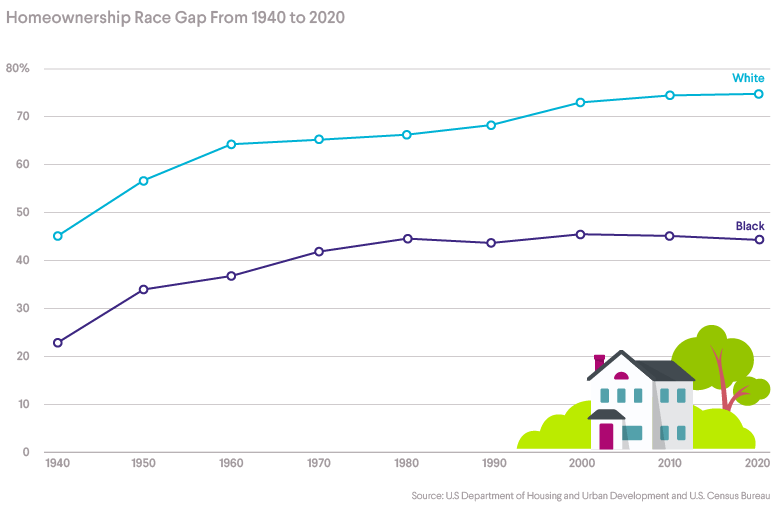
These racial disparities are not new. Historical records confirm a large race gap in homeownership rates has existed since the abolition of slavery. Below we further examine the race gap in homeownership and identify possible solutions.

History of Racial Housing Disparities

The United States has a long history of systemic racism that presents itself in a number of ways, including housing disparities. In January 2022, the National Community Reinvestment Coalition released its home mortgage report examining racial disparities in homeownership from 1900 to 2020.

The NCRC found the gap in homeownership rates between Black and white families reached its lowest level of 23 percentage points in 1980 and its highest level of 30 percentage points in 2015.

In the fourth quarter of 2021, the Black-white race gap in homeownership rates exceeded 31 percentage points. This gap narrowed to 29.6 percentage points in the fourth quarter of 2022, according to data released by the U.S. Census Bureau.

The homeownership rate as of Q4 2022 stood at 74.5% for non-Hispanic white households; 61.9% for Asian, Native Hawaiian, and Pacific Islander families; 48.5% for Hispanic families of any race; and 44.9% among Black households, according to the Census data.

A number of factors have contributed to the race gap in homeownership, including the legacy of race-based discrimination in the housing market.

First-time homebuyers can
prequalify for a SoFi mortgage loan,
with as little as 3% down.


Lasting Effects of Redlining

Redlining, the discriminatory practice of denying home loans and other credit services to ethnically diverse neighborhoods based on the race, color, or national origin of the residents of those neighborhoods, is one of the factors explaining America’s long-standing race gap in homeownership.

The federal government institutionalized redlining in the 1930s when a now-defunct federal agency, the Home Owners’ Loan Corp., created “residential security maps” in dozens of cities across the country to systematically deny mortgages in neighborhoods of color.

HOLC ceased to exist in 1951, and Congress later outlawed redlining with the Fair Housing Act of 1968, but lending discrimination in the housing market has persisted.

An article published in the journal SSM-Population Health in June 2021 found that “redlining has continued to influence racialized perceptions of neighborhood value and practices that have perpetuated racial inequities in lending.”

“Decades of racism in the housing market,” the article adds, “have prevented people of color, particularly Black Americans, equal access to capital, low-cost loans, and homeownership.”

The Department of Justice continues to enforce the Fair Housing Act to address ongoing allegations of modern-day redlining.

Current Black Homeownership Gap

As mentioned, the current race gap in homeownership rates between Black and white families is 29.6 percentage points as of Q4 2022. The vast majority of white families own residential property, while the majority of Black families do not, data shows.

Homeownership is often regarded as the American dream, but not everyone who wants to buy a house is able to get financing. The overall denial rate for home-purchase loans among all applicants in 2021 stood at 8.3%, according to the Consumer Financial Protection Bureau.

Bureau data shows that 15.3% of Black applicants had their mortgage loan requests denied in 2021, compared with 6.3% of non-Hispanic white applicants.

This first-time homebuyer guide recommends downloading your credit reports before submitting any applications for home loans. Creditworthy applicants who have home loan applications denied may be victims of discrimination. You can get free credit reports at AnnualCreditReport.com and can check your credit scores in several ways.

Homeownership by Race

The below table highlights homeownership data by race as of Q4 2022

Race Homeownership rate
Non-Hispanic white alone 74.5%
Asian, Native Hawaiian, and Pacific Islander 61.9%
Hispanic (of any race) 48.5%
Black alone 44.9%
Other (including mixed races) 58.7%
All (nationwide population) 65.9%

Homeownership Race Gap 1940-2020

Fixing the Black Homeownership Gap

The Urban Institute, a nonprofit research organization, has a five-point framework aimed at reducing the Black homeownership gap. Here are the five points:

1. Advance Local Policy Solutions

Local policy reforms, including the removal of any discriminatory terms in homeowner and condominium associations and possible property tax relief for low-income and moderate-income taxpayers, can help reduce the Black homeownership gap.

Expanding small-dollar mortgages could also make a difference.

2. Tackle Housing Supply Constraints and Affordability

Promoting affordable housing nationwide, including new investments in historically segregated and devalued neighborhoods, may help reduce the Black homeownership gap.

Public policy leaders could also review the viability of lease-to-own programs as a pathway to homeownership.

3. Promote an Equitable and Accessible Housing Finance System

Greater access to down payment assistance programs for economically disadvantaged consumers may reduce the Black homeownership gap.

This online mortgage calculator shows how home loan seekers can lower their monthly mortgage payments and total interest charges by making a larger down payment on a home.

Recommended: Do You Still Need to Put a 20% Down Payment On a House?

4. Accelerate Outreach for Mortgage-Ready Millennials

Reaching out to mortgage-ready millennials and improving tax credit incentives for renters to become homeowners may help reduce the Black homeownership gap.

Public-private partnerships can scale up additional programs aimed at bolstering homeownership among low-income people.

5. Focus on Sustainable Homeownership and Preservation

Funded programs that prevent foreclosures in the United States may particularly help Black homeowners maintain their wealth.

Providing homeowners of color with financial literacy may also help preserve homeownership among Black families.

The Takeaway

Racial housing disparities persist, despite federal laws designed to equal the playing field. The effects of redlining echo today, when 74.5% of white families own residential property and just 44.9% of Black families do. Solving this social inequity may require significant action and reform. See how employers can help first-time homebuyers.

If you’re looking for a mortgage lender, SoFi can help you achieve the American dream. Qualified first-time homebuyers can put as little as 3% down.

Explore SoFi fixed-rate mortgage options and view your rate in minutes.


Photo credit: iStock/Morsa Images

SoFi Loan Products
SoFi loans are originated by SoFi Bank, N.A., NMLS #696891 (Member FDIC). For additional product-specific legal and licensing information, see SoFi.com/legal. Equal Housing Lender.


SoFi Mortgages
Terms, conditions, and state restrictions apply. Not all products are available in all states. See SoFi.com/eligibility-criteria for more information.


Financial Tips & Strategies: The tips provided on this website are of a general nature and do not take into account your specific objectives, financial situation, and needs. You should always consider their appropriateness given your own circumstances.

Third-Party Brand Mentions: No brands, products, or companies mentioned are affiliated with SoFi, nor do they endorse or sponsor this article. Third-party trademarks referenced herein are property of their respective owners.

Disclaimer: Many factors affect your credit scores and the interest rates you may receive. SoFi is not a Credit Repair Organization as defined under federal or state law, including the Credit Repair Organizations Act. SoFi does not provide “credit repair” services or advice or assistance regarding “rebuilding” or “improving” your credit record, credit history, or credit rating. For details, see the FTC’s website .

SOHL0222027

Read more
TLS 1.2 Encrypted
Equal Housing Lender