Guide to Changing the Name on Your Credit Card

Guide to Changing the Name on Your Credit Card

If you’re going through a life transition or identity shift, you’ll need to change your legal name. And beyond making the update on government-issued IDs and your social media account, you’ll need to change your name on your credit cards as well.

If you have multiple cards, this might be a tad trickier — and more time-consuming. To avoid the process turning into a stressful, hair-pulling endeavor, we’ll go over the process of how to change your name on credit cards.

Recommended: Tips for Using a Credit Card Responsibly

Reasons for Changing Your Name on a Credit Card

Here are the most common reasons for undergoing a legal name change:

•   Getting married

•   Getting divorced

•   Changing your name to one that’s a better fit for you

•   Changing to mother’s or father’s last name as an adult

•   Undergoing a gender transition (i.e., male-to-female [MTF] or female-to-male [MTF]) and adopting a moniker that’s more representative of your new identity

Steps to Get a Name Change on a Credit Card

Are you asking yourself, “Can I put a different name on my credit card?” The answer is yes — canceling your credit card won’t be necessary. Here’s how to change your name on credit cards.

Update Your Name on Government-Issued ID Cards

Before you reach out to your credit card issuer to change your name, you’ll need to update your alias on government-issued ID cards, such as your Social Security card, driver’s license, and passport.

Not taking this initial step will leave you at a standstill with changing your name on a credit card. That’s because your credit card company will most likely request a legitimate form of ID that verifies that your name has already been legally changed.

To change your name on your Social Security card, you’ll need to submit an application. You’ll also need to provide proper documents verifying your name and identity change. Then, you must submit everything via snail mail or by dropping it off at a nearby Social Security office.

As for changing your name on your driver’s license, each state has slightly different steps. For more information, start by sleuthing around your state’s DMV website.

To learn how to update your name on your passport, visit the U.S. Department of State’s website , where it lays out the process.

Contact Your Credit Card Issuer for Necessary Information

Next, you’ll want to check your credit card issuer’s website for details on how to go about making a legal name change on your credit card. Credit card requirements and procedures for each card issuer can differ.

A time-saving tactic: If you need to change your name across all of your credit cards, block out a few hours and research the steps and necessary information and documents you’ll need to execute the name change. Jot down the main steps and what information and documentation is needed.

Depending on the credit card company, you may have to go to a physical location to make the change, or you may be able to do it over the phone or online. An issuer might ask that you fill out a form through its online portal, while another may have you talk to someone via chat or phone first.

Collect Documents and Information Requested by Your Issuer

If you’ve done your research ahead of time by looking on a credit card issuer’s website, then you might have handled this step before reaching out to the issuer.

Either way, depending on the reason for the name change, here are some documents and information that you might need to gather:

•   Photo ID

•   Government-issued ID like a driver’s license or other legal document showing the name change

•   Signed W-9 with your new name

•   Social Security number

•   Marriage certificate

•   Divorce decree

•   Birth certificate

•   Court order approving the name change

Some credit card issuers will ask for a driver’s license and ID, while others might need more substantial proof, such as a marriage license. Similarly to if you were getting a credit card for the first time, it’s worth investigating in advance.

Submit Your Documentation

As previously mentioned, how you can submit documentation will depend on the requirements and process of the credit card issuer. Some issuers allow you to do everything online or over the phone, while others require you to step foot inside a physical office and speak with a representative. Issuers may have a handy form that you can easily access online, or they might require that you give them a call.

One thing to keep in mind: When making the name change across your cards, or when applying for new cards, make sure to be consistent in how your name appears. Otherwise, this could cause issues later on, given what a credit card is and how it works.

Recommended: Does Applying For a Credit Card Hurt Your Credit Score

Follow Up If the Name Change Doesn’t Take Effect After Some Time

After the name change is approved by the credit card issuer, you’ll need to wait to receive a new card in the mail. How long you’ll wait before you have a new card in your hands can vary, but expect to wait at least five days.

If it’s been more than 10 days after the change was given the green light, follow up by reaching out to the credit card issuer and asking for a status update. If there’s been a snag, they can look into this further.

Changing Your Name on Your Credit Report

Once you change the name on your credit card accounts, you don’t need to take any action to have this change reflected on your credit reports.

Your credit card issuers will automatically let each of the three credit bureaus know. This usually happens at the end of the billing cycle. And should you open a credit card with your new name, this will also be reflected on your credit report.

If you notice that something went awry while changing your name — for instance, the new name shows up incorrectly — make sure to reach out to the credit bureau where the error appears and file a dispute. Once your dispute is received, the credit bureau usually has 30 days to look into it and get back to you.

How Long Will a Name Change Take to Update?

As mentioned before, how long a name change takes to update will largely depend on the credit card company. Each card issuer has different time frames for when the name change will get approved and processed.

For instance, one credit card issuer number may be able to approve the change over the phone and drop a card in the mail right away. Another issuer might require you to talk to them over the phone, then pay them an in-person visit to drop off your forms and required documentation.

What to Expect After a Name Change

Once your name is updated on your credit cards, you can go out into the world under your new moniker. The transition is usually pretty seamless, though you’ll want to look out for any typos or errors.

You’ll be able to use your credit cards in all the ways you had before — online, in-person, and through your digital wallet. If you’re still waiting for your new card with your updated name to arrive in the mail, you might consider carrying an unexpired government-issued ID with your old name on it just in case.

Does Changing Your Name Affect Credit?

Changing your name doesn’t not affect your credit in any way, shape, or form. While your new name will be reported to the three major credit bureaus on both existing and new cards, it won’t impact your credit history.

Keeping an Eye on your Credit

After you’ve updated your name on all your credit cards, stay on the lookout for any potential snags, such as a typo in your name. Certain mistakes can create confusion and further errors given how credit cards work. If you see anything amiss on your credit report, make sure to report it immediately.

Otherwise, the same basic credit card rules and practices apply once you’ve submitted your request for your name change.

The Takeaway

Making a name change on a credit card doesn’t have to be an overwhelming process. While there are certain steps to take, doing your homework and learning what those steps are and how they differ between different credit card issuers will help ensure smooth sailing. If you’re applying for a credit card, remember you’ll need to open it under your updated name as well.

Whether you're looking to build credit, apply for a new credit card, or save money with the cards you have, it's important to understand the options that are best for you. Learn more about credit cards by exploring this credit card guide.

FAQ

How can I change the name on my credit card after marriage?

You’ll need to make the change directly with each credit card issuer. Before you reach out, poke around the credit card issuer’s website and look into the specific steps involved. From there, gather the information and required documents. Depending on the issuer, you’ll need to submit an application either online or in person.

Does changing my name impact my credit score?

Changing the name on your credit cards to match your legal name will not impact your credit score in any way. Once the name is updated, the credit card companies will report the change automatically to the credit bureaus.

Does the name on a credit card matter?

Yes, the name on a credit card needs to match legal documents, such as your Social Security number and driver’s license. So if you’re undergoing a name change, you’ll need to update your cards to reflect this.

Should I leave my credit cards in my old name?

No, your credit cards need to match your legal name. If you’re changing your name due to a marriage, divorce, gender transition, or some other reason, you’ll need to update the name on your credit cards so everything is the same.


Photo credit: iStock/BongkarnThanyakij

Financial Tips & Strategies: The tips provided on this website are of a general nature and do not take into account your specific objectives, financial situation, and needs. You should always consider their appropriateness given your own circumstances.

SOCC0722002

Read more

13 Online Shopping Trends

The Covid-19 pandemic has changed the way people shop. While ecommerce sales have been on the rise for years, the need to stay home accelerated the growth of online shopping in the U.S.

To learn more about today’s online shopping trends, we used a multi-pronged approach that included:

•  A Survey: We surveyed over 1,000 people who regularly shop online (meaning at least once a week) to gain insights into current trends, especially as they relate to the new shopping landscape post-pandemic.

•  Social listening data: We analyzed 30,000 Twitter posts from March 2021 to March 2022, and leveraged customized research from Meltwater to gain further insights about online shopping while drunk, online shopping regrets, and online grocery delivery.

Read on for the 13 most compelling online shopping trends we’re seeing today.

1. Social influence: People buy what they see on social media.

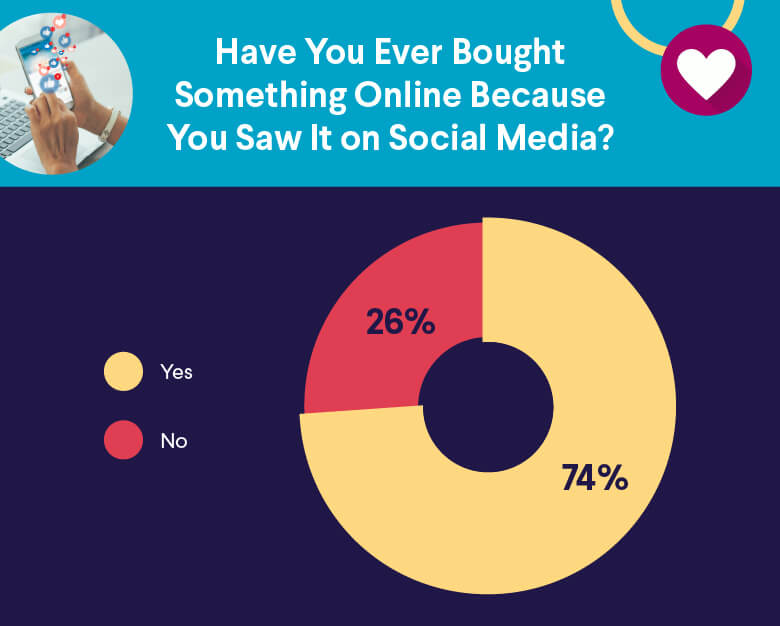
Have you ever bought something online because you saw it on social media?

The power of social media as a purchasing tool can’t be overstated.

According to our research, 74% of respondents say they’ve bought something they’ve seen on social media platforms like TikTok, Instagram, and Facebook. In 2017, only 40% of adults said they’d bought something after seeing it on social media.

What’s more, men are more likely to make these purchases than women: 78% of men say they’ve purchased something they’d seen on social media, compared to 70% of women who say the same.

2. Buy now, think later: Most online purchases are impulse buys.

What percentage of people's online purchases are impulse buys?

If you’ve bought something on the spot while browsing online, you’re not alone: 56% of people say that more than half of their online purchases are impulse buys.

Comparing age groups, millennials are the most impulsive online shoppers, with 63% of respondents saying their online purchases are not planned.

Gen Z may be the most prudent online shoppers. Of all the age groups, they had the highest percentage of respondents who said none of their online purchases are impulse buys (12%). Boomers, at 10%, were a close second.

3. At some point, most people shop online while not totally sober.

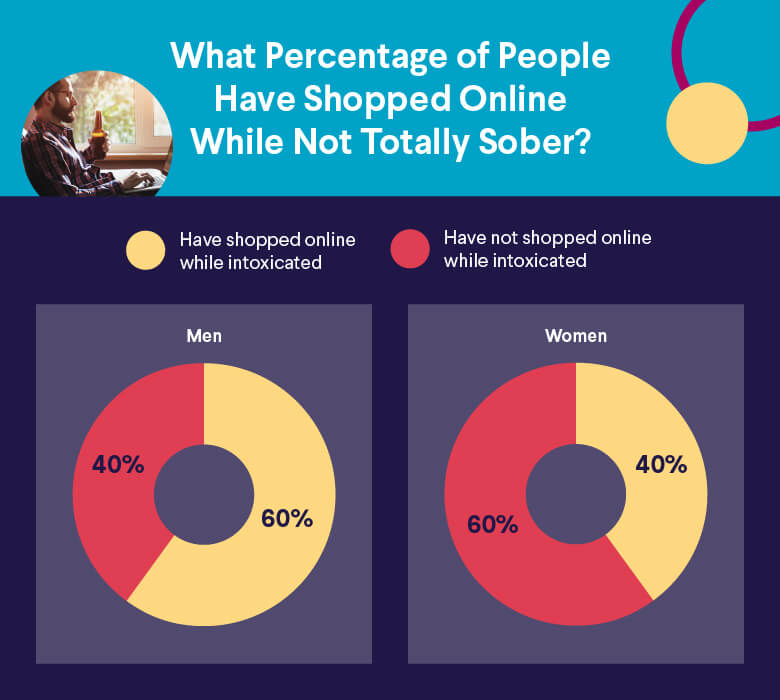
One interesting finding from our research: A majority (53%) of respondents admit they haven’t been sober when making an online purchase.

What percentage of people have shopped online while not totally sober?

Men are more likely to shop while intoxicated than women, with 60% saying they’d shopped online while not sober, compared to 40% of women who said the same. When looking at age groups, millennials (60%) are most likely to shop while not sober, and Boomers (37%) are the least likely to do so.

Online shopping while drunk isn’t necessarily a private activity. Some shoppers have shared their intoxicated online shopping adventures on social media.

According to Meltwater data, there was a 496% increase in the number of Tweets about drunk online shopping from 2020 to 2022.

While our survey found men to be more likely to engage in drunk online shopping, women were more likely to post about their intoxicated online shopping experiences on social media. According to our social listening data, millennial moms and wives made up the largest cohort of Twitter users who posted about drunk online shopping.

What drunken online purchases are people most likely to discuss?

Clothing was the most discussed shopping category in the social posts we analyzed. About 10% of people who mentioned drinking and online shopping discussed buying items for their children.

Amazon was by far the most mentioned shopping source (83%) in posts about drunk online shopping in which the name of the store was included.

People are most likely to talk about drunk online shopping on Saturday between 9am and 10am, and Sunday from 6am to 7am (possibly recounting the night before). Interestingly, Thursday morning between 10 and 11 is also a popular time to discuss drunk online shopping.

4. Beer is the top drink of choice for intoxicated online shopping experiences.

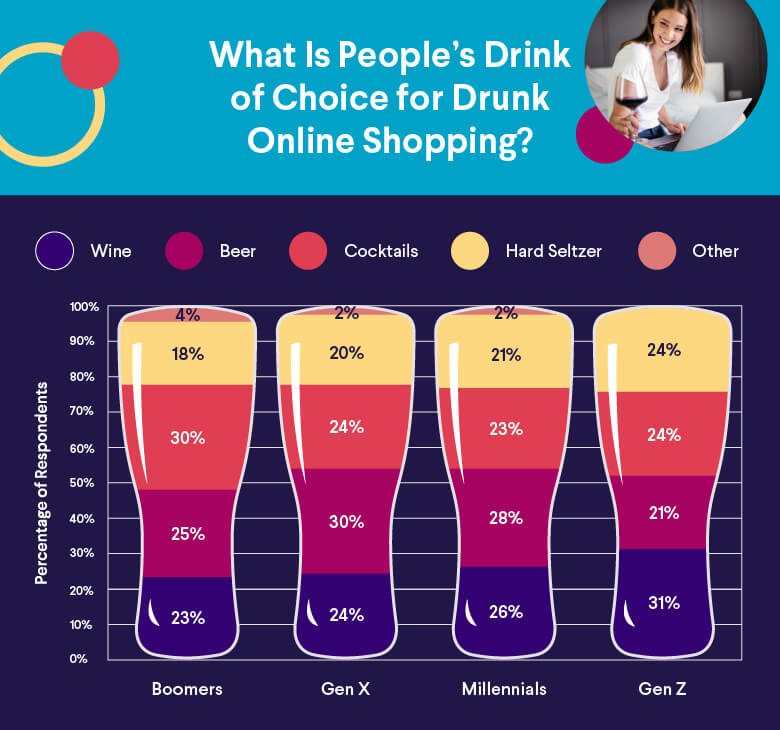
What is people's drink of choice for drunk online shopping?

Beer is the top drink for drunk online shoppers, with 54% of respondents saying they typically consume it before an intoxicated shopping experience. Wine (52%) was a close second, followed by cocktails (47%), and seltzers (42%).

The drinks of choice vary by age group. The most popular drinks for each generation are:

•  Boomers: Cocktails (30%)

•  Gen X: Beer (30%)

•  Millennials: Beer (28%)

•  Gen Z: Wine (31%)

5. Shoppers may not remember purchasing something online until it arrives.

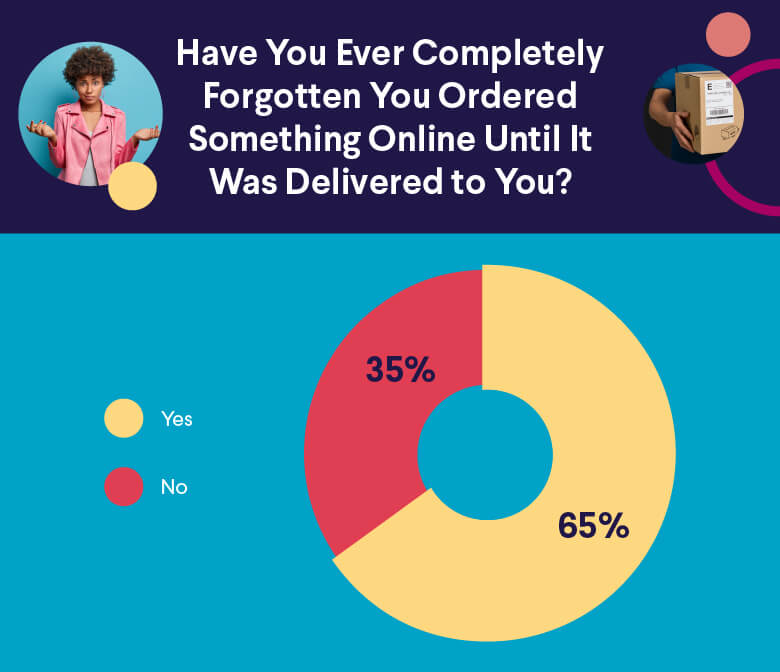
Have you ever forgotten you ordered something online until it was delivered to you?

Have you ever forgotten ordering an item until it arrived on your doorstep? A full 65% of our survey respondents say they have.

Of all the age groups, millennials were the most likely to order something and forget about it, with seven out of 10 respondents saying that’s happened to them. Boomers were the least likely to forget making an online purchase.

6. Just because stores have reopened doesn’t mean people are coming back.

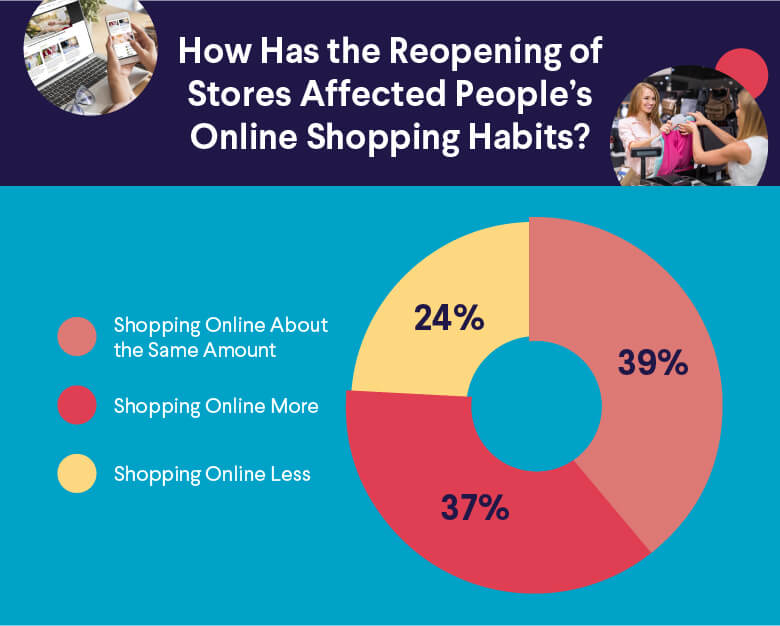
How has the reopening of stores affected people's online shopping habits?

The pandemic caused a massive ripple in worldwide markets due to government shutdowns. Apparently, the reopening of stores hasn’t done much to convince consumers to return.

The percentage of Americans who have recently visited a mall is less than half of what it was pre-Covid. Before the pandemic, about 56% of Americans said they visited a mall within the last 30 days. Now, just 26% of respondents say they’ve shopped at a mall in the last month.

Even with stores reopening, 39% of consumers say they will continue shopping online the same amount, and 37% say they plan to shop online even more. In other words, a majority of people will maintain or increase the online shopping habit they picked up during the pandemic.

7. Men spend more online shopping now than they did pre-pandemic, compared to women.

How much money do people spend on online shopping now compared to pre-pandemic days?

The pandemic has changed all kinds of consumer shopping habits, including the amount of money people spend online now versus what they spent before the pandemic. When comparing men and women, we found that:

•  25% of men are spending over $500 more on online shopping now than they did pre-pandemic

•  17% of women are spending over $500 more on online shopping now than they did pre-pandemic

•  37% of women are spending $100 or less on online shopping now compared to pre-pandemic days

•  29% of men are spending $100 or less on online shopping now compared to pre-pandemic days

8. People tend to order from Amazon at least three times per month.

How often are people shopping on Amazon?

People are ordering more from Amazon than ever before. The company’s profits increased 220% in 2021 from the previous year when the pandemic was in full effect.

A majority of respondents (65%) place three or more orders on Amazon each month. And 16% place more than five Amazon orders every month.

9. Shoppers are split on in-store vs. online clothes shopping.

Despite the convenience of online shopping, there was a near-even split between the percentage of people who prefer to shop for clothes online (52%) versus in-person (48%).

Boomers had the largest percentage of respondents (60%) who prefer to shop for clothes online. Gen Z had the largest percentage of respondents who prefer to shop for clothes in-person (55%).

in-store vs. online clothes shopping

While many online retailers have made it easier to return clothes, the inconvenience of having to ship items back may outweigh the inconvenience of having to drive to a store to try things on.

10. Items that look different online vs. in-person are a common source of purchase regret.

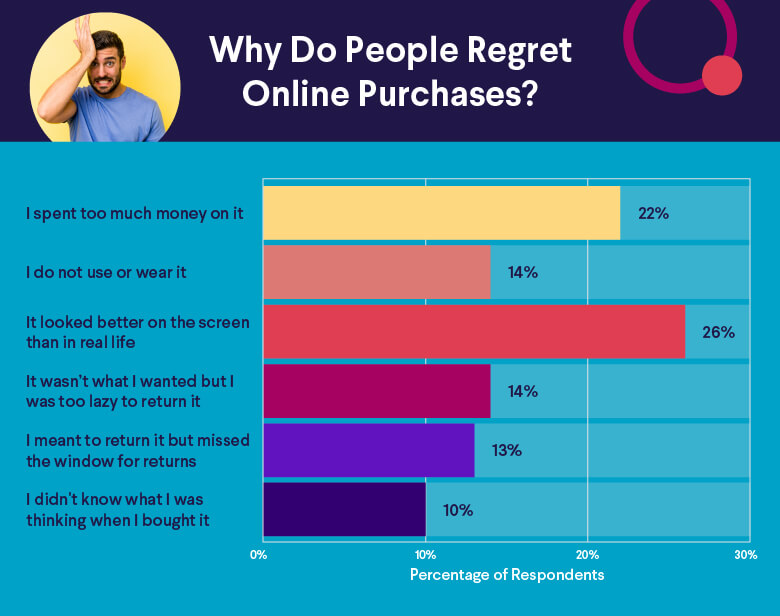
Why do people regret online purchases?

Buyer’s remorse is not new. However, with the rise of online shopping, we wanted to find out the most common reason people regret their online purchases specifically.

Apparently, it’s because items can look a lot better on-screen than in-person. The biggest reason our respondents regretted an online purchase was because they felt it looked different in real life compared to how it was presented online (26%). The second-most popular reason was overspending on an online purchase (22%).

Here’s a breakdown of the reasons people regret online purchases:

•  It looked better on the screen than in real life – 26%

•  I spent too much money on it – 22%

•  I do not use or wear it – 14%

•  It wasn’t what I wanted but I was too lazy to return it – 14%

•  I meant to return it but missed the window for returns – 13%

•  I don’t know what I was thinking when I bought it – 10%

When we analyzed social posts that discussed online shopping regrets, we found that the posters tended to be Gen Z women who are mothers, have dogs, and/or are writers or artists.

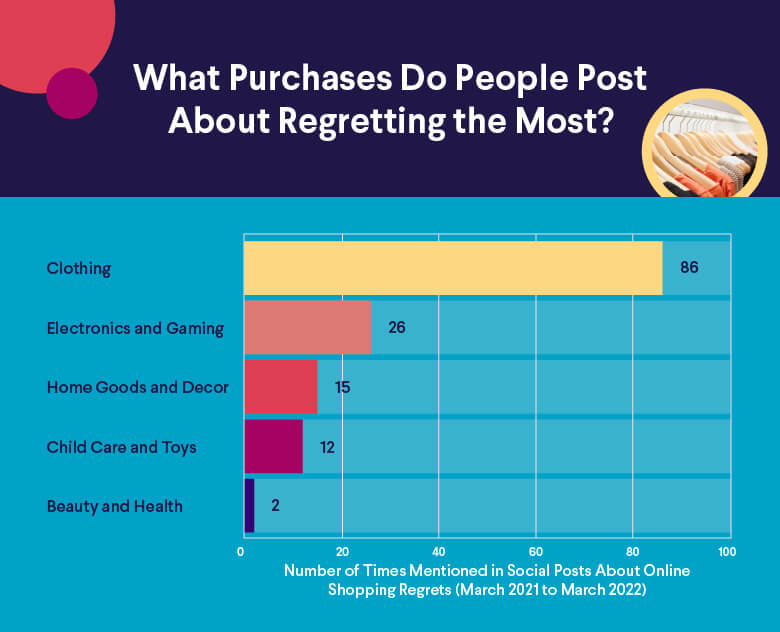
What purchases do people post about regretting the most?

According to the social listening data, people regret buying clothing the most, and they regret buying beauty and health products the least.

11. Buy Now Pay Later: Convenient or confusing?

When looking at social posts about shopping regrets from March 2021 to March 2022, we noticed a spike in negative sentiment in February 2022. The spike was caused by a viral Bloomberg article that discusses the dangers and confusion around buy-now-pay-later (BNPL) options while shopping online.

The article talked about how BNPL models can be misleading about how much they charge consumers, especially compared to credit cards. It discussed how using a buy-now-pay-later option can end up being more expensive than using a credit card.

Buy-now-pay-later is a relatively new concept for online shoppers, but it’s already gained popularity: More than one in 10 of our survey respondents (14%) say they prefer to use a BNPL service to finance their online purchases. If you choose to use buy now pay later, read all the terms carefully and make sure you fully understand how much you’re being charged. You may find that paying with a credit card is a more cost-effective option.

12. Haul videos are an influential source of shopping inspiration.

What's the main reason people watch haul videos?

Our data shows that haul videos are an influential source of shopping inspiration. In fact, one-third of our respondents said the main reason they watch haul videos is to discover new products they might want to buy.

More than half (53%) of our respondents say they’ve bought something they saw on a haul video. When comparing different age groups, younger people appear to be the most influenced by haul videos, with 70% of Gen Zers saying they’ve bought something after watching one. Looking at men versus women, men are more likely to have purchased something they saw on a haul video (60%) than women (46%).

13. Online grocery delivery is here to stay.

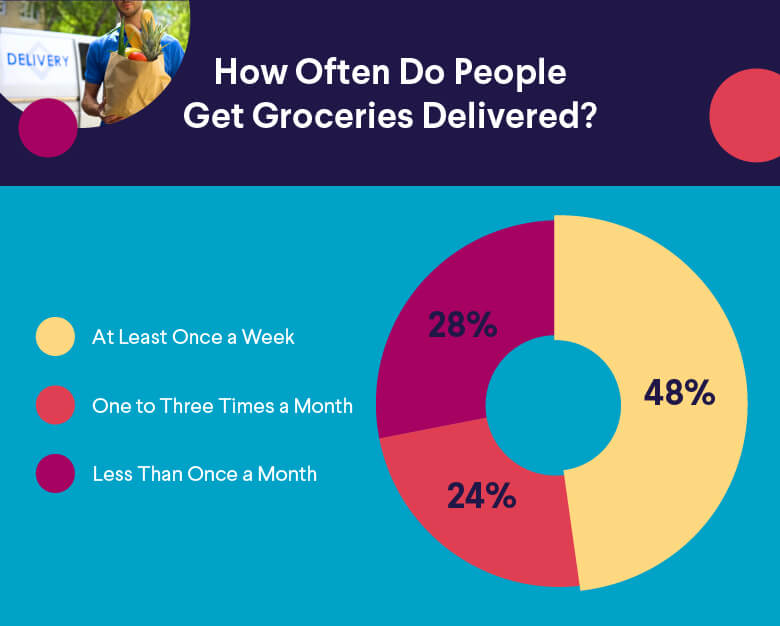
How often do people get groceries delivered?

While in-store grocery shopping continued during the pandemic, reluctance to be out in public opened the door for more options, such as grocery delivery apps and DIY meal kits.

In fact, 38% of respondents now use grocery delivery services but didn’t before the pandemic. And 48% of people have food or groceries delivered to their house at least once a week. Before the pandemic, only 3% of grocery spending occurred online!

We also found that 22% of people use meal kits such as Blue Apron and Hello Fresh currently, but did not use them before the pandemic.

And on days when people don’t feel like cooking, online food delivery comes to the rescue. In fact, 28% of respondents said they now order meals from services like UberEats and DoorDash but never used to pre-pandemic.

When we asked respondents what they get when ordering food or groceries online, the most common answers were:

•  Sweet snacks (such as candy, cookies, ice cream): 45%

•  Salty snacks (such as chips, jerky, nuts): 43%

•  Vegetables and fruit: 42%

The Takeaway

Mass shutdowns and the reluctance to go out in public made consumers rely more on online shopping during the pandemic. And now that stores have reopened, people plan to continue shopping online at the same rate, or even more.

With so many consumers now embracing the convenience of online grocery and food delivery, leaving the house for necessities may become a thing of the past. One reason people might consider venturing out, however, is to buy new clothing. Nearly half of shoppers still want to try things on before they buy them.

A majority of people say most of their online purchases are impulse buys—and they’ve even forgotten they ordered something until it arrived at their door. Perhaps that has some correlation with the fact that more than half of our survey respondents say they haven’t been sober when shopping online.

There has also an increase in the use of the buy-now-pay-later model, which became popular during the pandemic. In fact, over 10% of our respondents say it’s their preferred payment method when shopping online. But buy-now-pay-later models can be misleading, and may ultimately end up costing buyers more than they expected.

Credit cards offer a similar type of financing, but are typically much clearer in their repayment terms and interest rates. They also often offer rewards.


Enjoy unlimited cash back rewards with fewer restrictions.


Photo credit: iStock/AsiaVision
1See Rewards Details at SoFi.com/card/rewards.

New and existing Checking and Savings members who have not previously enrolled in direct deposit with SoFi are eligible to earn a cash bonus when they set up direct deposits of at least $1,000 over a consecutive 25-day period. Cash bonus will be based on the total amount of direct deposit. The Program will be available through 12/31/23. Full terms at sofi.com/banking. SoFi Checking and Savings is offered through SoFi Bank, N.A. Member FDIC.

SoFi members with direct deposit can earn up to 3.80% annual percentage yield (APY) interest on Savings account balances (including Vaults) and up to 0.50% APY on Checking account balances. There is no minimum direct deposit amount required to qualify for these rates. Members without direct deposit will earn 1.00% APY on all account balances in Checking and Savings (including Vaults). Interest rates are variable and subject to change at any time. These rates are current as of 3/17/2023. Additional information can be found at https://www.sofi.com/legal/banking-rate-sheet

SoFi Credit Cards are issued by SoFi Bank, N.A. pursuant to license by Mastercard® International Incorporated and can be used everywhere Mastercard is accepted. Mastercard is a registered trademark, and the circles design is a trademark of Mastercard International Incorporated.

Financial Tips & Strategies: The tips provided on this website are of a general nature and do not take into account your specific objectives, financial situation, and needs. You should always consider their appropriateness given your own circumstances.

SOCC0622017

Read more

Guide to Destroying a Metal Credit Card

Plastic credit cards are easily destroyed by simply cutting them up with a household pair of scissors. But in recent years, some credit card issuers have started issuing metal credit cards. While these have become somewhat of a status symbol, the problem comes in trying to figure out how to dispose of metal credit cards.

It’s good practice to destroy a metal credit card once you’re done using it so that nobody can access your personal information. However, disposing of a metal credit card is not as easy as using a pair of regular household scissors. Thankfully, there are a few options to consider if you want to know how to destroy a metal credit card.

Why Should You Destroy a Metal Credit Card?

The biggest reason to destroy a metal credit card is to make sure that nobody uses your credit card information.

Even though most credit card companies have a $0 fraud liability policy, you don’t want to deal with the hassle of unauthorized purchases. And even if you’ve canceled your credit card or it’s expired, you’ll still want to destroy it, since it has personal information that might be used in different types of identity theft.

Recommended: Does Applying For a Credit Card Hurt Your Credit Score

Factors to Consider Before Destroying a Credit Card

Before destroying a metal credit card, you’ll want to make sure that it makes sense to cancel your account.

If you’re still using a credit card through automatic payments or recurring purchases, make sure to cancel those or move them to other cards. Once you close your account and dispose of your metal credit card, any such purchases will be declined.

Also take into account any potential impacts on your credit score that closing your account may have. Closing an account could increase your credit utilization ratio since you’ll have less available overall credit, and it could also lower the age of your accounts, depending on how long you’ve had your account. Both factors could lead to a dip in your credit score.

Before moving forward with closing your account, you’ll also want to take a look at your rewards to ensure you wouldn’t lose what you’ve already earned. Also remember that you’ll still need to pay off your card’s balance in full. Keep an eye out for any final payments that might roll in after your account is closed.

Recommended: When Are Credit Card Payments Due

Ways to Get Rid of a Metal Credit Card

If you’re confident you want to move forward, here are some options for how to dispose of a metal credit card.

Sending It Back to Your Credit Card Issuer

One of the best ways to dispose of a metal credit card is to return it directly to your credit card issuer. Most credit card issuers will provide you with a postage-paid envelope to return your metal credit card, if you ask. This can be a great (and relatively secure) way to dispose of your metal credit card.

Returning It to a Physical Bank Branch

Another option for returning your metal credit card to your credit card issuer is by bringing it to a physical bank branch. Of course, this is only a viable option if your issuer has physical branches near you. If your card has reached its credit card expiration date and you want to get rid of it, this can be a reasonable option.

Stowing It Away

Another option for disposing of a metal credit card is to simply stow it away somewhere safe in your house. This could be a filing cabinet, sock drawer, or anywhere else in your home. While this isn’t a great long-term solution, since there is some risk, it may work in the short-term.

Destroying It on Your Own

The final option for disposing of a metal credit card that you’re no longer using is destroying it on your own. After all, this is the preferred solution for most non-metal credit cards. And it is still possible with a metal credit card, though it is a bit trickier, as you’ll see in the next section.

Guide to Disposing a Metal Credit Card on Your Own

For those who want to DIY the destruction of their metal card, here’s how you destroy metal credit cards.

Using Tin Snips

If you have a pair of tin snips, that’s probably the easiest way to destroy a metal credit card on your own. Tin snips should make quick work of most metal credit cards. If you don’t have a pair of tin snips yourself, check with friends and family to see if you can borrow a pair.

Using Heavy-Duty Scissors

While most traditional or kitchen scissors will not do much to a metal credit card, if you have a heavy-duty pair of scissors, you may be in luck. Heavy-duty scissors made of stainless steel or titanium may be able to help you destroy and dispose of a metal credit card.

Mangling It With Pliers

If you don’t have heavy-duty scissors or tin snips, another option is to use a regular pair of pliers. While this may not be the most practical way to dispose of a metal credit card, it could be worth a try.

Drilling Holes Into It

If you have a power drill with metal-cutting bits, you might be able to dispose of your metal credit card by drilling holes into it. You’d just need to drill enough holes in your card to remove any of your personal information as well as the EMV chip. Keep in mind that you’ll need a powerful drill with special bits — it’s unlikely that a regular drill will do the job.

Using a Blow Torch

If you have access to a blow torch, and are knowledgeable enough about it to be able to use it safely, you may have luck using it to destroy your metal credit card. Of course, if you have a big enough shop to have a blow torch, you probably also have a pair of tin snips. That will be much easier, but maybe not as fun!

Throwing It in Your Fire Pit

While you may be able to destroy your metal credit card by simply throwing it in your fire pit, this may not be the most environmentally-conscious way to dispose of your metal credit card. Many metal credit cards have different kinds of metals in them that may not be safe to burn.

Avoid These Methods for Discarding a Metal Credit Card

Out of the many ways you can dispose of your metal credit card, here are the methods to steer clear of.

Giving It to Third-Party Services

One of the top credit card rules is that you should not give your personal information out to anyone. This still holds true, even if your credit card account is closed. Your personal information can still be used for identity theft or other nefarious purposes. Either destroy your metal credit card yourself, or deal directly with your credit card issuer.

Throwing It Away or Recycling It

You’ll also want to avoid simply throwing your metal credit card away or recycling it. You may be trying to take advantage of “security by obscurity,” hoping that nobody will find it. But because of how a credit card works, it’s easy for anybody that has your card to access your account and your personal information. Don’t take that risk — make sure to destroy your card responsibly.

Recommended: Tips for Using a Credit Card Responsibly

Using a Paper Shredder

While most paper shredders do have the capacity to shred a non-metal credit card, it is unlikely that your typical paper shredder can handle a metal credit card. You are more likely to damage your paper shredder and still have an intact metal credit card.

Using Traditional Scissors

Traditional kitchen scissors will not be able to destroy most metal credit cards. While you’re unlikely to damage your scissors, you’re also quite unlikely to make any progress trying to destroy your metal card with a traditional pair of scissors.

Recommended: Can You Buy Crypto With a Credit Card

The Takeaway

While it may be trickier to destroy a metal credit card than it is to get rid of a plastic credit card, it’s still important to do. You don’t want your personal information floating around for anyone to possibly use. Even if your credit card account is closed, you still run the risk of someone using the card to steal your identity. The easiest way to destroy a metal credit card is securely sending it back to your credit card issuer.

Enjoy unlimited cash back rewards with fewer restrictions.

FAQ

What is the safest way to destroy a credit card?

The safest way to destroy a metal credit card is to securely send it back to your credit card issuer. Most credit card issuers will send you a postage-paid envelope that will allow you to send the metal card back to them. Alternatively, you can return it directly back to a physical branch location.

How do I get rid of a metal credit card at home?

One of the easiest ways to get rid of a metal credit card at home is using tin snips. If you have a pair of tin snips, they will make quick work of a metal credit card. Just make sure to be careful with the rough metal edges once you cut it up.

Can you burn a metal credit card?

It is possible to burn a metal credit card, though it may not be the most environmentally-conscious thing to do. Burning a metal credit card may release toxic gasses into the air.

Can I destroy my metal credit card with tin snips?

Yes, destroying a metal credit card with tin snips is one of the easiest ways to dispose of a metal credit card. Of all the different options for destroying a metal credit card at home, tin snips are the tool that is most likely to be found in the homes of most credit card consumers.


Photo credit: iStock/Katya_Havok

Financial Tips & Strategies: The tips provided on this website are of a general nature and do not take into account your specific objectives, financial situation, and needs. You should always consider their appropriateness given your own circumstances.

Disclaimer: Many factors affect your credit scores and the interest rates you may receive. SoFi is not a Credit Repair Organization as defined under federal or state law, including the Credit Repair Organizations Act. SoFi does not provide “credit repair” services or advice or assistance regarding “rebuilding” or “improving” your credit record, credit history, or credit rating. For details, see the FTC’s website .

SoFi Credit Cards are issued by SoFi Bank, N.A. pursuant to license by Mastercard® International Incorporated and can be used everywhere Mastercard is accepted. Mastercard is a registered trademark, and the circles design is a trademark of Mastercard International Incorporated.

1See Rewards Details at SoFi.com/card/rewards.

New and existing Checking and Savings members who have not previously enrolled in direct deposit with SoFi are eligible to earn a cash bonus when they set up direct deposits of at least $1,000 over a consecutive 25-day period. Cash bonus will be based on the total amount of direct deposit. The Program will be available through 12/31/23. Full terms at sofi.com/banking. SoFi Checking and Savings is offered through SoFi Bank, N.A. Member FDIC.

SoFi members with direct deposit can earn up to 3.80% annual percentage yield (APY) interest on Savings account balances (including Vaults) and up to 0.50% APY on Checking account balances. There is no minimum direct deposit amount required to qualify for these rates. Members without direct deposit will earn 1.00% APY on all account balances in Checking and Savings (including Vaults). Interest rates are variable and subject to change at any time. These rates are current as of 3/17/2023. Additional information can be found at https://www.sofi.com/legal/banking-rate-sheet


SOCC0622017

Read more
Best Entry Level Jobs For Antisocial People

15 Entry-Level Jobs for Antisocial People

Antisocial people tend not to like being around others, which can sometimes be a barrier to getting certain jobs. In reality there are plenty of jobs that do not require any social interaction, making them perfect for an antisocial person.

Key Points

•   Antisocial individuals prefer jobs with minimal or no social interaction.

•   Ideal roles for antisocial people include computer programming, farming, and writing, which require limited public engagement.

•   Such positions often allow for remote work or solitary environments.

•   Entry-level jobs well-suited for antisocial personalities include truck driving and craft artistry.

•   These jobs provide opportunities to work independently, away from team settings or customer interactions.

What Does It Mean to Be Antisocial?

The clinical definition of “antisocial” is someone that shows no regard for others and does not want to be in the company of other people. However, in common usage, antisocial can be used to describe someone that prefers to be alone most or all of the time.

Check your score with SoFi

Track your credit score for free. Sign up and get $10.*


Why It Can Be Difficult for Antisocial People to Find Work

Most jobs require at least some form of interaction, either with customers or coworkers. This can be a struggle for an antisocial person, who would likely prefer to find work that requires limited or no interpersonal interaction.

Antisocial people may also experience anxiety about job interviews, which are typically a prerequisite in the hiring process for many jobs.

What Makes the Ideal Job for an Antisocial Person?

An antisocial person may want to find a job that requires no interaction and can be done from a quiet and isolated location at their leisure. Self-employment can be a career path for antisocial people to consider or jobs that only require interaction through virtual (email, text, etc.) correspondence.

What Kind of Work Does Not Suit an Antisocial Person?

Any job that requires a lot of engagement with others, such as customer service or retail, would likely not be a good fit for an antisocial person. At the same time, any job that requires a lot of on-the-job training or management would likely not be ideal.

15 Entry-Level Jobs for Antisocial People

Antisocial disorder is often diagnosed at a young age. For those looking to start an entry-level career, here are 15 jobs that are well-suited to an antisocial person (with salary data from the Bureau of Labor Statistics):

Computer Programmer

2021 median salary: $93,000
Primary Duties: Write and test code and scripts that enable computer software to function.

Farmer or Rancher

2021 median salary: $73,060
Primary Duties: Oversee the production of crops, livestock and dairy products.

Writer and Author

2021 median salary: $69,510
Primary Duties: Write original copy for personal or business websites.

Aircraft Mechanic

2021 median salary: $65,550
Primary duties: Repair, inspect and perform maintenance on various aircraft.

Craft Artist

2021 median salary: $49,960
Primary Duties: Create original works of art for sale and exhibition using a variety of materials.

Truck Driver

2021 median salary: $48,310
Primary Duties: Pick up, transport, and deliver packages or goods from one location to another.

Machinist

2021 median Salary: $47,940
Primary Duties: Operate mechanical- and computer-controlled equipment used to manipulate metal parts, instruments, and tools.

Embalmer

2021 median salary: $47,780
Primary duties: Prepare the bodies of the deceased for interment.

Medical Transcriptionist

2021 median salary: $30,100
Primary duties: Transfer voice recordings from physicians and other healthcare professionals into formal reports or other documents.

Proofreader

2021 median salary: $43,940
Primary duties: Read content and correct for spelling, punctuation, and grammatical errors.

Assembly Line Worker

2021 median salary: $37,170
Primary duties: Use hand tools or machinery to produce vehicles, electronic devices and other materials and goods.

Animal Trainer

2021 median salary: $31,280
Primary duties: Teach animals skills such as obedience, performance, riding, security, and assisting people.

Veterinary Assistant

2021 median salary: $29,780
Primary duties: Feed, bathe and take care of animals in need of treatment.

Janitor

2021 median salary: $29,760
Primary duties: Clear and sterilize buildings, schools, hospitals and other commercial businesses.

Crematory Operator

2021 average salary: $37,490
Primary Duties: Perform cremations, including the preparation and transfer of the body post-service.

Recommended: High Paying Trade Jobs in Demand

The Takeaway

Having antisocial tendencies doesn’t mean you can’t find a fulfilling career. In fact, many jobs offer solitude and limited people interaction, which can appeal to many antisocial and introverted individuals.

Regardless of your chosen career path, it’s important to exercise responsible spending and money habits and keep track of your financial goals.

SoFi can help you track your money like a champion, with tools for monitoring your credit score, setting financial goals and monitoring your spending.

FAQ

What jobs require no social interaction?

Computer programmers that work from home, janitors that work night shifts, and farmers and ranch-hands typically have little to no social interaction in their day-to-day work.

What is a good job for antisocial people with no experience?

Artisan jobs, online bloggers, and transcriptionists all provide strong starting salaries and require no formal degree or experience.


Photo credit: iStock/ferrantraite

SoFi Relay offers users the ability to connect both SoFi accounts and external accounts using Plaid, Inc.’s service. When you use the service to connect an account, you authorize SoFi to obtain account information from any external accounts as set forth in SoFi’s Terms of Use. Based on your consent SoFi will also automatically provide some financial data received from the credit bureau for your visibility, without the need of you connecting additional accounts. SoFi assumes no responsibility for the timeliness, accuracy, deletion, non-delivery or failure to store any user data, loss of user data, communications, or personalization settings. You shall confirm the accuracy of Plaid data through sources independent of SoFi. The credit score is a VantageScore® based on TransUnion® (the “Processing Agent”) data.

*Terms and conditions apply. This offer is only available to new SoFi users without existing SoFi accounts. It is non-transferable. One offer per person. To receive the rewards points offer, you must successfully complete setting up Credit Score Monitoring. Rewards points may only be redeemed towards active SoFi accounts, such as your SoFi Checking or Savings account, subject to program terms that may be found here: SoFi Member Rewards Terms and Conditions. SoFi reserves the right to modify or discontinue this offer at any time without notice.

Financial Tips & Strategies: The tips provided on this website are of a general nature and do not take into account your specific objectives, financial situation, and needs. You should always consider their appropriateness given your own circumstances.

SORL0522025

Read more

Guide to Saving Money on Hotels for Your Next Vacation

Along with flights, lodging costs are one of the biggest expenses for many vacationers. As such, savvy travelers are likely on the lookout for how to save money on hotels when planning their vacation.

While hotel prices often rise and fall over time based on supply and demand, there are ways to save money on hotels on vacation. This ranges from being flexible about when and where you travel to getting a hotel credit card and taking advantage of cashback rewards. Read on for a full rundown of the best ways to save on hotels for your next vacation.

Recommended: Can You Buy Crypto With a Credit Card

Tips to Save on Hotels While Traveling

Wondering how to save on hotels when traveling? Here are some tips to try.

Getting a Hotel Credit Card

Using credit card rewards to travel for less is one way to save money on hotels while traveling. Most major hotel chains have a co-branded credit card that allows you to earn points for staying with them as well as on your everyday spending.

Additionally, many of these hotel credit cards offer sign-up bonuses. With these bonuses, you may be able to earn enough credit card points for a few free nights just by meeting a minimum spending amount.

There are different credit card rewards programs, so just make sure to choose the one for the hotel where you’re wanting to stay.

Earning Hotel Cashback

One of the downsides of getting a hotel credit card is that in most cases, you’re limited to using your points to stay with that particular hotel chain. If you have a Marriott credit card that earns Marriott Bonvoy hotel points, for instance, you can’t use them to stay at a Hilton or Hyatt.

One way to get around that is to use a credit card that offers cash back rewards. These cards allow you to redeem cash rewards from your everyday purchases that you can then use to pay for any hotel you want.

Recommended: What is the Average Credit Card Limit

Keeping an Eye Out for Deals

Flexibility is key to saving money on hotels, and the earlier you start planning your vacation, the more luck you’ll have in finding travel deals. Many successful vacationers start planning their trips up to a year before they actually plan to travel. That gives you plenty of time to explore your options, wait for deals to pop up, and keep an eye out for sales.

Checking All the Conditions While Booking the Hotel

When you’re booking a hotel room, you’re generally presented with several different room rates. You might have a different rate if you’re a member of the hotel loyalty program, if you prepay for your stay, or if you belong to a specific organization.

These different rates also usually come with different cancellation policies. Make sure to read the fine print before you book, so you can know what to expect during your stay. The fine print could also detail additional fees that the rate doesn’t clearly include.

Looking Out for Free Breakfast

One way to plan a budget family vacation is to look for hotels that include complimentary breakfast with the room rate. If you’re traveling with a family, getting the breakfast that’s included in your hotel reservation might save you anywhere from $20-$50 per day. This can free up some of your hotel funds for other vacation activities, and can make a difference when comparing rates from different hotels.

Joining a Hotel Points Program

Even if you don’t sign up for a hotel chain’s co-branded credit card, you’ll want to make sure to join their loyalty program. There’s typically no cost to join the hotel’s loyalty program, and you’ll generally get perks like lower nightly rates or complimentary Wi-Fi. This can be a great way to save money for a trip.

Taking Advantage of Falling Rates

One strategy for saving money on hotels is to only book a refundable rate that you can cancel at any time. Then, periodically check back to see if the rate has fallen. If the rate is lower than when you first booked the hotel, cancel your original reservation and book at the new lower rate.

There are also services that you can take advantage of if you don’t want to stay on top of price tracking yourself. For example, websites and apps like Hopper and Rebookey can monitor hotel prices and notify you if the price drops after you’ve booked.

Recommended: How to Avoid Interest On a Credit Card

Making Payments in Advance

Alternatively, you can prepare financially for travel by making your hotel payments in advance. Many hotels offer a lower rate when you prepay as compared to a refundable hotel rate where your credit card isn’t charged until your stay. You could save anywhere from $10 to $20 per night by prepaying in advance.

Plus, if you pay with a credit card that offers credit card travel insurance, you’ll have peace of mind that your prepaid funds aren’t lost if your travel plans change unexpectedly.

Recommended: When Are Credit Card Payments Due

Sticking to Your Budget

Like most financial purchases, one of the best ways to save money is to establish a written budget and then stick to it. If you plan for a trip a year in advance, you can make a budget for your trip and then create a travel fund where you put 1/12 of the cost into your travel fund each month.

Recommended: Tips for Using a Credit Card Responsibly

Being Spontaneous

While hotel prices go up and down — sometimes multiple times per day — based on supply and demand, you can sometimes get great deals by booking at the very last minute. If you have a ton of flexibility, you can sometimes find cheap cruises or outstanding last-minute weekend hotel deals. This strategy is best used if you don’t have concrete plans and don’t have a strong preference for where you go.

Using Discounts You Already Have

If you’re a frugal traveler, you’ll want to also take advantage of any discounts that you already have. This could include saving on gas using grocery fuel points, buying discounted gift cards, or using credit card points to offset some of your travel costs.

This is another reason why planning in advance and being flexible can help — the more time you have to plan, the more time for you to take advantage of some of these deals.

Recommended: Does Applying For a Credit Card Hurt Your Credit Score

Apply for a New Rewards Credit Card With SoFi

Lodging costs can be one of the most expensive parts of any vacation, so it’s a good idea to know how to save money on hotel rooms. Hotel prices fluctuate often based on supply and demand, so plan as far in advance as your schedule allows. The more flexible you can be in terms of when you travel, where you go, and what hotel you want to stay at, the more likely it is that you’ll be able to save money on hotels.

Enjoy unlimited cash back rewards with fewer restrictions.

FAQ

What days are the cheapest to stay in hotels?

Determining which days are the cheapest to stay in hotels depends quite a bit on where the hotel is and who their clientele typically is. If you’re looking to stay in a tourist-heavy vacation spot, it’s likely that weekends are most expensive. On the other hand, a hotel that caters to business travelers might be more expensive during the week and cheaper on weekends.

What time of the year do hotel prices drop?

There isn’t a set time of day or year when hotel prices drop. Instead, hotel prices vary according to supply and demand. One strategy to save money on hotels is to book a refundable rate initially. Then, you can monitor prices and if the price goes down, you can just rebook.

Are hotels cheaper last minute?

Hotel prices vary all the time, both up and down. It’s possible for hotel prices to go down if you wait until late in the day on the night you want to stay. This can be an option if you have flexibility in your plans.


Photo credit: iStock/aquaArts studio

Financial Tips & Strategies: The tips provided on this website are of a general nature and do not take into account your specific objectives, financial situation, and needs. You should always consider their appropriateness given your own circumstances.

SoFi Credit Cards are issued by SoFi Bank, N.A. pursuant to license by Mastercard® International Incorporated and can be used everywhere Mastercard is accepted. Mastercard is a registered trademark, and the circles design is a trademark of Mastercard International Incorporated.

1See Rewards Details at SoFi.com/card/rewards.

Third-Party Brand Mentions: No brands, products, or companies mentioned are affiliated with SoFi, nor do they endorse or sponsor this article. Third-party trademarks referenced herein are property of their respective owners.

New and existing Checking and Savings members who have not previously enrolled in direct deposit with SoFi are eligible to earn a cash bonus when they set up direct deposits of at least $1,000 over a consecutive 25-day period. Cash bonus will be based on the total amount of direct deposit. The Program will be available through 12/31/23. Full terms at sofi.com/banking. SoFi Checking and Savings is offered through SoFi Bank, N.A. Member FDIC.

SoFi members with direct deposit can earn up to 3.80% annual percentage yield (APY) interest on Savings account balances (including Vaults) and up to 0.50% APY on Checking account balances. There is no minimum direct deposit amount required to qualify for these rates. Members without direct deposit will earn 1.00% APY on all account balances in Checking and Savings (including Vaults). Interest rates are variable and subject to change at any time. These rates are current as of 3/17/2023. Additional information can be found at https://www.sofi.com/legal/banking-rate-sheet


SOCC0622009

Read more
TLS 1.2 Encrypted
Equal Housing Lender