A woman in a high school graduation cap looks up thoughtfully, symbolizing college success and opportunity.

Finding & Applying to Scholarships for Grad School

Scholarships can be a helpful resource to pay for grad school and are available through many different avenues, including states, organizations, nonprofits, companies, and more.

Grants and scholarships are similar in that they’re both gift aid that typically doesn’t need to be repaid after graduation. The main difference is that scholarships are usually merit-based, while grants are need-based.

Let’s look at some common scholarships and grants for prospective graduate students.

Key Points

•   You can find graduate school scholarships at the state level, the federal level, through your university, through your community, and through your employer.

•   Customize each master degree scholarship application to match the specific criteria of the scholarship, such as academic achievements, leadership skills, or field of study.

•   Keep track of deadlines and submit applications well in advance. Late submissions are often disqualified automatically.

•   Work with academic advisors or mentors to identify the best scholarship opportunities and ensure applications are complete and compelling.

•   In addition to graduate scholarships, students can pay for graduate school with cash savings, grants, federal student loans, and private student loans.

State Scholarships & Grants

To find scholarships and grants at the state level, you can try contacting your state’s Education Department for assistance and resources. Scholarships and grants vary state by state, but here are 11 options you may want to consider:

Graduate Tuition Assistance Grant (Colorado)

Provides financial support to graduate students enrolled at participating Colorado public universities. Awards are need-based and subject to fund availability.

Kansas Comprehensive Grant (Kansas)

Offers need-based grants to Kansas residents attending state universities, private colleges, or community colleges for graduate programs.

Massachusetts Gilbert Matching Student Grant (Massachusetts)

Supports financially needy graduate students attending participating colleges in Massachusetts.

Texas Public Education Grant (TPEG) (Texas)

Available to graduate students with demonstrated financial need attending Texas public colleges or universities.

Florida Student Assistance Grant (Florida)

Offers need-based aid to graduate students enrolled in eligible Florida postsecondary institutions.

New York State TAP for Graduate Studies (New York)

Provides financial aid for eligible New York residents pursuing graduate degrees at participating institutions within the state.

Oregon Chafee Education and Training Grant (Oregon)

Supports former foster youth pursuing graduate studies in Oregon with financial need.

North Carolina Education Lottery Scholarship (North Carolina)

Available to graduate students who demonstrate financial need and meet residency requirements.

Georgia Tuition Equalization Grant (Georgia)

Offers financial assistance to graduate students attending private colleges in Georgia, encouraging participation in higher education.

Maine State Grant Program for Graduate Students (Maine)

Provides financial aid to graduate students with financial need attending eligible institutions in or out of Maine.

California Graduate Equity Fellowship Program (California)

Provides financial support to economically or educationally disadvantaged graduate students at participating California State University (CSU) campuses.

Recommended: The Differences Between Grants, Scholarships, and Loans

Federal Scholarships & Grants

To apply for federal grants and scholarships, students will need to fill out the Free Application for Federal Student Aid, or FAFSA®, each year. There are several types of federal grants available, including:

Teacher Education Assistance for College and Higher Education (TEACH) Grants

Teacher Education Assistance for College and Higher Education (TEACH) Grants provide up to $4,000 per year for students preparing to become teachers in high-need fields. In exchange, recipients must agree to teach for four years at an eligible low-income school.

Fulbright Grants

The U.S. Education Department provides Fulbright Grants for graduate students to study and research in designated countries abroad.

When you visit the Fulbright website, click on your country of interest to view the details. For example, in Germany, there are 70 study/research grants available, the program lasts for 10 months, and its recommended participants speak German at the beginner level. In Iceland, there are only seven grants available, the program lasts nine months, and there is no foreign language requirement.

Finding Additional Federal Grants

To find additional federal grants for graduate school, take a look at Grants.gov or the U.S. Department of Labor’s database. On these sites, students can specify their search by things like their program, field of study, or other qualifiers.

National Science Foundation (NSF) Graduate Research Fellowship

The National Science Foundation (NSF) Graduate Research Fellowship Program (GRFP) provides generous funding to outstanding graduate students pursuing research-based master’s or doctoral degrees in STEM fields. Fellows receive a multi-year stipend and cost-of-education allowance, giving them financial support and research flexibility early in their careers.

Private Graduate Scholarships & Grants

When it comes to paying for grad school, there are plenty of organizations, companies, and nonprofits that offer scholarship opportunities. The scholarships could be merit-based, need-based, or simply granted based on your affiliation or application. Some scholarships are on the smaller side, others much larger, but any amount of aid can help. You may want to consider these elements while you’re on the hunt for private scholarships for graduate school:

Your College or University

Your school might offer merit-based scholarships or grants for college. To see what your school offers, connect with the office of financial aid to see if you qualify for any scholarships from the school and what additional steps you may need to take to apply.

Your Course of Study

You may be able to find scholarships related to your field of study. To find scholarships in your area of study, search national foundations or companies that might provide a scholarship. This might be especially helpful in STEM fields and other careers where there’s a high need for employees in the workforce.

Recommended: Scholarships for STEM Students

Your Neighborhood

Another way to find scholarships as a grad student is to see if your religious organization, local civic group, or other community organizations you belong to offer scholarships. You could reach out to see what may be available and perhaps complete the necessary applications.

Your Background

Based on your ethnicity or cultural heritage, you may be able to qualify for several scholarships or grants. Reach out to national foundations or local community groups to see what they offer.

Some specific private scholarships and grants include:

Greek Life Scholarships

Contrary to what society may think, enrolling in a fraternity, sorority, or other Greek organization has more benefits than the wild parties. Many Greek organizations reward their high-achieving members and alumni who pursue master’s degrees.

For example, members of Alpha Chi Rho could receive up to $3,000 for their graduate studies.

The Harry S. Truman Scholarship

The Truman Scholarship is for students who want to make a difference in society. If you’re pursuing a degree, such as Master of Public Administration, Master of Education, or Master of Social Work, and you have significant community service experience, you could qualify for the Truman Scholarship.

To apply, you must be pursuing any major that could lead to a career in public service and interested in a graduate degree. Between 55 and 65 students receive the Truman Scholarship per year, each receiving up to $30,000.

Government Finance Officers Association (GFOA) Scholarships

GFOA Scholarships are for graduate students intending to pursue a career in state or local finance. The association offers 11 scholarships ranging from $5,000 to $30,000.
The four kinds of graduate school scholarships are as follows:

•   The Goldberg-Miller Public Finance Scholarship for full-time students. Award amount is $30,000.

•   The Frank L. Greathouse Government Accounting Scholarship for full-time accounting students. Award amount is $10,000.

•   The Clark Burrus Public Service Academic Scholarship for minority students studying for a career in state or local government finance. Award amount is $10,000.

•   The Betty Jo Harker Professional Development Scholarship for part-time graduate students. Award amount is $10,000.

NCAA Postgraduate Scholarship

The NCAA Postgraduate Scholarship is for athletes who have attended an NCAA member institution for their undergraduate studies. Students must be in their final year of undergraduate athletics to apply.

The distribution of graduate school scholarships is unique. Three times per year (autumn, winter, spring), the NCAA gives scholarships to 21 men and 21 women per each sports season, for a total of 126 scholarships per year. This timeline splits up candidates based on the sport they play. Each scholarship is $10,000.

American Association of University Women

The American Association of University Women (AAUW) Fellowships and Grants program provides substantial financial support to women pursuing graduate study, research, and professional development across a wide range of fields. These awards help recipients cover tuition, living expenses, and project costs, with specific programs dedicated to career changers, international scholars, and women advancing in male-dominated disciplines.

The Career Development Grant recipients will receive up to $8,000 for graduate school.

The Geological Society of America Grant

If you’re going into geological research, joining the Geological Society of America (GSA) and applying for their Graduate Student Research Grant may open up some opportunities. The GSA awarded 354 students money in 2025, with roughly 52% of students that applied receiving aid. The average grant amount was $2,688.

These are only a few avenues to consider when looking for private graduate school scholarships. Databases and search engines can help, but don’t be afraid to get creative.

Recommended: Paying for College Without Financial Aid

Fellowships

Unlike a grant or scholarship, graduate fellowships are money typically tied to an opportunity. Those who get a fellowship likely have to meet requirements to study, research, or work in a field for a short period. Not only will fellowships help students pay for graduate school, but they can also be a valuable opportunity to gain relevant experience.

Finding a fellowship will be specific to your field of study. One place to start your search process is by talking to your academic department for assistance or finding a nonprofit institution specializing in your field of study. Applicants should be aware that fellowships typically require a fairly rigorous application process.

The Paul & Daisy Soros Fellowships for New Americans

The Paul & Daisy Soros Fellowships for New Americans is a prestigious program that supports immigrants and children of immigrants pursuing graduate education in the United States. Each year, the fellowship provides generous funding for tuition and living expenses, empowering recipients to fully focus on their academic and professional goals.

Since 1998, the program has awarded over $80 million to 805 Fellows from 103 countries, supporting graduate studies in a wide range of fields — from screenwriting and painting to medicine and neuroscience.

How to Qualify for Graduate School Scholarships

Qualifying for graduate school scholarships involves careful planning and preparation. Below are tips to help you qualify:

•   Start by researching types of scholarships specific to your field of study, location, or demographics.

•   Maintain a strong academic record, as many scholarships prioritize academic excellence.

•   Demonstrate leadership, community involvement, and unique skills, which can set you apart from other applicants.

•   Craft a compelling personal statement that highlights your achievements, goals, and passion for your field.

•   Submit all required materials, such as transcripts, letters of recommendation, and essays, by the deadlines.

•   Make sure to apply for multiple scholarships to increase your chances of success, ensuring you meet the specific eligibility criteria for each opportunity.

Academic Achievement and Professional Goals

Graduate school scholarships often prioritize students who demonstrate strong academic achievement and clear professional goals. High GPAs, test scores, and a record of academic excellence can make applicants more competitive, while well-defined career objectives show scholarship committees that you have a purposeful plan for applying your education.

Recommended: What Is a Pell Grant?

Where to Find Scholarships for Graduate Students

When looking for scholarships for grad school, filling out the FAFSA is the first step. Just like undergraduates, the FAFSA is required for graduate students interested in federal student aid, including scholarships, grants, and student loans. Some schools may also use the FAFSA to determine aid awards.

Community organizations can be another source of scholarships. Some career or professional organizations may also offer scholarships.

Scholarship Databases and University Financial Aid Offices

From there, you can check in with your school’s financial aid office. They may have more information on the scholarship opportunities and requirements available at your school.

Scholarship databases compile thousands of scholarships in one place, allowing students to filter by field of study, eligibility, and award amount. SoFi’s scholarship search tool, for example, helps students quickly identify relevant scholarships, making it easier to find both school-specific and external awards that align with their academic and professional goals.

When to Apply for Graduate School Scholarships

Fill out the FAFSA as early as possible. Some aid may be awarded on a first come, first served basis, so completing the application early could potentially improve your chances of qualifying for some aid.

For private scholarships, be sure to track all relevant deadlines. Each scholarship may have its own deadline, so it may help to put together a spreadsheet so you can see a high level overview of important deadlines and application requirements.

Application Timing for Fall vs. Spring Admissions

Application timing can significantly impact your chances of receiving graduate school scholarships, depending on whether you’re applying for fall or spring admissions. Many scholarship deadlines align with fall entry, so students aiming for a spring start may have fewer opportunities or tighter timelines. Planning ahead and submitting materials early ensures you meet all deadlines and remain competitive for available funding, regardless of your intended start term.

Recommended: FAFSA Guide

Factors to Consider When Applying for Graduate School Scholarships

Applying for scholarships is a time commitment, but it may be time well spent if you can secure money to help pay for your graduate school program. Consider the following factors when applying to graduate school scholarships:

Eligibility Requirements

Review eligibility requirements closely. Do you need to be enrolled in a specific school or program of study? Be sure you understand and meet the eligibility requirements so you don’t waste time applying for grad school scholarships you aren’t actually eligible for.

Application Requirements

Some applications may require an essay and letters of recommendation. Think carefully about who you want to ask to write a letter of recommendation on your behalf. Be mindful of deadlines and ask with enough advance notice to give them enough time to write a letter.

Deadlines

Each scholarship may have its own deadlines. Track these closely. Many scholarships won’t accept late submissions.

Some scholarships may go unclaimed when the school year starts. Consider checking in with your financial aid office to see if there are any unclaimed scholarship funds available. For more information on appealing for these awards, take a look at SoFi’s guide to unclaimed scholarships.

Renewal Terms and Conditions

Many scholarships are only awarded for one year or require recipients to meet specific criteria to maintain funding, so it’s important to read the renewal terms and conditions of the scholarships you receive. Students may need to maintain a minimum GPA, be enrolled full-time, or continue in a particular field of study. Understanding these requirements upfront helps students plan academically and financially, avoid losing their award unexpectedly, and ensures long-term support throughout their graduate program.

Using Student Loans to Cover Grad School

Scholarships and grants aren’t the only options for paying for graduate school. You may also choose to take out graduate student loans.

Consider focusing on scholarships and grants before student loans, as those don’t need to be repaid. Student loans, on the other hand, will have to be paid back. If you’re applying for graduate federal or private loans, it’s worth noting that you can borrow more as a graduate student, but you might be looking at higher interest rates.

If you don’t receive enough financial aid through federal loans, you can consider private student loans. Rather than being provided by the government, these loans come from private businesses, banks, and online lenders. Students should focus on private student loans as a last resort, as private student loans lack the borrower protections afforded to federal student loans.

Alternative Funding for Graduate School

Other than taking on student loans, there are several alternatives to funding your graduate degree. If you’re able to work while attending school, you can save and budget to cover a portion or all of your tuition.

Employer Tuition Assistance

If you are working, you can speak with your employer to see if they offer a tuition reimbursement program. Employee tuition reimbursement might require you to stay at the company for a number of years or pursue a specific degree. Program requirements will vary by company.

Graduate Assistantships and Teaching Roles

Graduate assistantships and teaching roles offer graduate students a valuable way to fund their education while gaining professional experience. In exchange for assisting with research, teaching undergraduate courses, or supporting academic departments, students often receive tuition waivers, stipends, or both. Speak with your particular university for specific details.

The Takeaway

There are a wide array of grants and scholarships available for students pursuing graduate school. These include those offered by federal and state governments, individual schools, and other interest groups like nonprofit organizations. To find grants and scholarships, students can review online databases, speak with the financial aid office at their school, and fill out the FAFSA each year.

In addition to scholarships, students can pay for graduate school with cash savings, grants, and federal and private student loans.

If you’ve exhausted all federal student aid options, no-fee private student loans from SoFi can help you pay for school. The online application process is easy, and you can see rates and terms in just minutes. Repayment plans are flexible, so you can find an option that works for your financial plan and budget.


Cover up to 100% of school-certified costs including tuition, books, supplies, room and board, and transportation with a private student loan from SoFi.

FAQ

How do I get a full scholarship to graduate school?

It’s possible to get a scholarship that will pay for all of your graduate school costs. It can be very competitive to qualify for full-ride scholarships, so it may help to complete an application and make sure you meet all the requirements. If an essay is required, be sure to allocate enough time for writing and editing so that you are submitting a strong application. Some schools may offer full-ride scholarships to the top students.

Do master’s programs give scholarships?

Yes, many master’s programs offer scholarships to help offset tuition costs. These can include merit-based awards, need-based scholarships, and funding for specific fields of study. Additionally, universities, private organizations, and government programs often provide scholarships tailored to graduate students pursuing advanced degrees in various disciplines.

Are scholarships available for graduate school?

Yes, scholarships are available for graduate school. Fill out the Free Application for Federal Student Aid if you are interested in federal scholarships or grants. Check in with your school’s financial aid office for more resources.

Can I apply for scholarships if I’m already enrolled in grad school?

Yes. Many scholarships allow applications from students already enrolled in graduate programs. Schools, professional organizations, and private foundations often offer awards for current students to help cover ongoing tuition, fees, or living expenses. Always check eligibility requirements, as some scholarships target specific years, fields, or academic progress.

How can you find scholarships for graduate students?

Graduate students can find scholarships by checking their university’s financial aid office, searching online scholarship databases, and exploring awards from professional associations in their field. Local nonprofits, employers, and community organizations also offer funding.


SoFi Private Student Loans
Please borrow responsibly. SoFi Private Student loans are not a substitute for federal loans, grants, and work-study programs. We encourage you to evaluate all your federal student aid options before you consider any private loans, including ours. Read our FAQs.

Terms and conditions apply. SOFI RESERVES THE RIGHT TO MODIFY OR DISCONTINUE PRODUCTS AND BENEFITS AT ANY TIME WITHOUT NOTICE. SoFi Private Student loans are subject to program terms and restrictions, such as completion of a loan application and self-certification form, verification of application information, the student's at least half-time enrollment in a degree program at a SoFi-participating school, and, if applicable, a co-signer. In addition, borrowers must be U.S. citizens or other eligible status, be residing in the U.S., Puerto Rico, U.S. Virgin Islands, or American Samoa, and must meet SoFi’s underwriting requirements, including verification of sufficient income to support your ability to repay. Minimum loan amount is $1,000. See SoFi.com/eligibility for more information. Lowest rates reserved for the most creditworthy borrowers. SoFi reserves the right to modify eligibility criteria at any time. This information is subject to change. This information is current as of 4/22/2025 and is subject to change. SoFi Private Student loans are originated by SoFi Bank, N.A. Member FDIC. NMLS #696891 (www.nmlsconsumeraccess.org).

SoFi Loan Products
SoFi loans are originated by SoFi Bank, N.A., NMLS #696891 (Member FDIC). For additional product-specific legal and licensing information, see SoFi.com/legal. Equal Housing Lender.


Non affiliation: SoFi isn’t affiliated with any of the companies highlighted in this article.

Financial Tips & Strategies: The tips provided on this website are of a general nature and do not take into account your specific objectives, financial situation, and needs. You should always consider their appropriateness given your own circumstances.

Third-Party Brand Mentions: No brands, products, or companies mentioned are affiliated with SoFi, nor do they endorse or sponsor this article. Third-party trademarks referenced herein are property of their respective owners.

External Websites: The information and analysis provided through hyperlinks to third-party websites, while believed to be accurate, cannot be guaranteed by SoFi. Links are provided for informational purposes and should not be viewed as an endorsement.
Third Party Trademarks: Certified Financial Planner Board of Standards Center for Financial Planning, Inc. owns and licenses the certification marks CFP®, CERTIFIED FINANCIAL PLANNER®

SOISL-Q425-046

Read more
woman on couch with laptop

How Many Personal Loans Can You Have at Once?

If you already have a personal loan but need more funds, you may wonder if you can take out another one. Some lenders will approve you for a second personal loan if you stay under their maximum borrowing cap. You may also be able to get a new personal loan from a different lender, provided you meet their requirements. Already having a personal loan, however, could make it harder to get approved.

Read on to learn more about how many personal loans you can have at once, how stacking personal loans can impact your credit, and alternatives to consider.

Key Points

•   It’s possible to take out more than one personal loan, but having an existing loan can make it harder to get approved.

•   Some lenders limit the number of concurrent loans you can have or total borrowing amount.

•   Additional loans can impact your credit scores (due to hard inquiries) and increase your debt-to-income ratio.

•   Responsible handling of multiple loans can positively influence credit over time, while missed payments can harm credit scores.

•   Alternatives to multiple loans include 0% interest credit cards and home equity loans or lines of credit.

Can You Have More Than One Personal Loan at Once?

Technically, there is no limit on how many personal loans you can have. Whether you can get approved for a second or third personal loan will depend on the lender and your qualifications as a borrower.

Some lenders limit the number of concurrent personal loans you can have to one or two. They might also restrict you to a maximum borrowing amount (such as $50,000) across all of the personal loans you hold with them.

If you’re maxed out with your current lender, you may be able to get a new personal loan with a different lender. Generally, lenders don’t reject applicants solely due to having an existing loan. However, they may decline approval if they feel you carry too much debt and might struggle to make an additional payment.

Does It Ever Make Sense to Have Multiple Loans?

There are some situations where it can make sense to have more than one personal loan. If you took out a loan to consolidate credit card debt and then got hit with an unexpected medical or car repair bill, for example, you may be better off getting a second personal loan rather than running up new and expensive credit card debt. Before taking out another personal loan, however, it’s worth checking to see if you might qualify for a lower-cost way to borrow money (more on that below).

If you’re looking to get another personal loan to bridge a gap between your spending and income, on the other hand, taking on additional debt could add to the problem. You may be better off looking at ways to reduce expenses and pay down your existing debt.

Pros and Cons of Taking Out Multiple Personal Loans

If you’re seriously considering taking out a second or third personal loan, it’s wise to familiarize yourself with the benefits and disadvantages of doing so.

Pros of Multiple Personal Loans

On the plus side, pros include:

•   Access to more cash

•   Often a quick approval and disbursement process

•   Ability to use loans for different purposes, such as debt consolidation and a home improvement project

•   Credit building, provided the debts are handled responsibly

Cons of Multiple Personal Loans

Next, consider the downsides of taking out multiple personal loans:

•   Spending more on interest

•   More stress on your budget, perhaps meaning you can’t save as much

•   Increased debt-to-income ratio (DTI)

•   More opportunities to miss a payment, which can negatively impact your credit score

•   Applying for new loans typically lowers your credit score by several points temporarily

Here is this information in chart form:

Pros of Multiple Personal Loans Cons of Multiple Personal Loans
Access to more cash Spending more on interest
Quick approval and disbursement Stress on your budget
Flexible uses Increased DTI
Credit building if loans are managed responsibly More opportunity to miss a payment, which can lower your credit score
Applications require a hard credit pull which can temporarily lower your credit score

Awarded Best Online Personal Loan by NerdWallet.
Apply Online, Same Day Funding


Ways Multiple Personal Loans Can Affect Your Credit

Having multiple personal loans can have both negative and positive impacts on your credit, as noted above. Any time you apply for new credit, the lender will do a hard pull on your credit, which can cause a small, temporary dip in your scores. Multiple hard credit inquiries in a short period of time, however, can significantly harm your credit. Late or missed payments can also negatively affect your credit score.

On the plus side, taking out a new personal loan and handling it responsibly (by making on-time payments) can positively influence your credit over time.

Other Potential Complications

Here’s a look at some other ways that having multiple personal loans can affect your finances.

•  Multiple payments: A new personal loan means a new monthly payment. Before you add to your debts, it’s a good idea to review your budget to ensure you can manage an additional monthly loan payment.

•  Debt-to-income ratio: Each personal loan impacts your debt-to-income ratio (DTI). This ratio measures how much of your monthly income goes toward current debt. A higher DTI can make it harder to qualify for other types of loans, such as a mortgage, in the future.

•  Higher interest rates: A lender could approve you for an additional personal loan but at a high annual percentage rate (APR), which is the personal loan’s interest rate blended with applicable fees and charges, because of your existing debt.

Getting Multiple Loans From the Same Lender

Before applying for an additional personal loan from your current lender, it’s a good idea to check their policies. Some lenders limit the number of outstanding personal loans you can take out at one time or cap the total amount you can borrow. In addition, some lenders require that you make a certain number of consecutive on-time payments (such as three or six) toward an existing loan before you can apply for another loan.

If you believe you’ll meet the lender’s requirements for a second personal loan — and you feel comfortable making the additional monthly payment — getting an additional loan from the same lender could be a smart strategy.

Recommended: Average Personal Loan Interest Rates

Qualifying for Another Personal Loan

If you apply for a personal loan with another lender, you won’t have to worry about a cap on the number of loans you have or the combined amount you can borrow. However, you will have to go through the whole application process, and the lender will likely perform a hard credit check. They will factor in how much debt you already carry, even though it may be with another lender.

You can get an idea of whether or not you’ll get approved for an additional personal loan by calculating your current DTI. To do this, simply add up all your current debt payments, including any auto loans, mortgage, credit cards, and student loans. If that number comes close to 50% of your monthly gross (pre-tax) income, another personal loan may not be in the cards. The max DTI for a personal loan is typically 50%. However, many lenders like to see a DTI that is less than 36%.

Recommended: Secured vs Unsecured Personal Loans: Comparison

Alternatives to Multiple Personal Loans

When you need to cover unexpected expenses, a personal loan (whether for several hundred dollars or a $15,000 personal loan or more) can be a great resource — but it’s not your only option. Here are some alternatives to personal loans you might consider.

0% Interest Credit Card

If your credit is strong, you may be able to take advantage of a credit card with a 0% introductory APR. The promo rate can last up to 21 months; after that, the card will reset to its regular APR.

If you can use the card to cover your costs and repay the balance before the 0% rate ends, it’s the equivalent to an interest-free loan. If you’ll need a significantly longer period of time, however, this route could end up costing more than a personal loan.

Home Equity Loans or Lines of Credit

A home equity loan or home equity line of credit (HELOC) may be worth exploring if you own a home and have built up significant equity. A home equity loan is a single lump sum you repay (plus interest) over time. A HELOC is a revolving line of credit that you can draw from as needed; you pay interest only on what you use.

Home equity loans and HELOCs are secured by your home, which lowers risk for the lender. As a result, they may come with lower interest rates than personal loans. A major downside of this type of loan is that, if you default on the loan, you can lose your home.

Debt Consolidation Loan

A debt consolidation loan is actually a type of personal loan, but it can be used to replace multiple debts with a single, more convenient loan.

Here’s how debt consolidation works:

•  Say, you already have a $5,000 personal loan.

•  You are also carrying credit card debt totaling a few thousand dollars.

•  Getting a new $10,000 personal loan can allow you to eliminate both of those debts. The funds from the new loan would pay off your existing loan and credit card balances, and you would then make payments on your new single personal loans until it’s paid off.

Having one loan vs. many can help some people avoid paying a bill late or missing a payment altogether.

The Takeaway

You can have as many personal loans as you like, provided you can get approved. Some lenders limit the number of loans they’ll extend to an individual at any one time, or cap the total amount one person can borrow. To get an additional personal loan with a new lender, you’ll need to meet their qualification requirements. Having an existing personal loan could make this harder to do. However, you may get approved if your monthly income is sufficient to cover the new payment. Before you jump in, you’ll want to consider how it will impact your overall debt, credit score, and credit history.

Think twice before turning to high-interest credit cards. Consider a SoFi personal loan instead. SoFi offers competitive fixed rates and same-day funding. See your rate in minutes.


SoFi’s Personal Loan was named a NerdWallet 2026 winner for Best Personal Loan for Large Loan Amounts.

FAQ

How long should you wait between loans?

A general rule of thumb is to wait at least six months between applying for new credit. Submitting multiple loan applications in a short time frame can result in several hard inquiries on your credit report, which can lower your credit score. It may also signal to lenders that you are in financial distress, which could make it harder to get approved for a new loan.

Do multiple loans affect credit score?

Multiple loans can positively and negatively impact your credit. Each new loan application can result in a hard inquiry on your credit report, which may temporarily lower your score. Having multiple loans can also increase your debt-to-income ratio, which can make you appear less creditworthy to lenders. If you consistently make on-time payments on all of your loans, however, it can positively impact your credit history over time.

What happens if you pay off a loan too quickly?

Paying off a loan early can have mixed effects. While it can save you interest payments, some lenders may charge prepayment penalties, which could offset the benefits of early repayment. When you’re shopping for loans, it’s a good idea to ask if there is an early payoff fee. Some lenders do not charge them.

Paying off a loan early can also have a slightly negative impact on your credit by bringing down your average credit history length and reducing your credit mix.

Paying off a loan early can also have a slightly negative impact on your credit by bringing down your average credit history length and reducing your credit mix.

Is it legal to have multiple personal loans?

There is no federal law against having multiple personal loans. As long as lenders approve you and you handle the debt responsibly, it should not be a problem. However, note that you typically cannot use personal loans for any illegal uses, business purposes, or tuition payments.

Can you be denied a personal loan if you already have one?

Yes, you can be denied a personal loan if you already have one. The lender may have a cap on how much applicants can borrow that you would exceed with a new loan, or your DTI (debt-to-income) ratio may exceed the amount they are comfortable with.


SoFi Loan Products
SoFi loans are originated by SoFi Bank, N.A., NMLS #696891 (Member FDIC). For additional product-specific legal and licensing information, see SoFi.com/legal. Equal Housing Lender.


*Awards or rankings from NerdWallet are not indicative of future success or results. This award and its ratings are independently determined and awarded by their respective publications.

Disclaimer: Many factors affect your credit scores and the interest rates you may receive. SoFi is not a Credit Repair Organization as defined under federal or state law, including the Credit Repair Organizations Act. SoFi does not provide “credit repair” services or advice or assistance regarding “rebuilding” or “improving” your credit record, credit history, or credit rating. For details, see the FTC’s website .

Financial Tips & Strategies: The tips provided on this website are of a general nature and do not take into account your specific objectives, financial situation, and needs. You should always consider their appropriateness given your own circumstances.

This article is not intended to be legal advice. Please consult an attorney for advice.

Third Party Trademarks: Certified Financial Planner Board of Standards Center for Financial Planning, Inc. owns and licenses the certification marks CFP®, CERTIFIED FINANCIAL PLANNER®

SOPL-Q425-055

Read more
HELOC vs Home Equity Loan: How They Compare

HELOC vs Home Equity Loan: How They Compare

If you’re thinking about tapping the equity in your home, you’re looking at either a home equity loan or a home equity line of credit, better known as a HELOC. Both may allow you to borrow a large sum at a relatively low interest rate and with lower fees than a mortgage refinance.

Either a home equity loan or a HELOC is a second mortgage, so you’re literally betting the house: Your home can be foreclosed on if you cannot make payments. But for homeowners who have a secure income, good credit, and a substantial amount of equity, either one can be an excellent way to fund big expenses like renovations and debt consolidation.

When you’re considering a HELOC vs. a home equity loan side by side, there are differences that mean one type of loan may make more sense for you than the other. Let’s take a deep dive into the two to help you decide.

Key Points

•   HELOCs provide revolving credit, whereas home equity loans offer a single lump sum.

•   HELOCs typically feature variable interest rates, while home equity loans usually have fixed rates.

•   HELOCs have a draw period and a subsequent repayment period.

•   Home equity loans require that payment of the loan and principal begin immediately, typically in monthly payments.

•   Both HELOCs and home equity loans offer flexibility, but HELOCs are more flexible in borrowing and repayment.

What’s the Difference Between a Home Equity Line of Credit (HELOC) and Home Equity Loan?

Both HELOCs and home equity loans let you use your home equity as collateral, but they’re not exactly the same. The main differences between the two are how the money is disbursed, how it’s repaid, and how the interest rate works. Let’s take a closer look.

What Is a Home Equity Line of Credit?

A HELOC is a revolving line of credit. You can take out money as you need it, up to your approved limit, during the draw period, which is typically 10 years. You may be able to make interest-only payments on the amount you withdraw during that time if you’re not ready to start paying back the funds you borrowed.

After the draw period comes the repayment period, which is usually 20 years. During this period, you must repay any principal balance with interest.
Most HELOCs have a variable interest rate. Some have a low introductory rate, and some require minimum withdrawal amounts.

What Is a Home Equity Loan?

A home equity loan is another type of second mortgage that uses your home as collateral. In this case, however, the funds are disbursed to you all at once, and repayment (with interest) starts immediately. It is usually a fixed-rate loan of five to 30 years, and monthly payments remain the same until the loan is paid off.

Key Differences

HELOC

Home equity loan

APR Typically variable Typically fixed
Repayment Repay only the amount borrowed plus interest; may have the option to pay interest only in the draw period Repayment starts immediately at a set monthly payment
When are funds disbursed? Funds are disbursed as you need them Funds are disbursed all at once
Loan type Revolving line of credit Installment loan

How Each Option Uses Home Equity as Collateral

Both types of loan rely on the equity in your house to secure the loan. This means that if you don’t repay your debt, the lender can take your home as payment. Because you repay these loans differently, when this becomes an issue may also be different.

With a home equity loan, you begin repaying the loan in set monthly payments immediately. You know what to expect, but if your financial situation changes and you can’t make your payments, your house can be at risk during any time in the loan term.

With a HELOC, you usually pay for only what you borrow (and interest) during the draw period. During the repayment period, when you pay back principal and interest for anything you borrow, you may be less able to manage payments, especially since they can vary in amount.

First-time homebuyers can
prequalify for a SoFi mortgage loan,
with as little as 3% down.

Questions? Call (888)-541-0398.


Comparing HELOCs and Home Equity Loans

Homeowners usually will need to have 15% to 20% equity in their home — the home’s market value minus what is owed on any mortgage — to apply for a home equity line of credit or home equity loan.

If you’ve been diligently paying off your home loan and you meet this threshold, then how much home equity can you tap? Many lenders will require your combined loan-to-value ratio — combined loan balance / appraised home value — to be 90% or less, although some will allow you to borrow 100% of your home’s value.

Here’s what to look at when comparing a HELOC with a home equity loan.

Interest Rate

The interest rate for a home equity loan is typically fixed, while the interest rate for a HELOC is usually variable.

HELOC rates tend to be a little higher than home equity loan rates (but keep in mind that you pay interest only on what you borrow from the credit line). Some lenders offer a low HELOC teaser rate for six months to a year before converting to a variable rate.

Keep in mind that Federal Reserve decisions affect the rates for both products. The prime rate, the rate given to low-risk borrowers for prime loans, is based on the federal funds rate set by the Fed.

Even when home equity loan rates rise, though, the rate for these secured loans will be lower than those of almost all unsecured personal loans and credit cards.

Recommended: What to Learn From Historical Mortgage Rate Fluctuations

Costs

Closing costs are essentially the same for a HELOC and a home equity loan — 2% to 5% of the total loan amount — but many lenders offer to reduce or waive them. Lenders may have already baked their costs into your rate quote — but that doesn’t mean it’s a better deal.

You’ll want to shop around with multiple lenders for the best deal, comparing rates, upfront costs, closing costs, and fees. Bear in mind that advertised rates are often reserved for well-qualified borrowers, so read the fine print.

Requirements

To see if you qualify for a HELOC or home equity loan, lenders will look at your employment and credit history, income, and the appraised value of your home. In other words, you must:

•   Have enough equity in your home

•   Have enough income to cover the monthly payment on the home equity loan

•   Have a good credit score (typically 620 or over, though some lenders may require a higher score)

•   Have a debt-to-income ratio of 45% or lower

Repayment

When it comes to repayment, HELOCs and home equity loans are very different.

With a home equity loan, the entire loan amount is deposited into your account at once. This also means you’ll start paying on the loan immediately. You can use a mortgage repayment calculator to see what your monthly payment might be, depending on how much you borrow and your interest rate.

With a HELOC, you use funds as you need them, up to the limit, during the draw period. Your payment may be just the interest charge for the amount borrowed. (A HELOC interest-only calculator can show you what your payments might be during this time.) However, the revolving credit line means you can withdraw money, repay it, and repeat before the repayment period, when the draw period ends and principal and interest payments begin.

Money Disbursement

Funds for a home equity loan are disbursed immediately. Sums from a HELOC are withdrawn as needed.

Payments

Payments on a home equity loan begin immediately. Payments on a HELOC aren’t required until you start borrowing money from your credit line.

Flexibility and Access to Funds Over Time

A home equity loan allows you immediate access to the whole loan immediately. However, your payments also start immediately and are typically at a fixed rate, meaning they will remain stable over time until you’ve paid off the loan.

By contrast, with a HELOC, you have access to your line of credit maximum immediately, but you don’t have to withdraw funds until you need them. Typically, you may be able to pay back only the interest on what you’ve drawn out until the end of the draw period. Once the repayment period starts, however, you will not be able to draw funds, and you will need to make payments on a regular schedule.

Recommended: Turn Your Home Equity Into Cash

HELOC vs. Home Equity Loan: Pros and Cons

HELOC Pros and Cons

Pros:

•   Access up to 90% of your home equity, or sometimes more

•   Flexible use

•   Only borrow what you need

•   Lower interest rate than most unsecured loans or credit cards

•   Some have low introductory APR offers

•   Loan interest may be tax deductible if the borrowed money was used to buy, build, or substantially improve your primary home; consult a tax advisor for more information.

Cons:

•   May have a slightly higher interest rate than a home equity loan

•   Variable interest rate means your rate and monthly payment can change throughout the repayment period

•   Home is at risk of foreclosure if you’re unable to make payments

•   The repayment period could bring sticker shock

•   Paying off a loan balance early could trigger a prepayment penalty, and closing a credit line within a predetermined period — usually three years — could negate the waiving of closing costs

•   In a small number of cases, a balloon payment could be required at the end of the draw period

•   May include annual or inactivity fees

Home Equity Loan Pros and Cons

Pros:

•   Access up to 85% of your home equity and sometimes more

•   Funds disbursed at once

•   Fixed interest rate

•   Predictable monthly payments

•   Lower interest rate than unsecured loans

•   Loan interest may be tax deductible if the borrowed money was used to buy, build, or substantially improve your primary home; consult a tax advisor for more information.

Cons:

•   Home is at risk of foreclosure if you’re unable to make payments

•   No flexibility in the amount of money you get

•   Limited to fixed installment payments

Which Is Better, HELOC or Home Equity Loan?

The better loan is the one that fits your life circumstances. A home equity line or loan can be used to buy a second home or investment property, pay medical bills, pay off higher-interest credit card debt, fund home improvements, and pay for other big-ticket items. But differences in your situation can make one more appealing than the other.

When a HELOC Is a Better Fit

HELOCs are more flexible than home equity loans. If you’re unsure how much money you need, don’t need to borrow immediately, or want flexible repayment options, you might want to think about applying for a HELOC over a home equity loan.

When a Home Equity Loan Is a Better Fit

A home equity loan can be a good fit for people who know how much they need to borrow and want the regularity of an installment loan with a fixed interest rate and fixed payments.

Risks to Consider with Both HELOCs and Home Equity Loans

Since HELOCs and home loans both use your home itself as collateral, you are potentially risking your house if you can’t make payments. If you default, your lender can foreclose on your house.

The Takeaway

Your decision on a home equity loan vs. a HELOC can depend on what you’re planning to use the money for. If you need a certain amount of money all at once, a home equity loan may be a good fit. If you want the flexibility to take out money as you need it, a HELOC may work better.

SoFi now partners with Spring EQ to offer flexible HELOCs. Our HELOC options allow you to access up to 90% of your home’s value, or $500,000, at competitively lower rates. And the application process is quick and convenient.

Unlock your home’s value with a home equity line of credit from SoFi, brokered through Spring EQ.

FAQ

Which is faster, a HELOC or home equity loan?

When it comes to the time it takes to get a home equity loan vs. a HELOC, they’re tied, typically. It could take two to six weeks to get a HELOC or home equity loan.

HELOC or home equity loan for an investment property?

Investors may like the flexibility of a HELOC. A lump-sum home equity loan, however, could also be advantageous for renovating or buying properties.

HELOC or home equity loan for a home remodel?

If you know exactly how much you’re going to be spending on a home remodel and you’d like predictable payments, you can use a home equity loan. If you want more flexibility or are less certain about your costs, you might prefer a HELOC.

Can you have both a HELOC and home equity loan?

It is rare to have both a HELOC and a home equity loan. One would be a second mortgage and the other would be a third mortgage (assuming you are still paying off your first mortgage). Few banks are willing to lend money on a third mortgage, and for any that do, the interest rate would be high.

What happens if you default on a home equity loan or HELOC?

If you can’t or don’t make the required payments on your home equity loan or HELOC, you risk having your lender foreclose on your home. Since your house serves as collateral for both, if you default, you may lose it.


Photo credit: iStock/Hispanolistic

²SoFi Bank, N.A. NMLS #696891 (Member FDIC), offers loans directly or we may assist you in obtaining a loan from SpringEQ, a state licensed lender, NMLS #1464945.
All loan terms, fees, and rates may vary based upon your individual financial and personal circumstances and state.
You should consider and discuss with your loan officer whether a Cash Out Refinance, Home Equity Loan or a Home Equity Line of Credit is appropriate. Please note that the SoFi member discount does not apply to Home Equity Loans or Lines of Credit not originated by SoFi Bank. Terms and conditions will apply. Before you apply, please note that not all products are offered in all states, and all loans are subject to eligibility restrictions and limitations, including requirements related to loan applicant’s credit, income, property, and a minimum loan amount. Lowest rates are reserved for the most creditworthy borrowers. Products, rates, benefits, terms, and conditions are subject to change without notice. Learn more at SoFi.com/eligibility-criteria. Information current as of 06/27/24.
In the event SoFi serves as broker to Spring EQ for your loan, SoFi will be paid a fee.


SoFi Loan Products
SoFi loans are originated by SoFi Bank, N.A., NMLS #696891 (Member FDIC). For additional product-specific legal and licensing information, see SoFi.com/legal. Equal Housing Lender.


SoFi Mortgages
Terms, conditions, and state restrictions apply. Not all products are available in all states. See SoFi.com/eligibility-criteria for more information.


*SoFi requires Private Mortgage Insurance (PMI) for conforming home loans with a loan-to-value (LTV) ratio greater than 80%. As little as 3% down payments are for qualifying first-time homebuyers only. 5% minimum applies to other borrowers. Other loan types may require different fees or insurance (e.g., VA funding fee, FHA Mortgage Insurance Premiums, etc.). Loan requirements may vary depending on your down payment amount, and minimum down payment varies by loan type.

Financial Tips & Strategies: The tips provided on this website are of a general nature and do not take into account your specific objectives, financial situation, and needs. You should always consider their appropriateness given your own circumstances.

Tax Information: This article provides general background information only and is not intended to serve as legal or tax advice or as a substitute for legal counsel. You should consult your own attorney and/or tax advisor if you have a question requiring legal or tax advice.

SOHL-Q225-008

Read more

How Much Can You Borrow From Your Home Equity?

Many homeowners are flush with equity, and tapping it can be tempting. Some lenders will let you borrow as much as 100% of your home equity — the home’s current value minus the mortgage balance — for any purpose. Your house, though, will be on the line.

Here are things to know before applying for a home equity loan, a home equity line of credit (HELOC), or a cash-out refinance.

What’s the Most You Can Borrow With a Home Equity Loan?

To determine how much you can borrow with a home equity loan, lenders will calculate the combined loan-to-value ratio: your mortgage balance plus the amount you’d like to borrow compared with the appraised value of your home.

Most lenders will require your combined loan-to-value ratio (CLTV) to be 90% or less for a home equity loan or HELOC (although some will allow you to borrow 100% of your home’s value).

combined loan balance ÷ appraised home value = CLTV

Let’s say you have a mortgage balance of $150,000 and you want to borrow $50,000 of home equity. Your combined loan balance would be $200,000. Your home appraises for $300,000. (An appraiser from the lending institution determines your property value.) The math would look like this:

$200,000 ÷ $300,000 = 0.666

Your CLTV is 67%.

If a lender allowed you to borrow 90% of CLTV in this scenario, you would have a loan of $120,000:

($150,000 + $120,000) ÷ $300,000 = 0.900

But just because you might qualify for a loan or line of credit of this amount doesn’t mean it’s a good idea for your personal situation. Consider what the payments, which include interest, would look like and whether your financial situation is secure enough for you to afford them if you suffer a setback.

Three Ways to Tap Home Equity

You paid off a chunk of your mortgage or all of it, or your home value soared along with the market, but now a wedding, college, remodel, or something else has you wanting to put that home equity to use. Here are three ways to do that.

Remember that converting home equity to cash means you’ll be using your home as collateral.

Home Equity Loan

Home equity loans come in a lump sum. They are often useful for big one-time expenses like a new car or swimming pool and for borrowers who know how much they need and who want fixed payments.

Some lenders waive or reduce closing costs of 2% to 5%, but if you pay off and close the loan within a certain period of time — often three years — you may have to repay some of those costs.

HELOC

A HELOC may be helpful for long-term needs such as home renovations, college tuition, or medical bills.

Borrowers who want flexibility when dealing with, say, a home addition may favor a revolving line of credit over a lump-sum loan.

Again, some lenders waive the closing costs for a HELOC if you keep it open for a predetermined period.

Recommended: How Do Home Equity Lines of Credit Work?

Turn your home equity into cash with a HELOC from SoFi.

Access up to 90% or $500k of your home’s equity to finance almost anything.


Cash-Out Refinance

A cash-out refinance might be a good choice if you want to borrow more than you’d qualify for with a home equity loan or HELOC. A cash-out refi replaces your existing mortgage with a new mortgage for more than the previous balance. You receive the difference in cash.

Homeowners will often need to have 20% equity left in the home after refinancing. Some lenders will let them dip below that minimum but pay for private mortgage insurance on the new loan.

Some HELOC borrowers refinance before the draw period ends. In that case, the cash can be used to pay off the HELOC.

You can change the mortgage term and aim for a reduced interest rate with a cash-out refi. Closing costs will be required; it’s a new loan.

Recommended: Cash-Out Refinance vs HELOC

What’s the Difference Between a Home Equity Loan and a HELOC?

A home equity loan, also known as a second mortgage, comes in a lump sum with a repayment term of 10 to 30 years. It typically has a fixed interest rate.

A HELOC is a revolving line of credit that lets a homeowner borrow money as needed, up to the approved credit limit. The credit line has two periods:

•   The draw period, when you can use the line of credit. It’s often 10 years. Minimum monthly payments usually will be interest only on the amount withdrawn.

•   The repayment period, often 20 years, when principal and interest payments are due.

Most HELOCs have a variable interest rate but cap how much the rate can rise at one time and over the loan term. (Some lenders, though, offer fixed-rate HELOCs or allow the borrower to fix the rate on a balance partway through the loan.)

Some HELOCs require you to draw a minimum amount upfront. Some have a balloon payment at the end of the draw period, when the loan principal and interest are due. Ensure that you understand your HELOC’s terms, and when the draw period ends and the credit line is closed.

How Is a HELOC Calculated?

Qualified borrowers are often able to access as much as 90% of their equity with a HELOC.

Some HELOC lenders require that the homeowner retain at least 20% equity in the home, but a few are more generous.

Is Taking Out Home Equity Right for You?

If you’re aware of the risk, you’ve read all the fine print, and you forecast no job or income loss, tapping home equity can be extremely useful.

HELOCs usually have lower interest rates than home equity loans, but some people prefer the fixed rate and payments of the latter. HELOC rates tend to be a tad higher than mortgage rates, but you only have to pay interest on what you borrow during the draw period.

Most cash-out refinances result in a new 30-year fixed-rate mortgage.

Approval for a home equity product and the rate you’re offered will depend on your credit score, debt-to-income ratio, home equity, and home value.

Shopping around can yield the best offer.

Recommended: Home Improvement Cost Calculator

The Takeaway

How much equity can you borrow from your home? Homeowners who meet credit and income requirements are often able to tap up to 90% of equity and sometimes more with a home equity loan or HELOC. A cash-out refi is another way to make use of home equity.

SoFi now partners with Spring EQ to offer flexible HELOCs. Our HELOC options allow you to access up to 90% of your home’s value, or $500,000, at competitively lower rates. And the application process is quick and convenient.

Unlock your home’s value with a home equity line of credit brokered by SoFi.

FAQ

How can I increase my home equity?

Paying off your mortgage faster, refinancing to a shorter loan term, and making home improvements are some of the ways to boost home equity. In a competitive market, your home value may just naturally rise.

How quickly can I get cash from my home equity?

It depends on the product, but closing can take place in as little as two to four weeks.


SoFi Mortgages
Terms, conditions, and state restrictions apply. Not all products are available in all states. See SoFi.com/eligibility-criteria for more information.


²SoFi Bank, N.A. NMLS #696891 (Member FDIC), offers loans directly or we may assist you in obtaining a loan from SpringEQ, a state licensed lender, NMLS #1464945.
All loan terms, fees, and rates may vary based upon your individual financial and personal circumstances and state.
You should consider and discuss with your loan officer whether a Cash Out Refinance, Home Equity Loan or a Home Equity Line of Credit is appropriate. Please note that the SoFi member discount does not apply to Home Equity Loans or Lines of Credit not originated by SoFi Bank. Terms and conditions will apply. Before you apply, please note that not all products are offered in all states, and all loans are subject to eligibility restrictions and limitations, including requirements related to loan applicant’s credit, income, property, and a minimum loan amount. Lowest rates are reserved for the most creditworthy borrowers. Products, rates, benefits, terms, and conditions are subject to change without notice. Learn more at SoFi.com/eligibility-criteria. Information current as of 06/27/24.
In the event SoFi serves as broker to Spring EQ for your loan, SoFi will be paid a fee.


SoFi Loan Products
SoFi loans are originated by SoFi Bank, N.A., NMLS #696891 (Member FDIC). For additional product-specific legal and licensing information, see SoFi.com/legal. Equal Housing Lender.


*SoFi requires Private Mortgage Insurance (PMI) for conforming home loans with a loan-to-value (LTV) ratio greater than 80%. As little as 3% down payments are for qualifying first-time homebuyers only. 5% minimum applies to other borrowers. Other loan types may require different fees or insurance (e.g., VA funding fee, FHA Mortgage Insurance Premiums, etc.). Loan requirements may vary depending on your down payment amount, and minimum down payment varies by loan type.

Financial Tips & Strategies: The tips provided on this website are of a general nature and do not take into account your specific objectives, financial situation, and needs. You should always consider their appropriateness given your own circumstances.

SOHL-Q324-045

Read more

How Much Do I Need to Retire?

While there are formulas and calculators that can help you determine a basic amount that you need to save for retirement, these are just ballpark numbers. In some cases it can be useful to game out a couple of different scenarios — using different assumptions about where you might live, whether you’ll work part time or travel, and so on.

Doing this can help you, and your spouse or partner, decide on the retirement path that suits you. It can also help you make the best estimate of how much you need to retire.

Key Points

•   Determining the amount needed for retirement is a personalized calculation influenced by lifestyle, savings, Social Security, and various other factors.

•   Guidelines suggest saving 15% to 20% of income for retirement, with targets based on age, such as 10 times salary by age 67.

•   The 80% rule recommends replacing 80% of pre-retirement income, while the 4% rule provides a method for estimating required savings based on annual expenses.

•   Factors like retirement age, pre-retirement income, desired lifestyle, and future expenses significantly impact the amount needed for a comfortable retirement.

•   Starting retirement planning early and regularly assessing savings can help close the gap between current funds and future needs, especially considering inflation and healthcare costs.

This article is part of SoFi’s Retirement Planning Guide, our coverage of retirement readiness and all the steps you need to create a successful retirement plan.


money management guide for beginners

How Much Money Do You Need to Retire?

There isn’t a single number you need to retire that will work for everyone. As mentioned, every person’s situation is unique and comes with its own complications and assumptions for what retirement might mean.

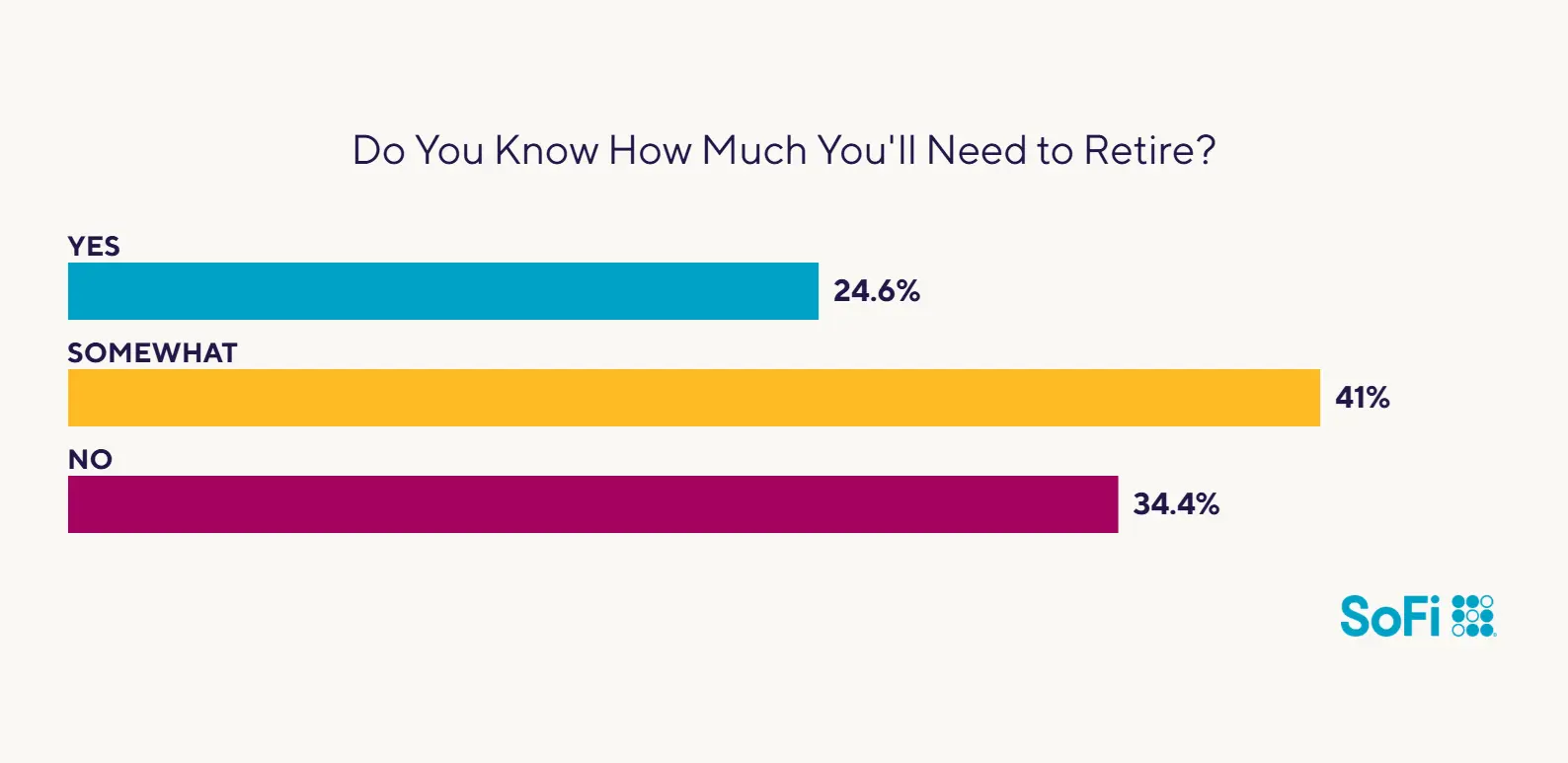
Many Americans aren’t sure where to begin when it comes to figuring out the exact amount they’ll need. In a 2024 SoFi Retirement Survey, 75% of adults don’t know how much they will need to retire. Just 1 in 4 have done the calculations to determine the amount, while 41% have a general sense, and 34% have no idea how much they’ll need for retirement.

do you know how much you need to retire - sofi retirement survey results
Source: SoFi’s 2024 Retirement Survey

Fortunately, there are some rules of thumb to consider to help determine retirement savings.

1. Retirement Savings Targets by Age

If you’re just starting out in life, you might think that with retirement decades away that you don’t have to worry about it. But the sooner you start saving for retirement, the better off you’ll be. Here are a few rough targets for how much you should have saved at certain ages:

By Age…

You should target saving this much

30 1X your salary
40 3X your salary
50 6X your salary
60 8X your salary
67 10X your salary

Source: Fidelity, “When Can I Retire”

These should only be considered as very rough guidelines — for more detailed retirement targets, consider working with a financial advisor.

retirement savings target by age

2. The 80% Rule

One basic guideline is known as the 80% rule, which says you should aim to replace 80% of your pre-retirement income. So, if you earn $100,000, you’ll need about $80,000 per year when you retire.

This is only meant as a guideline, but it has been called into question by some experts as being too high. As the thinking goes, your expenses decline in retirement, largely because you’re no longer saving for retirement, nor are you commuting.

Others have said workers should aim to replace 100% of their pre-retirement income, owing to inflation.

3. The 4% Rule

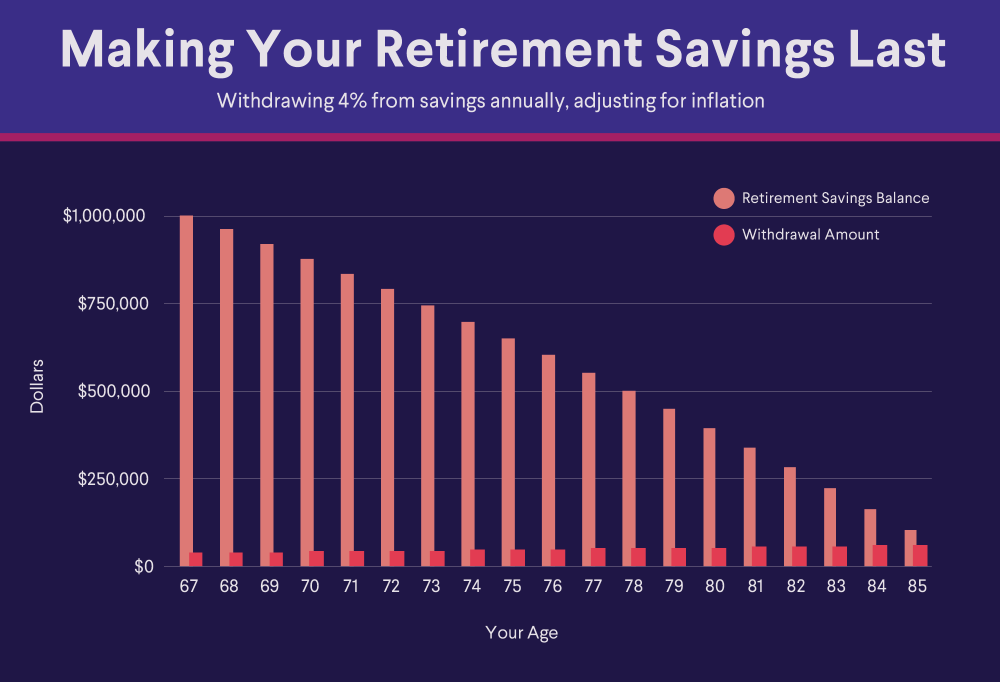
Another popular rule of thumb is the 4% rule, which says that you can take your projected annual retirement expenses and divide them by 4% (0.04) to know how much money you’ll need before you can safely retire.

If you project annual expenses of $50,000, you’ll need $1,250,000 (which is $50,000 divided by 0.04). Then each year you could withdraw 4% (indexed for inflation), which would come mostly if not completely from the appreciation of the portfolio.

Since the 4% rule was introduced in 1994, other advisors have said that it is not conservative enough, due partly to increased longevity, and have suggested 3.33% or even 3.7% might be more appropriate.

example of the 4 percent rule


💡 Quick Tip: Did you know that opening a brokerage account typically doesn’t come with any setup costs? Often, the only requirement to open a brokerage account — aside from providing personal details — is making an initial deposit.

Are You Currently Saving Enough?

First, take a good long look at how much you’re putting away for retirement. Have you reached —or come close to — the goal of saving 15% to 20% of your income? Unfortunately, many people have not.

In the SoFi Retirement Survey, just 17% of respondents say they’re putting 15% or more of their income toward retirement. The majority are contributing much less. Here’s how the numbers break down:

Retirement Contributions

•   49% contribute less than 10% of their income

•   23% contribute less than 5% of their income

•   17% contribute 15% or more of their income

Of those who are contributing 15% or more of their income to retirement savings, 50% have a household income of $100,000 or more. The older they get, the more likely survey respondents are to contribute. While 32% of those aged 25 to 34 put at least 15% of their income toward retirement savings, the number jumps to 60% for those aged 25 to 44.

Factors That Impact How Much Retirement Savings You’ll Need

factors to consider when saving for retirement

When considering how much you’ll need to retire, here are a few things that you will want to keep in mind:

Age You Plan to Retire

In simple terms, your retirement age is the age when you decide to retire. For example, you might set your target retirement date as 62 or 65 or 66 — all of which are related to Social Security benefits in some way.

Social Security has largely shaped how we view retirement age in the U.S. because that monthly payout is what enables the majority of people to leave work. Ninety-seven percent of adults ages 60 or older receive Social Security, according to a 2024 estimate by the Social Security Administration. And most people ages 65 and older say Social Security is the majority of their income, according to an analysis by the Center on Budget and Policy Priorities, a nonpartisan research and policy institute.

While retiring at 62 is the earliest age when you can claim Social Security, that’s not your “full retirement age” – 67 is generally considered the full retirement age for those born in 1960 or later.

Pre-Retirement Income

Some financial planners suggest that you base your retirement projections on your pre-retirement income. You might use 70%, 75%, or 80% of your current income as a basis for estimating how much money you’ll need in retirement.

For a more detailed look, go through your budget and see how each type of expense will change in retirement. You may need more or less income than you think.

Retirement Lifestyle Goals

Another thing to think about is how your lifestyle overall might change in retirement. Consider whether you plan to move or make other big lifestyle changes that can impact both expenses and taxes. While some costs may go down (such as if you pay off the mortgage on your home), others might go up as you change your lifestyle.

As one example, if you want to explore the world or visit grandchildren, your travel budget may drastically increase from pre-retirement levels.

Social Security

Social Security benefits can provide a vital supplement to your retirement income and help you get closer to financial security. However, it’s critical to understand that the amount of your benefit will vary depending on your age.

The earliest you can start receiving Social Security Benefits is age 62, but your benefits will be reduced by as much as 30% if you take them that early — and they will not increase as you age.

If you wait until your full retirement age (FRA) you can begin receiving full benefits. Your full retirement age is based on the year you were born. For example, if you were born in 1960 or later, your full retirement age is 67. You can find a detailed chart of retirement ages on the Social Security website.

But here is the real Social Security bonus: If you can put off claiming your Social Security benefits until age 70, perhaps by working longer or working part time, the size of your benefits will increase considerably. Typically, for each additional year you wait to claim your benefits up to age 70, your benefits will grow by 8%.

Future Retirement Expenses

Creating an estimated budget can help you get a sense of what your retirement expenses might be. For example, you may know how much you’ll pay for things like housing, utilities, and food. But it’s also important to consider any future expenses that could require you to spend more each month in retirement.

Most people aren’t sure how much money they need to retire, according to SoFi’s retirement survey. Just one quarter of respondents say they know the amount they need.

•   41% have a rough estimate of how much they’ll need to retire comfortably

•   25% know how much they’ll need to retire comfortably

•   25% don’t know how much they’ll need to retire comfortably

Of those who don’t know how much they’ll need for retirement, about 40% are aged 45 or older.

That’s why it’s so important to start thinking now about the expenses you might face in retirement. The sooner you start planning and saving for these costs, the more time — and ideally, the more money — you may be able to stash away.

For instance, healthcare can be a major cost in retirement, especially if you retire early. At age 65, you will qualify for Medicare, but if you retire before then, you’ll need to make sure that you have a plan for covering healthcare costs in retirement. Even after qualifying for Medicare, you may still have significant health-related costs, depending on your specific medical situation. While Medicare can pay for many health-related issues, it doesn’t pay for all of them. Long-term nursing care is a big exclusion.

Purchasing long-term care insurance or a long-term care annuity could provide you with the necessary funds to cover those expenses, should you need nursing care. But if you don’t have either of those options in place, you’ll need to consider how you’ll fit long-term care costs into your retirement budget.

Inflation

Inflation eats away at the value of each individual dollar, including savings and investments, so it’s important to keep in mind the inflation rate for retirement planning. There are several strategies you can use when investing during inflation.

The cost of living in the future will be higher than it is today. For example, if rent costs $1,000 today, but next year inflation rises by 2.5%, that cost could rise to $1,025. Over a decade or more, that price could double or triple.

Closing the Gap Between Current Savings and Your Goal

If you realize that you have a gap between your current savings and where you think you need to be when you retire, it’s important to make a plan to address the gap. If you choose to do nothing, the gap will only grow wider.

You have three main ways to close the gap — either start saving more of your money or find a way to increase the returns your investments are earning. You can also consider making different choices about the sort of retirement you want.

Retirement Savings Accounts

You have many different ways that you can invest and save for retirement. Many employers have 401(k) accounts that give tax advantages for saving for retirement. On top of that, some employers offer matching funds when you contribute to a 401(k) account.

Another option can be to open an IRA, which you can set up on your own.

There are two main types: a traditional IRA and a Roth IRA. While both types let you contribute up to $7,000 yearly for 2025, with an additional catch-up contribution of $1,000 for those age 50 and older, and up to $7,500 for 2026, with an additional catch-up contribution of $1,100 for those 50 and older, one key difference is the way the two accounts are taxed: Traditional IRAs let you deduct your contributions up front and pay taxes on distributions when you retire, whereas Roth IRA contributions are not tax deductible, but you can withdraw money tax-free in retirement.

The Takeaway

It would be nice if there was a simple way to calculate the exact amount you need to retire on. Instead, think of your retirement amount as an ongoing series of calculations that you’ll refine as you get older, and as your thinking gets clearer.

There are some things you can predict, but many that you can’t — including the state of your health (or your spouse’s), the turns the market might take, or a change in priorities. All you can do is start early and save steadily for the retirement you hope to have one day.

Prepare for your retirement with an individual retirement account (IRA). It’s easy to get started when you open a traditional or Roth IRA with SoFi. Whether you prefer a hands-on self-directed IRA through SoFi Securities or an automated robo IRA with SoFi Wealth, you can build a portfolio to help support your long-term goals while gaining access to tax-advantaged savings strategies.

Help build your nest egg with a SoFi IRA.

FAQ

How much money do you need to retire with a $100,000 salary?

In order to determine how much money you need to retire with a certain amount of salary, you’ll need to make a few assumptions. For example, you can estimate that you’ll need 75% of your pre-retirement income after you retire and follow the 4% rule. That would mean you’ll need $1,875,000 to be able to retire.

If you change your assumptions, it will also change your numbers. If you follow the 80% rule, for instance, you would aim to replace 80% of your $100,000 pre-retirement income — or $80,000 per year.

How can I catch up on retirement savings if I’m behind?

There are two main ways to catch up on retirement savings if you’re not meeting the targets for where you want to be. The first is to increase the amount of money you’re saving each month. Upping your contributions can help close your retirement savings gap. The other would be to try to increase the investment returns that you are earning, though that may also come with increased risk or volatility.

Should I factor in Social Security when determining how much retirement income I’ll need?

It may not be prudent to count on Social Security as a major contributor to your retirement amount, especially if it’s still decades until your retirement date. Current projections indicate that the government may not be able to fully fund Social Security payments at some point fairly soon — a June 2025 report by the Social Security Board of Trustees indicates that this might happen by 2034. Social Security recipients are still likely to receive benefits, though those benefits may be reduced by around 23%, the report said.

It’s conceivable that Congress could take action to address the shortfall, but that’s impossible to know.

Can you comfortably retire with $1.5 million?

Deciding whether $1.5 million is enough for you to comfortably retire depends a lot on your standard of living and annual retirement expenses. Using the 4% rule says that a nest egg of $1.5 million would give an annual amount of $60,000. Depending on the cost of living in your area and your own standard of living, that may be enough to retire comfortably.

Am I on track to retire comfortably?

To gauge if you are on track with your retirement savings, you can use a couple of general guidelines. The 80% rule says you will need 80% of your pre-retirement income per year when you retire. Another guideline recommends having 10 times your annual salary saved by the time you’re 67.

But you also need to factor in your personal financial situation, as well as your retirement goals to determine if you can retire comfortably. Depending on your circumstances, you may need to save more or less than the guidelines recommend.


Photo credit: iStock/Yaroslav Astakhov

INVESTMENTS ARE NOT FDIC INSURED • ARE NOT BANK GUARANTEED • MAY LOSE VALUE

SoFi Invest is a trade name used by SoFi Wealth LLC and SoFi Securities LLC offering investment products and services. Robo investing and advisory services are provided by SoFi Wealth LLC, an SEC-registered investment adviser. Brokerage and self-directed investing products offered through SoFi Securities LLC, Member FINRA/SIPC.

For disclosures on SoFi Invest platforms visit SoFi.com/legal. For a full listing of the fees associated with Sofi Invest please view our fee schedule.

Financial Tips & Strategies: The tips provided on this website are of a general nature and do not take into account your specific objectives, financial situation, and needs. You should always consider their appropriateness given your own circumstances.

Disclaimer: The projections or other information regarding the likelihood of various investment outcomes are hypothetical in nature, do not reflect actual investment results, and are not guarantees of future results.

Third-Party Brand Mentions: No brands, products, or companies mentioned are affiliated with SoFi, nor do they endorse or sponsor this article. Third-party trademarks referenced herein are property of their respective owners.

Third Party Trademarks: Certified Financial Planner Board of Standards Center for Financial Planning, Inc. owns and licenses the certification marks CFP®, CERTIFIED FINANCIAL PLANNER®

External Websites: The information and analysis provided through hyperlinks to third-party websites, while believed to be accurate, cannot be guaranteed by SoFi. Links are provided for informational purposes and should not be viewed as an endorsement.

SOIN-Q325-044
CN-Q425-3236452-42

Read more
TLS 1.2 Encrypted
Equal Housing Lender