woman on smartphone

SEP IRA vs SIMPLE IRA: Differences & Pros and Cons

One of the most common retirement plans is an IRA, or individual retirement account, which allows individuals to contribute and save money for retirement over time. The money can be withdrawn during retirement to cover living expenses and other costs.

There are several different types of IRAs. Two of the most popular types are the Roth IRA and the Traditional IRA.

Perhaps less well-known are the SEP IRA and the SIMPLE IRA. These IRAs are designed for business owners, sole proprietors, and the self-employed.

For small business owners who would like to offer their employees — and themselves — a retirement savings plan, a SEP IRA and a Simple IRA can be options to explore. According to a 2023 study by Fidelity, only 34% of small business owners offer their employees a retirement plan. This is because they believe they can’t afford to do so (48%), are too busy running their company to do it (22%), or don’t know how to start (21%). SEP or Simple IRAs are generally easy to set up and manage and have lower fees than other types of accounts.

There are a number of similarities and differences between the SEP IRA vs. the SIMPLE IRA. Exploring the pros and cons of each and comparing the two plans can help self-employed people, small business owners, and also employees make informed decisions about retirement savings.

How SEP IRAs Work

A SEP IRA, or Simplified Employee Pension IRA, is a retirement plan set up by employers, sole proprietors, and the self-employed. Although SEP IRAs can be used by any size business, they are geared towards sole proprietors and small business owners. SEP IRAs are typically easy to set up and have lower management fees than other types of retirement accounts.

Employers make contributions to the plan for their employees. They are not required to contribute to a SEP every year. This flexibility can be beneficial for businesses with fluctuating income because the employer can decide when and how much to contribute to the account.

Employers can contribute up to 25% of an employee’s annual salary or $70,000 in 2025, whichever is less. In 2026, employers can contribute up to $72,000 or 25% of an employee’s salary, whichever is less. The employer and all employees must receive the same rate of contribution.

Employees cannot make contributions to their SEP accounts.

💡 Quick Tip: All investments come with some degree of risk — and some are riskier than others. Before investing online, decide on your investment goals and how much risk you want to take.

SEP IRA Pros and Cons

There are advantages to a SEP IRA, but there are disadvantages as well. Here are some of the main benefits and drawbacks to be aware of.

Pros

The pros of a SEP IRA include:

•   A SEP IRA is an easy way for a small business owner or self-employed individual to set up a retirement plan.

•   The contribution limit is higher than that for a SIMPLE IRA. In 2025, the contribution limit is $70,000 to a SEP IRA, and in 2026, the contribution limit is $72,000.

•   Employers can deduct contributions to the account from their taxes up to certain amounts, and employees don’t have to include the contributions in their gross income. The money in the account is tax-deferred, and employees don’t pay taxes on the money until it gets withdrawn.

•   For self-employed individuals, a SEP IRA may help reduce certain taxes, such as self-employment tax.

•   An employer isn’t required to make contributions to a SEP IRA every year. This can be helpful if their business has a bad year, for example.

•   For employees, the money in a SEP is immediately 100% vested, and each employee manages their own assets and investments.

•   Having a SEP IRA does not restrict an individual from having other types of IRAs.

Cons

There are some drawbacks to a SEP IRA for employees and employers. These include:

•   Employees are not able to make contributions to their own SEP accounts.

•   Individuals cannot choose to pay taxes on the contributions in their SEP now, even if they’d like to.

•   Employers must contribute the same percentage to all employees’ SEP accounts that they contribute to their own account.

•   There are no catch-up contributions for those 50 and older.

How SIMPLE IRAs Work

SIMPLE IRAs, or Savings Incentive Match Plan for Employees Individual Retirement Accounts, are set up for businesses with 100 or fewer employees. Unlike the SEP IRA, both the employer and the employees can contribute to a SIMPLE IRA.

Any employee who earns more than $5,000 per year (and has done so for any two- year period prior to the current year) is eligible to participate in a SIMPLE IRA plan. Employees contribute pre-tax dollars to their plan — and they may have the funds automatically deducted from their paychecks.

Employers are required to contribute to employee SIMPLE IRAs, and they may do so in one of two ways. They can either match employee contributions up to 3% of the employee’s annual salary, or they can make non-elective contributions whether the employee contributes or not. If they choose the second option, the employer must contribute a flat rate of 2% of the employee’s salary up to a limit of $350,000 in 2025, and up to a limit of $360,000 in 2026.

Both employer contributions and employee salary deferral contributions are tax-deductible.

As of 2025, the annual contribution limit to SIMPLE IRAs is $16,500. Workers age 50 and up can contribute an additional $3,500. In 2026, the annual contribution limit is $17,000, and workers age 50 and up can contribute an additional $4,000.

SIMPLE IRA Pros and Cons

There are benefits and drawbacks to a SIMPLE IRA.

Pros

These are some of the pros of a SIMPLE IRA:

•   A SIMPLE IRA is a way to save for retirement for yourself and your employees. And the plan is typically easy to set up.

•   Both employees and employers can make contributions.

•   Money contributed to a SIMPLE IRA may grow tax-deferred until an individual withdraws it in retirement.

•   For employees, SIMPLE IRA contributions can be deducted directly from their paychecks.

•   Employers can choose one of two ways to contribute to employees’ plans — by either matching employee contributions up to 3% of the employee’s annual salary, or making non-elective contributions of 2% of the employee’s salary up to an annual compensation limit.

•   Employees are immediately 100% vested in the SIMPLE IRA plan.

•   A SIMPLE IRA has higher contribution limits compared to a traditional or Roth IRA.

•   Catch-up contributions are allowed for those 50 and up.

Cons

SIMPLE IRAs also have some drawbacks, including:

•   A SIMPLE IRA is only for companies with 100 employees or fewer.

•   Employers are required to fund employees’ accounts.

•   The SIMPLE IRA contribution limit ($16,500 in 2025, and $17,000 in 2026) is much lower than the SEP IRA contribution limit ($70,000 in 2025, and $72,000 in 2026).

Main Differences Between SEP and Simple IRAs

While SEP IRAs and SIMPLE IRAs share many similarities, there are some important differences between them that both employers and employees should be aware of.

Eligibility

On the employer side, a business of any size is eligible for a SEP IRA. However, SIMPLE IRAs are for businesses with no more than 100 employees.

For employees to be eligible to participate in a SIMPLE IRA, they must earn $5,000 or more annually and have done so for at least two years previously. To be eligible for a SEP IRA, an employee must have worked for the employer for at least three of the last five years and earned at least $750.

Who Can Contribute

Only employers may contribute to a SEP IRA. Employees cannot contribute to this plan.

Both employers and employees can contribute to a SIMPLE IRA. Employers are required to contribute to their employees’ plans.

Contribution limits

Employers are required to contribute to employee SIMPLE IRAs either by matching employee contributions up to 3% of the employee’s annual salary, or making non-elective contributions of 2% of the employee’s salary up to a limit of $350,000 in 2025, and up to a limit of $360,000 in 2026.

With a SEP IRA, employers can contribute up to 25% of an employee’s annual salary or $70,000 in 2025, whichever is less. In 2026, an employer can contribute up to 25% of an employee’s annual salary or $72,000, whiever is less. A business owner and all employees must receive the same rate of contribution. Employers are not required to contribute to A SEP plan every year.

Taxes

For both SEP IRAS and SIMPLE IRAs, contributions are tax deductible. Individuals typically pay taxes on the money when they withdraw it from the plan.

Vesting

All participants in SIMPLE IRAs and SEP IRAS are immediately 100% vested in the plan.

Paycheck Deductions

Employees contributing to a SIMPLE IRA can have their contributions automatically deducted from their paychecks.

Employees cannot contribute to a SEP IRA, thus there are no paycheck deductions.

Withdrawals

For both SEP IRAs and SIMPLE IRAS, participants may withdraw the money penalty-free at age 59 ½ . Withdrawals are taxable in the year they are taken.

If an individual makes an early withdrawal from a SEP IRA or a SIMPLE IRA, they will generally be subject to a 10% penalty. For a SIMPLE IRA, if the withdrawal is taken within the first two years of participation in the plan, the penalty is raised to 25%.

SEP IRAs may be rolled over into other IRAs or certain other retirement plans without penalty. SIMPLE IRAs are eligible for rollovers into other IRAs without penalty after two years of participation in the plan. Before then, they may only be rolled over into another SIMPLE IRA.

Here’s an at-a-glance comparison of a SEP IRA vs. SIMPLE IRA:

SEP IRA

SIMPLE IRA

Eligibility Businesses of any size

Employee must have worked for the employer for at least three of the last five years and earn at least $750 annually

Business must have no more than than 100 employees

Employees must earn $5,000 or more per year and have done so for two years prior to the current year

Who can contribute Employers only Employers and employees (employers are required to contribute to their employees’ plans)
Contribution limits Employers can contribute up to 25% of an employee’s annual salary or $70,000 in 2025, and up to $72,000 in 2026, whichever is less

No catch-up contributions

$16,500 per year in 2025, and $17,000 in 2026

Catch-up contributions of $3,500 for those 50 and up in 2025 and $4,000 for those 50 and up in 2026

Taxes Contributions are tax deductible. Taxes are paid when the money is withdrawn Contributions are tax deductible. Taxes are paid when the money is withdrawn
Vesting 100% immediate vesting 100% immediate vesting
Paycheck deductions No (employees cannot contribute to the plan) Yes
Withdrawals Money can be withdrawn without penalty at age 59 ½. There is generally a 10% penalty if money is withdrawn early, before age 59 ½ Money can be withdrawn without penalty at age 59 ½. There is generally a 10% penalty if money is withdrawn early, before age 59 ½ (or 25% if the account has been open for less than 2 years)

The Takeaway

Both the SEP IRA and the SIMPLE IRA were created to help small business owners and their employees save for retirement. Each account may benefit employers and employees in different ways.

With the SEP IRA, the employer (including a self-employed person) contributes to the plan. They are not required to contribute every year. With the SIMPLE IRA, the employer is required to contribute, and the employee may contribute but can choose not to.

In addition to these plans, there are other ways to save for retirement. For instance, individuals can contribute to their own personal retirement plans, such as a traditional or Roth IRA, to help save money for their golden years. Just be sure to be aware of the contribution limits.

Prepare for your retirement with an individual retirement account (IRA). It’s easy to get started when you open a traditional or Roth IRA with SoFi. Whether you prefer a hands-on self-directed IRA through SoFi Securities or an automated robo IRA with SoFi Wealth, you can build a portfolio to help support your long-term goals while gaining access to tax-advantaged savings strategies.

Easily manage your retirement savings with a SoFi IRA.


Third-Party Brand Mentions: No brands, products, or companies mentioned are affiliated with SoFi, nor do they endorse or sponsor this article. Third-party trademarks referenced herein are property of their respective owners.

Tax Information: This article provides general background information only and is not intended to serve as legal or tax advice or as a substitute for legal counsel. You should consult your own attorney and/or tax advisor if you have a question requiring legal or tax advice.

Financial Tips & Strategies: The tips provided on this website are of a general nature and do not take into account your specific objectives, financial situation, and needs. You should always consider their appropriateness given your own circumstances.

INVESTMENTS ARE NOT FDIC INSURED • ARE NOT BANK GUARANTEED • MAY LOSE VALUE

SoFi Invest is a trade name used by SoFi Wealth LLC and SoFi Securities LLC offering investment products and services. Robo investing and advisory services are provided by SoFi Wealth LLC, an SEC-registered investment adviser. Brokerage and self-directed investing products offered through SoFi Securities LLC, Member FINRA/SIPC.

For disclosures on SoFi Invest platforms visit SoFi.com/legal. For a full listing of the fees associated with Sofi Invest please view our fee schedule.

SOIN0124022
CN-Q425-3236452-26

Read more

What to Do About Excess Contributions to a Roth IRA

If you contribute more than the annual allowable limit to a Roth IRA given your income and tax filing status, you need to withdraw the excess amount or face a 6% penalty.

The good news is that it’s possible to withdraw or transfer excess IRA contributions. Knowing how to fix this mistake — and how to best plan yearly contributions — can help you to avoid an excess IRA contribution penalty going forward. 

Note that the rules are generally the same for excess contributions to a traditional IRA or to a Roth IRA.

Key Points

•   Excess contributions to a Roth IRA incur a 6% penalty each year they remain in your account.

•   You can withdraw excess contributions before the tax filing deadline (or extension deadline) to avoid penalties.

•   Report excess IRA contributions on IRS Form 5329, which you include with your Form 1040 when you file your return or an extension.

•   If you don’t wish to withdraw excess contributions, you may be able to recharacterize — or shift them — to another type of IRA before the deadline.

•   You may also be able to apply excess contributions to future years within the allowed limits to avoid penalties.

Maximum Annual Roth IRA Contributions

If you don’t know what a Roth IRA is, it’s a tax-advantaged individual retirement account. Contributions to a Roth are made with after-tax dollars, and qualified withdrawals from a Roth IRA are tax-free, which can make them attractive for people who expect to be in a higher tax bracket when they retire — or who want a tax-free income source later in life. 

You can contribute to both a Roth IRA and a workplace retirement plan like a 401(k), at the same time, as long as you observe the contribution limits for each type of account, and as long as you qualify for a Roth IRA.

Whether you’re eligible to contribute to a Roth IRA depends on your tax filing status and income (see chart below). Roth IRA contribution limits are set by the IRS and adjusted periodically for inflation. 

The contribution limit for a Roth IRA in 2025 is $7,000 per year, while those 50 and up can contribute up to $8,000 per year. In 2026, the contribution limited is $7,500, and those 50 and up can contribute up to $8,600. These annual limits are the same, whether you’re saving in a traditional IRA vs. Roth IRA, and these are total amounts across all IRA accounts.

Here’s how Roth IRA income limits and contribution rules work for 2025 and 2026.

Filing Status

2025: If your Modified Adjusted Gross Income (MAGI) is …

2026: If your Modified Adjusted Gross Income (MAGI) is …

You can contribute…

Married filing jointly or qualifying widow(er)

< $236,000

≥ $242,000 and < $252,000

Up to a maximum of $7,000 per year ($8,000 for those 50 and older) in 2025; up to $7,500 ($8,600 for those 50 and up in 2026).

Married filing jointly or qualifying widow(er)

≥ $236,000 and < $246,000

≥ $246,000 and < $252,000

a reduced amount

Married filing jointly or qualifying widow(er)

≥  $246,000

≥  $252,000

Not eligible to contribute to a Roth

Married filing separately and you lived with your spouse at any time during the year

< $10,000

< $10,000

a reduced amount

Married filing separately and you lived with your spouse at any time during the year

≥ $10,000

≥ $10,000

Not eligible

Single, head of household, or married filing separately and you did not live with your spouse at any time during the year

< $150,000

< $153,000

up to the limit

Single, head of household, or married filing separately and you did not live with your spouse at any time during the year

≥ $150,000 and < $165,000

≥ $153,000 and < $168,000

a reduced amount

Single, head of household, or married filing separately and you did not live with your spouse at any time during the year

≥ $165,000

≥ $168,000

Not eligible

What Happens If You Contribute Too Much to a Roth IRA?

Opening an IRA can get help you save for retirement. The downside is that contributing too much money to a Roth IRA (or traditional IRA) can result in a tax penalty. An excess contribution to an IRA can happen when:

•   You contribute more than the annual contribution limit because you have multiple IRAs.

•   You make an improper rollover contribution. 

•   You inadvertently contribute more than the amount allowed for your income and filing status.

•   You made a contribution early in the year, but you ended up earning more than anticipated, which changed the amount you would be allowed to contribute.

Excess IRA contributions are subject to a 6% penalty each year that they remain in your account. Per the IRS: “The tax can’t be more than 6% of the combined value of all your IRAs as of the end of the tax year.” 

If you’ve contributed too much to your Roth IRA, there are some steps you can take to rectify this mistake. 

How Do You Report Excess Roth IRA Contributions?

Excess IRA contributions are reported on IRS Form 5329. You’ll include this form with your Form 1040 when you file your return or an extension. 

This form allows the IRS to calculate how much of a tax penalty you’ll owe if you don’t take steps to correct an excess Roth IRA contribution. 

Can You Withdraw Excess Roth IRA Contributions?

If you realize that you contributed too much before you file your tax return, you can avoid the tax penalty by withdrawing the excess Roth IRA contribution by the tax filing deadline, or by the extension deadline. Any excess amounts withdrawn before the tax filing or extension deadline, would not be subject to the 6% penalty. 

That said: If those excess contributions generated investment gains while in your IRA account, you’d have to withdraw the gains as well. And you would have to report them as income. 

However, as of Dec. 29, 2022, a “corrective distribution” — meaning, a withdrawal of the gains on an excess contribution — is no longer subject to a 10% early withdrawal penalty.

You can contact your IRA custodian (the bank that holds your IRA account) if you’re not sure how to withdraw excess amounts. Keep in mind that you’ll need to withdraw the excess contribution amount as well as any earnings those contributions generated. 

You may owe tax on the earnings from the excess contribution amount (see below for possible ways to avoid this). There are no guarantees that a Roth contribution would see a gain, however; if there is a net loss, you could still withdraw the remainder of your contribution, minus the loss.

If you’ve already filed your taxes, you have up to six months — usually until October 15 of the same year — to amend your return and make the necessary withdrawals. 

Recharacterizing Excess Roth IRA Contributions

Recharacterizing IRA contributions allows you to move assets deposited in one IRA to a second IRA, and treat that money as if it had originally been contributed to the second IRA. 

If you have excess contributions because you contributed more than was allowed based on your income and filing status, recharacterization could allow you to avoid a tax penalty. You would transfer the excess contribution from one IRA to the second IRA by the tax-filing or extension deadline, doing a direct transfer within the same institution, or a trustee-to-trustee transfer to an IRA at another bank (not a withdrawal, which could be subject to additional taxes and/or a penalty).

For example: If you made excess contributions to an IRA for tax year 2024, you have until April 15, 2025 to recharacterize the excess contribution and earnings (or net loss); or until the extension deadline in October. 

If you made excess contributions in prior years, you couldn’t recharacterize these, as the window for recharacterization would have passed, and you’d likely owe a penalty. 

In order to complete a recharacterization of the excess funds, you must take the following steps: 

•   Include any earnings specific to the excess amount. If there was a loss attributable to that contribution, you would note a negative amount. 

•   Be sure to report the recharacterization on your tax return for the year in which you made the original excess contribution. 

•   Use the date of the excess contribution to the first IRA as the date the contribution is made to the second IRA.

Applying Excess Contributions to the Following Year

The IRS also allows you to carry excess Roth IRA contributions forward. You can apply excess contributions to your annual contribution limit for future years. 

Again, the contributions you carry forward must be within your allowed limit for that following year. Be sure to check, so as not to create excess contributions in a subsequent year. 

Penalties for Excess Roth IRA Contributions

As mentioned, the IRS imposes a penalty on excess Roth IRA contributions in the form of a 6% tax, as of 2024. It applies each year that excess Roth IRA contributions remain in your account. 

Keep in mind that you might also owe ordinary income tax on any earnings on that contribution amount as well. 

When Are Excess Contributions Penalized?

Excess Roth IRA contributions are penalized when they’re not corrected. The IRS will continue to penalize you for each year that you allow the excess contributions to remain in your IRA. That rule goes for both Roth and traditional IRA contributions. 

Again, if you haven’t filed your tax return yet, the simplest way to correct them and avoid the penalty is to withdraw the excess amounts, plus any gains. As long as you do that by the tax-filing deadline or extension deadline, then the IRS doesn’t consider those amounts to be excess contributions. 

How to Avoid Excess IRA Contributions

Avoiding excess IRA contributions is possible if you understand how much you’re able to contribute each year, then planning your contributions accordingly. With Roth IRA contributions, your contribution amount will depend on your tax filing status and modified AGI for the tax year. 

You can use a tax calculator to estimate your modified AGI and use that to plan your contributions. Remember that you have until the April tax-filing deadline to make IRA contributions for the current tax year.

The extra few months allow you time to prepare your return and make your contributions — or withdraw them if necessary — to stay within your annual contribution limit. 

Calculating Excess Contributions

While you have until tax day in April of the following year to contribute to a Roth IRA for the current tax year, the income you use to determine the amount of your allowable Roth contribution is based only on the current tax year, which ends on December 31.

Example: To determine whether your modified AGI is within allowable Roth IRA limits for 2025, you would calculate your compensation from Jan. 1 to Dec. 31, 2025.

If you’re married, filing jointly for tax year 2025, your MAGI must be less than $236,000 in order to make a full contribution of $7,000 ($8,000 if you’re 50 and up). From $236,000 up to $246,000 you can only make a partial contribution. If you earn $246,000 or more, you are not eligible to contribute to a Roth IRA.

If you’re married, filing jointly for tax year 2026, your MAGI must be less than $242,000 in order to make a full contribution of $7,500 ($8,600 if you’re 50 and up). From $242,000 up to $252,000 you can only make a partial contribution. If you earn $252,000 or more, you are not eligible to contribute to a Roth IRA.

If you need help to determine your allowable contribution, you can use an Roth IRA contribution calculator to estimate what you can save. You may want to consult with a tax professional if you have any questions.

The Takeaway

A Roth IRA can be a useful tool for retirement planning, but it’s important to keep track of how much you’re saving. All IRAs, including Roth IRAs, have strict annual contribution limits. Making excess Roth IRA contributions could result in an unexpected — and costly — tax penalty. 

Prepare for your retirement with an individual retirement account (IRA). It’s easy to get started when you open a traditional or Roth IRA with SoFi. Whether you prefer a hands-on self-directed IRA through SoFi Securities or an automated robo IRA with SoFi Wealth, you can build a portfolio to help support your long-term goals while gaining access to tax-advantaged savings strategies.

Easily manage your retirement savings with a SoFi IRA. 

FAQ

What happens if you accidentally contribute too much to a Roth IRA?

If you make excess Roth IRA contributions the IRS can assess a tax penalty of 6% each year that they remain in your account. You can avoid the tax penalty by withdrawing excess amounts, recharacterizing them, or carrying them ahead for future tax years. 

How do you correct excess Roth IRA contributions?

The easiest way to correct an excess Roth IRA contribution is to withdraw the excess amount, along with any interest earned. You can do that before the tax filing deadline, including extension deadlines, to avoid the IRS tax penalty. You cannot correct or recharacterize excess contributions once the tax-filing and extension deadlines have passed for the relevant tax year.

What is the penalty for excess IRA contributions?

A 6% tax applies to excess IRA contributions. The penalty applies each year that the excess contributions remain in your retirement account.


About the author

Rebecca Lake

Rebecca Lake

Rebecca Lake has been a finance writer for nearly a decade, specializing in personal finance, investing, and small business. She is a contributor at Forbes Advisor, SmartAsset, Investopedia, The Balance, MyBankTracker, MoneyRates and CreditCards.com. Read full bio.


Photo credit: iStock/mixetto

INVESTMENTS ARE NOT FDIC INSURED • ARE NOT BANK GUARANTEED • MAY LOSE VALUE

SoFi Invest is a trade name used by SoFi Wealth LLC and SoFi Securities LLC offering investment products and services. Robo investing and advisory services are provided by SoFi Wealth LLC, an SEC-registered investment adviser. Brokerage and self-directed investing products offered through SoFi Securities LLC, Member FINRA/SIPC.

For disclosures on SoFi Invest platforms visit SoFi.com/legal. For a full listing of the fees associated with Sofi Invest please view our fee schedule.

Tax Information: This article provides general background information only and is not intended to serve as legal or tax advice or as a substitute for legal counsel. You should consult your own attorney and/or tax advisor if you have a question requiring legal or tax advice.

Financial Tips & Strategies: The tips provided on this website are of a general nature and do not take into account your specific objectives, financial situation, and needs. You should always consider their appropriateness given your own circumstances.

Disclaimer: The projections or other information regarding the likelihood of various investment outcomes are hypothetical in nature, do not reflect actual investment results, and are not guarantees of future results.

SOIN0423007
CN-Q425-3236452-15

Read more
couple looking at view

Can You Have a Joint Retirement Account?

No matter what stage of life you’re in, it’s likely that planning for retirement may be looming in the back of your mind. And that’s a good thing: According to the Center for Retirement Research, 39% of households are at risk for not having enough to maintain their living standards in retirement.

One way to start your retirement savings plan is to work shoulder-to-shoulder with your partner. You’ve no doubt heard of joint checking accounts, but what about joint retirement accounts – is there such a thing? Unfortunately, no. But while retirement plans like a 401(k) or IRA do not allow for multiple owners, there are ways couples can plan their retirement savings together.

Key Points

•   Joint retirement accounts are not available, but couples can coordinate their retirement planning.

•   Reviewing retirement goals together helps couples align their financial strategies for the future.

•   Each spouse can name the other as a beneficiary on their individual retirement accounts to ensure shared access to funds.

•   Couples can each have their own IRAs and contribute based on their joint taxable income.

•   Spousal IRAs allow a non-working spouse to contribute to an IRA, provided the other spouse has earned income.

How Couples Can Plan Together for Retirement

Although there are no joint retirement account options, you can prepare for your golden years together by combining retirement forces. Here’s how.

Review Your Retirement Goals as a Couple

Talking openly and honestly about your finances is one of the keys to building a healthy financial plan. A good first step is to have a productive conversation about your plans and goals for retirement with your significant other. Do you plan on staying in the same home during your retirement years? Perhaps you want to travel internationally once per year or buy a camper and travel across the country.

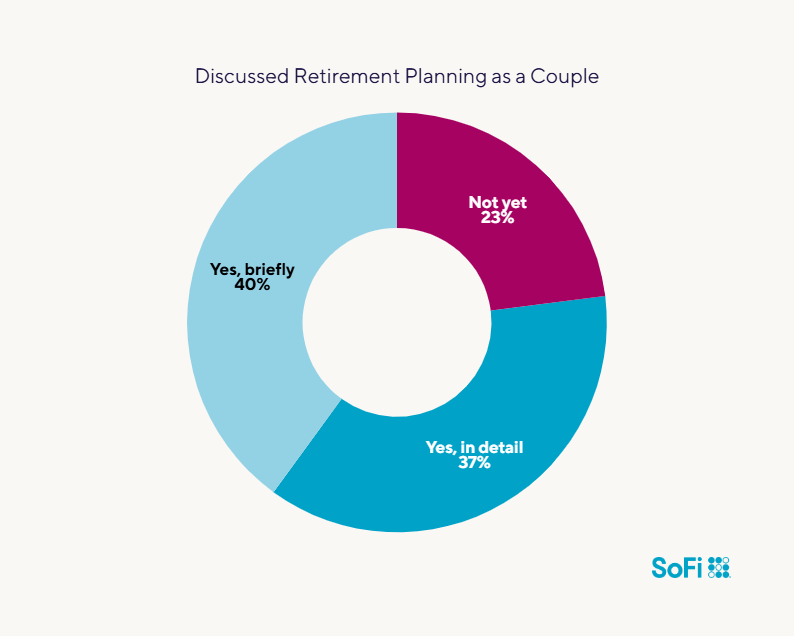
Many couples are talking about retirement early in their relationship. According to SoFi’s 2024 Love & Money Survey of 600 adults in the U.S. who have been married less than one year, 77% have discussed planning for retirement, including 37% who have talked about it in detail.

Source: SoFi’s 2024 Love & Money Survey

Determine the amount of money you want in retirement, too. While of course each couple’s retirement number is dependent upon their standard of living, you can calculate an estimate: Start with your current income, subtract estimated Social Security benefits, and divide by 0.04 to get your target number in today’s dollars.

Once you’ve put the numbers together and have a sense of how much you need to retire, you can figure out what you can safely withdraw to make your retirement last as long as you do.

💡 Quick Tip: Did you know that you must choose the investments in your IRA? Once you open an IRA and start saving, you get to decide which mutual funds, ETFs, or other investments you want — it’s totally up to you.

Determine When Both of You Will Retire

Do you know when you will retire? How about your partner? Remember, retirement plans like 401(k)s and IRAs generally cannot be withdrawn from penalty-free until you reach age 59 ½.

If you or your partner do plan to retire earlier than 59 ½, it might make sense to put some of your retirement funds into a taxable brokerage account that you can access at any time.

Name Your Spouse as a Beneficiary

While there are many ways to start saving for retirement, unfortunately, there aren’t any options that operate as a joint retirement account by default. A work-around to this is for each of you to name your spouse as a beneficiary in your retirement account. If something were to happen to one of you, the other person would still have access to your accounts and the money in it.

Your Top Questions About Joint Retirement, Answered

These are some of the biggest questions couples have when it comes to joint retirement.

Can both spouses contribute to a 401(k)?

No — only one spouse can contribute to a 401(k) account. 401(k)s are employer-sponsored plans. So just the spouse who works at the company offering the plan can participate in it and contribute to it.

However, the other spouse can be a beneficiary of the plan. This means that if the original planholder dies, the spouse gets the inherited 401(k) and can then roll it into their own 401(k) or into an IRA.

How much can a married couple contribute to a 401(k)?

As noted above, 401(k) plans are individual, with only one person contributing to each account (along with their employer, in some cases). The maximum annual 401(k) contribution allowed in 2025 is $23,500, with an additional catch-up contribution of $7,500 for those 50 and older — with a special “super catch-up” contribution limit of $11,250 for those aged 60 to 63 only. Those between age 60 and 63 could contribute $11,250 rather than $7,500, not in addition.

For 2026, the limits are $24,500 per year, and an additional $8,000 for those 50 and up — with the special “super catch-up” contribution limit of $11,250 for those aged 60 to 63 who could contribute $11,250 rather than $8,000.

With those figures in mind, in 2025 a married couple could each contribute $23,500 for a combined $47,000 per year, with the same catch-up provisions for those 50 and up, or 60 to 63. And in 2026, a married couple could each contribute $24,500 for a combined $49,000 per year, with the same catch-up contrbutions for those 50 and up, or 60 to 63.

How many IRAs can a married couple have?

If a couple is married and files their taxes jointly, each partner in the marriage can contribute to their own IRAs. There is a contribution limit, however — the total contributions to the IRAs “may not exceed your joint taxable income or the annual contribution limit on IRAs times two, whichever is less,” according to the IRS.

The annual IRA contribution limit is $7,000 for tax year 2025, so the total limit is $14,000 for the year. Those 50 and older can contribute an additional catch-up amount of $1,000 for 2025. The annual IRA contribution limit is $7,500 for tax year 2026, so the total limit is $15,000 for the year. Those 50 and older can contribute an additional catch-up amount of $1,100 for 2026. Note that the “super catch-up” amount does not apply to IRAs.

Recommended: How Many IRAs Can You Have?

Can my spouse contribute to an IRA if she doesn’t work?

Yes, a non-working spouse can open and contribute to an IRA (called a spousal IRA) as long as the other spouse is working and the couple files a joint federal income tax return. The spouse who doesn’t work can contribute up to the IRA limit of $7,000 in 2025 and $7,500 in 2026, plus $1,000 additional in catch-up contributions in 2025, and $1,100 in 2026, if they are 50 or older.

What is a spousal Roth IRA?

A spousal IRA is a Roth or traditional IRA for a spouse who doesn’t work. A couple must file their taxes as married filing jointly to be eligible for a spousal IRA. The spouse who doesn’t work can contribute up to the IRA limit of $7,000 in 2025, plus $1,000 additional in catch-up contributions if they are 50 or older. In 2026, the non-working spouse can contribute up to $7,500, plus an extra $1,100 in catch-up contributions if they are 50 or older.

Can a husband and wife both have a Roth IRA?

A husband and wife can each have their own separate Roth IRAs. Their total contributions to both IRAs must not exceed their joint taxable income, or the annual contribution limit to the IRAs, times two. For tax year 2025, each spouse can contribute $7,000 to separate Roth IRAs, making the total contribution limit $14,000 for those under age 50. Those 50 and up can each contribute an extra $1,000 if they choose. For tax year 2026, each spouse can contribute $7,500 to separate Roth IRAs, making the total contribution limit $15,000 for those under age 50. Those 50 and up can each contribute an extra $1,100 if they choose.

Can my non-working spouse have a Roth IRA?

Yes. Spousal IRAs can be traditional or Roth IRAs. In a Roth IRA, the money put into it is not tax deductible. Instead the money comes from taxable income but may grow tax free, so that an individual typically doesn’t have to pay taxes on the money that’s taken out of the account when they retire. While the contribution limits vary according to your tax filing and income status, typically the limit of contributions is the same as it is for traditional IRAs.

What is the maximum Roth contribution for a married couple?

In 2024, the annual limit for an IRA contribution is 7,000 per person, or $8,000 for those 50 and older. However, a Roth IRA has income limits. In 2024, a couple that is married filing jointly cannot contribute to a Roth IRA if their modified adjusted gross income (MAGI) is more than $240,000. Those with a MAGI between $230,000 and $240,000 can contribute a partial amount, and those whose income is less than $230,000 can contribute the full amount.

Should a married couple have two Roth IRAs?

Whether you should have two Roth IRAs is a personal decision. One consideration: Since a married couple cannot have a joint retirement account like a joint Roth IRA, if you each have a Roth IRA, you may be able to save more for retirement if you both contribute the full amount allowed to your separate IRAs. For 2024, that amount is $7,000 for those under age 50, and $8,000 for those 50 and up. However, your total contributions to both IRAs must not exceed your joint taxable income

The Takeaway

While no specific retirement savings plans — such as 401(k)s or IRAs — offer joint retirement accounts, there are ways for couples to plan and save for retirement together. One way is to each have your own separate IRAs that you contribute to. Another easy way to make sure you’re both taken care of in retirement is to make each other the beneficiaries on your individual accounts.

Prepare for your retirement with an individual retirement account (IRA). It’s easy to get started when you open a traditional or Roth IRA with SoFi. Whether you prefer a hands-on self-directed IRA through SoFi Securities or an automated robo IRA with SoFi Wealth, you can build a portfolio to help support your long-term goals while gaining access to tax-advantaged savings strategies.

Easily manage your retirement savings with a SoFi IRA.


Third-Party Brand Mentions: No brands, products, or companies mentioned are affiliated with SoFi, nor do they endorse or sponsor this article. Third-party trademarks referenced herein are property of their respective owners.

Financial Tips & Strategies: The tips provided on this website are of a general nature and do not take into account your specific objectives, financial situation, and needs. You should always consider their appropriateness given your own circumstances.

Tax Information: This article provides general background information only and is not intended to serve as legal or tax advice or as a substitute for legal counsel. You should consult your own attorney and/or tax advisor if you have a question requiring legal or tax advice.

INVESTMENTS ARE NOT FDIC INSURED • ARE NOT BANK GUARANTEED • MAY LOSE VALUE

SoFi Invest is a trade name used by SoFi Wealth LLC and SoFi Securities LLC offering investment products and services. Robo investing and advisory services are provided by SoFi Wealth LLC, an SEC-registered investment adviser. Brokerage and self-directed investing products offered through SoFi Securities LLC, Member FINRA/SIPC.

For disclosures on SoFi Invest platforms visit SoFi.com/legal. For a full listing of the fees associated with Sofi Invest please view our fee schedule.

Investment Risk: Diversification can help reduce some investment risk. It cannot guarantee profit, or fully protect in a down market.

SOIN0124060
CN-Q425-3236452-17

Read more
piggy bank on orange background

How Much Money Should I Have Saved by 30?

As you near 30, you probably have lots of different financial goals. Maybe you’re planning to buy a house. Or perhaps you’re considering starting a family. And while retirement may seem a long way off, it’s never too early to start saving and planning for your future.

You might know you want to save money for all these different things, but you don’t know exactly how much you should be saving. Chances are, you may have been wondering, how much money should I have saved by 30?

The good news is, money you save now can add up. And if you invest that money in a retirement account or an investment portfolio, you can get longer-term growth on your money.

First, though, it helps to know how much you should be saving by age 30 to see if you’re on track. Learn how much you should have saved — plus tips to help you reach your savings goals.

Average/Median Savings by Age 30

The average savings for individuals by age 30 is approximately $20,540, and their median savings is $5,400, according to the Federal Reserve’s most recent Survey of Consumer Finances. It’s important to note that the Fed’s survey doesn’t look specifically at people who are age 30. Instead, it divides them into groups, including 25 to 34 year olds.

These savings amounts are in what the Fed calls “Transaction Accounts.” This includes checking and savings accounts and money market accounts.

How Much Should a 30-Year-Old Have in Savings?

If you’re still asking yourself, how much money should I have saved by 30?, know this: By age 30, you should have the equivalent of your annual salary in savings, according to one rule of thumb. That means if you’re earning $54,000 a year, you should have $54,000 saved.

This number — $54,000 — is based on the average annual salary for those 25 to 34 years old, which is $54,080, according to 2023 data from the Bureau of Labor Statistics.

Strategies to Help You Reach Your Savings Goals by 30

If you don’t have $54,000 saved by age 30, you can still catch up and reach your financial goals.

Here are some techniques that can help you get there.

Set Up an Emergency Fund

Having an emergency savings fund to pay for sudden expenses is vital. That way you’ll have money to pay for emergencies like unexpected medical bills or to help cover your expenses if you lose your job, rather than having to resort to using a credit card or taking out a loan. Put three to six months’ worth of expenses in your emergency fund and keep the money in a savings account where you can quickly and easily access it if you need it.

Pay Down Debt

Debt, especially high-interest debt like credit card debt, can drain your income so that you don’t have much, if anything, left to put in savings. Make a plan to pay it off.

For example, you might want to try the debt avalanche method. List your debts in order of those with the highest interest to those with the lowest interest. Then, make extra payments on your debt with the highest interest, while paying at least the minimum payments on all your other debts. Once you pay the highest interest debt off, move on to the debt with the second highest interest rate and continue the pattern.

With the debt avalanche technique, you eliminate your most expensive debts first, which can help you save money. You may also get debt-free sooner because, as you pay the debt off, less interest accumulates each month.

If the avalanche method isn’t right for you, you could try the debt snowball method, in which you pay off the smallest debts first and work your way up to the largest, or the fireball method, which is a combination of the avalanche and snowball methods.

Start Investing

Retirement probably feels like a long way off for you. But the sooner you can start saving for retirement, the better, since it will give your savings time to grow.

If you have access to a 401(k) plan at work, take advantage of it. Once you open an account, the money will be automatically deducted from your paycheck each pay period, which can make it easier to save since you don’t have to think about it.

If your employer doesn’t offer a 401(k), or even if they do and you want to save even more for retirement, consider opening an IRA account. There are two types of IRAs to choose from: a traditional IRA and a Roth IRA. At this point in your life, when you’re likely to be earning less than you will be later on, a Roth IRA might be a good choice because you pay the taxes on it now, when your income is lower. And in retirement, you withdraw your money tax-free.

However, if you expect that your income will be less in retirement than it is now, a traditional IRA is typically your best choice. You’ll get the tax break now, in the year you open the account, and pay taxes on the money you withdraw in retirement, when you expect to be in a lower tax bracket.

Contribute the full amount to your IRA if you can. In tax year 2025, those under age 50 can contribute up to $7,000 a year, and in tax year 2026, they can contribute up to $7,500 a year.

Take Advantage of 401(k) Matching

When choosing how much to contribute to your 401(k), be sure to contribute at least enough to get your employer’s matching funds if such a benefit is offered by your company.

An employer match is, essentially, free money that can help you grow your retirement savings even more. With an employer match, an employer contributes a certain amount to their employees’ 401(k) plans. The match may be based on a percentage of an employee’s contribution up to a certain portion of their total salary, or it may be a set dollar amount, depending on the plan.

Save More as Your Salary Increases

When you get a raise, instead of using that extra money to buy more things, put it into savings instead. That will help you reach your financial goals faster and avoid the kind of lifestyle creep in which your spending outpaces your earnings.

Though it’s tempting to celebrate a pay raise by buying a fancier car or taking an expensive vacation, consider the fact that you’ll have a bigger car payment to make every month moving forward, which can result in even more spending, or that you may be paying off high interest credit card debt that you used to finance your vacation fun.

Instead, make your celebration a little smaller, like dinner with a few best friends, and put the rest of the money into a savings or investment account for your future.

The Takeaway

By age 30, you should have saved the equivalent of your annual salary, according to a popular rule of thumb. For the average 30 year old, that works out to about $54,000.

But don’t fret if you haven’t saved that much. It’s not too late to start. By taking such steps as paying down high-interest debt, creating an emergency fund, saving more from your salary, and saving for retirement with a 401(k), IRA, or other investment account, you still have time to reach your financial goals.

Invest in what matters most to you with SoFi Active Invest. In a self-directed account provided by SoFi Securities, you can trade stocks, exchange-traded funds (ETFs), mutual funds, alternative funds, options, and more — all while paying $0 commission on every trade. Other fees may apply. Whether you want to trade after-hours or manage your portfolio using real-time stock insights and analyst ratings, you can invest your way in SoFi's easy-to-use mobile app.

Invest with as little as $5 with a SoFi Active Investing account.

FAQ

Is $50k saved at 30 good?

Yes, saving $50,000 by age 30 is quite good. According to one rule of thumb, you should save the equivalent of your annual salary by age 30. The latest data from the Bureau of Labor Statistics shows that the annual average salary of a 30 year-old is approximately $54,080. So you are basically on target with your savings.

Plus, when you consider the fact that the average individual’s savings by age 30 is approximately $20,540, according to the Federal Reserve’s most recent Survey of Consumer Finances, you are ahead of many of your peers.

Is $100k savings good for a 30 year old?

Yes, $100,000 in savings for a 30 year old is good. It’s almost double the amount recommended by a popular rule of thumb, which is to save about $54,000, or the equivalent of the average annual salary of a 30 year old, based on data from the Bureau of Labor Statistics.

Where should I be financially at 35?

By age 35, you should save more than three times your annual salary, according to conventional wisdom. The average salary of those ages 35 to 44 is $65,676, according to the Bureau of Labor Statistics. That means by 35 you should have saved approximately $197,000.


Third-Party Brand Mentions: No brands, products, or companies mentioned are affiliated with SoFi, nor do they endorse or sponsor this article. Third-party trademarks referenced herein are property of their respective owners.

Tax Information: This article provides general background information only and is not intended to serve as legal or tax advice or as a substitute for legal counsel. You should consult your own attorney and/or tax advisor if you have a question requiring legal or tax advice.

Financial Tips & Strategies: The tips provided on this website are of a general nature and do not take into account your specific objectives, financial situation, and needs. You should always consider their appropriateness given your own circumstances.

INVESTMENTS ARE NOT FDIC INSURED • ARE NOT BANK GUARANTEED • MAY LOSE VALUE

SoFi Invest is a trade name used by SoFi Wealth LLC and SoFi Securities LLC offering investment products and services. Robo investing and advisory services are provided by SoFi Wealth LLC, an SEC-registered investment adviser. Brokerage and self-directed investing products offered through SoFi Securities LLC, Member FINRA/SIPC.

For disclosures on SoFi Invest platforms visit SoFi.com/legal. For a full listing of the fees associated with Sofi Invest please view our fee schedule.

SOIN0124003
CN-Q425-3236452-37

Read more
All You Need to Know About IRA Certificates of Deposit (CDs)

All You Need to Know About IRA Certificates of Deposit (CDs)

An IRA CD is simply an individual retirement account (IRA) in which the investor has opened one or more certificates of deposit (CDs).

This may provide tax advantages and be a smart long-term move for some savers. Keep reading to learn how an IRA CD works and its pros and cons.

What Is an IRA CD?

An IRA CD is an IRA where your money is invested in certificates of deposit. In other words, an IRA CD is a traditional, Roth, or other type of IRA account where the funds are invested at least partly in CDs.

Investing in CDs can offer some tax advantages and may be a good option for long-term savings. As you may know, a CD, or certificate of deposit, is a time deposit. You agree to keep your funds on deposit for a certain amount of time, typically at a fixed interest rate.

💡 Quick Tip: Don’t think too hard about your money. Automate your budgeting, saving, and spending with SoFi’s seamless and secure mobile banking app.

How Do IRA CDs Work?

If you choose to put your retirement money in an IRA, you have the chance to choose investments that might include stocks, mutual funds, bonds — and also CDs. By investing in CDs within an IRA, you can add to your portfolio’s diversification. Unlike equities, CDs can offer a predictable rate of return.

By investing in an IRA CD, you no longer have to pay taxes on the interest gains, and the money can grow taxed-deferred.

But if you withdraw funds prior to the CD’s maturity date, and you’re under age 59½, you’ll need to pay income taxes and likely a 10% penalty. Plus, your bank may charge you a fee for making an early withdrawal from the CD. Once the IRA CD matures, you can renew the CD or transfer the funds into another investment held in your IRA.

How much can you contribute to an IRA CD? It depends on the type of IRA account you choose. The annual contribution limit for a traditional and Roth IRA is $7,000 for 2025. Those 50 and older can contribute an additional $1,000 per individual, for a total of $8,000 per year.

For 2026, the annual contribution limit is $7,500, and those 50 and older can contribute an additional $1,100 per individual, for a total of $8,600 per year. The contribution limits for SEP IRAs are typically higher.

If you choose an IRA CD with a bank or credit union backed by the Federal Deposit Insurance Corp., or FDIC, your money in the IRA CD is insured for up to $250,000 per depositor, per account ownership category, per insured institution. This means that if the bank goes under for any reason, your retirement funds are covered up to that amount.

CD Basics

A CD or a certificate of deposit is a type of savings or deposit account that usually offers a fixed interest rate for locking up your money for a certain period of time, known as the term. An investor deposits funds for the specified terms (usually a few months to a few years), and cannot add to the account or withdraw funds from the account until the CD matures.

In exchange, for keeping your money in a CD, the bank will offer a higher interest rate compared with a traditional savings account. But the chief appeal for retirement-focused investors is that CDs can provide a steady rate of return, versus other securities in a portfolio which may entail more risk.

You may be able to find variable-rate and promotional-rate CDs as well.

Recommended: How Investment Risk Factors into a Portfolio

IRA Basics

An IRA or individual retirement account is a tax-advantaged account designed for retirement planning. There are different IRA types to choose from, such as a traditional IRA, Roth IRA, or SEP IRA. By contributing to this type of account, you can have your money grow tax-free or tax-deferred, depending on the type of IRA you open.

Think of an IRA as a box in which you place your retirement investments. With an IRA, investors have the flexibility to invest in a variety of securities for their portfolio.

For this reason, it might make sense for some investors to include CDs as part of their asset allocation within the IRA.

Increase your savings
with a limited-time APY boost.*


*Earn up to 4.00% Annual Percentage Yield (APY) on SoFi Savings with a 0.70% APY Boost (added to the 3.30% APY as of 12/23/25) for up to 6 months. Open a new SoFi Checking and Savings account and pay the $10 SoFi Plus subscription every 30 days OR receive eligible direct deposits OR qualifying deposits of $5,000 every 31 days by 3/30/26. Rates variable, subject to change. Terms apply here. SoFi Bank, N.A. Member FDIC.

Pros and Cons of IRA CDs

IRA CDs have unique characteristics that can benefit account holders as they think about how to handle their retirement funds. The upsides include:

•   Compared to investing in the stock market where investment returns can be volatile and unpredictable, IRA CDs are low-risk cash investments.

•   CDs guarantee a fixed return.

•   With an IRA CD, there are similar tax benefits that come with a traditional IRA. Investors can enjoy tax benefits such as growing your account with pretax dollars while having your earnings accumulate tax-deferred until you reach retirement.

There are some cons associated with IRA CDs to keep in mind:

•   With an IRA CD, you have to keep your money locked away for a period of time that varies depending on the maturity date you choose. During this time, you cannot access your funds in the event you need capital.

•   If you decide to withdraw cash prior to the IRA CD’s maturity, you will incur early withdrawal penalties. After age 59 ½ there is no penalty for withdrawing cash.

•   While putting your retirement funds in an IRA CD is a safer and lower-risk option than investing in the stock market, the returns can be quite low. If you are in retirement and are concerned about the stock market’s volatility, an IRA CD could be a safer option than other securities. But if you are many years away from retirement, an IRA CD may not yield enough returns to outpace inflation over time.

Pros of IRA CDs

Cons of IRA CDs

Low-risk investment Money is locked away until maturity
Guaranteed return Penalty for early withdrawal
Tax-deferred growth Returns can be low vs. other retirement savings options

Who Should and Should Not Invest in an IRA CD?

IRA CDs are a safe way to invest money for retirement. However, they are best suited for pre-retirees who are looking for low-risk investments as they approach retirement age.

If you are many years away from retirement, an IRA CD is probably not the best option for you because they are low-risk and low-return retirement saving vehicles. In order to see growth on your investments you may need to take on some risk.

If you decide an IRA CD is the right option for you, you also must determine if you are comfortable with keeping your money stowed away for a period of time. Account holders can choose the length of maturity that best suits them.

How to Open an IRA CD

The first step is to open an IRA at a bank, brokerage, or other financial institution. Decide if a traditional, SEP, or Roth IRA is right for you. You can set up the IRA in-person or online. Once you open an IRA account, you can buy the CD.

Choose the CD that fits your minimum account requirements and length of maturity preference. Typically, the shorter the CD maturity, the lower the minimum to open the account. When considering maturity, you also should compare rates. Often, the longer the maturity, the higher the rate of return.

The Takeaway

If you’re looking to add diversification to the cash or fixed-income part of your portfolio, you might want to consider opening an IRA CD — which simply means funding a CD account within a traditional, Roth, or SEP IRA. Bear in mind that CDs typically offer very low interest rates, though, and your money might see more growth if you chose other securities, such as bonds or bond funds.

If you’re thinking about how to earn a steady rate of return on your savings, consider an account with SoFi.

Interested in opening an online bank account? When you sign up for a SoFi Checking and Savings account with eligible direct deposit, you’ll get a competitive annual percentage yield (APY), pay zero account fees, and enjoy an array of rewards, such as access to the Allpoint Network of 55,000+ fee-free ATMs globally. Qualifying accounts can even access their paycheck up to two days early.

Better banking is here with SoFi, NerdWallet’s 2024 winner for Best Checking Account Overall.* Enjoy 3.30% APY on SoFi Checking and Savings with eligible direct deposit.

FAQ

What is the difference between an IRA CD and a regular CD?

A standard CD is a separate account you open at a bank or credit union. An IRA CD is where the CD is funded within the IRA itself.

Can you withdraw from an IRA CD?

With a regular CD, you withdraw the funds penalty-free when the CD matures. With an IRA CD, however, you can withdraw the funds penalty free starting at age 59½, per the rules and restrictions of the IRA.

What happens when an IRA CD matures?

Once your IRA CD matures, you’ll receive the principal plus interest. Then you can either leave the IRA CD as is or renew it. You cannot withdraw the funds from an IRA CD until age 59 ½, as noted above.

Are IRA CDs safe?

Yes, IRA CDs are considered low-risk. If you open an IRA CD with a federally insured institution, your funds can be covered up to $250,000 per depositor, per account ownership category, per insured institution.

Who offers IRA CDs?

IRA CDs can typically be found at traditional and online-only banks as well as credit unions and brokerage firms.


Photo credit: iStock/LeszekCzerwonka

SoFi Checking and Savings is offered through SoFi Bank, N.A. Member FDIC. The SoFi® Bank Debit Mastercard® is issued by SoFi Bank, N.A., pursuant to license by Mastercard International Incorporated and can be used everywhere Mastercard is accepted. Mastercard is a registered trademark, and the circles design is a trademark of Mastercard International Incorporated.

Annual percentage yield (APY) is variable and subject to change at any time. Rates are current as of 12/23/25. There is no minimum balance requirement. Fees may reduce earnings. Additional rates and information can be found at https://www.sofi.com/legal/banking-rate-sheet

Eligible Direct Deposit means a recurring deposit of regular income to an account holder’s SoFi Checking or Savings account, including payroll, pension, or government benefit payments (e.g., Social Security), made by the account holder’s employer, payroll or benefits provider or government agency (“Eligible Direct Deposit”) via the Automated Clearing House (“ACH”) Network every 31 calendar days.

Although we do our best to recognize all Eligible Direct Deposits, a small number of employers, payroll providers, benefits providers, or government agencies do not designate payments as direct deposit. To ensure you're earning the APY for account holders with Eligible Direct Deposit, we encourage you to check your APY Details page the day after your Eligible Direct Deposit posts to your SoFi account. If your APY is not showing as the APY for account holders with Eligible Direct Deposit, contact us at 855-456-7634 with the details of your Eligible Direct Deposit. As long as SoFi Bank can validate those details, you will start earning the APY for account holders with Eligible Direct Deposit from the date you contact SoFi for the next 31 calendar days. You will also be eligible for the APY for account holders with Eligible Direct Deposit on future Eligible Direct Deposits, as long as SoFi Bank can validate them.

Deposits that are not from an employer, payroll, or benefits provider or government agency, including but not limited to check deposits, peer-to-peer transfers (e.g., transfers from PayPal, Venmo, Wise, etc.), merchant transactions (e.g., transactions from PayPal, Stripe, Square, etc.), and bank ACH funds transfers and wire transfers from external accounts, or are non-recurring in nature (e.g., IRS tax refunds), do not constitute Eligible Direct Deposit activity. There is no minimum Eligible Direct Deposit amount required to qualify for the stated interest rate. SoFi Bank shall, in its sole discretion, assess each account holder's Eligible Direct Deposit activity to determine the applicability of rates and may request additional documentation for verification of eligibility.

See additional details at https://www.sofi.com/legal/banking-rate-sheet.

*Awards or rankings from NerdWallet are not indicative of future success or results. This award and its ratings are independently determined and awarded by their respective publications.

Financial Tips & Strategies: The tips provided on this website are of a general nature and do not take into account your specific objectives, financial situation, and needs. You should always consider their appropriateness given your own circumstances.

INVESTMENTS ARE NOT FDIC INSURED • ARE NOT BANK GUARANTEED • MAY LOSE VALUE

SoFi Invest is a trade name used by SoFi Wealth LLC and SoFi Securities LLC offering investment products and services. Robo investing and advisory services are provided by SoFi Wealth LLC, an SEC-registered investment adviser. Brokerage and self-directed investing products offered through SoFi Securities LLC, Member FINRA/SIPC.

For disclosures on SoFi Invest platforms visit SoFi.com/legal. For a full listing of the fees associated with Sofi Invest please view our fee schedule.

Tax Information: This article provides general background information only and is not intended to serve as legal or tax advice or as a substitute for legal counsel. You should consult your own attorney and/or tax advisor if you have a question requiring legal or tax advice.

Third-Party Brand Mentions: No brands, products, or companies mentioned are affiliated with SoFi, nor do they endorse or sponsor this article. Third-party trademarks referenced herein are property of their respective owners.

SOBK-Q224-1920326-V1
CN-Q425-3236452-53

Read more
TLS 1.2 Encrypted
Equal Housing Lender