An orange background features a blue note with "Late Payment" clipped on, next to an orange calculator and blue pen.

2025 Debt Snowball Payoff Calculation Table with Examples

When you carry large amounts of debt across different credit cards and loans, it’s easy to feel snowed under. Making the minimum payment on each leaves you paying a lot in interest and doesn’t make it easy to eliminate all that debt.

One debt repayment strategy you might want to consider is the debt snowball method. The debt snowball method is a debt repayment strategy where you focus on paying off your smallest debts first while making minimum payments on the rest. Once a smaller debt is paid off, you apply that payment amount to the next smallest debt, creating momentum (“like a snowball”) until all debts are eliminated.

Let’s look at what a debt snowball strategy looks like, including how to use a debt snowball calculation table.

Key Points

•  The debt snowball strategy focuses on paying off debts from the smallest balance to largest, regardless of interest rate, to build momentum and motivation.

•  Continue paying minimums on all other debts while putting extra money toward the smallest one.

•  Once a debt is paid off, roll that payment amount into the next smallest debt, creating a “snowball” effect.

•  The debt snowball calculation table shows exactly how this method works and allows you to visualize how the debt payments are applied.

•  Another method of paying off debt is the debt avalanche method, which prioritizes paying off the debts with the highest interest rates first.

Debt Terms Defined

Before we go into creating a debt reduction plan, let’s make sure you’re up to speed on certain debt terms.

Interest Rate: The interest rate is the percent of the amount you borrow that you pay to the lender in addition to the principal.

Annual Percentage Rate: This is the total yearly cost of borrowing money, including interest and fees, expressed as a percentage of the loan amount.

Minimum Payment: Loans and credit cards have a minimum amount you must pay each month on the balance, though you certainly can pay more.

Bankruptcy: If you’re unable to pay off your debts, filing bankruptcy may be a last-ditch solution to consider. Essentially, it reduces or eliminates your debts. Know that it will negatively impact your credit for many years. That’s why it’s worth it to come up with a plan for the ultimate debt payoff strategy.


💡 Quick Tip: We love a good spreadsheet, but not everyone feels the same. An online budget planner can give you the same insight into your budgeting and spending at a glance, without the extra effort.

What Is the Debt Snowball?

Just like an actual snowball, the debt snowball method starts out small. You first tackle the smallest debt balances you have. Once those are paid off, you apply what you were paying on those to the next smallest debts. You continue to pay at least the minimum due on all your debts.

However, by focusing your attention on one debt at a time, you then free up more money to make larger payments on other debts until it’s all gone. Your snowball of debt repayment, so to speak, grows over time.

Benefits of the Snowball Method

The snowball method is one of the fastest ways to pay off debt. And over time, this method will help you have fewer payments as you pay off credit cards and loans and put more money to the remaining debt.

Drawbacks of the Snowball Method

The smallest debts you have may not be the ones with the highest interest. So while you’re paying off the little loans, the debts with higher interest continue to accumulate interest, which adds to your debt.

Check your score with SoFi

Track your credit score for free. Sign up and get $10.*


Debt Snowball vs. Debt Avalanche

If you have larger loans with higher interest, the debt snowball method may not be your best option. You might also explore another popular way to way to pay off debt: the debt avalanche method.

With the debt avalanche method, you start paying down the loans and credit cards with the highest interest first. By doing so, you reduce the amount of debt you have at those higher interest rates, which slows down the amount of interest that accumulates over time.

Just like with the snowball, you pay off one debt and then put the money you were paying on that debt toward the loan or card with the next highest interest rate until it’s all paid off.


💡 Quick Tip: Income, expenses, and life circumstances can change. Consider reviewing your budget a few times a year and making any adjustments if needed.

How Is Debt Snowball Payoff Calculated?

To use the debt snowball payoff method, you’ll need to gather information about all the debt you have. Let’s use the following example:

•   Personal loan 1 balance: $3,000

◦   12% interest

◦   Minimum payment: $100 per month

•   Credit card A balance: $2,000

◦   17% interest

◦   Minimum payment: $25 per month

•   Credit card B balance: $1,000

◦   22% interest

◦   Minimum payment: $30 per month

•   Personal loan 2 balance: $750

◦   8% interest

◦   Minimum payment: $20 per month

Even without a snowball debt payoff calculation table, you can reorder these debts so that you focus on the one with the lowest balance first:

•   Personal loan 2: $750

•   Credit card B: $1,000

•   Credit card A: $2,000

•   Personal loan 1: $3,000

Now that you’ve ordered your debts from least to greatest, you can see how once you pay off the $750 loan, that money can go toward the credit card with the $1,000 balance. Once that’s paid off, you put all that money toward paying off the $2,000 credit card balance, and then finally, to pay off the $3,000 loan.

Debt Snowball Payoff Examples

Let’s look at what the monthly payments for these reordered debts would look like if you were able to set aside $400 a month toward paying them off.

# Payments Personal Loan 2 ($750) Credit Card B ($1,000) Credit Card A ($2,000) Personal Loan 1 ($3,000)
1 $245 $30 $25 $100
2 $245 $30 $25 $100
3 $245 $30 $25 $100
4 $25.19 $249.81 $25 $100
5 $275 $25 $100
6 $275 $25 $100
7 $300 $100
8 $300 $100
9 $300 $100
10 $300 $100
11 $300 $100
12 $300 $100
13 $300 $100
14 $260.72 $139.28
15 $400
16 $400
17 $400
18 $400
19 $400
20 $400
Total principal & interest $7,568 Total interest $829

As the chart shows, what might have taken you years to pay off can be paid off in under two years with the debt snowball method.

One way to keep your finances on track while you’re paying off debt is to create a budget. A money tracker app can help you come up with a spending and saving plan that works for you.

Is a Debt Snowball for You?

To determine whether the debt snowball method is right for you, consider how many different debts you have as well as their interest rates. If your larger debts have higher interest rates, you might consider the avalanche method.

But if your interest rates vary, or the smaller debts have higher interest, you might benefit from paying off those lower amounts first before snowballing those payments into the larger debts.

Recommended: Tips for Paying Off Outstanding Debt

The Takeaway

If you’re trying to pay off outstanding debt, you have options. The debt snowball method has been proven effective for many people. If nothing else, it’s a way for you to focus your attention on whittling down debt and minimizing how much you pay in interest.

Take control of your finances with SoFi. With our financial insights and credit score monitoring tools, you can view all of your accounts in one convenient dashboard. From there, you can see your various balances, spending breakdowns, and credit score. Plus you can easily set up budgets and discover valuable financial insights — all at no cost.

See exactly how your money comes and goes at a glance.

FAQ

How long does it take to pay off debt using the snowball method?

The time it takes to pay off debt using the snowball method depends on your total debt, interest rates, and how much extra you can pay each month. Generally, people may become debt-free within a few years, as the method builds motivation by quickly eliminating smaller balances first.

What is the best way to pay off debt using the snowball method?

The debt snowball method pays off your smallest balances first, then rolls those payments up toward the larger debts until they are all paid off.

What are the 3 biggest strategies for paying down debt?

To pay down or pay off debt, you can consider the debt snowball method (which pays off the smallest balances first), the debt avalanche method (which pays off the balances with the highest interest first), or debt consolidation (which provides a new loan with a single payment and single interest rate).


Photo credit: iStock/Abu Hanifah

SoFi Relay offers users the ability to connect both SoFi accounts and external accounts using Plaid, Inc.’s service. When you use the service to connect an account, you authorize SoFi to obtain account information from any external accounts as set forth in SoFi’s Terms of Use. Based on your consent SoFi will also automatically provide some financial data received from the credit bureau for your visibility, without the need of you connecting additional accounts. SoFi assumes no responsibility for the timeliness, accuracy, deletion, non-delivery or failure to store any user data, loss of user data, communications, or personalization settings. You shall confirm the accuracy of Plaid data through sources independent of SoFi. The credit score is a VantageScore® based on TransUnion® (the “Processing Agent”) data.

This content is provided for informational and educational purposes only and should not be construed as financial advice.

Financial Tips & Strategies: The tips provided on this website are of a general nature and do not take into account your specific objectives, financial situation, and needs. You should always consider their appropriateness given your own circumstances.

Third-Party Brand Mentions: No brands, products, or companies mentioned are affiliated with SoFi, nor do they endorse or sponsor this article. Third-party trademarks referenced herein are property of their respective owners.

SORL-Q425-002

Read more

What Is a Student Checking Account?

A student checking account is a bank account that is specially designed for students in their teens and early 20s. This type of account typically offers the same tools as a regular checking account, like a debit card and checks, but may have lower fees and minimal balance requirements to make banking more accessible for young adults. Some student bank accounts may also offer extra perks like sign-on bonuses and financial education tools tailored to students.

But student bank accounts also come with some limitations, such as low or no interest and certain eligibility requirements, so it’s important to weigh the pros and cons before choosing this type of account. Here are key things to know about student checking accounts, including their requirements and costs, and how they compare to traditional checking accounts.

Key Points

•   Student checking accounts can offer students a secure, user-friendly, and low-cost way to handle their finances while they’re in school.

•   Student bank account features can include no account, ATM, or overdraft fees, along with perks like financial education programs and cash back.

•   To open a student checking account, you typically need to provide personal details and proof of school enrollment.

•   Students under age 18 may need a parent or guardian to co-own and cosign their student bank account.

•   After graduation, a financial institution may automatically convert a student checking account to a standard checking account.

What Are Student Checking Accounts?

A student checking account is a type of bank account tailored specifically for students, typically those in college. These accounts function similarly to traditional checking accounts but come with benefits tailored to young adults who may be new to banking.

Like a standard checking account, a student checking account allows you to easily deposit, withdraw, and transfer funds. These accounts typically offer a debit card, checks, mobile banking, and ATM access to facilitate shopping and bill paying. Some checking accounts may also pay a small amount of interest (especially if your account is with an online bank).

Unlike traditional checking accounts, however, student bank accounts are generally limited to students and usually require proof of enrollment in school. They also tend to charge lower and fewer fees compared to traditional accounts, along with lower balance requirements. In addition, some student accounts offer additional benefits, such as rewards programs and overdraft forgiveness.

Student Checking Account Features

Here’s a closer look at the features that a typical student checking account may offer:

•  Low (or no) minimum balance requirements: Typically, students are not required to maintain a high balance in order to avoid monthly fees or keep the account open.

•  Free ATM access: Many banks provide fee-free access to a large network of ATMs, making it easy to access funds whether you’re on campus or home for the summer.

•  Overdraft protection: You may have the option to link your checking account to a savings account or receive alerts to prevent overdrafts. Some student accounts also forgive overdrafts, which means you won’t be hit with a fee if you accidentally overdraft your account.

•  Mobile and online banking: Once you set up your account, you can typically check your balance, make payments, and transfer funds on the go via an app or online platform.

•  Debit card access: Debit cards are linked to your checking account and allow you to make purchases (both online and in-store), as well as withdraw cash at ATMs.

•  Direct deposit: A student checking account will typically allow you to have your paychecks or financial aid directly deposited into the account, which can give you faster access to your funds.

•  Rewards programs: Many student checking accounts offer cash back on purchases made with your debit card, which can help you save money on everday expenses.

•  Financial education resources: A student account often comes with tools to help students budget, save, and track expenses.

Recommended: Savings Account Calculator

Who’s Eligible to Open a Student Checking Account?

Student checking account eligibility requirements can vary among financial institutions. In general, these accounts are limited to certain age groups, which can be anywhere from age 13 to 25. If you’re below the age at which you can open a bank account, which is age 18 in most states, you will likely need to open a joint student account with a parent, guardian, or another adult.

To open a student bank account, you must typically also be a current student. This generally means full-time enrollment but some banks may allow part-time students to open a student bank account. Either way, you will likely need to provide proof of enrollment to be approved for a student account.

When you graduate school and/or age out of a student checking account, the financial institution may automatically convert your student account into a standard checking account.

Recommended: How to Deposit a Check

Pros and Cons of Student Checking Accounts

Student checking accounts come with numerous benefits, but also a few downsides. Here’s a look at how the pros and cons stack up.

thumb_up

Pros:

•   No or low monthly fees

•   No or low minimum deposit required

•   No or low minimum balance requirements

•   No or low fees for overdrafting

•   May offer exclusive student perks

thumb_down

Cons:

•   Must meet eligibility criteria

•   May need to open the account in person

•   Joint account holder may be required

•   Pays little or no interest

•   Account conversion after graduation

Advantages of Student Checking Accounts

•  Waived or discounted monthly fees: Banks will often waive or reduce monthly maintenance fees for student checking accounts.

•  Low or no initial deposit: You may be able to open a student checking account with a small, or no, initial deposit.

•  Reduced minimum balance requirements. You may avoid being charged a fee or having your account closed due to not having a certain amount of money in your account.

•  Lower (or no) penalties for overdrafts: A student account will often charge reduced penalties for overdrafts compared to traditional accounts. Some student accounts may not charge any overdraft fees.

•  Special perks: Some accounts come with exclusive benefits like cash back rewards, student sign-up bonuses, and educational resources tailored for students.

Disadvantages of a Student Bank Account

•  Limited availability: Only students can apply, and eligibility ends after graduation or when you turn a certain age.

•  May need to visit a branch: While some banks allow you to apply for a student account online, many require you to come into a branch and apply in person.

•  Low or no interest on deposits. As with a traditional checking account, student checking accounts generally pay little to no interest on any money sitting in the account.

•  You may need a cosigner: Some banks only allow students (especially those under age 18) to open a joint account with a parent or a guardian. This means you may need an adult to cosign your student account when you open it.

•  Potential conversion fees: Once you’re no longer a student, or turn a certain age (such as 25), the account may be converted into a regular checking account and start charging monthly fees.

How to Choose Between Different Student Checking Accounts

Choosing the right student checking account involves understanding your needs and finding the right match. Here are some considerations:

•  Can you open the account on your own, or will you need a joint account holder due to your age?

•  What are the requirements in terms of your school enrollment status?

•  What are the monthly fees, if any?

•  Will your money on deposit earn any interest? If so, how much?

•  How much is the minimum initial deposit when opening the account?

•  Must you maintain a certain balance in the checking account to avoid fees?

•  What happens if you overdraft your account?

•  Is there a sign-up bonus or are any rewards (such as cash back for using your debit card)?

•  What kinds of financial education programs are available in conjunction with the student checking account?

•  Does the bank have branches and/or ATMs in convenient locations?

•  Will your account automatically become a standard checking account when you finish your education or age out of the student checking account?

How to Open a Student Bank Account

Once you’ve figured out which bank is your choice for a student account, you’ll typically follow these steps to open a checking account:

•  Find out if you can sign up online or if you need to apply in person at a branch, and whether or not you’ll need an adult cosigner.

•  Provide your personal information (such as your home address, phone number, and Social Security number) and school information (e.g., school name, address, and phone number).

•  Provide a driver’s license, a student ID, or another official photo ID.

•  Supply proof of enrollment in a school (if required). This might be a school report card, transcript, or acceptance letter, or your student ID.

•  Have your cosigner provide their information (if required).

•  Make an initial deposit (if required). Some banks require an initial deposit of $10 or $25; others may allow you to open your account without any cash at first.

Once your application is reviewed and approved, you may be able to start using your account right away. However, it can take up to 10 days or longer for your debit card and paper checks to arrive in the mail. Once that happens, you’re all set to start fully using your student banking account — congrats!

The Takeaway

A student checking account can be a great tool for a young person learning how to manage their finances. With features like low fees, mobile banking, and overdraft forgiveness, these accounts can provide the flexibility and convenience students need. However, it’s important to shop around and compare different options, understand the terms, and prepare for the transition to a regular checking account after graduation.

Interested in opening an online bank account? When you sign up for a SoFi Checking and Savings account with eligible direct deposit, you’ll get a competitive annual percentage yield (APY), pay zero account fees, and enjoy an array of rewards, such as access to the Allpoint Network of 55,000+ fee-free ATMs globally. Qualifying accounts can even access their paycheck up to two days early.


Better banking is here with SoFi, NerdWallet’s 2024 winner for Best Checking Account Overall.* Enjoy 3.30% APY on SoFi Checking and Savings with eligible direct deposit.

FAQ

Do student checking accounts charge monthly fees?

Many student checking accounts do not charge monthly fees. Banks will often waive or reduce maintenance fees as a benefit to students, helping them manage their finances without extra costs. Some banks will also waive or discount other fees, such as overdraft and ATMs fees, for students. However, it’s important to read the account terms carefully to understand any potential charges before you open a student checking account.

Can I open a student checking account if I’m an international student?

International students are often eligible to open a student checking account in the U.S. Requirements vary by bank but you may need to provide both a foreign and U.S. address, two forms of ID (such as a passport, U.S. student ID, and/or foreign driver’s license), and a foreign tax identification number (FTIN). It’s a good idea to check with specific banks to determine their policies for international students.

What happens to a student checking account after you graduate?

After your scheduled graduation date, your student checking account will likely convert into standard checking accounts, which may include monthly maintenance fees and different account terms. Some banks offer a grace period of a few months post-graduation before making the transition. To avoid unexpected fees, it’s important to check with your bank about post-graduation policies and consider switching to an account that offers benefits that are better suited to your financial situation.


photo credit: iStock/Iryna Melnyk
SoFi Checking and Savings is offered through SoFi Bank, N.A. Member FDIC. The SoFi® Bank Debit Mastercard® is issued by SoFi Bank, N.A., pursuant to license by Mastercard International Incorporated and can be used everywhere Mastercard is accepted. Mastercard is a registered trademark, and the circles design is a trademark of Mastercard International Incorporated.

Annual percentage yield (APY) is variable and subject to change at any time. Rates are current as of 12/23/25. There is no minimum balance requirement. Fees may reduce earnings. Additional rates and information can be found at https://www.sofi.com/legal/banking-rate-sheet

Eligible Direct Deposit means a recurring deposit of regular income to an account holder’s SoFi Checking or Savings account, including payroll, pension, or government benefit payments (e.g., Social Security), made by the account holder’s employer, payroll or benefits provider or government agency (“Eligible Direct Deposit”) via the Automated Clearing House (“ACH”) Network every 31 calendar days.

Although we do our best to recognize all Eligible Direct Deposits, a small number of employers, payroll providers, benefits providers, or government agencies do not designate payments as direct deposit. To ensure you're earning the APY for account holders with Eligible Direct Deposit, we encourage you to check your APY Details page the day after your Eligible Direct Deposit posts to your SoFi account. If your APY is not showing as the APY for account holders with Eligible Direct Deposit, contact us at 855-456-7634 with the details of your Eligible Direct Deposit. As long as SoFi Bank can validate those details, you will start earning the APY for account holders with Eligible Direct Deposit from the date you contact SoFi for the next 31 calendar days. You will also be eligible for the APY for account holders with Eligible Direct Deposit on future Eligible Direct Deposits, as long as SoFi Bank can validate them.

Deposits that are not from an employer, payroll, or benefits provider or government agency, including but not limited to check deposits, peer-to-peer transfers (e.g., transfers from PayPal, Venmo, Wise, etc.), merchant transactions (e.g., transactions from PayPal, Stripe, Square, etc.), and bank ACH funds transfers and wire transfers from external accounts, or are non-recurring in nature (e.g., IRS tax refunds), do not constitute Eligible Direct Deposit activity. There is no minimum Eligible Direct Deposit amount required to qualify for the stated interest rate. SoFi Bank shall, in its sole discretion, assess each account holder's Eligible Direct Deposit activity to determine the applicability of rates and may request additional documentation for verification of eligibility.

See additional details at https://www.sofi.com/legal/banking-rate-sheet.

*Awards or rankings from NerdWallet are not indicative of future success or results. This award and its ratings are independently determined and awarded by their respective publications.

Financial Tips & Strategies: The tips provided on this website are of a general nature and do not take into account your specific objectives, financial situation, and needs. You should always consider their appropriateness given your own circumstances.

Third Party Trademarks: Certified Financial Planner Board of Standards Center for Financial Planning, Inc. owns and licenses the certification marks CFP®, CERTIFIED FINANCIAL PLANNER®

SOBNK-Q125-007

Read more

Free Monthly Budget Template: Your Tool for Financial Success

Budgets can help you take control of your money and make it work harder for you. A monthly budget template can help you stay organized as you track your income, expenses, savings, and debt repayment. There are different ways to make a budget template, but if you don’t have time to do it yourself, it’s easy to find one online.

If you’re specifically looking for an Excel budget template then you’re in the right place. You’ll find a free budget Excel template you can download to help you better manage your money.

Key Points

•   A monthly budget template helps track income, expenses, savings, and debt, providing a comprehensive financial overview.

•   The budget template is customizable, allowing users to add, remove, and rename lines to fit personal financial needs.

•   The template includes sections for essential and discretionary expenses, savings, and debt repayment, which automatically total calculations.

•   Users can track variable expenses like groceries and gas to identify spending patterns and adjust budgets accordingly.

•   The template can be used in Excel or Google Sheets, offering flexibility in managing finances.

Options trading online by SoFi Invest.

Monthly Budget Template


There are different types of budgeting methods to choose from, such as the envelope system or the 50/30/20 budget rule. This free budget template can likely work well with many of them. The template allows you to enter your income, expenses, savings, and debt payments to create a comprehensive snapshot of your finances from month to month.

Here’s what you can expect when using this monthly budget template.

Key Components of the Template


When making a financial plan, it’s important to include the most important components of a budget. This simple budget template is divided into five sections:

•   Income

•   Essential expenses (the “needs” in life)

•   Discretionary expenses (the “wants” in life)

•   Savings and debt repayment

•   Monthly totals

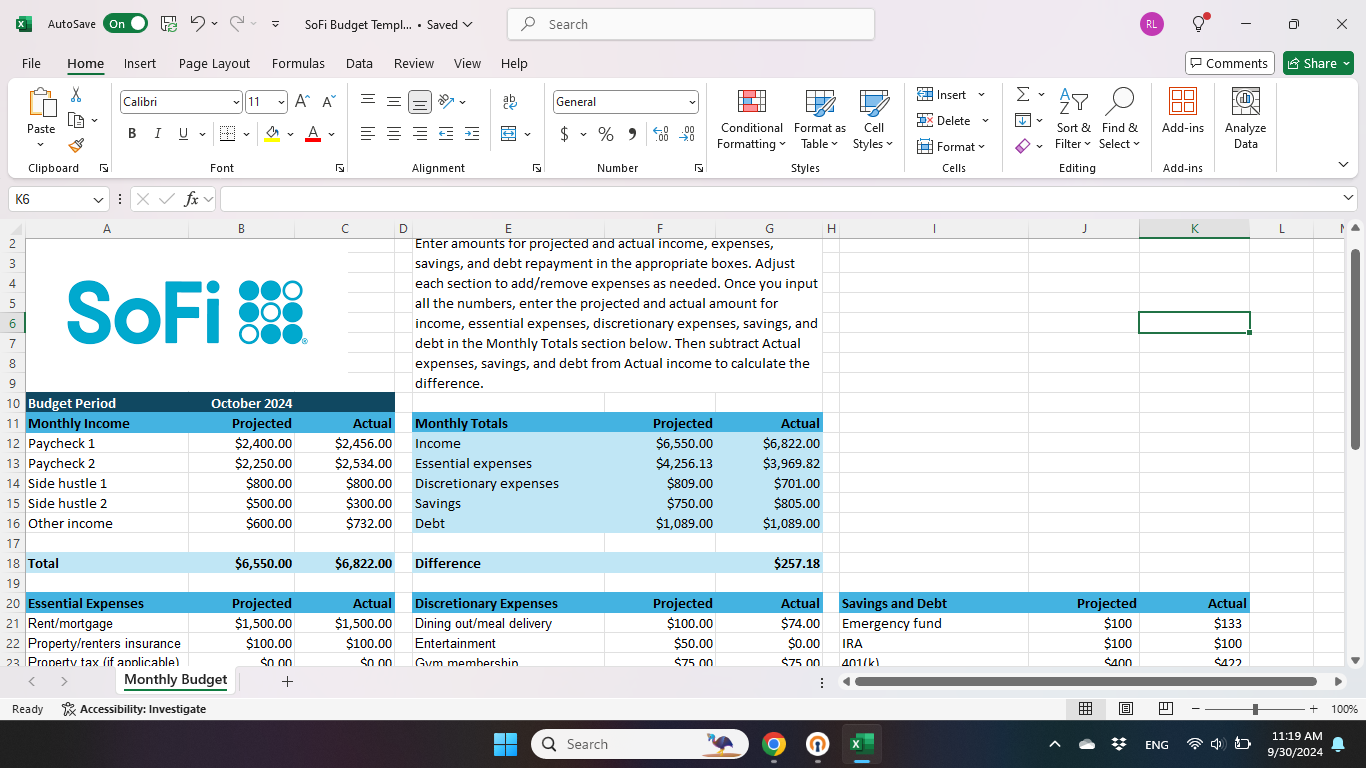
You’ll be able to enter projected and actual amounts for each section. You can add or remove lines as needed or edit the descriptions for expenses, savings, and debt payments. Totals are calculated for you automatically.

Screenshot of SoFi Free Budget Template

How to Download and Access the Template


Here are steps for downloading the free monthly budget template:

•   You can download the Excel budget template here.

•   Once you download the file, you’ll open it and then click “Enable editing.”

•   You can then save the file to your preferred location on your device, and start using it to make a budget.

If you don’t have Excel, you can open the file in Google Sheets. You’ll need to:

•   Download the Excel file

•   Open Google Sheets

•   Click “File,” then “Import”

•   Click “Upload” and “Browse,” then find the Excel file

•   Select the file and click “Open”

•   In Google Sheets, select “Create new spreadsheet” from the dropdown menu (or this may automatically populate on a pop-up screen), and click “Import data”

•   Click the blue “Open now” link to start using the spreadsheet

If you’re opening the file in Google Sheets, you may need to make adjustments to the font or spacing if you have a default font that you use.

Recommended: 50/30/20 Budget Calculator

Increase your savings
with a limited-time APY boost.*


*Earn up to 4.00% Annual Percentage Yield (APY) on SoFi Savings with a 0.70% APY Boost (added to the 3.30% APY as of 12/23/25) for up to 6 months. Open a new SoFi Checking and Savings account and pay the $10 SoFi Plus subscription every 30 days OR receive eligible direct deposits OR qualifying deposits of $5,000 every 31 days by 3/30/26. Rates variable, subject to change. Terms apply here. SoFi Bank, N.A. Member FDIC.

Using the Monthly Budget Template Effectively


Every monthly budget template is different, and you may need to do some customizing to make it your own. Here are some tips for living on a budget and tracking all of the numbers.

•   Review each section one by one to determine whether you’ll need to add or remove lines or make changes to descriptions.

•   Start by reviewing your monthly income and adding the projected amount for each income stream that you have.

•   Enter “Essential expenses” next, using the projected amount for each budget category. Again, you may need to add or remove expenses or adjust the descriptions to match your needs.

•   Enter “Discretionary expenses,” using the projected amount for each budget category. There’s plenty of room in the budget template to add additional expense categories if you have them.

•   Enter projected amounts for each of your monthly savings goals and debt repayment goals.

•   As you pay your essential expenses, add the actual amount spent for each one to your budget template.

•   Use the “Expense tracker” tab included in the budget template to record expenses for things like groceries and gas throughout the month. You can then add up the amounts for each category and enter them in the relevant box on the “Monthly budget” tab.

•   Enter savings contributions and debt payments in the “Actual” column as you make them.

Once you’ve added your income, expenses, savings, and debt payments and calculated the projected and actual amounts for each category, you can enter those numbers into the “Monthly totals” section. You can then subtract your actual expenses, savings, and debt payments from your actual income to calculate the difference. Managing your budget in this way adds an extra level of insight onto and control of what’s going on in your bank account.

Personalizing Your Budget


The monthly budget template is customizable so you can add or remove items as needed.

For example in the “Income section,” you’ll see room to enter amounts for two paychecks, two side hustles, and an ‘Other’ category. If you only get paid monthly, you can delete one of the paycheck lines. Or if you get paid biweekly and have a three-paycheck month coming up, you can add a line to account for that.

You can do the same with all of the other sections so that your budget template reflects your monthly expenses and savings goals. For example, say that you use sinking funds — money set aside for specific goals — to save money for one-time expenses. You could add individual lines for each one in the “Savings” and “Debt” section.

So your savings goals might include:

•   Emergency fund

•   Holiday fund

•   Vacation fund

•   New car fund

Likewise, you might have multiple student loans you’re repaying that you’d like to list separately. Having a projected column and an actual column can be a huge asset. This can help you see how well you’re doing with your spending, savings, and debt repayment goals month to month. That, in turn, can help you manage your money better.

Tracking and Analyzing Your Spending


Failing to track variable or discretionary expenses is one of the most common budgeting mistakes. It’s easy to go over budget if you don’t know what you’re spending.

This budget template includes an “Expense Tracker” sheet that you can use to record spending, outside of what you pay toward the bills. Tracking expenses monthly is a great way to see how your expenses are trending, where your money goes, and what you might want or need to cut back on.

Some of the most helpful expenses to track may include:

•   Groceries

•   Gas

•   Anything that’s in your “Discretionary expenses” category on the template, such as entertainment and dining out

These are the areas of your budget where spending may not be the same month to month. You can look at each expense category and ask yourself what you could do to reduce spending or even eliminate it altogether if you’re trying to free up funds to save or pay down debt.

It’s also helpful to look back each month to see how your essential expenses have changed. Some costs, like your mortgage or rent payments, may always be the same but you might spend more on utilities during certain times of the year than others. Getting to know these patterns can help you adjust your budget accordingly so you’re not surprised by a higher-than-usual electric bill.

Budget Template vs App


Using a budget template is a hands-on way to track your income and spending because you have to enter amounts in the sheet manually. If you don’t have time to do that or you’re worried about getting the numbers wrong, you might use a free budget app instead.

These can let you link your bank account, including checking and savings accounts, in one place so you can see what you’re spending. You can also add investment accounts, retirement accounts, credit cards, student loans, and other loans to track your net worth. Many financial institutions offer these tools, so it can be worthwhile to check with yours, or many third-party apps are available as well, some for free and others with associated costs.

You might also find that a budgeting app can help you move towards your short- and longer-term money goals, as you see where your cash goes and how you can lower debt and build savings over time.

In addition, credit score monitoring may be included so you can see how paying down debt or taking out a new loan affects your credit rating.

Recommended: Ways to Earn Money From Home

The Takeaway


If you’re ready to make budgeting part of your money routine or looking to fine-tune how you track your finances, a monthly budget template can help you do it. This Excel budget template is designed to be user-friendly.

As you work on tracking your money, it’s wise to have a banking partner that helps you manage and grow your wealth.

Interested in opening an online bank account? When you sign up for a SoFi Checking and Savings account with eligible direct deposit, you’ll get a competitive annual percentage yield (APY), pay zero account fees, and enjoy an array of rewards, such as access to the Allpoint Network of 55,000+ fee-free ATMs globally. Qualifying accounts can even access their paycheck up to two days early.


Better banking is here with SoFi, NerdWallet’s 2024 winner for Best Checking Account Overall.* Enjoy 3.30% APY on SoFi Checking and Savings with eligible direct deposit.


Photo credit: iStock/cagkansayin

SoFi Checking and Savings is offered through SoFi Bank, N.A. Member FDIC. The SoFi® Bank Debit Mastercard® is issued by SoFi Bank, N.A., pursuant to license by Mastercard International Incorporated and can be used everywhere Mastercard is accepted. Mastercard is a registered trademark, and the circles design is a trademark of Mastercard International Incorporated.

Annual percentage yield (APY) is variable and subject to change at any time. Rates are current as of 12/23/25. There is no minimum balance requirement. Fees may reduce earnings. Additional rates and information can be found at https://www.sofi.com/legal/banking-rate-sheet

Eligible Direct Deposit means a recurring deposit of regular income to an account holder’s SoFi Checking or Savings account, including payroll, pension, or government benefit payments (e.g., Social Security), made by the account holder’s employer, payroll or benefits provider or government agency (“Eligible Direct Deposit”) via the Automated Clearing House (“ACH”) Network every 31 calendar days.

Although we do our best to recognize all Eligible Direct Deposits, a small number of employers, payroll providers, benefits providers, or government agencies do not designate payments as direct deposit. To ensure you're earning the APY for account holders with Eligible Direct Deposit, we encourage you to check your APY Details page the day after your Eligible Direct Deposit posts to your SoFi account. If your APY is not showing as the APY for account holders with Eligible Direct Deposit, contact us at 855-456-7634 with the details of your Eligible Direct Deposit. As long as SoFi Bank can validate those details, you will start earning the APY for account holders with Eligible Direct Deposit from the date you contact SoFi for the next 31 calendar days. You will also be eligible for the APY for account holders with Eligible Direct Deposit on future Eligible Direct Deposits, as long as SoFi Bank can validate them.

Deposits that are not from an employer, payroll, or benefits provider or government agency, including but not limited to check deposits, peer-to-peer transfers (e.g., transfers from PayPal, Venmo, Wise, etc.), merchant transactions (e.g., transactions from PayPal, Stripe, Square, etc.), and bank ACH funds transfers and wire transfers from external accounts, or are non-recurring in nature (e.g., IRS tax refunds), do not constitute Eligible Direct Deposit activity. There is no minimum Eligible Direct Deposit amount required to qualify for the stated interest rate. SoFi Bank shall, in its sole discretion, assess each account holder's Eligible Direct Deposit activity to determine the applicability of rates and may request additional documentation for verification of eligibility.

See additional details at https://www.sofi.com/legal/banking-rate-sheet.

*Awards or rankings from NerdWallet are not indicative of future success or results. This award and its ratings are independently determined and awarded by their respective publications.

SoFi Relay offers users the ability to connect both SoFi accounts and external accounts using Plaid, Inc.’s service. When you use the service to connect an account, you authorize SoFi to obtain account information from any external accounts as set forth in SoFi’s Terms of Use. Based on your consent SoFi will also automatically provide some financial data received from the credit bureau for your visibility, without the need of you connecting additional accounts. SoFi assumes no responsibility for the timeliness, accuracy, deletion, non-delivery or failure to store any user data, loss of user data, communications, or personalization settings. You shall confirm the accuracy of Plaid data through sources independent of SoFi. The credit score is a VantageScore® based on TransUnion® (the “Processing Agent”) data.

*Terms and conditions apply. This offer is only available to new SoFi users without existing SoFi accounts. It is non-transferable. One offer per person. To receive the rewards points offer, you must successfully complete setting up Credit Score Monitoring. Rewards points may only be redeemed towards active SoFi accounts, such as your SoFi Checking or Savings account, subject to program terms that may be found here: SoFi Member Rewards Terms and Conditions. SoFi reserves the right to modify or discontinue this offer at any time without notice.

Disclaimer: Many factors affect your credit scores and the interest rates you may receive. SoFi is not a Credit Repair Organization as defined under federal or state law, including the Credit Repair Organizations Act. SoFi does not provide “credit repair” services or advice or assistance regarding “rebuilding” or “improving” your credit record, credit history, or credit rating. For details, see the FTC’s website .

Financial Tips & Strategies: The tips provided on this website are of a general nature and do not take into account your specific objectives, financial situation, and needs. You should always consider their appropriateness given your own circumstances.

Third-Party Brand Mentions: No brands, products, or companies mentioned are affiliated with SoFi, nor do they endorse or sponsor this article. Third-party trademarks referenced herein are property of their respective owners.

SOBNK-Q324-110

Read more

FHA Loan Closing Costs Calculator Table with Examples

It’s not news that FHA (Federal Housing Administration) loans can be a great way for first-time homebuyers to break into the market. They’re government-backed and tend to come with lower costs and less-stringent eligibility requirements.

But like any mortgage, FHA loans do still come with closing costs — expenses due at the time the mortgage is signed — which can add up to a pretty penny. It’s a good idea to know what you’re getting into ahead of time with closing costs to avoid sticker shock, which is exactly why you’re here.

Keep reading to get intel like how to figure out your FHA loan closing costs, what an FHA loan closing cost calculator is, how to use a calculator table to determine your FHA loan closing costs, and how to lower those costs.

Key Points

•   FHA loans are government-backed and have lower down payment and eligibility requirements than many other loans, making them appealing to first-time homebuyers.

•   Closing costs for FHA loans include lender fees, third-party fees, and prepaid items, generally totaling between 2% and 6% of the loan amount.

•   Mortgage Insurance Premium (MIP) is 1.75% of the loan amount upfront and between 0.15% and 0.75% of the outstanding loan balance annually.

•   Closing costs can be estimated using a calculator table based on home price and down payment percentage.

•   Buyers may be able to lower closing costs by negotiating with the seller, using gift funds, or rolling costs into the mortgage.

Why Use an FHA Loan Closing Costs Calculator Table?

Closing costs for FHA loans (a kind of government loan) are made up of several different expenses, including lender fees, third-party fees, and prepaid items. Each of these categories of expenses is composed of smaller costs.

For example:

•   Lender fees might include an origination fee, underwriting fee, document preparation fee, and other charges.

•   Third-party fees might include an appraisal fee and real estate attorney fees, just to name a couple.

•   That is a lot of instances of the word “fee.” And that’s before you factor in the mandatory FHA mortgage insurance premium, or MIP — which is basically the FHA version of private mortgage insurance (PMI).

That’s why using an FHA loan closing costs calculator table can be an efficient way to see, at a glance, a ballpark range of what you might expect to plunk down on the closing table. Of course, the best way to know exactly what to expect is to calculate all of your FHA loan closing costs by hand – or to ask your lender to share the expected or actual fees involved.


💡 Quick Tip: Buying a home shouldn’t be aggravating. SoFi’s online mortgage application is quick and simple, with dedicated Mortgage Loan Officers to guide you throughout the process.

First-time homebuyers can
prequalify for a SoFi mortgage loan,
with as little as 3% down.

Questions? Call (888)-541-0398.


How to Calculate Your FHA Loan Closing Costs

To calculate your specific FHA loan closing costs, you’ll need to add up all the smaller costs — which means ascertaining exactly what they are. Asking your lender is a great way to do this for these government-backed mortgages, whether you’re a first-time homebuyer or a repeat owner. Your lender should even be able to tell you the overall cost without your needing to calculate it yourself.

As a general rule of thumb, closing costs tend to amount to about 2% to 6% of the amount you borrow. In other words, if you were buying a million dollar home and putting down $700,000, your mortgage would be $300,000, and your closing costs would be between $6,000 and $18,000.

If you were buying a home that costs $330,000 and putting down $30,000, your home loan would again be $300,000, and your closing costs would be similar to the range above.

Calculating MIP

Next, here are more details about the MIP portion:

•   With an FHA loan, you can expect to pay 1.75% of the loan amount in MIP upfront.

•   It may be possible to finance your upfront MIP by adding it to your overall loan, but doing so will likely increase the amount you pay in interest over time.

•   In addition, you will pay an ongoing premium as part of your monthly payment that ranges from 0.15% to 0.75% of your home’s outstanding loan balance annually.

Below, you’ll find a chart that shows a range of possible down payments and closing costs on FHA loans.

Recommended: Cost of Living by State

2025 FHA Loan Closing Costs Calculator Table

Here’s a basic guide to approximately how much you can expect to pay in closing costs if you take out an FHA loan in 2025, depending on the cost of your home. (Actual figures may vary, but this serves as an overall FHA loan closing cost calculator.)

Home Price 3.5% Down payment 10% Down payment MIP due at closing (1.75%) with 3.5% down MIP due at closing (1.75%) with 10% down Overall Closing Costs (2% to 6%, including MIP) with 3.5% down Overall closing costs (2% to 6%, including MIP) with 10% down
$200,000 $7,000 $20,000 $3,377.50 $3,150 $3,947 – $11,580 $3,600 – $10,800
$350,000 $12,250 $35,000 $5,910.63 $5,512.50 $6,755 – $20,265 $6,300 – $18,900
$500,000 $17,500 $50,000 $8,443.75 $7,875 $9,650 – $28,950 $9,000 – $27,000
$650,000 $22,750 $65,000 $10,976.88 $10,237.50 $12,545 – $37,635 $11,700 – $35,100

As you see, when you put more money down, your home loan is smaller, and closing costs can be reduced somewhat.

Recommended: Guide to FHA 203(k) Home Loans

Examples of FHA Loan Closing Cost Calculations

So, how do such seemingly small percentages add up so quickly?

Here are some examples of the types of fees that add up to that 2% to 6% in closing costs. This percentage tends to apply to different kinds of home loans, including FHA ones:

•   Lender fees. Your lender is in business to make money, and may charge various fees associated with the service of originating, writing, and maintaining the loan, such as:

◦   Loan origination fee: 0.5% to 1% of your home loan total

◦   Underwriting fee: $300 to $750

◦   Document preparation fee: Around $50

•   Third-party fees. From getting your property appraised to finding and insuring your title, there are plenty of third-party fees that crank up your closing cost total.

◦   Appraisal fee: $300 to $1,000+

◦   Survey fee: $400+

◦   Real estate attorney fee: $500 to $1,500

◦   Title search fee: $75 to $200

◦   Title insurance: 0.1% to 2% of your home purchase price

◦   Recording fees: $20 to $250

•   Prepaid items. As part of signing, you’ll also need to pay a certain number of items upfront, such as your first year’s worth of homeowners insurance to be held in escrow. These costs vary depending on your home’s location and overall value, but they can be substantial. They can include:

◦   Real estate taxes

◦   Tax and insurance escrow deposits

◦   Flood, earthquake, or hazard insurance premiums

•   MIP: As mentioned above, this will be 1.75% of the loan amount, though some borrowers may roll it into the loan amount).

As you can see, FHA loan closing costs can really add up — but it can be worth it to have a home to call you very own.


💡 Quick Tip: Backed by the Federal Housing Administration (FHA), FHA loans provide those with a fair credit score the opportunity to buy a home. They’re a great option for first-time homebuyers.

Reasons to Calculate Your FHA Loan Closing Costs First

If you’re searching for your dream house and accessing a home loan help center, that’s terrific. Be sure to also focus on understanding how much you may pay in closing costs. This can help you know how much house you can really afford to buy.

Often, buyers get so caught up in trying to save up for their down payment that they forget about closing costs entirely. This lump sum, which is often five figures, could be a pretty upsetting thing to be surprised by as you move toward signing.

Calculating your closing costs ahead of time will help ensure you’ve actually saved up enough to comfortably make your home purchase. Your lender is required to give you a closing disclosure statement at least three days before it’s time to sign the deal.

That said, the more preplanning you can achieve when it comes to these amounts of money, the better. You may want to use a closing cost FHA loan calculator (look online for tools that can help) so you can get a feel for these numbers.

Tips on How to Save on Your FHA Loan Closing Costs

If you are planning on buying a home, you are probably researching tips to qualify for a mortgage. In addition, you may want to consider ways to lower the overall expense of closing costs.

Closing costs can be a hefty chunk of change. Fortunately, there are a few ways to help lower them.

•   Negotiate with the seller. If the person you’re buying the house from is eager to let it go, they may be willing to pay some — or even all — of your closing costs.

•   Ask for a gift. Not all mortgages allow gift funds to be used for closing costs, but FHA loans do. If you have a friend or family member who is willing to offer a sum of money, you could consider using gift funds to lower your costs.

•   Roll them into the mortgage. As with MIP, it can be possible to roll some of the remainder of your closing costs into your mortgage. Keep in mind that doing so can raise your monthly payment and mean you pay more in interest overall.

The Takeaway


FHA loans do come with closing costs, and most buyers can expect to pay about 2% to 6% of the loan amount at signing. This type of mortgage in particular requires a mortgage insurance premium (MIP) of 1.75% of the loan amount closing, which can drive up the overall price of FHA loans upfront. Despite these charges, FHA loans can be an important option for many borrowers as they move along the path to homeownership.

SoFi offers a wide range of FHA loan options that are easier to qualify for and may have a lower interest rate than a conventional mortgage. You can put down as little as 3.5%, making an FHA loan a great option for first-time homebuyers.

Another perk: FHA loans are assumable mortgages!

FAQ


Who pays the closing costs on an FHA loan?


Traditionally, closing costs are the responsibility of the buyer. However, it is possible to ask the seller to pay closing costs as part of your negotiation. (Keep in mind that this probably won’t work in a highly competitive seller’s market, though.)

How much FHA loan can I qualify for?


The amount you qualify for will depend on personal financial data like your income and credit score. That said, it’s also important to understand that the FHA does impose loan limits that cap the maximum amount borrowers can take out. In 2025, the FHA loan limits for a single-family housing unit are $524,225 in most areas of the country, and up to $1,209,750 in specific, high-cost counties.

Can closing costs be included in an FHA loan?


Some of your FHA loan closing costs, including the upfront MIP, can be rolled into your mortgage, but keep in mind doing so will increase your monthly payment and also mean you will be spending more in interest over time. And note that you can’t include your down payment in the loan. The minimum FHA loan down payment is 3.5%. Using a closing cost FHA loan calculator can help you estimate your expenses.


Photo credit: iStock/ridvan_celik

¹FHA loans are subject to unique terms and conditions established by FHA and SoFi. Ask your SoFi loan officer for details about eligibility, documentation, and other requirements. FHA loans require an Upfront Mortgage Insurance Premium (UFMIP), which may be financed or paid at closing, in addition to monthly Mortgage Insurance Premiums (MIP). Maximum loan amounts vary by county. The minimum FHA mortgage down payment is 3.5% for those who qualify financially for a primary purchase. SoFi is not affiliated with any government agency.

*SoFi requires Private Mortgage Insurance (PMI) for conforming home loans with a loan-to-value (LTV) ratio greater than 80%. As little as 3% down payments are for qualifying first-time homebuyers only. 5% minimum applies to other borrowers. Other loan types may require different fees or insurance (e.g., VA funding fee, FHA Mortgage Insurance Premiums, etc.). Loan requirements may vary depending on your down payment amount, and minimum down payment varies by loan type.

SoFi Mortgages
Terms, conditions, and state restrictions apply. Not all products are available in all states. See SoFi.com/eligibility-criteria for more information.


SoFi Loan Products
SoFi loans are originated by SoFi Bank, N.A., NMLS #696891 (Member FDIC). For additional product-specific legal and licensing information, see SoFi.com/legal. Equal Housing Lender.


Financial Tips & Strategies: The tips provided on this website are of a general nature and do not take into account your specific objectives, financial situation, and needs. You should always consider their appropriateness given your own circumstances.

Third Party Trademarks: Certified Financial Planner Board of Standards Center for Financial Planning, Inc. owns and licenses the certification marks CFP®, CERTIFIED FINANCIAL PLANNER®

SOHL-Q325-048

Read more

How to Get Your Money Back From Unauthorized Transactions

Finding an unfamiliar purchase or withdrawal on your checking account statement or online activity can be alarming. While it could be a legitimate transaction you simply forgot about, it could also be a sign that your account has been compromised.

Either way, there’s no reason to panic: Banks typically reimburse customers for unauthorized transactions. That means if someone steals money from your bank account, you can generally get it back.

The hitch is that you need to act fairly quickly. The window for resolving disputes for debit cards and bank accounts is generally shorter than it is than resolving disputes for credit cards.
Here’s a closer look at what counts as an unauthorized banking transaction, what to do if someone steals money from your bank account, and how to protect yourself in the future

Key Points

  • Contact the bank immediately upon noticing unauthorized transactions to report the issue and minimize liability.
  • File a formal dispute, including account details and the date of the unauthorized transaction.
  • Change account passwords and PINs to prevent further unauthorized access.
  • Review all recent transactions for additional suspicious activity and report it.
  • Place a freeze or lock on the account or establish alerts to prevent additional unauthorized use.

What Constitutes an Unauthorized Transaction

An unauthorized transaction occurs when someone makes a payment or transfers money from your bank account without your permission.[1] This could happen to your account for various reasons, including someone stealing your debit card, a hacker or fraudster using your stolen account information, or even a simple error or mistake.

However, it’s important to distinguish between unauthorized transactions and transactions you may simply disagree with. Some examples of charges you may find questionable or irksome but that don’t qualify as unauthorized transactions include:

  • You forgot you signed up for a free trial that turned into a paid subscription.
  • A family member made a purchase without telling you.
  • You don’t recognize a legitimate transaction because the merchant bills under a different name than they do business with.
  • You purchased something and were unhappy with the service or product.

These cases, while potentially frustrating, are generally not considered unauthorized by banks. Instead, they may fall under billing disputes or customer service issues.

Steps to Take If You Suspect an Unauthorized Transaction

If you believe a transaction in your banking history truly is unauthorized, you’ll want to act quickly. Federal law provides strong consumer protections, but they often come with strict timelines. Waiting too long can limit your options and your potential for a full refund.[2]

Here are the steps that can help you make a complete recovery:

1. Contact Your Bank or Credit Union Immediately

It’s wise to notify your bank or credit union as soon as you notice a potentially fraudulent transaction. You can do this by calling the customer service number found on the back of your debit card, listed on your statement, or published on the bank’s website or in its app. You’ll likely need to provide your account information, the date and amount of the transaction[3], and why you believe it was unauthorized.

Many financial institutions also allow you to report fraud through their online banking or mobile app platforms. To start your dispute, you typically need to select the transaction from your recent transaction list, then select “Report an issue,” and answer questions about the charge.

🛈 If you’re a SoFi member, you can report unauthorized transactions or a debit card loss from within the SoFi app or website or by calling SoFi Customer Support at 1-855-456-7634.

2. File a Formal Dispute/Follow-Up in Writing

Once you’ve contacted your bank, you may be asked to submit a written statement to back up your claim and include any supporting documents (such as screenshots or receipts).

Even if your bank doesn’t request you to file a formal dispute, it can be a good idea to follow up your phone call with a written or emailed letter.[4] You’ll want to be sure to include:

  • Your account number
  • The date and time when you noticed your account was compromised
  • When you reported the unauthorized transaction

Once you’ve notified your institution about an unauthorized transaction, it generally has 10 business days to investigate the issue. The countdown begins from the time you give verbal notice of the issue, even if you were required to follow-up with written confirmation.

If the transaction involved a merchant, you may also want to contact the merchant and dispute the purchase. The merchant could potentially refund your money more quickly than the bank can.

Recommended: How to Cancel a Pending Transaction

3. Change Your Account Passwords and PINs

If someone has gained unauthorized access to your bank account, there’s a good chance they may have your login credentials or debit card information. To protect yourself from further bank account fraud:

  • Change your account password: To stop hackers, it is important to create complex, unique login credentials for your online banking accounts.
  • Enable multi-factor authentication (MFA): If you haven’t already, now is a good time to set up MFA on your account. This second layer of protection can involve being texted a code or providing biometric information, such as facial recognition, for greater security.[5]
  • Update your PIN: If the fraud involved an ATM or debit transaction, you’ll want to create a new (and hard to guess) debit card PIN, or personal identification number.

4. Review Recent Transactions Carefully

After identifying one suspicious charge, it’s crucial to scan through recent transactions for other red flags. Be on the lookout for charges from unfamiliar locations and businesses, duplicate transactions, and small transactions you didn’t authorize (fraudsters often start with small “test” charges, or micro-payments, before moving on to larger amounts[6]).

You’ll want to report any additional suspicious activity you find during this review.

5. Consider Placing a Freeze or Lock on Your Account/Card

To prevent further unauthorized use, you may want to place a temporary lock or freeze on your debit card or account.

Many banks offer:

  • Instant card locks via mobile app: You may be able to lock your debit or credit card by logging into your banking app. This typically involves tapping the Menu, then “Manage debit/credit card,” selecting the card you wish to lock, and tapping “Lock.” You can also usually lock your card through online banking or over the phone.
  • Bank account freezes: With an account is frozen, you can still monitor your account and receive deposits (including your paycheck), but no one — not even you — can take or transfer money out of the account until the freeze is lifted. This means that any automatic payments you have set up through your checking account won’t go through, so you’ll need to pay these bills in a different way until the freeze comes off.

Will Your Bank Refund Unauthorized Transactions?

Yes — in most cases, your bank is required by law to reimburse you for unauthorized electronic transactions, provided you report them within a specific time frame. In the case of debit card loss or theft, however, you may have some liability.

Timeline for Reporting Suspicious Activity

Under federal law, you have protections that help limit what you have to pay if your ATM or debit card is lost or stolen, or you notice any unauthorized charges on your bank statement. Here’s how it breaks down:

  • For debit/ATM card loss: If you report a lost/stolen debit card or PIN to your bank or credit union within two days of noticing it, your liability will be limited to no more than $50 in charges. If you report the loss after two business days, however, you could be responsible for up to $500 in unauthorized transactions. If you wait more than 60 days to report the loss, you may be responsible for all the money taken from your ATM/debit card account.
  • For unauthorized bank account transactions: If an unauthorized electronic fund transfer (EFT) appears on your statement, but your card or PIN has not been lost or stolen, you will not be liable for the debit if you report it within 60 days after your account statement is sent to you. If you report it after the 60-day window, on the other hand, you could be on the hook for the full transaction amount.

Credit vs Debit Unauthorized Transaction Liability

Credit cards generally offer broader liability protections than debit cards.

Under the Fair Credit Billing Act, your liability for unauthorized credit card transactions is limited to $50 if you report the suspicious charge within 60 days.[7] However, the major credit card issuers generally offer zero liability for unauthorized purchases if you report them within 30 days, and some issuers offer zero liability with no time limit.

Debit cards work differently, since the money you spend is immediately debited from your checking account. As mentioned above, your liability depends on how quickly you report the lost or stolen card. If you report it within two business days, your maximum loss will be $50. If you wait more than two business days but less than 60 days, your max loss will be $500. After 60 days, your liability is unlimited.

Recommended: Debit Card Fraud: How It Works and How To Prevent It

While no one is immune to fraud, you can significantly reduce your risk by following some smart financial habits:

  • Avoid isolated ATMs: Criminals will sometimes set up skimming devices (plastic overlays that fit onto the slot and can capture your PIN and other card information) at ATMs that are located in dimly lit, out-the-way places. Try to choose ATMs located inside a bank branch, where there are security cameras. If an ATM looks as if it may have been tampered with, trust your gut, and avoid it.
  • Be alert to fake emails and texts: If you receive a text or an email notifying you of a problem with an account, you’ll want to avoid clicking on any links. They may take you to a legitimate-looking site that asks you to enter your private information, which is then sent directly to scammers. The link could also download malware such as viruses, ransomware, and spyware onto your device.[8]
  • Beef up your personal security: Using strong, unique passwords for each account (and an unusual PIN for your debit card) is key. But those measures aren’t always enough. It’s also wise to set up MFA authentication and biometrics (fingerprint or facial ID) to further safeguard your accounts.
  • Monitor your accounts: Since time can be critical when reporting —- and stopping — unauthorized transactions, it’s important to regularly review your bank statements or online banking transactions. It’s also a good idea to set up mobile banking alerts for large or international transactions, so you are aware of any suspicious transactions right away.
  • Use digital wallets whenever possible: Digital wallets, like Apple Pay or Google Pay, have multilayered security features. This typically includes tokenization, which encodes your debit and credit card details, so the numbers are never shared with a merchant. Some wallets also use biometric data to confirm it’s really you making the transaction.

Recommended: Passive Income Ideas

The Takeaway

Unauthorized transactions can be unsettling, but you’re not powerless. You can typically recoup your losses if you act quickly.
If you notice something suspicious, immediately contact your bank, file a dispute, and take steps to secure your information. There are also things you can do to prevent future incidents, like avoiding ATMs that could be tampered with, monitoring your accounts, and using a digital wallet.

Interested in opening an online bank account? When you sign up for a SoFi Checking and Savings account with eligible direct deposit, you’ll get a competitive annual percentage yield (APY), pay zero account fees, and enjoy an array of rewards, such as access to the Allpoint Network of 55,000+ fee-free ATMs globally. Qualifying accounts can even access their paycheck up to two days early.


Better banking is here with SoFi, NerdWallet’s 2024 winner for Best Checking Account Overall.* Enjoy 3.30% APY on SoFi Checking and Savings with eligible direct deposit.

FAQ

Can I get my money back if someone used my debit card?

Yes, you can usually get your money back if someone used your debit card without permission, especially if you report it quickly, though you may have some liability. Typically, if you report the unauthorized debit card use within two business days, your liability is limited to $50. If you wait more than two business days but less than 60 days, your max loss will be $500. After 60 days, you could be on the hook for the full amount.

Can banks reverse unauthorized transactions?

Yes, banks are generally required to refund unauthorized transactions if you report them in a timely manner. However, it’s important to act quickly. If you report an unauthorized electronic fund transfer (EFT) later than 60 days after receiving the statement that lists the charge, you may be liable for the full amount.

Can my bank find out who used my card?

Yes, banks can sometimes identify who used a card, especially in cases of fraud. Banks often work with law enforcement to gather data, including transaction details, location data (if available), IP addresses (for online transactions), and surveillance footage, when investigating unauthorized transactions. However, it’s not always possible to pinpoint the exact identity of the card user.

How do I get a refund for an unauthorized payment?

To get a refund for an unauthorized payment, you’ll want to contact your bank immediately through their fraud or customer service line. Banks typically require you to report the issue within 60 days of the statement date showing the transaction. They may ask you to fill out a dispute form or provide written confirmation. The bank will then investigate and determine whether to refund the payment based on the findings.

Is there a time limit on when I can report unauthorized transactions?

Yes. Under federal law, you must report any unauthorized bank account transactions within 60 days of the statement date that includes the unauthorized charge to avoid any liability. Delays in reporting could increase your financial responsibility, potentially up to the full amount. So it’s crucial to monitor your account regularly and report any suspicious activity as soon as possible.

Article Sources

About the author

Julia Califano

Julia Califano

Julia Califano is an award-winning journalist who covers banking, small business, personal loans, student loans, and other money issues for SoFi. She has over 20 years of experience writing about personal finance and lifestyle topics. Read full bio.


photo credit: iStock/Yurii Karvatskyi
SoFi Checking and Savings is offered through SoFi Bank, N.A. Member FDIC. The SoFi® Bank Debit Mastercard® is issued by SoFi Bank, N.A., pursuant to license by Mastercard International Incorporated and can be used everywhere Mastercard is accepted. Mastercard is a registered trademark, and the circles design is a trademark of Mastercard International Incorporated.

Annual percentage yield (APY) is variable and subject to change at any time. Rates are current as of 12/23/25. There is no minimum balance requirement. Fees may reduce earnings. Additional rates and information can be found at https://www.sofi.com/legal/banking-rate-sheet

Eligible Direct Deposit means a recurring deposit of regular income to an account holder’s SoFi Checking or Savings account, including payroll, pension, or government benefit payments (e.g., Social Security), made by the account holder’s employer, payroll or benefits provider or government agency (“Eligible Direct Deposit”) via the Automated Clearing House (“ACH”) Network every 31 calendar days.

Although we do our best to recognize all Eligible Direct Deposits, a small number of employers, payroll providers, benefits providers, or government agencies do not designate payments as direct deposit. To ensure you're earning the APY for account holders with Eligible Direct Deposit, we encourage you to check your APY Details page the day after your Eligible Direct Deposit posts to your SoFi account. If your APY is not showing as the APY for account holders with Eligible Direct Deposit, contact us at 855-456-7634 with the details of your Eligible Direct Deposit. As long as SoFi Bank can validate those details, you will start earning the APY for account holders with Eligible Direct Deposit from the date you contact SoFi for the next 31 calendar days. You will also be eligible for the APY for account holders with Eligible Direct Deposit on future Eligible Direct Deposits, as long as SoFi Bank can validate them.

Deposits that are not from an employer, payroll, or benefits provider or government agency, including but not limited to check deposits, peer-to-peer transfers (e.g., transfers from PayPal, Venmo, Wise, etc.), merchant transactions (e.g., transactions from PayPal, Stripe, Square, etc.), and bank ACH funds transfers and wire transfers from external accounts, or are non-recurring in nature (e.g., IRS tax refunds), do not constitute Eligible Direct Deposit activity. There is no minimum Eligible Direct Deposit amount required to qualify for the stated interest rate. SoFi Bank shall, in its sole discretion, assess each account holder's Eligible Direct Deposit activity to determine the applicability of rates and may request additional documentation for verification of eligibility.

See additional details at https://www.sofi.com/legal/banking-rate-sheet.

*Awards or rankings from NerdWallet are not indicative of future success or results. This award and its ratings are independently determined and awarded by their respective publications.

Financial Tips & Strategies: The tips provided on this website are of a general nature and do not take into account your specific objectives, financial situation, and needs. You should always consider their appropriateness given your own circumstances.

We do not charge any account, service or maintenance fees for SoFi Checking and Savings. We do charge a transaction fee to process each outgoing wire transfer. SoFi does not charge a fee for incoming wire transfers, however the sending bank may charge a fee. Our fee policy is subject to change at any time. See the SoFi Bank Fee Sheet for details at sofi.com/legal/banking-fees/.
Third-Party Brand Mentions: No brands, products, or companies mentioned are affiliated with SoFi, nor do they endorse or sponsor this article. Third-party trademarks referenced herein are property of their respective owners.

Third Party Trademarks: Certified Financial Planner Board of Standards Center for Financial Planning, Inc. owns and licenses the certification marks CFP®, CERTIFIED FINANCIAL PLANNER®


SOBNK-Q225-040

Read more
TLS 1.2 Encrypted
Equal Housing Lender