
A student at a desk researching on a phone whether student loans can be used to purchase a car

Can You Buy a Car With Student Loans?

Having a car can make college life easier, especially if you’re balancing classes, work, and off-campus living. It’s natural to wonder whether student loans can help cover this major expense. After all, they can pay for tuition, housing, and other college-related costs.

However, student loans come with strict rules about how the money can be used — and buying a car isn’t one of them. That said, you can use student loans for certain car-related expenses, such as gas, maintenance, and parking. You can also use student loans to cover other transportation costs like bus, train, or subway passes.

Here’s a closer look at what expenses student loans can and can’t cover, plus some alternative ways to afford a car while you’re in college.

Key Points

•   Student loans are designed for education-related expenses, not for purchasing cars.

•   Acceptable uses include tuition, room/board, books, and transportation costs (including car maintenance).

•   Misusing student loans can lead to penalties and harm financial aid eligibility.

•   Alternatives for car financing include saving and taking out a separate car loan.

•   Existing student loans affect car loan eligibility through their impact on debt-to-income ratio and credit history.

What Student Loans Can Be Used For

Both federal student loans (which are funded by the U.S. government) and private student loans (which are funded by banks, credit unions, and other private lenders) are meant to be used for expenses essential to your education.

Generally, you can use your student loans to pay for:

•   Tuition: Your loan can be used to cover the cost of attending classes.

•   Books, supplies, and fees: This includes course materials, required supplies (like notebooks and pens), and lab and other fees not covered by tuition.

•   On-campus room and board: You can use your loan to cover your dorm expenses and meal plan.

•   Off-campus housing and food: If you live off-campus, eligible expenses include rent, utilities, and groceries.

•   Transportation: You can use loan funds for transportation expenses such as gas, car maintenance, and public transportation to get to and from school.

•   Study abroad: If you choose to spend a semester or year abroad, you can use your loan to cover those costs.

•   Technology and equipment: This includes a laptop, software, or any other equipment needed for your classes.

•   Professional expenses: You can use your loan to pay for professional certification tests and licenses related to your career field.

•   Disability needs: Loans can be used to pay for specialty services, equipment, and necessary supplies.

•   Child care: If you’re a parent, you may be able to use your loan to cover child care necessary for you to study and attend classes.

The list of qualifying expenses is relatively broad. Essentially, if the expense is essential to your educational success (meaning it supports your living arrangements, basic daily needs, or attendance at school), then it is likely an acceptable use of student loan funds.

Why Student Loans Generally Can’t Be Used to Buy a Car

While transportation is considered a legitimate educational expense, buying a car itself is not. In fact, federal regulations specifically exclude the purchase of vehicles as an allowable use of student loan funds.

If you want to purchase a new or used car, that money has to come from another source, such as savings or a car loan. The same goes for buying a motorcycle or e-scooter, since these are also considered personal purchases not necessary to your education.

Here are some other purchases student loans should not be used for:

•   Clothing and accessories

•   Grooming items

•   Nonessential household goods (like a TV, video gaming device, decor)

•   Restaurants and entertainment (e.g., eating out, takeout, concerts, sports tickets)

•   Nonessential travel (such as vacations or nonschool related trips)

•   Purchasing a home (such as down payment)

Though lenders and financial aid offices generally don’t actively monitor your use of student loan funds, you could potentially face consequences for misusing the money. Though rare, a lender could terminate your loan agreement and require you to pay back the full amount right away. Misuse of federal student loans could make you ineligible for future federal student aid, making it harder to pay for college moving forward.

Transportation Costs That May Be Covered by Student Loans

While you can’t buy a car with student loans, you can use these funds for transportation costs related to car ownership. For example, if you use a family car or buy a car with other funds, you can use your student loan to cover the cost of gas, oil, essential repairs, general maintenance, and insurance payments.

Student loans can also be used for parking costs and tolls, as well as other forms of transportation, such as buses, trains, subways, and bike-sharing programs.

Recommended: How Do Student Loans Work?

Alternatives to Using Student Loans to Buy a Car

While you can’t use student loan money to buy a car, there are other ways to finance a car purchase while you’re in college. You might also consider some alternative (less costly) ways to get around. Some ideas:

•   Save up and pay cash: The best way to avoid debt is to choose a car you can afford to pay for upfront. Consider working part-time during the school year or over the summer to help stash money away so you can buy an inexpensive but reliable used car. Websites like Kelley Blue Book and Edmunds can help you find affordable, fuel-efficient options for students.

•   Apply for a car loan: This type of financing is offered through banks, credit unions, private lenders, and car dealerships. Some lenders and dealerships offer special deals on car loans for college students, such as a rate discount or more flexible qualification requirements (such as using grades in lieu of a credit score).

•   Apply with a cosigner: As a student, you may have limited or no credit history. A creditworthy cosigner (like a parent) can significantly improve your chances of loan approval and help you secure a better interest rate.

•   Use public or campus transportation: If your school is in an area with solid public transit, a monthly bus or train pass might be cheaper and more practical than owning a car. Some campuses also offer free shuttles or student discounts for local transportation.

•   Car sharing/ridesharing: Services like Zipcar or use of Uber/Lyft can be cost-effective for occasional trips, allowing you to avoid car maintenance, insurance, and monthly parking costs.

•   Biking or walking: If you live close to campus or work, human-powered transport can be a free and healthy alternative to buying a car.

How Having Student Loans Can Affect Getting a Car Loan

If you feel you really need a car and want to pursue separate financing, it’s important to understand how your existing student debt can influence your ability to get approved for a car loan. Two key factors to keep in mind:

•   Your debt-to-income (DTI) ratio: Lenders look at your DTI ratio — the percentage of your monthly income that goes toward debt payments — to determine how much additional debt you can handle. If you have high student loan payments, your DTI may be too high to qualify for another loan.

•   Student loans can impact your credit: Having student loans can help you build credit if you make on-time payments. This can make it easier to qualify for a car loan with attractive rates and terms. On the flip side, however, missed or late payments can hurt your score and make qualifying for a car loan more difficult.

If you’re still in school and relying heavily on federal or private student loans, it might be smarter to wait until after graduation, when your income is more stable and you’ve established a stronger credit profile, to take on an auto loan.

The Takeaway

Using student loan funds to purchase a car is generally prohibited by both federal and private student loan rules, as a vehicle is considered a nonessential personal asset.

While these loans can cover transportation costs related to your education, such as gas, insurance, and maintenance for a car you already own, or public transit fares, they cannot be used for the vehicle purchase itself.

Misusing student loan money can lead to severe penalties, including the potential loss of future financial aid or immediate repayment of the loan. If you need a car for college, consider alternatives like saving up to pay cash or applying for a separate auto loan.

If you’ve exhausted all federal student aid options, no-fee private student loans from SoFi can help you pay for school. The online application process is easy, and you can see rates and terms in just minutes. Repayment plans are flexible, so you can find an option that works for your financial plan and budget.


Cover up to 100% of school-certified costs including tuition, books, supplies, room and board, and transportation with a private student loan from SoFi.

FAQ

Can I use leftover student loan money to buy a car?

No. Although student loan funds can be used to cover transportation costs associated with your education, buying a car itself is not considered an allowable or qualified education expense. Student loan funds are meant for essential costs like tuition, books, fees, and housing. The purchase of a personal asset like a car is generally viewed as a nonessential expense by both federal and private student loan lenders.

Are cars considered a qualified education expense?

No, a car purchase is explicitly not considered a qualified education expense by federal student loan regulations, and private student lenders typically have similar guidelines. While transportation costs (like gas, car maintenance, and public transit) that are essential for attending school may be covered, purchasing the vehicle itself is considered a personal, nonessential asset acquisition.

What happens if I use student loans for noneducational expenses?

Though lenders generally do not actively monitor your spending, misusing student loan funds can lead to negative consequences. If the misuse is discovered, the lender may terminate your loan agreement and require you to pay back the full loan amount right away. Misusing federal student aid can also result in losing your eligibility for all future federal financial aid, making it significantly harder to afford the remainder of your education.

Can I get an auto loan while repaying student loans?

Yes, you can get an auto loan while repaying student loans. Lenders will assess your overall financial situation, including your student loan debt, to determine your eligibility and interest rate. Key factors include your credit score and your debt-to-income (DTI) ratio. If your student loan payments are high relative to your income, that could make it harder to qualify for an auto loan or result in a higher interest rate. However, making consistent, on-time payments on your student loans can help build a positive credit history, which can improve your chances of securing a favorable auto loan.

Are there student transportation assistance programs?

Yes, many colleges offer student transportation assistance programs, including free or reduced-fare public transit passes, campus shuttle services, and emergency grants for transportation. Some schools offer transportation assistance programs targeted to specific student populations, such as low-income students, students with disabilities, or students experiencing homelessness or housing insecurity.


Photo credit: iStock/yuki-ramen1025

SoFi Private Student Loans
Please borrow responsibly. SoFi Private Student loans are not a substitute for federal loans, grants, and work-study programs. We encourage you to evaluate all your federal student aid options before you consider any private loans, including ours. Read our FAQs.

Terms and conditions apply. SOFI RESERVES THE RIGHT TO MODIFY OR DISCONTINUE PRODUCTS AND BENEFITS AT ANY TIME WITHOUT NOTICE. SoFi Private Student loans are subject to program terms and restrictions, such as completion of a loan application and self-certification form, verification of application information, the student's at least half-time enrollment in a degree program at a SoFi-participating school, and, if applicable, a co-signer. In addition, borrowers must be U.S. citizens or other eligible status, be residing in the U.S., Puerto Rico, U.S. Virgin Islands, or American Samoa, and must meet SoFi’s underwriting requirements, including verification of sufficient income to support your ability to repay. Minimum loan amount is $1,000. See SoFi.com/eligibility for more information. Lowest rates reserved for the most creditworthy borrowers. SoFi reserves the right to modify eligibility criteria at any time. This information is subject to change. This information is current as of 4/22/2025 and is subject to change. SoFi Private Student loans are originated by SoFi Bank, N.A. Member FDIC. NMLS #696891 (www.nmlsconsumeraccess.org).

SoFi Bank, N.A. and its lending products are not endorsed by or directly affiliated with any college or university unless otherwise disclosed.

SoFi Loan Products
SoFi loans are originated by SoFi Bank, N.A., NMLS #696891 (Member FDIC). For additional product-specific legal and licensing information, see SoFi.com/legal. Equal Housing Lender.


Non affiliation: SoFi isn’t affiliated with any of the companies highlighted in this article.

Third-Party Brand Mentions: No brands, products, or companies mentioned are affiliated with SoFi, nor do they endorse or sponsor this article. Third-party trademarks referenced herein are property of their respective owners.

Disclaimer: Many factors affect your credit scores and the interest rates you may receive. SoFi is not a Credit Repair Organization as defined under federal or state law, including the Credit Repair Organizations Act. SoFi does not provide “credit repair” services or advice or assistance regarding “rebuilding” or “improving” your credit record, credit history, or credit rating. For details, see the FTC’s website .

SOISL-Q425-006

Read more

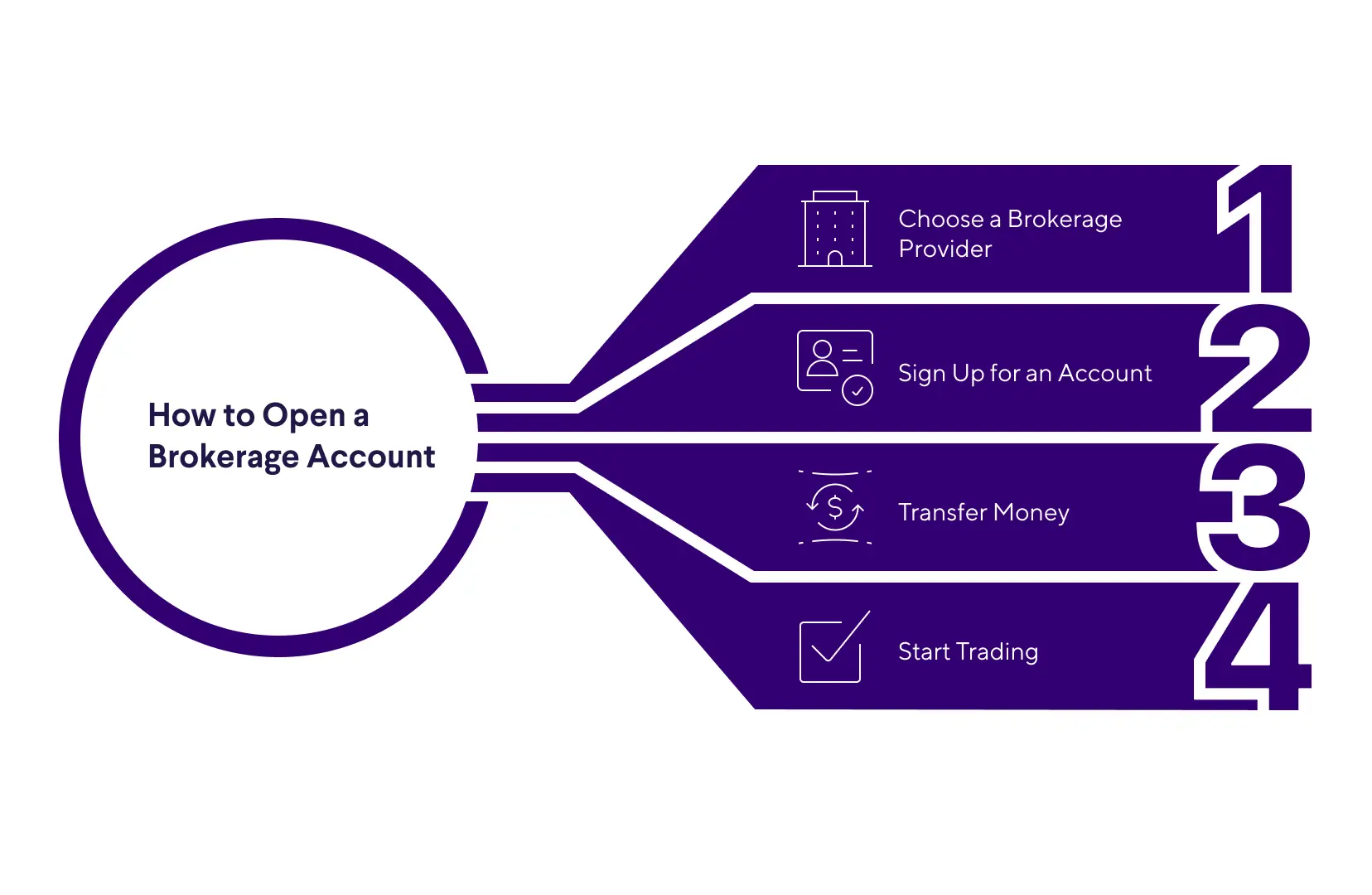
How to Open a Brokerage Account

When you open a brokerage account with a brokerage firm, you transfer money into the account that you can use to start investing. While some brokerage accounts may set an account minimum, there is typically no limit to how much you can deposit or when you can withdraw your money.

With a brokerage account, investors can invest in a variety of securities, including stocks, bonds, ETFs, and more. There are many brokerages, but the steps to open a brokerage account are similar among most of them.

Key Points

  • Select a brokerage provider that aligns with your investment goals, considering services and fees.
  • Complete the online account setup by submitting personal and financial information.
  • Fund the account by transferring money, similar to a bank deposit.
  • Start trading stocks, bonds, and ETFs once the account is funded.
  • SIPC insurance protects up to $500,000 in cash and securities if the brokerage fails.[1] However, if the brokerage firm fails, the account fails, too.

How to Open a Brokerage Account

How to Open a Brokerage Account Step-by-Step

There are a few simple steps to opening your first brokerage account. We’ll dive deep into each one below.

  1. Choose a brokerage provider.
  2. Sign up for an account.
  3. Transfer money.
  4. Start trading.

Step 1: Choose a Brokerage Provider

There are several types of brokerage accounts[2], and the type you choose will depend on what you’re trying to accomplish.

  • Full-service brokerage firms not only allow clients to trade securities, they may also offer financial consulting and other services — though the price may be steep, compared to the other options here.
  • Discount brokerage firms typically charge lower fees than full-service, but as a result clients don’t have access to additional financial consulting or planning services.
  • Online brokerage firms are typically online-only, allowing clients to sign up, transfer money, and make trades through their website. These firms typically offer the lowest fees.

The accounts above are known as cash accounts: You must buy securities with funds you put in your account ahead of time.

You may also encounter other more complicated types of brokerage accounts known as margin accounts, which allow you to borrow money from your brokerage to make investments, using your case account as collateral. These accounts tend to be for sophisticated investors willing to shoulder the risk that investments bought with borrowed funds will lose value.

Before working with an individual investment advisor or a firm and opening a cash or margin account, it can be a good idea to run a check on their background. The Financial Industry Regulatory Authority (FINRA) offers online broker checks where you can enter a broker’s name, or the name of a firm, to learn whether a broker is registered to sell securities, offer investment advice, or both.[3]

And you can learn about a broker’s employment history, regulatory actions, and whether there are past or current arbitrations and complaints.

Step 2: Sign Up for a Brokerage Account

Most brokers of all kinds allow you to open and access your brokerage account online. When you open the account, you will likely be asked to provide your Social Security number or taxpayer identification number, your address, date of birth, driver’s license or passport information, employment status, annual income and net worth. You may also be asked about your investment goals and risk tolerance.

For the most part, they should not charge you a fee for opening an account. While some may require account minimums, others allow you to open an account with no minimum deposit. There is no limit on the number of brokerage accounts you can open, and you may be able to hold multiple accounts with multiple brokerage firms.

Step 3: Transfer Money

You will need to fund your new brokerage account before you can purchase any types of securities. You can deposit money in a brokerage account like you would in a traditional bank account.

Step 4: Start Trading

Many brokerage firms will offer a way for you to earn interest on uninvested funds so that your money continues to work for you even when not invested in the market.

How Do Brokerage Accounts Work?

The brokerage firm with which you hold your account maintains the account and acts as the custodian for the assets you hold. In other words, the custodian provides a space for investors to use their account in the way that it was intended.

However, you own the investments in the account and can buy and sell them as you wish. The brokerage firm acts as a middleman between you and the markets, matching you with buyers and sellers, and executing trades based on your instructions.

For example, if you place an order with your brokerage to buy a certain number of shares of stock, the brokerage will match you with a seller looking to sell those shares and make the trade for you.

What’s the Difference Between Brokerage Accounts and Retirement Accounts?

Brokerage accounts are also known as taxable accounts, because profits on sales of securities inside the account are potentially subject to capital gains taxes. Generally speaking, these accounts offer no tax advantages for investors.

Retirement accounts, on the other hand, offer a number of tax advantages that may make them preferable to taxable accounts if you’re planning to save for retirement. Retirement accounts place limits on how much money you can contribute and when you can withdraw funds.

If retirement planning is your main concern, you may consider saving as much as you can in both a 401(k) if your employer offers one, and a traditional or Roth IRA. If you have funds left over, you may choose to invest those in your taxable brokerage account.

Is My Money Safe in a Brokerage Account?

The money and securities held in a brokerage account are insured by the Securities Investor Protection Corporation (SIPC). The SIPC protects against the loss of cash and securities held at failing brokerage firms. If your brokerage firm goes bankrupt, the SIPC covers $500,000 worth of losses, including $250,000 in cash losses.

The SIPC only provides protection for the custody function of a brokerage firm. In other words, they work to restore the cash and securities that were in a customer’s account when the brokerage started its liquidation proceedings. The organization does not protect against declines in value of the securities you hold, nor does it protect against receiving and acting upon bad investment advice.

It is important that any investor realizes and accepts that investment comes with a certain amount of risk. While security prices may gain in value, it is also possible that you could lose some or all of your investment.

The Takeaway

Opening a brokerage account is a simple process that allows you to invest in securities. Effectively, you’re depositing money at a brokerage, which will allow you to buy investments such as stocks, bonds, or ETFs. There are numerous brokerages out there, and different types of brokerage accounts.

Invest in what matters most to you with SoFi Active Invest. In a self-directed account provided by SoFi Securities, you can trade stocks, exchange-traded funds (ETFs), mutual funds, alternative funds, options, and more — all while paying $0 commission on every trade. Other fees may apply. Whether you want to trade after-hours or manage your portfolio using real-time stock insights and analyst ratings, you can invest your way in SoFi's easy-to-use mobile app.

Opening and funding an Active Invest account gives you the opportunity to get up to $1,000 in the stock of your choice.¹

FAQ

How do I open a brokerage account?

Broadly speaking, you can open a brokerage account by choosing a broker or brokerage account provider, signing up, transferring money into the account, and then starting to trade or invest.

What are the different types of brokers?

There are several different types of brokerages, and those include full-service brokerage firms, discount brokerage firms, and online brokerage firms. Each type may offer different products and services, or levels of service.

Is money in a brokerage account safe?

While nothing is ever truly safe, money and securities that are held in brokerage accounts are insured by the Securities Investor Protection Corporation, or SIPC, for up to $500,000 in losses.

Article Sources

INVESTMENTS ARE NOT FDIC INSURED • ARE NOT BANK GUARANTEED • MAY LOSE VALUE

SoFi Invest is a trade name used by SoFi Wealth LLC and SoFi Securities LLC offering investment products and services. Robo investing and advisory services are provided by SoFi Wealth LLC, an SEC-registered investment adviser. Brokerage and self-directed investing products offered through SoFi Securities LLC, Member FINRA/SIPC.

For disclosures on SoFi Invest platforms visit SoFi.com/legal. For a full listing of the fees associated with Sofi Invest please view our fee schedule.

Financial Tips & Strategies: The tips provided on this website are of a general nature and do not take into account your specific objectives, financial situation, and needs. You should always consider their appropriateness given your own circumstances.

Disclaimer: The projections or other information regarding the likelihood of various investment outcomes are hypothetical in nature, do not reflect actual investment results, and are not guarantees of future results.

Exchange Traded Funds (ETFs): Investors should carefully consider the information contained in the prospectus, which contains the Fund’s investment objectives, risks, charges, expenses, and other relevant information. You may obtain a prospectus from the Fund company’s website or by emailing customer service at [email protected]. Please read the prospectus carefully prior to investing.

Fund Fees
If you invest in Exchange Traded Funds (ETFs) through SoFi Invest (either by buying them yourself or via investing in SoFi Invest’s automated investments, formerly SoFi Wealth), these funds will have their own management fees. These fees are not paid directly by you, but rather by the fund itself. these fees do reduce the fund’s returns. Check out each fund’s prospectus for details. SoFi Invest does not receive sales commissions, 12b-1 fees, or other fees from ETFs for investing such funds on behalf of advisory clients, though if SoFi Invest creates its own funds, it could earn management fees there.
SoFi Invest may waive all, or part of any of these fees, permanently or for a period of time, at its sole discretion for any reason. Fees are subject to change at any time. The current fee schedule will always be available in your Account Documents section of SoFi Invest.


Utilizing a margin loan is generally considered more appropriate for experienced investors as there are additional costs and risks associated. It is possible to lose more than your initial investment when using margin. Please see SoFi.com/wealth/assets/documents/brokerage-margin-disclosure-statement.pdf for detailed disclosure information.

Tax Information: This article provides general background information only and is not intended to serve as legal or tax advice or as a substitute for legal counsel. You should consult your own attorney and/or tax advisor if you have a question requiring legal or tax advice.


¹Probability of Member receiving $1,000 is a probability of 0.026%; If you don’t make a selection in 45 days, you’ll no longer qualify for the promo. Customer must fund their account with a minimum of $50.00 to qualify. Probability percentage is subject to decrease. See full terms and conditions.

Third Party Trademarks: Certified Financial Planner Board of Standards Center for Financial Planning, Inc. owns and licenses the certification marks CFP®, CERTIFIED FINANCIAL PLANNER®

SOIN-Q225-132

Read more
A young woman with dark hair tied back, wearing a white polka-dot shirt, focuses on a laptop researching student loans.

2026 Top Game Design Schools and Colleges in the U.S.

Turn your passion for playing video games into a career by attending one of the top game design colleges in the country.

Game design is an in-demand industry, with new video games for gaming systems, tablets, and phones continually being developed and released. Here, we’re exploring 20 of the best gaming development programs you might want to consider.

What to Look for in a Game Design School

If you’re looking into colleges for video game design, you’ll quickly realize that not all programs are created equally. Some schools only offer a class or two in game design, while others go deep into the field, offering internships and hands-on experiences.

If you’re interested in attending a game design school, it’s important to research schools and programs prior to making your decision. Make sure to look into the specific type of degree you want (undergraduate degree or certificate, for example), the length and commitment of the program, what current and former students have to say about the program, the helpfulness of the faculty and staff, and more.

Fortunately, we’ve done some of the work for you. Here’s a look at some of the best game design programs in the country.

Top Colleges for Game Design

There are a number of video game design colleges and programs in the U.S. Here, we’ve created a list of well-regarded programs at all different price points.

Shawnee State University

Shawnee’s Game Design School has made it on The Princeton Review’s Top Undergraduate Schools for Game Design list for 15 consecutive years, and with such low tuition, it might be a great bargain. Located in Portsmouth, OH, you can elect to study Game Programming or Game Arts.

•   1 year of tuition: In-state $10,180.38; Out-of-state $17.248.50

University of Silicon Valley

USV is available on-campus in the heart of Silicon Valley or 100% online. The university offers Bachelor of Arts degrees in both Game Design and Game Art, as well as a Bachelor of Science in Game Engineering. After graduating, students are qualified for roles including animator, modeler, game writer, computer programmer, and more.

•   1 year of tuition: $21,980 (in-person); $16,667 (online)

Arizona State University

ASU’s Bachelor of Arts in Interdisciplinary Studies offers a concentration in Computer Gaming with three tracks to choose from: Programming, Art, or Education. Located in stunning Tempe, AZ, courses in the program include Introduction to Graphics and Game Development, Fundamentals of Game Art, Game Engine Architecture, and 3D Modeling and Texturing.

•   1 year of tuition: In-state $12,975; Out-of-state $35,167

University of Utah

The Utah Division of Games, located in Salt Lake City, is a college for game designing that combines art, humanities, social science, and computational research and practice to prepare students for careers in the field. Students can choose from multiple gaming bachelor’s degrees, a master’s degree, and even a minor in gaming. The Bachelor of Science in Games includes courses like Survey of Games, Ethics in Games, and Alternative Game Development.

•   1 year of tuition: In-state $10,004; Out-of-state $31,748


💡 Quick Tip: Fund your education with a competitive-rate, no-fees-required SoFi private student loan that covers up to 100% of school-certified costs.

University of Southern California

USC’s Interactive Media & Games program offers three undergraduate options: a BFA in Themed Entertainment, a BFA in Game Development and Interaction, and a BFA in Game Art. Located in sunny Los Angeles, the program also offers four graduate degrees and nine minors.

•   1 year of tuition: $75,162

Laguna College of Art and Design

Laguna College of Art and Design Game Art program, located in Laguna Beach, CA, prepares students for employment in any studio or software environment. Students learn the fundamentals of storytelling at every phase of the creation process, how to use a workflow methodology, and how to solve problems in concept challenges.

•   1 year of tuition: $39,376

Full Sail University

Full Sail’s Interactive Technology Bachelor of Science Completion Program in Winter Park, FL, offers a Game Design concentration that includes high-level game design and production courses that prepare students to work in game studios after graduation. Recognized as a Top Game Designs Schools by The Princeton Review, the program offers multiple start dates throughout the year and has an accelerated schedule for students looking to finish early.

•   1 year of tuition: $40,300

Drexel University

Drexel University in Philadelphia offers a Bachelor of Science in Game Design & Production, and is recognized as one of the country’s top undergraduate game design programs. Students learn skills like scripting and storytelling, computer programming, computer graphics, animation, motion capture, and more.

•   1 year of tuition: $64,262

Bradley University

Bradley University in Peoria, IL, offers both a BA and a BS in Game Design. During your studies, you’ll have the opportunity to intern for a design company, participate in competitions, and show your work at an annual exhibit.

•   1 year of tuition: $43,850

Savannah College of Art and Design

SCAD’s Interactive Design and Game Development degrees offer locations in Atlanta and Savannah, GA, with the option to study abroad in Lacoste, France. Students can study at any of the three locations each semester, with the option to switch locations during their time in the program. Courses in the program include Digital Communication, Visual Culture in Context: Pre-Modern Global Perspectives, Aesthetics, and Core Principles: Game Art.

•   1 year of tuition: $42,165

Michigan State University

MSU offers a Game Design and Development Program, a Top 10 Ranked program by The Princeton Review, that was founded in 2005. Students can choose from a Bachelor of Arts in Games and Interactive Media, a Minor in Game Design and Development, or a Serious Games Graduate Certificate. All students get the opportunity to design prototypes and conduct research on the effects of gaming.

•   1 year of tuition: In-state $17,374; Out-of-state $44,758

Recommended: How to Complete the FAFSA Application

University of California – Irvine

The Bachelor of Science degree in Game Design & Interactive Media at UC Irvine includes coursework in game programming, game design and development, visual design, interactive storytelling, data science, and game studies. Students graduate the program well-prepared for a career as a designer, developer, and industry leader. Students also get access to well-respected industry mentors.

•   1 year of tuition: In-state $19,268; Out-of-state $56,870

Champlain College

Champlain’s Bachelor of Science in Game Programming provides hands-on experience, with students collaborating to create and complete game projects. Located in gorgeous Burlington, VT, Champlain was named a “Most Innovative School” by U.S. News & World Report in 2022. Upon graduation, students are well-prepared to work in gaming studios.

•   1 year of tuition: $48,800

Quinnipiac University

Level up your creativity with Quinnipiac University’s Game Design & Development Program. Ranked as one of The Princeton Review’s Top Game Design Programs, students can choose a concentration to focus on, including programming, technology, design process, art, game studies, and more. Located in Hamden, CT, the program also gives students the chance to collaborate with partners both within and outside the community.

•   1 year of tuition: $57,700

Recommended: Private vs. Public College: The Pros & Cons of Both

Rochester Institute of Technology

The Game Design, Development, and Arts program at RIT has been rated one of the best programs in this field of study by many organizations, including U.S. News & World Report. Degree options include 3D Digital Design, Film & Animation, Illustration, New Media Interactive Development, and more.

•   1 year of tuition: $61,204

💡 Quick Tip: Need a private student loan to cover your school bills? Because approval for a private student loan is based on creditworthiness, a cosigner may help a student get loan approval and a lower rate.

Worcester Polytechnic Institute

The Interactive Media and Game Development (IMGD) program at WPI dives into different aspects of gaming design, including digital painting, 3D modeling, writing for games, game audio, artificial intelligence, and virtual reality. Located in Worcester, MA, the program is recognized as one of the oldest gaming programs in the country.

•   1 year of tuition: $62,266

New York University

New York University’s BFA in Game Design has three primary areas of study: Game Studies, Game Design, and Game Development. You can also choose from one the following Production Areas: Programming, Video Design, Audio Design, and Game Business. Though tuition here is a bit higher than at some of the other schools, you can pay for it with a federal or private student loan.

•   1 year of tuition: $65,622

Carnegie Mellon

The Game Design undergraduate program at Carnegie Mellon in Pittsburgh, PA, will give you a solid foundation in game systems and mechanics design, interactive narrative and character development, visual and audio asset creation, game programming, interface design and user testing, and collaboration and the iterative design process.

•   1 year of tuition: $68,096

University of California – Santa Cruz

In USC Santa Cruz’s Bachelor of Science in Computer Science: Computer Game Design, you’ll learn about the construction and design of interactive computer games. In your final year of study, you’ll be immersed in an intensive year-long game project sequence.

•   1 year of tuition: In-state: $16,785; Out-of-state: $37,602

Recommended: Student Debt Guide

Cornell University

Cornell, another of the best game design colleges, is located in Ithaca, NY. It offers a minor in Game Design that includes classes like Intro to Computer Game Architecture, Advanced Computer Game Architecture, Analytics-Driven Game Design, Graphics and Art, the Psychology of Gaming, and Human-Computer Interaction.

•   1 year of tuition: $71,266

The Takeaway

With so many game design colleges available, it might be hard to make a decision. Factors to keep in mind include the type of program, the location, the faculty and staff, and the cost.

However, don’t let a high sticker price keep you from applying to your top choice. Many colleges offer generous financial aid packages — which may include grants, scholarships, work-study, and federal student loans — that can make your education more affordable.

If you’ve exhausted all federal student aid options, no-fee private student loans from SoFi can help you pay for school. The online application process is easy, and you can see rates and terms in just minutes. Repayment plans are flexible, so you can find an option that works for your financial plan and budget.


Cover up to 100% of school-certified costs including tuition, books, supplies, room and board, and transportation with a private student loan from SoFi.

FAQ

What’s the most affordable game design program?

Shawnee State University offers a nationally acclaimed game design program with low tuition. Tuition for in-state residents is $10,180 per year.

What’s the most expensive game design program?

Cornell University has one of the most expensive game design programs in the U.S. at over $71,000 per year.

How much does game design school cost?

Game design schools can range anywhere from $10,180 to more than $70,000 per year.


Photo credit: iStock/fizkes

SoFi Private Student Loans
Please borrow responsibly. SoFi Private Student loans are not a substitute for federal loans, grants, and work-study programs. We encourage you to evaluate all your federal student aid options before you consider any private loans, including ours. Read our FAQs.

Terms and conditions apply. SOFI RESERVES THE RIGHT TO MODIFY OR DISCONTINUE PRODUCTS AND BENEFITS AT ANY TIME WITHOUT NOTICE. SoFi Private Student loans are subject to program terms and restrictions, such as completion of a loan application and self-certification form, verification of application information, the student's at least half-time enrollment in a degree program at a SoFi-participating school, and, if applicable, a co-signer. In addition, borrowers must be U.S. citizens or other eligible status, be residing in the U.S., Puerto Rico, U.S. Virgin Islands, or American Samoa, and must meet SoFi’s underwriting requirements, including verification of sufficient income to support your ability to repay. Minimum loan amount is $1,000. See SoFi.com/eligibility for more information. Lowest rates reserved for the most creditworthy borrowers. SoFi reserves the right to modify eligibility criteria at any time. This information is subject to change. This information is current as of 4/22/2025 and is subject to change. SoFi Private Student loans are originated by SoFi Bank, N.A. Member FDIC. NMLS #696891 (www.nmlsconsumeraccess.org).

SoFi Bank, N.A. and its lending products are not endorsed by or directly affiliated with any college or university unless otherwise disclosed.

SoFi Loan Products
SoFi loans are originated by SoFi Bank, N.A., NMLS #696891 (Member FDIC). For additional product-specific legal and licensing information, see SoFi.com/legal. Equal Housing Lender.


Non affiliation: SoFi isn’t affiliated with any of the companies highlighted in this article.

External Websites: The information and analysis provided through hyperlinks to third-party websites, while believed to be accurate, cannot be guaranteed by SoFi. Links are provided for informational purposes and should not be viewed as an endorsement.
Third-Party Brand Mentions: No brands, products, or companies mentioned are affiliated with SoFi, nor do they endorse or sponsor this article. Third-party trademarks referenced herein are property of their respective owners.

SOISL-Q425-029

Read more
A stack of books topped with a jar full of money labeled "EDUCATION" wearing a graduation cap, on a green background.

What to Do When Financial Aid Isn’t Enough

The average cost of college tuition and fees for the 2025-2026 academic year is $11,950 at public colleges for in-state residents, $31,880 at public colleges for out-of-state residents, and a whopping $45,000 at private colleges. And the price tag for an undergraduate degree typically goes up every year. Any way you look at it, college is a huge expense for students and their families.

Many schools offer financial aid to make college more affordable. But sometimes your initial financial aid offer — which may include grants, scholarships, loans, and work-study — just isn’t enough to cover the cost. And your family may not be in a position to help you make up the difference. What do you do if you can’t afford college, even with financial aid?

Take heart: There are many options out there to help you pay for higher education. Navigating them can be a challenge, though, especially if you haven’t had to manage major financial responsibilities until now. The key is doing the research and giving yourself enough time to take advantage of all the opportunities available to you.

What follows are a few ideas on how you could get more money for school.

Key Points

•   If financial aid isn’t enough to cover college costs, you can apply for additional scholarships and grants, including institutional and external awards.

•   You may qualify for a work-study job or a part-time position to help offset expenses while in school.

•   Appealing your financial aid award is an option if your financial situation has changed or if the FAFSA® didn’t accurately reflect your ability to pay.

•   Attending a more affordable college or technical school can significantly reduce expenses.

•   Private student loans can help fill any remaining gaps but typically have higher interest rates and fewer repayment protections than federal loans.

7 Ways to Pay for College When Financial Aid Falls Short

Apply for Scholarships and Grants

There’s a lot of “free money” for college out there in the form of scholarships and grants. Your Free Application for Federal Student Aid (FAFSA®) will automatically match you with any federal financial aid programs you qualify for. The form is also used by many states and colleges to determine eligibility for their own aid. In addition, there are numerous scholarships available from private organizations that you can seek out and apply for separately.

You might start your search by asking your high school guidance office and the admissions or financial aid department at the school you plan to attend about college scholarships opportunities you may be eligible for. These might be need-based, merit-based, or a combination of both.

You can also do your own online research. A search engine like FastWeb or FinAid can help you hunt down scholarships that are a good fit. SoFi also offers a Scholarship Search Tool, as well as a state-based search tool.

To uncover more obscure scholarships, you may want to reach out directly to companies and organizations you have some connection to. This might include:

•   Family members’ employers and associations

•   Community service groups with whom you’ve volunteered

•   Identity/heritage groups

•   Religious communities you’re involved with

•   Special-interest groups, such as the Starfleet scholarship offered by the Star Trek Fan Association (there are many niche scholarships like this)

Once you’ve identified relevant scholarships, you’ll need to carefully put together your application materials. Typically, you need to include a transcript, personal statement, and personal references. You may want to have a teacher, parent, or guidance counselor read over your materials and give you feedback.

Though time-consuming, this project can be well worth the effort. It’s remarkable how a bunch of smaller scholarships or grants can add up and help make college more affordable.

💡 Quick Tip: You’ll make no payments on some private student loans for six months after graduation.

How to Request More Financial Aid

You might consider appealing your financial aid award if there has been a change in your financial circumstances or if you believe the information on your FAFSA form does not accurately represent your ability to pay for college.

College financial aid office websites often provide information about what steps to take if you’ve had a change in financial circumstances since completing your aid application. In addition, financial aid staff are often available to provide you with guidance and discuss options if your financial aid awards or offers aren’t enough to cover your college expenses.

This appeal process will likely require you to submit additional documentation to your school’s financial aid office. If warranted, the financial aid office can then recalculate your eligibility, possibly resulting in a change to your financial aid offer.

Get a Work-Study Job

Another way to help pay for college is to work while you’re in school. Federal student aid packages may include a job through the Federal Work-Study program, which aims to fund part-time jobs that are (ideally) in the public interest or related to your field of study. Federal work-study is awarded based on financial need, so it may not be part of every student aid package.

These jobs may be on or off campus, at a nonprofit organization or government agency, or simply within your university. Some schools also set up work-study jobs with for-profit employers that may be relevant to what you’re studying. These jobs pay at least minimum wage, but sometimes more, depending on the position.

With a work-study job, your school typically pays you by the hour, at least once a month. The number of hours you can work is limited and set by your school. To get the full low-down, ask your school’s financial aid office whether they participate in the Federal Work-Study program, how many hours you qualify for, and what job opportunities exist.

Note that qualifying for work-study doesn’t automatically guarantee you a job. You may still need to find one and apply for it. These opportunities are often limited, so it’s a good idea to start gathering information early if you decide to go this route.

Recommended: Guide to Saving Money in College

Find A Part-Time Job

Another option is to look for a part-time job on your own. Your college might have internal job boards that list on-campus jobs for students or jobs that alumni have posted. Because you’re in the same network (either at your school or via alumni), you might have a leg up on outside applicants.

If you don’t find the right fit, be proactive by asking your professors, academic departments, family friends, and establishments around town whether they are looking for help. And of course, check external job sites for part-time opportunities.

Some part-time jobs, like research assistant or tutor, can help build your resume. But don’t discount flexible gigs outside your field of study that just pay well, such as waiting tables or walking dogs. If you play your cards right, your part-time job can more than make up for a financial aid shortfall.

Take Out Additional Federal Student Loans

If you still need more funds to fill the tuition gap, taking out additional student loans may still be an option. It’s likely that if you filled out the FAFSA and received a federal financial aid package, you may have already been awarded federal student loans.

Federal loans offer fixed interest rates and more flexible repayment terms than most private lenders. In most cases, student loans from the federal government don’t require a credit check or a cosigner, which can be especially helpful if you haven’t had time to build up a credit history.

As an undergraduate, you can take out two different types of loans under the Federal Direct Loan program. One of these is a Direct Subsidized Loan, which is awarded based on financial need. If you qualify for this loan, you will not be responsible for the interest that accrues while you’re in school and for six months after you graduate.

You can also take out a Direct Unsubsidized Loan, which does not depend on financial need. Interest on this loan will accrue while you’re in school and during the six-month grace period, though you will not be responsible for paying that interest until your repayment period begins. And you don’t have to start repaying subsidized or unsubsidized federal loans until you graduate or drop below half-time enrollment (and after the six-month grace period).

Currently, you can take out anywhere from $5,500 to $12,500 per year in federal loans as an undergraduate, depending on your dependency status and your year in school.

A parent can also take out a Direct PLUS Loan from the federal government to help you pay for school. For the 2025-2026 academic year, parents can borrow as much as your total cost of attendance minus any financial aid you’ve gotten. Starting in the 2026-2027 academic year, Parent PLUS loans will be capped at $20,000 annually.

In order to qualify for a Direct PLUS Loan as a parent of a dependent undergrad, they will have to go through a credit check and must not have a problematic credit history. If parents request a deferment, they don’t necessarily have to start repaying their loans until six months after their child graduates or drops below part-time enrollment.

💡 Quick Tip: Parents and sponsors with strong credit and income may find much lower rates on no-fee private parent student loans than federal parent PLUS loans. Federal PLUS loans also come with an origination fee.

Apply for Private Student Loans

If you weren’t able to get enough in federal aid, including federal loans, you may be able to borrow additional loans through a private lender (such as a bank, credit union, or online lender) to cover the balance.

Private student loans typically come with higher interest rates than federal student loans and don’t offer the same borrower protections (like income-driven repayment). However, they come with higher borrowing limits. Typically, you can borrow up to the total cost of attendance, minus any financial aid received, every year, giving you more flexibility to get the funding you need.

Loans amounts, rates, and repayment terms vary by lender, so it’s a good idea to shop around to find the best options. As you compare lenders, keep in mind that a fixed interest rate will stay the same for the life of a loan, while a variable rate can change over time as market interest rates change.

Private student loan lenders often have a minimum credit score requirement to qualify, so you might need a cosigner to get approved for funding.

Ask Your School About Payment Plans

“If the cost of college tuition is a concern, it could be worth looking into tuition payment plans,” says Brian Walsh, CFP® and Head of Advice & Planning at SoFi. “ These plans are offered by some colleges and could help make tuition payments more manageable for students and parents.” For example, you may be able to pay monthly without being charged late fees or getting dropped from your classes.

While a tuition payment plan may not reduce your expenses, it could at least make them easier to manage. You can find out about payment plans by contacting your school’s billing office (it may also be referred to as the bursar’s office, cashier’s office, or student accounts office).

Consider More Affordable Options

If you don’t qualify for financial aid, or your financial aid is not enough, you might try to reduce your costs by choosing a less expensive school. The average in-state cost of a public college is nearly 75% less than the average sticker price at a private college, according to data from U.S. News. There are even some schools that offer free tuition.

You can also reduce the cost of a bachelor’s degree by starting out at a community college, then transferring to your desired four-year school. A community college, particularly a public one, may offer a significantly lower sticker price. However, you’ll want to make sure that your prospective college will allow the credits to transfer.

If you have your eye on a specific career, you might also consider going to a trade or technical college. Technical schools provide industry-specific classes that prepare students for a particular career or trade. Programs can take anywhere from less than two years to up to four years, after which you earn a certificate, diploma, or associate degree. The cost of tuition at a technical school is usually significantly less than a college or university — often as little as $5,000 per year.

The Takeaway

Just because you didn’t get enough financial aid doesn’t mean you can’t afford to attend college. By applying for grants and scholarships, taking on a part-time job, appealing your aid award, and applying for loans, you may be able to find a path to achieving your dreams.

If you’ve exhausted all federal student aid options, no-fee private student loans from SoFi can help you pay for school. The online application process is easy, and you can see rates and terms in just minutes. Repayment plans are flexible, so you can find an option that works for your financial plan and budget.


Cover up to 100% of school-certified costs including tuition, books, supplies, room and board, and transportation with a private student loan from SoFi.

FAQ

How can I increase my financial aid for college?

You may be able to increase your financial aid by appealing your award. You can contact the school’s financial aid office to find out how its appeals process works. Your appeal is most likely to be successful if there was an error on your aid application, your family’s circumstances have changed since you first applied, or you have a competing offer from another school that you can ask your dream school to match.

You may also be able to get more aid for college by searching — and applying — for private scholarships. There are numerous private scholarships and fellowships available, often funded by foundations, corporations, and other independent organizations.

What income gets the most financial aid?

The amount of financial aid you receive is primarily based on your financial need as calculated by the FAFSA® and your school. Generally, students from lower-income families who demonstrate greater financial need are eligible for the most need-based financial aid, such as the Pell Grant and Direct Subsidized Loans. However, merit-based aid, which is not dependent on income, can be awarded to students from any income level based on academic achievement, talents, or other criteria. Ultimately, there is no specific income that guarantees the “most” aid; it is a combination of financial need and merit-based eligibility.

What GPA does FAFSA require?

The FAFSA® itself does not have a GPA requirement. However, to remain eligible for federal student aid once you are enrolled in college, you must meet the satisfactory academic progress (SAP) standards set by your school. These standards typically include maintaining a minimum GPA, usually a C average (2.0 on a 4.0 scale), and successfully completing a certain percentage of the courses you attempt.

If you fail to meet SAP, your school may put you on academic probation, and if you don’t improve, you could lose your eligibility for federal financial aid. Check your college’s specific SAP policy for details.

Is there a limit to how much FAFSA you can get?

Yes, there are limits on how much federal student aid you can receive through FAFSA®, both annually and in total, depending on the type of aid (grants or loans) and your status as an undergraduate or graduate student. For example, annual loan limits for undergraduates range from $5,500 to $12,500, depending on their year in school and dependency status, while the maximum annual Federal Pell Grant award is $7,395.


SoFi Private Student Loans
Please borrow responsibly. SoFi Private Student loans are not a substitute for federal loans, grants, and work-study programs. We encourage you to evaluate all your federal student aid options before you consider any private loans, including ours. Read our FAQs.

Terms and conditions apply. SOFI RESERVES THE RIGHT TO MODIFY OR DISCONTINUE PRODUCTS AND BENEFITS AT ANY TIME WITHOUT NOTICE. SoFi Private Student loans are subject to program terms and restrictions, such as completion of a loan application and self-certification form, verification of application information, the student's at least half-time enrollment in a degree program at a SoFi-participating school, and, if applicable, a co-signer. In addition, borrowers must be U.S. citizens or other eligible status, be residing in the U.S., Puerto Rico, U.S. Virgin Islands, or American Samoa, and must meet SoFi’s underwriting requirements, including verification of sufficient income to support your ability to repay. Minimum loan amount is $1,000. See SoFi.com/eligibility for more information. Lowest rates reserved for the most creditworthy borrowers. SoFi reserves the right to modify eligibility criteria at any time. This information is subject to change. This information is current as of 4/22/2025 and is subject to change. SoFi Private Student loans are originated by SoFi Bank, N.A. Member FDIC. NMLS #696891 (www.nmlsconsumeraccess.org).

SoFi Bank, N.A. and its lending products are not endorsed by or directly affiliated with any college or university unless otherwise disclosed.

SoFi Loan Products
SoFi loans are originated by SoFi Bank, N.A., NMLS #696891 (Member FDIC). For additional product-specific legal and licensing information, see SoFi.com/legal. Equal Housing Lender.


Non affiliation: SoFi isn’t affiliated with any of the companies highlighted in this article.

Third Party Trademarks: Certified Financial Planner Board of Standards Center for Financial Planning, Inc. owns and licenses the certification marks CFP®, CERTIFIED FINANCIAL PLANNER®

External Websites: The information and analysis provided through hyperlinks to third-party websites, while believed to be accurate, cannot be guaranteed by SoFi. Links are provided for informational purposes and should not be viewed as an endorsement.
Third-Party Brand Mentions: No brands, products, or companies mentioned are affiliated with SoFi, nor do they endorse or sponsor this article. Third-party trademarks referenced herein are property of their respective owners.

SOISL-Q425-019

Read more
A man sitting on his couch and working on his computer, tracking the funds in his online investment account.

Target Funds vs Index Funds: Key Differences

Target-date funds and index funds are two common investment vehicles for individuals investing for retirement. Investors may see one or both of these types of investments as options in their 401(k) or other workplace retirement fund. Target-date funds offer a sort of set-it-and-forget-it approach to investing typically tied to an investor’s timeline, while index funds include a basket of investments corresponding to an underlying market index.

Understanding the key differences between target date funds and index funds can help investors understand which option may be a fit for their portfolio.

Key Points

•   Target-date funds provide a set-it-and-forget-it investment strategy, ideal for investors looking for a more hands-off approach.

•   These funds automatically reallocate assets to become more conservative as the investor’s retirement date nears.

•   Index funds offer broad market exposure and are generally passively managed, resulting in lower fees.

•   Investors in index funds may benefit from simplicity and cost-effectiveness, which may make them suitable for beginners.

•   Key considerations when choosing between a target-date fund and an index fund include personal financial goals, risk tolerance, and the trade-off between control and convenience.

Target-Date Funds vs Index Funds: A Comparison

Target-date funds and index funds are both common ways for investors to save for future goals, especially retirement. Target-date funds offer what can feel like a hands-off approach to saving for retirement. Investors choose a target fund with a date that’s closest to the year they plan to retire.

Over time, these funds automatically adjust their asset allocation, typically becoming more conservative as the investor gets closer to retirement. Investors do not have to choose the assets held by target date funds or reallocate the fund as it nears its target date.

Target-date funds may include index funds. Index funds track specific market indices and typically perform in line with the broader market.

Here’s a quick look at the main differences between these two types of funds.

Target Date Funds

Index Funds

•   A fund that provides investors with a set-it-and-forget-it option to retirement savings.

•   Reallocates automatically. Portfolios typically become more conservative as a target date approaches.

•   May have higher fees if they are actively managed.

•   Designed to track an index, such as the S&P 500, and seek to achieve returns similar to the movements of the index.

•   Allows investors more flexibility in choosing the funds in their portfolios.

•   Passive management typically translates into lower fees.

Target-Date Funds

A target date fund is a type of investment that holds a mix of different funds, which may include mutual funds, such as stock and bond funds. When choosing a target date fund, investors must decide on a target date, often offered in five-year intervals and included in the name of the fund and corresponding with the year in which they want to retire. For example, someone in their early 30s might choose a target date of 2055 with a goal of retiring around age 65.

You could, in theory, use target date funds to save for any point in the future. However, they’re a popular type of vehicle for saving for retirement and often appear on the menu of investments available to employees through their 401(k)s.

As an individual nears their target date, the fund automatically rebalances from higher-risk, higher-reward investments into lower-risk, lower-reward investments. For example, the rebalancing might include shifting a greater proportion of its holdings into bonds to help preserve accrued increases in a portfolio’s value.

Pros of Target-Date Funds

There are several reasons investors might choose a target date fund.

First, they essentially provide a ready-made portfolio of diversified stock and bond funds, making it easy to save for retirement. This may appeal to beginner investors, those who don’t want to design their own portfolios, or those who find a hands-on approach to researching and choosing investments difficult.

Additionally, target-date funds provide automatic rebalancing. As the market shifts up and down, different investments may move off track from their initial allocations. When that happens, the fund will rebalance itself so that the allocation remains in line with its original allocation plan. The target date fund also automatically shifts its allocation to more conservative investments as the target date approaches.

Recommended: When Can I Retire?

Cons of Target-Date Funds

Investors who want more control over their portfolios may not like target-date funds, which don’t allow investors any control over their mix of investments or when and how rebalancing takes place.

Target-date funds build portfolios using a variety of investments. Some may use index mutual funds that come with relatively low fees. Others might use managed mutual funds, which may come with higher fees. It’s important to look closely at target-date fund holdings to understand what types of fees they might charge.

Here are the pros and cons of target date funds at a glance.

Pros

Cons

•   Ready-made portfolio.

•   A basket of mutual funds may help provide some diversification.

•   Automatic rebalancing, including a shift to more conservative assets over time.

•   Lack of control over investments and when portfolio is rebalanced.

•   Potentially higher fees for funds that hold managed mutual funds.

💡 Quick Tip: How do you decide if a certain online trading platform or app is right for you? Ideally, the online investment platform you choose offers the features that can support your investment goals or strategy, e.g., an easy-to-use interface, data analysis, educational tools.

Index Funds

An index fund is a type of mutual fund or exchange-traded fund (ETF). It’s built to follow the returns of a market index, of which there are many.

These indexes track a basket of securities meant to represent the market as a whole or certain sectors. For example, the S&P 500 is a market capitalization weighted index that tracks the top 500 U.S. stocks.

An index fund may follow a market index using several strategies. Some index funds may hold all of the securities included in the index. Others may include only a portion of the securities held by an index, and they may have the leeway to include some investments not tracked by the index.

Because index funds are attempting to follow an index rather than beat it, they don’t require as much active management as fully managed funds. As a result, they may charge lower fees, making them a low-cost option for investors.

Index funds are popular choices for retirement savings accounts. They are designed to offer diversification through exposure to a wide range of securities, they’re easy to manage, and they offer the potential for steady long-term growth.

Pros of Index Funds

Low fees and full transparency are among the benefits of holding index funds. Investors can review all of the securities held by the fund, which can help them identify and weigh risk.

Historically, index funds have also potentially offered better returns over the long term than their actively managed counterparts, especially after factoring in fees.

Recommended: Actively Managed Funds vs. Index Funds: Differences and Similarities

Cons of Index Funds

Some of the drawbacks to index funds include the fact that they are often fairly inflexible. If they follow an index that requires them to hold a certain mix of stocks, they decline in value when the market does.

In addition, because many index funds use market capitalization weighting, the funds can be concentrated in a few large companies with a higher market capitalization. If those few companies don’t perform well, it can affect the entire fund’s performance.

Here’s a look at the pros and cons of index funds at a glance.

Pros

Cons

•   Designed to offer broad exposure through a basket of securities that tracks an index.

•   Transparency. Investors can review the holdings in the fund.

•   Lower fees. Passive management typically makes it cheaper to operate funds, which results in lower management fees passed on to investors.

•   Potentially better returns than actively managed funds.

•   Lack of flexibility. There may be strict mandates about what can and can’t be included in the fund.

•   A few companies with a higher market capitalization may have a significant impact on a fund’s performance.

Index Funds for Retirement

You can use index funds to build a retirement portfolio as well as to save for other goals. If you’re using them for retirement, you may want to consider a mix of index funds covering a range of asset classes that can provide some diversity within your overall portfolio. Unlike a target-date fund, if that allocation strays from your goals, you’ll need to handle the rebalancing on your own.

The Takeaway

Index funds and target-date funds are funds used by retail investors for different purposes. Investors choosing between the two will need to consider their personal financial circumstances and needs. Index funds may be an option for investors looking for passive, long-term investments that they can choose based on their own goals, risk tolerance, and time horizon. They may also be a choice for beginners who are looking for simple, low-cost investment options.

Target date funds, on the other hand, may be another option for long-term investors who do not want to have to rethink their portfolio allocations on a regular basis.

Invest in what matters most to you with SoFi Active Invest. In a self-directed account provided by SoFi Securities, you can trade stocks, exchange-traded funds (ETFs), mutual funds, alternative funds, options, and more — all while paying $0 commission on every trade. Other fees may apply. Whether you want to trade after-hours or manage your portfolio using real-time stock insights and analyst ratings, you can invest your way in SoFi's easy-to-use mobile app.


Invest with as little as $5 with a SoFi Active Investing account.

FAQ

Are target-date funds or index funds better?

Whether index funds or target-date funds are better depends on an investor’s circumstances and goals. Index funds track a market index, offer broad market exposure, and are generally simple, low-cost investments. Target-date funds, frequently used for retirement savings, offer a hands-off investment approach tied to an investor’s timeline, automatically adjusting the asset allocation. An investor can weigh the pros and cons of both options to determine which is right for them.

What is the downside to target-date funds?

A downside to target-date funds is that investors don’t have control over the mix of investments in the funds or when rebalancing takes place. These funds may also come with higher fees.

Are index funds good for beginners?

Index funds can be a good option for beginners because they are a simple, low-cost way to hold a mix of securities that track a particular market index, such as the S&P 500.


Photo credit: iStock/Ridofranz

INVESTMENTS ARE NOT FDIC INSURED • ARE NOT BANK GUARANTEED • MAY LOSE VALUE

SoFi Invest is a trade name used by SoFi Wealth LLC and SoFi Securities LLC offering investment products and services. Robo investing and advisory services are provided by SoFi Wealth LLC, an SEC-registered investment adviser. Brokerage and self-directed investing products offered through SoFi Securities LLC, Member FINRA/SIPC.

For disclosures on SoFi Invest platforms visit SoFi.com/legal. For a full listing of the fees associated with Sofi Invest please view our fee schedule.

Investment Risk: Diversification can help reduce some investment risk. It cannot guarantee profit, or fully protect in a down market.

Exchange Traded Funds (ETFs): Investors should carefully consider the information contained in the prospectus, which contains the Fund’s investment objectives, risks, charges, expenses, and other relevant information. You may obtain a prospectus from the Fund company’s website or by emailing customer service at [email protected]. Please read the prospectus carefully prior to investing.

Mutual Funds (MFs): Investors should carefully consider the information contained in the prospectus, which contains the Fund’s investment objectives, risks, charges, expenses, and other relevant information. You may obtain a prospectus from the Fund company’s website or clicking the prospectus link on the fund's respective page at sofi.com. You may also contact customer service at: 1.855.456.7634. Please read the prospectus carefully prior to investing.Mutual Funds must be bought and sold at NAV (Net Asset Value); unless otherwise noted in the prospectus, trades are only done once per day after the markets close. Investment returns are subject to risk, include the risk of loss. Shares may be worth more or less their original value when redeemed. The diversification of a mutual fund will not protect against loss. A mutual fund may not achieve its stated investment objective. Rebalancing and other activities within the fund may be subject to tax consequences.

Dollar Cost Averaging (DCA): Dollar cost averaging is an investment strategy that involves regularly investing a fixed amount of money, regardless of market conditions. This approach can help reduce the impact of market volatility and lower the average cost per share over time. However, it does not guarantee a profit or protect against losses in declining markets. Investors should consider their financial goals, risk tolerance, and market conditions when deciding whether to use dollar cost averaging. Past performance is not indicative of future results. You should consult with a financial advisor to determine if this strategy is appropriate for your individual circumstances.

S&P 500 Index: The S&P 500 Index is a market-capitalization-weighted index of 500 leading publicly traded companies in the U.S. It is not an investment product, but a measure of U.S. equity performance. Historical performance of the S&P 500 Index does not guarantee similar results in the future. The historical return of the S&P 500 Index shown does not include the reinvestment of dividends or account for investment fees, expenses, or taxes, which would reduce actual returns.
Financial Tips & Strategies: The tips provided on this website are of a general nature and do not take into account your specific objectives, financial situation, and needs. You should always consider their appropriateness given your own circumstances.

Third Party Trademarks: Certified Financial Planner Board of Standards Center for Financial Planning, Inc. owns and licenses the certification marks CFP®, CERTIFIED FINANCIAL PLANNER®

SOIN-Q425-004

Read more
TLS 1.2 Encrypted
Equal Housing Lender