The Most Important Components of a Successful Budget

Financial gurus, your money-savvy friend, and personal finance books and articles all say the same thing: You need a budget. Why? Because without any guardrails to guide your spending decisions, you can end up overspending (and, in turn, running up debt). You may also find it difficult to reach important financial goals, such as building an emergency fund, going on vacation, or buying a home.

The main characteristics of any budget are estimates of how much money you’ll make and how much you’ll spend over a certain period of time, typically a month. Trouble is, it can be hard to predict every expense that may come up in a given month. That can make it hard to know what to include in your budget. But don’t give up — read on. What follows are eight key components of a successful and realistic budget.

Key Points

•   A successful budget includes estimates of income and expenses over a specific period, typically monthly.

•   Emergency funds are crucial, ideally covering three to six months of expenses.

•   Budgets should account for irregular and one-off expenses by setting aside funds monthly.

•   Debt repayment is a key component, with strategies like the 50/30/20 rule guiding spending.

•   Accurate tracking of monthly income is essential for effective budget allocation.

The Importance of Budgeting

While a budget may sound restrictive, it’s really nothing more than a plan for how you will spend your money. Why bother making one? Here’s a look at some of the benefits of putting together a basic budget:

•   Lets you know if you’re spending more than, less than, or about the same as you’re earning each month.

•   Gives you a birds-eye view at where exactly your money is going each month.

•   Helps you avoid spending more than you have or want to spend.

•   Alerts you to subscriptions or services you’re paying for but may no longer need.

•   Ensures you stay on top of debt payments.

•   Allows you to make adjustments in your spending and saving so you can align your financial habits to reach your goals.

•   Can prevent you from going into debt should there be an unexpected, emergency expense or if you get laid off

•   Helps you feel more secures and less stressed about money

Increase your savings
with a limited-time APY boost.*


*Earn up to 4.00% Annual Percentage Yield (APY) on SoFi Savings with a 0.70% APY Boost (added to the 3.30% APY as of 12/23/25) for up to 6 months. Open a new SoFi Checking and Savings account and pay the $10 SoFi Plus subscription every 30 days OR receive eligible direct deposits OR qualifying deposits of $5,000 every 31 days by 3/30/26. Rates variable, subject to change. Terms apply here. SoFi Bank, N.A. Member FDIC.

Key Characteristics That Make a Budget Successful

While there are many ways you can approach managing your money, all budgeting styles share some of the same key elements. Let’s take a look at the main characteristics of a budget that can help you stay on track and boost your overall financial wellbeing.

Emergency Funds

The bedrock of any type of budget is an emergency fund. Without a cash reserve set aside specifically for unplanned expenses or financial emergencies, any bump in the road — say a car repair, trip to the ER, or a loss of income — can force you to run up credit card debt. This can lead to a debt spiral that can take months, potentially years, to recover from.

A general rule of thumb is to keep three to six months’ worth of basic living expenses in a separate savings account earmarked for emergencies. If you’re self-employed or work seasonally, however, you might want to aim for six or 12 months of expenses to feel secure and protected.

Recommended: Where to Keep Emergency Funds

Irregular Expenses

When creating a budget, you likely won’t overlook your recurring monthly expenses, such as rent, utility bills, and food. What’s easy to forget about are your one-off and irregular expenses.

To set up an accurate budget, you’ll want to be sure to jot down any annual or seasonal expenses you anticipate, such as membership dues, holiday gifts, insurance payments, car and registration fees, or kid’s camp expenses. Scanning through your monthly checking account statements for a year should help you suss out your irregular expenses.

To adequately account for these expenses, determine the annual cost, divide by 12, and build that amount into your monthly budget. You may want to transfer that money into a separate account so you can pay those expenses when they’re due.

Recommended: What Are the Average Monthly Expenses for One Person?

Repaying Debt

For a budget to be successful, you want to make sure you’re accounting for debt repayment, including minimum monthly payments and (if you’re carrying high-interest debt) additional payments. The 50/30/20 budgeting rule, for example, recommends putting 50% of your money take-home income toward needs (including minimum debt payments), 30% toward wants, and 20% toward savings and debt repayment beyond the minimum.

Once you’ve paid off your balances, the money you were spending on debt/interest each month can now go towards other goals, such as a vacation, large-ticket purchase, or down payment on a house.

Recommended: See how your money is categorized using the 50/30/20 Budget Calculator.

Monthly Savings

Even if you tend to live paycheck to paycheck, a key element of a budget is putting at least something into savings each month. For example, with the “pay yourself first” approach to budgeting, you set up a recurring transfer from your checking account into your savings account on the same day each month, ideally right after you get paid.

Once you’ve fully funded your emergency saving account, you can funnel this extra money into a high-yield savings account to work towards your short-term savings goals.

And it’s fine to start small. If you save $20 a week, in a year you’ll have accumulated $1,040. If you commit to the 52-week savings challenge, where you save $1 the first week, $2 the second week, and so forth for an entire year, you’ll have stashed away $1,378 by week 52.

💡 Quick Tip: Most savings accounts only earn a fraction of a percentage in interest. Not at SoFi. Our high-yield savings account can help you make meaningful progress towards your financial goals.

Accurate Monthly Income

Without knowing exactly how much money hits your bank account each month, you won’t be able to allocate your funds accordingly and create an accurate budget. Besides your paycheck, you’ll want to factor in any other income streams, such as freelance work, government benefits, alimony, or child support.

If you’re self-employed and your income varies from month to month, determining your monthly income can be a bit trickier. One solution is to use your lowest monthly income over the past year as your baseline income (minus any taxes you will owe). This gives you a margin of safety, since you will likely make more than that.

Money for Vacations and Free Time

While it’s important to save for an emergency fund and pay off your debt, a key component of budgeting is money for fun and leisure. Without it, you likely won’t stick to your budget at all.

Think about what activities bring you the most joy and offer the most value in your life. What hobbies would you like to invest more time, energy, and resources in? Where would you like to vacation next? From there, you can set some “fun” savings goals. Consider how much you will need and when you want to reach your goal to determine how much to set aside for fun each month.

Recommended: 15 Creative Ways to Save Money

Retirement

Retirement might seem far off but failing to start saving early can put you in a tough predicament later on. Thanks to compound interest — the interest earned on your initial savings and the reinvested earnings — it’s much easier to amass a comfortable nest egg when you start early. Even if you’re still paying off your student loans, retirement is an important element of a budget that can make a huge difference in your future.

If you work for a traditional employer, you likely have a company 401(k) you are eligible to participate in. If your employer offers a company match, it’s wise to contribute at least up to match — otherwise you’re leaving free money on the table.

Realistic Goals

While many people don’t write down specific goals when creating a budget, this is actually an important element of budgeting. By setting realistic goals, such as building an emergency fund, saving for a downpayment on a car or a home, getting out of debt, or saving for retirement, you can begin to find ways to save for those goals and track your progress towards achieving them.

Having specific and realistic money goals can give you the motivation to take control of your spending. It also gives all the money that comes into your account a purpose.

Keep in mind, though, that goals and budgets are ever-evolving. When changes arise in your situation, you can tweak your goals accordingly. For instance, maybe you suffered a financial setback. In that case, you might want to put your foot off the pedal on aggressively paying off debt, and focus on replenishing your emergency fund.

Tips on Starting a Budget

If the idea of creating a budget feels overwhelming, here are some stimple steps that help jump start the process.

•   Determine your after-tax income. If you get a regular paycheck, the amount you receive is probably just that, but if you have automatic deductions, such as 401(k) contributions or health and life insurance, you’ll want to add those back in to give yourself an accurate picture of your earnings.

•   Tally your monthly expenses. You can scan your bank and credit card statements for the past three to six months to get an idea of what you typically spend each month and on what. You can then make a list of spending categories, how much (on average) you spend on each per month, and then break down those expenses into two main categories: “needs” and “wants.”

•   Make adjustments. If your average monthly income is less than your average monthly spending (meaning you are going backwards) or is about the same (meaning you aren’t saving anything), you’ll want to look for places to cut back. You likely find it easier to cut back spending in your “wants” categories, such as cooking a few more times a week (and getting take-out less often) or cutting the cord on cable and opting for cheaper streaming services.

•   Choose a budgeting plan. Once you’ve done the basics, you can take it a step further by selecting a budgeting plan. Any budget must cover all of your needs, some of your wants and — this is key — savings for emergencies and the future. The 50/30/20 budget (mentioned above) often works well for beginners. But there are many different types of budget — including the envelope system and zero-based budget. You might choose a budgeting app, such as YNAB or Goodbudget, to automate the process.

Banking With SoFi

Knowing exactly what elements go into a successful budget can help you create a spending plan that’s in step with your goals and help you do a lot more with the money you have.

Interested in opening an online bank account? When you sign up for a SoFi Checking and Savings account with eligible direct deposit, you’ll get a competitive annual percentage yield (APY), pay zero account fees, and enjoy an array of rewards, such as access to the Allpoint Network of 55,000+ fee-free ATMs globally. Qualifying accounts can even access their paycheck up to two days early.

Better banking is here with SoFi, NerdWallet’s 2024 winner for Best Checking Account Overall.* Enjoy 3.30% APY on SoFi Checking and Savings with eligible direct deposit.

FAQ

How do I stick to a budget?

The best way to stick to a budget is to never spend more than you have. Running up high-interest debt can be a vicious cycle that is tough to get out of. You also end up spending a lot more on your purchases than if you have held off and saved up.

If you can’t afford something you want right now, it’s generally a good idea to put it off until you can. If you want to go on vacation or buy new furniture, for example, plan for it and save regularly so it doesn’t throw off your budget.

What is the best budgeting method?

The best budgeting method is the one you’re most likely to stick with. If you prefer to not worry so much about where you’re spending each dollar, you might prefer the 50/30/20 budget. If you like to get granular with your spending, then a zero-sum budget might be a good choice.

What are the benefits of budgeting?

Budgeting is a tool that helps ensure you’re spending your money in a way that aligns with your priorities. If you simply spend here and there without any type of plan, you can end up spending on things you don’t care all that much about, and never saving up enough for the things that you do — such as buying a car, going on vacation, or putting a downpayment on home.

Budgeting also helps ensure you can pay all your bills, have a cushion for the unexpected, and avoid running up expensive debt.


Photo credit: iStock/AndreyPopov

Annual percentage yield (APY) is variable and subject to change at any time. Rates are current as of 12/23/25. There is no minimum balance requirement. Fees may reduce earnings. Additional rates and information can be found at https://www.sofi.com/legal/banking-rate-sheet

Eligible Direct Deposit means a recurring deposit of regular income to an account holder’s SoFi Checking or Savings account, including payroll, pension, or government benefit payments (e.g., Social Security), made by the account holder’s employer, payroll or benefits provider or government agency (“Eligible Direct Deposit”) via the Automated Clearing House (“ACH”) Network every 31 calendar days.

Although we do our best to recognize all Eligible Direct Deposits, a small number of employers, payroll providers, benefits providers, or government agencies do not designate payments as direct deposit. To ensure you're earning the APY for account holders with Eligible Direct Deposit, we encourage you to check your APY Details page the day after your Eligible Direct Deposit posts to your SoFi account. If your APY is not showing as the APY for account holders with Eligible Direct Deposit, contact us at 855-456-7634 with the details of your Eligible Direct Deposit. As long as SoFi Bank can validate those details, you will start earning the APY for account holders with Eligible Direct Deposit from the date you contact SoFi for the next 31 calendar days. You will also be eligible for the APY for account holders with Eligible Direct Deposit on future Eligible Direct Deposits, as long as SoFi Bank can validate them.

Deposits that are not from an employer, payroll, or benefits provider or government agency, including but not limited to check deposits, peer-to-peer transfers (e.g., transfers from PayPal, Venmo, Wise, etc.), merchant transactions (e.g., transactions from PayPal, Stripe, Square, etc.), and bank ACH funds transfers and wire transfers from external accounts, or are non-recurring in nature (e.g., IRS tax refunds), do not constitute Eligible Direct Deposit activity. There is no minimum Eligible Direct Deposit amount required to qualify for the stated interest rate. SoFi Bank shall, in its sole discretion, assess each account holder's Eligible Direct Deposit activity to determine the applicability of rates and may request additional documentation for verification of eligibility.

See additional details at https://www.sofi.com/legal/banking-rate-sheet.

SoFi Checking and Savings is offered through SoFi Bank, N.A. Member FDIC. The SoFi® Bank Debit Mastercard® is issued by SoFi Bank, N.A., pursuant to license by Mastercard International Incorporated and can be used everywhere Mastercard is accepted. Mastercard is a registered trademark, and the circles design is a trademark of Mastercard International Incorporated.

Financial Tips & Strategies: The tips provided on this website are of a general nature and do not take into account your specific objectives, financial situation, and needs. You should always consider their appropriateness given your own circumstances.

Third-Party Brand Mentions: No brands, products, or companies mentioned are affiliated with SoFi, nor do they endorse or sponsor this article. Third-party trademarks referenced herein are property of their respective owners.

SOBK0124056

Read more
What Does a Pending Transaction Mean on a Bank Account?

What Does a Pending Transaction Mean on a Bank Account?

A pending transaction on your bank account means that a transaction has been approved but hasn’t been processed. Perhaps a merchant has accepted your debit card as payment but the funds haven’t yet transferred from your account to the merchant’s account. Or maybe you deposited a check but your bank is still in the process of making sure the funds are available from the issuing bank.

Usually, your bank takes a few business days to resolve the pending transaction and post it to your account. However, it’s important to remember that pending debits are subtracted from your available balance even if they have not yet been posted. A pending credit, on the other hand, will not appear in your available balance until it’s fully cleared.

Understanding how pending transactions work, why they occur, and how they affect your account balance is important for managing your finances responsibly. Here’s what you need to know.

Key Points

  • A pending transaction on a bank account means a transaction is in progress but hasn’t been fully processed yet.
  • Pending transactions can include purchases, bill payments, or deposits that are awaiting completion by the bank.
  • Banks typically take a few business days to resolve pending transactions and post them to the account.
  • Pending transactions affect the amount of money available for use in your bank account.
  • It may be possible to cancel a pending transaction but you need to act quickly.

What Is a Pending Transaction?

A pending transaction on your bank account refers to a transaction that has been authorized but not yet fully processed and settled by the bank. It essentially means the money has been committed to a purchase or transfer but hasn’t been officially debited or credited to your checking account just yet.

For example, when you purchase a good or service by using your debit card, the transaction may immediately show up as pending when you view your account online or in a mobile banking app. This indicates that your debit card was accepted but the money is still in transition from one bank to another. Once the business receives payment, the transaction goes from pending to posted.

Likewise, pending deposits happen when the funds from another account haven’t been released to your bank account yet. However, they appear pending to let you know funds are processing and should be deposited soon. This could reflect a check you deposited or perhaps a direct deposit that you set up.

Pending Transaction vs Posted Transaction

Understanding the difference between a pending transaction and a posted transaction is critical for effective money management. Here’s how they differ:

  • Pending transaction: This is a temporary status indicating that a transaction is still in process. It shows that your bank is aware of the transaction but hasn’t fully completed it. The funds for a payment or purchase may still be in your account, but they’re not accessible.
  • Posted transaction: Once the transaction has been processed and finalized, it becomes “posted.” At this point, the transaction is officially recorded in your account history, and the money has either been deducted (for purchases or withdrawals) or added (for deposits).

For example, if you buy groceries for $60 with your debit card, your account may immediately show a $60 pending transaction. However, it may take a day or two before it becomes a posted transaction and is permanently deducted from your account balance.

How Long Does a Transaction Stay Pending?

A transaction can stay pending anywhere from a few hours or to several business days, and possibly longer. The exact timing depends on the type of transaction, the merchant’s processing speed, and whether the transaction occurred on a weekday or weekend/holiday.

Here are some typical timelines you can expect:

  • Debit card transactions: 1 business day
  • Online payments: 1 to 5 business days
  • Check deposits: 1 to 2 business days
  • Direct deposits: 1 business day

What Causes a Transaction to Stay Pending?

A transaction can stay pending for various reasons:

  • Merchant delay in finalizing: Many businesses (especially gas stations, hotels, and restaurants) place a temporary authorization hold on your funds. They might take a day or more to finalize or settle the actual charge, especially if they are adjusting for things like tips or room charges.
  • Check deposits: To process a check, your financial institution must obtain funds from the payer’s account. If the account is at a different bank, the check usually goes to a clearinghouse for handling. This process can take one or two days to complete. Your bank may place a longer hold on a check if the check is for a large amount, your account is less than 30 days old, or there is a suspicion of fraud.
  • Online purchases: E-commerce platforms may place a hold when you order but only finalize it when the item ships, keeping the transaction pending in the meantime.
  • Non-business days: Transactions made on weekends or holidays often don’t post until the next business day or later.

How Does a Pending Transaction Impact Your Account Balance?

Although a pending transaction on your bank account means the vendor hasn’t received payment yet or the funds for the deposit are not cleared, it still influences your account balance.

A pending debit will be reflected in your available balance. This is key because it prevents you from spending money that is already committed elsewhere, helping you avoid overdraft and non-sufficient fund (NSF) fees.

A pending deposit will be reflected in your account’s current balance but won’t be included in your available balance, since the money is not yet available to spend.

Pending Transaction Examples

Let’s walk through a few everyday examples to illustrate how pending transactions work in different situations:

  • Debit card purchase: You buy a $400 espresso machine and the merchant initiates a hold with your bank account. This transaction reduces your available balance by $400 but doesn’t impact your current balance. The next day, the pending transaction has posted and your current balance now matches your available balance.
  • Hotel authorization hold: You check into a hotel that places a $150 hold on your card for incidentals. The pending transaction appears in your account. When you check out three days later, you didn’t use any incidentals, so only the room fee of $300 posts — and the $150 hold is released.
  • Mobile deposit: You use your bank’s app to make a mobile deposit of a $500 check. The bank places a hold on the funds, and the transaction is marked pending. Two days later, the check clears and the funds are officially posted to your account.

These examples highlight why it’s important to pay attention to the available balance in your account, as this reflects both cleared and pending transactions.

Increase your savings
with a limited-time APY boost.*


*Earn up to 4.00% Annual Percentage Yield (APY) on SoFi Savings with a 0.70% APY Boost (added to the 3.30% APY as of 12/23/25) for up to 6 months. Open a new SoFi Checking and Savings account and pay the $10 SoFi Plus subscription every 30 days OR receive eligible direct deposits OR qualifying deposits of $5,000 every 31 days by 3/30/26. Rates variable, subject to change. Terms apply here. SoFi Bank, N.A. Member FDIC.

Can You Cancel a Pending Transaction?

In most cases, you cannot cancel a pending transaction once it has been initiated. This is because the transaction is already in the process of being authorized and settled. However, there are a few exceptions and actions you can consider:

  • Contact the merchant right away: You may be able to cancel a pending debit card purchase by reaching out to the seller and asking them to cancel the sale. But timing is key: You generally need to do this before the pending charge posts or before they’ve shipped the item.
  • Dispute the charge: If a transaction has already posted but there is an error (such as an amount that doesn’t match your records or two charges instead of one), start by asking the merchant to refund any overpayments. If the seller is not responsive, you can initiate a dispute with your bank. Banks typically have procedures in place for chargebacks and transaction disputes.
  • Report fraud to your bank: If the pending transaction is unauthorized or fraudulent, you’ll want to contact your bank immediately. Most banks have protocols to stop or flag transactions before they post and will investigate to potentially reverse the charge.

Test your understanding of what you just read.


The Takeaway

Pending transactions are a normal and essential part of modern banking, serving as placeholders while your bank verifies and processes transactions. They represent funds that are spoken for but not yet fully moved.

While they’re often temporary, pending transactions can affect your available balance, making it important to track your spending closely. Failing to account for these holds can result in overdrafts or declined transactions.

Being aware of how pending transactions work can help you avoid financial hiccups and give you more confidence in managing your day-to-day banking activities.

Interested in opening an online bank account? When you sign up for a SoFi Checking and Savings account with eligible direct deposit, you’ll get a competitive annual percentage yield (APY), pay zero account fees, and enjoy an array of rewards, such as access to the Allpoint Network of 55,000+ fee-free ATMs globally. Qualifying accounts can even access their paycheck up to two days early.


Better banking is here with SoFi, NerdWallet’s 2024 winner for Best Checking Account Overall.* Enjoy 3.30% APY on SoFi Checking and Savings with eligible direct deposit.

FAQ

Are pending transactions already deducted from my account?

Yes, once a pending transaction appears on your bank account, the amount is deducted from your available balance. As a result, you don’t have to wait for the transaction to post to see how the purchase impacts your bank account.

What do I do if my transaction is pending?

If a transaction is pending, you typically don’t need to take immediate action. Pending charges often resolve automatically within a few business days. However, if a transaction appears incorrect, duplicated, or unauthorized, you’ll want to contact your merchant and/or your bank right away to report the issue.

Can pending transactions be declined?

Yes, pending transactions can be declined, though it’s not common. A transaction may be declined during the pending stage if the merchant cancels it. A bank may also decline a pending debit transaction if the amount exceeds your available funds. In addition, a bank might cancel a pending check deposit if the check turns out to be fraudulent.


About the author

Ashley Kilroy

Ashley Kilroy

Ashley Kilroy is a seasoned personal finance writer with 15 years of experience simplifying complex concepts for individuals seeking financial security. Her expertise has shined through in well-known publications like Rolling Stone, Forbes, SmartAsset, and Money Talks News. Read full bio.


Photo credit: iStock/Morsa Images

SoFi Checking and Savings is offered through SoFi Bank, N.A. Member FDIC. The SoFi® Bank Debit Mastercard® is issued by SoFi Bank, N.A., pursuant to license by Mastercard International Incorporated and can be used everywhere Mastercard is accepted. Mastercard is a registered trademark, and the circles design is a trademark of Mastercard International Incorporated.

Annual percentage yield (APY) is variable and subject to change at any time. Rates are current as of 12/23/25. There is no minimum balance requirement. Fees may reduce earnings. Additional rates and information can be found at https://www.sofi.com/legal/banking-rate-sheet

Eligible Direct Deposit means a recurring deposit of regular income to an account holder’s SoFi Checking or Savings account, including payroll, pension, or government benefit payments (e.g., Social Security), made by the account holder’s employer, payroll or benefits provider or government agency (“Eligible Direct Deposit”) via the Automated Clearing House (“ACH”) Network every 31 calendar days.

Although we do our best to recognize all Eligible Direct Deposits, a small number of employers, payroll providers, benefits providers, or government agencies do not designate payments as direct deposit. To ensure you're earning the APY for account holders with Eligible Direct Deposit, we encourage you to check your APY Details page the day after your Eligible Direct Deposit posts to your SoFi account. If your APY is not showing as the APY for account holders with Eligible Direct Deposit, contact us at 855-456-7634 with the details of your Eligible Direct Deposit. As long as SoFi Bank can validate those details, you will start earning the APY for account holders with Eligible Direct Deposit from the date you contact SoFi for the next 31 calendar days. You will also be eligible for the APY for account holders with Eligible Direct Deposit on future Eligible Direct Deposits, as long as SoFi Bank can validate them.

Deposits that are not from an employer, payroll, or benefits provider or government agency, including but not limited to check deposits, peer-to-peer transfers (e.g., transfers from PayPal, Venmo, Wise, etc.), merchant transactions (e.g., transactions from PayPal, Stripe, Square, etc.), and bank ACH funds transfers and wire transfers from external accounts, or are non-recurring in nature (e.g., IRS tax refunds), do not constitute Eligible Direct Deposit activity. There is no minimum Eligible Direct Deposit amount required to qualify for the stated interest rate. SoFi Bank shall, in its sole discretion, assess each account holder's Eligible Direct Deposit activity to determine the applicability of rates and may request additional documentation for verification of eligibility.

See additional details at https://www.sofi.com/legal/banking-rate-sheet.

*Awards or rankings from NerdWallet are not indicative of future success or results. This award and its ratings are independently determined and awarded by their respective publications.

Financial Tips & Strategies: The tips provided on this website are of a general nature and do not take into account your specific objectives, financial situation, and needs. You should always consider their appropriateness given your own circumstances.

We do not charge any account, service or maintenance fees for SoFi Checking and Savings. We do charge a transaction fee to process each outgoing wire transfer. SoFi does not charge a fee for incoming wire transfers, however the sending bank may charge a fee. Our fee policy is subject to change at any time. See the SoFi Bank Fee Sheet for details at sofi.com/legal/banking-fees/.
^Early access to direct deposit funds is based on the timing in which we receive notice of impending payment from the Federal Reserve, which is typically up to two days before the scheduled payment date, but may vary.

SOBNK-Q225-114

Read more

ATM Withdrawal Limits: What You Need to Know

ATMs can be a quick, easy solution when you need a fast cash infusion, but banks typically impose a limit on how much money you can withdraw in one day. If you are planning to withdraw a certain amount of cash, it can be wise to know whether you’ll actually be able to get the money you need from the nearest ATM. The typical amount is between $500 and $1,000.

Here, you’ll learn how much money you can likely withdraw from an ATM and how to get around these ATM maximum limits.

Key Points

•   ATM withdrawal limits are set by banks to manage cash availability and enhance security for consumers against potential fraud.

•   Daily withdrawal limits can vary widely, typically ranging from $300 to $5,000, depending on the bank and account type.

•   Premium checking accounts often have higher ATM withdrawal limits compared to standard accounts, reflecting the banking history of the customer.

•   To access more cash than the ATM limit allows, individuals can consider methods such as cash back at stores, withdrawals from savings accounts, or visiting a bank teller.

•   Understanding specific bank policies and planning ahead can help individuals navigate ATM withdrawal limits more effectively.

🛈 SoFi members interested in ATM withdrawal limits can review these details.

What Is an ATM Withdrawal Limit?

An ATM withdrawal limit sets a maximum amount of cash you can withdraw per day from these machines. The limits vary widely, from several hundred to several thousand dollars. Often, those with premium checking accounts may have higher limits than those with standard accounts.

The kind of ATM you’re using (in-network or out-of-network) can make a difference, too, with in-network often having higher limits.

💡 Quick Tip: Don’t think too hard about your money. Automate your budgeting, saving, and spending with SoFi’s seamless and secure mobile banking app.

Why Do Banks Have ATM Withdrawal Limits?

While ATM withdrawal limits can be frustrating, they exist for two important reasons:

•   Cash availability: Banks want to make sure there is enough money available for all ATM users. But ATMs can only hold so much cash, and banks only have so much cash on hand at any one given time. Say you go to an ATM on the Friday before a long holiday weekend to get some spending money and find that there is no cash left. This doesn’t happen often, but it’s a possibility. Capping the amount of money that can be withdrawn at an ATM helps ensure that customers can’t clean out ATMs or drain the bank’s cash reserves.

•   Security: ATM withdrawal limits also protect consumers. If someone were to get hold of your debit card and PIN number, the ATM withdrawal maximum would prevent that fraudster from immediately draining your entire checking or savings account.

How Much Can I Withdraw From an ATM per Day?

The answer depends on the specific bank’s rules around withdrawals, with some capping at $300 and others going as high as $5,000 a day. A limit of somewhere between $500 and $1,000 is common.

In some cases, a withdrawal limit depends on a specific customer’s banking history or account type. A new customer with a basic checking account may have a lower withdrawal limit than an established customer with a premium checking account. If you have a student or a second chance account, your max ATM withdrawal might be lower than if you had a standard checking account.

Whether you are withdrawing from checking vs. savings can also make a difference. In some cases, how savings accounts work is to have a higher cap on how much you can withdraw at any one time. In others, you will find that you can pull more cash from an ATM using your checking account.

One thing to be aware of: You may be limited to how many withdrawal transactions you can make per month from your savings account. Check your financial institution’s policies for specifics.

You may also find that how much you can withdraw will depend on the type of ATM you are using. For example, you may be able to withdraw more from an in-network machine than an independent one at a gas station.

Here’s a chart showing the range of withdrawal limits for some popular banks:

Bank

Daily ATM Withdrawal Limit

Ally $1,000
Bank of America Varies; typically up to $1,500
Capital One Varies; typically $200 to $5,000
Chase Varies; typically $500 to $3,000
Citi Typically $1,500
PNC Varies; often $500 and up

Increase your savings
with a limited-time APY boost.*


*Earn up to 4.00% Annual Percentage Yield (APY) on SoFi Savings with a 0.70% APY Boost (added to the 3.30% APY as of 12/23/25) for up to 6 months. Open a new SoFi Checking and Savings account and pay the $10 SoFi Plus subscription every 30 days OR receive eligible direct deposits OR qualifying deposits of $5,000 every 31 days by 3/30/26. Rates variable, subject to change. Terms apply here. SoFi Bank, N.A. Member FDIC.

How to Work Around ATM Withdrawal Limits

If you need more cash than an ATM will allow you to withdraw, there are a few workarounds that can help as you manage your money.

Ask for Cash Back While Shopping

In some stores (like grocery stores), it’s possible to ask for cash back at checkout when making a purchase. While cash back may count toward your debit card’s daily purchase limit, it typically doesn’t count toward a daily ATM withdrawal limit.

The store will likely also have a cash back limit that applies on a per-purchase basis. That could mean you’ll need to make multiple purchases to withdraw the full amount of cash needed.

Withdraw From Savings

If you have both a checking account and savings account, you can withdraw money from a savings account when using an ATM. This can help avoid the daily checking account withdrawal limit.

There may, however, still be some limitations on ATM savings withdrawals, and this may vary with the kind of savings account you have.

Withdraw at the Window

If you bank at a brick-and-mortar location and the branch is open when you need more money, head inside. You can withdraw the amount you need by seeing a teller.

Contact Your Bank to Increase Your Limit

You may be able to negotiate a higher ATM withdrawal limit simply by contacting your bank’s customer service department and asking for a boost.

Recommended: ATM Cards vs Debit Cards: What’s the Difference?

Meet the new SoFi Plus!

Get access to higher APY, credit card cash back rewards, discounts, and more.

money management guide for beginners

The Takeaway

ATM withdrawal limits are there for your protection as well as the bank’s, but that doesn’t mean they aren’t inconvenient at times.

If you regularly need cash, you may want to find out your bank’s daily ATM withdrawal limits and plan ahead. Or, you can work around the maximums in place and get cash from other sources. By using a bit of smart strategy, you can make sure you have the cash you need on hand.

Interested in opening an online bank account? When you sign up for a SoFi Checking and Savings account with eligible direct deposit, you’ll get a competitive annual percentage yield (APY), pay zero account fees, and enjoy an array of rewards, such as access to the Allpoint Network of 55,000+ fee-free ATMs globally. Qualifying accounts can even access their paycheck up to two days early.


Better banking is here with SoFi, NerdWallet’s 2024 winner for Best Checking Account Overall.* Enjoy 3.30% APY on SoFi Checking and Savings with eligible direct deposit.

🛈 SoFi members interested in ATM withdrawal limits can review these details.

FAQ

Can you withdraw $1,000 at an ATM?

The amount you can withdraw will vary based on a number of factors, including your account type (standard or premium) and the type of ATM you are using (in-network or out-of-network).

Which ATM lets you withdraw the most money?

You may find you can withdraw more cash at an in-network than out-of-network ATM.

What is the maximum amount I can withdraw from an ATM at one time?

The amount you can withdraw from an ATM may range from $300 to $5,000 a day, depending on the financial institution and your particular account. Somewhere between $500 and $1,000 is typical.


About the author

Jacqueline DeMarco

Jacqueline DeMarco

Jacqueline DeMarco is a freelance writer who specializes in financial topics. Her first job out of college was in the financial industry, and it was there she gained a passion for helping others understand tricky financial topics. Read full bio.


Photo credit: iStock/RgStudio

SoFi Checking and Savings is offered through SoFi Bank, N.A. Member FDIC. The SoFi® Bank Debit Mastercard® is issued by SoFi Bank, N.A., pursuant to license by Mastercard International Incorporated and can be used everywhere Mastercard is accepted. Mastercard is a registered trademark, and the circles design is a trademark of Mastercard International Incorporated.

Annual percentage yield (APY) is variable and subject to change at any time. Rates are current as of 12/23/25. There is no minimum balance requirement. Fees may reduce earnings. Additional rates and information can be found at https://www.sofi.com/legal/banking-rate-sheet

Eligible Direct Deposit means a recurring deposit of regular income to an account holder’s SoFi Checking or Savings account, including payroll, pension, or government benefit payments (e.g., Social Security), made by the account holder’s employer, payroll or benefits provider or government agency (“Eligible Direct Deposit”) via the Automated Clearing House (“ACH”) Network every 31 calendar days.

Although we do our best to recognize all Eligible Direct Deposits, a small number of employers, payroll providers, benefits providers, or government agencies do not designate payments as direct deposit. To ensure you're earning the APY for account holders with Eligible Direct Deposit, we encourage you to check your APY Details page the day after your Eligible Direct Deposit posts to your SoFi account. If your APY is not showing as the APY for account holders with Eligible Direct Deposit, contact us at 855-456-7634 with the details of your Eligible Direct Deposit. As long as SoFi Bank can validate those details, you will start earning the APY for account holders with Eligible Direct Deposit from the date you contact SoFi for the next 31 calendar days. You will also be eligible for the APY for account holders with Eligible Direct Deposit on future Eligible Direct Deposits, as long as SoFi Bank can validate them.

Deposits that are not from an employer, payroll, or benefits provider or government agency, including but not limited to check deposits, peer-to-peer transfers (e.g., transfers from PayPal, Venmo, Wise, etc.), merchant transactions (e.g., transactions from PayPal, Stripe, Square, etc.), and bank ACH funds transfers and wire transfers from external accounts, or are non-recurring in nature (e.g., IRS tax refunds), do not constitute Eligible Direct Deposit activity. There is no minimum Eligible Direct Deposit amount required to qualify for the stated interest rate. SoFi Bank shall, in its sole discretion, assess each account holder's Eligible Direct Deposit activity to determine the applicability of rates and may request additional documentation for verification of eligibility.

See additional details at https://www.sofi.com/legal/banking-rate-sheet.

*Awards or rankings from NerdWallet are not indicative of future success or results. This award and its ratings are independently determined and awarded by their respective publications.

Financial Tips & Strategies: The tips provided on this website are of a general nature and do not take into account your specific objectives, financial situation, and needs. You should always consider their appropriateness given your own circumstances.

Third-Party Brand Mentions: No brands, products, or companies mentioned are affiliated with SoFi, nor do they endorse or sponsor this article. Third-party trademarks referenced herein are property of their respective owners.

SOBK-Q224-1920360-V1

Read more
piggy bank with band-aids

Emergency Fund: What It Is and Why It’s Important

An emergency savings fund is a lump sum of cash set aside to cover any unanticipated expenses or financial emergencies that may come your way.

Besides offering peace of mind, an emergency fund can help save you from having to rely on high-interest debt options. These include credit cards or unsecured loans which can snowball. Not having rainy-day savings can also threaten to undermine your future security if you wind up tapping into retirement funds to get by.

Key Points

•   An emergency fund is a financial safety net that can be used for unexpected expenses, for financial emergencies, or in the event of income loss.

•   Financial professionals generally advise having three to six months’ worth of living expenses in your savings account.

•   An emergency fund may prevent you from going into debt, provide funds during unemployment, give you the space needed to make better financial decisions, and provide peace of mind.

•   To begin building an emergency fund, it can help to start with a smaller goal, such as $1,000.

•   Using a high-yield savings account and automating contributions to the account can help you gradually build up your emergency fund to the amount that’s best for your circumstances.

What Is an Emergency Fund?

An emergency fund is essentially a savings fund earmarked for emergency expenses—aka unplanned expenses or financial emergencies. A major home repair, like a leaking roof, is an example of an unplanned expense that needs to be dealt with right away. Losing a job is an example of a financial emergency that can cause a lot of stress if you don’t have an emergency fund to dip into to pay for necessities and bills.

If someone doesn’t have an emergency fund and experiences financial difficulties, they may turn to high-interest debt. For instance, they may use credit cards or personal loans to cover expenses, which can lead to struggling to pay down the debt that’s left in its wake.

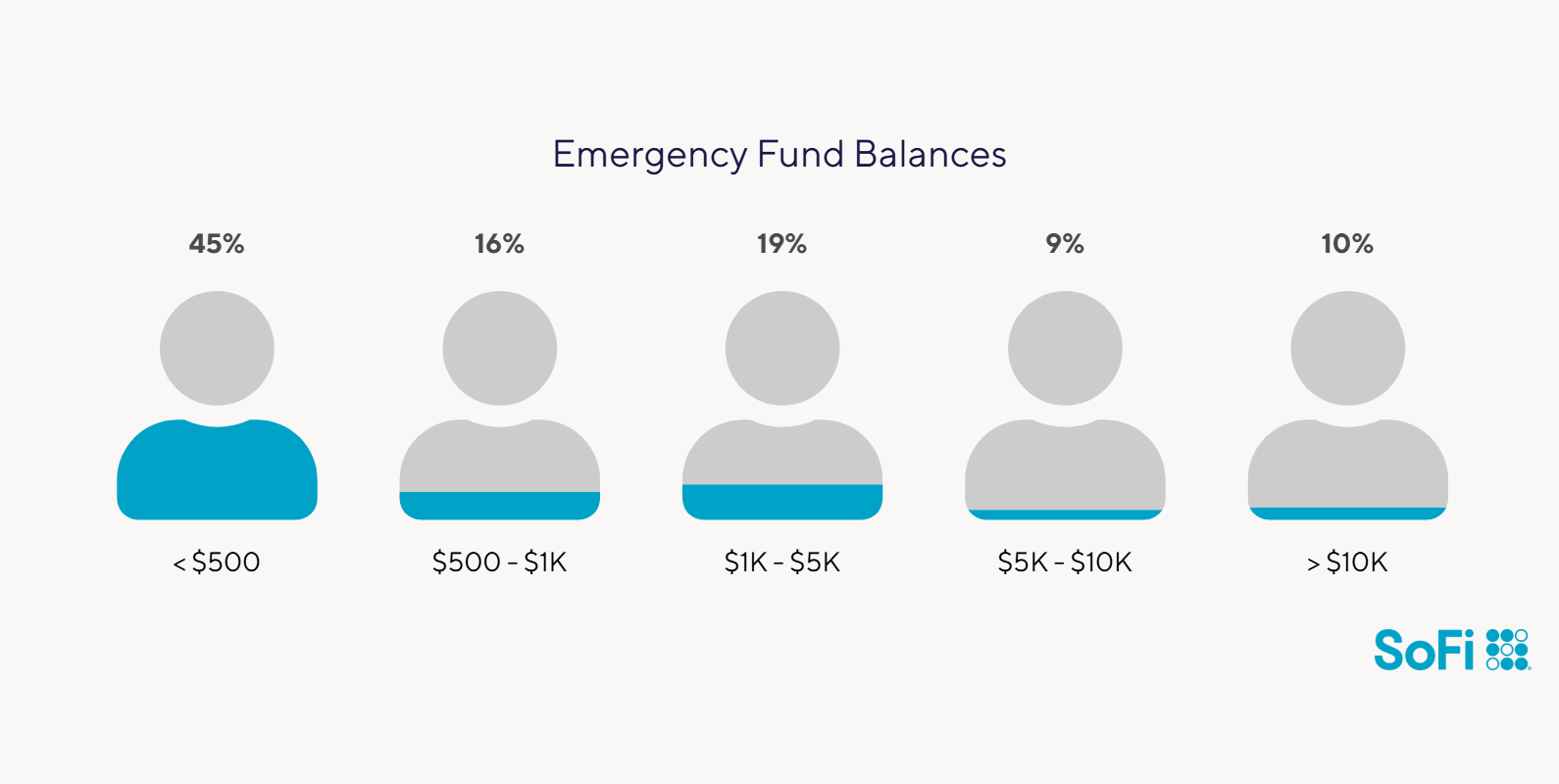
You may be wondering just how much to keep in an emergency fund. Financial experts often recommend having at least three to six months’ worth of basic living expenses set aside in an emergency fund. That can be a lofty goal considering that one recent study showed that about half of all Americans would struggle to come up with $400 in an emergency scenario. And in SoFi’s April 2024 Banking Survey of 500 U.S. adults, 45% of respondents said they have less than $500 set aside in an emergency fund. It’s wise not to be caught short and to prioritize saving an emergency fund.

Emergency Fund Balances - SoFi How People Bank Today Survey
Source: SoFi’s 2024 Banking Survey

Why Do You Need an Emergency Fund?

With all of the bills that a person typically has to pay, you may wonder, “Why should creating an emergency fund be a top priority?” Here’s why: An emergency fund can be a kind of self-funded insurance policy. Instead of paying an insurance company to back you up if something goes wrong, you’re paying yourself by setting aside these funds for the future. Building this cushion into your budget can be a vital step in better money management.

How you invest emergency funds is of course up to you, but keeping the money in a high-yield savings account typically gives you the liquidity you need while earning some interest.

Having this kind of financial safety net comes with a range of benefits. Below are some of the key perks of having an ample emergency fund.

Preventing You From Going into Debt

Yes, there may be other ways to quickly access cash to cover the cost of an emergency, such as credit cards, unsecured loans, home equity lines of credit, or pulling from other sayings, like retirement funds.

Preventing debt is one of the most important reasons to have an emergency fund.

But these options typically come with high interest fees or penalties. Though there are many reasons for having an emergency fund, preventing debt is among the most important and enticing.

Providing Peace of Mind

Here’s another reason why it is important to have an emergency fund: Living without a safety net and simply hoping to get by can cause you to stress. Thoughts about what would happen if you got hit with a large, unanticipated expense could keep you up at night.

Being prepared with an emergency fund, on the other hand, can give you a sense of confidence that you can tackle any of life’s unexpected events without experiencing financial hardship.

Increase your savings
with a limited-time APY boost.*


*Earn up to 4.00% Annual Percentage Yield (APY) on SoFi Savings with a 0.70% APY Boost (added to the 3.30% APY as of 12/23/25) for up to 6 months. Open a new SoFi Checking and Savings account and pay the $10 SoFi Plus subscription every 30 days OR receive eligible direct deposits OR qualifying deposits of $5,000 every 31 days by 3/30/26. Rates variable, subject to change. Terms apply here. SoFi Bank, N.A. Member FDIC.

Providing Finances During Unemployment

Applying for unemployment benefits, if you are entitled to them, can help you afford some of your daily expenses. Unfortunately, these payments are generally not enough to cover your entire cost of living.

If you have an emergency fund, you can tap into it to cover the cost of everyday expenses — like utility bills, groceries, and insurance payments — while you’re unemployed.

Starting an emergency fund also gives you the freedom to leave a job you dislike, without having to secure a new job first. Sometimes this can be the best move if you are stuck in a toxic situation.

Making Better Financial Decisions

Having extra cash set aside in an emergency fund helps keep that money out of sight and out of mind. Having money out of your immediate reach can make you less likely to spend it on a whim, no matter how much you’d like to.

Also by having a separate emergency account, you’ll know exactly how much you have — and how much you may still need to save. This can be preferable to keeping a cash cushion in your checking account and hoping it will be enough. In fact, 77% of the SoFi survey respondents who have a savings account said they used it specifically for emergencies.

Recommended: Guide to Practicing Financial Self-Care

Emergency Fund Statistics

Curious about how much other people have in their emergency funds? Or what percentage of Americans actually have a rainy-day account? Here are some recent research numbers to know:

•   About 75% of people report having emergency savings.

•   46% have enough money to cover three months’ worth of expenses.

•   Just 19% of people in SoFi’s report said they have between $1,000 and $5,000 in emergency savings.

•   24% of people overall have no emergency savings at all.

•   37% of Americans said they couldn’t cover a $400 emergency expense, according to Empower data.

•   59% of U.S. survey respondents said they couldn’t cover a $1,000 emergency bill.

How Do You Build an Emergency Fund?

One of the basic steps of how to start a financial plan is saving for emergencies. Stashing money aside for a rainy day is a vital part of financial health.

The good news is that starting an emergency fund doesn’t have to be complicated. These tips can help you get your emergency fund off to a good start.

•   Set your savings target. The first step in building an emergency fund is deciding how much to save. The easiest way to do that is to add up your monthly expenses, then multiply that by the number of months you’d like to save (typically, at least three to six months). If the amount seems overwhelming, you can start smaller and aim to save $1,000 first, then build up your emergency fund from there.

•   Decide where to keep it. The next step is deciding where to hold your emergency savings. Opening a bank account online could be a good fit, since you can earn a competitive APY (annual percentage yield) on balances while maintaining convenient access to your money. You could also choose to open a traditional bank account and use its online banking features. Forty-eight percent of people say they use online banking daily, according to SoFi’s data.

•   Automate contributions. Once you set up an online bank account for your emergency fund, you can schedule automatic transfers from checking. This way, you can easily grow your emergency fund without having to worry about accidentally spending down that money.

One of the most frequently asked emergency fund questions is whether a savings account is really the best place to keep your savings. After all, you could put the money into a certificate of deposit (CD) account instead or invest it in the market. But there are issues with those options.

A CD is a time deposit, meaning you agree to leave your savings in the account for a set maturity period. If you need to withdraw money from a CD in an emergency before maturity, your bank may charge you an early withdrawal penalty.

So, should emergency funds be invested instead? Not so fast. Investing your emergency fund money in the stock market could help you to earn a higher rate of return compared to a savings account. But you’re also taking more risk with that money, since a downturn could reduce your investment’s value. Proceed with caution before taking this step.

How Long Does It Take to Grow an Emergency Fund?

Emergency funds don’t necessarily come together overnight. Saving after-tax dollars to equal six months’ worth of typical living expenses can take some work and time. Here’s an example to consider: If your monthly costs are $3,000, you would want to have between $9,000 and $18,000 set aside for an emergency, such as being laid-off.

•   If your goal is $9,000 and you can set aside $200 per month, that would take you 45 months, or almost four years, to accumulate the funds.

•   If you can put aside $300 a month, you’d hit your goal in 30 months, or two and a half years.

•   If you can stash $500 a month, you’d have $9,000 saved in one and a half years.

A terrific way to grow your emergency fund is to set up automatic transfers from your checking account into your rainy-day savings. That way, you won’t see the money sitting in your checking and feel as if it’s available to be spent.

Recommended: Online Emergency Fund Calculator

How Can You Grow It Faster?

You’ve just seen how gradually saving can build a cash cushion should an emergency hit. Here are some ways to save even faster:

•   Put a windfall into your emergency fund. This could be a tax refund, a bonus at work, or gift money from a relative perhaps.

•   Sell items you don’t need or use. If you have gently used clothing, electronics, jewelry, or furniture, you might sell it on a local site, such a Facebook group or Craigslist, or, if small in size, on eBay or Etsy.

•   Start a side hustle. One of the benefits of a side hustle is bringing in extra cash; it can also be a fun way to explore new directions, build your skills, and fill free time.

These techniques can help you ramp up your savings even faster and be prepared for an emergency that much sooner.

Prioritizing Your Emergency Fund When You Have Other Financial Obligations

Most of us have competing financial goals: paying down student debt or a credit card balance; accumulating enough money for a down payment on a house; saving for college for kids; and socking away money for retirement. In many cases, you’ll see variability in financial goals by age, but there are often several needs vying for your dollars at any given time.

Here’s advice on how to allocate funds:

•   Definitely start or continue saving towards your emergency fund. Even if you can only spare $25 per month right now, do it! It will get you on the road to hitting your goal and earning you compound interest. Otherwise, if an emergency were to strike, you’ll likely have to resort to credit cards or tapping any retirement savings, which probably involves a penalty.

•   Continue to pay down high-interest debt, like credit card debt. You want to get this kind of debt out of your life, given the interest rates can currently top 20%. You might explore balance transfer offers that let you pay no or very low interest for a period of time (say, 18 months) which can help you pay down your debt. Just make sure you understand the fees that are typically involved.

•   Steadily stick to your schedule for low-interest debt, which typically includes student loans and mortgages.

•   Fund your retirement savings as much as you can. As with an emergency fund, even a small amount will be worthwhile, especially with the benefit of compound interest. Make sure to contribute enough to take advantage of the company match if your employer offers that as part of a 401(k) plan; that is akin to free money.


Test your understanding of what you just read.


The Takeaway

An emergency fund is an important financial goal. Once you’ve accrued at least three to six months’ worth of basic living expenses, you can feel more secure if a major unexpected expense pops up or job loss happens. It can be wise to store emergency funds in a high-yield savings account to deliver both liquidity and interest.

Interested in opening an online bank account? When you sign up for a SoFi Checking and Savings account with eligible direct deposit, you’ll get a competitive annual percentage yield (APY), pay zero account fees, and enjoy an array of rewards, such as access to the Allpoint Network of 55,000+ fee-free ATMs globally. Qualifying accounts can even access their paycheck up to two days early.


Better banking is here with SoFi, NerdWallet’s 2024 winner for Best Checking Account Overall.* Enjoy 3.30% APY on SoFi Checking and Savings with eligible direct deposit.

FAQ

What is the purpose of an emergency fund?

An emergency fund is a financial safety net. It’s money set aside that you can use if you are hit with a big, urgent, unexpected bill (like a medical expense or car repair) or endure a loss of income. In these situations, an emergency fund can help you avoid using your credit cards and taking on high-interest debt or hurting your credit score by paying bills late. How to invest an emergency fund is up to you, but a high-interest savings account is one good, liquid option.

Can I use an emergency fund for a non-emergency expense?

Technically, you can use an emergency fund for a non-emergency expense. After all, it’s your money. But it’s not wise to do so and defeats the whole purpose of saving this cash. If you use your emergency funds to pay for a vacation or new clothes, then if a true emergency arises, you won’t be prepared.

How difficult is it to rebuild an emergency fund?

It can be difficult to rebuild an emergency fund, just as it was to accumulate the money in the first place. But even if it takes years to achieve your goal, it is worth it. Putting away money gradually for an emergency is an important step towards being financially fit.

More from the emergency fund series:


SoFi Checking and Savings is offered through SoFi Bank, N.A. Member FDIC. The SoFi® Bank Debit Mastercard® is issued by SoFi Bank, N.A., pursuant to license by Mastercard International Incorporated and can be used everywhere Mastercard is accepted. Mastercard is a registered trademark, and the circles design is a trademark of Mastercard International Incorporated.

Annual percentage yield (APY) is variable and subject to change at any time. Rates are current as of 12/23/25. There is no minimum balance requirement. Fees may reduce earnings. Additional rates and information can be found at https://www.sofi.com/legal/banking-rate-sheet

Eligible Direct Deposit means a recurring deposit of regular income to an account holder’s SoFi Checking or Savings account, including payroll, pension, or government benefit payments (e.g., Social Security), made by the account holder’s employer, payroll or benefits provider or government agency (“Eligible Direct Deposit”) via the Automated Clearing House (“ACH”) Network every 31 calendar days.

Although we do our best to recognize all Eligible Direct Deposits, a small number of employers, payroll providers, benefits providers, or government agencies do not designate payments as direct deposit. To ensure you're earning the APY for account holders with Eligible Direct Deposit, we encourage you to check your APY Details page the day after your Eligible Direct Deposit posts to your SoFi account. If your APY is not showing as the APY for account holders with Eligible Direct Deposit, contact us at 855-456-7634 with the details of your Eligible Direct Deposit. As long as SoFi Bank can validate those details, you will start earning the APY for account holders with Eligible Direct Deposit from the date you contact SoFi for the next 31 calendar days. You will also be eligible for the APY for account holders with Eligible Direct Deposit on future Eligible Direct Deposits, as long as SoFi Bank can validate them.

Deposits that are not from an employer, payroll, or benefits provider or government agency, including but not limited to check deposits, peer-to-peer transfers (e.g., transfers from PayPal, Venmo, Wise, etc.), merchant transactions (e.g., transactions from PayPal, Stripe, Square, etc.), and bank ACH funds transfers and wire transfers from external accounts, or are non-recurring in nature (e.g., IRS tax refunds), do not constitute Eligible Direct Deposit activity. There is no minimum Eligible Direct Deposit amount required to qualify for the stated interest rate. SoFi Bank shall, in its sole discretion, assess each account holder's Eligible Direct Deposit activity to determine the applicability of rates and may request additional documentation for verification of eligibility.

See additional details at https://www.sofi.com/legal/banking-rate-sheet.

*Awards or rankings from NerdWallet are not indicative of future success or results. This award and its ratings are independently determined and awarded by their respective publications.

Financial Tips & Strategies: The tips provided on this website are of a general nature and do not take into account your specific objectives, financial situation, and needs. You should always consider their appropriateness given your own circumstances.

Disclaimer: Many factors affect your credit scores and the interest rates you may receive. SoFi is not a Credit Repair Organization as defined under federal or state law, including the Credit Repair Organizations Act. SoFi does not provide “credit repair” services or advice or assistance regarding “rebuilding” or “improving” your credit record, credit history, or credit rating. For details, see the FTC’s website .

Third-Party Brand Mentions: No brands, products, or companies mentioned are affiliated with SoFi, nor do they endorse or sponsor this article. Third-party trademarks referenced herein are property of their respective owners.

Third Party Trademarks: Certified Financial Planner Board of Standards Center for Financial Planning, Inc. owns and licenses the certification marks CFP®, CERTIFIED FINANCIAL PLANNER®

SOBNK-Q325-116

Read more
man on laptop at library

How to Invest as a College Student

As a college student, it’s not too early to start investing your money. In fact, the sooner you start, the more time your money may have to grow. That could help you meet your financial goals such as going to graduate school, buying a house, or saving for retirement.

There are different types of accounts college students can use to invest, including brokerage accounts and retirement accounts like individual retirement accounts (IRAs) and 401(k)s. But there are some important steps college students should take before they start investing. Here’s what to know about investing as a college student.

Key Points

•   Investing early may give college students the opportunity to benefit from compound returns over time.

•   IRAs, brokerage accounts, and 401(k) plans are investment accounts to consider.

•   Setting clear financial goals, understanding different types of investments, and choosing the appropriate investment account are steps college students can use to get started.

•   Balancing investing with academic responsibilities is important.

•   Maintaining a long-term perspective and avoiding emotional investing can help navigate market fluctuations.

Why You Should Start Investing Early

One key reason to start investing early is the potential return on your investment. The average annual return offered by the S&P 500 — a stock market index of the 500 largest companies in the U.S. — is around 7% when adjusted for inflation.

While investing does involve risk, it may help you outpace inflation and give you an extra boost toward your long term goals.

Investing as a college student can be a good time to get started.


💡 Quick Tip: Look for an online brokerage with low trading commissions as well as no account minimum. Higher fees can cut into investment returns over time.

3 Ways to Invest While in College

There are several ways for college students to invest their money, including using tax-advantaged retirement accounts and brokerage accounts.

IRA

An IRA, whether it’s a traditional or Roth IRA, is a type of retirement account that almost anyone with an earned income can open up and start contributing to. There are rules regarding how much you can contribute to an IRA every year — up to $7,000 for those under age 50 in 2025 — and when you can take withdrawals (depending on the type of IRA you open). However, these accounts can be relatively easy ways to kick-start a college students’ investment portfolio.

Two of the most common types of IRAs are traditional IRAs and Roth IRAs. With a Roth IRA, you contribute after-tax dollars and you can withdraw the money tax-free in retirement. With a traditional IRA, you contribute pre-tax dollars (those contributions may be tax deductible), and you pay taxes on the money when you withdraw it in retirement.

IRAs do have withdrawal rules and penalties. Early withdrawals may incur taxes and penalties, with some exceptions. The rules for making withdrawals from a Roth IRA are different from those for a traditional IRA, so it’s wise to understand what they each involve.

Brokerage Account

A brokerage account allows investors to make investments by depositing funds in the account. Your financial institution may have brokerage options, or you may consider using an outside financial brokerage firm or an online brokerage. You can shop around and research different brokerage accounts to compare their minimum deposit required (if they have one), the fees they charge, the investments they offer, and the responsiveness of their customer service department.

With a brokerage account, a college student can buy and sell stocks, bonds, mutual funds, index funds, and other assets. Once an investor opens an account they can transfer money into it from a checking or savings account to fund their investments. Unlike IRAs, brokerage accounts have no contribution limits.

However, selling assets in a brokerage account can trigger capital gains taxes. Short-term capital gains (from assets you’ve held for less than a year) are charged at a higher rate than long-term capital gains (assets you’ve held a year or more).

401(k)

A 401(k) is a type of retirement account offered through an employer (though there are different types of 401(k)s, such as solo 401(k)s, that you can open yourself if you are self-employed). Like IRAs, 401(k)s have annual contribution limits — up to $23,500 for those under age 50 in 2025.

The money you put in a 401(k) account is pre-tax dollars and it reduces your taxable income. The money grows tax-deferred while it’s invested. Your contributions are typically deducted automatically from your paycheck and you have a choice of investments to pick from, depending on your employer’s plan. Your employer may offer a 401(k) match — essentially matching your contribution up to a certain amount and/or percentage.

Aside from certain specific exceptions, you can’t withdraw money from the account until you reach age 59 ½, or you’ll be subject to a 10% early withdrawal penalty.

🛈 While SoFi does not offer 401(k) plans at this time, we do offer a range of individual retirement accounts (IRAs).

Steps to Start Investing as a College Student

If you’re a college student who is new to investing, there are several actions that could help you get started.

Set Clear Financial Goals

Before you make your first investment as a college student, it’s important to give some serious thought and consideration to your financial goals. Do you want to try to hit a total net worth or dollar amount by a certain age, for instance? Or do you want to save up enough to buy a home or start a family?

Having clear financial goals in mind before you start investing can help guide your decision-making about what types of investments you make.

Determine How Much Money You Can Set Aside

With your goals in mind, think about how much money you realistically can set aside to invest. Even if you have a part-time job, odds are, you won’t be able to invest your entire paycheck. But if you can free up some additional money in your budget for investing, that could help you get started. Even a small amount can help.

Choose the Right Investment Account

Next, knowing how much you have to invest and with some end-goals in mind, you’ll need to decide what type of investment account will best help you build your portfolio and reach your objectives. As discussed, this might be a retirement account like an IRA, a 401(k), or a brokerage account.

Understand Types of Investments

You’ll also want to review and understand the different investments available. That can include a variety of asset types such as stocks, bonds, cash, mutual funds, exchanged-traded funds (ETFs), and more. Study up on each one to help determine which makes the most sense for your situation and your goals.

Also, consider your risk tolerance. Remember, investing involves risk, and some assets are riskier than others, so you’ll want to make sure you are comfortable with your choices.

Fund Your Investments

The final step is to go ahead and fund your investment account and make your initial investments. You may want to start small and increase your contributions over time if your financial situation allows.

Tips for Investing as a College Student

Investing as a college student may feel intimidating at first, but these tips and guidelines can help.

Consider Diversification

A good rule of thumb for all investors is to invest in different types of assets and asset classes. The basic idea behind portfolio diversification is that by diversifying the assets you have, you may offset a certain amount of investment risk. Conversely, the fewer types of assets you have, the more risk you may take on should they perform poorly.

For example, imagine you invest in only one stock and that company folds — if that happens, you’ve lost your entire investment. However, if you’ve invested in a number of different stocks in different sectors, one company failing would affect you far less. However, it’s important to note that diversification does not eliminate risks.

One way to potentially stay diversified is by investing in mutual funds or exchange-traded funds, which bundle different groups of stocks together.

Avoid Emotional Investing

The market experiences natural ups and downs. As market fluctuations occur, it’s critical to try to avoid letting your emotions impact your investing.

When the market makes a big dip, you may feel the urge to quickly sell investments. However, by doing so, you may be locking in your losses. Letting reason prevail over emotions is generally wise — that way you don’t miss out on any future potential upturn that may take place.

Think of investing as a long-term proposition. The longer you allow your investments to stay in the market, the more opportunity they may have to ride out downturns — and the greater the potential you may have to take advantage of an upswing.

Timing the Market vs Time in the Market

When the market is doing well, you may find yourself tempted to get in on the action and end up buying investments that are too expensive or selling investments too soon. This type of buying and selling is known as timing the market. You may want to avoid checking the market frequently to help keep your emotions in check.

Rather than trying to time the market, think about investing over the long term.

Balancing Investing With Academic Responsibilities

As a college student working on earning your degree, your school work comes first. That means your academic responsibilities should take precedence over your investing activity. Remember, your education is an investment, too — one that is likely vital to your future.

That said, you may want to keep an eye on your portfolio and review your investments and allocations from time to time, whether that’s monthly or quarterly, and make any changes as necessary. But don’t get so caught up in investing that you neglect your classwork.

The Takeaway

Investing as a college student is possible, and there are many ways to get started. College students can explore various types of retirement accounts, like IRAs or 401(k)s, or brokerage accounts to get started. Investing when you’re young may help you build wealth over time. But investing involves risk, so make sure to choose investment accounts and asset types that you’re comfortable with.

Invest in what matters most to you with SoFi Active Invest. In a self-directed account provided by SoFi Securities, you can trade stocks, exchange-traded funds (ETFs), mutual funds, alternative funds, options, and more — all while paying $0 commission on every trade. Other fees may apply. Whether you want to trade after-hours or manage your portfolio using real-time stock insights and analyst ratings, you can invest your way in SoFi's easy-to-use mobile app.


Opening and funding an Active Invest account gives you the opportunity to get up to $1,000 in the stock of your choice.¹

FAQ

How should I invest as a college student?

How you invest as a college student depends on your financial situation and your goals. For example, if you’re saving for a long-term goal such as retirement, you may want to open a retirement account, such as an IRA or, if you’re eligible, a 401(k). However, if your goal is more of a short-term one such as going to grad school or buying a car, you may want to open a brokerage account that gives you more flexibility for making withdrawals.

Carefully consider your objectives, the amount of money you have to invest, your risk tolerance, and the types of investments you’d like to make, whether it’s mutual funds or a mix of stocks and bonds.

How much will $100 a month be worth in 30 years?

How much $100 a month will be worth in 30 years depends on an investment’s rate of return. For example, if the annual average return is 5%, you could have about $83,673 after 30 years. With a 10% rate of return on the investment, you could end up with approximately $228,003 in 30 years.

Which investment is best for students?

The type of investment that’s best for students depends on the student’s specific financial situation, investing timeframe, financial goals, and appetite for risk. Generally speaking, low-cost assets that offer some diversification such as exchange-traded funds, mutual funds, and index funds may be investment options for students to explore. Do your research on the different investment options to help determine which may be best for you.


INVESTMENTS ARE NOT FDIC INSURED • ARE NOT BANK GUARANTEED • MAY LOSE VALUE

SoFi Invest is a trade name used by SoFi Wealth LLC and SoFi Securities LLC offering investment products and services. Robo investing and advisory services are provided by SoFi Wealth LLC, an SEC-registered investment adviser. Brokerage and self-directed investing products offered through SoFi Securities LLC, Member FINRA/SIPC.

For disclosures on SoFi Invest platforms visit SoFi.com/legal. For a full listing of the fees associated with Sofi Invest please view our fee schedule.

Financial Tips & Strategies: The tips provided on this website are of a general nature and do not take into account your specific objectives, financial situation, and needs. You should always consider their appropriateness given your own circumstances.

Investment Risk: Diversification can help reduce some investment risk. It cannot guarantee profit, or fully protect in a down market.

Disclaimer: The projections or other information regarding the likelihood of various investment outcomes are hypothetical in nature, do not reflect actual investment results, and are not guarantees of future results.

Mutual Funds (MFs): Investors should carefully consider the information contained in the prospectus, which contains the Fund’s investment objectives, risks, charges, expenses, and other relevant information. You may obtain a prospectus from the Fund company’s website or clicking the prospectus link on the fund's respective page at sofi.com. You may also contact customer service at: 1.855.456.7634. Please read the prospectus carefully prior to investing.Mutual Funds must be bought and sold at NAV (Net Asset Value); unless otherwise noted in the prospectus, trades are only done once per day after the markets close. Investment returns are subject to risk, include the risk of loss. Shares may be worth more or less their original value when redeemed. The diversification of a mutual fund will not protect against loss. A mutual fund may not achieve its stated investment objective. Rebalancing and other activities within the fund may be subject to tax consequences.

Exchange Traded Funds (ETFs): Investors should carefully consider the information contained in the prospectus, which contains the Fund’s investment objectives, risks, charges, expenses, and other relevant information. You may obtain a prospectus from the Fund company’s website or by emailing customer service at [email protected]. Please read the prospectus carefully prior to investing.

S&P 500 Index: The S&P 500 Index is a market-capitalization-weighted index of 500 leading publicly traded companies in the U.S. It is not an investment product, but a measure of U.S. equity performance. Historical performance of the S&P 500 Index does not guarantee similar results in the future. The historical return of the S&P 500 Index shown does not include the reinvestment of dividends or account for investment fees, expenses, or taxes, which would reduce actual returns.
Third-Party Brand Mentions: No brands, products, or companies mentioned are affiliated with SoFi, nor do they endorse or sponsor this article. Third-party trademarks referenced herein are property of their respective owners.

Third Party Trademarks: Certified Financial Planner Board of Standards Center for Financial Planning, Inc. owns and licenses the certification marks CFP®, CERTIFIED FINANCIAL PLANNER®

Tax Information: This article provides general background information only and is not intended to serve as legal or tax advice or as a substitute for legal counsel. You should consult your own attorney and/or tax advisor if you have a question requiring legal or tax advice.


¹Probability of Member receiving $1,000 is a probability of 0.026%; If you don’t make a selection in 45 days, you’ll no longer qualify for the promo. Customer must fund their account with a minimum of $50.00 to qualify. Probability percentage is subject to decrease. See full terms and conditions.

SOIN-Q325-116

Read more
TLS 1.2 Encrypted
Equal Housing Lender