How to Set Up a Health Savings Account

How Do I Start a Health Savings Account?

A Health Savings Account (HSA) can be set up in three simple steps, and once it’s up and running, it can help you bridge the gap between what your health insurance covers and your actual costs, among other benefits.

Let’s face it: Many of us these days select a High Deductible Health Plan, or HDHP, when it comes to health insurance. That means you may be paying a lower monthly premium in exchange for a high deductible. You could potentially get hit with a lot of unforeseen healthcare expenses before your benefits kick in. And even after you meet that deductible, you may have charges that are not reimbursed. A Health Savings Account (HSA) can help you set money aside to fill that gap.

Setting up an HSA may sound intimidating, as if you’ll have to fill out reams of paperwork, but that’s not at all the case! Whether through an employer or on your own, once you’re ready to start saving, the steps to opening an HSA account can be as simple as filling out an online form with basic information — easy peasy.

Here’s a look at the steps involved, plus a few important considerations before you take the leap.

Key Points

•   Eligibility for a Health Savings Account (HSA) requires enrollment in a high deductible health plan without other health coverage or Medicare.

•   Setting up an HSA involves selecting a provider, completing paperwork, and verifying health plan coverage.

•   Contributions to an HSA are pre-tax, reducing taxable income and allowing tax-free growth, with a maximum limit set annually.

•   Funds from the HSA can be used to pay for a wide range of medical expenses, including those not covered under typical health plans.

•   After age 65, funds can be used for any purpose without penalties, though they will be taxed if not used for qualified medical expenses.

What Is a Health Savings Account (HSA)?

The HSA is over 20 years old. In 2003, Congress passed the Medicare Prescription Drug, Improvement, and Modernization Act which created the Health Savings Account. These accounts were meant to help people with high deductible health plans set aside money to pay for out-of-pocket medical expenses: copays, dental care, eyeglasses, prescriptions, psychiatric help, and more. This can happen both before and after you reach your deductible.

In addition to covering health costs, these tax-free accounts can lower your amount of federal income tax owed. What’s more, HSAs can help with saving for retirement and unforeseen emergencies.

How Does an HSA Work?

A Health Savings Account can work just like a checking account. You can make deposits (or contributions), pay bills online, make transfers, and even pay for qualified medical expenses with an HSA debit card. You are free to withdraw HSA funds at any time to pay for health costs not covered by your high deductible health plan. One big note: Once you enroll in Medicare, you can no longer contribute to an HSA.

Deposits can also be contributed by your employer, with direct deposits made into your HSA straight from payroll. A nice aspect of these plans: Health Savings Account contributions roll over every year, so you don’t have to race to spend the pre-tax funds in your account. If you stay healthy, you can build up your emergency fund as well as your retirement nest egg. Your good health can lead to wealth down the line!

Who Can Open an HSA?

According to Federal Guidelines, you qualify to open a Health Savings Account if you:

•   Are covered under a high deductible health plan, or HDHP.

•   Are not covered by any other health plan, including a spouse’s.

•   Are not claimed as a dependent on someone else’s tax return.

•   Are not enrolled in a disqualifying alternate medical savings account, such as an FSA (Flexible Spending Account) or an MSA (a Medicare medical savings account).

•   Are not currently enrolled in Medicare.

How to Set Up a Health Savings Account

Once you’ve established that the pros outweigh the cons, you may wonder exactly how to set up a Health Savings Account (HSA). Fortunately, the process is pretty straightforward:

Step 1: Research Your HSA Options

If an HSA plan is offered directly through your employer, go to Step Two.
If you’re self-employed, investigate HSA options online, or reach out to banks or other financial entities.

Step 2: Fill Out the Necessary Paperwork

The set-up for an HSA is not unlike opening a bank account. You’ll be provided with paperwork or an online form, where you’ll give basic information such as your Social Security Number and proof of your identity (typically verified by a government-issued photo ID).

Step 3: Complete Verification

Be prepared to offer verification of your high deductible health plan (HDHP).

That’s it! It’s a quick and simple process to set up a Health Savings Account.

Once your HSA is up and running, you may be able to opt for automatic regular deposits from your bank account or straight from your paycheck. There is no minimum amount required to open an HSA, but you typically need at least $1,000 in the account in order to invest in certain mutual funds.

HSA Contribution Limits

For tax year 2025, HSA contribution limits are $4,300 for individuals and $8,550 for families with HDHP coverage. For 2026, HSA contribution limits are $4,400 for individuals and $8,750 for families. Those 55 and older can contribute an additional $1,000 as a catch-up contribution in either tax year. There is never a minimum requirement for deposits. Some ground rules to be aware of:

•  You are covered under a high deductible health plan (HDHP), described later, on the first day of the month.

•  You have no supplemental health coverage except what is permitted under other health coverage.

•  You aren’t enrolled in Medicare.

•  You can’t be claimed as a dependent on someone else’s tax return.

Advantages of an HSA

There are many benefits to opening an HSA. Sure, it can provide a cushion or safety net when it comes to out-of-pocket medical costs. But there are other perks beyond covering the price of a new pair of glasses.

Covering Expenses for You and Your Family

From ambulances to acupuncture, a Health Savings Account can cover the costs your HDHP doesn’t. The IRS has an extensive listof ways you can use your HSA funds. One example: Did you know you can also use your Health Savings Account to pay for medical expenses for a spouse or a child — anyone who is part of your tax household — even if they aren’t on your HDHP? It’s true!

Lowering Taxable Income

Here’s another bonus to having this kind of account: Your HSA contributions are made before taxes are deducted, thereby lowering your taxable income. As a result, you may pay less in taxes.

Rollover Contributions

There’s no “use-it-or-lose it” pressure when you have a Health Savings Account. Unused HSA funds don’t disappear at the end of the year. You can roll them over again and again, accumulating tax-free interest. Those earnings can turn into savings to be invested in the future or used for life’s little surprises — say, a chipped tooth.

Saving for Retirement

At age 65, you can start using the funds in your Health Savings Account for anything, without penalty. Withdrawals will be taxed the same as they would from a 401(k) or IRA, but any funds waiting for use will avoid taxes while earning interest.

Additionally, if you are lucky enough to be able to max out your annual IRA and/or 401(k) contributions, an HSA is another way to save more tax-free money toward retirement. Beyond covering copays, an HSA is a great way to get your money working for you.

Disadvantages of an HSA

Okay, now you know the upside of opening an HSA. But there are potential downsides that are worth knowing about and considering before you sign up.

Penalties for Unqualified Expenses

Until you turn 65, HSA funds cannot be used for anything but eligible medical expenses. To do so would subject withdrawals to income taxes and a 20% penalty.

Monthly Fees

Health Saving Account providers may charge a monthly fee. These fees generally tend to be lower than $5 bucks per month, but they do add up. While there are providers out there that don’t charge account management fees, all will assess an investment fee. Do your homework to find the vehicle with the lowest fees.

Potential Losses

Like an IRA or 401(k), any invested money in an HSA can mean monetary gains and losses. As with any investment account, you need to be prepared for your HSA balance to dip if the market trends downward.

Keeping Tabs for Your Tax Records

HSA contributions and expenditures must be reported on your tax return. It may not be a deal-breaker, but for some people, keeping records of your HSA activity can be a nuisance.

HSA Advantages vs. Disadvantages

Pros Cons

•   Covers an extensive list of out-of-pocket health expenses

•   Can be used for family members

•   Lowers taxable income and therefore may decrease your taxes

•   Contributions roll over to the next year

•   Promotes tax-free savings for retirement

•   Penalties for nonqualified expenses

•   Unexpected and potentially hidden fees

•   Account balance can fluctuate with the marketplace

•   Activity must be reported on your tax return

Things to Consider When Choosing an HSA

If your job offers a Health Saving Plans, great! They’ve done the research for you. Employers may also offer Flexible Spending Accounts (FSAs). But unlike FSAs, which are owned by an employer and can be inflexible, a Health Savings Account has higher contribution limits and is controlled by you.

If you are self-employed, do your research. You’ll find an array of Health Savings Plans to choose among; HSA comparison websites can help you navigate the search. Remember to pay attention to any monthly/annual fees so you know exactly what to expect. Ideally, you’ll want an HSA that makes it easy to manage your account online. Many banks and credit unions offer HSAs, so check with your financial institution.

The Takeaway

Once you’ve made the decision to enroll in a Health Savings Account, the steps to set it up are relatively painless. You can start using your HSA funds right away to help cover qualified health-related costs. Contributions are made with pre-tax dollars, don’t need to be used up by the end of the year, and can potentially even help boost your retirement fund. A Health Savings Account goes beyond just covering your healthcare expenses and can serve as one of the best tax-advantaged savings vehicles available. It can enhance your sense of security and keep your wealth growing.

Interested in opening an online bank account? When you sign up for a SoFi Checking and Savings account with eligible direct deposit, you’ll get a competitive annual percentage yield (APY), pay zero account fees, and enjoy an array of rewards, such as access to the Allpoint Network of 55,000+ fee-free ATMs globally. Qualifying accounts can even access their paycheck up to two days early.

Better banking is here with SoFi, NerdWallet’s 2024 winner for Best Checking Account Overall.* Enjoy 3.30% APY on SoFi Checking and Savings with eligible direct deposit.

🛈 While SoFi does not offer Health Savings Accounts (HSAs), we do offer alternative savings vehicles such as high-yield savings accounts.

FAQ

How do I set up an HSA account?

With a valid government-issued photo ID, Social Security number, and proof of your HDHP, you can fill out a basic paper or online HSA form, provided by an employer or financial institution.

Can I start an HSA on my own?

Yes. As long as you are enrolled in an HDHP and not covered under someone else’s policy, you can start an HSA.

How much does it cost to open an HSA?

The initial sign-up is free, and there is no minimum deposit amount to start. But expect investment fees and possibly monthly management fees.


Photo credit: iStock/AndreyPopov

Annual percentage yield (APY) is variable and subject to change at any time. Rates are current as of 12/23/25. There is no minimum balance requirement. Fees may reduce earnings. Additional rates and information can be found at https://www.sofi.com/legal/banking-rate-sheet

Eligible Direct Deposit means a recurring deposit of regular income to an account holder’s SoFi Checking or Savings account, including payroll, pension, or government benefit payments (e.g., Social Security), made by the account holder’s employer, payroll or benefits provider or government agency (“Eligible Direct Deposit”) via the Automated Clearing House (“ACH”) Network every 31 calendar days.

Although we do our best to recognize all Eligible Direct Deposits, a small number of employers, payroll providers, benefits providers, or government agencies do not designate payments as direct deposit. To ensure you're earning the APY for account holders with Eligible Direct Deposit, we encourage you to check your APY Details page the day after your Eligible Direct Deposit posts to your SoFi account. If your APY is not showing as the APY for account holders with Eligible Direct Deposit, contact us at 855-456-7634 with the details of your Eligible Direct Deposit. As long as SoFi Bank can validate those details, you will start earning the APY for account holders with Eligible Direct Deposit from the date you contact SoFi for the next 31 calendar days. You will also be eligible for the APY for account holders with Eligible Direct Deposit on future Eligible Direct Deposits, as long as SoFi Bank can validate them.

Deposits that are not from an employer, payroll, or benefits provider or government agency, including but not limited to check deposits, peer-to-peer transfers (e.g., transfers from PayPal, Venmo, Wise, etc.), merchant transactions (e.g., transactions from PayPal, Stripe, Square, etc.), and bank ACH funds transfers and wire transfers from external accounts, or are non-recurring in nature (e.g., IRS tax refunds), do not constitute Eligible Direct Deposit activity. There is no minimum Eligible Direct Deposit amount required to qualify for the stated interest rate. SoFi Bank shall, in its sole discretion, assess each account holder's Eligible Direct Deposit activity to determine the applicability of rates and may request additional documentation for verification of eligibility.

See additional details at https://www.sofi.com/legal/banking-rate-sheet.

SoFi Checking and Savings is offered through SoFi Bank, N.A. Member FDIC. The SoFi® Bank Debit Mastercard® is issued by SoFi Bank, N.A., pursuant to license by Mastercard International Incorporated and can be used everywhere Mastercard is accepted. Mastercard is a registered trademark, and the circles design is a trademark of Mastercard International Incorporated.

Tax Information: This article provides general background information only and is not intended to serve as legal or tax advice or as a substitute for legal counsel. You should consult your own attorney and/or tax advisor if you have a question requiring legal or tax advice.

External Websites: The information and analysis provided through hyperlinks to third-party websites, while believed to be accurate, cannot be guaranteed by SoFi. Links are provided for informational purposes and should not be viewed as an endorsement.
Financial Tips & Strategies: The tips provided on this website are of a general nature and do not take into account your specific objectives, financial situation, and needs. You should always consider their appropriateness given your own circumstances.

SOBK0324005
CN-Q425-3236452-113

Read more
A woman stands at a mailbox looking at a letter, possibly a tax refund check mailed by the IRS.

How Long Does It Take for the IRS to Mail Tax Refund Checks?

If you’re expecting a refund from the IRS, you shouldn’t have to wait too long for your money. According to the IRS, it issues most refunds within three weeks of receiving your filing. Key to receiving your refund quickly are two actions on your part: using e-file and providing your bank info for direct deposit.

In fact, a directly deposited refund can show up in less than 21 days.

This table shows the estimated times for receiving an IRS tax refund depending on how you file and choose to get your refund:

Estimated Federal Tax Refund Schedule
Filing Method and Receiving Method E-File, Direct Deposit Paper File, Direct Deposit E-File, Check in Mail Paper File, Check in Mail
Time between filing date and receiving refund Up to 3 weeks 3 weeks 1 month 6 weeks or more

Key Points

•   Most tax refunds are issued within three weeks of receiving the tax filing.

•   E-filing and direct deposit can expedite the refund process, often under 21 days.

•   Incomplete or incorrect tax returns can delay processing up to four months.

•   Refunds may be held for manual review due to suspected fraud or discrepancies.

•   Use the “Where’s My Refund?” tool or call 800-829-1954 to check refund status.

What Money Will Be Included in My Tax Refund This Year?

Of course, the size of your refund depends on how much you overpaid. But as of October 2025, the average refund for individuals was $3,052. That figure is up from 2024, when the average tax refund was $2,850.

To get your refund faster, you may want to file earlier, rather than waiting until the last minute. Typically, the tax season, when the IRS starts accepting and processing returns, starts in late January.

When your refund does arrive, an online budget planner can help you keep track of where your money is going.

Check your score with SoFi

Track your credit score for free. Sign up and get $10.*


Reasons for Your Tax Refund to be Delayed

People typically receive their tax refund two weeks after the IRS accepts their tax filing if they opt to receive a direct deposit, or in three weeks if they choose to get a check in the mail. But if you’re still waiting after that point and wondering where your tax refund is, here are a few possible reasons for the delay:

•   If anything in your return is incomplete or incorrect, the IRS may need to give the return further review before sending you a refund check. In this case, you may get a notice from the IRS in the mail with instructions for fixing or completing your tax return. It may take up to four months for the IRS to process returns that require extra handling. The sooner you respond to the IRS request for information, the sooner your return will be processed.

•   If you are claiming the Earned Income Tax Credit or Additional Child Tax Credit, there may be a delay in receiving your tax refund. The IRS is required to hold any tax returns for people claiming those two tax credits until mid-February. This hold will show up in the “Where’s My Refund?” tool on the IRS site if it applies to you.

•   Your bank or credit union may take more time to post a refund to your account. The time for posting IRS refunds varies from institution to institution.

Recommended: IRS Tax Refund Dates and Deadlines

How to Use the ‘Where’s My Refund?’ Tool on the IRS Site

The IRS has a “Where’s My Refund?” tool on irs.gov where anyone can check and see the status of their tax refund. It can also be accessed using the IRS2Go mobile app. If you submit your tax return electronically, you can easily check on the status of your refund online within 24 hours of filing. If you mail your tax return, it will take about a month or longer for any information about refunds to show up on the IRS site.

In order to access your refund information on the IRS website, you will need to input your Social Security number, tax filing status, and the dollar amount that you expect to receive on the return. Double check your information before submitting it: If the wrong Social Security number is entered, this could result in an error, extra identity verification steps, and even a delay in receiving your tax refund.

What Do the IRS Tax Return Statuses Mean?

There are three different IRS tax return statuses that you will see when you use the “Where’s My Refund?” tool. Here’s what they mean:

Received

Once the IRS has received a return, it is marked as received. You can check to see if your return has been received using the “Where’s My Refund?” tool on the IRS site.

Approved

Once the IRS processes a tax return and there are no errors or missing information, it is marked as approved. At that point, the process of sending a refund by mail or direct deposit can begin.

Sent

When the IRS mails out a refund check or sends a direct deposit refund, the tax return status is marked as “sent.”

How to Contact the IRS About Your Tax Refund

It’s best to wait at least 21 days after filing your return electronically, and six weeks after mailing your return, to contact the IRS by phone. At that point, you can call the IRS refund hotline at 800-829-1954.

Recommended: 5 Things to Do With Your Tax Refund

The Takeaway

Knowing when you’ll receive your tax refund can be helpful if you’re planning to use the money to pay off debt, create a budget, or save for a big purchase. Filing your return electronically and opting to get your refund via direct deposit will allow you to get your return quickly, typically within three weeks. A money tracker app can help you manage your finances, including your refund, and track your spending and savings.

Take control of your finances with SoFi. With our financial insights and credit score monitoring tools, you can view all of your accounts in one convenient dashboard. From there, you can see your various balances, spending breakdowns, and credit score. Plus you can easily set up budgets and discover valuable financial insights — all at no cost.

SoFi helps you stay on top of your finances.

FAQ

How quickly will I get my refund?

Most refunds are sent within three weeks of the IRS receiving a tax filing, but it can sometimes take longer, especially if you mail your return or opt to get your refund by check through the mail.

It’s been longer than 21 days since the IRS received my return and I haven’t gotten my refund. Why?

Sometimes the IRS needs to manually review tax returns if they are incomplete, have errors, or if fraud is suspected. Also, if a taxpayer claims certain tax credits, such as the Earned Income Credit or Additional Child Tax Credit, his or her return may take longer to process.

Will calling help me get my refund any faster?

Calling may help you track where your refund is, but it won’t necessarily help you get it faster. Wait at least 21 days after filing your return electronically, and six weeks after mailing your return to contact the IRS by phone. You can call the IRS refund hotline at 800-829-1954.


Photo credit: iStock/rez-art

SoFi Relay offers users the ability to connect both SoFi accounts and external accounts using Plaid, Inc.’s service. When you use the service to connect an account, you authorize SoFi to obtain account information from any external accounts as set forth in SoFi’s Terms of Use. Based on your consent SoFi will also automatically provide some financial data received from the credit bureau for your visibility, without the need of you connecting additional accounts. SoFi assumes no responsibility for the timeliness, accuracy, deletion, non-delivery or failure to store any user data, loss of user data, communications, or personalization settings. You shall confirm the accuracy of Plaid data through sources independent of SoFi. The credit score is a VantageScore® based on TransUnion® (the “Processing Agent”) data.

Tax Information: This article provides general background information only and is not intended to serve as legal or tax advice or as a substitute for legal counsel. You should consult your own attorney and/or tax advisor if you have a question requiring legal or tax advice.

Non affiliation: SoFi isn’t affiliated with any of the companies highlighted in this article.

Financial Tips & Strategies: The tips provided on this website are of a general nature and do not take into account your specific objectives, financial situation, and needs. You should always consider their appropriateness given your own circumstances.

Third Party Trademarks: Certified Financial Planner Board of Standards Center for Financial Planning, Inc. owns and licenses the certification marks CFP®, CERTIFIED FINANCIAL PLANNER®

SORL-Q425-076

Read more
young woman in front of ocean

The Strategic Guide to Early Retirement

An early retirement used to be considered a bit of a dream, but for many people it’s a reality — especially those who are willing to budget, save, and invest with this goal in mind.

If you’d like to retire early, there are concrete steps you can take to help reach your goal. Here’s what you need to know about how to retire early.

Key Points

•   Early retirement requires significant savings, often guided by the Rule of 25, which suggests saving 25 times annual expenses.

•   The FIRE movement encourages saving 50-75% of income to retire early.

•   Effective budgeting and reducing expenses are crucial for accumulating necessary retirement funds.

•   Investment strategies should balance growth and risk, adjusting as retirement nears.

•   Health insurance planning is essential when retiring before qualifying for Medicare at age 65.

Understanding Early Retirement

Early retirement typically refers to retiring before the age of 65, which is when eligibility for Medicare benefits begins. Some people may want to retire just a few years earlier, at age 60, for instance. But others dream of retiring in their 40s or 50s or even younger.

Clarifying Early Retirement Age and Goals

You’re probably wondering, how can I retire early? That’s an important question to ask. First, though, you have to decide at what age to retire.

Some people dream of retiring at 50 — or even earlier. According to SoFi’s 2024 Retirement Survey of 500 U.S. adults, 12% want to retire at age 49 or younger. Here’s how that group respondents breaks down:


Source: SoFi Retirement Survey, April 2024

Reasons for Retiring

In the same 2024 SoFi retirement survey, respondents cite the following as the top factors influencing their reasons to retire:

Insights into the Financial Independence, Retire Early (FIRE) Movement

There’s a movement of people who want to retire early. It’s called the FIRE movement, which stands for “financially independent, retire early.” FIRE has become a worldwide trend that’s inspiring people to work toward retiring in their 50s, 40s, and even their 30s. In the 2024 SoFi Retirement Survey, 12% of respondents say the retirement age they’re aiming for is 49 or younger.

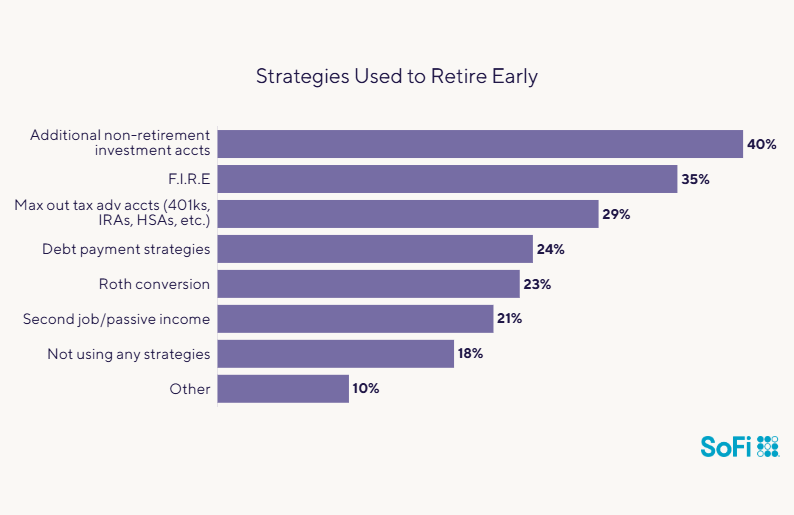
Here’s how FIRE works: In order to retire at a young age, people who follow the movement allocate 50% to 75% of their income to savings. However, that can be challenging because it means they have to sacrifice certain lifestyle pleasures such as eating out or traveling. Of the SoFi survey respondents who said they want to retire at age 49, 18% are not using any strategies that might help them retire early.

Another 35% of that group are using the FIRE method, while others are using a variety of different methods to try to reach their early retirement goal as shown here:

Source: SoFi Retirement Survey, April 2024

💡 Quick Tip: Did you know that a traditional IRA, is a tax-deferred account? That means you don’t pay taxes on the money you put in it (up to an annual limit) or the gains you earn, until you retire and start making withdrawals.

Financial Planning for Early Retirement

In order to start planning to retire early, first ask yourself how confident you are about pulling it off. In the SoFi Retirement Survey, 68% of respondents say they are very or somewhat confident in their ability to retire at their target age, while 15% are very or somewhat doubtful they can do it.

Once you’ve assessed your confidence level, the next step is to calculate how much money you’ll need to live on once you stop working. How much would you have to save and invest to arrive at an amount that would allow you to retire early? Here’s how to help figure that out.

Many people wonder: How much do I need to retire early? There isn’t one answer to that question. The right answer for you is one that you must arrive at based on your unique needs and circumstances. That said, to learn whether you’re on track for retirement it helps to begin somewhere, and the Rule of 25 may provide a good ballpark estimate.

The Rule of 25 recommends saving 25 times your annual expenses in order to retire. Why? Because according to one rule of thumb, you should only spend 4% of your total nest egg every year. By limiting your spending to a small percentage of your savings, the logic goes, your money is more likely to last.

Here’s an example: if you spend $75,000 a year, you’ll need a nest egg of $1,875,000 in order to retire.

$75,000 x 25 = $1,875,000

With that amount saved, and assuming an annual withdrawal rate of 4%, you would have $75,000 per year in income.

Obviously, this is just an example. You might need less income in retirement or more — perhaps a lot less or a lot more, depending on your situation. If your desired income is $50,000, for example, you’d need to save $1,250,000.

The Benefits of Social Security

Once you reach the age of 62, which some consider a traditional retirement age, you are then able to claim Social Security benefits. (Age 67 is considered “full retirement” age for those born in 1960 and later, and you can wait to claim benefits until age 70.)

The longer you wait to claim Social Security, the higher your monthly payments will be. You could add those Social Security benefits to your income or consider reinvesting the money, depending on your circumstances as you get older.

Recommended: Typical Retirement Expenses to Prepare For

Effective Savings Strategies

How do you save the amount of money you’d need for your early retirement plan?

Having a budget you can live with is critical to making this plan a success. The essential word here isn’t budget, it’s the whole phrase: a budget you can live with.

There are countless ways to manage how you budget. There’s the 50-30-20 plan, the envelope method, the zero-based budget, and so on. You could test a couple of them for a couple of months each in order to find one you can live with.

Another strategy for saving more is to get a side hustle to bring in some extra income. You can put that money toward your early retirement goal.

Adjusting Your Financial Habits

As you consider how to retire early, one of the first things you’ll need to do is cut your expenses now so that you can save more money. These strategies can help you get started.

Lifestyle Changes to Accelerate Savings

Take a look at your current spending and expenses and determine where you could cut back. Maybe instead of a $4,000 vacation, you plan a $2,000 trip instead, and then save or invest the other $2,000 for retirement.

You may be able to live more of a minimalist lifestyle overall. Rather than buying new clothes, for instance, search through your closets for items you can wear. Eat out less and cook at home more. Cut back on some of the streaming services you use. Scrutinize all areas of your spending to see what you can eliminate or pare back.

Debt Management Before Retirement

Obviously, it’s very difficult to achieve a big goal like saving for an early retirement if you’re also trying to pay down debt. It’s wise to work to pay off any and all debts you might have (credit card, student loan, personal loan, car loan, etc.).

That’s not only because being debt-free feels better — it also saves you money. For example, the interest rate you’re paying on credit card or store cards can be quite high, often above 15% or even 20%. If you owe $6,000 on a credit card at 17% interest, for example, when you pay that off, you’re essentially saving the interest that debt was costing you each year.

Health Care Planning: A Critical Component of Early Retirement

When you retire early, you need to think about health insurance since you’ll no longer be getting it through your employer. Medicare doesn’t begin until age 65, so start researching the private insurance market now to understand the different plans available and what you might need.

It’s critical to have the right health insurance in place, so make sure you devote proper time and attention to this task.

Investment Management for Future Retirees

Next up, you’ll need to decide what to invest in and how much to invest in order to grow your savings without putting it at risk.

Understanding Your Investment Options

How do you invest to retire early? You can invest in stocks, bonds, mutual funds, exchange-traded funds (ETFs), target date funds, and more.

One major factor to consider is how aggressively you want to invest. That means: Are you ready to invest more in equities, say, taking on the potential for greater risk in order to possibly reap potential gains? Or would you feel more at ease if you invested using a more conservative strategy, with less exposure to risk (but potentially less reward)?

Whichever strategy you choose, you may want to invest on a regular cadence. This approach, called dollar-cost averaging, is one way to maximize potential market returns and mitigate the risk of loss.

Balancing Growth and Risk in Your Investment Portfolio

Because you have less time to save for retirement, you will likely want your investments to grow. But you also need to consider your risk tolerance, as mentioned above. Think about a balanced, diversified portfolio that has the potential to give you long-term growth without taking on more risk than you are comfortable with.

As you get closer to your early retirement date, you can move some of your savings into safer, more liquid assets so that you have enough money on hand for your living, housing, and healthcare expenses.

Retirement Accounts: 401(k)s, IRAs, and HSAs

If your employer offers a retirement plan like a 401(k) or 403(b), that’s the first thing you want to take advantage of — especially if your employer matches a percentage of your savings.

The other reason to save and invest in an employer-sponsored plan is that in most cases the money you save the plan reduces your taxable income. These accounts are considered tax deferred because the amount you save is deducted from your gross income. So the more you save, the less you might pay in taxes. You do pay ordinary income tax on the withdrawals in retirement, however.

The caveat here is that you can’t access those funds before you’re 59½ without paying a penalty. So if you plan to retire early at 50, you will need to tap other savings for roughly the first decade to avoid the withdrawal penalties you’d incur if you tapped your 401(k) or Individual Retirement Account (IRA) early.

Be sure to find out from HR if there are any other employee benefits you might qualify for, such as stock options or a pension, for instance.

Additionally, if your employer offers a Health Savings Account as part of your employee benefits, you might consider opening one.

A Health Savings Account allows you to save additional money: For tax year 2025, the HSA contribution caps are $4,300 for individuals and $8,550 for family coverage. For tax year 2026, the HSA contribution caps are $4,400 for individuals and $8,750 for family coverage.

Your contributions are considered pre-tax, similar to 401(k) or IRA contributions, and the money you withdraw for qualified medical expenses is tax free (although you’ll pay taxes on money spent on non-medical expenses).

Finally, consider opening a Roth IRA. The advantage of saving in a Roth IRA vs. a regular IRA is that you’re contributing after-tax money that can be withdrawn penalty- and tax-free at any time.

To withdraw your earnings without paying taxes or a penalty, though, you must have had the account for at least five years (as per the Roth IRA 5-Year Rule), and you must be over 59 ½.

Recommended: How to Open an IRA in 5 Steps

The Pillars of Early Retirement

Retiring early means you’ll need to have income coming in to help support you. You may have a pension, which can also help. Once you’ve identified the income you’ll be generating, you’ll need to withdraw it in a manner that will help it last over the years of your retirement.

Establishing Multiple Income Streams

Having different streams of income is important so that you’re not just relying on one type of money coming in. For instance, your investments can be a source of potential income and growth, as mentioned. In addition, you may want to get a second job now in addition to your full-time job — perhaps a side hustle on evenings and weekends — to generate more money that you can put toward your retirement savings.

The Role of Social Security and Pensions in Early Retirement

Social Security can help supplement your retirement income. However, as covered above, the earliest you can collect it is at age 62. And if you take your benefits that early they will be reduced by as much as 30%. On the other hand, if you wait until full retirement age to collect them, you’ll receive full benefits. If you were born in 1960 or later, your full retirement age is 67. You can find out more information at ssa.gov.

If your employer offers a pension, you should be able to collect that as another income stream for your retirement years. Generally, you need to be fully vested in the plan to collect the entire pension. The amount you are eligible for is typically based on what you earned, how long you worked for the company, and when you stop working there. Check with your HR department to learn more.

The Significance of Withdrawal Strategies: Rules of 55 and 4%

When it comes to withdrawing money from your investments after retirement, there are some rules and guidelines to be aware of. According to the Rule of 55, the IRS allows certain workers who leave their jobs to take penalty-free distributions from their current employer’s workplace retirement account, such as a 401(k) or 403(b), the year they turn 55.

The 4% rule is a general rule of thumb that recommends that you take 4% of your total retirement savings per year to cover your expenses.

To figure out what you would need, start with your desired yearly retirement income, subtract the annual amount of any pension or additional revenue stream you might have, and divide that number by 0.4. The resulting amount will be 4%, and you can aim to withdraw no more than that amount every year. The rest of your money would stay in your retirement portfolio.

Monitoring Your Progress Towards Early Retirement

To stay on course to reach your goal of early retirement, keep tabs on your progress at regular intervals. For instance, you may want to do a monthly or bi-monthly financial check-in to see where you’re at. Are you saving as much as you planned? If not, what could you do to save more?

Using an online retirement calculator can help you keep track of your goals. From there you can make any adjustments as needed to help make your dreams of early retirement come true.

How to Manage Early Retirement When You Get There

The budget you make in order to save for an early retirement is probably a good blueprint for how you should think about your spending habits after you retire. Unless your expenses will drop significantly after you retire (for instance, if you move or need one car instead of two, etc.), you can expect your spending to be about the same.

That said, you may be spending on different things. Whatever your retirement looks like, though, it’s wise to keep your spending as steady as you can, to keep your nest egg intact.

The Takeaway

An early retirement may appeal to many people, but it takes a real commitment to actually embrace it as your goal. These days, many people are using movements like FIRE (financial independence, retire early) to help them take the steps necessary to retire in their 30s, 40s, and 50s.

You can also make progress toward an early retirement by determining how much money you’ll need for post-work life, budgeting, and cutting back on expenses . And by saving and investing wisely, you may be able to make your goal a reality.

Prepare for your retirement with an individual retirement account (IRA). It’s easy to get started when you open a traditional or Roth IRA with SoFi. Whether you prefer a hands-on self-directed IRA through SoFi Securities or an automated robo IRA with SoFi Wealth, you can build a portfolio to help support your long-term goals while gaining access to tax-advantaged savings strategies.

Help grow your nest egg with a SoFi IRA.

FAQs

How much do you need to save for early retirement?

There isn’t one right answer to the question of how much you need to save for early retirement. It depends on your specific needs and circumstances. However, as a starting point, the Rule of 25 may give you an estimate. This guideline recommends saving 25 times your annual expenses in order to retire, and then following the 4% rule, and withdrawing no more than 4% a year in retirement to cover your expenses.

Is early retirement a practical goal?

For some people, early retirement can be a practical goal if they plan properly. You’ll need to decide at what age you want to retire, and how much money you’ll need for your retirement years. Then, you will need to map out a budget and a concrete strategy to save enough. It will likely require adjusting your lifestyle now to cut back on spending and expenses to help save for the future, which can be challenging.


INVESTMENTS ARE NOT FDIC INSURED • ARE NOT BANK GUARANTEED • MAY LOSE VALUE

SoFi Invest is a trade name used by SoFi Wealth LLC and SoFi Securities LLC offering investment products and services. Robo investing and advisory services are provided by SoFi Wealth LLC, an SEC-registered investment adviser. Brokerage and self-directed investing products offered through SoFi Securities LLC, Member FINRA/SIPC.

For disclosures on SoFi Invest platforms visit SoFi.com/legal. For a full listing of the fees associated with Sofi Invest please view our fee schedule.

Tax Information: This article provides general background information only and is not intended to serve as legal or tax advice or as a substitute for legal counsel. You should consult your own attorney and/or tax advisor if you have a question requiring legal or tax advice.

Exchange Traded Funds (ETFs): Investors should carefully consider the information contained in the prospectus, which contains the Fund’s investment objectives, risks, charges, expenses, and other relevant information. You may obtain a prospectus from the Fund company’s website or by emailing customer service at [email protected]. Please read the prospectus carefully prior to investing.

Financial Tips & Strategies: The tips provided on this website are of a general nature and do not take into account your specific objectives, financial situation, and needs. You should always consider their appropriateness given your own circumstances.

SOIN0224019
CN-Q425-3236452-112

Read more

What Is MAGI and How Do You Calculate It?

MAGI, or modified adjusted gross income, is your adjusted gross income, plus certain deductions added back in. Adjusted gross income, or AGI, is your total income, minus any deductions you’re eligible to claim.

Knowing how to calculate MAGI can help you determine which tax deductions or credits you may be eligible for when it’s time to file your return. Here’s a breakdown of what MAGI is, and why it matters.

Key Points

•   MAGI (Modified Adjusted Gross Income) is adjusted gross income (AGI) plus certain deductions added back in.

•   Knowing MAGI can be crucial for tax planning, minimizing tax liabilities, and determining eligibility for tax credits, such as the Child Tax Credit.

•   Gross income may include wages, business and retirement income, tips, dividends, capital gains, rents, and interest.

•   Common deductions used to determine AGI include student loan interest, contributions to certain retirement plans, educator expenses, and health savings account (HSA) contributions.

•   Deductions that need to be added back to AGI to determine MAGI may include traditional IRA contributions, student loan interest, passive loss or passive income, excluded foreign income, and rental losses, among others.

What Is MAGI?


MAGI is a tax term that refers to modified adjusted gross income. Gross income is your income before taxes or other deductions are applied. Understanding your MAGI can be helpful for tax planning, whether you’re making money trading stocks, or simply working a single job and earning a paycheck.

Definition of MAGI


In simple terms, MAGI is your adjusted gross income with some deductions added back in to see if you qualify for specific deductions or income-based programs.

Some groups may define MAGI slightly differently depending on how it’s used. For instance, in context of student loan interest deductions, the Internal Revenue Service (IRS) notes the following:

For most taxpayers, MAGI is the adjusted gross income (AGI) as calculated on their federal income tax return before subtracting any deduction for student loan interest.

The Social Security Administration (SSA), meanwhile, uses this definition:

Modified Adjusted Gross Income (MAGI) is the sum of the beneficiary’s adjusted gross income (AGI) (found on line 11 of the Internal Revenue Service (IRS) tax filing form 1040), plus tax-exempt interest income (line 2a of IRS Form 1040).

You may wonder why you’re subtracting certain deductions and then adding them back in, but the totals of your MAGI and AGI may differ. We’ll compare MAGI and AGI a little further on to help you understand the difference.

Recommended: What Is Income Tax?

Why MAGI Is Important


MAGI becomes important when determining which, if any, tax breaks you may be eligible to claim. It’s helpful to know your MAGI if you plan to:

•   Make traditional IRA contributions that you plan to deduct on your taxes.

•   Claim a premium tax credit for health insurance expenses.

•   Claim child tax credits or education credits, which reduce your tax liability dollar for dollar.

It can also be helpful if you plan to contribute to a Roth IRA, which requires you to be income-eligible. An IRA is a tax-advantaged account that you can use to save for retirement. Traditional IRAs allow for deductible contributions while Roth IRAs offer tax-free qualified withdrawals.

Apart from tax planning, your MAGI is used for Medicare planning to determine what you’ll pay for monthly premiums once you turn 65.

MAGI vs. Adjusted Gross Income (AGI)


MAGI and AGI are two different calculations, though the final numbers may be very close. Here’s how the IRS defines AGI:

Adjusted gross income, also known as (AGI), is defined as total income minus deductions, or “adjustments” to income that you are eligible to take.

Gross income, for AGI purposes, includes wages, dividends, capital gains, business and retirement income, tips, rents, and interest. Adjustments to income are deductions that reduce your gross income.

Some common deductions that reduce gross income to determine AGI include:

•   Health insurance premiums (if self-employed)

•   One half of self-employment taxes paid

•   Student loan interest

•   Educator expenses

•   Traditional IRA contributions and other qualified retirement plans

Your MAGI is your AGI, with some deductions added back in. Certain deductions are subject to limits, meaning that if your MAGI is too high, your deduction may be reduced or phased out entirely.

Who Needs to Calculate MAGI


Anyone who’s interested in claiming every tax credit or deduction they’re eligible for, up to the full amount allowed by the IRS, may benefit from knowing how to calculate MAGI.

Estimating your tax liability before the year ends gives you time to make some last-minute financial moves that might reduce what you owe or increase your refund. For instance, say you’ve been thinking of opening a Roth IRA. You’ll first need to know your MAGI to know if you’re eligible to contribute to a Roth, based on your income.

It’s also helpful to know your MAGI when applying for federal benefit programs. Your MAGI can affect your eligibility for:

•   Supplemental Nutrition Assistance Program (SNAP) benefits

•   Medicaid

•   Children’s Health Insurance Program (CHIP) benefits

Calculate your Roth IRA eligibility.

Using your MAGI, discover how much you can put into a Roth IRA in 2024 using SoFi’s IRA contribution calculator.


money management guide for beginners

How to Calculate MAGI


Tax planning software programs can calculate your MAGI automatically, or you consult with a tax professional. You’ll need a few pieces of information to find your MAGI.

Step 1: Calculate Your Adjusted Gross Income (AGI)


You’ll first need to find your AGI. To do that you first add up your total gross income. Again, this is all of your income from all sources, before taxes and deductions. Everyone’s list may be different, but might include:

•   Full or part-time employment wages

•   Self-employment income

•   Investments, including rental income

•   Interest and dividends

•   Capital gains

You’ll use your gross income number to find your AGI in the next step.

Step 2: Add or Subtract Applicable Adjustments


Now you’ll subtract applicable adjustments to gross income to find your AGI. Again, this will differ from individual to individual, but some of the most common adjustments for AGI include:

•   Traditional IRA contributions, including SEP IRA contributions if you’re self-employed

•   Student loan interest

•   Half of self-employment taxes paid

•   Tuition and fees

•   Contributions to a Health Savings Account (HSA)

The final number, after adjustments, is your AGI.

Step 3: Determine Your MAGI


Using your AGI you’ll now add back applicable adjustments to get your MAGI. Some of the things you’ll add back include:

•   Traditional IRA contributions, and SEP IRA contributions if you’re self-employed

•   Student loan interest

•   Half of self-employment taxes paid

•   Tuition and fees

•   Passive loss or passive income

•   Rental losses

•   Non-taxable Social Security payments

•   Foreign earned income exclusion

The resulting number is your MAGI, and this is what will help you discern which deductions or credits you might be eligible to take when filing your tax return.

Common Adjustments to AGI for MAGI Calculation


Some adjustments to AGI for MAGI calculations are more common than others. Here are some of the most-often used adjustments.

Tax-Exempt Interest Income


Tax-exempt interest income is not subject to tax at the federal level — as the name implies. This income may, however, still be subject to income tax at the state and local levels.

An example of tax-exempt interest income is income earned from municipal bonds. A municipal bond is a debt instrument that city and local governments use to raise money to fund public works.

When you buy a municipal bond or muni, the bond issuer agrees to pay you interest for a set term in exchange for the use of your money. If the bond is tax-exempt you won’t owe income tax on the interest earned.

But again, interest income from these bonds may still generate state or local tax liabilities.

Qualified Tuition Expenses


Qualified tuition expenses include tuition and required fees for enrollment or attendance at eligible postsecondary schools. The term “qualified tuition expenses” is most often used when discussing education tax credits, such as the American Opportunity Tax Credit (AOTC).

Qualified tuition expenses do not include:

•   Room and board

•   Transportation costs

•   Insurance and medical expenses

•   Student fees that are not required as a condition of enrollment or attendance

You can’t claim this credit for the same expenses that were paid for with tax-free scholarships or grants. Neither can you claim a deduction for the same education expenses that you claim a tax credit for.

IRA Contributions


Traditional IRAs allow you to deduct some or all of your contributions. The amount you can deduct is determined by three things:

•   Your MAGI

•   Your tax filing status

•   Whether you (and your spouse, if married) are covered by a retirement plan at your job

Note: If you or your spouse (if you’re married) are not covered by a retirement plan at work, your IRA contributions are fully deductible.

If either you or your spouse are covered by a workplace retirement plan, your IRA deduction may be limited. To determine how much of your IRA contributions you can deduct in a given year, if any, you’ll need to calculate your MAGI by adding certain deductions back to your AGI — such as the IRA contributions you deducted.

Deducting SEP or SIMPLE IRA Contributions

Keep in mind that contributions to self-employed retirement plans, such as SEP or SIMPLE IRAs, are generally subject to the same tax treatment as traditional IRAs. But because these accounts are used by small business owners and those who are self-employed, the rules governing deductions can be different from traditional IRAs, so it’s wise to check.

Roth IRAs do not allow for deductible contributions.

Student Loan Interest Deduction


The student loan interest deduction allows you to subtract amounts paid for student loan interest from your taxable income. For 2025 and 2026, you can deduct the lesser of $2,500 or the amount of interest you paid during the year.

The student loan interest deduction allows you to subtract amounts paid for student loan interest from your taxable income. For 2024 and 2025, you can deduct the lesser of $2,500 or the amount of interest you paid during the year.

Your MAGI must be below a certain amount to claim this deduction. For 2025, your ability to claim the deduction begins to phase out at these levels:

•   Single filers with a MAGI of $85,000 or more

•   Married couples filing jointly with a MAGI of $170,000

Single filers with a MAGI exceeding $100,000 and married couples with a MAGI greater than $200,000 won’t be able to deduct student loan interest.

For 2026, your ability to claim the deduction begins to phase out at these levels:

•   Single filers with a MAGI of $85,000 or more

•   Married couples filing jointly with a MAGI of $175,000

Single filers with a MAGI exceeding $100,000 and married couples with a MAGI greater than $205,000 won’t be able to deduct student loan interest.

MAGI and Tax Credits


Tax credits reduce your tax liability dollar for dollar. Some tax credits are refundable, meaning you can get a credit for them even if you don’t owe any tax.

MAGI is used to determine eligibility for a number of tax credits, including:

•   Child Tax Credit

•   Earned Income Tax Credit (EITC)

•   Premium tax credit for health insurance

•   Dependent Care Credit

Claiming credits can reduce your tax liability at the end of the year.

MAGI and Deductions


Tax deductions reduce your taxable income, which can push you into a lower tax bracket. As mentioned above, MAGI is used for several key deductions, including:

•   IRA contributions

•   Student loan interest

•   Educator expenses

•   Deductions for adoption expenses

You can claim both tax credits and deductions on your return to try and minimize your tax liability, or boost your refund. However, you can’t claim tax credits and deductions for the same expenses.

The Takeaway


MAGI is the same as AGI plus some adjustments added back into the mix. Navigating tax terms can seem daunting but it’s helpful to understand what MAGI is and how it can impact your financial situation. Learning about how taxes work can help you develop a plan for potentially minimizing your tax liabilities, so that you might have more money to invest.

Prepare for your retirement with an individual retirement account (IRA). It’s easy to get started when you open a traditional or Roth IRA with SoFi. Whether you prefer a hands-on self-directed IRA through SoFi Securities or an automated robo IRA with SoFi Wealth, you can build a portfolio to help support your long-term goals while gaining access to tax-advantaged savings strategies.

FAQ


What is the difference between MAGI and AGI?


Your MAGI is your adjusted gross income, with certain adjustments added back in. Your AGI is your gross income, after certain deductions are taken out.

Is MAGI used for all tax calculations?


MAGI is used for certain tax calculations that determine eligibility for tax breaks. For example, if you’re wondering whether you can claim the Earned Income Tax Credit, or get a deduction for traditional IRA contributions, your MAGI makes a difference.

Can MAGI be higher or lower than AGI?


Your MAGI will always be equal to your AGI, or higher. MAGI is your AGI, with certain deductions or adjustments added back in.


About the author

Rebecca Lake

Rebecca Lake

Rebecca Lake has been a finance writer for nearly a decade, specializing in personal finance, investing, and small business. She is a contributor at Forbes Advisor, SmartAsset, Investopedia, The Balance, MyBankTracker, MoneyRates and CreditCards.com. Read full bio.


Photo credit: iStock/NIKOLA ILIC PR AGENCIJA ZA DIZAJN STUDIOTRIPOD SURCIN

INVESTMENTS ARE NOT FDIC INSURED • ARE NOT BANK GUARANTEED • MAY LOSE VALUE

SoFi Invest is a trade name used by SoFi Wealth LLC and SoFi Securities LLC offering investment products and services. Robo investing and advisory services are provided by SoFi Wealth LLC, an SEC-registered investment adviser. Brokerage and self-directed investing products offered through SoFi Securities LLC, Member FINRA/SIPC.

For disclosures on SoFi Invest platforms visit SoFi.com/legal. For a full listing of the fees associated with Sofi Invest please view our fee schedule.

Financial Tips & Strategies: The tips provided on this website are of a general nature and do not take into account your specific objectives, financial situation, and needs. You should always consider their appropriateness given your own circumstances.

Tax Information: This article provides general background information only and is not intended to serve as legal or tax advice or as a substitute for legal counsel. You should consult your own attorney and/or tax advisor if you have a question requiring legal or tax advice.


¹Probability of Member receiving $1,000 is a probability of 0.026%; If you don’t make a selection in 45 days, you’ll no longer qualify for the promo. Customer must fund their account with a minimum of $50.00 to qualify. Probability percentage is subject to decrease. See full terms and conditions.

SOIN-Q324-016
CN-Q425-3236452-124

Read more
When Can I Retire This Formula Will Help You Know_780x440

When Can I Retire Calculator

When it comes to figuring out when you can retire, there are a number of factors to consider, including Social Security, other sources of income like a pension, and expenses such as health care costs.

Thankfully, there’s retirement calculators for figuring out these costs, which might help you plan for the future. But first, to decide when you can retire, determine at what age you want to retire and then see how that decision affects your finances.

Key Points

•   Factors to consider when deciding when to retire include Social Security benefits, other sources of income, and expenses like health care costs.

•   The full retirement age for Social Security benefits varies based on birth year.

•   Early retirement can result in reduced Social Security benefits, while delaying retirement can increase monthly benefits.

•   Different retirement accounts, such as Roth IRAs and traditional IRAs, have specific rules for withdrawals.

•   Other sources of retirement income to consider include part-time work, pensions, inheritance, and rental income.

When Can You Get Full Social Security Benefits?

As you consider when to apply for Social Security, you’ll want to understand at what age the government allows people to retire with full Social Security benefits. Not only that, at what age can people start withdrawing from their retirement accounts without facing penalties? For Social Security, the rules are based on your birth year.

The Social Security Administration (SSA) has a retirement age calculator. For example, people born between 1943 and 1954 could retire with full Social Security benefits at age 66.

Meanwhile, those born in 1955 could retire at age 66 and two months, and those born in 1956 could retire at age 66 and four months. Those born in or after 1960 can retire at age 67 to receive full benefits. This can help with your retirement planning.

When you plan to retire is important as you consider your Social Security benefits. What you can collect at full retirement age is different from what you can collect if you retire early or late.

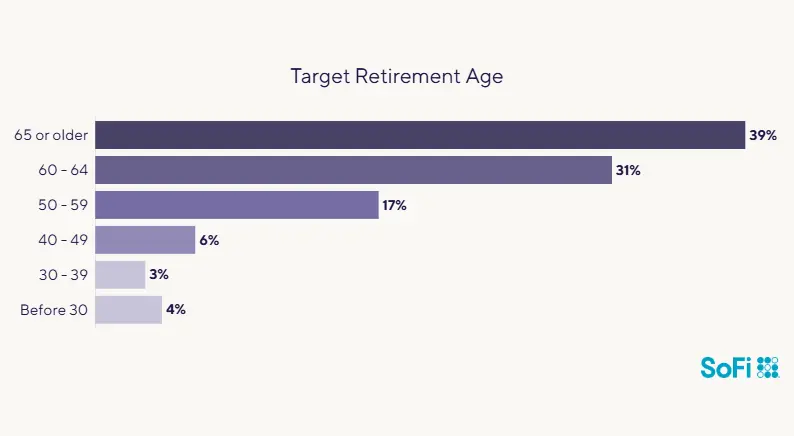
In a 2024 SoFi Retirement Survey, two out of three respondents say they are somewhat or very confident they can retire on time: 70% are hoping to leave the workforce at age 60 or older. Others hope to retire early —17% would like to retire between the ages of 50 and 59.

Target Retirement Age
Source: SoFi’s 2024 Retirement Survey

Social Security Early Retirement

A recipient’s benefits will be permanently reduced if they retire before full retirement age. That’s because the earlier a person retires, the less they’ll receive in Social Security.

Let’s use Jane Doe as an example and say she was born in 1960, so full retirement age is 67. If she retires at age 66, she’ll receive 93.3% of Social Security benefits; at age 65 will get Jane 86.7%. If she retires on her 62nd birthday — the earliest she can receive Social Security — she’ll only receive 70% of earnings.

Here’s a retirement planner table for those born in 1960, which shows how one’s benefits will be reduced with early retirement.

How Early Retirement Affects Your Social Security Benefits
Source: Social Security Administration

Social Security Late Retirement

If a person wants to keep working until after full retirement age, they could earn greater monthly benefits. This is helpful to know when choosing your retirement date.

For example, if the magic retirement number is 66 years but retirement is pushed back to 66 and one month, then Social Security benefits rise to 100.7% per month. So if your monthly benefit was supposed to be $1,000, but you wait until 66 years and one month, then your monthly allotment would increase to $1,007.

If retirement is pushed back to age 70, earnings go up to 132% of monthly benefits. But no need to calculate further: Social Security benefits stop increasing once a person reaches age 70. Here is a SSA table on delayed retirement .

Other Retirement Income to Consider

In retirement, you may have other income sources that can help you support your lifestyle and pay the bills. These might include:

Part-Time Work

Working after retirement by getting a part-time job, especially if it’s one you enjoy, could help cover your retirement expenses. And as long as you have reached your full retirement age (which is based on your year of birth, as noted above), your Social Security benefits will not be reduced, no matter what your earnings are.

However, if you retire early, you need to earn under an annual limit, which is $23,400 in 2025, and $24,480 in 2026, to keep your full benefits. If you earn more than that, you’ll lose $1 in Social Security benefits for every $2 you earn over the limit.

Pension

A pension plan, also sometimes known as a defined benefits plan, from your employer is usually based on how long you worked at your company, how much you earned, and when you stopped working. You’ll need to be fully vested, which typically means working at the company for five years, to collect the entire pension. Check with the HR rep at your company to get the full details about your pension.

A pension generally gives you a set monthly sum for life or a lump sum payment when you retire.

Inheritance

If you inherit money from a relative, these funds could also help you pay for your retirement. And fortunately, receiving an inheritance won’t affect your Social Security benefits, because Social Security is based on money you earn.

Rental Income

Another potential money-earning idea: You could rent out a home you own, or rent out just the upper floors of the house you live in, for some extra income in retirement. Like an inheritance, rental income will generally not affect your Social Security benefits.

Major Expenses in Retirement

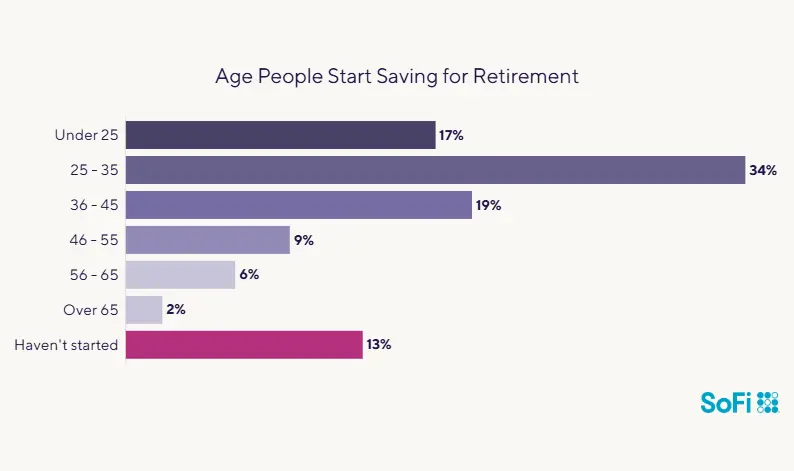
It’s important to draw up a budget for retirement to help determine how much money you might need. The amount may be higher than you realize — which is one of the reasons it’s beneficial to start saving early. In SoFi’s retirement survey, more than half of respondents (51%) say they started saving before age 35.

Age People Start Saving for Retirement
Source: SoFi’s 2024 Retirement Survey

As you put together your retirement budget, these are some of the major expenses retirees commonly face.

Healthcare

For most people, health care costs increase as they get older, as medical problems can become more serious or pervasive. According to Fidelity, based on 2024 numbers, the average amount that a couple who are both age 65 will spend on health care during their first year of retirement is $12,800.

Housing

Your mortgage, home insurance, and the costs of maintaining your house can be a significant monthly and yearly expense. In fact, according to the Bureau of Labor Statistics’ 2023 Consumer Expenditures report, Americans aged 65 and older spent an average of $21,445 on housing in 2023.

Travel

If you’re planning to take trips in retirement, or even just drive to visit family, transportation costs can quickly add up. The Bureau of Labor Statistics Consumer Expenditures report found that in 2023, people over age 65 averaged about $9,033 in transportation costs a year, including vehicles, maintenance, gas, and insurance.


💡 Quick Tip: You can’t just sit on the money you save in a traditional IRA account forever. The government requires withdrawals each year, starting at age 73 (for those born in 1950 or later). These are called required minimum distributions or RMDs.

When Can You Withdraw From Retirement Accounts?

Now that you have a sense of your expenses in retirement, let’s look at retirement accounts. Each type of account has different rules about when money can be taken out.

If a Roth IRA account has existed for at least five years, withdrawals can generally be taken from the account after age 59 ½ without consequences. These are known as qualified withdrawals. Taking out money earlier or withdrawing money from a Roth IRA that’s been open for fewer than five years could result in paying penalties and taxes.

There is a little wiggle room. Contributions (but not earnings) can be withdrawn at any time without penalty, no matter the age of the account holder or the age of the account.

Roth IRA withdrawal rules also have some exceptions. Qualified withdrawals may be made from an account that’s been open at least five years for the purchase of a first home (up to a $10,000 lifetime limit), due to a disability, or after the account holder’s death to be paid to their estate or a beneficiary.

People with a traditional IRA can make withdrawals after age 59 ½ without being penalized. The government will charge a 10% penalty on withdrawals before age 59 ½. There are some exceptions, such as the purchase of a first home (up to a $10,000 lifetime limit), some medical and educational expenses, disability, and death.

People with 401(k)s can make withdrawals after age 59 ½ without paying a 10% penalty. Again, there are some exceptions. For example, an individual can generally retire at age 55 and make withdrawals without penalty. There are also exceptions for those under age 59 ½ for hardship withdrawals, disability, and death, among others.

It’s important to be aware that with a traditional IRA and a 401(k), individuals must start making required minimum distributions (RMDs) by age 73 or face a penalty.


Test your understanding of what you just read.


The Takeaway

Deciding at what age to retire is a personal choice. However, by planning ahead for some common expenses, and understanding the age at which you can get full Social Security benefits, you can use a retirement calculator formula to estimate how much money you’ll need each year to live on. And you can supplement your Social Security benefits with other forms of income and by making smart decisions about savings and investments.

Prepare for your retirement with an individual retirement account (IRA). It’s easy to get started when you open a traditional or Roth IRA with SoFi. Whether you prefer a hands-on self-directed IRA through SoFi Securities or an automated robo IRA with SoFi Wealth, you can build a portfolio to help support your long-term goals while gaining access to tax-advantaged savings strategies.

Easily manage your retirement savings with a SoFi IRA.

FAQ

How do I calculate my retirement age?

To calculate your full retirement age, which is the age you can receive your full retirement benefits, you can use the Social Security administration’s retirement age calculator . Essentially, if you were born in 1960 or later, your full retirement age is 67. For those born between 1954 and 1959, the full retirement age is between 66 and 67, depending exactly how old they are when they retire (such as age 66 and two months). And for those born between 1943 and 1954, full retirement age is 66.

The earlier you retire before your full retirement age, the less you’ll receive in benefits. Conversely, the longer you keep working, up to age 70, the more you can receive.

Can you legally retire before 55?

Yes, you can legally retire before age 55. However, your Social Security benefits typically won’t kick in until age 62. And even then, because you’ll be tapping into those benefits before your full retirement age of 66 or 67, you’ll get a reduced amount.

The rule of 55 generally allows you to withdraw funds from a 401(k) or 403(b) at age 55 without paying a penalty. That may be something to look into if you’re planning to retire early.

Can you retire after 20 years of work?

In some lines of work, you can retire after 20 years on the job and likely get a pension. This includes those in the military, firefighters, police officers, and certain government employees.

That said, anyone in any industry can retire at any time. However, Social Security benefits don’t typically begin until age 62.


INVESTMENTS ARE NOT FDIC INSURED • ARE NOT BANK GUARANTEED • MAY LOSE VALUE

SoFi Invest is a trade name used by SoFi Wealth LLC and SoFi Securities LLC offering investment products and services. Robo investing and advisory services are provided by SoFi Wealth LLC, an SEC-registered investment adviser. Brokerage and self-directed investing products offered through SoFi Securities LLC, Member FINRA/SIPC.

For disclosures on SoFi Invest platforms visit SoFi.com/legal. For a full listing of the fees associated with Sofi Invest please view our fee schedule.

Financial Tips & Strategies: The tips provided on this website are of a general nature and do not take into account your specific objectives, financial situation, and needs. You should always consider their appropriateness given your own circumstances.

Disclaimer: The projections or other information regarding the likelihood of various investment outcomes are hypothetical in nature, do not reflect actual investment results, and are not guarantees of future results.

Third-Party Brand Mentions: No brands, products, or companies mentioned are affiliated with SoFi, nor do they endorse or sponsor this article. Third-party trademarks referenced herein are property of their respective owners.

Third Party Trademarks: Certified Financial Planner Board of Standards Center for Financial Planning, Inc. owns and licenses the certification marks CFP®, CERTIFIED FINANCIAL PLANNER®

External Websites: The information and analysis provided through hyperlinks to third-party websites, while believed to be accurate, cannot be guaranteed by SoFi. Links are provided for informational purposes and should not be viewed as an endorsement.

SOIN-Q325-038
CN-Q425-3236452-125

Read more
TLS 1.2 Encrypted
Equal Housing Lender