What Are Premium Checking Accounts?

What Is a Premium Checking Account?

Checking accounts are one of the hubs of most people’s financial lives, and there are many options available. If you’re curious about premium checking accounts, which typically offer many extra perks, you’re in the right place.

In this guide, you’ll learn about some of the pros of premium checking accounts, such as higher interest rates and ATM-fee reimbursements. You’ll also find out about the potential downsides, like the need to maintain a high balance. Read on for details, so you can decide if a premium checking account is right for you.

Key Points

•   Premium checking accounts offer benefits such as higher interest rates, waived fees, and dedicated customer service, appealing to those who maintain high balances.

•   These accounts usually require account holders to meet minimum balance requirements, often ranging from $10,000 to $15,000, to avoid fees or earn interest.

•   Potential downsides include lower interest rates compared to savings accounts and tiered benefits that necessitate maintaining even higher balances for maximum rewards.

•   Many financial institutions allow customers to meet balance requirements across multiple accounts, facilitating easier qualification for premium checking accounts.

•   Evaluating whether a premium checking account aligns with individual financial goals is crucial, as alternatives like high-yield savings accounts may provide similar benefits without high balance demands.

What Does Premium Checking Mean?

What is a premium checking account? It’s a type of checking account in which account holders are rewarded for meeting high balance requirements or paying higher monthly fees. These rewards may include higher interest rates, fee-free ATMs, free checks, and more.

In some cases, a bank may offer you these perks if you open multiple types of accounts at the same institution — an example would be having both premium checking and savings accounts at a bank. Another common model for premium checking accounts is that the more you keep on deposit, the more incentives you may receive.

What Are the Benefits of a Premium Checking Account?

Those who qualify for a premium checking account may be rewarded with the following benefits:

•   Lower fees for other financial products within the same financial institution

•   Dedicated customer service

•   Higher APYs, or annual percentage yields

•   Free or low-cost wire transfers

•   ATM fee reimbursements

•   Free checks.

These can be attractive ways to encourage customer loyalty, as many financial institutions work to find new ways to enhance their clients’ experience.

Increase your savings
with a limited-time APY boost.*


*Earn up to 4.00% Annual Percentage Yield (APY) on SoFi Savings with a 0.70% APY Boost (added to the 3.30% APY as of 12/23/25) for up to 6 months. Open a new SoFi Checking and Savings account and pay the $10 SoFi Plus subscription every 30 days OR receive eligible direct deposits OR qualifying deposits of $5,000 every 31 days by 3/30/26. Rates variable, subject to change. Terms apply here. SoFi Bank, N.A. Member FDIC.

Pros and Cons of a Premium Bank Account

Opening a premium bank account might be valuable if you can take advantage of all the benefits offered. That being said, there are some downsides, too. Meeting certain requirements can make this type of account inaccessible to some. Let’s take a closer look at the benefits and the downsides.

Pros

Here are the potential upsides of premium checking accounts:

•   Higher APYs: Premium checking accounts typically come with higher APYs compared to basic checking accounts (which may not accrue any interest at all). That enhanced interest rate means your money earns more money.

•   Waived or lowered fees: In most cases, premium checking accounts will waive fees such as those for out-of-network ATMs, money orders, cashier’s checks, and wire transfers. Depending on the bank and what other accounts you have with them, you may even get lowered or waived fees on exchange rates for ATM withdrawals outside the U.S.

•   Discounted rates on other financial products: It’ll depend on your relationship with the bank (and what other accounts you have in addition to a premium checking account), you could receive lower rates for personal loans or mortgages compared to other customers.

•   Higher transaction limits: You may be able to make larger daily ATM withdrawals, transfers, or debit card purchases.

Cons

Next, consider the possible downsides of a premium checking account:

•   Rates may not be as high as you think: Although you could receive a higher interest rate compared to other types of checking accounts, it may not be as high as what you could get with savings or money market accounts.

•   More stringent requirements: You’ll typically need to maintain a higher minimum balance in your account in order to avoid monthly maintenance fees or to earn interest. For instance, many banks require anywhere from $10,000 to $15,000 or more in your premium checking account. The good news is that the balance requirements may be the total across all your accounts with the same financial institution.

•   Benefits may be tiered: While it varies from bank to bank, you may have to “level up” to an even higher minimum balance to access the best interest rates and other perks.

How Can I Qualify for a Premium Checking Account?

In most cases, all you need to do is to have a minimum amount on deposit in order to open a premium checking account. Some may even require you to open other financial products or allow you to meet the minimum deposit requirements across a number of qualifying accounts.

Some major banks, like Chase and Bank of America, will allow you to meet minimum deposit requirements across different accounts as long as they’re linked.

Recommended: How to Automate Your Personal Finances

Additional Features of a Premium Checking Account

You may want to consider whether having that much money in a checking account is a worthwhile move for you. Consider the following points:

•   Is earning interest a priority for you? If you’re after a checking account that earns a higher amount in interest, a premium checking account may be for you. Keep in mind though that if you may not earn as much as you think you will. For instance, if a bank currently offers a 0.04% APY, on a $50,000 balance, you’re only earning $20 per year or so (how often interest compounds will make somewhat of a difference).

•   How often do you use ATMs? Many premium checking accounts offer more ATM transactions and even waive fees for third-party ATM fees. For those who use ATMs frequently, especially out-of-network ATMs, this perk may not be worth it.

•   Do these perks sync up with your financial goals? Premium checking can be part of a deeper relationship with your bank (often called relationship banking) that offers holistic support for your finances. This includes benefits like discounted rates on other financial products — say, a home loan. If you’re willing to keep all your finances at one bank, a premium checking account might be a good fit and open other doors for you.

Are Premium Checking Accounts Worth It?

To decide if a premium checking account is right for you, consider these points:

•   It can be a smart idea to compare premium accounts to standard checking accounts. You may be able to get many of the same benefits, such as free checks or equivalent interest rates, without stashing as much cash as premium accounts require.

•   Getting a high-yield savings account could be a good option if you want to earn a higher interest rate but can’t meet the large minimum balance criteria required of premium checking accounts.

•   If you want to keep all your banking (including investments and loans, for instance) with the same financial institution and can maintain a high balance across your qualifying accounts, premium checking could be well worth it. This is especially true if you’ll use all the perks like free checks and ATM reimbursements.

By thinking about your financial goals and how you like to bank, you may decide that premium checking is the right move for you.

The Takeaway

Premium checking accounts can be a valuable option for some bank customers. If you can maintain the high balance and can use the rewards offered, it may be a good fit.

For others, a high-yield checking without the high minimum requirements might be a better option. It’s up to you to decide what fits your financial style best.

Interested in opening an online bank account? When you sign up for a SoFi Checking and Savings account with eligible direct deposit, you’ll get a competitive annual percentage yield (APY), pay zero account fees, and enjoy an array of rewards, such as access to the Allpoint Network of 55,000+ fee-free ATMs globally. Qualifying accounts can even access their paycheck up to two days early.


Better banking is here with SoFi, NerdWallet’s 2024 winner for Best Checking Account Overall.* Enjoy 3.30% APY on SoFi Checking and Savings with eligible direct deposit.

FAQ

Is a premium checking account worth it?

A premium checking account may be worth it depending on whether you can afford to meet the higher than usual minimum balance amount and whether you’ll be able to take advantage of all the perks. If you can, it may be a good fit.

What are the benefits of a premium bank account?

Some of the key benefits of a premium bank account is a higher interest rate, waived out-of-network ATM fees, discounted rates on loan products, and overdraft protection. Some may even offer free financial and investing advice.

What does a premium bank account mean?

A premium bank account is a type of account offering extra perks once you meet a minimum balance requirement.


Photo credit: iStock/Charday Penn

SoFi Checking and Savings is offered through SoFi Bank, N.A. Member FDIC. The SoFi® Bank Debit Mastercard® is issued by SoFi Bank, N.A., pursuant to license by Mastercard International Incorporated and can be used everywhere Mastercard is accepted. Mastercard is a registered trademark, and the circles design is a trademark of Mastercard International Incorporated.

Annual percentage yield (APY) is variable and subject to change at any time. Rates are current as of 12/23/25. There is no minimum balance requirement. Fees may reduce earnings. Additional rates and information can be found at https://www.sofi.com/legal/banking-rate-sheet

Eligible Direct Deposit means a recurring deposit of regular income to an account holder’s SoFi Checking or Savings account, including payroll, pension, or government benefit payments (e.g., Social Security), made by the account holder’s employer, payroll or benefits provider or government agency (“Eligible Direct Deposit”) via the Automated Clearing House (“ACH”) Network every 31 calendar days.

Although we do our best to recognize all Eligible Direct Deposits, a small number of employers, payroll providers, benefits providers, or government agencies do not designate payments as direct deposit. To ensure you're earning the APY for account holders with Eligible Direct Deposit, we encourage you to check your APY Details page the day after your Eligible Direct Deposit posts to your SoFi account. If your APY is not showing as the APY for account holders with Eligible Direct Deposit, contact us at 855-456-7634 with the details of your Eligible Direct Deposit. As long as SoFi Bank can validate those details, you will start earning the APY for account holders with Eligible Direct Deposit from the date you contact SoFi for the next 31 calendar days. You will also be eligible for the APY for account holders with Eligible Direct Deposit on future Eligible Direct Deposits, as long as SoFi Bank can validate them.

Deposits that are not from an employer, payroll, or benefits provider or government agency, including but not limited to check deposits, peer-to-peer transfers (e.g., transfers from PayPal, Venmo, Wise, etc.), merchant transactions (e.g., transactions from PayPal, Stripe, Square, etc.), and bank ACH funds transfers and wire transfers from external accounts, or are non-recurring in nature (e.g., IRS tax refunds), do not constitute Eligible Direct Deposit activity. There is no minimum Eligible Direct Deposit amount required to qualify for the stated interest rate. SoFi Bank shall, in its sole discretion, assess each account holder's Eligible Direct Deposit activity to determine the applicability of rates and may request additional documentation for verification of eligibility.

See additional details at https://www.sofi.com/legal/banking-rate-sheet.

Financial Tips & Strategies: The tips provided on this website are of a general nature and do not take into account your specific objectives, financial situation, and needs. You should always consider their appropriateness given your own circumstances.

Third-Party Brand Mentions: No brands, products, or companies mentioned are affiliated with SoFi, nor do they endorse or sponsor this article. Third-party trademarks referenced herein are property of their respective owners.

SOBK0124015

Read more
scale

Overweight Stock, Explained

When a financial analyst rates a stock as overweight, it means that the analyst believes an overweight stock will likely outperform other stocks in its industry over the next six to 12 months. Conversely, if they describe a stock as underweight, they believe that it will perform poorly in the future.

It may be helpful to think of these terms as pointers: as if an industry specialist were saying, “You might want to overweight Stock X in your portfolio” or “maybe you should under-weight Stock Y.” These ratings are typically the result of factors in the news or pertaining to a specific company’s prospects. But the terms “overweight” and “underweight” also refer to a stock’s weighting in a relevant index or benchmark.

Key Points

•   An overweight stock rating indicates that analysts expect the stock to outperform its industry peers within the next six to twelve months.

•   The terms overweight and underweight also refer to a stock’s proportion in an investment portfolio, guiding investors on how much to hold.

•   Different market indexes apply unique weighting systems, influencing how stocks are rated as overweight or underweight based on market capitalization or stock price.

•   Investors should be cautious, as an overweight stock may not always lead to significant gains and could lead to portfolio imbalance if not managed properly.

•   The context of both the market and individual portfolios is crucial when interpreting overweight ratings, emphasizing the need for careful investment decisions.

What Is an Overweight Stock?

As noted, an overweight stock is one that analysts believe will outperform others in its sector or market segment in the near future. Similarly, overweight stock is a moniker that may also describe a specific security’s weighting in a portfolio, and one that analysts think investors should buy more of – so, its meaning can be contextual in certain situations.

💡 Quick Tip: How to manage potential risk factors in a self-directed investment account? Doing your research and employing strategies like dollar-cost averaging and diversification may help mitigate financial risk when trading stocks.

Types of Ratings and Where They Came From

To understand stock ratings related to weight, it’s important to know that market indexes assign a weight to the investments they track to be sure that the index accurately reflects the performance of that market sector.

For example, the S&P 500® tracks 500 large-cap U.S. companies. The companies in the index — called the constituents — are weighted by market capitalization. A company’s market cap is calculated by multiplying the current share price by the total number of outstanding shares.

Companies in that index are weighted based on the proportion of the overall index their market cap represents. Other indexes may use a different weighting system. The Dow Jones Industrial Average, for example, tracks 30 blue chip companies and weights them based on stock price. Companies with a higher share price are given more weight than those with lower prices.

Because of these different weighting systems, it’s important to understand that an overweight to a particular stock with regards to one index may not be the same when it comes to another.

Overweight Stocks

When an analyst rates Stock X as overweight, it’s generally a positive sign. First, they believe Stock X is likely to outperform its benchmark index, or even the market as a whole, depending on market conditions, so investors should consider holding more of the stock.

Bear in mind that an “overweight stock” rating doesn’t necessarily mean that stock is a juggernaut. In a down market, being overweight could simply mean the company might not lose as much ground as its peers, or it might grow less slowly than its peers.

Underweight Stocks

When an analyst rates Stock Y as underweight, the analyst believes that Stock Y is likely to underperform its benchmark, and investors should consider holding less of this stock.

Equal Weight Stocks

When an analyst gives an equal weight rating to a stock, that simply means it’s in line with the overall benchmark. Again, when considering these ratings it’s important to keep in mind the overall context of the market, and what these ratings mean to analysts.

Get up to $1,000 in stock when you fund a new Active Invest account.*

Access stock trading, options, alternative investments, IRAs, and more. Get started in just a few minutes.


*Customer must fund their Active Invest account with at least $50 within 45 days of opening the account. Probability of customer receiving $1,000 is 0.026%. See full terms and conditions.

Example of an Overweight Stock

A very simple example of an overweight stock could be when a stock, Stock X, is selling for $50, but experts and analysts think it’s undervalued and should trade for $75, it could be overweight.

Further, an overweight stock rating can be taken in two ways: First, that the stock will outperform its benchmark index and second that investors may want to take advantage of the increase in price.

When an analyst indicates their belief that a stock will appreciate, they may also state a potential time frame and price target for the stock. So, if Stock X is trading at $75 per share, and the company releases new earnings data that’s positive, an analyst might rate the stock as overweight, with a price target of $100 per share in the coming year.

The Downside of Weighting Stocks

One critique of this rating system is that no analyst, of course, can recommend how many shares investors should buy. It’s simply not possible for analysts to know whether Investor A’s portfolio might benefit from an additional 100 shares of Stock X, while Investor B might want to buy 1,000 shares of Stock X.

As a result, it’s incumbent on individual investor’s themselves to keep an eye on how relevant an overweight stock rating might be for their specific allocation. Buying more of Stock X could, in theory, create an imbalance and reduce a portfolio’s overall diversification. So while an overweight stock might be a good thing, an overweight portfolio usually is not.

How Can Investors Interpret Overweight Stocks?

At first glance, the terms overweight and underweight may seem more or less synonymous with “buy” and “sell” — in that case, why don’t analysts use these more straightforward terms?

In fact, the terms overweight and underweight do have a slightly different connotation than simply to buy or sell a security. Rather, the terms suggest a recommendation that a portfolio hold more or less of a particular position than an index or other benchmarks would suggest.

It may mean acquiring more, or selling some, of a particular investment. But it wouldn’t necessarily mean buying something new or selling all of a position. For example, if your portfolio has an allocation to tech stocks, and an analyst recommends overweighting one of those stocks, you may want to buy more of that company. Or you may not need more growth in your tech holdings, so you might look for an overweight stock.

Also, analysts aren’t always comfortable giving specific directions to buy or sell certain securities. The terms overweight and underweight are more like offering guidance: “Here’s what I think of Stock X or Stock Y. I’ll let the investor take it from here.”

In many cases an overweight or underweight recommendation might not be very useful for investors. For example, if an analyst recommends an overweight to a certain commodity but an investor’s portfolio doesn’t hold any commodities, this information may not have much bearing on their situation.

Can a Portfolio Be Considered Overweight?

Overweight can refer to a portfolio that holds more of a stock or other investments than it theoretically should. For individual investors, this might mean that more of a portfolio is allocated to stock than the investor intended.

For example, say an investor has a portfolio allocation in which 70% of its allocation is held in stock and 30% is held in bonds. If the stock market goes up, the proportion of the portfolio held in stock may grow beyond the 70% mark. At that point, the portfolio may be described as overweight in stocks, and an investor may want to rebalance to bring it in line with their initial allocation plan.

It may come as no surprise that the opposite of an overweight allocation is an underweight allocation. For example, if the stock allocation in the portfolio above fell below 70%, that allocation could be described as underweight in stocks.

The term can also apply in a narrower sense. For example, a stock portfolio could hold too much stock in one company, sector, or geographical region. In each case the holding could be described as overweight.

Professional fund managers may also use overweight to describe portfolios they work with that are off track with their index, including mutual funds, exchange-traded funds, and index funds. From time to time, a fund may get out of line with its benchmark index by holding more or less of an investment that index tracks.

For example, say an index fund is built to track the S&P 500. To track the index, fund managers will usually attempt to hold every stock in the index. Additionally, they will try to match the proportion of each individual company their fund holds to the index as well. So if stock A represents 5% of the original index, the fund will also hold 5% of stock A.

Some funds have a little bit of wiggle room in terms of how far they can stray from the index. Some might be allowed to hold more or less stocks if they think the stocks will outperform or underperform. When they hold more than the index, the managers are taking an overweight position. And when they hold less than the index, the managers are taking an underweight position.

The Takeaway

Overweight stocks are those that may be undervalued by the market. When an analyst gives a stock an overweight rating, broadly speaking it could be a good thing. If the analyst is correct, and the stock is indeed poised to perform better than its benchmark — maybe even better than the market as a whole — investors may want to buy that stock.

But the necessary caveat is that it all depends on context — the context of the market, and the context of an investor’s portfolio overall. You don’t want to buy a stock that could throw your allocation off, and make your portfolio overweight in a way that’s not ideal.

Invest in what matters most to you with SoFi Active Invest. In a self-directed account provided by SoFi Securities, you can trade stocks, exchange-traded funds (ETFs), mutual funds, alternative funds, options, and more — all while paying $0 commission on every trade. Other fees may apply. Whether you want to trade after-hours or manage your portfolio using real-time stock insights and analyst ratings, you can invest your way in SoFi's easy-to-use mobile app.

Opening and funding an Active Invest account gives you the opportunity to get up to $1,000 in the stock of your choice.¹

FAQ

Is overweight stock good?

An overweight stock can be good for investors looking for a relative deal, but it may not be a good thing if the investor already owns shares of the stock.

What is the difference between overweight and outperform stocks?

Outperform stocks and overweight stocks are similar, and the terms are often used interchangeably. But generally, “outperform” may describe a stock that’s undervalued or expected to offer solid returns in the future, but perhaps perform not quite as well as an “overweight” stock.

What is the difference between buy and overweight?

On an analysts’ rating system, “buy” and “overweight” stocks are rated differently, with “buy” being a higher rating – though both ratings are positive.


INVESTMENTS ARE NOT FDIC INSURED • ARE NOT BANK GUARANTEED • MAY LOSE VALUE

SoFi Invest is a trade name used by SoFi Wealth LLC and SoFi Securities LLC offering investment products and services. Robo investing and advisory services are provided by SoFi Wealth LLC, an SEC-registered investment adviser. Brokerage and self-directed investing products offered through SoFi Securities LLC, Member FINRA/SIPC.

For disclosures on SoFi Invest platforms visit SoFi.com/legal. For a full listing of the fees associated with Sofi Invest please view our fee schedule.

Financial Tips & Strategies: The tips provided on this website are of a general nature and do not take into account your specific objectives, financial situation, and needs. You should always consider their appropriateness given your own circumstances.


¹Probability of Member receiving $1,000 is a probability of 0.026%; If you don’t make a selection in 45 days, you’ll no longer qualify for the promo. Customer must fund their account with a minimum of $50.00 to qualify. Probability percentage is subject to decrease. See full terms and conditions.

SOIN0124033

Read more
Understanding Bond Valuation

What Is Bond Valuation?

Bond valuation is a way of determining the fair value of a bond. Bond valuation involves calculating the present value of the bond’s future coupon payments, its cash flow, and the bond’s value at maturity (or par value), to determine its current fair value or price. The price of a bond is what investors are willing to pay for it on the secondary market.

When an investor buys a bond from the issuing company or institution, they typically buy it at its face value. But when an investor purchases a bond on the open market, they need to know its current value. Because a bond’s face value and interest payments are fixed, the valuation process helps investors decide what rate of return would make that bond worth the cost.

Key Points

•   Bond valuation is the process of determining a bond’s fair value by calculating the present value of future coupon payments and its value at maturity.

•   Investors must consider the bond’s current price, which may differ from its face value, as it reflects market conditions and the issuing company’s creditworthiness.

•   The valuation involves discounting the bond’s future cash flows using a realistic discount rate, which is essential due to the time value of money.

•   Changes in interest rates significantly affect bond pricing; rising rates usually decrease bond prices, while falling rates can increase them.

•   Investing in bonds can diversify a portfolio, as they tend to be less risky than stocks and provide a predictable income stream through fixed payments.

How Bond Valuation Works

First, it’s important to remember that bonds are generally long-term investments, where the par value or face value is fixed and so are the coupon payments (the bond’s rate of return over time) — but interest rates are not, and that impacts the present or fair value of a bond at any given moment.

To determine the present or fair value of a bond, the investor must calculate the current value of the bond’s future payments using a discount rate, as well as the bond’s value at maturity to make sure the bond you’re buying is worth it.

Some terms to know when calculating bond valuation:

•   Coupon rate/Cash flow: The coupon rate refers to the interest payments the investor receives; usually it’s a fixed percentage of the bond’s face value and typically investors get annual or semi-annual payments. For example, a $1,000 bond with a 10-year term and a 3% annual coupon would pay the investor $30 per year for 10 years ($1,000 x 0.03 = $30 per year).

•   Maturity: This is when the bond’s principal is scheduled to be repaid to the bondholder (i.e. in one year, five years, 10 years, and so on). When a bond reaches maturity, the corporation or government that issued the bond must repay the full amount of the face value (in this example, $1,000).

•   Current price: The current price is different from the bond’s face value or par value, which is fixed: i.e. a $1,000 bond is a $1,000 bond. The current price is what people mean when they talk about bond valuation: What is the bond currently worth, today?

The face value is not necessarily the amount you pay to purchase the bond, since you might buy a bond at a price above or below par value. A bond that trades at a price below its face value is called a discount bond. A bond price above par value is called a premium bond.

💡 Quick Tip: Are self-directed brokerage accounts cost efficient? They can be, because they offer the convenience of being able to buy stocks online without using a traditional full-service broker (and the typical broker fees).

Get up to $1,000 in stock when you fund a new Active Invest account.*

Access stock trading, options, alternative investments, IRAs, and more. Get started in just a few minutes.


*Customer must fund their Active Invest account with at least $50 within 45 days of opening the account. Probability of customer receiving $1,000 is 0.026%. See full terms and conditions.

How to Calculate Bond Valuation

Bond valuation can seem like a daunting task to new investors, but it is not that onerous once you break it down into steps. This process helps investors know how to calculate bond valuation.

Bond Valuation Formula

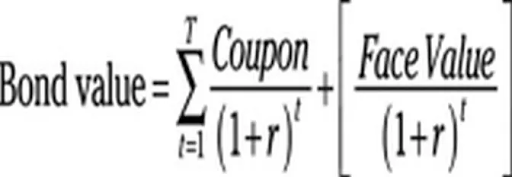
The bond valuation formula uses a discounting process for all future cash flows to determine the present fair value of the bond, sometimes called the theoretical fair value of the bond (since it’s calculated using certain assumptions).

bond valuation formula

The following steps explain each part of the formula and how to calculate a bond’s price.

Step 1: Determine the cash flow and remaining payments.

A bond’s cash flow is determined by calculating the coupon rate multiplied by the face value. A $1,000 corporate bond with a 3.0% coupon has an annual cash flow of $30. If it’s a 10-year bond that has five years left until maturity, there would be five coupon payments remaining.

Payment 1 = $30; Payment 2 = $30; and so on.

The final payment would include the face value: $1,000 + $30 = $1,030.

This is important because the closer the bond is to maturity, the higher its value may be.

Step 2: Determine a realistic discount rate.

The coupon payments are based on future values and thus the bond’s cash flow must be discounted back to the present (thanks to the time value of money theory, a future dollar is worth less than a dollar in the present).

To determine a discount rate, you can check the current rates for 10-year corporate bonds. For this example, let’s go with 2.5% (or 0.025, when expressed as a decimal).

Step 3: Calculate the present value of the remaining payments.

Calculate the present value of future cash flows including the principal repayment at maturity. In other words, divide the yearly coupon payment by (1 + r)t, where r equals the discount rate and t is the remaining payment number.

$30 / (1 + .025)1 = $29.26

$30 / (1 + .025)2 = 28.55

$30 / (1 + .025)3 = 27.85

$30 / (1 + .025)4 = 27.17

$1030 / (1 + .025)5 = 1,004.87

Step 4: Sum all future cash flows.

Sum all future cash flows to arrive at the present market value of the bond : $1,117.70

Understanding Bond Pricing

In this example, the price of the bond is $1,117.70, or $117.70 above par. A bond’s face or par value will often differ from its market value — and in this case its current fair value (market value) is higher. There are a number of factors that come into play, including the company’s credit rating, the time to maturity (the closer the bond is to maturity the closer the price comes to its face value), and of course changes to interest rates.

Remember that a bond’s price tends to move in the opposite direction of interest rates. If prevailing interest rates are higher than when the bond was issued, its price will generally fall. That’s because, as interest rates rise, new bonds are likely to be issued with higher coupon rates, making the new bonds more attractive. So bonds with lower coupon payments would be less attractive, and likely sell for a lower price. So, higher rates generally mean lower prices for existing bonds.

The same logic applies when interest rates are lower; the price of existing bonds tends to increase, because their higher coupons are now more attractive and investors may be willing to pay a premium for bonds with those higher interest payments.

Is Investing in Bonds Right for You?

Investing in bonds can help diversify a stock portfolio since stocks and bonds trade differently. In general, bonds are seen as less risky than equities since they often provide a predictable stream of income. Investors can consider bonds as an investment, and those with a lower risk tolerance might be better served with a portfolio weighted highly in bonds.

Performing proper bond valuation can be part of a solid research and due diligence process when attempting to find securities for your portfolio. Moreover, different bonds have different risk and return profiles. Some bonds — such as junk bonds and fixed-income securities offered in emerging markets — feature higher potential rates of return with greater risk. “Junk” is a term used to describe high-yield bonds. You can take on higher risk with long-duration bonds and convertible bonds. Some of the safest bonds are short-term Treasury securities.

You can also purchase bond exchange-traded funds (ETFs) and bond mutual funds that own a diversified basket of fixed-income securities.

The Takeaway

Bond valuation is the process of determining the fair value of a bond after it’s been issued. In order to price a bond, you must calculate the present value of a bond’s future interest payments using a reasonable discount rate. By adding the discounted coupon payments, and the bond’s face value, you can arrive at the theoretical fair value of the bond.

A bond can be priced at a discount to its par value or at a premium depending on market conditions and how traders view the issuing company’s prospects. Owning bonds can help diversify your portfolio. Many investors also find bonds appealing because of their steady payments (one reason that bonds are considered fixed-income assets).

Invest in what matters most to you with SoFi Active Invest. In a self-directed account provided by SoFi Securities, you can trade stocks, exchange-traded funds (ETFs), mutual funds, alternative funds, options, and more — all while paying $0 commission on every trade. Other fees may apply. Whether you want to trade after-hours or manage your portfolio using real-time stock insights and analyst ratings, you can invest your way in SoFi's easy-to-use mobile app.

Opening and funding an Active Invest account gives you the opportunity to get up to $1,000 in the stock of your choice.¹


Photo credit: iStock/Tempura

INVESTMENTS ARE NOT FDIC INSURED • ARE NOT BANK GUARANTEED • MAY LOSE VALUE

SoFi Invest is a trade name used by SoFi Wealth LLC and SoFi Securities LLC offering investment products and services. Robo investing and advisory services are provided by SoFi Wealth LLC, an SEC-registered investment adviser. Brokerage and self-directed investing products offered through SoFi Securities LLC, Member FINRA/SIPC.

For disclosures on SoFi Invest platforms visit SoFi.com/legal. For a full listing of the fees associated with Sofi Invest please view our fee schedule.

Financial Tips & Strategies: The tips provided on this website are of a general nature and do not take into account your specific objectives, financial situation, and needs. You should always consider their appropriateness given your own circumstances.

Exchange Traded Funds (ETFs): Investors should carefully consider the information contained in the prospectus, which contains the Fund’s investment objectives, risks, charges, expenses, and other relevant information. You may obtain a prospectus from the Fund company’s website or by emailing customer service at [email protected]. Please read the prospectus carefully prior to investing.

Fund Fees
If you invest in Exchange Traded Funds (ETFs) through SoFi Invest (either by buying them yourself or via investing in SoFi Invest’s automated investments, formerly SoFi Wealth), these funds will have their own management fees. These fees are not paid directly by you, but rather by the fund itself. these fees do reduce the fund’s returns. Check out each fund’s prospectus for details. SoFi Invest does not receive sales commissions, 12b-1 fees, or other fees from ETFs for investing such funds on behalf of advisory clients, though if SoFi Invest creates its own funds, it could earn management fees there.
SoFi Invest may waive all, or part of any of these fees, permanently or for a period of time, at its sole discretion for any reason. Fees are subject to change at any time. The current fee schedule will always be available in your Account Documents section of SoFi Invest.


Investment Risk: Diversification can help reduce some investment risk. It cannot guarantee profit, or fully protect in a down market.


¹Probability of Member receiving $1,000 is a probability of 0.026%; If you don’t make a selection in 45 days, you’ll no longer qualify for the promo. Customer must fund their account with a minimum of $50.00 to qualify. Probability percentage is subject to decrease. See full terms and conditions.

SOIN-Q224-1862302-V1

Read more
What Is Maintenance Margin? How Margin Maintenance Requirements Work

What Is Maintenance Margin? How Its Requirements Work

Maintenance margin, as it relates to margin accounts and trading, refers to the necessary amount of funds an investor needs to maintain in their brokerage account in order to utilize margin. Margin accounts work differently than other trading accounts. Instead of allowing the trader to do regular trades, the margin account allows leveraged trades.

This means that the trader can buy securities including stocks, bonds, or options for more than the amount that they have in their account, paying only a deposit on the trade. They borrow the rest of the cash needed for the investment from the broker.

Key Points

•   Maintenance margin represents the minimum balance required in a trader’s margin account to avoid a margin call and continue leveraged trading.

•   The Financial Industry Regulatory Authority mandates a minimum maintenance margin of 25%, but individual brokerage firms often set higher requirements for added security.

•   Margin trading carries significant risks, as traders can incur losses exceeding their account balance, leading to margin debt owed to brokers.

•   If a trader’s account balance falls below the maintenance margin, the broker can issue a margin call, requiring additional funds or asset liquidation within a specified timeframe.

•   Understanding the distinction between maintenance margin and initial margin is crucial, as the initial margin is the upfront deposit required to open a margin account.

Maintenance Margin Definition

In margin trading, the maintenance margin is the minimum amount of funds that a trader must hold in their portfolio to avoid being issued a margin call, for as long as they are actively involved in a trade. If a trade they enter decreases in value, the trader may owe money, which is taken from their account.

Minimum margin requirements for leveraged accounts are regulated by the government. Currently the Financial Industry Regulatory Authority (FINRA) sets the maintenance margin at 25% of the total value of securities that a trader holds in their margin account.

Specific brokerage firms also maintain their own requirements. It is common for brokerage requirements to be higher than the government required amount to provide the firm with greater financial security.

Margin maintenance requirements shift based on various factors, including market liquidity and volatility. And different stocks have differing maintenance requirements: if they are more likely to be volatile, the requirements may be higher.

Does a Maintenance Margin Mitigate Risk?

Maintenance margin doesn’t mitigate risk for traders. Margin investing is risky because traders can lose more money than they have in their account, creating a debt with the broker, called margin debt.

When a trader opens a margin account, they must sign an agreement and deposit a certain amount into the account before they can start trading. To pay off any debt from assets that have lost value, the trader will need to deposit additional funds, deposit securities, or sell off holdings.

Therefore, margin trading isn’t recommended for beginner traders, and it’s important for traders to understand the risks and how it works before trying it out.


💡 Quick Tip: When you’re actively investing in stocks, it’s important to ask what types of fees you might have to pay. For example, brokers may charge a flat fee for trading stocks, or require some commission for every trade. Taking the time to manage investment costs can be beneficial over the long term.

Increase your buying power with a margin loan from SoFi.

Borrow against your current investments at just 4.75% to 9.50%* and start margin trading.


*For full margin details, see terms.


Maintenance Margin Requirement Examples

Let’s look at an example of how maintenance margin requirements work.

Let’s say a trader wants to purchase 100 shares of Company XYZ at $40 per share. They don’t have sufficient funds to purchase the entire number of shares. The trader can use a margin account which allows them to purchase the entire amount of shares but only deposit a percentage of the total price into the trade and also pay a financing fee. This deposit amount is known as the initial margin requirement.

In this example, the initial maintenance margin requirement is 40% of the purchase price of the trade. For the trader to purchase the full 100 shares, they need to maintain a balance of 40% of the trade purchase amount in their margin account.

When Maintenance Margin Requirements Aren’t Met

If the amount in their account dips below the minimum requirement, their broker will issue a margin call notification. Generally, the trader will have between 2-5 days to either add more funds to their account or sell some of the assets they are invested in to move enough cash funds back into their account.

If the trader doesn’t sell holdings or add funds to their account to meet the margin maintenance requirement, the broker may sell the trader’s securities without notifying them, and they have the right to decide which ones they sell. They are also allowed to charge the trader commissions and even sue the trader for losses.

A margin call can also be sent out if the brokerage firm changes their requirements, which they can do at any time.

Calculating Maintenance Margin

Each brokerage firm has their own maintenance margin requirements. The formula to calculate the maintenance margin is:

Account value = (Margin Loan) / (1 – Maintenance Margin %)

This can be used to determine the stock price that will trigger a margin call.

For example, a trader opens a margin account and deposits $20,000 into it, then borrows $10,000 from the broker in a margin loan in order to purchase 200 shares of stock at a price of $100 each. The broker’s maintenance margin is 30%. Here is what the calculation would be to figure out what account balance would trigger the margin call:

($10,000 Margin Loan) / (1 – 0.30 Maintenance Margin %) = $14,285.71

That means that if the trader’s account dips below $14,285.71, or if the price of the stock falls below $71.43 ($14,285.71 / 200 shares) then the broker will issue a margin call.

Recommended: What Is Margin Interest and How to Calculate It

Maintenance Margin vs Initial Margin

When traders open a margin account, there is an initial margin amount they are required to deposit before they can start trading. This is set by FINRA, and brokers may also have their own additional requirements. The initial margin required by FINRA is currently $2,000 in cash or securities.

After a trader starts buying on margin, they must meet the maintenance margin on their account — at least 25% of the market value of the securities in their account.

The Takeaway

A maintenance margin is a monetary buffer for traders with margin accounts. The maintenance margin is a minimum balance required to execute leveraged trades. If a trader’s margin account dips below the minimum set by FINRA and the broker, the broker will issue a warning, or margin call, so that the trader can add cash to their account or sell holdings to cover the gap.

Maintenance margins do not mitigate risks for traders, and if an investor is utilizing margin as a part of their investment strategy, they should know what they’re getting into. Margin accounts have their pros and cons, but it’s important to keep the risks in mind.

Invest in what matters most to you with SoFi Active Invest. In a self-directed account provided by SoFi Securities, you can trade stocks, exchange-traded funds (ETFs), mutual funds, alternative funds, options, and more — all while paying $0 commission on every trade. Other fees may apply. Whether you want to trade after-hours or manage your portfolio using real-time stock insights and analyst ratings, you can invest your way in SoFi's easy-to-use mobile app.


Opening and funding an Active Invest account gives you the opportunity to get up to $1,000 in the stock of your choice.¹

FAQ

What happens if you go below maintenance margin?

Generally, if a trader or investor’s account goes below the maintenance margin, their brokerage will send them a margin call, or otherwise warn them that they need to deposit funds or sell holdings.

What does current maintenance margin mean?

Current maintenance margin refers to the literal current maintenance margin set by financial regulators or by a specific brokerage. For example, it may be 25% of the value of an investor’s total holdings.

What is the difference between maintenance margin and minimum margin?

Minimum margin refers to the minimum amount of collateral needed in a margin account to execute leveraged trades, while maintenance margin is the total capital that needs to remain in the account as the investor continues to utilize a margin account.

Who sets the maintenance margin?

FINRA currently sets the maintenance margin, which is 25%. But specific brokerage firms can set their own beyond that, and often, at a higher threshold.

Why is my maintenance margin so high?

Maintenance margin requirements can be determined by a number of factors beyond regulatory minimums, such as market conditions and volatility, and the specific types of securities an investor is trading.

What does 25% maintenance margin mean?

Twenty-five percent maintenance margin means that an investor must hold 25% of the total value of their holdings in their account. It is the minimum amount of equity that must be maintained in their margin account.


Photo credit: iStock/StockRocket

INVESTMENTS ARE NOT FDIC INSURED • ARE NOT BANK GUARANTEED • MAY LOSE VALUE

SoFi Invest is a trade name used by SoFi Wealth LLC and SoFi Securities LLC offering investment products and services. Robo investing and advisory services are provided by SoFi Wealth LLC, an SEC-registered investment adviser. Brokerage and self-directed investing products offered through SoFi Securities LLC, Member FINRA/SIPC.

For disclosures on SoFi Invest platforms visit SoFi.com/legal. For a full listing of the fees associated with Sofi Invest please view our fee schedule.

Financial Tips & Strategies: The tips provided on this website are of a general nature and do not take into account your specific objectives, financial situation, and needs. You should always consider their appropriateness given your own circumstances.


¹Probability of Member receiving $1,000 is a probability of 0.026%; If you don’t make a selection in 45 days, you’ll no longer qualify for the promo. Customer must fund their account with a minimum of $50.00 to qualify. Probability percentage is subject to decrease. See full terms and conditions.


SOIN1023010

Read more
What Is an Exponential Moving Average (EMA) in Stock Trading? How Does It Work?

What Is Exponential Moving Average (EMA)?

An exponential moving average (EMA) is a commonly used average price calculation done for a specific time period that places more weight and importance on the most recent price data. Since it is weighted this way it reacts faster to recent price changes than a simple moving average (SMA) which is a type of average price calculation, which equally weights all data points within a time period.

Moving averages are technical analysis trading indicators used by traders to help them understand the direction, market trend, and strength of price movement of an asset. They measure the average price of a security by taking averages of the prices of the security over a specific period of time, and can be used to show traders the location of support and resistance levels. Read on to learn more about the meaning of EMA in stocks, the EMA formula, and how to calculate EMA.

Key Points

•   An exponential moving average (EMA) gives more weight to recent price data, making it a useful tool for traders to gauge market trends and price movements.

•   The formula for calculating EMA incorporates the current price, the previous EMA, and an exponential smoothing constant, allowing for dynamic adjustments based on market behavior.

•   Calculating EMA involves determining the simple moving average first, then applying a weighting multiplier, and finally using the EMA formula to derive values.

•   While EMAs can effectively indicate support and resistance levels, they have limitations, such as lagging indicators and the potential for false signals in flat markets.

•   Traders often use EMA alongside other indicators to enhance their analysis, helping them make informed decisions about entry and exit points in their trading strategies.

What is EMA?

An EMA, exponentially weighted moving average, is a type of moving average (MA) used by traders to evaluate the potential trajectory of a financial security. Using the EMA calculation, the most recent price data has the greatest impact on the moving average, while older data has a lower impact. The previous EMA value is included in the calculation, so the current value includes all the price data.

As noted, it reacts faster to price changes than a simple moving average, which may be helpful to some investors.

EMA Formula

The formula for calculating EMA is:

EMA = (K x (C – P)) + P

Where:

C = Current Price

P = Previous Period’s EMA (for the first period calculated the SMA is used)

K = Exponential Smoothing Constant (this applies appropriate weight to the most recent security price, using the number of periods specified in the moving average. The most common smoothing constant is 2, but the higher it is the more influence recent data points have on the EMA)

💡 Quick Tip: Are self-directed brokerage accounts cost efficient? They can be, because they offer the convenience of being able to buy stocks online without using a traditional full-service broker (and the typical broker fees).

Get up to $1,000 in stock when you fund a new Active Invest account.*

Access stock trading, options, alternative investments, IRAs, and more. Get started in just a few minutes.


*Customer must fund their Active Invest account with at least $50 within 45 days of opening the account. Probability of customer receiving $1,000 is 0.026%. See full terms and conditions.

How to Calculate EMA

Technical analysts follow three steps to calculating an EMA.

1.    Calculate the simple moving average (SMA) to find the initial EMA data point. The SMA is used as the previous period’s EMA for the first calculated data point of the EMA. To calculate the SMA of the last 20 days, a trader would add the amounts of the last 20 closing prices of the security and then divide that sum by 20.

2.    Calculate the weighting multiplier for the number of periods that will be used to calculate the EMA. The number of periods used for the EMA has a significant impact on the value of the weighting multiplier.

   The formula for finding the weighting multiplier is:

   EMA(current) = ((Price(current) – EMA (prev)) x Multiplier) + EMA(prev)

3.    Calculate the EMA using the formula described above.

Some traders also use the open, high, low, or median price instead of the closing price for the EMA calculation.

Example of EMA

Taking the above into consideration and following the three steps to calculate EMA, here’s an example of how it might all come together.

Again, here’s the EMA formula: EMA = (K x (C – P)) + P

We’ll assume that the previous period’s EMA is 50, and that the current price is 60. We’ll also assume that our smoothing constant is 2, for simplicity’s sake.

So: EMA= (2 x (60 – 50)) + 50 = 70

What Does EMA Show You?

An EMA follows prices more closely than a SMA since it puts more weight on recent data points. This is helpful for determining when to enter and exit trades. EMA is a lagging indicator that shows market trends and directions and the strength of price movements. It’s best used in trending markets.

By looking at past trends traders can gain an understanding of what might happen with a security’s price in the future, which may help them identify investment opportunities. Although past performance is no guarantee of future performance.

Limitations of Using EMA

Although EMA is a very useful trading tool, it does have some constraints.

•   Spotting trends and directions using EMA is difficult in a flat market.

•   The EMA shows present market trends but is not a predictor of future trends and prices. It also doesn’t show exact highs and lows or precise entry and exit points.

•   The EMA can show false signals and can show more short term price changes that aren’t trading indicators.

•   Even though it is weighted toward recent prices, the EMA does rely on past price movements, so it is a lagging indicator. Because of this the optimal time to enter a trade may have already passed by the time the trend direction shows up in an EMA chart.

How Investors Can Use EMA

Usually traders look at the direction the EMA is going in and they trade in the direction of the trend. In addition to spotting market trends and direction, EMA can also identify spot reversals that occur when a security is overbought or oversold.

The EMA is a fairly accurate tool because stock prices typically only stray so far from the average before returning to test the average, creating support or resistance and continuing to rise or fall. Even beginning investors can use EMA to spot trends and gain an understanding of what direction the market is heading.

Like other indicators, It’s best to use EMA in conjunction with other tools such as relative strength index (RSI) and moving average convergence divergence (MACD) to get a more comprehensive and accurate picture of the market. There are a few ways investors can use EMA:

Trend Trading

Traders can use the EMA to discover and trade primary market trends. When the EMA rises this is a bullish indicator, a trader may buy when the stock price dips to hit the EMA line or just below it. When EMA goes down, a trader might sell their position when the stock price goes up to hit the EMA line or just above. If the stock has a closing price that crosses over the average line, the trader closes out their trade.

Support and Resistance

EMA lines can track support and resistance levels, another useful way to track price movements and trends. If EMA goes up, this is a support indicator, while if it goes down this shows resistance to the security’s price movement.

Buy and Sell Signals

Traders can set up fast and slow moving averages and then find buy and sell signals when the two lines cross each other.

The Takeaway

EMA is a useful tool for both advanced and beginner traders to understand market trends and directions. It’s a technical indicator that evaluates a stock’s price trend with a greater emphasis on recent price levels.

Whether you’re planning to use in-depth technical analysis or not, a great way to get started building a portfolio is by opening an investment account on the SoFi Invest® stock trading app. It lets you research, track, buy and sell stocks, exchange-traded funds, and other assets right from your phone.

Invest in what matters most to you with SoFi Active Invest. In a self-directed account provided by SoFi Securities, you can trade stocks, exchange-traded funds (ETFs), mutual funds, alternative funds, options, and more — all while paying $0 commission on every trade. Other fees may apply. Whether you want to trade after-hours or manage your portfolio using real-time stock insights and analyst ratings, you can invest your way in SoFi's easy-to-use mobile app.

Opening and funding an Active Invest account gives you the opportunity to get up to $1,000 in the stock of your choice.¹

FAQ

Which EMA is best?

Day traders often use 8- and 20-day EMA periods, while long-term investors use 50- and 200-day EMA. Indicators such as the moving average convergence divergence (MACD) and percentage price oscillator (PPO) use 12- and 26-day periods. If a security passes over a 200-day EMA this is a technical sign that a trend reversal has occurred.

What’s the difference between EMA and SMA?

Both simple moving average and exponential moving average are used by traders to measure market trends. They both create a graphical line that smoothes out price fluctuations using calculated averages. But they weigh price data differently, and may have different sensitivities to price changes.

What is 5 EMA and 20 EMA?

There are different EMAs referring to different time periods that can identify trends. In that sense, 5 EMA and 20 EMA refers to the 5-day and 20-day EMA, a shorter and longer-term EMA measure.


Photo credit: iStock/South_agency

INVESTMENTS ARE NOT FDIC INSURED • ARE NOT BANK GUARANTEED • MAY LOSE VALUE

SoFi Invest is a trade name used by SoFi Wealth LLC and SoFi Securities LLC offering investment products and services. Robo investing and advisory services are provided by SoFi Wealth LLC, an SEC-registered investment adviser. Brokerage and self-directed investing products offered through SoFi Securities LLC, Member FINRA/SIPC.

For disclosures on SoFi Invest platforms visit SoFi.com/legal. For a full listing of the fees associated with Sofi Invest please view our fee schedule.

Financial Tips & Strategies: The tips provided on this website are of a general nature and do not take into account your specific objectives, financial situation, and needs. You should always consider their appropriateness given your own circumstances.


¹Probability of Member receiving $1,000 is a probability of 0.026%; If you don’t make a selection in 45 days, you’ll no longer qualify for the promo. Customer must fund their account with a minimum of $50.00 to qualify. Probability percentage is subject to decrease. See full terms and conditions.

SOIN0124043

Read more
TLS 1.2 Encrypted
Equal Housing Lender