How to Use a Personal Loan for Loan Consolidation

How to Use a Personal Loan for Loan Consolidation

If you have multiple loans or credit cards with high interest rates, you might feel like you are continually paying interest and not making much headway on the principal of the debt. By consolidating those debts into one loan — ideally with a lower interest rate — you may be able to reduce your monthly payments or save on interest. Using a personal loan to consolidate debt can be one way to accomplish this goal.

This guide tells you everything you need to know about how loan consolidation works, what types of loans benefit from consolidation, and when to start the consolidation process.

Key Points

•   Loan consolidation is the process of combining multiple debts into one, usually using a new loan or line of credit to pay off existing debts.

•   Types of loan consolidation include student loan consolidation, credit card consolidation, and general loan consolidation.

•   Loan consolidation can help simplify finances, lower interest rates, and shorten the time until debt is paid off.

•   Downsides to loan consolidation include potentially high interest rates, fees, and the possibility of adding to debt if credit cards are used again.

•   Using a personal loan for loan consolidation can be a financially savvy move if you have a good credit history and score.

What Is Loan Consolidation?

Loan consolidation, at its most basic, is the process of combining multiple debts into one. Usually, this means using a new loan or line of credit to pay off your existing debts, consolidating multiple payments into one.

For example, imagine you have the following debt:

•   $5,000 on a private student loan

•   $10,000 in credit card debt on Card A

•   $10,000 in credit card debt on Card B

Your private student loan may have a high interest rate, and your credit card interest rates probably aren’t much better. Each month you’re making three different payments on your various debts. You’re also continuing to rack up interest on each of the debts.

When you took out those loans, maybe you were earning less and living on ramen you bought on credit. But now you have a steady job and a good credit score. Your new financial reality means that you may qualify for a better interest rate or more favorable terms on a new loan.

A personal loan, sometimes called a debt consolidation loan, is one way to help you pay off the $25,000 you currently owe on your private student loan and credit cards in a financially beneficial way.

Using a debt consolidation loan to pay off the three debts effectively condenses those debts into one single debt of $25,000. This avoids the headache of multiple payments with, ideally, a lower interest rate or more favorable repayment terms.

Recommended: Using Credit Cards vs. Personal Loans

What Types of Loan Consolidation Are Available?

There are different types of loan consolidation. Which one is right for you depends on your financial circumstances and needs.

Student Loan Consolidation

If you have more than one federal student loan, the government offers Direct Consolidation Loans for eligible borrowers. This program essentially rolls multiple federal student loans into one. However, because the new interest rate is the weighted average of all your loans combined, it might be slightly higher than your current interest rate.

You may also be able to consolidate your student loans with a personal loan. If you’re in a healthy financial position with a good credit score and a strong income (among other factors), a personal loan might give you more favorable repayment terms, including a lower interest rate or a shorter repayment period.

Consolidating federal student loans may not be right for every borrower. There are some circumstances in which consolidating some types of federal student loans may lead to a loss of benefits tied to those loans. By the way, you don’t have to consolidate all eligible federal loans when applying for a Direct Consolidation Loan.

Credit Card Consolidation Loan

If you’re carrying balances on multiple credit cards with varying interest rates — and those interest rates are fairly high — a credit card consolidation loan is one way to better manage that debt.

Credit card loan consolidation is the process of paying off credit card debt with either a new, lower interest credit card or a personal loan that has better repayment terms or a lower interest rate than the credit cards. Choosing to consolidate with a personal loan instead of another credit card means potential balance transfer fees won’t add to your debt.

General Loan Consolidation

Let’s say you have multiple debts from various lenders: some credit card debt, some private student loan debt, and maybe a personal loan. You may be able to combine these debts into a single payment. In this case, using a personal loan to consolidate those debts would mean you would no longer have to deal with multiple monthly payments to multiple lenders.

Awarded Best Personal Loan by NerdWallet.
Apply Online, Same Day Funding


Why Consider Loan Consolidation?

There are many reasons to consider loan consolidation, but here are some of the most common:

•   You’re a minimalist. Did you join in the “pandemic purge”? If your home looks less cluttered and you’d like your finances to match, you might be thinking about financial decluttering by consolidating some of your high-interest debt into one personal loan that has a lower interest rate or terms that work better for your budget.

•   Your financial circumstances have improved. Maybe you spent some time living off student loans to finish your degree, and now you’ve started your dream job. You have a steady salary, and you’ve taken control of your finances. Because of your financial growth, you may be able to qualify for lower interest rates than when you first took out your loans. Loan consolidation can reward all that hard work by potentially saving you money on interest payments.

•   Your credit card interest rates are super high. If thinking about the interest rate on your current credit cards makes you want to hide under your desk, consolidating those cards with a personal loan may be just what you’re looking for. High interest rates can add up over the time it takes to pay off your credit card. Using a personal loan to consolidate those cards can potentially reduce your interest rate and help you get your debt paid off more quickly.

Are There Downsides to Loan Consolidation?

Using a personal loan to consolidate debt may not be the right move for everyone. Here are some things to think about if you’re considering this financial step.

Potentially High Interest Rate

Not everyone can qualify for a personal loan that offers a lower interest rate than the credit cards you want to pay off. Using a credit card interest calculator will help you compare rates and see if consolidating credit cards with a personal loan is worth it for your financial situation.

Fees May Apply

Looking for a lender that offers personal loans without fees can help you avoid this potential downside. Keep an eye out for application fees, origination fees, and prepayment penalties.

Recommended: Find Out How a Balance Transfer Credit Card Works

Putting Your Assets at Risk

If you choose a secured personal loan, you pledge a particular asset as collateral, which the lender can seize if you don’t pay the loan according to its terms.

Possibility of Adding to Your Debt

The general idea behind consolidating debt is to be able to pay off your debt faster or at a lower interest rate — and then have no debt. However, continuing to use the credit cards or lines of credit that have zero balances after consolidating them into a personal loan will merely lead to increasing your debt load. If you can get to the root of why you have debt it may make it easier to remain debt free.

The Takeaway

Using a personal loan to consolidate debt can be a financial savvy move — especially if you have the credit history and score to qualify for a low interest rate and favorable loan terms. Consolidating multiple credit cards and loans with a single personal loan can help simplify your finances, lower the interest you pay, and shorten the time until you’re debt free.

If you’re thinking about consolidating credit card or other debt, a SoFi Personal Loan is a strong option to consider. SoFi’s Personal Loan was named NerdWallet’s 2024 winner for Best Personal Loan overall.

Learn more about unsecured personal loans from SoFi.


SoFi Loan Products
SoFi loans are originated by SoFi Bank, N.A., NMLS #696891 (Member FDIC). For additional product-specific legal and licensing information, see SoFi.com/legal. Equal Housing Lender.


SoFi Student Loan Refinance
Terms and conditions apply. SoFi Refinance Student Loans are private loans. When you refinance federal loans with a SoFi loan, YOU FORFEIT YOUR ELIGIBILITY FOR ALL FEDERAL LOAN BENEFITS, including all flexible federal repayment and forgiveness options that are or may become available to federal student loan borrowers including, but not limited to: Public Service Loan Forgiveness (PSLF), Income-Based Repayment, Income-Contingent Repayment, extended repayment plans, PAYE or SAVE. Lowest rates reserved for the most creditworthy borrowers.
Learn more at SoFi.com/eligibility. SoFi Refinance Student Loans are originated by SoFi Bank, N.A. Member FDIC. NMLS #696891 (www.nmlsconsumeraccess.org).

Non affiliation: SoFi isn’t affiliated with any of the companies highlighted in this article.

External Websites: The information and analysis provided through hyperlinks to third-party websites, while believed to be accurate, cannot be guaranteed by SoFi. Links are provided for informational purposes and should not be viewed as an endorsement.
Third-Party Brand Mentions: No brands, products, or companies mentioned are affiliated with SoFi, nor do they endorse or sponsor this article. Third-party trademarks referenced herein are property of their respective owners.

Financial Tips & Strategies: The tips provided on this website are of a general nature and do not take into account your specific objectives, financial situation, and needs. You should always consider their appropriateness given your own circumstances.

SOPL0822005

Read more

What the Binomial Option Pricing Model Is & How It Works


Editor's Note: Options are not suitable for all investors. Options involve risks, including substantial risk of loss and the possibility an investor may lose the entire amount invested in a short period of time. Please see the Characteristics and Risks of Standardized Options.

The binomial option pricing model is a valuation tool that predicts the price of an asset for selected future points in time then uses an iterative approach to work backwards to determine the present value of options on that underlying asset.

The binomial option pricing model has the benefit of being relatively easy to implement and provides visibility into the linkages between the underlying asset price and the option prices as the expiration date approaches.

What Is the Binomial Option Pricing Model?

The binomial option pricing model is a widely used option pricing formula. There are multiple versions of the model, depending on what assumptions the trader wishes to make and what types of options are to be priced.

Fundamentally, the model involves a three-step process:

1.    Generate the binomial price tree for the underlying asset.

2.    Calculate the options values based on the asset prices for each final node.

3.    Calculate the option value at each preceding node.

Recommended: How to Trade Options

Assumptions of the Binomial Option Pricing Model

The binomial option pricing model assumes two possible outcomes: an up or down change in the stock price. While it’s simple in a one-period approach, the model can quickly turn complex over multiple time frames. However, constructing the pricing tree illustrates how an asset’s price changes from period to period.

Another advantage is that the binomial option pricing model can be used to value American, European, and Bermuda-style options. There are adjustments needed to use the binomial model based on which options are being priced. For this discussion, we will focus on American options only.

Other assumptions in the model discussed herein include that the underlying asset pays no dividends, the interest rate is constant, there are no transaction costs, there are no taxes, and that the risk-free rate is constant.

It also assumes investors are risk-neutral.

💡 Quick Tip: If you’re an experienced investor and bullish about a stock, buying call options (rather than the stock itself) can allow you to take the same position, with less cash outlay. It is possible to lose money trading options, if the price moves against you.

How Does the Binomial Model Work?

The binomial option tree is used for finding the current value of an option. This value is equal to the present value of the probability-weighted future payoffs.

Binomial Option Pricing Model Calculations

Let’s dive into calculations for calls and puts. In order to understand how these calculations are made it helps to know the basics of options trading strategies.

Call Options

A call option gives the holder the right but not the obligation to purchase a security at a specific price at a specific time. A call option is in the money when the stock price is above the strike price. A binomial tree’s nodes will value an option at the maximum of zero or its calculated value.

Recommended: How Options Are Priced

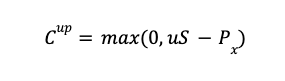
When the underlying asset moves up in price, the call option’s payoff (Cup) is the maximum of zero and the stock price (S) multiplied by the up factor (u) and reduced by the exercise price (Px).

call-options-underlying-asset-moves-up-in-price

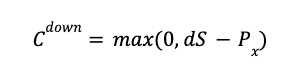
When the underlying asset moves down in price, the call option’s payoff (Cdown) is the maximum of zero and the stock price (S) multiplied by the down factor (d) and reduced by the exercise price (Px).

call-options-underlying-asset-moves-down-in-price

The binomial model calculates all possible payoffs, based on these calculations. The final outcomes are then discounted back to calculate the present value.

Put Options

Put options give the holder the right but not the obligation to sell a security at a specific price at a specific time. A put option is in the money when the stock price is below the strike price.

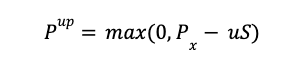
When the underlying asset moves up in price, the put option’s payoff (Pup) is the maximum between zero and the exercise price (Px) minus the stock price (S) multiplied by the up factor (u).

put-options-underlying-asset-moves-up-in-price

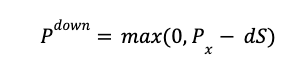
When the underlying asset moves down in price, the put option’s payoff (Pdown) is the maximum between zero and the exercise price (Px) minus the stock price (S) multiplied by the down factor (d).

put-options-underlying-asset-moves-down-in-price

Binomial Model Example

Assumptions

XYZ stock is currently trading at $100 and you wish to calculate the value of a call option with a $105 strike price that will expire in two weeks.

You expect that each week the stock may increase by 10% or decrease by 15%. The risk-free rate is currently 5% and you will be looking for cash settlement rather than delivery of shares. Additionally, XYZ is not expected to pay dividends over the two-week holding period.

You want to view how the option price will move weekly up until expiration and calculate the option value today.

Generate the Binomial Tree

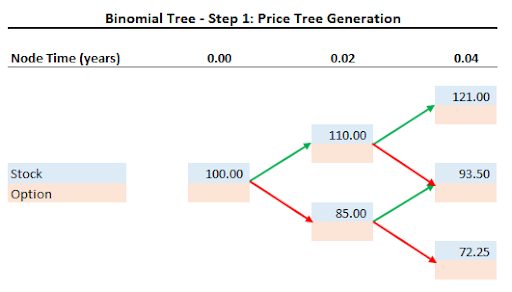
We construct the binomial tree for the prices of XYZ stock.

binomial-tree-step-1-price-tree-generation

At the end of one week (1/52 of a year or 0.02 years) the stock will be priced at either $110 or $85.

After two weeks, (0.04 years) the price will increase to $121 if the price moves up twice in a row. The stock price will be $93.50 if the price moves up then down, or down then up. Finally, if the stock moves down twice in a row the stock will drop to $72.25.

Note that we can create a binomial tree for any time period size and include many more steps at the cost of greater complexity in the calculations.

Calculate Final Option Values

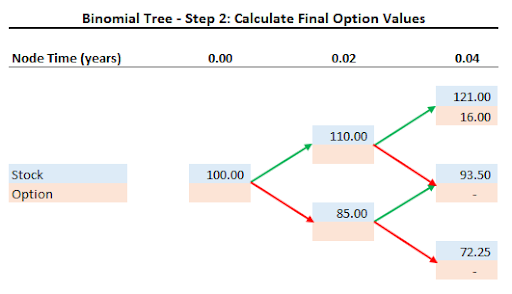
Having forecast the stock price two weeks into the future we can calculate the value of the $105 strike price call option at that time.

binomial-tree-step-2-calculate-final-option-values

The call option will only have value if the stock moves up twice in a row. At that time the shares will be worth $121 and the option will be worth $16.

Stock price – Strike price = $121 – $105 = $16

Work Backward to Calculate Present Values

Before we can perform the present value calculations we need to determine the probability that the stock price, and the call option price, will move along the upward path in the binomial tree during each week.

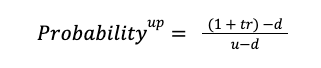
Fortunately we have all the information we need to calculate the probability based on our initial assumptions. The probability for an up move is:

probability-for-an-up-move

Where:

•   t = the time period in years (1 week = 0.02 years)

•   r = the risk-free rate (5%)

•   u = up factor ($110 / $100 = 1.1)

•   D = down factor ($85 / $100 = 0.85)

Substituting into the equation:

probability-for-an-up-move-substituting-into-the-equation

Because there are only two paths at each node the the probability of a down move is:

probability-for-an-down-move

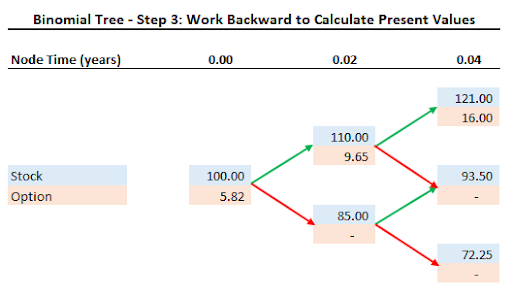
Given the probabilities and the potential option values at the end of week two, we use the present value calculation to determine the option value for the end of week one.

We repeat this process until we arrive at the value of the call option today.

binomial-tree-step-3-work-backward-to-calculate-present-values

At each step we weigh the final values by their respective probabilities and discount by the risk-free rate using the following equation:

discounted-value-equation

discounted-value-with-numbers

Finally, we arrive at the present value of the call option of $5.82.

Finally, user-friendly options trading is here.*

Trade options with SoFi Invest on an easy-to-use, intuitively designed online platform.

Pros and Cons of the Binomial Model

Pros

Cons

Simple to calculate Difficult to predict future prices and probabilities
Can be used on American options Assumes conditions that are not seen in real-world markets
Can be used over multiple periods Complexity grows as more periods are considered

Binomial Option Pricing Model vs Black-Scholes Model

The Black-Scholes model comes to a deterministic result based on the inputs. Its inputs are option variables such as the strike price, the current stock price, the time to expiration, the risk-free rate, and the volatility. While the binomial model is considered path dependent, the Black-Scholes model is path independent.

Widely used in practice and considered accurate, the Black-Scholes model makes assumptions that sometimes arrive at options prices that are different from those seen in the real world.

The Black-Scholes model is considered the standard when valuing European options since the model does not allow for options to be exercised early.

Binomial Option Pricing Model

Black-Scholes Model

Probabilistic approach Deterministic approach
Path dependent with two possible outcomes at each node Usually accurate, but output prices sometimes deviate from those seen in the real world
Helpful for American options Helpful for European options

Binomial Option Pricing Model vs Monte Carlo Model

The Monte Carlo model runs thousands of computer simulations to arrive at a solution. Monte Carlo simulation often includes an array of possible paths — some that show higher ending prices and others that show lower prices.

The computer simulations are only as good as the assumptions used. Analysts can tailor the inputs. Often, historical data is used in Monte Carlo simulations which may lead to results that aren’t applicable.

Binomial Option Pricing Model

Monte Carlo Model

An iterative approach that is path dependent Based on computer simulations
Less computer intensive You can tailor the inputs and scenarios
Uses future assumptions, not historical data Output only as good as the assumptions used

The Takeaway

The binomial option pricing model is a valuation tool that predicts the price of an asset for selected future points in time then uses an iterative approach to work backwards to determine the present value of options on that underlying asset.

Due to its relative simplicity and speed, traders often prefer it to the Black-Scholes and Monte Carlo models.

SoFi’s options trading platform offers qualified investors the flexibility to pursue income generation, manage risk, and use advanced trading strategies. Investors may buy put and call options or sell covered calls and cash-secured puts to speculate on the price movements of stocks, all through a simple, intuitive interface.

With SoFi Invest® online options trading, there are no contract fees and no commissions. Plus, SoFi offers educational support — including in-app coaching resources, real-time pricing, and other tools to help you make informed decisions, based on your tolerance for risk.

Explore SoFi’s user-friendly options trading platform.

FAQ

Who developed the binomial model?

The binomial options pricing model was first suggested by William Sharpe in 1978, but the model’s development is associated with work done by John Cox, Stephen Ross, and Mark Rubinstein in 1979.

Are the Black-Scholes and binomial option pricing models the same?

No, these are two different models. The Black-Scholes model provides a numerical result based on inputs. The binomial options pricing model prices an asset based on a range of possible results. The binomial model is considered an iterative calculation since there is a range of possible outcomes to value options. The Black Scholes model uses fixed inputs to arrive at an option’s value.

How is the binomial option pricing model different from the Monte Carlo model?

The Monte Carlo model runs thousands of computer simulations to eventually arrive at an options price. The model first generates a random number based on a probability distribution. That number then uses additional option inputs like volatility and time to expiration to generate a stock price. The stock price at expiration is then used to calculate the value of the option. The result is only as good as the inputs used.

The model runs that process thousands of times, using different variables from the probability functions. To determine option pricing, the Monte Carlo model uses the average of all the calculated results.


Photo credit: iStock/David Petrus Ibars

INVESTMENTS ARE NOT FDIC INSURED • ARE NOT BANK GUARANTEED • MAY LOSE VALUE

SoFi Invest is a trade name used by SoFi Wealth LLC and SoFi Securities LLC offering investment products and services. Robo investing and advisory services are provided by SoFi Wealth LLC, an SEC-registered investment adviser. Brokerage and self-directed investing products offered through SoFi Securities LLC, Member FINRA/SIPC.

For disclosures on SoFi Invest platforms visit SoFi.com/legal. For a full listing of the fees associated with Sofi Invest please view our fee schedule.

Options involve risks, including substantial risk of loss and the possibility an investor may lose the entire amount invested in a short period of time. Before an investor begins trading options they should familiarize themselves with the Characteristics and Risks of Standardized Options . Tax considerations with options transactions are unique, investors should consult with their tax advisor to understand the impact to their taxes.

Financial Tips & Strategies: The tips provided on this website are of a general nature and do not take into account your specific objectives, financial situation, and needs. You should always consider their appropriateness given your own circumstances.

SOIN1221525

Read more
How Does the Iron Butterfly Spread Work?

What Is an Iron Butterfly Option Strategy?


Editor's Note: Options are not suitable for all investors. Options involve risks, including substantial risk of loss and the possibility an investor may lose the entire amount invested in a short period of time. Please see the Characteristics and Risks of Standardized Options.

An iron butterfly spread is a type of options trade involving four separate options contracts. It’s a complicated and advanced options trade, meaning that many beginner investors will likely never use it — they may not have even heard of it.

Iron butterfly spreads can be used as a part of a larger options trading strategy, however, so long as investors understand the ins and outs of how it works, and most importantly, the risks involved.

What Is an Iron Butterfly?

An iron butterfly spread, sometimes called an “Iron Fly” or a “Butterfly Spread” is a trade involving four separate options contracts.

As a strategy that earns investors money when stocks or futures prices make moves within a defined range, it’s especially popular with traders who expect a decrease in implied volatility. To succeed with an iron butterfly spread, traders will try to forecast when option prices will likely decline, usually when the broader markets are in a holding pattern, or gradually moving upwards.

How Does an Iron Butterfly Trade Work?

An Iron Butterfly is a four-legged options spread, since an investor buys four options contracts, two calls and two puts. The call options allow the investor to buy a stock at a given price, and the put options allow the investor to sell a stock at a given price.

In the trade, the calls and puts have three strike prices, but the same expiration date.

In a put or call option, the strike price is the price an investor can sell the underlying security when it is exercised. With a call option, the strike price is the price at which the investor can buy the security. With a put, the strike price is the value at which they can sell the security.

The three strike prices consist of one in the middle, called the options straddle, and two other strike prices, called the strangle, positioned above and below that price. As a trade, the Iron Butterfly has the propensity to deliver profits when the option’s underlying stock hits its expiration date at the middle strike price.

Recommended: Popular Options Trading Terminology to Know

Example of an Iron Butterfly

For the strategy to work, the call and put options that sit on either side of the target stock price should be far enough apart that they can still make money regardless of the unexpected price movement of the stock between the time when the trade is executed, and the expiration of the options.

As an example, you’re an investor with a sense that a stock would reach $50 in the next month, and that it would be at least within a range of $10 above or below the target price. To make an Iron Butterfly trade, you’d buy a call and a put option with a strike price of $50. Then you’d buy a call option ten dollars higher, followed by a put option ten dollars lower than the target price, or saddle price, of $50.

The theory behind the Iron Butterfly strategy is that there’s a high likelihood that the eventual price of the stock targeted in the strategy will trade within a profitable range by the time the strike price of the options arrives.

Pros and Cons of Iron Butterfly Spreads

There is a limit to the maximum profit that an investor can earn by using the Iron Butterfly. That’s because of the cost of the options they have to buy to make money on their bet, as well as the cost of the options they purchase to protect themselves in the event that their hunch is wrong.

In the strategy, the most money the investor can make becomes possible when the underlying stock reaches the stock price at which they’ve purchased the saddle options. But even in this best-case scenario, at least half of the options expire worthless.

While this limited return may seem like a downside, it also comes with limited risk. As long as the stock rises or falls — at the time of the options’ expiration — between the target price and the strike prices of the outlying call and put options, then the trade will not lose money. But the closer it is to the target price, the more money it will make.

The biggest risk in an Iron Butterfly strategy is that the stock trades outside of the strangle, making all of the options worthless.

Recommended: What Is Your Risk Tolerance?

How to Sell out of an Iron Butterfly Spread

The investor will have at least one option that is in the money, and possibly two options that are in the money, when the options expire. They will exercise those options, and make money on the trade.

Traders realize that it’s unrealistic that any given trade will reach its expiration date exactly at the strike price, or straddle price, that they choose. But with a smart spread on the outer range of the call and put options in the trade, the strategy can deliver returns on the capital put at risk that are consistently in the 15-20% range.

What Is the Difference Between Iron Condor and Iron Butterfly?

An Iron Butterfly is similar to another option strategy known as an Iron Condor. The strategies differ in terms of their strike prices and premiums. In an Iron Condor the strike prices are different and in an Iron Butterfly they’re the same. The premiums are higher in an Iron Butterfly than an Iron Condor.


💡 Quick Tip: In order to profit from purchasing a stock, the price has to rise. But an options account offers more flexibility, and an options trader might gain if the price rises or falls. This is a high-risk strategy, and investors can lose money if the trade moves in the wrong direction.

The Takeaway

The Iron Butterfly is a trading strategy that investors use when they believe that a stock price will trade within a specific range. Rather than buying the stock itself, an Iron Butterfly involves purchasing four options based on the investor’s price prediction for a certain security.

Again, trading options is an advanced investment strategy that requires a good amount of background knowledge and market experience. It may not be a good idea for beginning investors to wade into options, or advanced moves like the Iron Butterfly. However, speaking with a financial professional may help get you prepared for trading options.

SoFi’s options trading platform offers qualified investors the flexibility to pursue income generation, manage risk, and use advanced trading strategies. Investors may buy put and call options or sell covered calls and cash-secured puts to speculate on the price movements of stocks, all through a simple, intuitive interface.

With SoFi Invest® online options trading, there are no contract fees and no commissions. Plus, SoFi offers educational support — including in-app coaching resources, real-time pricing, and other tools to help you make informed decisions, based on your tolerance for risk.

Explore SoFi’s user-friendly options trading platform.


Photo credit: iStock/ponla1975

INVESTMENTS ARE NOT FDIC INSURED • ARE NOT BANK GUARANTEED • MAY LOSE VALUE

SoFi Invest is a trade name used by SoFi Wealth LLC and SoFi Securities LLC offering investment products and services. Robo investing and advisory services are provided by SoFi Wealth LLC, an SEC-registered investment adviser. Brokerage and self-directed investing products offered through SoFi Securities LLC, Member FINRA/SIPC.

For disclosures on SoFi Invest platforms visit SoFi.com/legal. For a full listing of the fees associated with Sofi Invest please view our fee schedule.

Financial Tips & Strategies: The tips provided on this website are of a general nature and do not take into account your specific objectives, financial situation, and needs. You should always consider their appropriateness given your own circumstances.

Options involve risks, including substantial risk of loss and the possibility an investor may lose the entire amount invested in a short period of time. Before an investor begins trading options they should familiarize themselves with the Characteristics and Risks of Standardized Options . Tax considerations with options transactions are unique, investors should consult with their tax advisor to understand the impact to their taxes.


¹Probability of Member receiving $1,000 is a probability of 0.026%; If you don’t make a selection in 45 days, you’ll no longer qualify for the promo. Customer must fund their account with a minimum of $50.00 to qualify. Probability percentage is subject to decrease. See full terms and conditions.

SOIN0723046

Read more
What is a Death Cross Pattern in Stocks? How Do They Form?

What Is a Death Cross Pattern in Stocks? How Do They Form?

A death cross is the X-shape created when a stock’s or index’s short-term moving average descends below the long-term moving average, possibly signaling a sell-off. The death cross typically shows up on a technical chart when the 50-day simple moving average (SMA) of a stock or index peaks, drops, and then crosses below the 200-day moving average.

Because the 50-day SMA is more of a short-term indicator, it’s considered to be a more accurate indicator of potential volatility ahead than the 200-day SMA, which has averaged in 200 days worth of prices. That said, both the 50-day moving average and the 200-day are, by definition, lagging indicators. Meaning: They only capture what has already happened. Still, some death crosses have appeared to forecast major recessions — although they can also send false signals.

What Is a Death Cross, Exactly?

A death cross is based on a technical analysis of a security’s price. The short-term average dropping below the long-term average to create an X-shape is the “cross”; the “death” part of the name refers to the ominous signal that such a crossing may send for individual securities or overall markets.

A death cross tends to form over the course of three separate phases. In the first phase, the rising value of a security reaches its peak as the momentum dies down, and sellers begin to outnumber buyers. That brings on the second phase, in which the price of the security begins to decline to the point where the actual death cross occurs.

That’s typically marked as being when the security’s 50-day moving average dips under the 200-day moving average.
That crossing alerts the broader market to a potential bearish, long-term trend, which brings about the third and final phase of the death cross. In this phase, the stock may continue to lose value over a longer period.

If the dip following the cross is short-lived, and the stock’s short-term moving average moves back up over its long-term moving average, then the death cross is usually considered to be a false signal.


💡 Quick Tip: Are self-directed brokerage accounts cost efficient? They can be, because they offer the convenience of being able to buy stocks online without using a traditional full-service broker (and the typical broker fees).

What Does the Death Cross Tell Investors?

The death cross has helped predict some of some of the worst bear markets of the past 100 years: e.g., in 1929, 1938, 1974, and 2008. Nonetheless, because it’s a lagging indicator, meaning that it only reveals a stock’s past performance, it’s not 100% reliable.

Another criticism of the death cross is that the pattern sometimes won’t show up until a security’s price has fallen well below its peak. In order to alter a death cross calculation to see the downtrend a little sooner, some investors say that a death cross occurs when the security’s trading price (not its short-term moving average), falls under its 200-day moving average.

For experienced traders, investors, and analysts, a death cross pattern for a stock is most meaningful when combined with, and confirmed by, other technical indicators.

When interpreting the seriousness of a death cross, experienced investors will often look at a stock’s trading volume. Higher trading volumes during a death cross tend to reveal that more investors are selling into the death cross, and thus buying into the downward trend of the stock.

Investors will also look to technical momentum indicators to see how seriously to take a death cross. One of the most popular of these is the moving average convergence divergence (MACD), which is based on the moving averages of 15, 20, 30, 50, 100, and 200 days, and is designed to give investors a clearer idea of where a stock is trading than one that’s updated second by second.

Death Cross vs Golden Cross: Main Differences

The opposite of a death cross is known as a golden cross. The golden cross indicator is when the 50-day moving average of a particular security moves higher than its 200-day moving average.

While the golden cross is broadly considered a signal of a bull market, it has some of the same characteristics as the death cross in that it’s essentially a lagging indicator. Experienced investors use the golden cross in conjunction with other technical indicators such as trading volume and MACD.

Is a Death Cross a Reliable Indicator?

Historically, the death cross indicator has an impressive track record as a barometer of the broader stock market, especially when it comes to severe downturns, as noted above.

The Dow Jones Industrial Average (DJIA) went through a death cross shortly before the crash of 1929. More recently, the S&P 500 Index underwent a death cross in May of 2008 – four months before the 2008 crash. In both instances, investors who stayed in the market faced extreme losses. But the Dow also experienced a death cross in March of 2020. And the markets quickly rebounded, and rose to new heights.

The fact is that broad-market death crosses happen frequently. Prior to 2020, the Dow has gone through five death crosses since 2010, and 46 death crosses since 1950. Yet the index has only entered a bear market 11 times since the 1950s. A death cross doesn’t necessarily bring significant losses, either.

Even more noteworthy is that the Dow continued falling after a death cross only 52% of the time since 1950. And when it did keep falling, its median decline after a month was only 0.9%.

For short-term traders, the death cross has less value than it does for investors with longer-term outlooks. As an indicator, the death cross – especially one that’s market-wide – can be especially valuable for long-term investors who hope to lock in their gains before a bear market begins.

How to Trade a Death Cross

The death cross is a significant indicator for some investors. But it’s important to remember that it only shows past trends. As an investor, it’s equally important to use the death cross in conjunction with other indicators such as the MACD and trading volume, as well as other news and information related to the security you’re investing in.


💡 Quick Tip: Look for an online brokerage with low trading commissions as well as no account minimum. Higher fees can cut into investment returns over time.

The Takeaway

Although the ominous-sounding death cross stock pattern is valued by some analysts and investors as a way to foretell a downturn in a certain security or even the broader market, it’s really not that reliable. The main elements of the death cross — a stock’s short-term moving average and long-term moving average — are lagging indicators that may or may not predict a bearish turn of events.

The typical investor may not use or even look for death crosses as a part of their strategy. But knowing, on a basic level, what the term refers to, and why it may be important to the markets, is a good idea.

Invest in what matters most to you with SoFi Active Invest. In a self-directed account provided by SoFi Securities, you can trade stocks, exchange-traded funds (ETFs), mutual funds, alternative funds, options, and more — all while paying $0 commission on every trade. Other fees may apply. Whether you want to trade after-hours or manage your portfolio using real-time stock insights and analyst ratings, you can invest your way in SoFi's easy-to-use mobile app.


Opening and funding an Active Invest account gives you the opportunity to get up to $1,000 in the stock of your choice.¹

Photo credit: iStock/goir


INVESTMENTS ARE NOT FDIC INSURED • ARE NOT BANK GUARANTEED • MAY LOSE VALUE

SoFi Invest is a trade name used by SoFi Wealth LLC and SoFi Securities LLC offering investment products and services. Robo investing and advisory services are provided by SoFi Wealth LLC, an SEC-registered investment adviser. Brokerage and self-directed investing products offered through SoFi Securities LLC, Member FINRA/SIPC.

For disclosures on SoFi Invest platforms visit SoFi.com/legal. For a full listing of the fees associated with Sofi Invest please view our fee schedule.

Financial Tips & Strategies: The tips provided on this website are of a general nature and do not take into account your specific objectives, financial situation, and needs. You should always consider their appropriateness given your own circumstances.


¹Probability of Member receiving $1,000 is a probability of 0.026%; If you don’t make a selection in 45 days, you’ll no longer qualify for the promo. Customer must fund their account with a minimum of $50.00 to qualify. Probability percentage is subject to decrease. See full terms and conditions.

SOIN0723070

Read more
student on laptop

What Is Expected Family Contribution (EFC)?

Expected Family Contribution (EFC), which will soon be replaced by the Student Aid Index (SAI), is a measure of how much a student and their family can be expected to contribute to the cost of college for an upcoming academic year. Your EFC/SAI is an important number because it impacts how much need-based financial aid you qualify for.

EFC meaning is sometimes mistaken as the dollar amount that a student and their family will pay for college. However, the amount families end up paying could be significantly more or less than the EFC, depending on the cost of attendance and scholarships.

As a result of this confusion, the EFC will be replaced by the Student Aid Index (SAI) starting in the 2024-2025 academic year. While the name change is essentially just a rebranding, there will be some changes in how a family’s expected contribution will be calculated. The change is part of the new, simplified Free Application for Federal Student Aid (FAFSA) that will be available to students in December 2023.

Here’s what you need to know about EFC/SAI and how it affects your potential aid.

Expect Family Contribution vs Student Aid Index

The Expected Family Contribution and Student Aid Index are essentially the same thing — an estimate of how much money a family can contribute out of pocket toward a student’s college education based on information provided on the FAFSA.

However, it’s only an estimate. As college tuition has gone up over the years, many students will pay significantly more than the EFC/SAI amount that the FAFSA form generates. The change from Expected Family Contribution to Student Aid Index reflects that the amount is simply a guideline, not a determination of what an applicant will pay. The switch to SAI also comes with some differences in how a family’s EFC is calculated (more on that below).

Like EFC, SAI is a vital metric used to determine how much — if any — federal financial aid students will receive to help them pay for college. However, it’s not the only factor. Eligibility for federal aid also takes into account a student’s year in school, enrollment status, and the cost of attendance at the school the student will be attending.


💡 Quick Tip: Some lenders help you pay down your student loans sooner with reward points you earn along the way.

How Colleges Used the Information

Once you complete the FAFSA, college financial aid staff will use all the information provided to determine your financial need.

Here’s the process:

1. The college financial aid staffers decide your cost of attendance (which includes tuition, fees, room and board, and books) at that school.

2. They then consider your EFC/SAI.

3. Next, they subtract your EFC/SAI from your cost of attendance to determine how much need-based aid you can get.

For example, let’s say a school’s total cost of attendance is $30,000 and your EFC/SAI is $8,000. You could qualify for up to $22,000 of need-based aid through programs like federal Pell Grants, direct subsidized loans, and the work-study program.

That doesn’t necessarily mean you will get that much aid, however. Colleges aren’t required to meet 100% of a student’s demonstrated financial need (the total cost of attendance minus your EFC/SAI). The amount you receive will depend on funding availability at your school, and how much has already been given out to other students.

Generally, the lower the SAI/EFC value, the higher the financial need, and the greater the eligibility for federal financial aid programs, such as Pell Grants, Direct Subsidized Loans, federal work-study programs.

Your offer of financial aid may change from year to year.

How Your EFC/SAI Is Calculated

EFC/SAI methodology utilizes financial information from the FAFSA (such as taxed and untaxed income, investments, assets, benefits, and household size) to quantify an applicant’s financial need. With the change to a simplified FAFSA, however, students and families will not only see a different measure of their ability to pay (SAI vs EFC), but will also experience a change in the methodology used to determine aid.

One key change is that, unlike the EFC, the SAI will not factor in the number of family members currently enrolled in college (which benefited families with multiple children in college). Three other changes that will happen with the switch from EFC to SAI:

•  Unlike the EFC, SAI can be a negative number (as low as -$1,500). This enables financial aid officers to better differentiate levels of need.

•  SAI will increase the Income Protection Allowance (IPA), which shelters a certain amount of parent income from being included in the calculation of total income.

•  The SAI calculation will eliminate the EFC allowance for state and local taxes.

After you complete the FAFSA, your EFC/SAI will be listed in the top right corner of your Student Aid Report, which outlines financial aid eligibility.

Calculating EFC/SAI With the CSS Profile

Around 200 colleges require students to provide supplemental financial information through the College Scholarship Service (CSS) Profile. The 2025-2026 list of participating institutions is available online .

Colleges may customize their questions on the CSS Profile to capture more information to evaluate a student’s financial need. For instance, the CSS Profile may ask about home value and financial information from both households if a student’s parents are separated. The CSS Profile may also consider the regional cost of living and personal circumstances in its calculation of financial need.

These colleges use the CSS Profile to calculate a different EFC/SAI for awarding their own financial aid funds. Typically, they will use their own institutional EFC/SAI methodology when determining a financial aid award.

While filling out the CSS Profile is extra work, it can give you access to private student aid from many universities and scholarship programs. However, the CSS is not used to determine federal financial aid.

Federal Need-Based Aid Available for Qualifying Students

Depending on your EFC/SAI and other eligibility criteria, a financial aid package could include the following need-based federal student aid programs.

•  Federal Pell Grant: Student eligibility for a Pell Grant is determined by financial need and the funding amount can fluctuate each year. For the 2023-2024 academic year, the maximum award is $7,395. The amount an individual student may receive depends on a number of factors.

•  Federal Supplemental Educational Opportunity Grant (FSEOG): Participating schools receive a set amount of federal funding that is distributed to students based on financial need each year. Eligible students can receive between $100 and $4,000 a year based on funding availability and their overall financial aid package.

•  Direct Subsidized Loans: Undergraduate students with financial need may qualify for subsidized loans — a type of federal student loan that does not accrue interest payments while you are in school at least half-time. Students also receive a six-month grace period on interest payments after graduation and may qualify for a deferment based on income, health, continuing education, military service, and other factors.

•  Federal Work-Study: This program provides part-time employment for undergraduate and graduate students with financial needs at participating schools. The total work-study award depends on the level of need, the timing of application, and a school’s available funding.

💡 Quick Tip: Federal student loans carry an origination or processing fee (1.057% for Direct Subsididized and Unsubsidized loans first disbursed from Oct. 1, 2020, through Oct. 1, 2024). The fee is subtracted from your loan amount, which is why the amount disbursed is less than the amount you borrowed. That said, some private student loan lenders don’t charge an origination fee.

Fill Out the FAFSA Early?

Even if you qualify for a specific amount of need-based aid, you may not receive all of it. That’s because the amount a student receives depends on the available funding at their school.

Colleges are not required to meet 100% of a student’s financial need, and some programs like the Pell Grant have limited funds that are divided up among schools each year.

It can be a smart idea to fill out the FAFSA as soon as possible to ensure they are among the first in line to receive available aid.

Typically, the FAFSA is available as of October 1 for the following academic year. However, the simplified FAFSA will not be available to students until December 2024 for the 2025-26 academic year. You have until June 30, 2025 to fill it out, but earlier may be better than later. Stay tuned for more updates on the new FAFSA deadline.

Bridging the Financial Gaps

Once you get your EFC/SAI and financial aid package (which may include scholarships, grants, work-study, and federal loans), you may find there are still some gaps in funding. If you’ve already exhausted federal loan options, you might consider looking into the possibility of getting a private student loan.

Unlike federal student loans, private loans require a credit check. Students who have strong financials (or who have cosigners who do) generally qualify for the best rates and terms. Just keep in mind that private loans don’t come with government protection programs, like forgiveness or forbearance, offered by federal student loans.

If you’ve exhausted all federal student aid options, no-fee private student loans from SoFi can help you pay for school. The online application process is easy, and you can see rates and terms in just minutes. Repayment plans are flexible, so you can find an option that works for your financial plan and budget.


Cover up to 100% of school-certified costs including tuition, books, supplies, room and board, and transportation with a private student loan from SoFi.


SoFi Loan Products
SoFi loans are originated by SoFi Bank, N.A., NMLS #696891 (Member FDIC). For additional product-specific legal and licensing information, see SoFi.com/legal. Equal Housing Lender.


SoFi Private Student Loans
Please borrow responsibly. SoFi Private Student loans are not a substitute for federal loans, grants, and work-study programs. We encourage you to evaluate all your federal student aid options before you consider any private loans, including ours. Read our FAQs.

Terms and conditions apply. SOFI RESERVES THE RIGHT TO MODIFY OR DISCONTINUE PRODUCTS AND BENEFITS AT ANY TIME WITHOUT NOTICE. SoFi Private Student loans are subject to program terms and restrictions, such as completion of a loan application and self-certification form, verification of application information, the student's at least half-time enrollment in a degree program at a SoFi-participating school, and, if applicable, a co-signer. In addition, borrowers must be U.S. citizens or other eligible status, be residing in the U.S., Puerto Rico, U.S. Virgin Islands, or American Samoa, and must meet SoFi’s underwriting requirements, including verification of sufficient income to support your ability to repay. Minimum loan amount is $1,000. See SoFi.com/eligibility for more information. Lowest rates reserved for the most creditworthy borrowers. SoFi reserves the right to modify eligibility criteria at any time. This information is subject to change. This information is current as of 4/22/2025 and is subject to change. SoFi Private Student loans are originated by SoFi Bank, N.A. Member FDIC. NMLS #696891 (www.nmlsconsumeraccess.org).

Financial Tips & Strategies: The tips provided on this website are of a general nature and do not take into account your specific objectives, financial situation, and needs. You should always consider their appropriateness given your own circumstances.

External Websites: The information and analysis provided through hyperlinks to third-party websites, while believed to be accurate, cannot be guaranteed by SoFi. Links are provided for informational purposes and should not be viewed as an endorsement.

SOIS0723017

Read more
TLS 1.2 Encrypted
Equal Housing Lender