What Does a Credit Score of 800 Mean?

What Does a Credit Score of 800 Mean?

On a credit scoring scale of 300 to 850, a credit score of 800 is considered exceptional. Having an 800 credit score has the potential to open up many doors for you financially, including competitive interest rates on loans, higher chances of approval and at better loan terms, and even access to premium credit cards.

As such, when you have a credit score of 800, it’s worth taking steps to ensure you maintain it — or if you’re ambitious, even improve it. That way, you can continue unlocking the benefits that a high credit score can offer.

What It Means to Have an 800 Credit Score

Your credit score is a three-digit number that’s an indicator of your creditworthiness. The higher the number, the more likely you appear to lenders as a responsible borrower who will pay back what’s owed on time.

Credit scoring models count an 800 credit score as being excellent. For instance, a 800 FICO credit score is considered “exceptional,” and VantageScore considers it in their “superprime” range.

These scoring models use your credit history to calculate your score — having such a high score means that you most likely haven’t missed any payments and have maintained a low credit utilization. It could also mean you’ve had a relatively long credit history and held a variety of types of credit and loan accounts — in other words, you’re well past the point of a starting credit score.

To stay at this point on the credit rating scale, you’ll need to keep exhibiting the responsible financial behaviors you’ve already displayed. Further improving it could be a matter of continuing these behaviors over a longer period of time. Or, you might look into your score to see if there’s any one area you can tweak to further improve your credit behavior.

Recommended: When Are Credit Card Payments Due?

Is 800 a Perfect Credit Score?

No, 800 is not a perfect credit score. Both FICO and VantageScore scoring models have a maximum credit score of 850. That being said, an 800 credit score can be considered near-perfect.

Benefits of an 800 Credit Score

Having an excellent credit score comes with a few perks, such as increased odds of getting approved for lower interest rates and higher credit card limits, as well as offers for better loan terms.

Better Credit Offers

Lenders are more likely to approve consumers with excellent credit, and with more favorable terms, compared to someone with a minimum credit score for a credit card. If you have a high credit score, you’re a good candidate for better credit offers, such as personal loans with higher loan amounts and a wider selection of credit cards.

You also may be able to qualify for premium rewards credit cards. These cards tend to offer more benefits like airport lounge access, better earnings opportunities, and more.

Recommended: How to Avoid Interest On a Credit Card

Lower Interest Rates

Lenders generally are willing to lend to those with a credit score of 800 at lower interest rates than other applicants. That’s because people with a credit score in this range generally pose less risk to the lender. With a credit score of 800, you’ve already proven that you can handle loans responsibly.

Getting approved for lower interest rates helps you to save significant amounts of money over your lifetime. For instance, if your 800 credit score gets you a mortgage interest rate that’s 1% to 2% lower than someone with a fair credit score, that alone can save you tens of thousands of dollars over the life of your home loan.

Recommended: Tips for Using a Credit Card Responsibly

Higher Credit Limits

Not only will you be more likely to get approved for a credit card with an 800 credit score, but credit card issuers may offer you access to higher credit limits. Having increased spending power is great for when you need to make bigger purchases. It’s also helpful for keeping a low credit utilization, which in turn can help you maintain or even boost your credit score.

Since you’re also more likely to be eligible for rewards credit cards, each purchase can help you earn more in points or cash back — meaning, you can use your credit card to maximize your purchases. That deal becomes even better if you can pay off the entire balance each month so you’re not paying any interest.

Recommended: Does Applying For a Credit Card Hurt Your Credit Score?

Monitoring and Managing Your Credit Score

Even if you have an excellent credit score now, it doesn’t mean it will stay that way forever. It’s important to regularly monitor your credit score so you know exactly where you stand.

There are free ways to check your credit score. Some credit cards will show you your score on your credit statements, and some banks offer this feature as well. If your score changes in any way, you can then figure out the types of financial behaviors that may have contributed to the change. Also don’t be surprised if you have different credit scores depending on where you look — this is because credit scoring models can vary in how they calculate scores.

Checking your credit report will also help you monitor and manage your credit score. That’s because the activity on your credit report affects how your credit score is calculated. You can check your credit report for free once a year through all three major credit bureaus: Experian, Equifax, and TransUnion.

By checking your credit report, you’ll be able to see if there is any information on there that may affect your score. If you spot any errors, it’s best to dispute them right away, especially if they’ll have a negative effect.

Factors That Can Damage Your 800 Credit Score

You’ve worked hard to build your credit score. To maintain it, you’ll want to avoid the following behaviors that could damage your 800 credit score. While it’s a long drop to a bad credit score from exceptional, it’s not a given that your good credit will last.

High Utilization Rate

Your credit utilization is the percentage of your available revolving credit that you’re using. The higher the percentage, the more it seems to lenders that you’re relying on too much credit, which could negatively impact your score.

To help maintain your credit score, try to keep your credit utilization to 30% or under. You can do that by paying down your balances, even making extra payments if you can. That way, your balance will be as low as possible before the credit card issuer reports it to the credit bureaus.

Late and Missed Payments

Your payment history is one of the biggest factors that affects your credit score. A late or missed payment could have a major effect on your credit score — even if you’ve paid consistently on-time beforehand.

If you’ve been a responsible borrower, you may be able to contact your creditor and ask to have the late payment removed from your credit report. That way, it won’t impact your score.

Credit Applications and New Credit Accounts

Each time you submit an application for a new loan or credit card, lenders will conduct a hard credit inquiry, which may temporarily affect your credit score. While one hard inquiry may not have major consequences, applying for multiple loan products at once could signal to lenders you’re stretched thin financially. Your score could take a dive, since it looks like you need to rely on credit.

To maintain your credit score, apply for new accounts sparingly. Or, if you’re shopping around for large loans like mortgages, applying for a few within a short span of time will typically show up as one hard inquiry on your credit report. This may prevent your applications from impacting your score as much.

Public Records Appearance

Public records such as bankruptcy can appear on your credit report. These negative remarks can damage your credit score. In some cases, you may have to explain to lenders in more detail about these public records.

Recommended: What is the Average Credit Card Limit?

The Takeaway

Having a 800 credit score means you have excellent credit. As such, lenders are more likely to offer you better rates and terms. Other benefits include saving money on interest and higher credit limits. Even with a high score, it’s still important to continually monitor your credit behavior to ensure you can maintain it.

Looking for a credit card that earns rewards? Consider the SoFi Credit Card, which offers cash-back rewards on qualifying purchases. You’ll also get access to other perks, such as the ability to lower your APR through on-time payments and cell phone protection.

Enjoy unlimited cash back rewards with fewer restrictions.

FAQ

How long does it take to reach a credit score of 800?

How long it takes you to get an 800 credit score will depend on several factors, including your current credit score and how long your credit history is. You may be able to reach it faster if you exhibit responsible behavior, such as consistent on-time payments and the maintenance of a low credit utilization ratio.

What percentage of the population has a credit score of 800 and above?

According to the credit bureau Experian, 21% of consumers have a FICO score of 800 and higher, or in the “exceptional” range.

Why is it difficult to reach a credit score of 800?

It’s difficult to reach an 800 credit score because you’ll typically need a long credit history and to show responsible credit behavior consistently over a period of time.

What credit limit is possible with an 800 credit score?

The credit limit you’ll qualify for will ultimately depend on the credit card issuer. However, with an 800 credit score, you’ll generally get higher limits compared to someone with a lower score.


Photo credit: iStock/milan2099


1See Rewards Details at SoFi.com/card/rewards.

Financial Tips & Strategies: The tips provided on this website are of a general nature and do not take into account your specific objectives, financial situation, and needs. You should always consider their appropriateness given your own circumstances.

SoFi Credit Cards are issued by SoFi Bank, N.A. pursuant to license by Mastercard® International Incorporated and can be used everywhere Mastercard is accepted. Mastercard is a registered trademark, and the circles design is a trademark of Mastercard International Incorporated.

Disclaimer: Many factors affect your credit scores and the interest rates you may receive. SoFi is not a Credit Repair Organization as defined under federal or state law, including the Credit Repair Organizations Act. SoFi does not provide “credit repair” services or advice or assistance regarding “rebuilding” or “improving” your credit record, credit history, or credit rating. For details, see the FTC’s website .

Third-Party Brand Mentions: No brands, products, or companies mentioned are affiliated with SoFi, nor do they endorse or sponsor this article. Third-party trademarks referenced herein are property of their respective owners.

SOCC0223006

Read more
Homeownership and the Race Gap

Examining the Race Gap in Homeownership

Despite the Fair Housing Act of 1968 and other federal laws, a large race gap in homeownership continues to exist across the United States. The Black homeownership rate in the fourth quarter of 2022 stood at 44.9%, compared with 74.5% for non-Hispanic whites, according to the U.S. Census Bureau.

The Black-white race gap in homeownership rates widened as the Federal Reserve attempted to bring inflation under control — going from 29.3 percentage points in the first quarter of 2022 to 29.6 percentage points in Q4. Average mortgage interest rates generally increased in 2022 after the Fed implemented a series of rate hikes.

These racial disparities are not new. Historical records confirm a large race gap in homeownership rates has existed since the abolition of slavery. Below we further examine the race gap in homeownership and identify possible solutions.

History of Racial Housing Disparities

The United States has a long history of systemic racism that presents itself in a number of ways, including housing disparities. In January 2022, the National Community Reinvestment Coalition released its home mortgage report examining racial disparities in homeownership from 1900 to 2020.

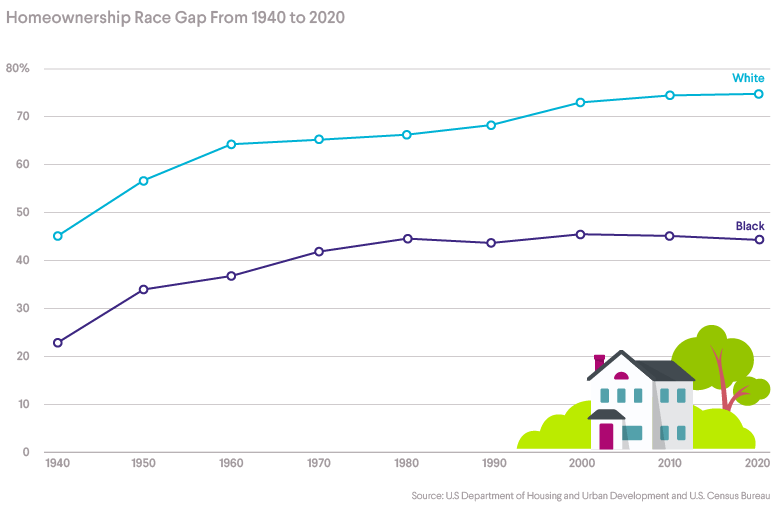
The NCRC found the gap in homeownership rates between Black and white families reached its lowest level of 23 percentage points in 1980 and its highest level of 30 percentage points in 2015.

In the fourth quarter of 2021, the Black-white race gap in homeownership rates exceeded 31 percentage points. This gap narrowed to 29.6 percentage points in the fourth quarter of 2022, according to data released by the U.S. Census Bureau.

The homeownership rate as of Q4 2022 stood at 74.5% for non-Hispanic white households; 61.9% for Asian, Native Hawaiian, and Pacific Islander families; 48.5% for Hispanic families of any race; and 44.9% among Black households, according to the Census data.

A number of factors have contributed to the race gap in homeownership, including the legacy of race-based discrimination in the housing market.

First-time homebuyers can
prequalify for a SoFi mortgage loan,
with as little as 3% down.


Lasting Effects of Redlining

Redlining, the discriminatory practice of denying home loans and other credit services to ethnically diverse neighborhoods based on the race, color, or national origin of the residents of those neighborhoods, is one of the factors explaining America’s long-standing race gap in homeownership.

The federal government institutionalized redlining in the 1930s when a now-defunct federal agency, the Home Owners’ Loan Corp., created “residential security maps” in dozens of cities across the country to systematically deny mortgages in neighborhoods of color.

HOLC ceased to exist in 1951, and Congress later outlawed redlining with the Fair Housing Act of 1968, but lending discrimination in the housing market has persisted.

An article published in the journal SSM-Population Health in June 2021 found that “redlining has continued to influence racialized perceptions of neighborhood value and practices that have perpetuated racial inequities in lending.”

“Decades of racism in the housing market,” the article adds, “have prevented people of color, particularly Black Americans, equal access to capital, low-cost loans, and homeownership.”

The Department of Justice continues to enforce the Fair Housing Act to address ongoing allegations of modern-day redlining.

Current Black Homeownership Gap

As mentioned, the current race gap in homeownership rates between Black and white families is 29.6 percentage points as of Q4 2022. The vast majority of white families own residential property, while the majority of Black families do not, data shows.

Homeownership is often regarded as the American dream, but not everyone who wants to buy a house is able to get financing. The overall denial rate for home-purchase loans among all applicants in 2021 stood at 8.3%, according to the Consumer Financial Protection Bureau.

Bureau data shows that 15.3% of Black applicants had their mortgage loan requests denied in 2021, compared with 6.3% of non-Hispanic white applicants.

This first-time homebuyer guide recommends downloading your credit reports before submitting any applications for home loans. Creditworthy applicants who have home loan applications denied may be victims of discrimination. You can get free credit reports at AnnualCreditReport.com and can check your credit scores in several ways.

Homeownership by Race

The below table highlights homeownership data by race as of Q4 2022

Race Homeownership rate
Non-Hispanic white alone 74.5%
Asian, Native Hawaiian, and Pacific Islander 61.9%
Hispanic (of any race) 48.5%
Black alone 44.9%
Other (including mixed races) 58.7%
All (nationwide population) 65.9%

Homeownership Race Gap 1940-2020

Fixing the Black Homeownership Gap

The Urban Institute, a nonprofit research organization, has a five-point framework aimed at reducing the Black homeownership gap. Here are the five points:

1. Advance Local Policy Solutions

Local policy reforms, including the removal of any discriminatory terms in homeowner and condominium associations and possible property tax relief for low-income and moderate-income taxpayers, can help reduce the Black homeownership gap.

Expanding small-dollar mortgages could also make a difference.

2. Tackle Housing Supply Constraints and Affordability

Promoting affordable housing nationwide, including new investments in historically segregated and devalued neighborhoods, may help reduce the Black homeownership gap.

Public policy leaders could also review the viability of lease-to-own programs as a pathway to homeownership.

3. Promote an Equitable and Accessible Housing Finance System

Greater access to down payment assistance programs for economically disadvantaged consumers may reduce the Black homeownership gap.

This online mortgage calculator shows how home loan seekers can lower their monthly mortgage payments and total interest charges by making a larger down payment on a home.

Recommended: Do You Still Need to Put a 20% Down Payment On a House?

4. Accelerate Outreach for Mortgage-Ready Millennials

Reaching out to mortgage-ready millennials and improving tax credit incentives for renters to become homeowners may help reduce the Black homeownership gap.

Public-private partnerships can scale up additional programs aimed at bolstering homeownership among low-income people.

5. Focus on Sustainable Homeownership and Preservation

Funded programs that prevent foreclosures in the United States may particularly help Black homeowners maintain their wealth.

Providing homeowners of color with financial literacy may also help preserve homeownership among Black families.

The Takeaway

Racial housing disparities persist, despite federal laws designed to equal the playing field. The effects of redlining echo today, when 74.5% of white families own residential property and just 44.9% of Black families do. Solving this social inequity may require significant action and reform. See how employers can help first-time homebuyers.

If you’re looking for a mortgage lender, SoFi can help you achieve the American dream. Qualified first-time homebuyers can put as little as 3% down.

Explore SoFi fixed-rate mortgage options and view your rate in minutes.


Photo credit: iStock/Morsa Images

SoFi Loan Products
SoFi loans are originated by SoFi Bank, N.A., NMLS #696891 (Member FDIC). For additional product-specific legal and licensing information, see SoFi.com/legal. Equal Housing Lender.


SoFi Mortgages
Terms, conditions, and state restrictions apply. Not all products are available in all states. See SoFi.com/eligibility-criteria for more information.


Financial Tips & Strategies: The tips provided on this website are of a general nature and do not take into account your specific objectives, financial situation, and needs. You should always consider their appropriateness given your own circumstances.

Third-Party Brand Mentions: No brands, products, or companies mentioned are affiliated with SoFi, nor do they endorse or sponsor this article. Third-party trademarks referenced herein are property of their respective owners.

Disclaimer: Many factors affect your credit scores and the interest rates you may receive. SoFi is not a Credit Repair Organization as defined under federal or state law, including the Credit Repair Organizations Act. SoFi does not provide “credit repair” services or advice or assistance regarding “rebuilding” or “improving” your credit record, credit history, or credit rating. For details, see the FTC’s website .

SOHL0222027

Read more

5 Myths About Student Loans That Can Cost You Money

Don’t believe everything you hear about student loans. With tuition costs outpacing income, the fact is that 70% of college graduates need student loans to help pay for college. But bad information can make borrowers feel like they might have made the wrong decision.

Relax. Here are 5 myths about student loans that are pure fiction.

5 Myths About Student Loans

Have you been taken in by any of these student loan fictions and fallacies? A lot of students and parents are, which is why they’re still floating around.

Myth #1: Interest Rates Are Super High

It’s true that federal student loan interest rates can be higher than auto loan rates. But that doesn’t make student loans a bad deal. Here’s why.

Auto loans and mortgages are “secured” loans. The borrower’s car or home serves as collateral and can be repossessed by the bank if they default on the loan. Secured loans have lower interest rates because they’re less risky for the lender.

Student loans, meanwhile, are “unsecured.” If a borrower defaults on student loans, the bank doesn’t have anything to repossess. And so the interest rate is set a bit higher. But the interest rates on federal student loans are still much lower than what you’d qualify for at a bank.

Myth #2: Saving Money Is Impossible With Student Loans

For most people, student loan payments aren’t sky high. The key is choosing the right repayment plan. Take income-based repayment plans, which set monthly payments at just 10% of “disposable income” — or what’s left after your other bills are paid.

Let’s run some numbers. The average new graduate from a 4-year public college has $32K in student loan debt. And the average salary for 20- to 24-year-olds is $37K.

With income-based repayment, a single grad might pay about $138 per month. If they start a family, they pay much less: just $20 a month until their income grows. Which still leaves room for saving.

See how different terms and rates affect your monthly payment with our student loan refinance calculator.

Myth #3: Student Loans Kill Your Credit

Like any loan, student loans could help or hurt your credit depending on how you manage them. As long as you make your payments on time, student loans may build your credit history and boost your score over the long run.

If you’re struggling financially, consider switching your payment plan, or applying for student loan deferment or forbearance. Neither of these options will hurt your credit.

Myth #4: Student Loans Are All the Same

Nope. In fact, federal student loans are typically a better deal for borrowers than private loans. With subsidized loans, the government pays your interest while you’re in school and for 6 months after. And all federal loans offer special protections to borrowers in case of financial hardship.

In short, subsidized federal loans are pretty much the gold standard.

Myth #5: You Can Get Student Loans Forgiven, for a Fee

It sure seems plausible that a law firm or financial advisor might be able to cut through the red tape and reduce your payments or get them forgiven entirely. For a fee, of course.

Alas, this is a scam. If anyone reaches out to you by phone, text, email, or social media promising to help you with your student loans, it’s utter bull. You may catch on when the caller asks for your financial info, but your parent or grandparent may not, so you might want to warn them.

To make sure you hear about the latest student loan forgiveness news straight from the source, sign up for alerts from the DOE .

ReFi With SoFi

SoFi refinances student loans — both federal and private. (Just be aware that refinancing federal loans makes them ineligible for federal forgiveness and protections.) You can choose to lower your monthly payment by extending your term or pay off your debt faster and save money on interest. SoFi offers flexible terms and low fixed or variable interest rates. And there are no fees: no origination fees or late fees.

With SoFi, refinancing is fast, easy, and all online. We offer competitive fixed and variable rates.


Photo credit: iStock/Khosrork
SoFi Student Loan Refinance
Terms and conditions apply. SoFi Refinance Student Loans are private loans. When you refinance federal loans with a SoFi loan, YOU FORFEIT YOUR ELIGIBILITY FOR ALL FEDERAL LOAN BENEFITS, including all flexible federal repayment and forgiveness options that are or may become available to federal student loan borrowers including, but not limited to: Public Service Loan Forgiveness (PSLF), Income-Based Repayment, Income-Contingent Repayment, extended repayment plans, PAYE or SAVE. Lowest rates reserved for the most creditworthy borrowers.
Learn more at SoFi.com/eligibility. SoFi Refinance Student Loans are originated by SoFi Bank, N.A. Member FDIC. NMLS #696891 (www.nmlsconsumeraccess.org).

SoFi Loan Products
SoFi loans are originated by SoFi Bank, N.A., NMLS #696891 (Member FDIC). For additional product-specific legal and licensing information, see SoFi.com/legal. Equal Housing Lender.


External Websites: The information and analysis provided through hyperlinks to third-party websites, while believed to be accurate, cannot be guaranteed by SoFi. Links are provided for informational purposes and should not be viewed as an endorsement.
Non affiliation: SoFi isn’t affiliated with any of the companies highlighted in this article.

Financial Tips & Strategies: The tips provided on this website are of a general nature and do not take into account your specific objectives, financial situation, and needs. You should always consider their appropriateness given your own circumstances.

SOSL0123006

Read more
couple on laptop together

Competing Against Multiple Offers on a House

For sellers, the idea of multiple offers on the home they’ve put on the market is a dream. But for buyers, it can be a big source of stress: How can you get your bid to stand out and be the one selected? This is especially challenging in today’s seller’s market, when bidding wars and stiff competition has become more common.

So do you want to know how to compete against multiple offers on your dream house? You’re in the right place.
Here, you’ll learn some strategies and secrets that can help give you a competitive edge, from boosting your earnest money to waiving contingencies.

Read on to find out:

•   How to compete against multiple offers in a buyer’s and a seller’s market

•   How to collaborate most effectively with a buyer’s agent

•   How to increase your chances of competing against multiple offers on a house.

Multiple Offers in a Seller’s Market

A seller’s market means the demand for houses is greater than the supply for sale, causing home prices to increase and often giving sellers a serious advantage.

It can get pretty competitive for those who need to buy a house, and multiple offers on a house become the new norm.

Seller’s markets and the frequency of multiple offers can happen for a few reasons:

•   More houses typically go up for sale during peak homebuying season in the summer, so seller’s markets are more common in the winter when inventory is low.

•   Cities that see steady population growth and increased job opportunities often experience a higher demand for housing, leading to multiple interested buyers making offers on limited inventory.

•   A decrease in interest rates could mean more people are able to qualify for mortgages, causing an uptick in homebuyers that might work to the seller’s advantage. More interested parties can mean more negotiation power.

As of the end of 2022, despite rising interest rates and waning home construction, there has nevertheless been a hot market, with demand outstripping supply. According to NAR (the National Association of Realtors®), one in four houses on the market receives enough bids to sell above asking price – a significant amount of competition.

Multiple Offers in a Buyer’s Market

In a buyer’s market, there’s a greater number of houses than buyers demanding them. In this case, homebuyers can be more selective about their terms, and sellers might have to compete with one another to be the most sought-after house on the block.

In a buyer’s market, house hunters typically have more negotiating power. The number of offers on the table is usually lower than in a seller’s market, and the winning bid is often lower than the listing price.

In other words, you are likely to be better positioned to get a good deal.

Are Buyers’ Agents Aware of Other Offers?

Unless house hunters are buying a house without an agent, there are certain cases where the buyer’s agent could be tipped off to other offers on the house. This insight could help you hone your offer to be the winning bid.

A lot of it depends on the strategy of the sellers’ agent and whether it’s designed to stir up a bidding war with obscurity or transparency. Either way, the sellers and their agent could choose to:

•   Not disclose whether or not other buyers have made offers on the property.

•   Disclose the fact that there are other offers, but give no further transparency about how many or how much they’re offering.

•   Disclose the number of competing offers and their exact terms and/or amounts.

It’s up to the sellers and their agent to decide which strategy works best for their situation and, according to the National Association of Realtors® 2020 Code of Ethics & Standards of Practice, only with seller approval can an agent disclose the existence of other offers to potential buyers.

However, as you might guess, it can stir up more heated bidding if it is revealed that there are multiple offers. A prospective buyer might learn that intel and hike up their bid or offer other concessions, such as foregoing an inspection.

How Do Multiple Offers Affect a Home Appraisal?

What happens in the event of an all-out bidding war? Say a house comes on the market where few other properties are available, and it has all kinds of dream amenities: an outdoor pizza oven and slate patio, the perfect family room with a wall begging for a ginormous flat screen, a spa-style bathroom with soaking tub, and all kinds of energy-efficient bells and whistles.

Some buyers may be tempted to keep increasing their offer to one-up the competition. Unfortunately, this could lead to drastically overpaying for the house. And when it comes time for the mortgage lender to approve the loan, they may think the home isn’t worth all that money.

In these cases, buyers can add an appraisal contingency to their offer, asserting that the appraised value of the property must meet or exceed the price they agreed to pay for it or they can walk away from the deal without losing their deposit.

But what about in competitive seller’s markets when making mortgage contingencies could mean losing the deal? In those cases, buyers might have to put down extra money to bridge the gap between what their lender is willing to give and what they offered.

Think carefully in this situation about what you would do if the only way to nab your dream home would be to come up with more cash. For some people, it might be possible (perhaps by borrowing from family); for others, it would mean walking away or risk overextending oneself and blowing one’s budget.

Recommended: Home Affordability Calculator

How Can Buyers Beat Other Offers on a House?

Are you wondering, “But how can I compete against multiple offers on a house?” There are a few things homebuyers can do to improve their odds of winning when there are multiple offers on a house. Consider the following options:

A Sizable Earnest Money Deposit

Earnest money is a deposit made to the sellers that serves as the buyers’ good faith gesture to purchase the house, typically while they work on getting their full financing in order.

The amount of the earnest money deposit generally ranges between 1% and 3% of the purchase price, but in hot housing markets, it could go up to 5% to 10% of the home’s sale price.

By offering on the higher end of the spectrum, homebuyers can beat out contenders who offer less attractive earnest money deposits.

Best and Final Offer

Going into a multiple-offer situation and expecting negotiation can be tricky. It’s typically suggested that buyers go in right away with their strongest offer; one they can still live with if they lose to a contender — aka, they know they gave it their all.

In some cases, sellers deliberately list the home for less than comparable sales in the area in an attempt to stir up a bidding war. By going in with their highest offers, buyers could end up paying what the house is actually worth while still winning the deal.

Recommended: 7 Steps to Buying a Home

All-Cash Offer

By offering to pay cash upfront for the property, homebuyers effectively eliminate the need for third party (lender) involvement in the transaction. This can be appealing to sellers who are looking to streamline the sale and close ASAP.

However, this is obviously not possible for all homebuyers. It requires having quite a chunk of change on reserve to make this kind of offer. For some though (including those who just sold another property), it could be an option.

Waived Contingencies

Whether it’s offering the sellers extra time to move out or waiving the home inspection, potential homebuyers can gain wiggle room when they start to waive contingencies.

Contingencies are conditions that must be met in order to close on a house. If they’re not met, the buyers can back out of the deal without losing their earnest money deposit.

By waiving certain contingencies, buyers show that they’re willing to take on a level of risk to close the deal.
This can be appealing to some sellers. Of course, if you are the prospective buyer in a multiple-bidding situation, it means you are taking on risk.

What if, say, after you purchase the home, you discover that there’s $10,000 worth of HVAC work that needs to be done? An inspection would likely have revealed this, and you would have been able to negotiate with the sellers about this. But when you waive the inspection, you will be on the hook for this kind of upgrade.

Recommended: 6 First-time Home-Buying Mistakes to Avoid

Signs of Sincerity and Respect

Because many sellers have pride in and a deep affection for their home, buyers who show sincerity, respect, and sentiment may score extra points.

In some cases, it may be helpful for bidders to write a letter that details what they love about the home, which adds to the positive interactions with the sellers and their agent. It can make the sellers feel as if their home will be in good hands, with people who appreciate it rather than want to do a gut reno and strip away all the features they treasure.

This could lead to winning in a multiple-offer situation, but seek your real estate agent’s advice before penning such a letter. It could be a turn-off to some sellers.

An Offer of Extra Time to Move Out

In some cases, sellers might appreciate (or even require) a bit of a buffer between the closing date and when they formally move out of the house.

By offering them a few extra days post-closing without asking for compensation, flexible buyers can get ahead of contenders who might have stricter buyer possession policies.

Or you might offer to lease back the property for a month or more, if that would help the sellers get settled in their next residence. This kind of flexibility could tip the balance in your favor.

A Mortgage Pre-Approval Letter

Most offers are submitted with a lender-drafted letter that indicates the purchasers are pre-qualified for a loan.

But did you know there’s a difference between getting pre-qualified vs. pre-approved? A pre-approval letter can take it a step further by showing that the buyers are able to procure borrowed funds after deep financial, background, and credit history screening.

Pre-approval signifies to some sellers that the buyers can put their money where their mouth is, lessening the possibility of future financing falling through.

Recommended: Guide to Buying, Selling, and Updating Your Home

Kick-Starting the Homebuying Process

If you’re shopping for a home or plan to do so in the near future, it’s a wise move to get a jump on the process by exploring your mortgage options. For instance, how much of a loan do you qualify for and at what interest rate? How much would you have to put down?

As you move through this process, see what SoFi Mortgage Loans can offer. Our loans are convenient loans and have competitive rates. Plus, they can be available to qualifying first-time homebuyers with as little as 3% down. By knowing what your home loan funding looks like, you may be able to bid with greater confidence.

Get a leg up on buying a home, and find your rate in minutes with SoFi Mortgage Loans.


SoFi Mortgages
Terms, conditions, and state restrictions apply. Not all products are available in all states. See SoFi.com/eligibility-criteria for more information.


SoFi Loan Products
SoFi loans are originated by SoFi Bank, N.A., NMLS #696891 (Member FDIC). For additional product-specific legal and licensing information, see SoFi.com/legal. Equal Housing Lender.


Financial Tips & Strategies: The tips provided on this website are of a general nature and do not take into account your specific objectives, financial situation, and needs. You should always consider their appropriateness given your own circumstances.

Tax Information: This article provides general background information only and is not intended to serve as legal or tax advice or as a substitute for legal counsel. You should consult your own attorney and/or tax advisor if you have a question requiring legal or tax advice.

Third-Party Brand Mentions: No brands, products, or companies mentioned are affiliated with SoFi, nor do they endorse or sponsor this article. Third-party trademarks referenced herein are property of their respective owners.

SOHL20045

Read more
Using a Credit Union to Refinance Student Loans

Credit Union Student Loan Refinancing: All You Need To Know

In addition to typical banking and lending services, some credit unions also offer student loan refinancing opportunities. Refinancing student loans means that you pool all or some of your existing federal or private student loans into a new loan with a new, private lender. The goal is to achieve some sort of advantage when you refinance: for example, a lower interest rate or a lower monthly payment by extending your loan term.

It’s important to note that if you refinance federal student loans, you will forfeit access to federal repayment plans, such as the Standard, Graduated, and Extended Repayment plans.

Keep reading to learn more about how credit unions differ from traditional banks and why you may want to consider a credit union for student loan refinance.

How Credit Unions Differ from Traditional Banks

A credit union is a financial services cooperative that exists to serve its members. Products and services of a credit union typically include member education, financial planning help, mobile and online banking, checking and savings accounts, and the usual menu of loans.

Banks deliver many of the same types of services as credit unions. Their main goals are to benefit stakeholders and customers. But credit unions differ from traditional banks in one main way — they are nonprofit, whereas traditional banks are for-profit. Take a look at the comparison table below to learn more about the differences between credit unions vs. banks.

Credit Unions

Banks

Nonprofit organizations For-profit institutions
Must be a member; they are member-owned Anyone can be a customer; they are owned by shareholders
Dividends issued to members and also to benefit capital development for the overall benefit of members Stockholders receive dividends
More-limited product offerings Wide variety of product offerings
Deposit insurance, which helps provide insurance in case of institution failure, is provided by the National Credit Union Administration (NCUA) Deposit insurance in case of bank failure is provided by the FDIC
May offer lower rates and better fees Rates and fees may be higher due to for-profit status
Fewer locations and ATMs More branches and ATMs

Pros and Cons of Refinancing Student Loans With a Credit Union

Credit unions can offer benefits that other lenders might not give you, but there are some downsides to watch out for as well. It’s a good idea to take a look at both the pros and cons before refinancing student loans with a credit union.

Pros of Credit Union Refinancing

Cons of Credit Union Refinancing

May charge lower interest rates and fees May encounter limits on how much you can refinance
Credit unions have a greater understanding of member needs (such as alumni, military, or community credit unions) May offer less flexible repayment options
May earn discounts if you’re already a member or if you make your loan payments on time Interest rates and fees may cost more than with other types of financial institutions
Potentially better customer service due to dedication to members compared to large banks or online lenders Must apply to become a credit union member

If you’re looking for more in-depth information, SoFi offers a comprehensive student loan refinancing guide.

Finding a Credit Union That Refinances Student Loans

Which credit unions refinance student loans? It’s a good idea to consider a wide variety of lenders before you land on a credit union, including national credit unions, local credit unions, alumni credit unions, and even church credit unions. Not every credit union offers student loan refinancing, so you’ll have to do a little homework based on where you’re likely to be able to tap into membership opportunities.

By the time you finish comparing and contrasting all of your options (including interest rates), you’ll have a better idea of what type of lender you should choose. In addition to searching around for the right lender, you can do a few other things to strengthen your overall profile.

Review your FICO® credit score, the three-digit number that tells lenders how well you handle debt. Your credit score can reveal the rate and terms you will likely receive. It’s a good idea to try for the highest credit score you can get. The higher your credit score, the more favorable your terms will be, which can help you save a significant amount of money over time.

Consider paying down other debts you have, such as personal loans or credit card debt. Lenders take a look at your debt-to-income (DTI) ratio, which compares your monthly debt to the income you bring in. The lower your DTI, the better your opportunities may be.

You can also assemble the types of documents that you know your lender may need, including government-issued identification (such as your driver’s license), pay stubs from your employer, and recent tax returns. It may speed up the process of loan approval once you apply for a student loan refinance with the credit union.

Recommended: What Is a Bad Credit Score?

Comparing Credit Union Loan Terms

Loan terms refer to all the conditions and options available to you when borrowing money. The key elements you should look for in a refinance lender are:

•   Interest rate: What interest rate will you receive from the lender? You want to be able to get a lower interest rate than what you have on your current loan(s). The lower the interest rate, the more money you’ll be able to save on your loan over time.

•   Payoff amount: Know the total “payoff amount” for each loan offer. Getting a round figure from each lender will let you determine the interest amount you’ll pay over your entire loan period. A student loan refinancing calculator can also help you calculate your final costs. You can also find out whether a 20-year student loan refinance or 30-year student loan refinance makes sense for your needs.

•   Fees. Some lenders charge fees to help cover the cost of servicing a loan. These may include origination fees, prepayment penalties, and late fees.

Besides loan terms, consider asking about flexible repayment options and customer service:

•   Flexible repayment options: What happens if you have trouble making your payments? Will your lender work with you? It’s a good idea to ask questions about the types of repayment options they offer in the case of a job loss or a demotion, for example.

•   Customer service: Will you get good customer service from the credit union you’re considering? Ask for references from current customers. You may also know of student loan refinance customers in your community who already use a particular credit union and who can talk to you about their experiences.

Recommended: When Should I Refinance My Student Loans?

Alternatives to Credit Unions for Student Loan Refinancing

What alternatives to credit unions do you have, and should you refinance student loans in the first place? You can refinance with banks, online lenders, and other financial institutions.

Some online banks and lenders differ in that they cannot accept cash deposits (to savings or checking accounts) from customers. Or they may only offer loans, lines of credit, and credit cards. Because they don’t accept cash deposits, online lenders face less stringent government requirements than traditional banks and credit unions.

Before you make a final decision about a credit union student loan refinance or alternative banking solution, take a look at the interest rates, overall payoff amounts, repayment options, and customer service reviews.

The Takeaway

You can refinance private student loans with a credit union (as well as federal student loans), but it isn’t your only option. Credit unions differ from traditional banks due to their nonprofit status, membership requirements, dividends offered to members, limited product offerings, and backing by the NCUA rather than the FDIC. Shop around to find the best loan terms (interest rate, repayment period, and fees) before you settle on a lender.

If you think refinancing might make sense for your situation, consider refinancing your student loans with SoFi. You can refinance online and pay zero fees.

Check out student loan refinance rates offered by SoFi.


Student Loan Refinancing Tips

1.   Refinancing student loans is a way to lower your monthly payments by either getting a lower interest rate and/or extending the loan term. Please note: If you refinance a federal loan, you will no longer have access to federal protections and benefits.

2.   When refinancing a student loan, you may shorten or extend the loan term. Shortening your loan term may result in higher monthly payments but significantly less total interest paid. A longer loan term typically results in lower monthly payments but more total interest paid.

3.   It might be beneficial to look for a refinancing lender that offers extras. SoFi members, for instance, can qualify for rate discounts and have access to career services, financial advisors, networking events, and more — at no extra cost.


Photo credit: iStock/SDI Productions

SoFi Student Loan Refinance
Terms and conditions apply. SoFi Refinance Student Loans are private loans. When you refinance federal loans with a SoFi loan, YOU FORFEIT YOUR ELIGIBILITY FOR ALL FEDERAL LOAN BENEFITS, including all flexible federal repayment and forgiveness options that are or may become available to federal student loan borrowers including, but not limited to: Public Service Loan Forgiveness (PSLF), Income-Based Repayment, Income-Contingent Repayment, extended repayment plans, PAYE or SAVE. Lowest rates reserved for the most creditworthy borrowers.
Learn more at SoFi.com/eligibility. SoFi Refinance Student Loans are originated by SoFi Bank, N.A. Member FDIC. NMLS #696891 (www.nmlsconsumeraccess.org).

SoFi Loan Products
SoFi loans are originated by SoFi Bank, N.A., NMLS #696891 (Member FDIC). For additional product-specific legal and licensing information, see SoFi.com/legal. Equal Housing Lender.


Non affiliation: SoFi isn’t affiliated with any of the companies highlighted in this article.

Third-Party Brand Mentions: No brands, products, or companies mentioned are affiliated with SoFi, nor do they endorse or sponsor this article. Third-party trademarks referenced herein are property of their respective owners.

Disclaimer: Many factors affect your credit scores and the interest rates you may receive. SoFi is not a Credit Repair Organization as defined under federal or state law, including the Credit Repair Organizations Act. SoFi does not provide “credit repair” services or advice or assistance regarding “rebuilding” or “improving” your credit record, credit history, or credit rating. For details, see the FTC’s website .

Financial Tips & Strategies: The tips provided on this website are of a general nature and do not take into account your specific objectives, financial situation, and needs. You should always consider their appropriateness given your own circumstances.

SOSL0422001

Read more
TLS 1.2 Encrypted
Equal Housing Lender