female student in library

11 Ways to Make College More Affordable

College can be expensive. According to the College Board, the average cost of tuition and fees at a four-year private nonprofit institution for the 2024-25 school year was $43,350.

While that number may inspire sticker shock, there are options for students looking to make college more affordable. Some cost-cutting strategies include taking AP classes in high school, starting out at a community college, living at home to save on room and board, and applying for a variety of scholarships.

Keep reading for a closer look at these (plus other) ways to cut expenses and save money on college.

Key Points

•   Start with AP credits, community college, or in-state universities to reduce tuition costs — strategies like AP exam credit or transferring from community college can save thousands.

•   Living arrangements matter — commuting from home or living off-campus can significantly reduce room and board expenses compared to on-campus housing.

•   Apply for financial aid early to maximize eligibility for grants, scholarships, and federal work-study opportunities.

•   Target scholarships and reduce textbook costs by applying for niche awards and buying or renting used or digital books.

•   Federal loans should be prioritized due to their borrower protections; private student loans can fill gaps but often come with stricter terms.

Ways to Make College More Economical

1. Take Advantage of AP Credits

Taking Advanced Placement (AP) credits in high school could cut down on the overall cost of college. Here’s how: If you take an AP course and get a 3 or higher on the AP exam, colleges may count that class towards the overall credit hours you need to graduate.

The average cost of one credit hour at a public four-year college is $406 (the average cost per course is $1,218). The more credits you enter college with, the fewer total credits you typically have to pay for, and the quicker you can jump into more advanced courses. Early graduation is one way to make college more affordable.

Of course, not all schools accept all AP credits. Some ultra-competitive schools may not let you use AP courses to reduce the total number of credits you’ll need to graduate or to skip introductory level courses.

2. Start Out at a Community College

Where you choose to go to college can have a big influence on the overall cost. Some students may consider starting their college journey at a community college and then transferring to a four-year college or university to finish their degree.

One of the benefits of community college is that courses can be significantly less expensive than at a four year college. According to the College Board, the average cost for tuition and fees for a student attending a two-year, in-district public college was $4,050 during the 2024-25 school year.

3. Attend an In-State University or College

If community college isn’t the right fit for you, you might consider attending an in-state college or university. Typically, in-state tuition is more affordable than out-of-state tuition or tuition at a private college.

According to the College Board, the cost of tuition and fees for in-state tuition at a four-year public institution averaged $11,610 for the 2024-25 school year. For out-of-state students, that rose to $30,780. However, that is still significantly less than the average cost of tuition and fees for private four-year universities, which was $43,350.

4. Look into Regional Tuition Exchange Programs

Students who are attending a school in a nearby state can look into tuition reciprocity programs to see if their school offers anything. Reciprocal tuition is when states offer students from a partner state in-state tuition. For example, Minnesota and Wisconsin have a tuition reciprocity agreement. This is one avenue that allows out-of-state students to pay in-state tuition.

5. Commute to School and Live at Home

Room and board is another major expense for students living away from home. If you are attending a school near your home, you could consider living with your family a bit longer. Living at home can help students save a significant amount of money on college.

Recommended: How to Pay for College With No Money Saved

6. Live Off Campus

Living on-campus can have benefits like proximity to classes, friends, and extracurriculars, but on-campus living can be pricey. Depending on where your school is located and what the rental housing market is like, living off-campus may be less expensive than paying for on-campus housing.

Some schools might require first-year students, or even in some cases upper-classmen, to live on-campus. Others may not have these restrictions. Often, schools will publish information on what percentage of the study body lives on-campus vs. off-campus, which can help inform what popular living situations at that school are.

7. Apply for Financial Aid Early

Federal financial aid includes scholarships, grants, work-study, and federal student loans. Some aid is awarded on a first-come, first-served basis, so applying early could potentially help you qualify for more aid than if you had applied closer to the deadline.

To apply for federal financial aid, students are required to fill out the Free Application for Federal Student Aid (FAFSA®) annually. Schools may also use the information provided on the FAFSA to determine scholarship awards.

8. Choose the Right Student Loan

There can be a lot to consider when picking a student loan. There are two broad categories of student loans — private and federal. Federal loans are awarded to students based on information in their FAFSA. Private student loans are borrowed from individual lenders, such as banks, credit unions, or other financial institutions.

When evaluating your financial aid package, make note of the types of federal student loans you are awarded. For undergraduates, there are two main federal loans: unsubsidized and subsidized loans.

Direct Subsidized Loans

On Direct Subsidized Loans, the federal government covers the interest that accrues while you are enrolled in school at least half-time and during the loan’s grace period. These are awarded based on financial need. While it can seem minor, not having to pay interest on the loan for four or so years can significantly reduce the total cost of the loan.

Direct Unsubsidized Loans

For a Direct Unsubsidized Loan, the borrower is responsible for paying all accrued interest. Financial need is not a factor in qualifying for a Direct Unsubsidized Loan.

Private Student Loans

If you are exploring private student loans as an option to pay for college, know that they don’t always offer the same options or borrower protections as federal student loans. Individual lenders can set their own rates and repayment terms, so be sure to read the fine print before borrowing. In general, private student loans are considered an option only after all other sources of funding, including federal student loans, have been evaluated.

While considering private student loans, it’s a good idea to look at a few different lenders to find the best rate and terms for your personal situation. When making lending decisions, lenders will generally evaluate a borrower’s (or their cosigner’s) credit score and history, among other factors.

💡 Quick Tip: New to private student loans? Visit the Private Student Loans Glossary to get familiar with key terms you will see during the process.

Named a Best Private Student Loans
Company by U.S. News & World Report.


9. Target Specific Scholarships

A scholarship is money awarded to students to help pay for school expenses, and it generally doesn’t need to be repaid. Because of this, applying for scholarships can go a long way in reducing the amount of money a student has to spend on college.

Scholarships can be awarded by the school, or by corporations, nonprofits or community organizations. Some scholarships are merit-based, while others may have non-academic criteria like a specific talent, heritage, gender, interest or field of study, or location.

There are scholarship search engines that aggregate information on scholarships and can make it easy to browse thousands of scholarships at a time and narrow them down to your specific interests. The application requirements may vary depending on the scholarship, so be sure to read the application and expectations completely.

10. Spend Less on Textbooks

According to the Education Data Initiative, the average full-time undergraduate student at a four-year public university pays $1,212 for books and supplies in one academic year. Textbooks alone can cost over $100 each. While you may only use them for a few months, if they’re required by your professors, it may be integral to passing your courses.

To save on textbooks, students have a few options. One is to buy a digital version of the book. Some textbook distributors offer e-versions of their books for a fraction of the price. Another way to save is to buy a used version of the textbook. Used books are often readily available at school bookstores or can be found online.

Some students may rent books. This is generally cheaper than buying a textbook, and when the class is done you can send the book back to the bookseller.

11. Opt Out of the Dining Plan

If you’re living off-campus and have a kitchen available to you, consider opting out of the meal plan offered by your school. These plans are often more expensive than buying and cooking your own food. Plus, if you are making your own meals, you have full control of what you eat.

Students who appreciate the convenience of the meal plan while living off-campus might opt for a less expensive plan. Schools generally offer different options for meal plans, such as unlimited plans and tiered plans based on meals per week.

Recommended: 11 Strategies for Paying for College and Other Expenses

The Takeaway

There are options to save money when it comes to paying for college. Before you even get to college, you might consider taking AP classes, which could potentially allow you to skip some intro level courses (and save on tuition). Another key factor in college affordability is the school you choose to attend. Some students may choose to go to an in-state school with a more affordable tuition. Other students may find that, thanks to a generous financial aid package, one of their other choices may be more affordable than they originally imagined.

The type of student loans you borrow can also impact the overall cost of your education. Federal loans offer benefits and borrower protections like flexible income-driven repayment plans. Students who still have gaps in funding can also apply for private student loans. These loans may come with higher interest rates but allow you to borrow more (typically up to the full cost of attendance) than you can access with federal loans.

If you’ve exhausted all federal student aid options, no-fee private student loans from SoFi can help you pay for school. The online application process is easy, and you can see rates and terms in just minutes. Repayment plans are flexible, so you can find an option that works for your financial plan and budget.


Cover up to 100% of school-certified costs including tuition, books, supplies, room and board, and transportation with a private student loan from SoFi.

FAQ

Why is college so unaffordable?

College is unaffordable due to rising tuition costs, reduced state funding, and increased demand for higher education. Administrative expenses, infrastructure upgrades, and the need for specialized faculty also contribute. Student debt has become a significant burden, making affordability a pressing issue.

What are some ways to make college more affordable?

To make college more affordable, consider applying for scholarships, grants, and financial aid. Attend community college first, then transfer. Choose in-state public universities, work part-time, and explore online courses or tuition-free programs.

Is college worth the cost anymore?

College can still be worth the cost for many, offering higher earning potential, career opportunities, and personal growth. However, it depends on your field of study, the institution, and your financial situation. Weigh the benefits against the potential debt and consider alternatives like trade schools or online courses.


SoFi Private Student Loans
Please borrow responsibly. SoFi Private Student loans are not a substitute for federal loans, grants, and work-study programs. We encourage you to evaluate all your federal student aid options before you consider any private loans, including ours. Read our FAQs.

Terms and conditions apply. SOFI RESERVES THE RIGHT TO MODIFY OR DISCONTINUE PRODUCTS AND BENEFITS AT ANY TIME WITHOUT NOTICE. SoFi Private Student loans are subject to program terms and restrictions, such as completion of a loan application and self-certification form, verification of application information, the student's at least half-time enrollment in a degree program at a SoFi-participating school, and, if applicable, a co-signer. In addition, borrowers must be U.S. citizens or other eligible status, be residing in the U.S., Puerto Rico, U.S. Virgin Islands, or American Samoa, and must meet SoFi’s underwriting requirements, including verification of sufficient income to support your ability to repay. Minimum loan amount is $1,000. See SoFi.com/eligibility for more information. Lowest rates reserved for the most creditworthy borrowers. SoFi reserves the right to modify eligibility criteria at any time. This information is subject to change. This information is current as of 4/22/2025 and is subject to change. SoFi Private Student loans are originated by SoFi Bank, N.A. Member FDIC. NMLS #696891 (www.nmlsconsumeraccess.org).

SoFi Loan Products
SoFi loans are originated by SoFi Bank, N.A., NMLS #696891 (Member FDIC). For additional product-specific legal and licensing information, see SoFi.com/legal. Equal Housing Lender.


Financial Tips & Strategies: The tips provided on this website are of a general nature and do not take into account your specific objectives, financial situation, and needs. You should always consider their appropriateness given your own circumstances.

Third-Party Brand Mentions: No brands, products, or companies mentioned are affiliated with SoFi, nor do they endorse or sponsor this article. Third-party trademarks referenced herein are property of their respective owners.

Third Party Trademarks: Certified Financial Planner Board of Standards Center for Financial Planning, Inc. owns and licenses the certification marks CFP®, CERTIFIED FINANCIAL PLANNER®

SOISL-Q325-012

Read more
close up woman on laptop

What Happens When Your Student Loans Go to Collections?

When a borrower stops making payments on student loans for a period of time, they could end up in default. And in some cases, lenders may send defaulted loans onto collections.

If your student loans end up in collections, it can have serious financial consequences. Your credit score may be damaged, and sometimes your wages may be garnished. While it can be very stressful, there are steps you can take to fix the problem.

Key Points

•   When student loans go into collections, it can severely impact credit scores and may lead to wage garnishment.

•   Collections agencies are tasked with recovering debts and may charge additional fees.

•   Engaging with collections agencies can lead to possible repayment negotiations or plans.

•   Federal student loans allow wage garnishment without a court order, unlike private loans which require legal action.

•   Defaulting on student loans can result in losing eligibility for further federal aid and damage financial standing.

How Student Loans End Up in Collections

Student loans don’t go away until you’ve paid them off. If you haven’t been paying off your student loans, your debt can go into default because you are failing to fulfill your contractual obligation to repay your loan.

Americans owe $1.77 trillion in student loan debt as of 2025. When you consider that the average federal student loan debt is more than $37,000 per borrower, it’s no surprise that some have trouble keeping up with it. In fact, an average of 6.24% of student loans are in default at any given time.

Delinquent Federal Student Loans

The first day after missing a payment on a federal student loan, the loan becomes delinquent. The loan will remain delinquent until the overdue balance is paid or the borrower makes alternate arrangements, such as applying for deferment or forbearance or switching their payment plan.

After 90 days of missing payments for federal student loans, the loan servicer will report the late payments to credit bureaus, which could negatively impact the borrower’s credit score.

Federal Student Loans in Default

For federal student loans, you typically go into default after you haven’t paid your loan bill for nine months or 270 days. When in default, the entire balance of the loan comes due. But just because a loan is in default, doesn’t mean it automatically goes to a collections agency.

At this point, you may have the opportunity to make arrangements with your loan servicer. For example, your lender may help you tailor solutions that lower your monthly bill to make payments more manageable for you.

However, if you don’t come to an agreement, your lender can send your debt to a collections agency that will collect it for them.

Recommended: Defaulting on Student Loans: What You Should Know

Private Student Loans in Default

The timeframe may vary for private loans depending on the terms and conditions of the loan. Generally speaking, private student loans may go into default after 90 days ​of missed payments. You should read your loan agreement for more information on when your loan provider will send your defaulted loans to collections.

Refi now to pay off loans &
reach your goals faster with a shorter term.


What Does It Mean to Have a Loan Sent to Collections?

Once your debt is sent to a collections agency, that agency will do everything they can to get you to pay. Unfortunately, on top of collecting the debt, collections agencies typically charge fees.

Once your debt is in collections, the collections agency might try to work out a repayment plan with you as a first step. If you continue to not pay, the agency can then take actions to recoup the money, such as trying to garnish your wages.

Garnishment means the agency can take a certain amount from each paycheck and apply it toward your debt — in the case of federal student loans, it cannot be more than 15%. For federal student loans, lenders are not required to take the borrower to court before garnishing wages.

Private student loans function differently. They are not subject to the same special regulation as federal student loans. Private lenders interested in garnishing wages must follow garnishment rules laid out for private debt. In this case, the lender is required to take the borrower to court and obtain a judgment in their favor before any wages can be garnished.

Recommended: What Happens If You Just Stop Paying Your Student Loans

What Happens When Your Loans Go into Default and Collections?

Some other not-so-great things can happen when your loans go into default and collections.

First, if you have defaulted on federal student loans, you may lose access to various federal loan repayment plans and forbearance or deferment on federal loans. These programs are important tools designed to make it easier for you to pay off your loans. Loan forgiveness is offered to those who have jobs in certain government, healthcare, and nonprofit sectors. Forbearance allows you to temporarily stop making student loan payments or reduce the amount you pay each month.

Your credit score may take a hit, as well. With both private and federal student loans, the lender or the collections agency will report the late payments to the three major credit bureaus, and that might then lower your credit score.

A low credit score might cost you down the line, making it difficult to secure future loans at reasonable interest rates. It may even mean you won’t qualify for a loan at all.

How to Get Your Loans Out of Default

The best thing you can do to avoid your student loans going into default and being sent collections is to pay your bills on time. If you think you’re going to miss a payment, reach out to your loan provider to see if they’ll offer support.

But if you’ve defaulted, there may still be options for you to recover.

Options for Federal Student Loans

If you have federal student loans, you can try to rehabilitate your student loan in collections. Here’s how the program works: After you’ve made three consecutive on-time, voluntary, full payments on a defaulted federal loan, you can consolidate your federal loans.

The new direct loan pays off the old loans in full and consolidates them. Once you have made nine out of 10 consecutive, voluntary, on-time payments to this new loan, the loan may be rehabilitated and the default may be removed from your record.

With a Direct Consolidation Loan, your eligible federal loans will be combined into one loan with a fixed interest rate — and the new rate will be the weighted average of the rates on the loans being consolidated (rounded up to the nearest one-eighth of 1%).

Options for Private Student Loans

When it comes to private student loans, private lenders may or may not offer borrowers the opportunity to rehabilitate their loans. You should contact your lender and ask what you can do to get your loan out of default. Sometimes borrowers who have rehabilitated a private student loan may ask to have the default removed from their credit report, but there is no guarantee that it will be removed.

Additionally, it’s important to note that some lenders may charge off private student loans that are delinquent for 120 days, or a set period of time, which may vary from lender to lender. When a lender charges off a loan, it means they have written off the loan as a loss and close the account. They typically sell your loan to a debt buyer or collections agency, but you are still legally obligated to pay off the loan. If the debt is charged off, the lender may not be willing to work with the borrower.

What to Do If Your Student Loan Goes to Collections

If you do find yourself in the unfortunate situation of having debt in collections, there might be steps you can take.

First, you could talk to your collections agency. Remember: Collections agencies want you to pay. It’s in their best interest for you to ultimately pay back your loan. In many ways, this is a situation in which the ball is in your court.

When you talk to them, the collections agency might offer payment options tailored to your individual circumstances, depending on if you’re employed and how much money you earn.

They might offer solutions such as allowing you to pay a discounted lump sum, or they might set up a manageable monthly payment plan if you don’t have much income.

Having your loans in default or collections might have serious effects on your credit and your financial stability. If you’re afraid of defaulting on your loans, or if you already have, consider taking action as fast as you can. Taking control of the situation could help keep it from getting worse.

Preventing Default: Refinance Student Loans

Refinancing student loans can be a strategic move to prevent default by lowering monthly payments and interest rates. When you refinance, you replace your existing loans with a new one that often has more favorable terms, making it easier to manage your debt. This can provide much-needed relief, especially if you’re struggling with high interest or a tight budget.

Keep in mind, though, that when you refinance federal student loans with a private lender, you lose access to federal benefits, such as student loan forgiveness and income-driven repayment plans.

The Takeaway

In an ideal world, the best way to avoid going into student loan default is to make payments on time and in full. If you have competing financial priorities, however, it may be difficult for you to pay your loans on time.

If your student loans end up in collections, it may damage your credit score, and with federal loans, your wages may be garnished. There are steps you can take to rehabilitate your defaulted loans, depending on whether you have private or federal loans.

To avoid default, it’s best to make your payments on time. If you’re struggling to make your payments, consider student loan refinancing.

Looking to lower your monthly student loan payment? Refinancing may be one way to do it — by extending your loan term, getting a lower interest rate than what you currently have, or both. (Please note that refinancing federal loans makes them ineligible for federal forgiveness and protections. Also, lengthening your loan term may mean paying more in interest over the life of the loan.) SoFi student loan refinancing offers flexible terms that fit your budget.


With SoFi, refinancing is fast, easy, and all online. We offer competitive fixed and variable rates.

FAQ

What happens when student loans are sent to collections?

When student loans are sent to collections, your credit score drops, and you face increased interest rates and fees. Collection agencies may contact you frequently, and you could experience wage garnishment, tax refund offsets, and legal action.

What happens if you never pay off student loans?

If you never pay off student loans, consequences include damaged credit, wage garnishment, tax refund offsets, and potential legal action. Federal loans can also lead to loss of eligibility for federal benefits and increased interest. Private loans may result in more aggressive collection tactics.

How long can student loans stay in collections?

Student loans can remain in collections indefinitely, but the impact on your credit score typically diminishes over time. However, collectors can continue to pursue repayment, and the debt may be sold to other collection agencies, leading to ongoing financial and legal issues.


SoFi Student Loan Refinance
Terms and conditions apply. SoFi Refinance Student Loans are private loans. When you refinance federal loans with a SoFi loan, YOU FORFEIT YOUR ELIGIBILITY FOR ALL FEDERAL LOAN BENEFITS, including all flexible federal repayment and forgiveness options that are or may become available to federal student loan borrowers including, but not limited to: Public Service Loan Forgiveness (PSLF), Income-Based Repayment, Income-Contingent Repayment, extended repayment plans, PAYE or SAVE. Lowest rates reserved for the most creditworthy borrowers.
Learn more at SoFi.com/eligibility. SoFi Refinance Student Loans are originated by SoFi Bank, N.A. Member FDIC. NMLS #696891 (www.nmlsconsumeraccess.org).

SoFi Loan Products
SoFi loans are originated by SoFi Bank, N.A., NMLS #696891 (Member FDIC). For additional product-specific legal and licensing information, see SoFi.com/legal. Equal Housing Lender.


Financial Tips & Strategies: The tips provided on this website are of a general nature and do not take into account your specific objectives, financial situation, and needs. You should always consider their appropriateness given your own circumstances.

Third-Party Brand Mentions: No brands, products, or companies mentioned are affiliated with SoFi, nor do they endorse or sponsor this article. Third-party trademarks referenced herein are property of their respective owners.

Third Party Trademarks: Certified Financial Planner Board of Standards Center for Financial Planning, Inc. owns and licenses the certification marks CFP®, CERTIFIED FINANCIAL PLANNER®

External Websites: The information and analysis provided through hyperlinks to third-party websites, while believed to be accurate, cannot be guaranteed by SoFi. Links are provided for informational purposes and should not be viewed as an endorsement.

SOSLR-Q325-012

Read more
20 dollar bill in book

Do Student Loans Count as Income?

On top of sorting out whether you’re eligible for federal student loans and the difference between subsidized and unsubsidized loans, you may be wondering how student loans may impact your taxes and whether student loans count as income. In a nutshell, the answer is no, student loans are debt, and do not count as income.

Fellowships and other forms of financial grants, however, may be counted as income, depending on how the funds are spent. And loans that are forgiven can count as income.

Read on for more about the tax implications of student loans, grants, and student loan repayment. Just keep in mind that this is simply a helpful guide as you begin to explore the basics of student loans and taxes; always seek out a tax professional to help you with your specific situation.

Key Points

•   Student loans are classified as debt and do not count as taxable income, unlike certain types of forgiven loans which may be taxed.

•   Scholarships and grants can be taxable under specific circumstances, particularly if used for non-qualified expenses like room and board.

•   The Student Loan Interest Deduction allows borrowers to deduct up to $2,500 in interest paid on student loans, subject to income limits.

•   Employer contributions towards student loans are tax-free up to $5,250 annually, but any amount above this limit is considered taxable income.

•   Refinancing student loans may help reduce monthly payments or interest rates, but it may also result in losing federal loan benefits.

Are Student Loans Taxable?

As noted earlier, though, student loans are not taxed as income.

This is generally true of other types of loans as well, like mortgages, and personal loans (unless the loan is forgiven) — basically most debt that needs to be repaid. The IRS considers student loans a form of debt — not income — therefore, it is not taxed.

The only time that student loans (or other types of debt) can be taxed is if they are forgiven during repayment. If you are eligible for a federal student loan forgiveness program and have met the requirements (which vary, and may include stipulations like making eligible payments for 20 to 25 years via an income-driven repayment plan or completing eligible public service work/payment requirements, and others), the remaining balance on your student loans (the amount forgiven) may be taxed as income, depending on the repayment plan. This could amount to a hefty tax bill.

Are Scholarships Taxable?

The high-level answer to this question is: it depends. There are many different forms of scholarships, grants, and fellowships that are awarded to students to cover the costs of studying and research. Some are need-based and some are merit-based. The basic difference between scholarships and loans is that a scholarship is given while a loan is borrowed. You won’t typically have to pay back a scholarship, but you do have to pay back a loan.

Most scholarships are not taxed when you are enrolled in a formal educational institution and the scholarship is directly used to cover the costs of tuition, fees, books, and supplies used for study. These are typically referred to as qualified educational expenses.

There are some situations in which scholarships can be taxed, however. For instance, a scholarship can be taxed as income if you use it to cover what are considered “incidental” expenses related to your education such as travel, room and board, and supplementary equipment and supplies.

Another type of scholarship that can be taxed is a scholarship that has a service-related requirement to it. This frequently applies to scholarships for graduate students. If you are required to teach, provide research assistance, or perform other services as a condition of your scholarship, it can be taxed as income (with some exceptions) and you will be required to report the scholarship as part of your gross income.

(For more about which types of scholarships are considered income and what scholarship-related activities are taxable, check out IRS Publication 970 .)

Do Student Loans Come with Any Tax Benefits?

Student loans aren’t usually taxable as income, and in fact, they may come with a tax benefit that is meant to make repayment a little easier on borrowers investing in their education.

The student loan interest deduction allows you to deduct the amount of interest you paid on both federal and private student loans, up to a maximum of $2,500 per year. In order to be eligible to deduct the full amount in 2025, your modified adjusted gross income (MAGI) must be $85,000 or less (or $170,000 for married couples filing jointly). The amount you’re allowed to deduct in 2025 is gradually reduced if your modified MAGI is more $85,000 but less than $100,000 (or more than $170,00 but less than $200,000 for married couples filing jointly. Income above these thresholds renders you ineligible for the deduction.

As a tax deduction, the amount deducted helps to lower your overall taxable income, potentially resulting in a lower tax bill or higher tax refund. This deduction can also help defray some of your repayment costs.

Recommended: Income-Based Student Loan Repayment

Are Employer Student Loan Payments Taxable?

An increasingly popular benefit offered in some workplaces is help with education costs and student loan repayment. Employers such as Aetna, Fidelity Investments, Google, and more offer student loan assistance programs to employees.

Currently, employers are allowed to contribute up to $5,250 toward employees’ qualified education costs tax-free. Payments or reimbursements above that amount are considered taxable income for the employee. It’s important to note that this special tax treatment is temporary, however, and expires December 31, 2025. After this date, the full amount of any employer contributions toward education expenses or student loan repayment will be taxed as income.

How Can I Make My Student Loan Repayment Easier?

The cost of a student loan comes in the form of the interest you pay each month on the balance owed. Consider this example: Say you have a $30,000 loan with a 7% interest rate. On the 10-year Standard Repayment Plan, you would pay roughly $11,800 in interest in addition to repaying the $30,000 principal.

So what can make repayment easier, other than the student loan interest deduction? One option is to refinance your student loans with a private lender.

If you already have private and/or federal student loans, you may be able to refinance your student loans at a lower interest rate than you currently are paying. If you are eligible to refinance your student loans, you could shorten your term length, qualify to lower the interest rate on your loans, or possibly lower your monthly payment (by extending your term). But you may pay more interest over the life of the loan if you refinance with an extended term.

There are other potential drawbacks to think about. For instance, federal student loans come with several benefits and protections such as deferment, forbearance, income-driven repayment plans, and certain forgiveness programs that private loans do not offer. If you think you might need some of these benefits, or if you are eligible for student loan forgiveness, it might not be the right time to refinance.

However, if you have a steady income and good cash flow — along with other aspects of your financial picture that are appealing to a lender — and you are ready to focus on paying down your loans, refinancing might be the right solution for you.

The Takeaway

Generally, student loans are not considered income, so they are not taxed. The exception is when some or all of your student loan balance is forgiven. In some cases, the IRS may count the canceled debt as taxable income.

Educational grants and scholarships, on the other hand, may or may not count as income. Typically, they are taxed when they are spent on expenses outside of tuition and fees, such as room and board and travel.

Looking to lower your monthly student loan payment? Refinancing may be one way to do it — by extending your loan term, getting a lower interest rate than what you currently have, or both. (Please note that refinancing federal loans makes them ineligible for federal forgiveness and protections. Also, lengthening your loan term may mean paying more in interest over the life of the loan.) SoFi student loan refinancing offers flexible terms that fit your budget.

With SoFi, refinancing is fast, easy, and all online. We offer competitive fixed and variable rates.

FAQ

Does a student loan count as a source of income?

No, a student loan does not count as a source of income. The IRS considers student loans a form of debt, not income, which means, in most cases, that they are not taxed. The only time student loans may be taxed as income is when they are forgiven during repayment.

Do student loans count as household income?

No, student loans do not count as household income. The only time student loans may be considered as income is when the loans are forgiven during repayment. If you have forgiven student loans, you may want to consult with a tax professional about your situation.

Is student financial aid considered income?

It depends on the type of financial aid you receive. For example, student loans are not considered income. Most scholarships used to pay for qualified education expenses are not considered income. A Pell Grant, as long it is used for qualified educational expenses, is also not considered income.

However, earnings from a work-study job, and scholarships that require you to teach or perform other services, are generally considered taxable income. You may want to consult a tax professional about your specific situation.


SoFi Student Loan Refinance
Terms and conditions apply. SoFi Refinance Student Loans are private loans. When you refinance federal loans with a SoFi loan, YOU FORFEIT YOUR ELIGIBILITY FOR ALL FEDERAL LOAN BENEFITS, including all flexible federal repayment and forgiveness options that are or may become available to federal student loan borrowers including, but not limited to: Public Service Loan Forgiveness (PSLF), Income-Based Repayment, Income-Contingent Repayment, extended repayment plans, PAYE or SAVE. Lowest rates reserved for the most creditworthy borrowers.
Learn more at SoFi.com/eligibility. SoFi Refinance Student Loans are originated by SoFi Bank, N.A. Member FDIC. NMLS #696891 (www.nmlsconsumeraccess.org).

SoFi Loan Products
SoFi loans are originated by SoFi Bank, N.A., NMLS #696891 (Member FDIC). For additional product-specific legal and licensing information, see SoFi.com/legal. Equal Housing Lender.


Third-Party Brand Mentions: No brands, products, or companies mentioned are affiliated with SoFi, nor do they endorse or sponsor this article. Third-party trademarks referenced herein are property of their respective owners.

Non affiliation: SoFi isn’t affiliated with any of the companies highlighted in this article.

Financial Tips & Strategies: The tips provided on this website are of a general nature and do not take into account your specific objectives, financial situation, and needs. You should always consider their appropriateness given your own circumstances.

Tax Information: This article provides general background information only and is not intended to serve as legal or tax advice or as a substitute for legal counsel. You should consult your own attorney and/or tax advisor if you have a question requiring legal or tax advice.

Third Party Trademarks: Certified Financial Planner Board of Standards Center for Financial Planning, Inc. owns and licenses the certification marks CFP®, CERTIFIED FINANCIAL PLANNER®

External Websites: The information and analysis provided through hyperlinks to third-party websites, while believed to be accurate, cannot be guaranteed by SoFi. Links are provided for informational purposes and should not be viewed as an endorsement.

SOSLR-Q325-006

Read more
chef cooking in kitchen

Why College May Not Be for Everyone

While college is a good option for many people, it isn’t for everyone — and not going to a four-year college doesn’t mean you can’t have a meaningful career.

More people than ever before have a college degree, but a four-year program isn’t the only way to be successful. Even employers are realizing that there are many skills that can’t be captured in a degree program. In fact, some major tech companies, including Google and Apple, no longer require applicants to have a four-year degree for some of their positions.

There are certain jobs for which you need a college degree, like an electrical engineer, marketing manager, or teacher, but there are plenty of careers out there that don’t require additional degrees.

Keep reading for more on the pros and cons of going to college, alternatives to a college degree, and more.

Key Points

•   College may not suit everyone, and skipping it doesn’t preclude a successful career.

•   Major tech companies are increasingly open to hiring individuals without a four-year degree.

•   Specific careers require a college degree, but many do not.

•   Alternatives like trade schools, apprenticeships, and certificate programs offer viable career paths.

•   Taking a gap year or starting a business are potential options for those opting out of college.

Reasons Not to Go to College

There are a number of valid reasons to delay college — or put it off entirely. Here are some to consider:

•   You’re not excited about your options. Maybe you didn’t get into the schools you expected to or you’re having second thoughts when you try to imagine yourself attending the schools you did get into. If the thought of college fills you with dread or doubt rather than excitement, taking a year off to reassess your options can be a good strategy.

•   You’re unsure what career you are interested in pursuing. You may want to explore different options by being exposed to college-level courses at a community college, or spend time volunteering, working, or traveling.

•   You’re already working. If you already have a job, you may be wanting to lean into your current job or save money to go to school in a few years.

•   You’re exploring non-degree avenues. There are many high-paying trades that don’t require a degree, but may require on-the-job experience or an apprenticeship.

•   You have a plan for a gap year. Some people like to take a year to travel, work, or otherwise take a break in between high school and college to further explore their identity and what they want to do in the future.

•   You feel you’re going to college only to please your family. If you feel pressured to go to college, it may be a sign that college isn’t the right option for you, at least right now.

•   You have essential family obligations. Some students need to help their families and may not be able to take time off to go to school. These students may consider community college or a part-time degree program. Speaking with your current high school counselor may help you find ways to juggle multiple responsibilities.

•   You want to take time to pursue a talent. From sports to the performing arts to a creative path, some people choose to explore a talent more seriously, focusing time, energy, and resources prior to going to college. This can be a decision you make with the help of your family and any coaches or teachers.

Refi now to pay off loans &
reach your goals faster with a shorter term.


Reasons to Go to College

College can be a great time to grow and learn and, for some, it’s a natural step. Here are some other reasons why college may make sense:

•   You’re excited and realistic about college. You recognize college may have ups and downs, but feel confident that college feels “right” as your next step — not just something your family or teachers expect from you.

•   A college degree will help you achieve your career goals. You’ve done your research and/or talked with alums and people working in your targeted field and feel confident that college makes sense for your career goals.

•   College fits into your overall financial plan. You have a sense of how much college will cost and a plan for how you will pay for it, which might include a combination of financial aid, savings, and federal or private student loans. You also want to make sure you will be able to manage any student loan payments after you graduate.

•   You have a ‘Plan B’ in case you realize that college isn’t the right fit. Sometimes people realize one semester into school that college may not be what they need at that moment in their lives. It can be helpful to talk about what this may be, so that you don’t feel trapped if school doesn’t feel like it’s a good fit.

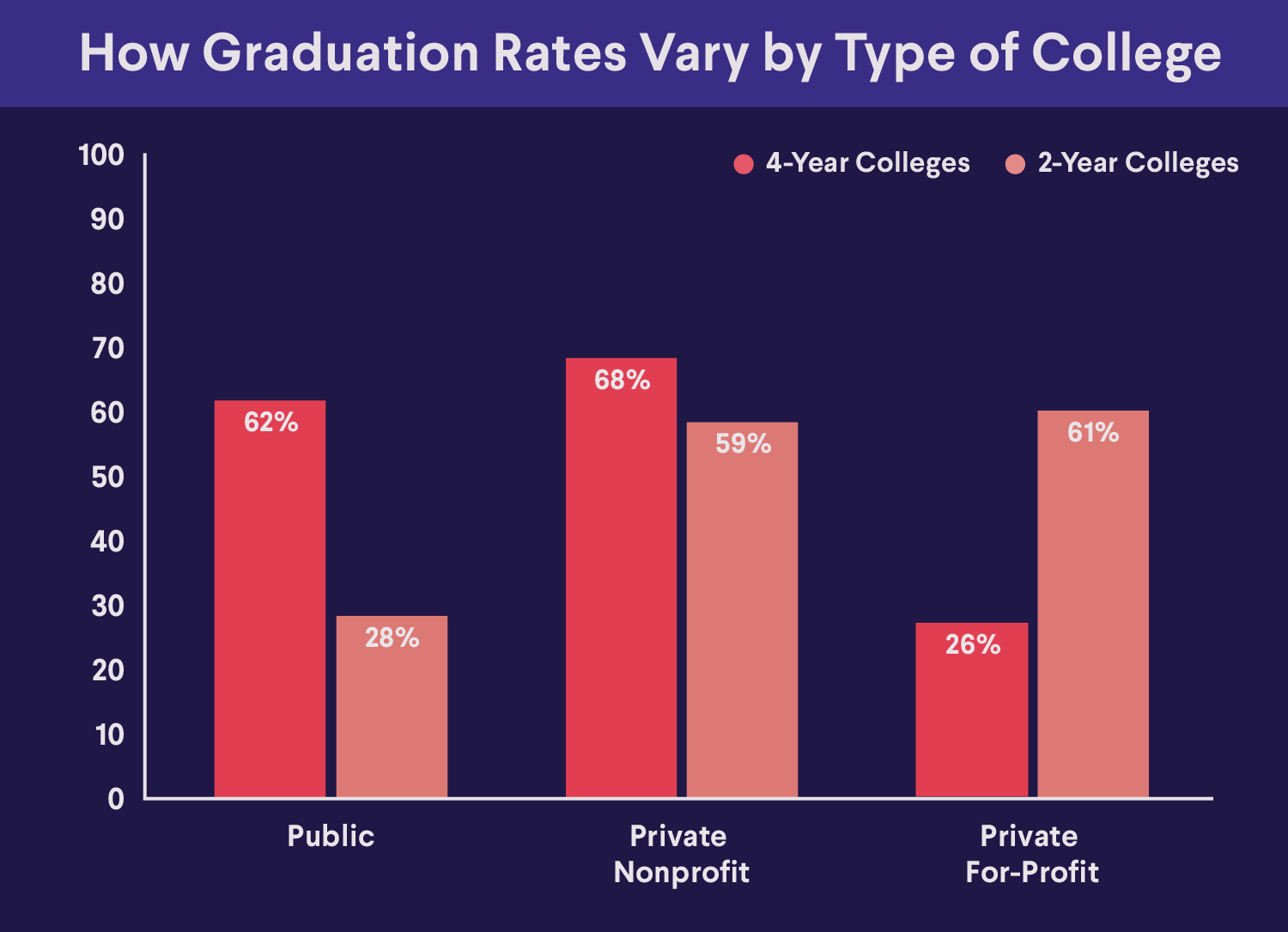
How Graduation Rates Vary by Type of College
Source: National Center for Education Statistics

Recommended: Full-time vs Part-time Student

Alternatives to a College Degree

Just because you aren’t interested in a four-year degree doesn’t mean you need to forgo higher education entirely. Alternative educational models, like trade schools and community colleges, offer many practical certification and two-year associate degree programs that can help you get ahead.

It is important to know that even if you’re not planning to pursue a four-year degree, you still have options when it comes to creating a career that is right for you.


💡 Quick Tip: You’ll make no payments on some private student loans for six months after graduation.

Trade School

Sometimes known as technical or vocational schools, trade schools can prepare you for a specific job, such as a dental hygienist, electrician, cosmetologist, or web developer. These programs are normally much shorter than four years, and certain programs may allow you to finish in only a few months. There are both public and private trade schools.

Trade schools don’t award bachelor’s degrees. Instead, when you graduate from a trade school, you typically receive a diploma or certificate indicating that you are trained and certified to perform a specific job. Some trade school programs do offer associate degrees, which are the same type of degrees offered by many community colleges.

Community College

As mentioned above, community colleges usually offer two-year degrees called associate degrees. These degrees can either stand alone or be a stepping stone to obtaining a bachelor’s degree at a four-year school.

Many community colleges also offer career preparation programs that are designed to help students jump into the workforce without the need for a bachelor’s degree.

Community college could also be a great way to test out college life and see if you want to continue pursuing higher education. They tend to be much less expensive than four-year universities, which means it won’t cost you an arm and a leg before you decide if higher education is right for you.

Apprenticeships

Apprenticeships are paid positions designed to teach the apprentice about a specific job or industry. They can help you learn how to use industry-specific tools and technologies and help you develop your skills over a period of time. This may be in fields as diverse as plumbing to transportation engineering to baking.

Apprenticeships can be a win-win for employers and employees because they allow those starting out to begin working (and earning a paycheck) immediately, and they help employers fill vacant jobs.

Certificate Programs

Similar and sometimes overlapping with trade schools, certificate programs offer specialized training in a specific area. This may include coding, cybersecurity, yoga, fitness, getting a commercial driver’s license (CDL), or other areas where specialized knowledge may be a prerequisite. These certificates may also be helpful in making job seekers eligible for positions with higher starting salaries.

Recommended: Are Coding Bootcamps Worth the Money?

Taking a Gap Year

A gap year is when a student takes a year off between high school and college. Some colleges allow accepted students to defer for a year, holding a place for them in the next year’s incoming class. Some people create a travel itinerary; others may work or volunteer for the year. There are some gap year programs that create opportunities for students, but keep in mind that some programs may be costly.

Starting a Business

If you are already passionate about — and have a lot of knowledge about — a specific field or industry, you might consider skipping college altogether and jumping into that business.

Starting your own business takes a lot of hard work, but it could mean that you get to be your own boss and work in an industry you love. And because you could quickly become an expert on the products or services you provide, you aren’t necessarily at a disadvantage because you lack a degree.

Recommended: 9 High Paying Jobs That Don’t Require a Degree

If You Do Go the College Route

There are plenty of options if you choose not to attend a four-year college. However, there are also options within the world of college, including the type of college you choose, the major you decide to pursue, and how you pay for college.

There’s no denying that college can be expensive. In the 2024-25 school year, the average cost for tuition and fees at an in-state college was $11,610, while the average sticker price for a private college was $43,350. And, these numbers don’t include room and board. This can be a big financial commitment, especially if you are on the fence about pursuing higher education.

That’s why it can be a good idea to begin creating a payment strategy early. A great first step is to fill out the Free Application for Federal Student Aid (FAFSA®) to see how much federal aid — including scholarships, grants, work-study, and federal student loans — you qualify for.

Federal student loans do have limits on how much a student can borrow each year they are enrolled in school. Some students may need additional funds to bridge the gap. In that case, some may consider borrowing a student loan from a private lender to help cover college costs.

In general, it can be a smart idea to tap all your federal loan and grant options before you consider private student loans. That’s because federal loans offer some protections, such as deferment options, that private loans may not. However, private loans can cover up to 100% of the cost of attendance, including money to pay for books, room and board, and personal expenses.


💡 Quick Tip: Parents and sponsors with strong credit and income may find much lower rates on no-fee private parent student loans than federal Parent PLUS Loans. Federal PLUS loans also come with an origination fee.

The Takeaway

College can lead students on a new career path, but depending on your goals and other factors, may not be necessary. Some students may choose to pursue a trade or vocational program instead of a four-year degree, while others may simply want to wait a year or so to earn and save more money to cover the cost of going to college.

If you do decide to go to college, you’ll have to figure out a way to pay for it. Most students rely on a combination of cash savings, scholarships, grants, federal student loans, and private student loans.

If you’ve exhausted all federal student aid options, no-fee private student loans from SoFi can help you pay for school. The online application process is easy, and you can see rates and terms in just minutes. Repayment plans are flexible, so you can find an option that works for your financial plan and budget.


Cover up to 100% of school-certified costs including tuition, books, supplies, room and board, and transportation with a private student loan from SoFi.

FAQ

Why do some people not like college?

Some people dislike college due to high costs, irrelevant coursework, lack of practical skills, social pressures, and the rigid structure that doesn’t suit everyone’s learning style.

What are some alternatives to college?

Alternatives to college include trade schools, apprenticeships, online courses, bootcamps, and self-directed learning. These options often offer practical skills, lower costs, and more flexible schedules.

What are the pros of not attending college?

Pros of not attending college include saving money, allowing for early career entry, providing hands-on experience, and offering more flexibility for personal or family responsibilities.


SoFi Private Student Loans
Please borrow responsibly. SoFi Private Student loans are not a substitute for federal loans, grants, and work-study programs. We encourage you to evaluate all your federal student aid options before you consider any private loans, including ours. Read our FAQs.

Terms and conditions apply. SOFI RESERVES THE RIGHT TO MODIFY OR DISCONTINUE PRODUCTS AND BENEFITS AT ANY TIME WITHOUT NOTICE. SoFi Private Student loans are subject to program terms and restrictions, such as completion of a loan application and self-certification form, verification of application information, the student's at least half-time enrollment in a degree program at a SoFi-participating school, and, if applicable, a co-signer. In addition, borrowers must be U.S. citizens or other eligible status, be residing in the U.S., Puerto Rico, U.S. Virgin Islands, or American Samoa, and must meet SoFi’s underwriting requirements, including verification of sufficient income to support your ability to repay. Minimum loan amount is $1,000. See SoFi.com/eligibility for more information. Lowest rates reserved for the most creditworthy borrowers. SoFi reserves the right to modify eligibility criteria at any time. This information is subject to change. This information is current as of 4/22/2025 and is subject to change. SoFi Private Student loans are originated by SoFi Bank, N.A. Member FDIC. NMLS #696891 (www.nmlsconsumeraccess.org).

SoFi Loan Products
SoFi loans are originated by SoFi Bank, N.A., NMLS #696891 (Member FDIC). For additional product-specific legal and licensing information, see SoFi.com/legal. Equal Housing Lender.


Financial Tips & Strategies: The tips provided on this website are of a general nature and do not take into account your specific objectives, financial situation, and needs. You should always consider their appropriateness given your own circumstances.

Third-Party Brand Mentions: No brands, products, or companies mentioned are affiliated with SoFi, nor do they endorse or sponsor this article. Third-party trademarks referenced herein are property of their respective owners.

External Websites: The information and analysis provided through hyperlinks to third-party websites, while believed to be accurate, cannot be guaranteed by SoFi. Links are provided for informational purposes and should not be viewed as an endorsement.

SOISL-Q325-009

Read more
woman college student

Using Income Share Agreements to Pay for School

An income share agreement (ISA) is a type of college financing in which you repay the funds you receive using a fixed percentage of your future income. While ISAs can be useful for some students who lack other funding options, it’s important to fully understand how these agreements work, since you can potentially end up owing significantly more than you borrow.

Read on for a closer look at income share agreements, including their pros and cons, who might consider them, and how they compare to other types of college financing.

Key Points

•   Income share agreements (ISAs) offer a flexible alternative to traditional student loans, allowing students to fund their education without immediate debt.

•   Payments are a percentage of the student’s future income, making repayment more manageable and aligned with earning potential.

•   Unlike loans, ISAs do not accrue interest, which can reduce the total cost over time.

•   ISAs have a set repayment period, providing clear end dates for financial obligations.

•   ISAs may be more expensive in the long run, and payments are not tax-deductible, so students should carefully consider the terms and compare with other options.

What Is an Income Share Agreement?

With an income share agreement (ISA), you receive money to pay for college and contractually agree to pay it back using a fixed percentage of your post-graduation income for a set period of time. ISAs are offered by some colleges and through several private lenders.

The income percentage and terms of an ISA will vary depending on the lender. Typically, the repayment percentage will range between 2% and 10% of the student’s future salary, and terms can be anywhere from two to 10 years.

Unlike other types of student loans, ISAs do not accrue interest. However, students commonly end up paying back more than the original amount that they borrowed.

How Income Share Agreements Work

Typically, you start repaying an ISA after you leave school and pass a specific income threshold, often $30,000 to $40,000 per year. If you earn less than the threshold in any month, you can waive your requirement payment that month. Some ISAs will count months in which you earn less than the minimum salary toward your repayment term, while others will extend the length of your loan.

You can typically exit your ISA at any time, provided you’re willing to pay the maximum repayment cap for your plan upfront.

With an ISA, your payment rises when your salary rises. However, the repayment term and total repayment amount are usually capped. The cap is the most you’ll have to repay under your ISA. With many plans, though, the cap can be as high as two (or more) times what you borrowed.

Income Share Agreement Example

To illustrate how an income share agreement might work, let’s say you sign an ISA agreement for $10,000 with the maximum number of monthly payments of 88, an income percentage of 4%, an income threshold of $30,000 (or $2,500 per month), and a payment cap of $23,000.

In this case, you would pay 4% of your income for any month you earn at least $2,500 and continue to do so until you make 88 payments or pay a total of $23,000 — whichever comes first. If you only earn the minimum, you will end up paying back $100 a month for 88 months for a total repayment of $8,800 (which is less than what you borrowed). However, if you make $55,000, you’ll pay $183 per month for 88 months, for a total repayment of $16,133, which is $6,000 more than you borrowed.

Keep in mind that the income percentages, terms, and repayment caps can vary considerably from one ISA provider to the next.

Recommended: How to Pay for College With No Money Saved

The Advantages of Income Share Agreements

Some of the pros of income share agreements include:

•   ISAs typically do not require a cosigner or good credit, so they can be easier to qualify for than other types of financing.

•   Payments won’t exceed a certain percentage of your monthly income.

•   Your ISA contract could expire years earlier than a traditional student loan.

•   Schools that offer ISA programs are incentivized to help you earn the highest paying jobs.

•   Depending on your future income, you may end up paying less than you would pay with a traditional student loan.

Potential Pitfalls of Income Share Agreements

There are also some significant cons to ISA loans that you’ll want to keep in mind:

•   In some cases, the ISA provider will cap payment more than twice the amount you receive.

•   Unlike other types of student loans, there’s uncertainty regarding how much your loan will cost.

•   In many cases, an ISA could cost more over the long run when compared to federal or private student loans.

•   Income-driven repayment plans are already an option with federal student loans, and federal loans also offer the potential for student loan forgiveness.

•   ISAs are not widely available and may be restricted to certain majors or programs.

Who Should Consider An ISA?

Income share agreements can end up being costly, especially if you enter a high-earning field and the ISA has a high payment cap. However, you might consider looking at ISA if:

•   You’ve maxed out federal loan options but are unable to qualify for private student loans.

•   You have a poor credit score and would receive high rates on private student loans.

•   Your school offers an ISA with reasonable terms and a low payment cap.

•   You’re planning to earn a degree in a field that doesn’t have steep salary growth potential.

If these scenarios don’t apply to you, you’re likely better off using federal student loans to pay for higher education, or even private student loans if you have good credit. Before signing up, you’ll want to compare your options side by side and run the numbers to see which is the better deal.

Recommended: Private Student Loans vs Federal Student Loans

Considering Private Loans

You generally want to exhaust all your federal financial aid options before considering other types of debt, but if you’re looking to fill gaps in your educational funding, it may be worth considering private student loans before signing an ISA.

Private student loans are only offered through private lenders, and come with either fixed or variable rates. For borrowers with excellent credit, rates may be relatively low. Unlike federal loans, however, undergraduate private student loans often require a cosigner. The cosigner is an adult who agrees to take full responsibility for your student loans if you default. Cosigners are almost always required by private lenders since undergraduates have not had much time to develop a credit history.

If you expect to have a high salary after graduation and/or can qualify for a low rate on a private student loan, you could end up paying less than you would for an ISA.

Recommended: A Complete Guide to Private Student Loans

The Takeaway

An income share agreement, or ISA, is an agreement between the borrower and the school or a lender that states the borrower will receive funds to pay for college and then repay those funds based on a certain percentage of their future salary for a set amount of time.

While ISAs may sound like a different type of college funding, they are, essentially, loans. And in many cases, you will end up paying back significantly more than what you borrow.

Generally, you would only want to consider ISAs after exhausting any undergraduate federal student loans and aid available to you. It’s also a good idea to compare ISA offers with traditional private student loans before deciding on the best funding option for your situation.

If you’ve exhausted all federal student aid options, no-fee private student loans from SoFi can help you pay for school. The online application process is easy, and you can see rates and terms in just minutes. Repayment plans are flexible, so you can find an option that works for your financial plan and budget.


Cover up to 100% of school-certified costs including tuition, books, supplies, room and board, and transportation with a private student loan from SoFi.

FAQ

What is an income share agreement?

An income share agreement (ISA) is a financial contract where a student receives funding for education in exchange for a percentage of their future income for a set period. It’s an alternative to traditional student loans, offering flexible repayment based on earnings.

Are income share agreements worth it?

Income share agreements (ISAs) can be worth it for students who need funding and prefer flexible repayment terms based on future income. However, they may be more costly in the long run compared to traditional loans, so it’s important to compare options and understand the terms.

Are income share agreements tax deductible?

Income share agreements (ISAs) are generally not tax deductible. Unlike student loans, payments made under an ISA are considered a share of income rather than debt repayment, so they do not qualify for the same tax benefits. Always consult a tax professional for personalized advice.


SoFi Private Student Loans
Please borrow responsibly. SoFi Private Student loans are not a substitute for federal loans, grants, and work-study programs. We encourage you to evaluate all your federal student aid options before you consider any private loans, including ours. Read our FAQs.

Terms and conditions apply. SOFI RESERVES THE RIGHT TO MODIFY OR DISCONTINUE PRODUCTS AND BENEFITS AT ANY TIME WITHOUT NOTICE. SoFi Private Student loans are subject to program terms and restrictions, such as completion of a loan application and self-certification form, verification of application information, the student's at least half-time enrollment in a degree program at a SoFi-participating school, and, if applicable, a co-signer. In addition, borrowers must be U.S. citizens or other eligible status, be residing in the U.S., Puerto Rico, U.S. Virgin Islands, or American Samoa, and must meet SoFi’s underwriting requirements, including verification of sufficient income to support your ability to repay. Minimum loan amount is $1,000. See SoFi.com/eligibility for more information. Lowest rates reserved for the most creditworthy borrowers. SoFi reserves the right to modify eligibility criteria at any time. This information is subject to change. This information is current as of 4/22/2025 and is subject to change. SoFi Private Student loans are originated by SoFi Bank, N.A. Member FDIC. NMLS #696891 (www.nmlsconsumeraccess.org).

SoFi Loan Products
SoFi loans are originated by SoFi Bank, N.A., NMLS #696891 (Member FDIC). For additional product-specific legal and licensing information, see SoFi.com/legal. Equal Housing Lender.


Financial Tips & Strategies: The tips provided on this website are of a general nature and do not take into account your specific objectives, financial situation, and needs. You should always consider their appropriateness given your own circumstances.

Third-Party Brand Mentions: No brands, products, or companies mentioned are affiliated with SoFi, nor do they endorse or sponsor this article. Third-party trademarks referenced herein are property of their respective owners.

Tax Information: This article provides general background information only and is not intended to serve as legal or tax advice or as a substitute for legal counsel. You should consult your own attorney and/or tax advisor if you have a question requiring legal or tax advice.

Third Party Trademarks: Certified Financial Planner Board of Standards Center for Financial Planning, Inc. owns and licenses the certification marks CFP®, CERTIFIED FINANCIAL PLANNER®

SOISL-Q325-004

Read more
TLS 1.2 Encrypted
Equal Housing Lender